AI Overview Keyword Finder
Detect keywords that can trigger AI Overviews and prioritize citation opportunities before competitors capture them.
Why AI Overview Keyword Detection Matters
Traditional keyword metrics are no longer enough. AI Overview visibility depends on citation readiness, answer clarity, and query volatility. This tool helps you find where your brand can gain citations and where rankings are unstable.
What This Tool Does
The AI Overview Keyword Finder analyzes your keyword set and returns likely AI Overview triggers, citation opportunity scores, volatility risk, and a practical recommendation for each term.
How to Use the Tool
Add one keyword per line in the input field.
Run the analysis to detect AI overview trigger probability.
Prioritize high citation opportunity keywords with manageable volatility.
Switch to advanced mode for deeper expansion and larger keyword sets.
Best Use Cases
Plan AI Overview-focused content briefs with clear citation goals.
Find volatile SERP spaces where fresh evidence-based content can win.
Prioritize editorial updates by citation potential instead of volume alone.
Build an AI search strategy before launching new topic clusters.
How the AI Overview Keyword Finder Works
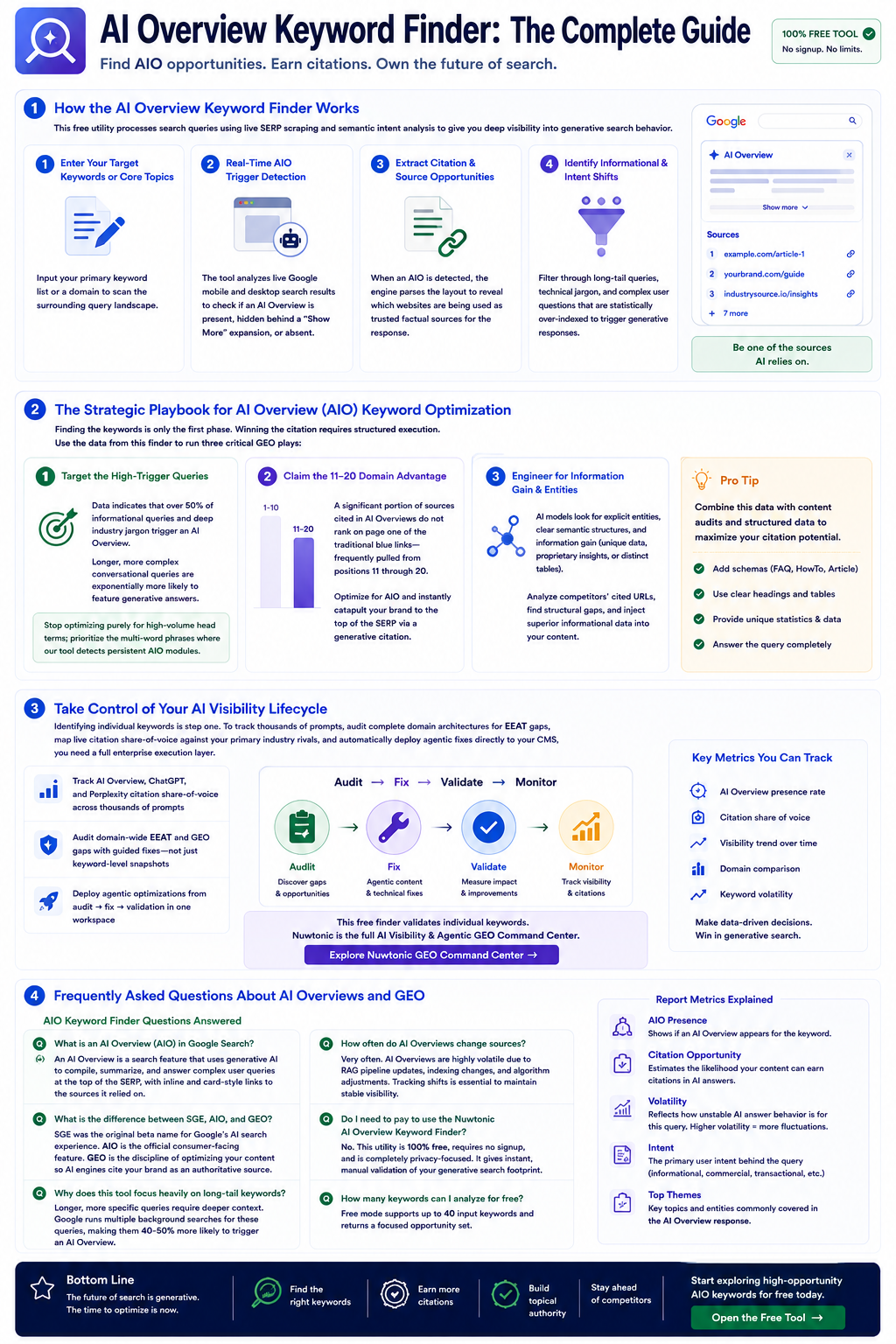
This free utility processes search queries using live SERP scraping and semantic intent analysis to give you deep visibility into generative search behavior.
Enter Your Target Keywords or Core Topics
Input your primary keyword list or a domain to scan the surrounding query landscape.
Real-Time AIO Trigger Detection
The tool analyzes live Google mobile and desktop search results to check if an AI Overview is present, hidden behind a "Show More" expansion, or completely absent.
Extract Citation & Source Opportunities
When an AIO is detected, the engine parses the layout to reveal which websites are being used as trusted factual sources for the response.
Identify Informational & Intent Shifts
Filter through long-tail queries, technical jargon, and complex user questions that are statistically over-indexed to trigger generative responses.
The Strategic Playbook for AI Overview (AIO) Keyword Optimization
Finding the keywords is only the first phase. Winning the citation requires structured execution. Use the data from this finder to run three critical GEO plays:
1. Target the High-Trigger Queries
Data indicates that over 50% of informational queries and deep industry jargon trigger an AI Overview. Furthermore, longer, more complex conversational queries are exponentially more likely to feature generative answers. Stop optimizing purely for high-volume head terms; prioritize the multi-word phrases where our tool detects persistent AIO modules.
2. Claim the 11-20 Domain Advantage
One of the most disruptive aspects of Google AI Overviews is its source selection matrix. Studies show that a significant portion of sources cited in AI Overviews do not rank on page one of the traditional blue links—frequently pulled from positions 11 through 20. If your page is stuck on page two for a high-value keyword, optimizing its structure for AIO can instantly catapult your brand to the absolute top of the SERP via a generative citation.
3. Engineer for Information Gain & Entities
AI models do not rank content based on simple keyword density. They look for explicit entities, clear semantic structures, and information gain (unique data, proprietary insights, or distinct tables). Use our tool to find your competitors' cited URLs, analyze their structural gaps, and inject superior informational data directly into your content architecture.
Take Control of Your AI Visibility Lifecycle
Identifying individual keywords is step one. To track thousands of prompts, audit complete domain architectures for EEAT gaps, map live citation share-of-voice against your primary industry rivals, and automatically deploy agentic fixes directly to your CMS, you need a full enterprise execution layer.
- Track AI Overview, ChatGPT, and Perplexity citation share-of-voice across thousands of prompts
- Audit domain-wide EEAT and GEO gaps with guided fixes—not just keyword-level snapshots
- Deploy agentic optimizations from audit → fix → validation in one workspace
This free finder validates individual keywords. Nuwtonic is the full AI Visibility & Agentic GEO Command Center.
Explore Nuwtonic GEO Command CenterFrequently Asked Questions About AI Overviews and GEO
AIO Keyword Finder Questions Answered
What is an AI Overview (AIO) in Google Search?
An AI Overview is a search feature introduced by Google that utilizes generative AI to compile, summarize, and answer complex user queries right at the top of the search engine results page. It extracts data from multiple web indexes and provides inline and card-style links to the source documents it relied on to build the summary.
What is the difference between SGE, AIO, and GEO?
SGE (Search Generative Experience) was the original beta and experimental name for Google's AI-integrated search engine framework. AIO (AI Overviews) is the official consumer-facing deployment of generative AI blocks inside Google's global search results. GEO (Generative Engine Optimization) is the marketing and engineering discipline of structuring your website's data and content to ensure AI engines (like Google AIO, ChatGPT, Perplexity, and Claude) cite your brand as an authoritative source.
Why does this tool focus heavily on long-tail keywords?
Large Language Models (LLMs) thrive on context. The longer and more specific a user's search query is, the more complex the informational need. Google utilizes query fan-out systems to run multiple background searches for these long-tail keywords, making them 40-50% more likely to trigger an AI Overview compared to transactional, single-word e-commerce searches.
How often do AI Overviews change sources?
AI Overviews are highly volatile. Google frequently updates its underlying retrieval-augmented generation (RAG) pipelines and algorithm models. A keyword that shows a specific set of citations today might display completely different sources tomorrow based on live data adjustments, indexing updates, and algorithmic corrections. Tracking these shifts with an AIO keyword tool is essential to maintaining stable visibility.
Do I need to pay to use the Nuwtonic AI Overview Keyword Finder?
No. This utility is 100% free, requires no signup, and is completely privacy-focused. It is built to give content teams, SEO specialists, and technical engineers immediate, manual validation of their generative search footprint.
How many keywords can I analyze for free?
Free mode supports up to 40 input keywords and returns a focused opportunity set.
What does citation opportunity mean?
Citation opportunity estimates how likely a keyword can earn references in AI answers when your content is structured with strong evidence and clear formatting.
What is volatility in this report?
Volatility reflects how unstable AI answer behavior can be for that query. Higher volatility means faster changes and more frequent ranking shifts.
What do I get in advanced mode?
Advanced mode expands your seed keywords into a larger AI overview opportunity map and charges 10 credits per run.
Complete your GEO workflow
Use these free tools in sequence to find AI Overview opportunities, audit pages for citation readiness, validate trust signals, and polish titles.
- 1
Find AI Overview keywords
You are hereDetect queries that trigger AI Overviews and prioritize citation opportunities before competitors do.
AI Overview Keyword Finder
- 2
Audit GEO readiness
Score structure, entities, and extraction signals to see whether your page can be cited in generative answers.
Free AIO & GEO Audit Tool
- 3
Validate E-E-A-T signals
Check experience, expertise, authoritativeness, and trust — key factors for AI citation and ranking.
Free EEAT Audit Tool
- 4
Optimize titles for clicks
Generate intent-aligned meta titles for your platform to improve CTR and snippet consistency.
Free Meta Title Generator
Try our other free SEO and AI tools
We have gathered some of our free tools that might help you in your SEO efforts.
Filter what tools to see
Free Meta Title Generator
Generate high-CTR title tags optimized for Google search results using AI-driven templates.
Free Keyword Clustering Tool
Group related keywords into clear topic clusters and build a stronger topical SEO plan.
Low Competition Keyword Finder
Find weak SERPs, forum-heavy opportunities, and keywords where lower-authority sites can still win.
Reddit Keyword Finder
Extract recurring questions, pain points, and buying intent patterns from Reddit and forums.
Question Keyword Tool
Find FAQ-style keywords and common user questions.
Buyer Intent Keyword Finder
Specifically filters for commercial and transactional keywords.
Zero Search Volume Keyword Finder
Uncovers emerging or hidden keywords that traditional volume tools miss.
Free SEO Title Length Checker
Check if your page titles fit within pixel limits to avoid truncation.
Free Meta Description Generator
Create compelling meta descriptions that summarize your content and boost click-through rates.
Free Meta Description Length Checker
Check if your meta descriptions fit within pixel limits to avoid truncation.
Free Google SERP Preview Tool
Simulate how your page title and meta description may appear in Google search results.
Free Schema Markup Checker
Validate your structured data to ensure it is readable by search engines and error-free.
Free Rich Results Test
Determine if your page is eligible for rich results in Google Search with our validation tool.
Free Alt Text Checker
Identify missing, empty, or duplicate alt text values across images.
Free AI Alt Text Generator
Generate descriptive, accessibility-compliant alt text for your images instantly.
Free Image Filename Generator
Convert plain text into SEO-friendly, hyphenated image filenames.
Free On-Page SEO Audit Tool
Run an on-page SEO audit for SEO services pages, technical SEO audit checks, and SEO optimization improvements.
Free H1 Tag Checker
Identify the presence and content of H1 heading tags on any webpage.
Free Heading Structure Checker
Audit your H1-H6 tags to ensure a logical and SEO-friendly document structure.
Free Canonical URL Checker
Identify declared canonical URLs and analyze canonical-related signals on any page.
Free EEAT Audit Tool
Analyze your content for Google's Experience, Expertise, Authoritativeness, and Trustworthiness signals.
Free AIO & GEO Audit Tool
Optimize your content for AI Overviews and Search Generative Experience with a detailed formatting audit.
Free Broken Link Checker
Scan a page to identify links that return error responses or cannot be reached.
Free Redirect Checker
Analyze URL redirection behavior to identify redirect types and destination URLs.
Latest SEO and AI related articles
Browse all articles
Best AI Writer: How To Choose the Right Tool in 2026
How to Create an SEO-Friendly XML Sitemap

11 ChatGPT SEO Strategy for B2B Companies (0 to 90 Days)
7 Strategies for AI Citation Gap Analysis for SaaS Companies
Best CMS for SEO 2026: Complete Guide & Tips