
A practical ChatGPT SEO strategy for B2B companies is not about trying to rank for one new channel. It is about making your expertise, products, evidence, and third-party reputation easy for AI systems to understand, retrieve, and reference when buyers ask complex questions.

TL;DR
I recommend treating ChatGPT visibility as an AI-answer and brand-trust problem, not only a ranking problem. Start with priority buyer questions, publish evidence-rich answer-ready pages, standardize your brand entity across the web, earn credible third-party mentions, and measure citation share alongside referral traffic and pipeline.
Define the B2B AI Visibility Opportunity
ChatGPT visibility is different from a position in search results
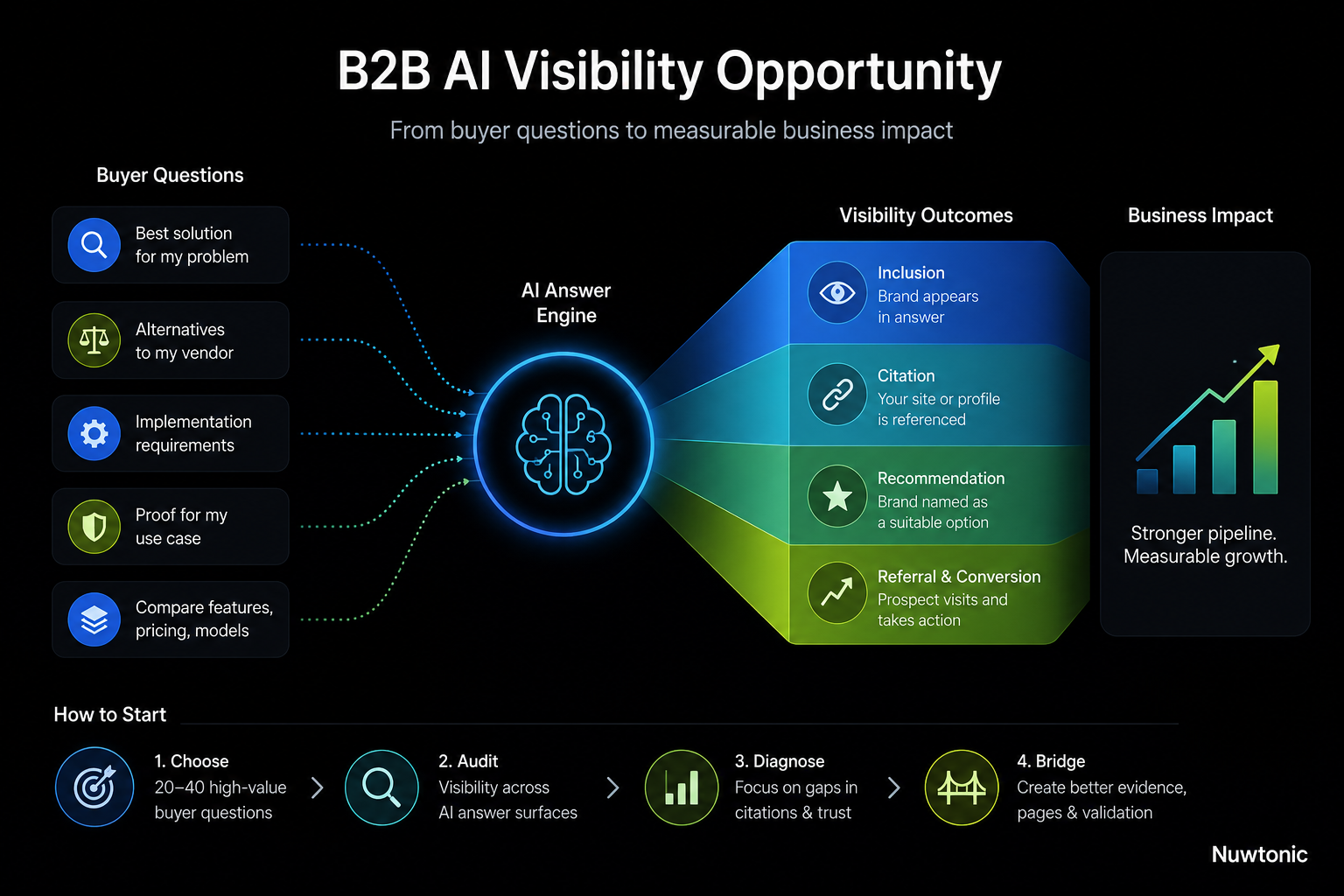
Classic SEO measures whether a page appears prominently for a query. AI-answer visibility asks a different question: does the system include, cite, or recommend your company when it assembles an answer? A page can perform well in organic search yet be absent from an answer if the page does not provide a clear extractable claim, credible support, or a strong connection to the buyer’s question.
For B2B companies, that distinction matters because purchase journeys are rarely one query long. A buyer may ask for:
• Best software for a specific operational problem
• Alternatives to an established vendor
• Implementation requirements for a category
• Evidence that a platform works for a regulated or technical use case
• A comparison between approaches, pricing models, or deployment options
A useful strategy therefore combines SEO, answer engine optimization, digital PR, review management, and product marketing. For a broader foundation, review this guide to AI search visibility before deciding which pages to prioritize.
Use a four-part visibility model
I recommend separating visibility into four outcomes. This avoids the common mistake of treating every mention as equally valuable.
Outcome | What it means | Why it matters for B2B | Primary measurement |
|---|---|---|---|
Inclusion | Your brand appears in an answer | Creates early category awareness | Brand appearance rate |
Citation | Your site or third-party profile is referenced | Indicates stronger retrievability and trust | Citation share |
Recommendation | Your brand is named as a suitable option | Influences shortlists and buying decisions | Recommendation rate |
Referral and conversion | A prospect visits and completes a meaningful action | Connects visibility to revenue outcomes | Assisted pipeline and conversion rate |
This model also clarifies where to act. If you have mentions but no citations, improve your source pages and external validation. If you have citations but no qualified traffic, review message alignment, landing-page relevance, and conversion paths.
Choose buyer questions before rewriting pages
Do not start by rewriting every blog post. Select questions with commercial relevance and an existing evidence base. A reasonable initial set is 20 to 40 questions across category discovery, comparison, problem solving, implementation, and vendor evaluation.
Lead Walnut’s ChatGPT SEO framework recommends an audit, diagnose, and bridge workflow that examines visibility across multiple surfaces and evaluates citation share rather than rankings alone. That approach is useful because it turns vague visibility goals into a list of observable gaps.
Build Pages That Are Easy to Extract and Trust
Decide which pages need answer-first rewrites
Not every B2B page should become a short FAQ. Product detail pages, implementation guides, and research articles serve different jobs. The right format depends on whether the buyer needs a quick decision, supporting proof, or technical depth.
Page type | Best use case | Recommended structure | Avoid when |
|---|---|---|---|
Product page | Buyers assessing fit | Direct value statement, use cases, proof, limitations, FAQs | The product scope is still unclear internally |
Comparison page | Buyers building a shortlist | Fair comparison criteria, table, alternatives, evidence | You cannot substantiate claims about competitors |
Solution page | Buyers defining a problem | Direct answer, workflow, outcomes, relevant examples | The audience has highly varied needs |
Technical guide | Buyers validating implementation | Detailed steps, architecture, constraints, SME review | You only have generic advice |
Research or thought leadership | Buyers seeking perspective | Original analysis, methodology, dated evidence | The page is being used as a substitute for product documentation |
For example, a cybersecurity vendor’s “What is continuous exposure management?” page should begin with a concise definition and explain the operational outcome. Its implementation guide should remain detailed, covering prerequisites, integrations, governance, and trade-offs. Compressing both into the same FAQ format would weaken the second page.
Write citable claims, not vague marketing copy
AI systems can only reuse what is clear enough to interpret. Replace broad promises such as “transform your operations” with specific, supportable statements about who the product is for, what it does, and under what conditions it helps.
A strong answer-ready block usually includes:
A direct answer in the first 40 to 80 words.
A clear definition using the category and product terminology buyers use.
Supporting detail that explains mechanism, scope, and exclusions.
Dated evidence, a customer example, an SME-reviewed explanation, or a cited external source where appropriate.
A next step for readers who need deeper technical or commercial detail.
HubSpot’s guidance on improving content for AI visibility specifically recommends direct answers, FAQ sections, clear heading structures, comparison tables, current statistics, schema markup, and stronger off-site presence on priority pages.
Use ChatGPT as an assistant, not the final authority
ChatGPT can speed up clustering, outline creation, question expansion, content refresh planning, and internal-link suggestions. It is less dependable as the sole producer of technical B2B copy because generic drafts can sound convincing while omitting constraints, proof, and domain-specific terminology.
Wix’s assessment of AI content for B2B SEO cautions that technical content needs SME data, case studies, and real customer evidence rather than unreviewed long-form generated text.
Use this editorial control sequence:
Let AI identify recurring questions, content gaps, and possible outlines.
Ask a subject matter expert to validate terminology, product limits, and technical claims.
Add dated statistics, source material, screenshots, product documentation, or case evidence.
Have an editor remove unsupported certainty and repetitive language.
Recheck the page after publication when product capabilities or market terminology changes.
Make Your Brand Entity Consistent Everywhere
Treat brand clarity as a graph problem
A B2B company is represented across its website, LinkedIn profile, product documentation, review platforms, partner pages, media coverage, and comparison articles. When the company name, product names, category description, target customer, or core claims vary across those surfaces, the brand becomes harder to interpret consistently.
Think of this as a brand graph. Each public reference is a node; consistent names and relationships connect those nodes. Inconsistent messaging creates weak or conflicting connections.
TripleDart’s 2026 guide to ChatGPT SEO recommends defining entities, relationships, and terminology consistently across content, PR, and sales materials, while also addressing FAQ schema, technical audits, digital PR, and review acquisition.
Create an entity consistency sheet
Build one shared reference document for marketing, sales, customer success, and external communications. Include the approved elements below.
Entity element | Example | Review trigger |
|---|---|---|
Company name | Full legal or public-facing brand name | Rebrand or merger |
Product names | Exact capitalization and naming conventions | Product launch or rename |
Category statement | “AI search visibility platform for SEO teams” | Positioning update |
Buyer segments | Mid-market B2B demand generation teams | ICP revision |
Core capabilities | Prompt monitoring, citation analysis, content workflows | Feature release |
Proof points | Approved case-study metrics and dates | Quarterly evidence review |
Use the same language in organization schema, product pages, LinkedIn company descriptions, review profiles, partner listings, and press materials. This is not a guarantee of inclusion in answers, but it reduces ambiguity when a system encounters your brand across multiple sources.
Validate technical access separately
Technical accessibility remains foundational. Important pages should be crawlable, fast enough to load reliably, internally linked, and free of accidental noindex directives. Review robots.txt and the access policies that apply to relevant retrieval systems before assuming content can be used.
Schema.org JSON-LD can reinforce machine readability for Organization, Product, Service, Article, FAQPage, and BreadcrumbList entities. Use structured data to describe visible page content accurately. Do not add FAQ schema for questions that users cannot actually read, and do not mark up claims that the page cannot support.
Earn External Proof That Buyers Can Verify
Prioritize B2B trust surfaces
For a B2B buyer, a company’s own website is only one source of confidence. Review platforms, analyst or industry publications, partner directories, customer stories, and credible editorial coverage can all provide independent context.
Flow Agency’s B2B guidance for ChatGPT visibility emphasizes consistent brand presence and Bing optimization as part of a broader approach. The practical implication is straightforward: do not isolate content work from the channels where buyers and external publishers describe your company.
Focus effort where third-party validation can answer real buying questions:
• Review profiles for software categories where buyers compare vendors
• Partner listings that verify integrations or ecosystem relationships
• Expert commentary in relevant trade publications
• Customer stories with a defined starting problem, implementation context, and measured outcome
• Comparison content that states criteria transparently rather than making unsupported superiority claims
Avoid reputation gaps and stale claims
A common failure mode is a mismatch between a company’s site and external descriptions. Your site may describe an enterprise product, while outdated directories describe a small-business tool. Or a review profile may list a retired feature as a core capability.
Run a quarterly reconciliation process:
Search for the company, products, category, and key competitors.
Record conflicting descriptions, obsolete claims, broken links, and inaccurate comparisons.
Correct owned profiles first.
Request updates from publishers when material errors appear.
Update your own pages so they state current limitations as clearly as current strengths.
Fair warning: external mentions cannot be fully controlled. The goal is not to manufacture consensus. It is to make accurate information more available than stale information.
Measure Visibility Through Pipeline, Not Curiosity
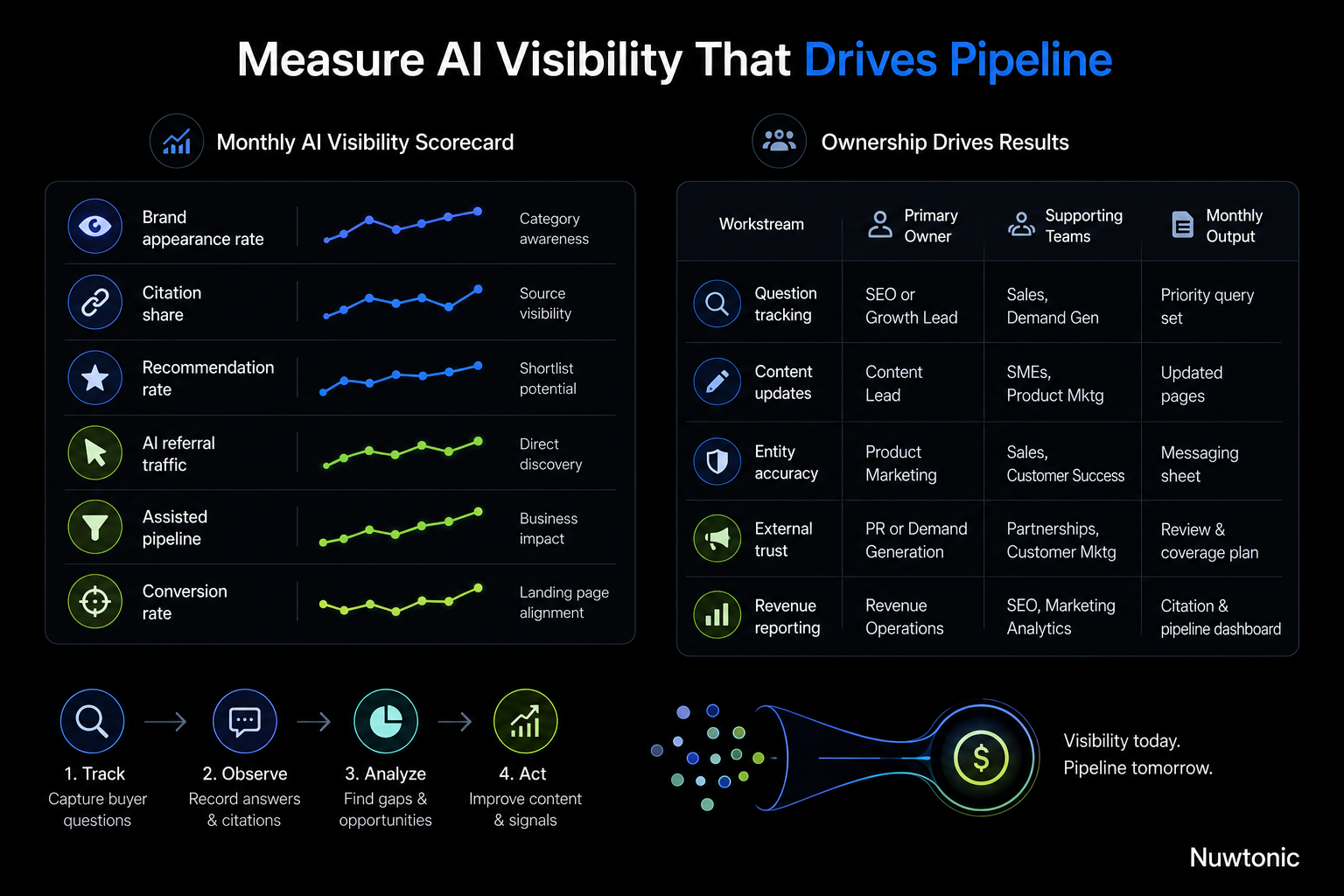
Build a monthly AI visibility scorecard
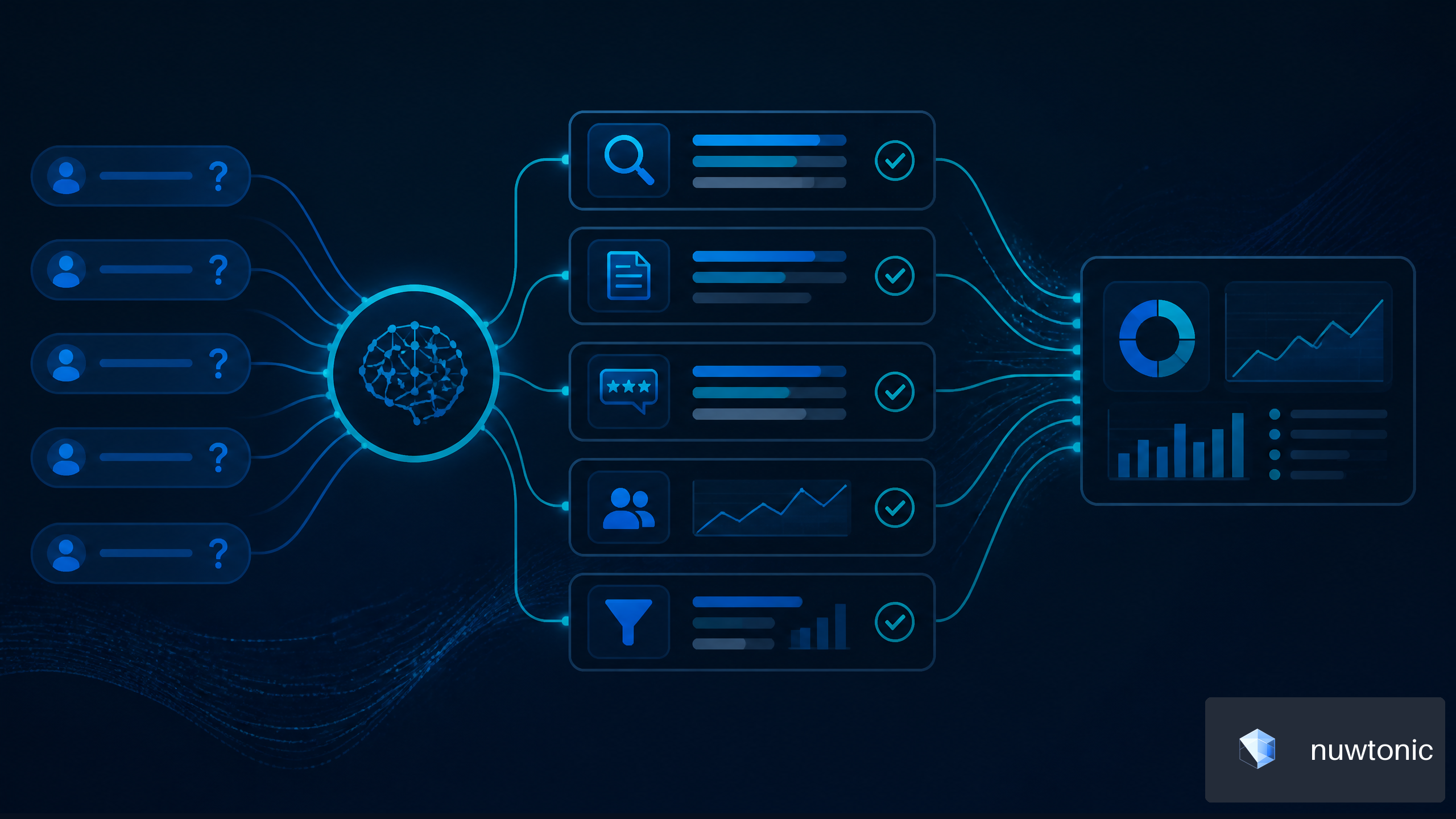
A mention without a click can still influence a buyer’s shortlist. A click without a qualified action may not. Report both, then connect the data to commercial outcomes over time.
Metric | How to calculate it | What it reveals | Decision rule |
|---|---|---|---|
Brand appearance rate | Answers naming your brand divided by tracked questions | Category awareness | Improve coverage if low on priority questions |
Citation share | Answers citing your domain or trusted profiles divided by tracked questions | Source visibility | Strengthen source pages and external proof if low |
Recommendation rate | Answers presenting your brand as a relevant option divided by tracked questions | Shortlist potential | Improve category fit and comparison evidence |
AI referral traffic | Tagged or identifiable visits from AI tools | Direct discovery | Review landing pages if visits do not engage |
Assisted pipeline | Opportunities with AI referral or self-reported AI influence | Business impact | Prioritize themes linked to qualified demand |
Conversion rate | Qualified actions divided by AI referrals | Landing-page alignment | Fix intent mismatch before scaling traffic efforts |
Start with manual checks. Capture the date, exact buyer question, answer summary, brands included, citations shown, and any notable omissions. Because answers can vary by session, location, account context, or retrieval state, treat a single output as a signal rather than a final verdict.
Assign ownership across the organization
AI visibility work fails when it is treated as a side project owned only by SEO. The inputs are distributed across teams.
Workstream | Primary owner | Supporting teams | Monthly output |
|---|---|---|---|
Question tracking | SEO or growth lead | Sales, demand generation | Priority query set |
Content updates | Content lead | SMEs, product marketing | Updated answer-ready pages |
Entity accuracy | Product marketing | Sales, customer success | Approved messaging sheet |
External trust | PR or demand generation | Partnerships, customer marketing | Review and coverage plan |
Revenue reporting | Revenue operations | SEO, marketing analytics | Citation and pipeline dashboard |
For teams selecting a platform to centralize audits, prompt tracking, content gaps, and execution workflows, compare the best AI SEO tools for B2B companies against the specific reporting and approval needs of your organization.
Turn the Strategy Into a 90-Day Operating Plan
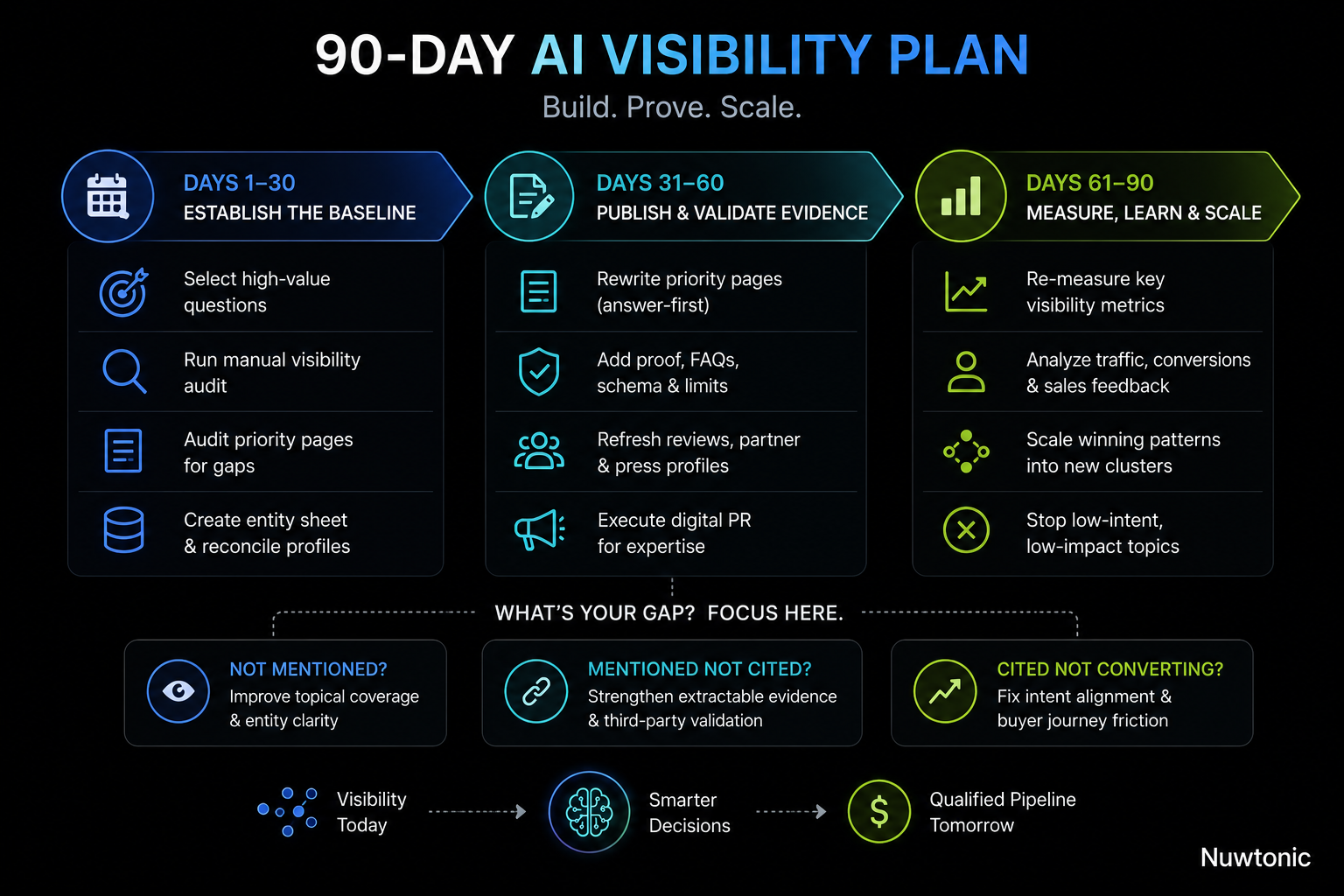
Days 1 to 30: establish the baseline
Select the highest-value product categories, pain points, alternatives, and implementation questions.
Run a manual visibility audit and document brands, citations, descriptions, and gaps.
Audit priority pages for direct answers, proof, internal links, technical access, and stale claims.
Create the entity consistency sheet and reconcile core owned profiles.
Days 31 to 60: publish and validate evidence
Rewrite the highest-priority product, solution, and comparison pages using answer-first structures.
Add SME-reviewed details, dated facts, clear limitations, FAQs, and appropriate schema.
Refresh review-platform profiles, partner listings, and press boilerplates.
Create a digital PR plan around expertise that can be independently validated.
Days 61 to 90: measure, learn, and scale
Repeat the same question set and compare appearance rate, citation share, and recommendation rate.
Review AI referral behavior, qualified conversions, sales notes, and self-reported attribution.
Expand winning page patterns into adjacent topic clusters.
Stop investing in questions that generate low-intent visibility without commercial relevance.
The best next move depends on the gap. If your brand is not mentioned, improve topical coverage and entity clarity. If it is mentioned but not cited, improve extractable evidence and authoritative third-party validation. If it is cited but not converting, address page intent and buyer journey friction. For more execution patterns, use these AI search visibility strategies to align technical, editorial, and authority work.
FAQ
What is a ChatGPT SEO strategy for B2B companies?
It is a coordinated approach to improving how a B2B brand is represented in AI-generated answers. It combines useful SEO fundamentals with answer-ready content, technical accessibility, entity consistency, credible third-party mentions, and measurement tied to citations, referrals, and pipeline.
How do B2B companies get mentioned in ChatGPT answers?
Companies improve their chances by publishing clear, accurate pages that address buyer questions, maintaining consistent brand information across public channels, and earning credible external validation. No tactic guarantees inclusion because answer generation and retrieval can vary, but useful content and reliable evidence create stronger inputs.
Which B2B pages should be updated first for AI visibility?
Start with product pages, solution pages, comparison pages, implementation guides, and category explainers that support active buying decisions. Prioritize pages connected to qualified pipeline, not simply pages with the highest traffic.
Do FAQs and schema markup still matter?
Yes, when they help users and accurately represent visible content. FAQs can clarify common objections and definitions. Schema can make page entities easier to interpret. Neither replaces evidence, crawl accessibility, or a useful page.
Can ChatGPT write B2B SEO content?
It can accelerate research, outlining, clustering, and first drafts. For technical, regulated, or high-consideration topics, human SME review is necessary to validate facts, add proprietary context, and remove unsupported claims.
How do you track whether ChatGPT traffic converts?
Use analytics to identify AI referral visits where possible, tag landing-page campaigns, capture self-reported attribution in forms, and connect qualified actions to CRM opportunities. Pair this with a prompt log because some AI citations influence awareness without producing an immediately visible referral click.
Sources/References
Verified sources
HubSpot — Prioritize Bing Seo: https://blog.hubspot.com/marketing/chatgpt-for-seo
Lead Walnut — ChatGPT SEO: How to Make Your Brand Visible in AI Search Answers: https://www.leadwalnut.com/blog/chatgpt-seo
Flow Agency — B2B SEO for ChatGPT: From Visibility to Sales: https://www.flow-agency.com/blog/seo-for-chatgpt/
TripleDart — Using ChatGPT for SEO: The Complete Guide for 2026: https://www.tripledart.com/blog/chatgpt-seo-guide
Wix — ChatGPT for B2B SEO: A 2-star review | Adriana Stein: https://www.wix.com/seo/learn/resource/ai-content-generation-b2b