
The B2B search environment is undergoing a fundamental shift. Traditional search engines are no longer the sole gatekeepers of organic traffic. Today, modern B2B buyers are bypassing standard search result pages entirely, opting instead for direct, conversational answers from artificial intelligence platforms.
To remain visible, B2B marketing leaders and SEO managers must adapt. Winning in this new environment requires tools that do more than track traditional keyword rankings—they must optimize for visibility within AI-generated answers. Choosing the right software can make—no, it will make—a significant difference in your organic growth trajectory.

Key Takeaways
• Shift in Buyer Behavior: A significant majority of B2B buyers now use conversational AI engines to research software and services.
• High Conversion Rates: Traffic originating from AI search engines converts at a substantially higher rate than traditional organic search.
• Dual-Optimization Strategy: Successful B2B companies are using a combined stack to optimize for both Google SERPs and AI citation engines.
• Operational Integration: The industry is moving away from fragmented point solutions toward integrated platforms that connect analysis with direct execution.
The New Paradigm of B2B Search: Traditional SEO Meets Answer Engine Optimization
The Rise of AI Citations and Search Habit Shifts
Look, the way businesses buy from other businesses has changed permanently. Buyers do not want to wade through pages of blue links when they have complex, multi-layered questions. They want direct answers.
According to a comprehensive study by SalesHive, 73% of B2B buyers now use AI tools like ChatGPT and Perplexity in their research process. When a prospect asks ChatGPT, "What are the best enterprise billing platforms for global SaaS?" your brand needs to be cited as a trusted source. This shift has birthed a new discipline: Answer Engine Optimization (AEO). AEO focuses on structuring your data and building the authority required to become the definitive source that LLMs reference.
The 5x Conversion Premium of AI Traffic
Optimizing for AI search isn't just a branding play; it is a high-yield conversion strategy. Traditional organic search often attracts top-of-funnel, informational traffic that requires months of nurturing. AI search engines, however, are typically queried by buyers who are deep in the consideration phase.
Data from SalesHive highlights that AI search traffic converts at roughly 5x the rate of traditional Google organic search (14.2% vs. 2.8%) for B2B companies. When an LLM recommends your software with a citation link, the user clicking that link has already been pre-qualified by the AI. They aren't browsing; they are evaluating.
Bridging the Gap: Hybrid Search Playbooks
Too often, businesses waste resources chasing trends instead of focusing on foundational SEO practices that yield long-term results. The goal isn't to abandon traditional search engine optimization. Instead, you need a hybrid playbook that satisfies both Google's ranking algorithms and the LLMs' citation logic.
Traditional SEO focuses on page-level technical health, keyword intent, and domain authority. AI search optimization relies heavily on clear entity definition, structured data, and high-quality digital PR that gets your brand mentioned in authoritative industry publications. The tools you choose must support both sides of this coin.
Evaluating the Top AI SEO Tools for B2B Teams
Semrush One & Ahrefs Brand Radar: The Heavyweights
When it comes to comprehensive analysis, the industry giants remain essential parts of the modern stack. Semrush One is widely regarded as a highly complete AI SEO platform, serving as a daily driver for keyword research and competitive benchmarking. It excels at mapping out keyword intent and identifying the search term volume that drives initial strategy.
On the other side of the heavyweight division is Ahrefs. Many companies overlook the importance of a solid backlink profile; it is often the missing piece in their SEO strategy. Ahrefs excels in competitive analysis, helping teams understand where their competitors are earning high-value editorial links. With features like Ahrefs Brand Radar, they are also stepping into the AI-visibility tracking space, allowing brands to see how often they are mentioned in AI-generated answers.
Surfer SEO & Clearscope: Content Optimization Standards
Once you have your keyword strategy, you have to write the content. This is where dedicated content intelligence platforms come in. Surfer SEO is highly regarded for its on-page SEO capabilities. Its Content Editor analyzes real-time SERP data to provide writers with exact semantic recommendations, structural guidance, and entity requirements.
Clearscope provides similar high-end content intelligence, grading your drafts on topical depth and readability. I've found that the most effective AI SEO tools focus on user intent rather than just keyword volume—it’s about relevance, not just traffic. These platforms prevent your writers from keyword stuffing, guiding them instead to create comprehensive content clusters that satisfy both human readers and search crawlers.
Profound & Peec AI: Pure-Play AI Visibility Tracking
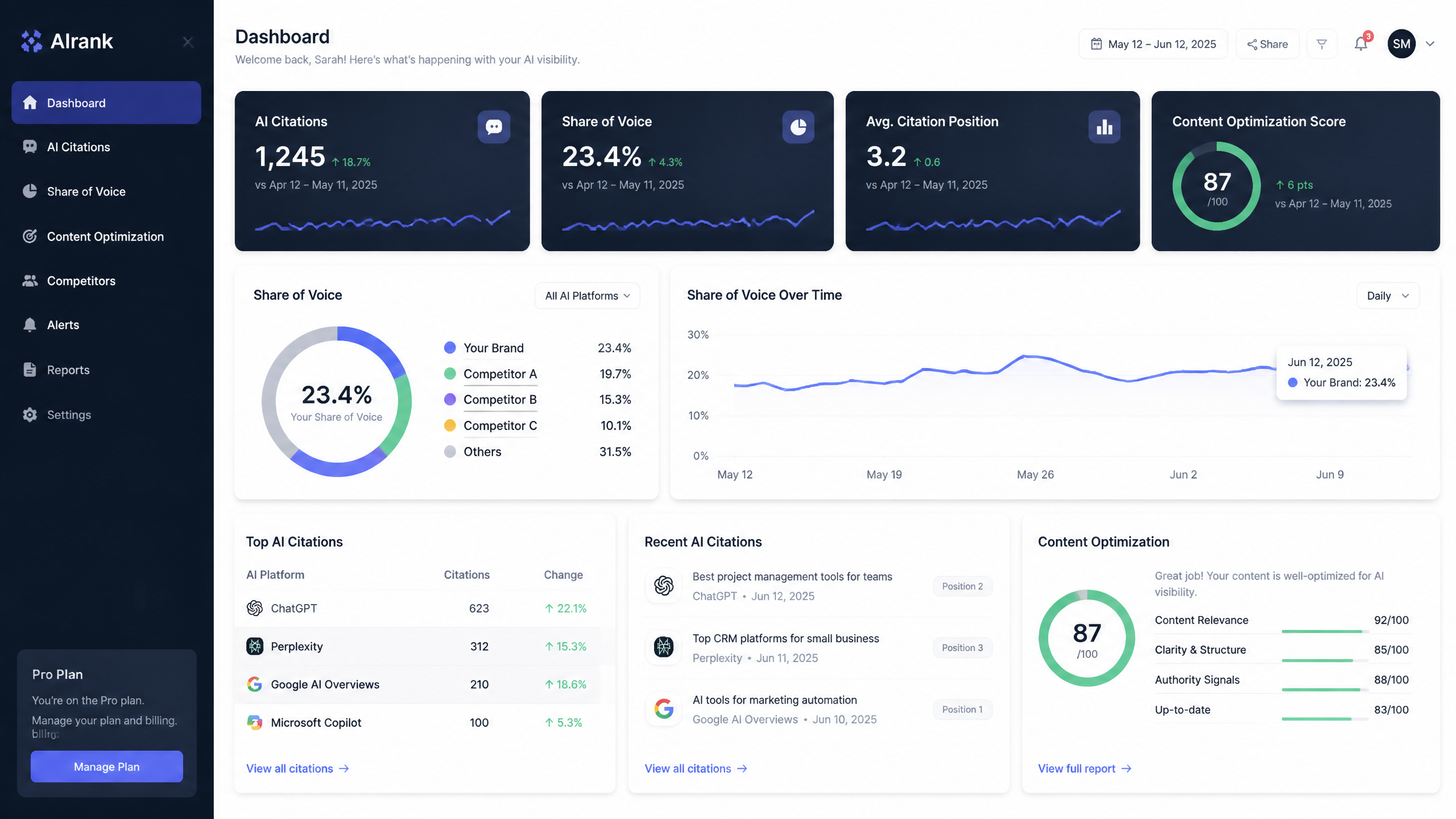
If your primary goal is measuring your brand's Share of Voice inside LLMs, traditional rank trackers won't cut it. You need specialized AI-visibility trackers. Profound is an enterprise-grade platform built specifically for holistic AI search visibility and AEO. According to research from Profound, the tool provides actionable competitive benchmarking and compliance features tailored for global B2B SaaS growth teams.
For smaller, agile teams, Peec AI offers a more accessible entry point. When paired with content optimizers, Peec AI allows you to track brand citations across ChatGPT, Claude, and Perplexity. These tools help you run citation gap analyses, showing you exactly which prompts your competitors are winning and where your brand is being left out of the conversation.
Nuwtonic: The Integrated SEO and AI Search Workflow
For B2B marketing teams that want to avoid tool fatigue, Nuwtonic offers a highly integrated approach. Rather than forcing you to purchase separate point solutions for traditional keyword research, rank tracking, GSC analysis, and AI visibility monitoring, Nuwtonic combines these workflows into a single workspace.
By leveraging your Google Search Console data, Nuwtonic automates the discovery of technical SEO issues, generates targeted topical maps, and identifies high-value citation gaps. It connects the analytical phase—identifying what is broken or missing—with direct, AI-assisted execution, all while keeping the marketer in control via an intuitive approval process. This integration prevents valuable search insights from getting lost in static spreadsheets.
| Platform | Primary Focus | Best For | Key Strength |
|---|---|---|---|
| Semrush One | All-in-one SEO suite | Established marketing teams | Broad keyword database & competitor research |
| Ahrefs | Backlink & competitive intelligence | Organic growth & link specialists | Industry-leading backlink index |
| Surfer SEO | On-page content optimization | Editorial teams & content agencies | Fast, actionable writing editors |
| Profound | AI search visibility & AEO | Enterprise B2B SaaS teams | Deep LLM citation tracking & compliance |
| Nuwtonic | Integrated SEO & AI workflows | Small-to-mid market B2B companies | GSC integration & automated optimization |
Building a Cost-Effective AI SEO Stack by Team Size
The Lean Stack: Small Teams and Agile Budgets
Look, if you are operating with a marketing team of under 50 employees, you do not need a five-figure enterprise software contract. You need a highly efficient, cost-effective stack that covers both content creation and citation tracking without introducing unnecessary complexity.
According to data from Authoricy, combining Surfer SEO ($89–219/month) with Peec AI ($100/month) provides an exceptionally balanced setup. For a combined investment of roughly $200–320/month, a small team can optimize their long-form content for traditional search while simultaneously measuring their brand citation share inside major AI engines. This lightweight stack ensures you are playing both games without draining your budget.
The Mid-Market Stack: Expanding Authority and Reach
As your team grows, your challenges shift from pure content production to workflow efficiency and technical site health. Mid-market B2B companies typically manage larger websites where manual SEO management becomes a significant bottleneck.
For these teams, integrating a platform like Nuwtonic alongside a traditional research tool like Semrush or LowFruits is highly effective. LowFruits specializes in finding high-value, low-competition long-tail keywords that larger competitors ignore, while Nuwtonic automates the technical audits and maps out content clusters. This combination ensures your content team is targeting high-intent terms while maintaining a clean, error-free technical foundation.
The Enterprise Stack: Compliance, Scale, and Governance
For global B2B enterprises, especially those in highly regulated fields like finance, healthcare, or legal, security and compliance are non-negotiable. You cannot simply deploy arbitrary AI tools without ensuring they meet rigorous data governance standards.
At this scale, the stack typically features enterprise-grade platforms like Profound or BrightEdge. These platforms offer SOC2 compliance, granular user permission controls, and robust audit trails. They allow global marketing departments to run multi-regional, GEO-optimized campaigns while ensuring all generated content and data collection practices align with internal compliance policies.
What NOT to Do: Common Pitfalls in B2B AI SEO
Chasing Volume Over Keyword Intent
I once invested too heavily in content without optimizing for keywords, and it was a costly mistake. But an even worse mistake is chasing massive search volume at the expense of search intent. In B2B, a keyword with 100 monthly searches that is typed by a Director of Procurement is worth infinitely more than a keyword with 10,000 monthly searches typed by students.
Don't let AI content tools tempt you into mass-producing low-intent articles just because you can. Focus your AI tools on mapping out highly specific, bottom-of-funnel queries that solve actual operational pain points for your ideal customer profile.
Overlooking Your Backlink Profile
Many companies assume that because AI engines generate answers, backlinks no longer matter. This is a critical misunderstanding of how LLMs operate. AI engines train on existing web data and use links to verify facts. If no authoritative sites are linking to you, the AI has no reason to trust your information.
• Keep building high-quality editorial links: AI search engines prioritize cited sources that have strong domain authority.
• Avoid spammy link schemes: LLMs are highly sensitive to unnatural patterns and will quickly filter out untrustworthy domains.
• Focus on digital PR: Earned media mentions in reputable industry publications are the fastest way to get noticed by AI crawler models.
Ignoring Enterprise Compliance and Data Security
Do not allow your team to feed proprietary customer data, product roadmaps, or sensitive company information into public, unsecured AI models. Many standard AI writing tools use your inputs to train their public datasets, which can lead to catastrophic data leaks.
Always verify the data privacy policies of your AI SEO vendors. Ensure they offer data exclusion opt-outs, and if you are operating at an enterprise scale, mandate SOC2 compliance and secure API integrations to protect your intellectual property.
Technical SEO Automation and Schema.org Entity Mapping
Automating Code Adjustments at Scale
Large B2B websites often have thousands of legacy pages suffering from minor technical issues like broken redirects, missing meta tags, or poor mobile rendering. Waiting for your internal development team to fix these issues can take months.
According to technical insights from Sight AI, platforms like AlliAI solve this operational bottleneck by allowing non-developers to deploy on-page technical SEO adjustments at scale without changing server code. This automation bypasses the developer queue, allowing marketing teams to clean up their site architecture and improve search engine crawlability in real-time.
Defining Your Brand Entity via Schema Markup
To be recommended by AI engines, you must make it incredibly easy for their crawlers to understand exactly who you are, what you sell, and who you serve. This is achieved through Schema.org structured data.
Implementing advanced Schema markup—specifically defining your Organization, Product, and Service entities—acts as a direct translation layer for LLMs. It explicitly connects your brand to key industry concepts, helping AI engines map your business within their semantic knowledge graphs and increasing the likelihood of your brand being served as a definitive answer.
Frequently Asked Questions About B2B AI SEO Tools
How do AI visibility tools track mentions in LLMs?
AI visibility tools monitor LLM mentions by querying major models (like ChatGPT, Claude, and Perplexity) with thousands of commercially relevant prompts. They analyze the generated outputs to see if your brand is recommended, calculate your Share of Voice, and identify which source links the AI cited to back up its answer.
Can AI-generated content pass enterprise quality standards?
Yes, but only if it undergoes a rigorous editorial review process. Purely automated AI content often lacks the original research, expert quotes, and unique perspectives required to rank well. Successful B2B teams use AI to generate briefs, outline structures, and draft initial sections, but rely on human subject matter experts to inject real-world experience and ensure compliance.
What is the cost of a typical B2B AI SEO tool stack?
The cost varies significantly depending on your team's size and requirements:
• Lean Stack (<50 employees): $200–$350/month (e.g., Surfer SEO + Peec AI)
• Mid-Market Stack: $500–$1,500/month (e.g., Semrush + Nuwtonic)
• Enterprise Stack: $3,000+/month (e.g., Profound + BrightEdge with custom API access)
The Strategic Path Forward for B2B Search
Summary of the Transition
The B2B search landscape is no longer a single-channel game. Winning in 2026 and beyond requires a dual-focus strategy: maintaining your visibility on traditional search engine results pages while aggressively claiming your share of citations within AI answer engines.
Rather than collecting an array of fragmented point solutions, evaluate your team's current operational bottlenecks. Whether you choose a specialized citation tracker or an integrated platform like Nuwtonic that automates the link between analysis and execution, the goal remains the same: provide clear, authoritative, and structured information that both search engines and AI models can trust.
References and Authoritative Sources
- SalesHive: Industry analysis on B2B buyer search habits and AI search conversion rates.
- Authoricy: Pricing models and tool combination strategies for small-to-midsize marketing teams.
- Profound: Enterprise standards, competitive benchmarking, and compliance in AI search visibility.
- Sight AI: Technical SEO automation and on-page deployment frameworks for enterprise sites.