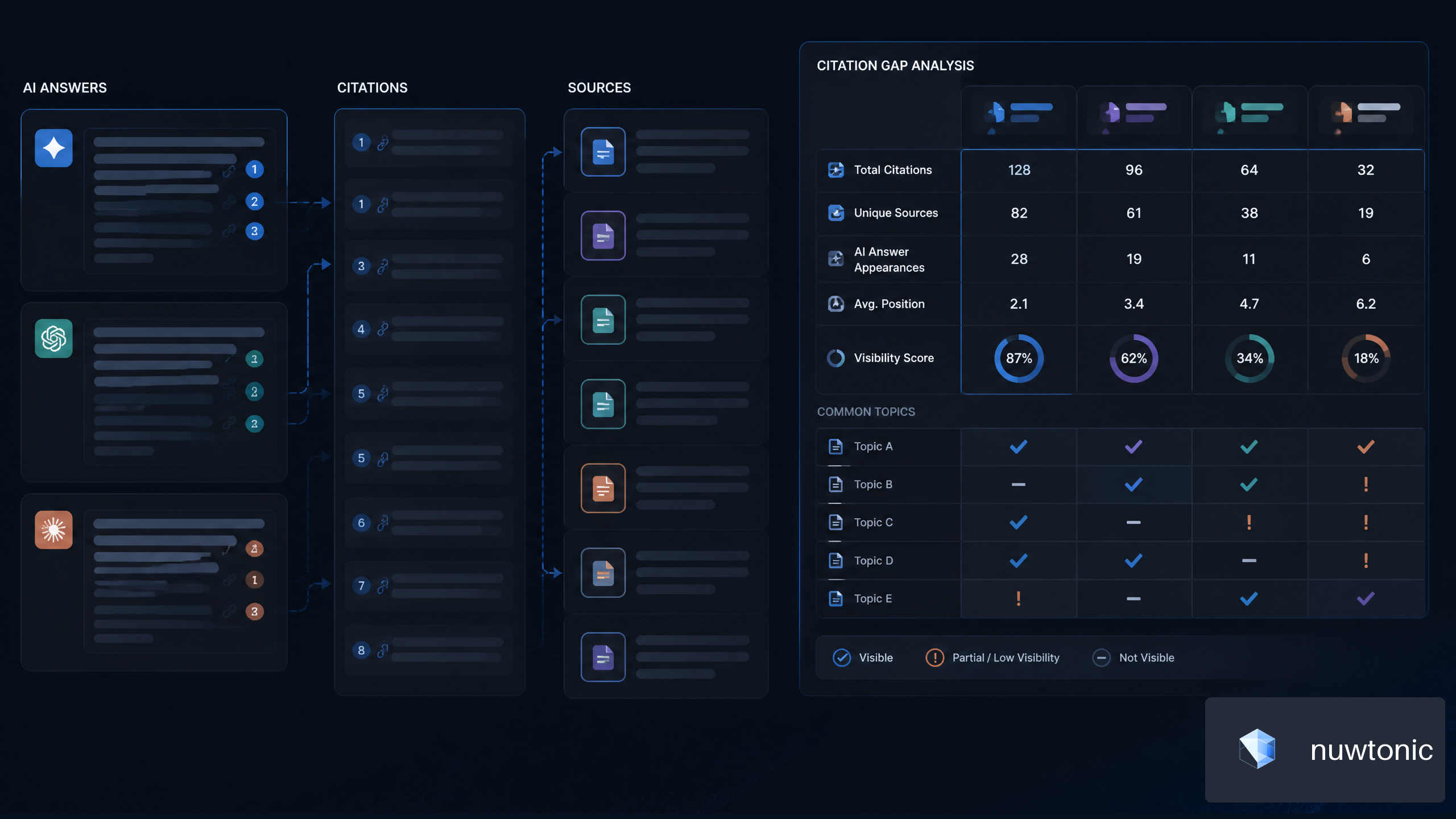
AI citation gap analysis for SaaS companies identifies where competitors appear as cited, recommended, or linked sources in AI-generated answers while your company does not. I recommend treating this as a measurement problem before treating it as a content problem: a missing citation may reflect weak evidence, poor source coverage, prompt variance, or a competitor’s stronger third-party validation.
TL;DR: Measure citations, mentions, and recommendations separately; test prompt clusters repeatedly; diagnose the source layer behind each gap; then choose between page updates, new content, or external validation.
Table of Contents
• Diagnose the source behind the gap
• Choose the right remediation
• Govern the process and avoid false conclusions
• FAQ
Measure the AI Search Recommendation Right Gap
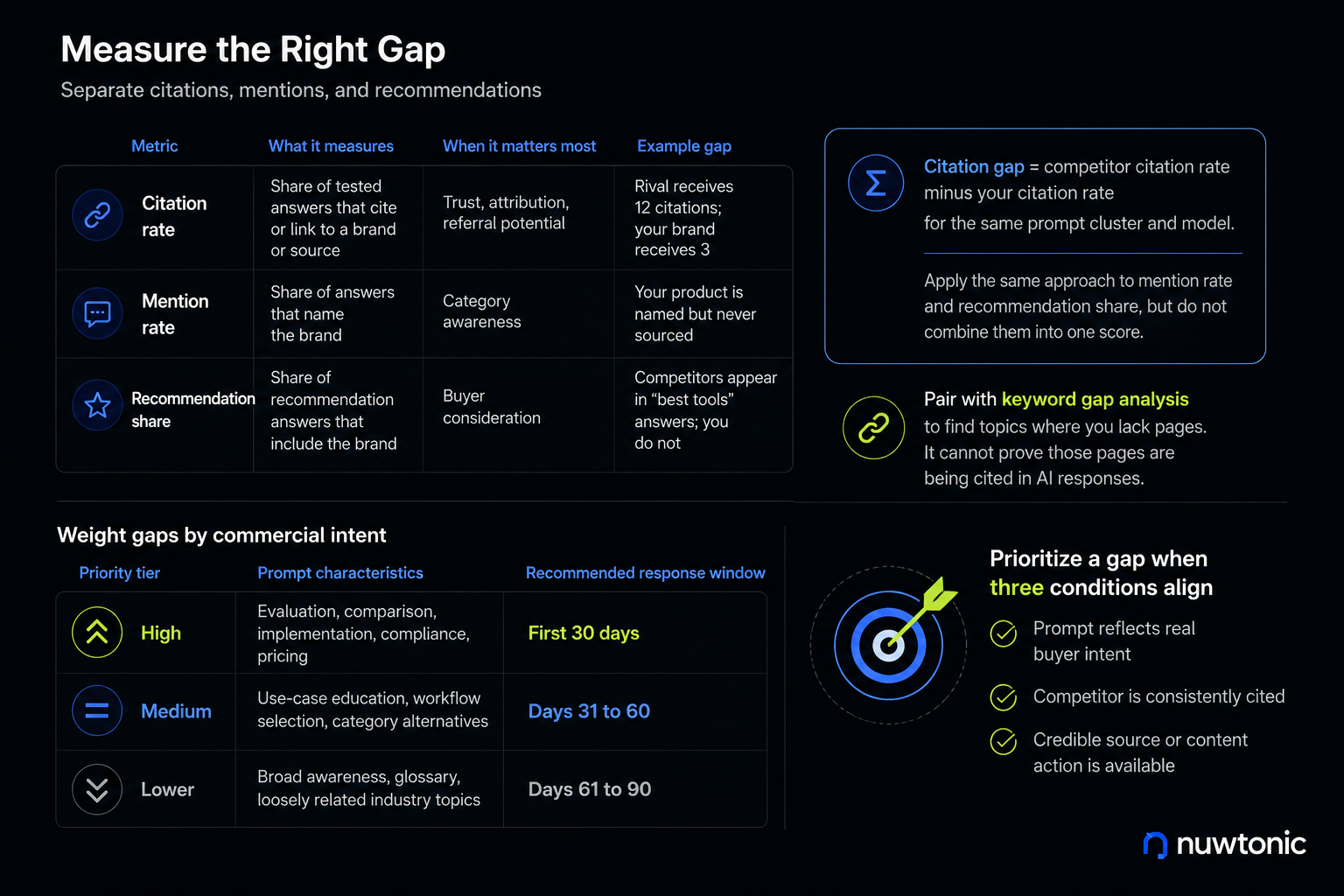
Separate citations, mentions, and recommendations
A brand mention is not proof of visibility quality. An AI system may name a SaaS company in a broad category list but cite a competitor’s documentation, review profile, or editorial comparison. That distinction changes what the team should fix.
Metric | What it measures | When it matters most | Example gap |
|---|---|---|---|
Citation rate | Share of tested answers that cite or link to a brand or source | Trust, attribution, referral potential | Rival receives 12 citations; your brand receives 3 |
Mention rate | Share of answers that name the brand | Category awareness | Your product is named but never sourced |
Recommendation share | Share of recommendation answers that include the brand | Buyer consideration | Competitors appear in “best tools” answers; you do not |
A practical formula is: citation gap = competitor citation rate minus your citation rate for the same prompt cluster and model. Apply the same approach to mention rate and recommendation share, but do not combine them into one score. A company could have high mention visibility and a serious citation gap at the same time.
For broader organic context, pair this work with keyword gap analysis. Keyword coverage can reveal topics where a SaaS brand lacks supporting pages, but it cannot prove that those pages are being cited in AI responses.
Weight gaps by commercial intent
Not every missing citation deserves equal effort. A gap in a generic definition query may have limited pipeline relevance. A gap in a migration, security, pricing, integration, or comparison question can influence an active buyer.
Priority tier | Prompt characteristics | Recommended response window |
|---|---|---|
High | Evaluation, comparison, implementation, compliance, pricing | First 30 days |
Medium | Use-case education, workflow selection, category alternatives | Days 31 to 60 |
Lower | Broad awareness, glossary, loosely related industry topics | Days 61 to 90 |
I would prioritize a gap when three conditions align: the prompt reflects real buyer intent, a competitor is consistently cited, and there is a credible source or content action available.
Build a Reliable Audit
Use prompt clusters, not isolated wording
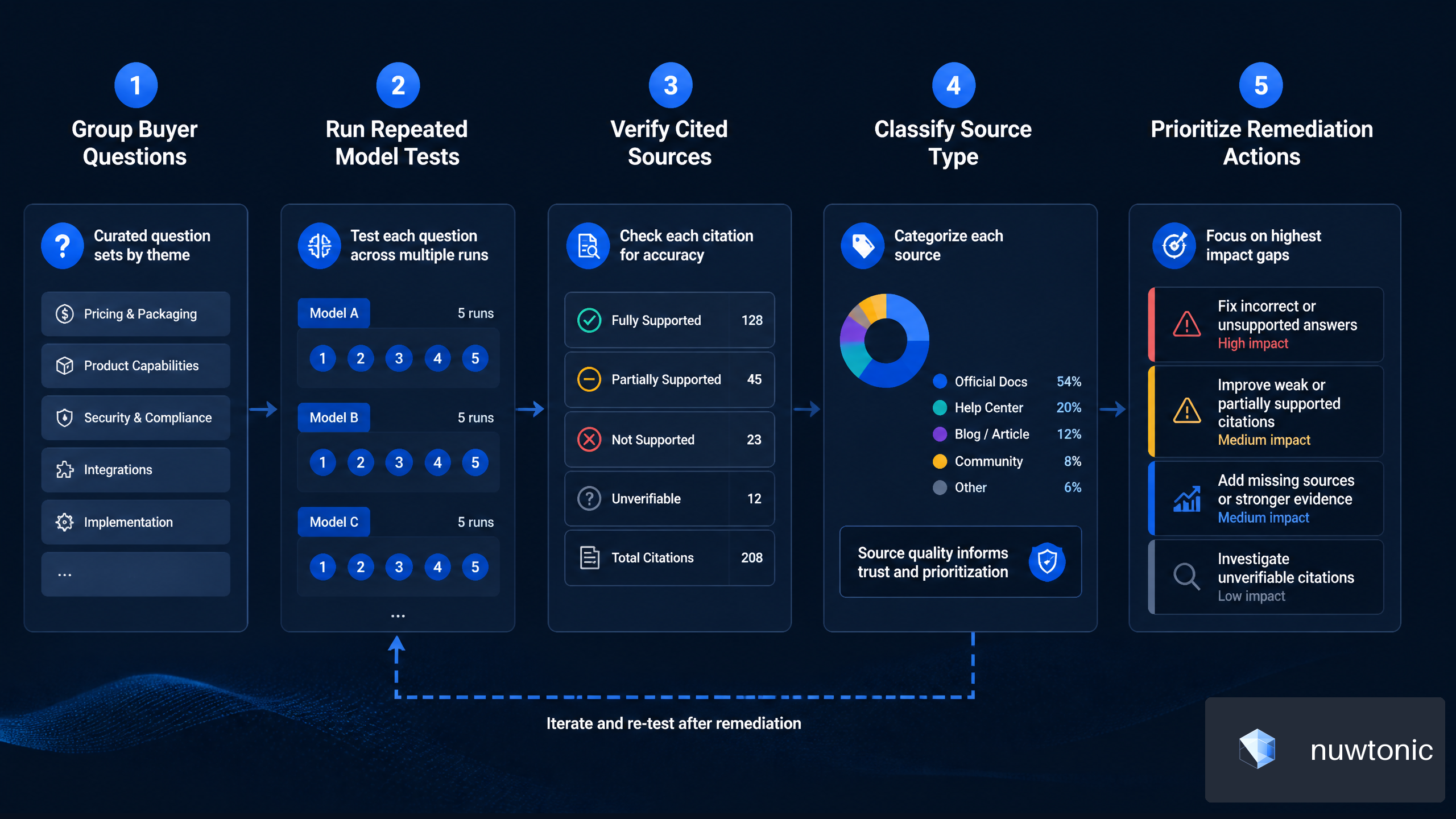
Single-query tests create false gaps. Small wording changes can alter answer structure, sources, and brand inclusion. Instead, group prompts by intent and test several natural variations.
For example, a project-management SaaS company might test these questions in one cluster:
What project management software works for distributed engineering teams?
Which tools support sprint planning and cross-functional collaboration?
What are alternatives to a specific competitor for software teams?
Run each cluster across the AI systems relevant to your audience, then record cited domains, linked pages, brand mentions, recommendation position, answer date, and exact wording. Analyzing citation gaps in AI becomes more useful when the audit preserves this evidence rather than relying on screenshots or anecdotal impressions.
Repeat tests to control variance
There is no universal replication count, but a sensible starting point is three runs per prompt variation at separate times. If a competitor appears once but disappears in later runs, classify that result as unstable rather than calling it a durable gap.
Audit signal | Interpretation | Action |
|---|---|---|
Competitor cited in most repeated runs | Likely durable competitive advantage | Investigate cited source and excerpt |
Competitor appears inconsistently | Possible model or wording variance | Expand sample before acting |
Your brand mentioned but uncited | Awareness without attributable evidence | Strengthen supporting sources |
Neither brand appears | Low current citation opportunity | Reassess prompt relevance |
Diagnose the Source Behind the Gap
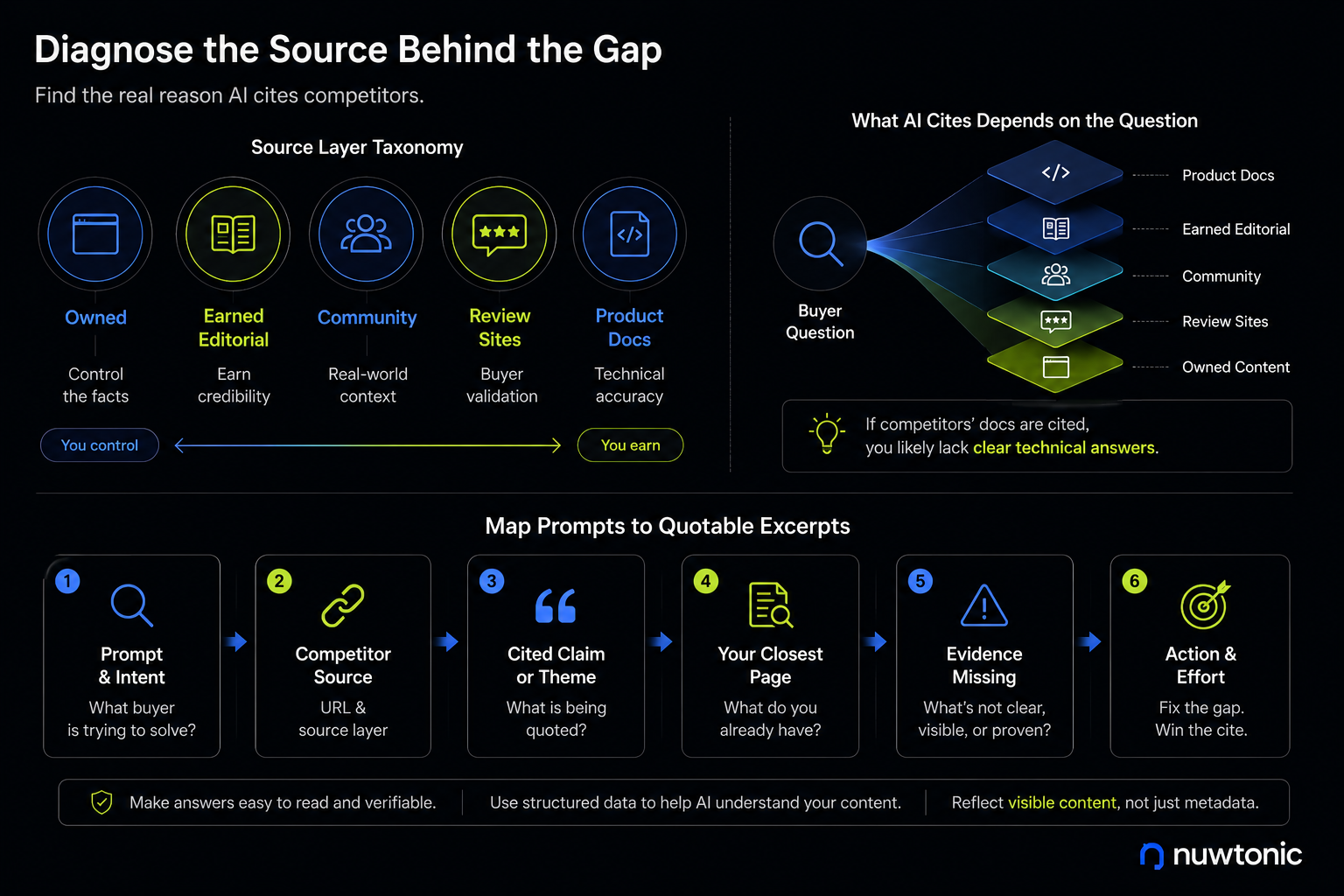
Classify the cited source layer
The cited page often explains the gap better than the answer itself. Use a source taxonomy that separates what you control from what must be earned.
Source layer | Typical examples | Best use | Primary limitation |
|---|---|---|---|
Owned | Product pages, docs, help center, original research | Product facts and implementation details | May lack independent validation |
Earned editorial | Trade publications, analyst-style articles, comparisons | Category credibility | Requires editorial interest |
Community | Forums, practitioner discussions, Q&A sites | Workflow context and candid feedback | Can be inconsistent or outdated |
Review sites | Review platforms and marketplace listings | Buyer validation and alternatives | Claims need careful governance |
Product documentation | API references, security pages, release notes | Technical accuracy | Often weak for broad category recommendations |
If an AI answer repeatedly cites a competitor’s security documentation, publishing another top-of-funnel blog post is unlikely to close the gap. The missing asset may be a clear security page, implementation guide, or accessible technical reference.
Map prompts to quotable excerpts
For each high-priority prompt, capture the exact competitor excerpt or source passage reflected in the answer. Then ask: does your site contain an equally direct, visible, and substantiated answer?
A useful mapping record includes:
• Prompt cluster and buyer intent
• Competitor source URL and source layer
• Cited claim or excerpt theme
• Your closest existing page
• Evidence missing from your page
• Recommended action and expected effort
Clear headings, visible answers, and accurate markup can improve content interpretation. Google Search Central’s structured data guidance explains that structured data can help search engines understand page content, but it must reflect visible content rather than metadata added solely for optimization.
Choose the Right Remediation
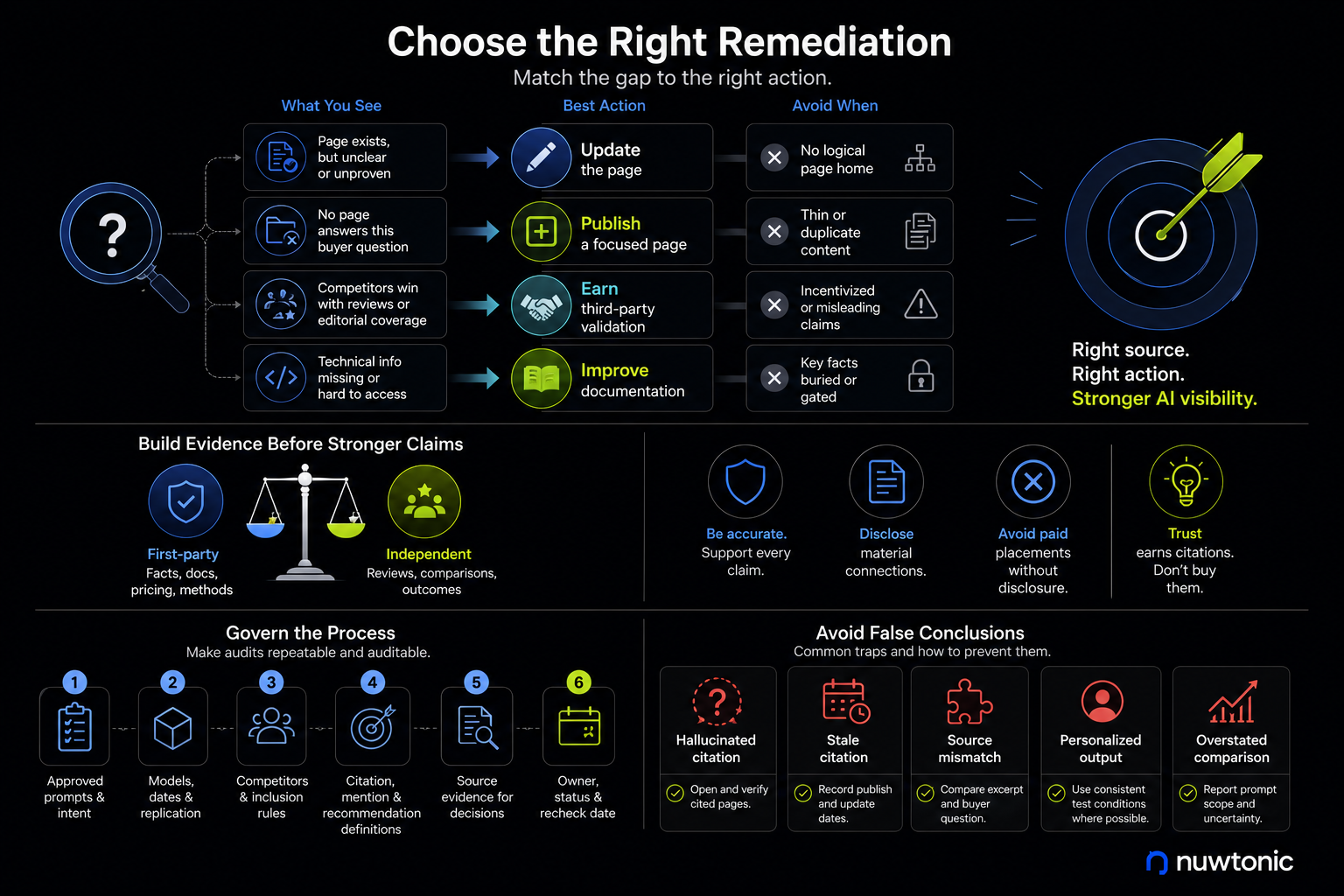
Edit, publish, or earn validation
The right fix depends on source mismatch, not on a default preference for publishing more articles.
Condition | Best action | When to avoid it |
|---|---|---|
Existing page answers the question but lacks clarity or proof | Update the page | Avoid if the topic has no logical page home |
No page addresses a recurring buyer question | Publish a focused page | Avoid thin, near-duplicate content |
Competitors win through independent reviews or editorial coverage | Earn third-party validation | Avoid incentivized or misleading claims |
Technical details are missing or inaccessible | Improve documentation | Avoid burying key facts in gated resources |
For SaaS teams, this work should complement SEO for SaaS companies, especially where product pages, documentation, comparison content, and conversion paths need to support the same commercial topic.
Build evidence before making stronger claims
AI systems can surface claims from vendor and third-party sources. That does not make unsupported claims safe to publish or repeat. The FTC’s guidance on endorsements, influencers, and reviews states that endorsements must not be deceptive and that material connections may require disclosure.
Use first-party sources for product facts, documentation, pricing mechanics, and methodology. Use independent sources for reputation, comparative perspectives, and externally verifiable outcomes. Fair warning: paying for a review or affiliate placement without clear disclosure can create compliance risk while also weakening the credibility of the evidence you want cited.
Govern the Process and Avoid False Conclusions
Use an auditable operating model
A citation audit should be repeatable. NIST’s AI Risk Management Framework 1.0 provides governance, mapping, measurement, and monitoring concepts that can support this type of process.
A simple governance record should include:
Approved prompt inventory and intent labels
Models tested, dates, and replication count
Competitor set and inclusion rules
Citation, mention, and recommendation definitions
Source evidence retained for every high-priority decision
Owner, remediation status, and recheck date
Watch for common failure modes
Failure mode | Why it distorts results | Safeguard |
|---|---|---|
Hallucinated citation | The answer references a source that does not support its claim | Open and verify cited pages |
Stale citation | An old page remains visible after product changes | Record publication and update dates |
Source mismatch | The cited asset serves a different intent than your replacement page | Compare excerpt and buyer question |
Personalized output | Account context changes recommendations | Use consistent test conditions where possible |
Overstated competitor comparison | A small sample becomes a broad market claim | Report prompt scope and uncertainty |
FAQ
What is the difference between a citation gap and a mention gap?
A citation gap means competitors receive attributable sources or links where your company does not. A mention gap means competitors are named more often. Fix citation gaps with stronger evidence and source coverage; fix mention gaps with clearer category relevance and broader topical presence.
How often should a SaaS company rerun an AI citation gap audit?
For high-intent prompt clusters, rerun checks monthly or after major page, product, documentation, or third-party coverage changes. Quarterly may be sufficient for lower-priority awareness topics. Increase frequency when model behavior, competitor messaging, or your product positioning changes materially.
How do you know whether to update a page or seek third-party coverage?
Update an existing page when the cited need is factual, technical, or directly tied to your product. Seek third-party coverage when the gap is trust-based, such as reviews, independent comparisons, or reputation signals. If both are missing, improve the owned evidence first, then pursue validation.
Sources/References
Official guidance
• Federal Trade Commission — Endorsement Guides: https://www.ftc.gov/business-guidance/advertising-marketing/endorsements-influencers-reviews
• NIST — AI Risk Management Framework 1.0: https://www.nist.gov/itl/ai-risk-management-framework
• Google Search Central — Structured data introduction: https://developers.google.com/search/docs/appearance/structured-data/intro-structured-data