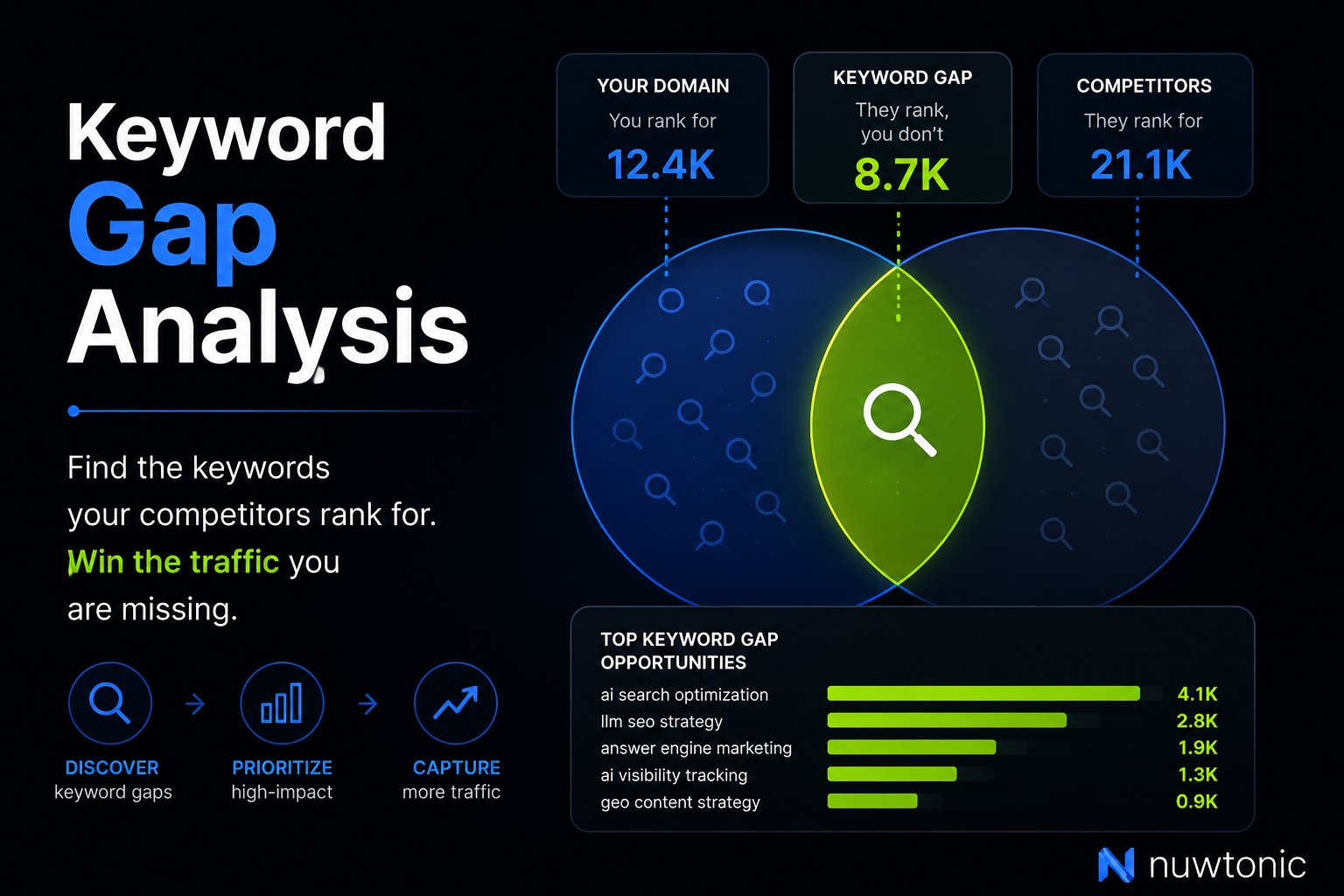
You already know the pattern. A competitor publishes a page, starts showing up for the queries you care about, and your team is left guessing whether the opportunity is a keyword, a topic cluster, or a page-level fix. Keyword gap analysis exists to remove that guesswork. It compares your rankings against competitor rankings, isolates what you're missing, and turns those gaps into content actions that can ship. The strongest tools do more than surface keywords, they help you qualify demand, cluster the terms, and push the work into an SEO workflow your team can execute.
That matters because the method is now a standard part of competitive SEO research. Industry guidance says regular keyword gap analysis can uncover 20% to 30% new keyword opportunities as Semrush describes the workflow. Another guide says businesses conducting regular keyword gap analyses can boost organic traffic by 37% within six months, while a cited example found 989 missing keywords and later saw traffic rise 550% in three months after targeting them in Vrid's published guide. Those figures are directional, not universal, but they explain why the best teams treat gap analysis as a repeatable operating system, not a one-time audit. For a related planning lens on discovery terms, see video SEO terms for marketers.
Table of Contents
- 1. Nuwtonic
- 1. Nuwtonic
- 3. Ahrefs Content Gap
- 3. Ahrefs Content Gap
- 4. Similarweb Keyword Gap and Overlap Analyzer
- 5. SpyFu Kombat SEO and PPC keyword gap
- 6. SE Ranking Competitive Research
- 7. Serpstat Missing Keywords and Competitor Analysis
- Top 7 Keyword Gap Tool Comparison
- From Analysis to Action Choosing the Right Tool
1. Nuwtonic
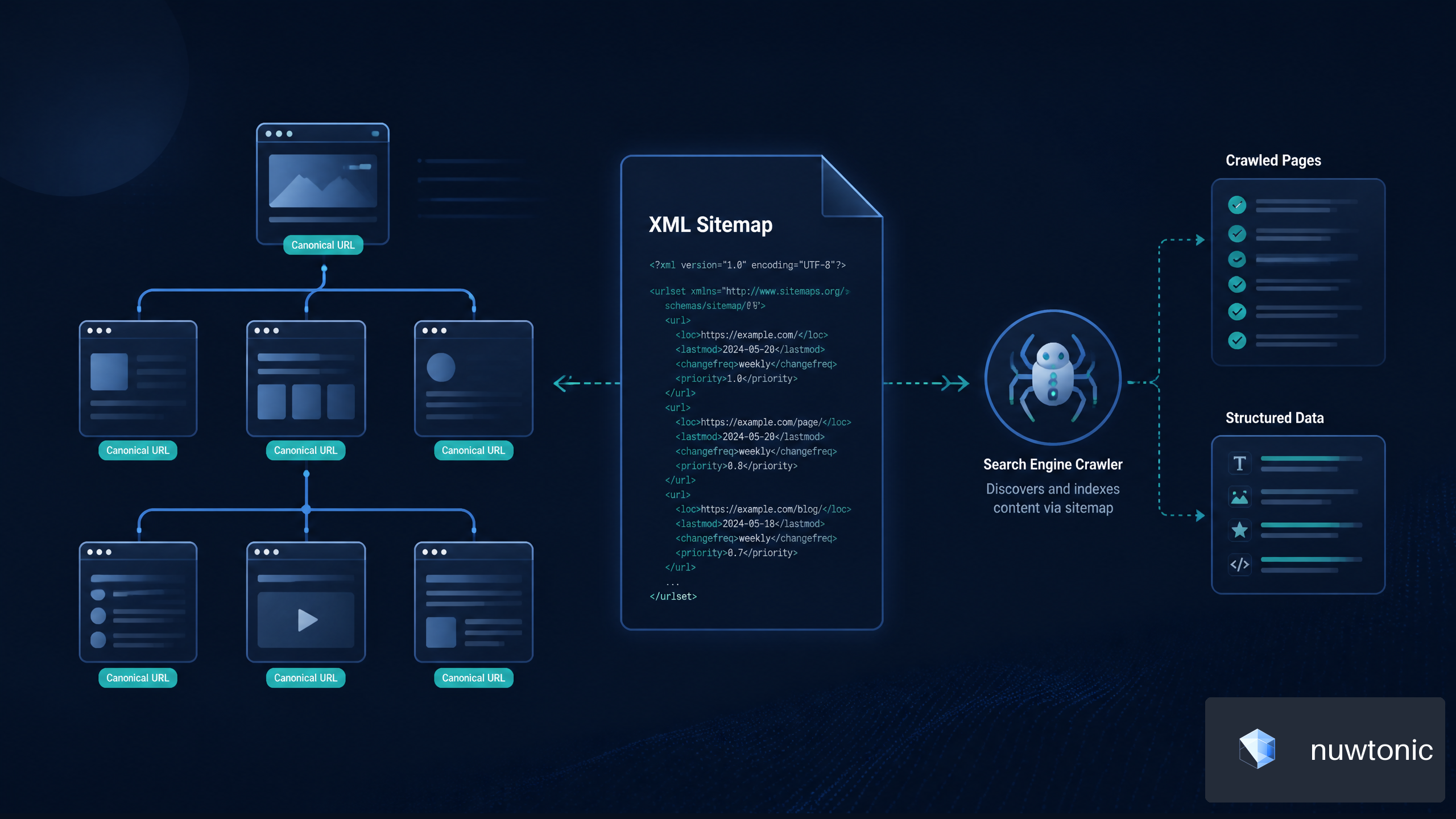
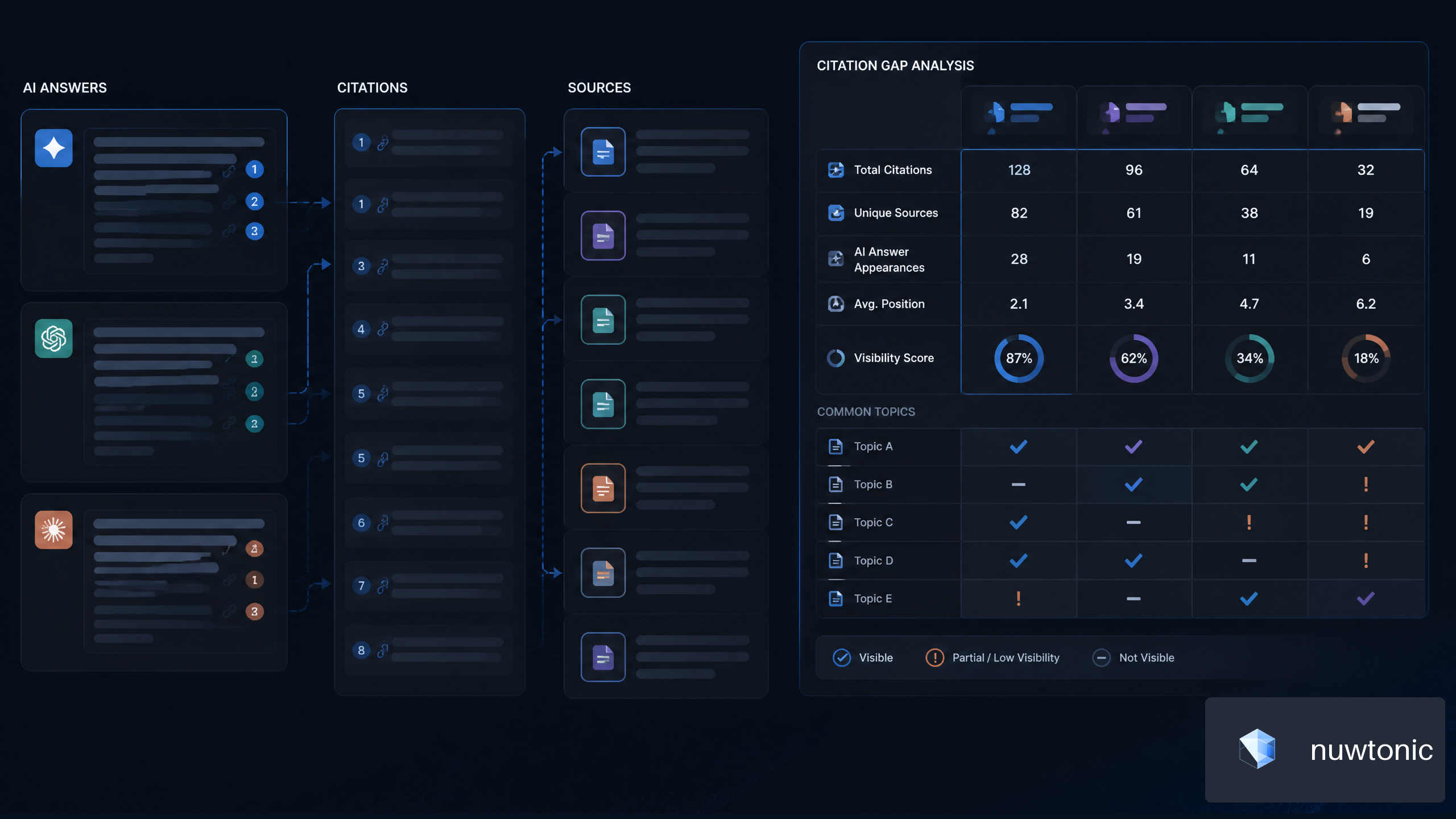
A keyword gap review usually starts with a list of missing terms, then stalls when the team has to decide what to fix first. Nuwtonic is built for teams that want that handoff to move faster, because it ties keyword gap analysis to execution instead of leaving the work in a spreadsheet. It connects to Google Search Console, runs 120+ AI- and SEO-focused checks, and flags issues such as AI citation gaps, so the starting point is your own site data rather than a generic keyword list. The platform also pairs competitor gap analysis with AI Search Agents that track prompts and brand visibility across ChatGPT, Gemini, Perplexity, Claude, Grok, and Google, which matters when the gap is no longer only blue-link rankings, but also whether AI systems cite your pages.
Built for teams that need fixes, not just findings
The main value is the execution layer. Nuwtonic ranks issues by urgency using GSC-trained signals, then lets teams push reviewable fixes into the CMS with permission control, which reduces the common gap between strategy and implementation. It also includes on-page auto-fixes for metadata, schema, and alt text, plus topical maps, content autopilot, sitewide cannibalization tracking, and a GSC Performance Dashboard that prioritizes actions by impact.
That setup fits agencies and in-house teams that need a repeatable workflow from discovery to release. The platform's competitor gap analysis feature is especially useful when the team needs to compare its own visibility against specific rivals, qualify which terms are worth chasing, and move those findings into content or site updates without rebuilding the process in another tool. It is less about handing analysts a raw export and more about keeping the research, prioritization, and fix process in one place.
Nuwtonic also helps teams that are tracking search beyond traditional rankings. If the goal is to understand where competitors are winning citations, which pages are underperforming, and how those gaps should map to updates in the CMS, it gives a practical path from diagnosis to action. That makes it a strong fit for teams that want one system for gap discovery, issue triage, and implementation tracking.
1. Nuwtonic
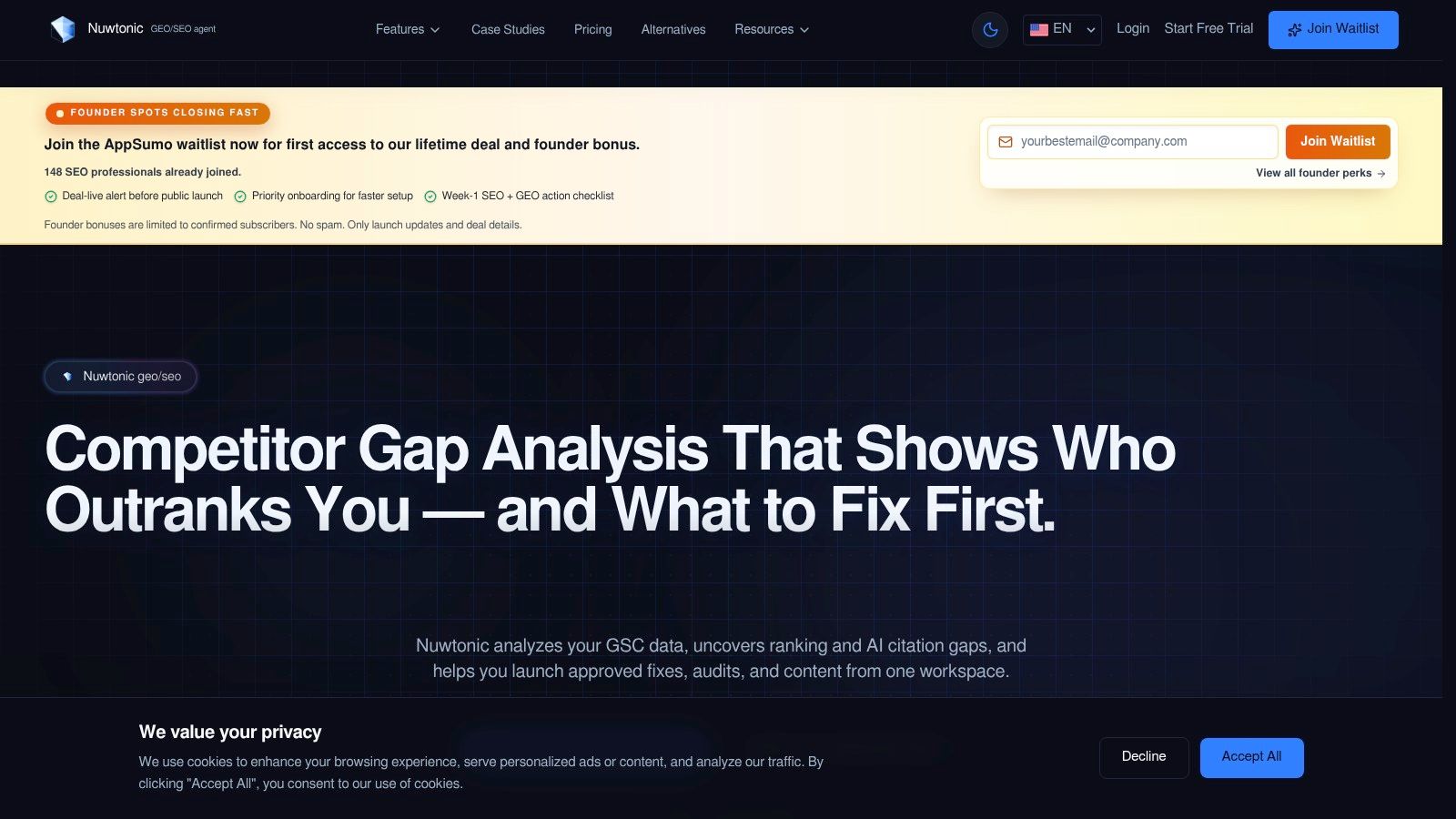
Nuwtonic is a strong fit for teams that want keyword gap analysis to lead to implementation, not another export. It connects to Google Search Console, runs 120+ AI- and SEO-focused checks, and surfaces ranked issues, including AI citation gaps, so the workflow begins with evidence from the site itself rather than broad ideation. The platform also pairs competitor gap analysis with AI Search Agents that track prompts and brand visibility across ChatGPT, Gemini, Perplexity, Claude, Grok, and Google, which matters when the gap is no longer only about blue-link rankings but also about whether AI systems cite your pages.
Built for teams that need fixes, not just findings
The practical advantage is the execution layer. Nuwtonic ranks issues by urgency using GSC-trained signals, then lets teams push reviewable fixes into the CMS with permission control, which helps reduce the common handoff problem where strategy lives in one tool and implementation happens somewhere else. It also covers on-page auto-fixes for metadata, schema, and alt text, plus topical maps, content autopilot, sitewide cannibalization tracking, and a GSC Performance Dashboard that prioritizes actions by impact.
That consolidation matters for agencies and in-house teams because the platform is designed to replace a large stack of point tools. Its site materials describe a combined entry cost of about $700+ per month across multiple tools, while Nuwtonic Pro starts at $99 per month, with Starter at $99 per month, Silver at $199 per month, and custom Gold for agencies. It also offers a 7-day free trial and a 7-day money-back guarantee on self-serve plans on the product site. If your team is already comparing gaps, content briefs, and site fixes across separate systems, that difference in workflow density is the reason Nuwtonic stands out.
For a deeper dive into competitor gap strategies, see our guide on competitor gap analysis.
Practical rule: use a gap tool that can rank opportunities by impact and then hand them to the people who can publish or deploy the fix the same week.
Where Nuwtonic fits best
Nuwtonic is a good fit for SEO agencies, B2B SaaS teams, ecommerce and DTC brands, and solo founders who need both SEO and GEO visibility. It shows review signals on G2 at about 4.9/5, a 5/5 score on Trustpilot, and a published case example where a new site reached 138,000 impressions and 1,600+ organic clicks within two months as listed by the company. The platform also says it supports GDPR/CCPA compliance and 256-bit SSL, which matters for teams handling multi-site or client data.
The tradeoff is straightforward. Nuwtonic favors consolidation and automated action, so teams that want only a narrow keyword-gap report may find it broader than necessary. If your workflow includes AI visibility, content generation, topical mapping, and review-before-deploy controls, it is the most complete option here. Nuwtonic is the tool to inspect first if your current process stops at the audit stage.
3. Ahrefs Content Gap
Ahrefs is a strong choice for analysts who need SERP qualification as well as discovery. Its Content Gap tool identifies keywords competitors rank for that your site does not, at the domain, subfolder, or exact URL level. That URL-level flexibility matters when the main issue is not a broad domain deficit, but a single page that is underbuilt and missing the right term set.
Ahrefs fit and URL-level qualification
The workflow stays focused because Content Gap sits beside Site Explorer and Keywords Explorer. That matters in gap analysis, because a keyword list only becomes useful once you can decide whether each term belongs on a new page, a rewrite, or a supporting section. Ahrefs gives you enough context to make that call without moving between too many exports. It also supports include and exclude brand logic plus position ranges, which helps remove branded noise and keep attention on terms that represent real opportunity.
Ahrefs is especially practical for teams fixing individual pages. If a service page, category page, or editorial hub is underperforming, the exact URL comparison can show whether the page lacks core modifiers, supporting questions, or enough topical coverage to compete. That makes it a useful fit for content leads who need a clean path from diagnosis to revision. Learn more about effective content gap analysis techniques to refine your strategy.
It also helps teams separate discovery from action. Ahrefs can surface the missing terms, but the analyst still has to decide whether those gaps point to a content brief, an on-page refresh, or a structural change to the page. That distinction matters in real workflows, since a keyword gap is only useful if it leads to a specific publishing decision.
For agencies and in-house SEOs, the tool fits best when the assignment is narrow, evidence-based, and page-level. Teams that need a quick read on one competitor set, or that are auditing a high-value landing page before rewriting it, get the most from it. Teams that want broader cross-channel planning may need to pair it with other research layers.
Good fit: analysts and content teams that need URL-level comparison, SERP qualification, and a clear way to judge whether a gap belongs on a rewrite, a new page, or a supporting section.
The tradeoff is scope. Ahrefs is excellent for identifying where a page falls short against a competitor set, but it is less centered on multi-channel planning than some broader suites. If your workflow starts with one important URL and ends with a content decision, it fits well. If your process needs the full path from keyword discovery through paid search and broader campaign planning, another platform may cover more of the workflow.
3. Ahrefs Content Gap
Ahrefs is the strongest choice for analysts who care about SERP qualification as much as discovery. Its Content Gap tool finds keywords competitors rank for where your site does not, at the domain, subfolder, or exact URL level. That URL-level flexibility is useful when the core problem is not “the domain is behind,” but “one important page is underbuilt and missing the right term set.”
Ahrefs fit and URL-level qualification
The workflow is clean because Content Gap sits naturally beside Site Explorer and Keywords Explorer. That matters for gap analysis, because the keyword list is only valuable if you can quickly judge whether the term belongs on a new page, a rewrite, or a supporting section. Ahrefs gives you the context to do that without bouncing between too many exports. It also supports include and exclude brand logic plus position ranges, which helps remove noise from branded overlap and focus on the terms that represent opportunity.
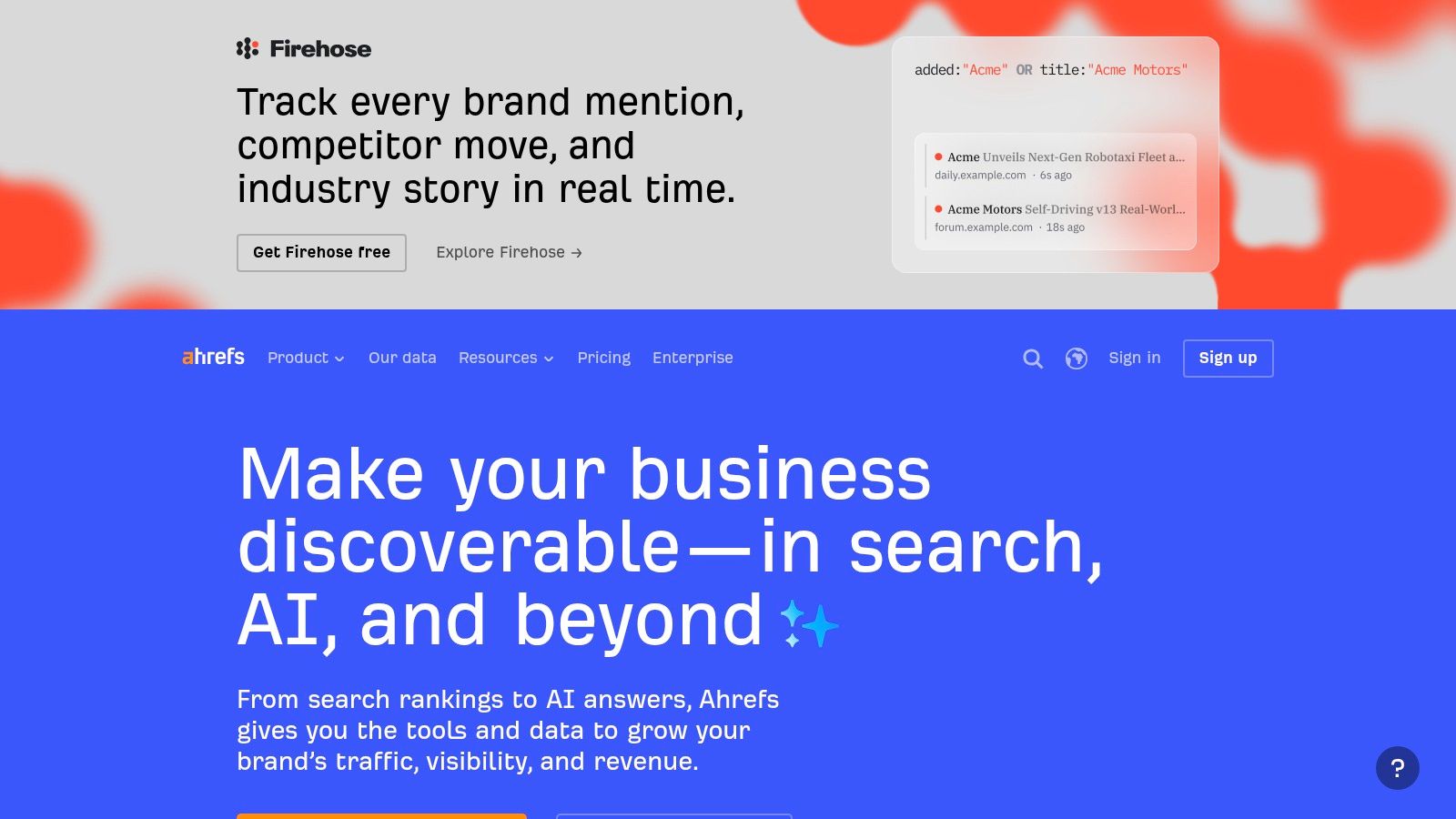
Ahrefs is especially practical for teams patching individual pages. If a service page, category page, or editorial hub is underperforming, the exact URL comparison can reveal whether the page is missing core modifiers, supporting questions, or enough topical coverage to compete. That makes it a good fit for content leads who already know the target page and need the keyword evidence to rebuild it properly. The platform's workflows and templates also help turn a raw gap list into a content plan instead of a pile of terms.
The tradeoff is cost and cadence. Higher limits and more users can push pricing up quickly, and many tiers use a weekly rank update cadence, which can feel slow in volatile niches. For stable markets, that's usually fine. For fast-moving SERPs, it means analysts still need to validate high-priority terms with current search results before they assign work.
Ahrefs in the broader workflow
Ahrefs fits best after you've picked the competitor set and want to vet the terms that deserve pages. It's not trying to be a market-intelligence suite. It's trying to help you see what competitors rank for, qualify it with SERP data, and convert it into content decisions. That makes it especially strong for teams that value clean UX and precise page-level planning more than breadth across every channel.
Use Ahrefs when your gap analysis question is tactical, not sprawling. The tool answers, “What does this page need to compete?” better than many competitors, and that narrow strength is why it still earns its place in serious SEO workflows.
4. Similarweb Keyword Gap and Overlap Analyzer
Similarweb fits teams that need market context around keyword gaps, not only a list of missing terms. Its Keyword Gap Analyzer shows keywords driving traffic to competitors that you do not capture across organic and paid, and it adds traffic share context plus near-real-time freshness windows. That makes it useful for teams that care about how quickly demand shifts, not just which phrases appear in a spreadsheet.
Why Similarweb feels different
The difference starts with scope. Similarweb is built for competitive intelligence, so its value rises when analysts need to understand how missing keywords sit inside a wider traffic picture. The tool compares up to 4 competitors and adds filters for keyword difficulty, intent, and SERP features as described in its product positioning. That gives analysts a market-facing view that is harder to get from classic SEO-only tools.
It also helps when the opportunity comes from a fresher query set. The platform emphasizes 28-day windows for trending keywords, which is useful in categories where demand changes quickly. Enterprise teams can go further with DaaS/API delivery, putting competitive data into internal dashboards and reports without manual exports.
Use it when the business question is broader than rankings. If you need traffic share, fresh trend windows, and paid-plus-organic context, Similarweb gives you a stronger market lens than a pure keyword spreadsheet.
For teams building a larger SEO workflow, the gap view is only one step. Similarweb fits earlier in the process, when analysts are defining the market, checking whether a competitor is winning through content, paid visibility, or both, and deciding which gaps are worth a page-level response. Explore more on SEO competitive intelligence to strengthen your market positioning.
The tradeoff is complexity. Sales-led pricing can vary by seats, coverage, and features, so it is harder to budget for than SMB-first tools. The interface can also feel heavy if the only task is a simple keyword-gap check before a brief goes to content. For enterprise or category-led teams, that extra depth is the point because it supports broader competitive analysis, not just isolated keyword review.
Best use case
Similarweb fits enterprise SEO, competitive intelligence teams, and growth marketers who need to map keyword gaps alongside market share and channel behavior. It works well when leadership wants an answer to, “What are our competitors capturing that we are not?” rather than only, “Which pages should we build next?” That makes it a strong choice for strategy layers above the content calendar.
5. SpyFu Kombat SEO and PPC keyword gap
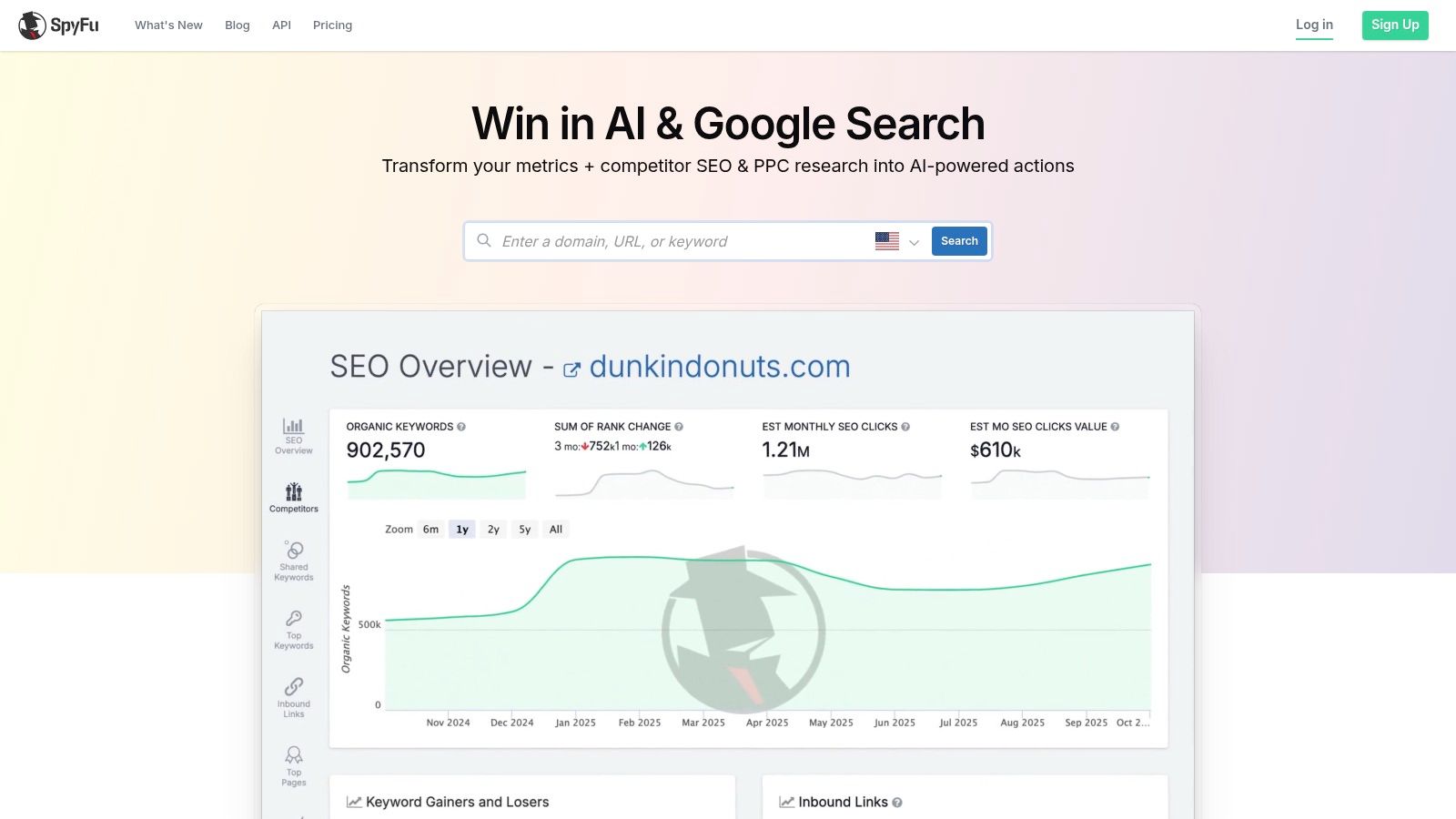
SpyFu is the clearest budget-friendly option for teams that want to unify SEO and PPC keyword gap analysis without paying for a larger suite. Kombat visualizes shared, missing, and exclusive keywords across competitors and your domain for both search and ads. That makes it useful not just for content planning, but for identifying terms that might also work as paid acquisition targets or negative-match candidates.
Why SpyFu is useful for lean teams
SpyFu is strongest when the team wants fast visibility into who owns what. The Kombat view makes overlap easy to scan, and the platform adds historical ad copy and spend estimates so paid teams can judge whether a gap is commercially viable before they build around it. It also supports bulk adds to projects and exports, which helps when an analyst wants to move quickly from discovery to action.
The budget argument is easy to understand. SpyFu is described as very affordable compared with larger suites, and paid plans include unlimited searches. For startups, smaller agencies, and in-house teams that don't need deep enterprise reporting, that lowers the friction of running regular competitor checks. The tradeoff is that the data depth and refresh can trail bigger platforms in some niches and locales, so high-stakes decisions still need validation.
A good way to use SpyFu is as a directional filter. It helps you decide which gaps are worth looking at more closely, especially if you care about paid search as part of the same funnel. It is not trying to replace a deep technical SEO platform. It's trying to make competitive keyword discovery cheap, fast, and easy to repeat.
Best fit
SpyFu fits small agencies, solo consultants, and SMB marketing teams that want one view for SEO and PPC. If your process starts with competitor keyword overlap and then ends in quick briefs or ad tests, SpyFu is efficient. If you need broader site health, deeper backlink analysis, or enterprise reporting, it becomes a supporting tool rather than the center of the workflow.
6. SE Ranking Competitive Research
SE Ranking is the strongest value play for teams that want a practical keyword gap workflow without paying for a heavyweight suite. Its Competitive Research tools reveal the keywords any domain ranks for, in both organic and paid, with filters for intent, KD, CPC, and traffic estimates. That combination gives teams enough signal to prioritize work without drowning in complexity.
SE Ranking for operational gap lists
The platform is especially useful when the task is to generate a usable opportunity list, not just a report. Its knowledge-base guided workflows support automated competitor comparisons, and the API and reporting options make it workable for agencies that want to build internal dashboards or client-facing views. SE Ranking also sits neatly beside rank tracking and site audits, so teams can move from gap discovery into execution without leaving the platform.
That matters for SMBs and agencies because the bottleneck is usually follow-through. A tool can produce hundreds of missing terms, but if the team can't filter by intent, cost, and difficulty, the list won't become a brief. SE Ranking helps turn discovery into a manageable backlog. It is also a good fit for marketers who want a repeated process for finding quick wins and then watching how rank tracking changes after the updates go live.
Best practice: use the filter set to separate terms that are worth a new page from terms that belong in an existing page update.
The caution is administrative. Pricing and plan names have changed recently, so teams need to verify limits before they commit. International and long-tail depth can also vary by market, which means local validation still matters. That said, the price-to-features balance is one of the better ones in the category, especially if you want something your team can learn quickly.
Best fit
SE Ranking is ideal for SMBs, growing agencies, and in-house marketers who need a dependable competitive research tool that doesn't demand a big-suite budget. If your workflow needs practical filtering, reporting, and follow-up tracking more than exhaustive market intelligence, SE Ranking is a smart middle ground.
7. Serpstat Missing Keywords and Competitor Analysis
Serpstat is the best lower-cost option for teams that want missing keyword discovery plus clustering in a single workflow. Its Missing Keywords report compares your page or domain with top-ranking pages and competitors to surface terms you don't rank for, then uses clustering tools to group opportunities by topic. That makes it especially useful when the gap list needs to become a content map quickly.
Serpstat for clustered content planning
The clustering layer is what separates Serpstat from more basic keyword gap tools. A raw missing-keyword list can get messy fast, but Serpstat groups terms by SERP-based similarity, which helps content teams decide whether they need one strong page or several related pages. It also pairs competitor and domain analysis with site audit and rank tracking, so the path from opportunity to execution stays inside one platform.
That kind of workflow works well for budget-minded teams that still need scale. Transparent tiers and generous limits are part of the appeal, and the bulk workflows make it easier to operate at a content-program level rather than a one-page-at-a-time level. If your team is planning new clusters around topic authority, the clustering output is more valuable than a prettier export.
The tradeoff is polish and depth. Interface refinement and data freshness can feel lighter than top-tier suites in some regions, and advanced exports or API quotas vary by plan. That means Serpstat is a practical choice, but not the deepest one, especially if your business depends on very current data in a fast-moving niche.
Best fit
Serpstat works best for budget-conscious SEO teams, smaller agencies, and content operators who need topic clustering as much as keyword discovery. It's a solid choice if your keyword gap workflow feeds directly into content planning and you want a tool that doesn't overcomplicate the handoff.
Top 7 Keyword Gap Tool Comparison
| Tool | Implementation complexity | Resource requirements | Expected outcomes | Ideal use cases | Key advantages |
|---|---|---|---|---|---|
| Nuwtonic | Moderate, connects to GSC and CMS; onboarding for integrations | Credit‑based consumption; affordable starting plans but may need upgrades for heavy multi‑domain use | Audit-to-action execution (auto-fixes, prioritized GSC signals), improved AI citations and schema | SEO agencies, in‑house/content teams, ecommerce/DTC, solo founders needing consolidated automation | Executes fixes (agent-driven CMS pushes), AI+GEO‑first checks, consolidated stack, review-before-deploy controls |
| Semrush, Keyword Gap + SERP Gap Analyzer | Low–Medium, fast setup, many modules and filters | Subscription with add‑ons; pricing tiers and add‑ons can complicate cost | Rapid discovery of missing/weak keywords and prioritized “winnable” queries tied to content actions | Competitive research, content strategy, teams needing integrated keyword/backlink/ad data | Broad suite across SEO/ads/links, SERP Gap prioritization, rich filters and reporting |
| Ahrefs, Content Gap | Low, straightforward workflows integrated with Site Explorer and Keywords Explorer | Subscription can get costly at higher limits; tiered usage and user limits | Clear domain/URL gap discovery with strong SERP/link vetting for content planning | Content teams focused on URL-level fixes and SERP qualification | Strong link and SERP data, clean UX, robust keyword/URL qualification |
| Similarweb, Keyword Gap and Overlap Analyzer | Medium–High, enterprise focus, API/DaaS setup | Sales‑led pricing; enterprise budgets often required for broad coverage | Market‑level competitive insights with near‑real‑time trending and traffic‑share context | Enterprise competitive intelligence, market analysis, product/market teams | Fresh trend windows, traffic‑share context, enterprise data delivery and APIs |
| SpyFu, Kombat (SEO & PPC keyword gap) | Low, simple, visual interface | Budget‑friendly subscriptions; generous limits on paid plans | Fast identification of SEO/PPC overlaps, gaps, and negative‑match opportunities | SMBs, PPC+SEO unified strategy, budget‑conscious marketers | Affordable, easy to learn, unified SEO+PPC gap views with historical ad data |
| SE Ranking, Competitive Research (Keyword Gap) | Low, guided workflows and quick setup | Good price-to-features for SMBs/agencies; API and reporting options | Quick gap lists and actionable quick‑win opportunities with rank tracking | Agencies and SMBs operationalizing gap-to-execution workflows | Cost‑effective, API/reporting for dashboards, easy to operationalize |
| Serpstat, Missing Keywords + Competitor Analysis | Low–Medium, includes clustering and bulk workflows | Transparent lower‑cost tiers with generous limits for growing teams | Missing keyword discovery plus topic clustering for scalable content planning | Budget teams scaling content production and gap-driven planning | Keyword clustering, bulk workflows, clear pricing tiers |
From Analysis to Action Choosing the Right Tool
Every tool on this list can surface valuable gaps. The difference is what happens after the list appears. Some platforms are strongest at discovery, some at SERP qualification, and a few, like Nuwtonic, are built to connect the analysis directly to fixes, content production, and AI visibility monitoring in the same workspace.
If your team needs a broad competitive suite, Semrush is still one of the cleanest choices for multi-domain discovery and workflow breadth. If your analysts care most about page-level precision and SERP vetting, Ahrefs remains a strong fit. If you want market-level context or fresh competitive intelligence, Similarweb is the most strategic option. If budget and speed matter more, SpyFu, SE Ranking, and Serpstat each solve a different version of the same problem without forcing a larger enterprise commitment.
The most important question is not which tool can find the most missing keywords. It's which tool fits the way your team works. A keyword gap list that never becomes a brief, a page, or a deployed fix doesn't create traffic. A tool that helps your team move from competitor comparison to clustered content to measurable action does.
If your workflow already includes Google Search Console, content operations, and AI visibility, start with Nuwtonic. It's built to find the gaps, rank the fixes, and help you ship the work without stitching together five separate systems.
If keyword gap analysis is already part of your SEO roadmap, Nuwtonic gives you a faster way to turn missing terms into published fixes. Visit Nuwtonic to see how its GSC-connected gap analysis, AI citation tracking, and reviewable CMS-ready actions fit into one workflow.