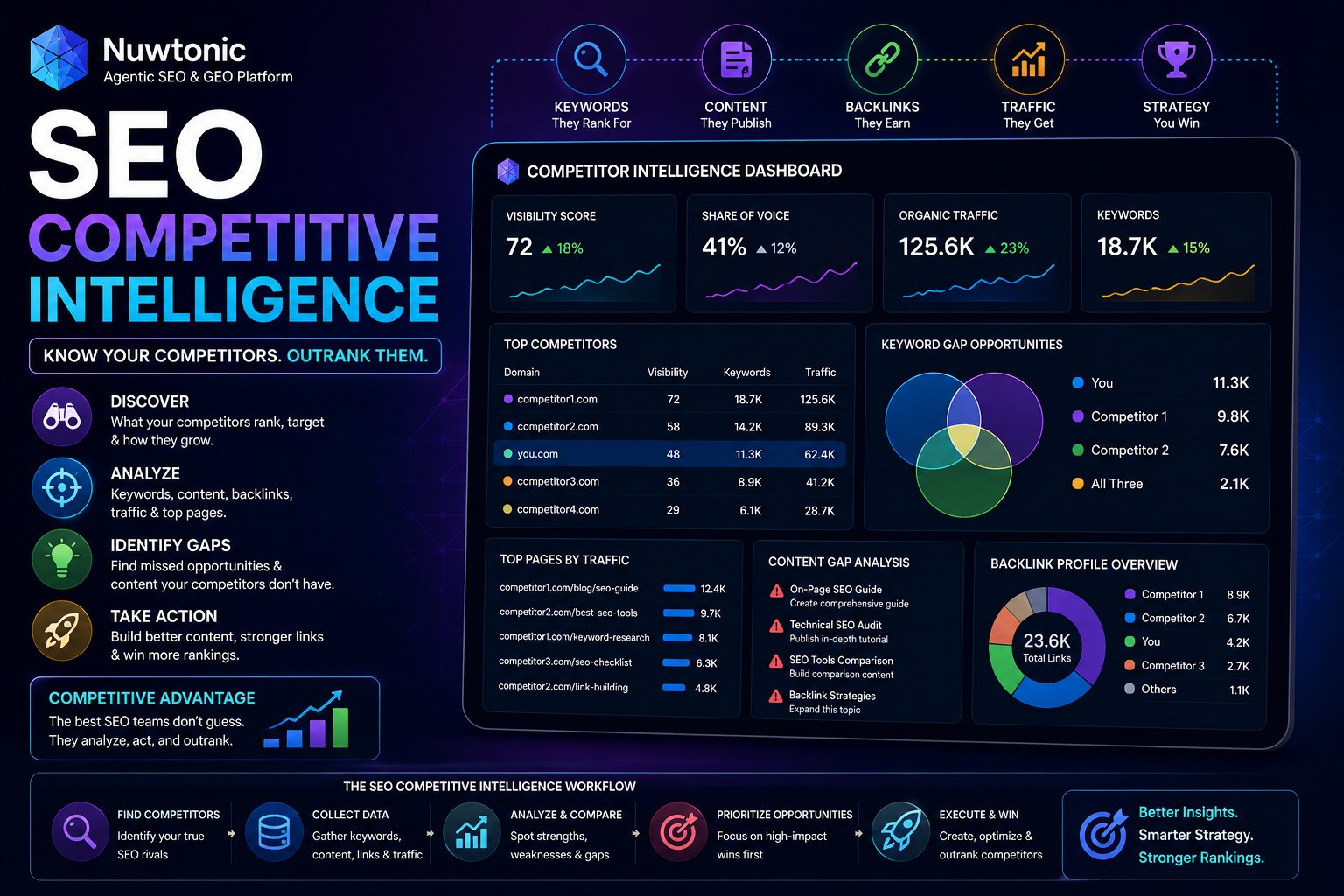
Your competitor keeps showing up for the queries that should be sending buyers to you. Their category page ranks. Their comparison page gets the click. Their brand is cited in AI answers while your better page gets ignored. Your team exports a few reports, highlights some keyword gaps, and then nothing meaningful ships.
That failure usually isn't in the analysis. It's in the handoff.
Most SEO teams already collect more competitive data than they can act on. A key problem is turning that data into a queue of specific, reviewable fixes that improve rankings, recover decaying pages, and close AI citation gaps. That's where SEO competitive intelligence stops being a dashboard exercise and starts becoming a market-share function.
In a market this large, passive monitoring is expensive. The SEO market was valued at USD 89.1 billion in 2024 and is projected to reach USD 143.9 billion by 2030. Retainer and subscription models accounted for 61.95% of 2025 revenue, which signals that businesses are investing in continuous competitive monitoring rather than one-off audits, according to Research and Markets' SEO market analysis.
Table of Contents
- Introduction From Insight to Impact
- Redefining SEO Competitive Intelligence
- The Three Pillars of Competitive Data
- A Repeatable Methodology for Discovery and Action
- Competitive Intelligence in Action Real World Scenarios
- Operationalizing Your Strategy with an Execution Layer
- Frequently Asked Questions
Introduction From Insight to Impact
Competitor data is often treated as a reading exercise. They inspect rankings, copy a few topics into a content plan, and hope momentum follows. It usually doesn't, because the useful question isn't "What does the competitor rank for?" The useful question is "What are they doing that creates durable visibility, and what can we change on our side this week to weaken that advantage?"
That's the difference between observation and offense.
SEO competitive intelligence works when it behaves like a continuous operating system for search decisions. It should tell you where a rival is overextended, where they have structural advantages, where your pages are decaying faster than theirs, and where AI systems treat their URLs as primary sources while excluding yours. If it can't produce actions at URL level, it's just reporting.
Three trade-offs shape the work:
- Breadth vs. precision: Tracking everything across every competitor feels thorough, but it blurs priority. Focus on the competitors who intercept your high-intent journeys.
- Data volume vs. decision quality: More exports don't improve strategy. Better filters do.
- Insight vs. execution: A clean deck doesn't recover traffic. Revised pages, schema updates, internal linking changes, and authority reinforcement do.
Practical rule: If a competitive insight doesn't resolve into a page, cluster, or technical fix, it shouldn't enter the sprint.
The strongest teams don't separate competitive research from content operations, technical SEO, and AI visibility work. They connect them. A competitor's category page isn't just "ranking well." It may have stronger entity coverage, a clearer intent match, better structural markup, and less click decay over time. An AI citation gap isn't just a branding issue. It's often a page architecture issue, a source clarity issue, or a weak URL-level authority issue.
That shift matters because search has become two systems at once. One is the traditional SERP. The other is answer generation. SEO competitive intelligence has to address both if you want to reclaim market share instead of just documenting why you lost it.
Redefining SEO Competitive Intelligence
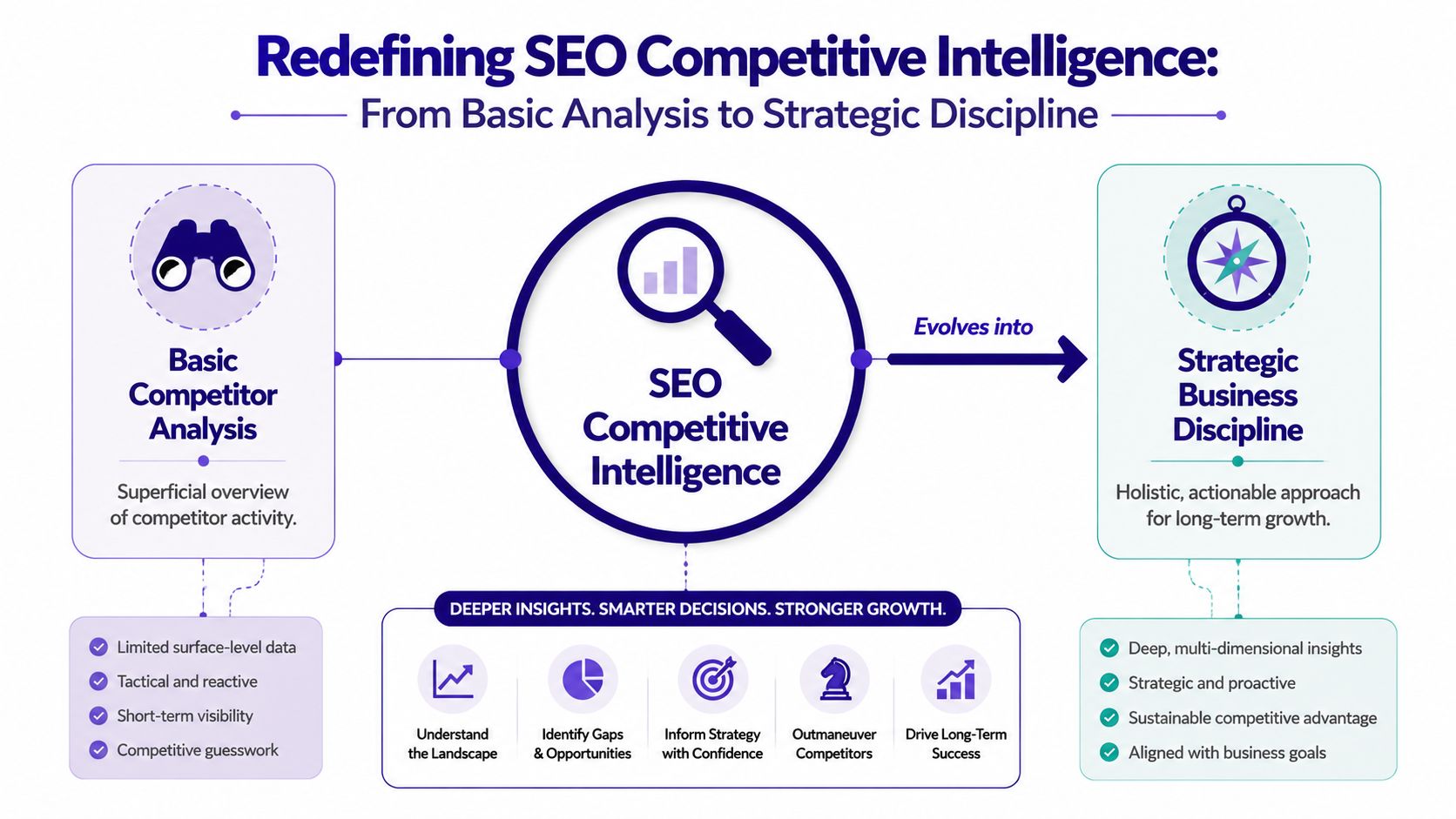
Most companies still define competitive SEO too narrowly. They compare a handful of domains, look at overlapping keywords, maybe scan backlinks, and call that intelligence. It isn't. That's a partial dataset with no business model for action.
Why rank tracking is not intelligence
Rank tracking tells you where you stand. Intelligence tells you why the gap exists, whether it's stable, and whether it's worth attacking.
A competitor analysis spreadsheet usually misses four things:
- Intent asymmetry: You and your competitor may target the same phrase with different page types. Only one matches what searchers want.
- Structural differences: Headings, schema, internal links, and page organization often explain visibility more than copy length.
- Decay patterns: A ranking snapshot hides whether the competitor's page is stable or slipping.
- AI source selection: Traditional tools can show rankings without showing whether LLMs cite the URL.
The market is moving toward that broader definition. The market for Competitive Intelligence Tools was valued at USD 6.63 billion in 2024 and is projected to grow to USD 15.45 billion by 2034, with an 8.82% CAGR, driven by the need to analyze competitor keyword strategies, domain analytics, and backlink profiles to uncover market weaknesses, according to Market Research Future's competitive intelligence tools report.
What the discipline actually covers
Effective SEO competitive intelligence sits across three business layers.
| Layer | What you inspect | Why it matters |
|---|---|---|
| Market layer | Which domains own core demand, which topics they're expanding into, which journeys they intercept | Reveals where share is shifting |
| Page layer | Which URLs win, lose, or hold over time | Shows where to build patches instead of broad campaigns |
| Execution layer | Which fixes can actually ship through your CMS and workflow | Separates analysis from results |
The missing piece in most programs is the third row.
A competitor isn't one domain. It's a set of winning pages, repeated patterns, and operational habits.
A mature program asks different questions from a basic SEO audit. Not "Which keywords are they ranking for?" but "Which non-brand, high-intent clusters are they holding in top positions, how much effort did they put into those pages, and where are they vulnerable?" That last point matters. Competitive work has to assess the actual effort behind the ranking page. Some competitors rank because they built deep, high-quality assets. Others rank with thin execution and a temporary advantage. Those are not the same battle.
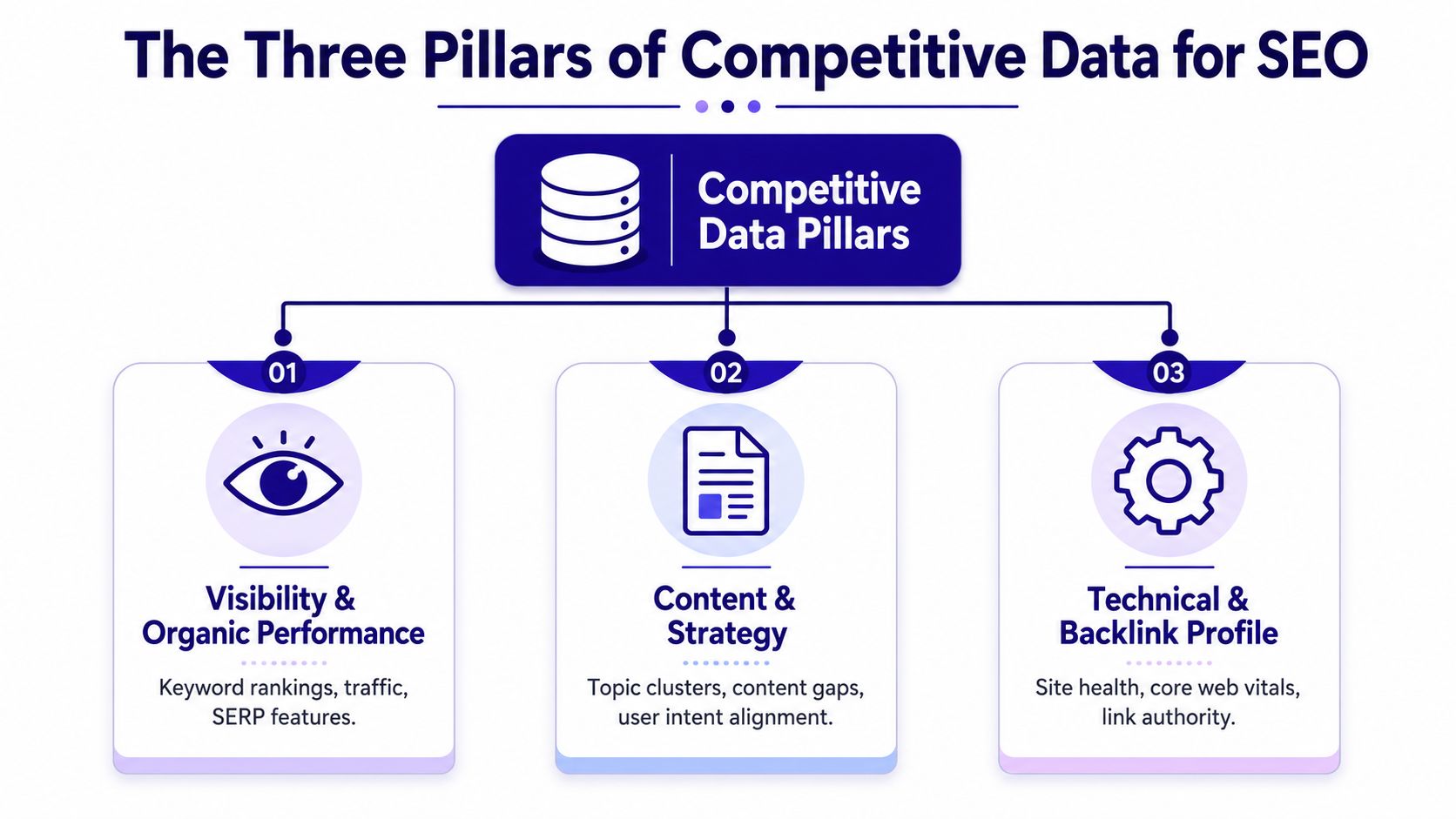
The Three Pillars of Competitive Data
Useful competitive analysis rests on three data pillars. Think of them as three lenses on the same battlefield. One shows where you're absent. One shows whether the opportunity is durable. One shows whether AI systems trust the competitor more than they trust you.
Pillar one SERP gap density
SERP gap density measures how many relevant, high-intent queries a competitor ranks for that your domain doesn't. This is more useful than a raw keyword-gap export because it forces qualification. You care about gaps tied to buying journeys, problem-aware searches, and commercially meaningful comparisons. You don't care about every informational phrase in the index.
A practical workflow is to filter for competitor terms where they rank strongly, remove brand terms, and limit the set to difficulty ranges your team can realistically attack. For a hands-on way to operationalize that process, review a structured competitor gap workflow that focuses on actionable overlap instead of vanity lists.
Pillar two Click-decay velocity
Click-decay velocity shows whether a winning competitor page is holding attention and visibility or slowly giving ground. This is one of the most underused signals in SEO competitive intelligence. A page can still rank while gradually weakening.
The most valuable setup is when a competitor ranks for 120+ high-intent keywords that your domain lacks, creating a SERP gap density of more than 15%, and those pages show a click-decay rate below 5% over 30 days. That combination points to a stable, high-value opportunity. Addressing those gaps can produce a 22% to 35% increase in organic traffic within 90 days, according to seoClarity's competitive intelligence workflow.
What that means in practice:
- High gap density: The competitor owns a meaningful cluster, not a random keyword scatter.
- Low click decay: Their page isn't winning by accident. Search engines continue to trust it.
- Patchable opportunity: If your content and structure are weaker but your authority is comparable, the gap is attackable.
Stable competitor pages deserve more attention than flashy new pages. They reveal what the search engine keeps rewarding.
Pillar three GEO citation differentials
GEO citation differentials measure how often AI systems cite competitor URLs versus yours for a topic cluster. This is not the same as brand mentions. Citation at URL level is stronger because it shows source preference.
Track this at entity-cluster level. For example, if competitors are cited on pages tied to a product category, use case, or comparison topic, inspect what those URLs have in common. Usually it's a combination of clear entity framing, machine-readable structure, and content that answers the query directly without forcing interpretation.
A simple decision matrix helps:
- Traditional SERP gap + no AI gap: Prioritize ranking fixes first.
- Traditional SERP gap + AI gap: Build a combined page and structured data response.
- No SERP gap + AI gap: The issue is often source formatting, schema clarity, or weak entity alignment.
- No SERP gap + no AI gap: Leave it alone unless conversion data says otherwise.
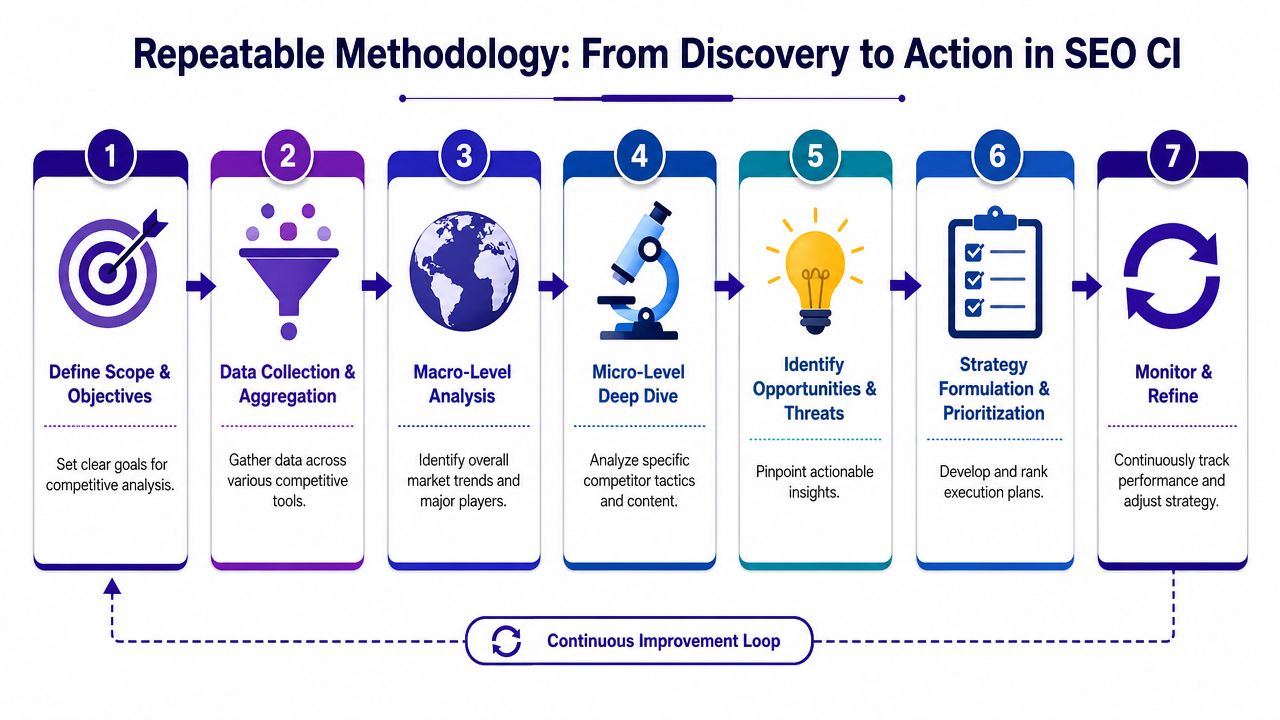
A Repeatable Methodology for Discovery and Action
Most workflows break because they stop at diagnosis. A usable methodology has to move from market view to URL decisions, then into edits that can ship.
Start with the operating model below.
Step one Strategic gap mapping
Build your first pass around journeys, not isolated keywords. Segment the market into commercial pages, comparison pages, use-case pages, and educational pages that support conversion. Then map which competitors dominate each layer.
Don't score every topic equally. Weight clusters by business relevance, existing authority, and evidence that the competitor's page is doing real work. A page ranking with weak depth and poor UX is a different opportunity from a page supported by strong links, sharp internal architecture, and entity-rich copy.
Use this simple review frame:
- Find the cluster owner: Which domain consistently appears across the set?
- Inspect the ranking asset: Which page type wins?
- Judge the effort level: Is the page genuinely strong or just present?
- Assign the attack type: New page, patch existing page, consolidate duplicates, or strengthen internal support.
Teams often overproduce net-new content here. That's a mistake. If you already have a page near the intent, patching is usually faster than publishing another URL and creating cannibalization risk.
A useful walk-through of the overall process sits below.
Step two Click-decay recovery
Competitive intelligence isn't only about pages you don't have. It's also about pages you have that are losing to rivals.
Run a decay review on your existing winners and near-winners. The point is to catch pages where the competitor's asset has become more current, more complete, or easier for search systems to parse. That doesn't always mean rewriting the whole page. Often it means one of these targeted patches:
- Intent correction: Rewrite the intro and subheads so the page answers the actual query faster.
- Structural cleanup: Improve headings, FAQs, schema, comparison tables, and page flow.
- Evidence upgrade: Add fresher examples, clearer definitions, and supporting sections that cover missing entities.
- Internal link reinforcement: Route authority from adjacent cluster pages with better anchor discipline.
Treat decaying pages like assets underperforming in a portfolio. Some need a refresh. Some need consolidation. A few need retirement.
Step three AI citation audits and remediation
Most traditional SEO programs fall short. They can tell you a competitor ranks. They can't tell you why AI answers keep citing that competitor's URL instead of yours.
A high-risk pattern is when a competitor holds 65% of unique AI citations for an entity cluster while your domain holds under 20%. That gap is a leading indicator of 40% potential share-of-voice loss in the next 6 months. Implementing entity-rich content and structured data can trigger a 30% higher inclusion rate in LLM-generated answers, based on MCP Market's GEO competitor intelligence guidance.
Your remediation sequence should be strict:
| Audit item | What to inspect | Typical fix |
|---|---|---|
| URL citation presence | Which exact URLs appear in AI answers | Strengthen or replace weak target URLs |
| Entity clarity | Whether the page clearly defines product, category, use case, and related concepts | Rewrite for explicit entity coverage |
| Structured data alignment | Whether schema supports the page's primary purpose | Add or refine relevant markup |
| Sourceworthiness | Whether the page reads like an original source or a thin summary | Add primary explanations, unique comparisons, and clear attribution structure |
| Cluster support | Whether adjacent pages reinforce the same topic | Build supporting internal links and related assets |
A citation audit should always end with deployable changes. If the output is "monitor mentions," the process is unfinished.
Competitive Intelligence in Action Real World Scenarios
Methodologies get clearer when you pressure-test them against actual situations. Two scenarios show where teams usually waste time, and where the framework provides an advantage.
Scenario one Ecommerce category erosion
An ecommerce brand sees category traffic flatten while a competitor steadily captures category and subcategory intent. The immediate temptation is to publish more blog content. That's usually the wrong move.
The better sequence starts with category-level gap mapping. Inspect which non-brand, high-intent category terms the competitor owns, which ranking pages support those terms, and whether the competitor's page quality justifies the position. Then review your equivalent URLs for weak product faceting, thin descriptive copy, poor entity signals, and weak internal links from buying guides or brand pages.
The content patch plan often looks like this:
- Tighten category intent: Make the page resolve shopper questions quickly, not just list products.
- Expand structural relevance: Add useful sectioning, comparison content, and machine-readable markup where appropriate.
- Repair support pages: Link from guides, FAQs, and collections that reinforce the category's authority.
- Refresh pages losing momentum: Use decay analysis to update pages that were once competitive.
Teams that also run paid acquisition can combine this with adjacent channel review. A useful companion process is structured PPC competitor research, especially when organic losses mirror rival moves in commercial messaging.
Scenario two B2B SaaS AI answer invisibility
A B2B SaaS company may still rank for some solution keywords yet remain invisible in AI-generated vendor discovery answers. That's a different problem. The domain has search presence, but not source preference.
The fix starts by testing prompts tied to pain points, use cases, and comparison language. Then document which competitor URLs receive citations, what those pages contain, and how clearly they define the category, problem, and solution. In many cases, the winning competitor page isn't longer. It's cleaner. It answers directly, uses stronger entity framing, and presents information in a way machines can extract without ambiguity.
The patching process is usually operational, not philosophical:
- Rework core solution pages so each URL owns one clear entity and intent.
- Add supporting comparison and use-case pages that connect naturally to the core page.
- Tighten headings and summary blocks so the answer is explicit near the top.
- Ensure structured data and internal links support the exact topical cluster.
The important lesson is that visibility loss can happen without an obvious ranking collapse. If your team only watches keyword positions, you'll miss it.
Operationalizing Your Strategy with an Execution Layer
The most common failure in competitive intelligence is simple. The report lands, everyone agrees with it, and the work dies in a backlog.

Why reports stall
Static reports create three operational problems.
First, they mix observations with recommendations but don't produce implementation objects. Editors need briefs. SEO leads need priority. Developers need scoped fixes. A slide deck helps none of them.
Second, AI visibility is often not treated as a repair workflow. A critical underserved angle in the market is the lack of execution-layer frameworks for AI-search competitive intelligence. 78% of SEO teams still treat competitive reports as static deliverables rather than triggers for agent-driven content patches. That's expensive when 42% of traffic declines now stem from missing AI citations, a metric traditional frameworks rarely track.
Third, ownership gets fuzzy. The content team assumes technical SEO will handle it. Technical SEO assumes content will rewrite the page. No one owns the citation gap end to end.
Insight without a deployment path isn't strategy. It's documentation.
What an execution layer changes
An execution layer converts findings into reviewable actions with clear owners, priority, and deployment paths. In practice, that means your system should do four things well:
- Rank issues by likely impact: Pull from search performance, page context, and competitor movement instead of creating flat task lists.
- Translate findings into page-level fixes: "Improve authority" is useless. "Add entity summary, repair schema, revise comparison block, add supporting internal links" is actionable.
- Support review before deployment: Competitive fixes affect important pages. Teams need previews, approvals, and change control.
- Close the loop after release: If the patch ships, the system should monitor whether rankings, clicks, and citations change.
Some teams assemble this with separate tools and project management layers. Others use an integrated workspace. One example is Nuwtonic, which connects with Google Search Console, surfaces ranked issues, tracks competitor gaps and AI citation opportunities, and supports reviewable fixes through agent-driven workflows. The practical point isn't the vendor. It's the operating model. Your competitive intelligence process needs to end in shipped updates, not exported spreadsheets. A stronger reporting workflow also helps teams keep those actions visible across stakeholders, especially when paired with disciplined SEO dashboard reporting.
Frequently Asked Questions
How do I measure competitor gaps in AI-driven SERPs beyond traditional keyword overlap
Track prompts, citations, and URL-level source selection. Keyword overlap only shows where a competitor ranks in classic search. It doesn't show whether AI systems choose their pages as sources.
This is urgent because 36% of B2B SaaS buyers now use AI search for vendor discovery, while 65% of agencies lack tools to map topical authority in AI answers. The practical requirement is tracking prompt decay and LLM citation visibility. Prompt decay means monitoring whether your brand's presence weakens across repeated prompt sets over time. Citation visibility means tracking which exact URLs AI systems cite for each entity cluster.
A usable audit includes prompt sets by funnel stage, cited URL logs, citation frequency by topic, and a remediation queue tied to specific pages.
How do I estimate the effort required to close a competitor gap
Judge the effort on three dimensions. First, how much work did the competitor put into the page. Second, how close you already are with existing assets. Third, whether the gap is content, technical structure, authority, or all three.
If the competitor ranks with shallow execution, a targeted patch can be enough. If they own the topic with a deep cluster and strong page relationships, you're not closing that gap with one article. This is why effort assessment matters more than raw opportunity size.
A useful internal rule is to classify every gap as patch, rebuild, cluster expansion, or defer.
How often should I run SEO competitive intelligence
Run light monitoring continuously and deeper reviews on a fixed cadence. Competitive intelligence breaks when teams treat it like an annual audit.
At minimum, watch for changes in core competitors, decaying pages, and AI citations on your priority clusters. Then schedule deeper reviews that reassess which domains matter, which pages are slipping, and which opportunities remain worth pursuing. Frequency matters less than continuity. The program has to live inside normal publishing and optimization cycles.
What usually fails in competitive intelligence programs
Three things fail most often:
- They track too much: Teams drown in exports and lose focus on high-value clusters.
- They ignore execution effort: They chase opportunities without estimating what it'll take to win.
- They stop at insight: No one converts findings into approved edits, technical fixes, or content patches.
The teams that get value from SEO competitive intelligence make it operational. They don't admire the gap. They close it.
If you want one workspace that ties competitor gap mapping, click-decay detection, AI citation visibility, technical fixes, and review-before-deploy content updates together, explore Nuwtonic. It fits teams that need competitive intelligence to produce shipped changes, not just reports.