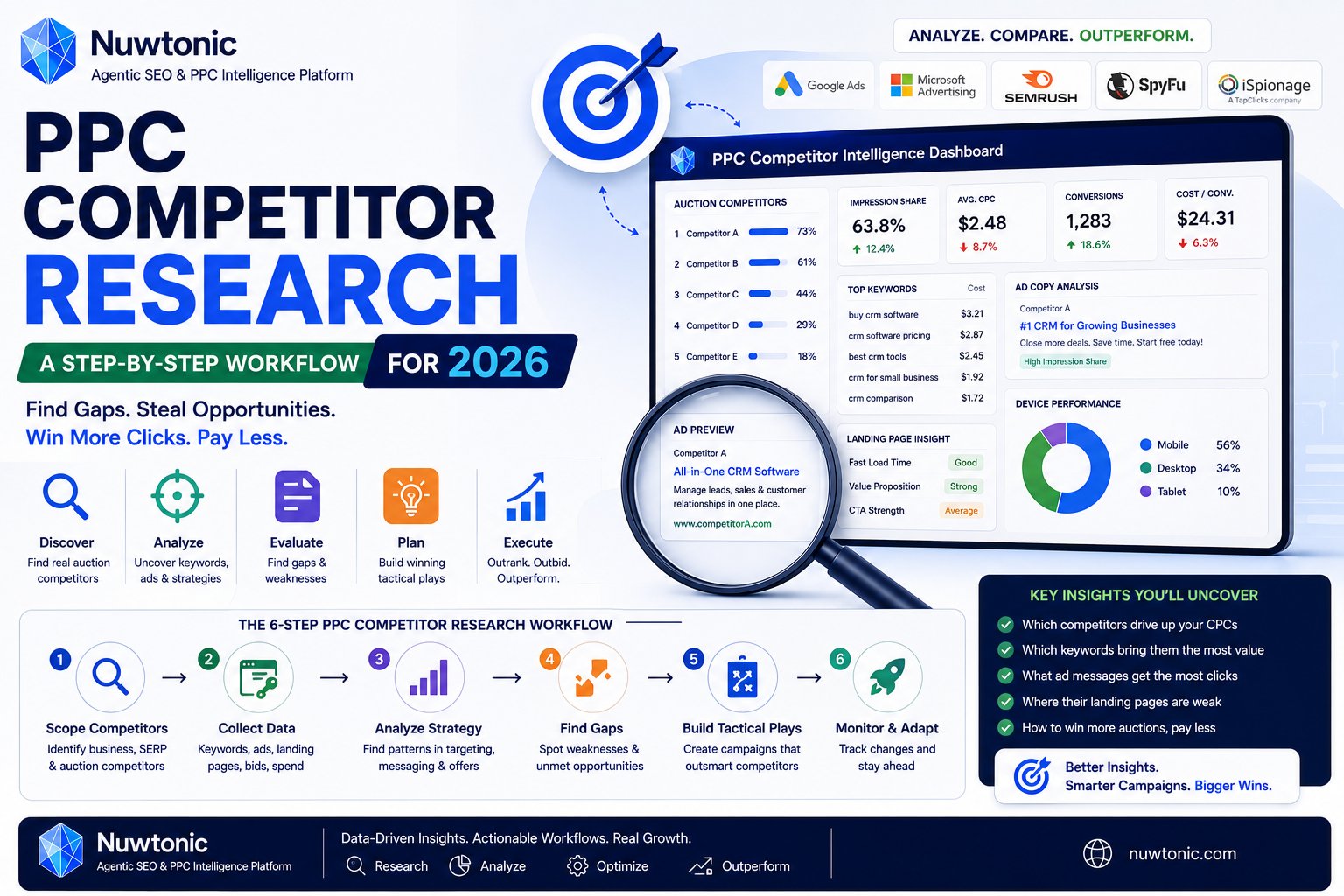
Most advice on PPC competitor research is shallow. It tells you to pull a list of competitor keywords, swipe a few headlines, and call it competitive intelligence. That workflow creates lookalike campaigns, not an advantage.
Useful PPC competitor research starts where popular advice usually stops. You need to identify who pressures your auctions, separate paid behavior from organic strength, and look at device-specific intent before you touch bids or ad copy. If you skip those layers, you end up reacting to noise, copying weak tactics, and spending more to learn less.
Table of Contents
- Scoping Your True PPC Competitors Not Just Your SEO Rivals
- The Modern PPC Analyst's Toolkit and Data Sources
- Deconstructing Competitor Strategy Key Metrics to Capture
- From Analysis to Action Tactical Plays to Exploit Gaps
- Establishing a Repeatable Monitoring Cadence
- PPC Competitor Research FAQ
- What if I'm in a niche market and there isn't much visible competitor data
- What's the best free or low-cost approach
- Should I bid on a competitor's brand name
- How many competitors should I monitor closely
- What's the biggest waste of time in PPC competitor research
- How do I know whether to react now or wait
Scoping Your True PPC Competitors Not Just Your SEO Rivals
The first mistake teams make is assuming their SEO rivals are their PPC rivals. Sometimes they overlap. Often they don't.
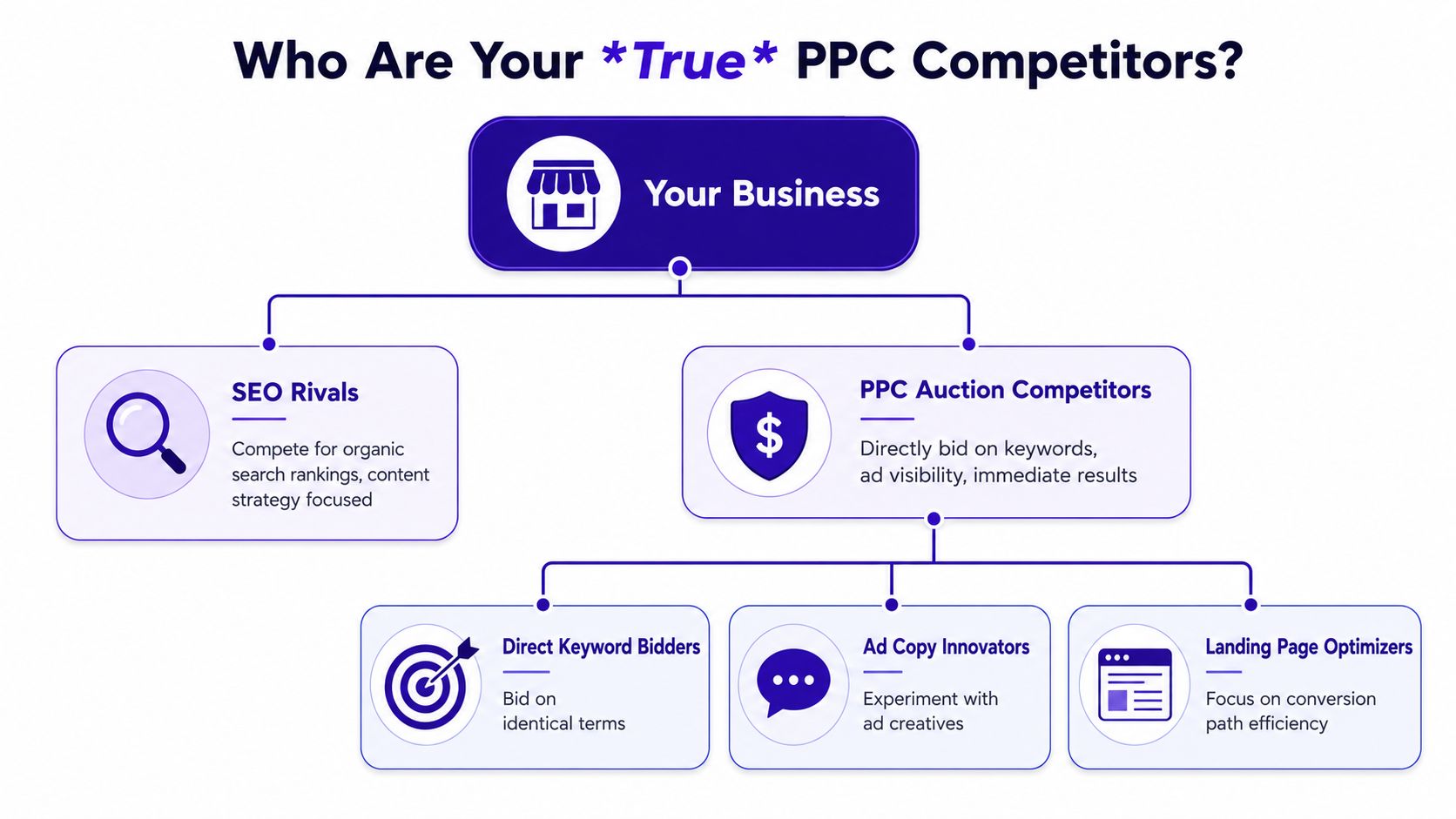
A company can dominate organic rankings and barely show up in paid search. Another can be invisible in SEO and still drive your CPCs up because they bid aggressively on your commercial terms. That's why I split the field into three buckets: business competitors, SERP competitors, and auction competitors. PPC competitor research only gets useful when you know which bucket you're looking at.
Separate the three rival types
Business competitors are the companies your sales team talks about. They sell a similar product, target a similar buyer, and show up in deal cycles.
SERP competitors are whoever owns attention on the search results page. Publishers, review sites, marketplaces, affiliates, and software directories often sit here. They may never close the same customer you want, but they can block your path to demand.
Auction competitors are the ones that matter most for paid search execution. They are the advertisers repeatedly entering the same auctions, forcing trade-offs on bids, impression share, and visibility.
Here's the practical test:
| Rival type | What they compete for | Why it matters |
|---|---|---|
| Business competitor | Revenue and accounts | Helps with positioning and offer strategy |
| SERP competitor | Search attention | Explains who intercepts intent before the click |
| Auction competitor | Paid visibility | Directly affects CPC pressure and ad exposure |
Build the right competitor list
Start with your own keyword clusters, not your homepage category labels. Search your highest-intent queries manually, review your paid search data, then build a list of recurring advertisers and recurring organic interceptors. You want to know who appears consistently across your money terms, not who feels like a competitor in a boardroom slide deck.
Practical rule: If a company never shows up in your critical auctions, it doesn't belong at the top of your PPC research queue.
Many teams waste time. They chase the largest brand in the category because that brand is famous, while a quieter specialist keeps taking the auction inventory that converts.
Look at organic strength with paid intent
The underused move is checking how a competitor's organic footprint changes their paid posture. A competitor with strong organic visibility can be far more selective in paid search. They don't have to buy every click. They can let SEO pre-qualify the user, then deploy paid only where intent is sharpest.
That pattern matters because it changes how you interpret their aggression. A projected 2026 trend says 68% of top SaaS competitors use organic SEO to pre-qualify traffic before adding paid spend, reducing effective CPC by 25 to 30%, according to Adthena's PPC competitor analysis guide.
If you're only studying paid keywords, you'll miss why they can afford to stay present on expensive terms. Their economics aren't the same as yours.
What actually belongs in your scoped list
Keep the working list short and tiered:
- Tier one rivals are repeated auction opponents on your highest-intent terms.
- Tier two rivals overlap on adjacent commercial queries or show signs of expansion.
- Tier three rivals are content-heavy SERP occupiers that shape the funnel before paid demand forms.
That model keeps your analysis honest. You're no longer asking, "Who competes with us?" You're asking, "Who changes our paid search outcomes, and why?"
The Modern PPC Analyst's Toolkit and Data Sources
Good competitor analysis falls apart when the data stack is messy. Teams grab screenshots from five tools, paste them into a deck, and end with observations they can't verify later. The fix is simple. Give each tool one job.
The fundamental starting point is Google Ads Auction Insights. It shows direct auction pressure from advertisers colliding with you. Third-party tools add history, scale, and context, but they should not replace auction data from your own account.

Use each source for one distinct purpose
Here's the stack I trust:
- Google Ads Auction Insights for live competitive overlap. ReportGarden notes that Auction Insights gives you impression share overlap, often 30 to 60% among direct competitors, plus average position differences and outranking share. That's your clearest signal of who is pressing your account.
- SpyFu for historical paid keyword behavior and ad copy persistence.
- Semrush or Ahrefs for broader keyword overlap, landing page patterns, and market scanning.
- Google Ads Transparency Center for active ad visibility.
- Meta Ad Library if the same competitors run coordinated cross-channel offers.
- Wayback Machine for historical landing page changes. This one is overlooked and useful. If a page has changed repeatedly, the offer probably matters.
One platform can also reduce spreadsheet sprawl. Nuwtonic has a competitor intelligence module that maps SERP gaps, click-decay signals, and content patch opportunities in one workspace. If your team already blends SEO and paid decisions, that kind of shared view is practical, especially when paired with upstream query discovery from a guide on how to do keyword research.
What to pull first and what to ignore
Don't start with estimated ad spend. Those estimates can be directionally interesting, but they're rarely the first lever to pull. Start with direct auction evidence, repeated keyword presence, and copy changes over time.
Use this order instead:
- Pull Auction Insights for your top campaigns and ad groups.
- Export competitor keyword overlap from one third-party tool.
- Capture active ads and compare messaging by funnel stage.
- Review landing pages for friction, offer structure, and mobile treatment.
- Archive everything with dates. Competitor research without timestamps turns into folklore.
The point isn't to know everything competitors are doing. It's to know which few behaviors change your own account decisions.
The wasteful version of this workflow
A lot of teams over-collect. They build giant swipe files of ads they'll never operationalize. They track every competitor in every region. They pull vanity screenshots without noting which query triggered the ad.
That work feels thorough, but it doesn't support action. A lean system is better. One trusted auction source. One historical ad source. One landing page review process. One shared place to store findings.
When the tooling has clear roles, PPC competitor research stops being a research hobby and starts behaving like an operating system.
Deconstructing Competitor Strategy Key Metrics to Capture
Once you've scoped the right competitors, stop thinking in terms of "their keywords" as if that tells the whole story. A PPC account is a stack of decisions. Keywords are only the top layer.
I break competitor review into five layers: keyword posture, ad copy, landing page design, spend proxies, and device intent signals. If you miss any one of those, you usually misread why they're winning.
Keywords and bidding posture
Keyword capture should focus on movement, not just overlap. A static list won't tell you much. You want to know where a competitor appears repeatedly, where they suddenly expand, and where they stop showing up.
Track these patterns:
- Core commercial terms that appear week after week
- Brand conquest terms if they're targeting competitor names
- Newly visible queries that suggest expansion into adjacent use cases
- Dropped terms that may signal weak performance or budget pullback
Don't obsess over collecting every keyword variant. Group them by intent. Compare pricing terms against demo terms, alternatives terms, problem-aware terms, and location-led terms. That framing shows strategy. A raw export does not.
Ad copy patterns that reveal strategy
Only noting headlines is too shallow. Good ad copy analysis asks what belief the ad is trying to install before the click.
Read their ads for these signals:
| Signal | What it usually means |
|---|---|
| Heavy trust language | They need to reduce perceived risk |
| Price-led hooks | They are competing in a commoditized lane |
| Feature-led headlines | They assume users are comparing options |
| Urgency and offer language | They are pushing short-window conversion behavior |
| Integration or compatibility mentions | They know the buyer already has context |
Capture repeated CTAs too. "Book demo" attracts a different click than "See pricing" or "Find a location." Repetition usually means the advertiser has learned which commitment level they want at that stage.
Landing page clues people skip
A competitor can run average ads and still beat you with stronger post-click alignment. That's why I always inspect the landing page manually on both desktop and mobile.
Check for:
- Message match between query, ad, and page headline
- Conversion path length and whether the form asks too much too early
- Mobile usability including speed, layout compression, and tap targets
- Proof architecture such as testimonials, logos, comparisons, or guarantees
- Offer clarity so the visitor knows what happens next
If the ad promises a comparison and the page opens with generic brand messaging, that's a gap. If the ad sounds local and the page feels national and vague, that's a gap too.
Spend proxies and pressure signals
You don't need perfect spend estimates to infer seriousness. Use proxy signals instead. Auction pressure, persistent presence, premium query coverage, and dedicated landing pages all suggest meaningful intent.
The mistake is treating all visibility the same. A competitor that appears sporadically with generic copy is very different from one that stays present on the same queries with evolving creative and customized pages.
Strong competitors don't just bid on terms. They keep refining the path from keyword to click to conversion.
Device intent is where lazy competitors expose themselves
This is the easiest gap to miss and one of the most useful. Most competitors use identical ad copy for mobile and desktop, even though CPC differences can exceed 40% for intent-rich keywords, according to SpyFu's analysis of PPC competitor behavior.
That matters because user intent shifts by device. Mobile users often want speed, location, and immediate clarity. Desktop users are more willing to compare, evaluate, and read deeper. If a competitor uses one message for both, they're leaving room for a sharper advertiser to take the click with better alignment.
I treat this as a required field in modern PPC competitor research. For every important rival, capture:
- Mobile ad framing and whether it prioritizes immediacy
- Desktop ad framing and whether it supports comparison behavior
- Device-specific landing page differences, if any
- Mobile versus desktop ranking and visibility gaps in your own environment
If your team is already tracking AI and search visibility across interfaces, a toolset built for that overlap can help. For example, this roundup of AI visibility tracking tools is useful when you want a broader view of how device behavior and search surfaces intersect.
The key judgment call is simple. When a competitor looks advanced at the keyword layer but lazy at the device layer, don't copy them. Attack the mismatch.
From Analysis to Action Tactical Plays to Exploit Gaps
Analysis is only worth the time if it changes bids, copy, landing pages, or channel mix. Often, the process stops one step too early. Gaps are identified, but then never translated into a play.
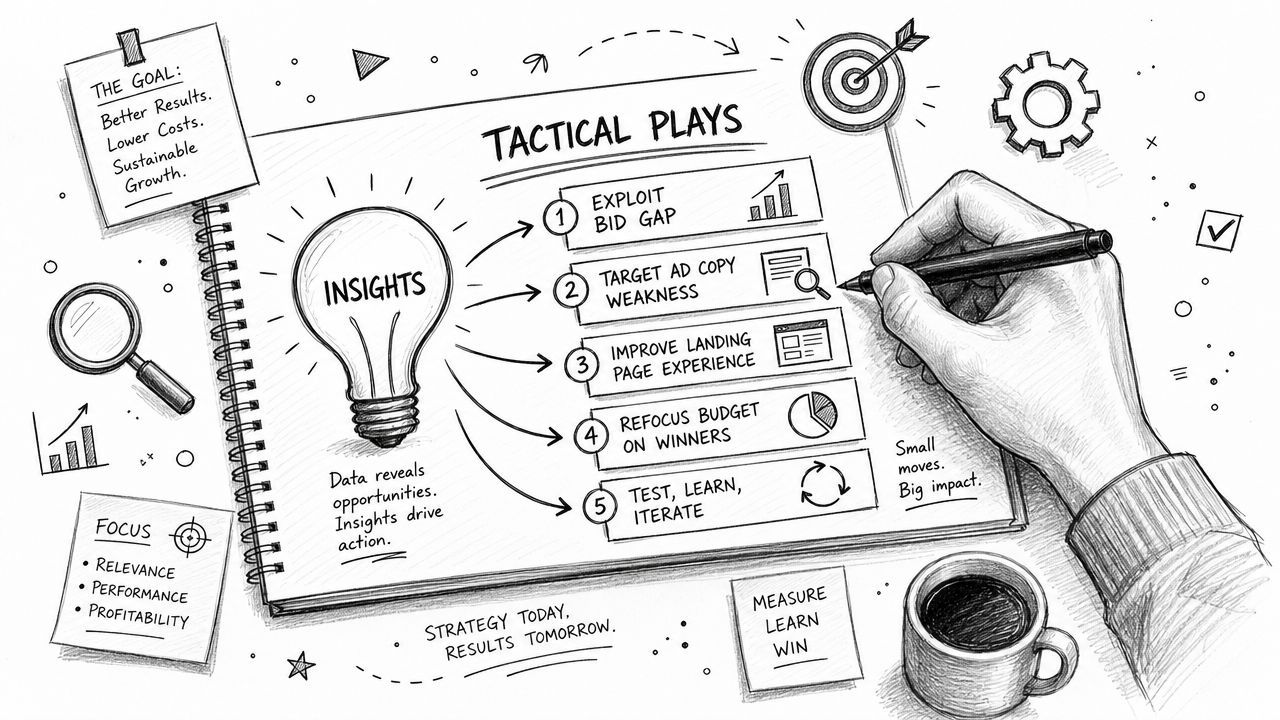
The simplest way to operationalize PPC competitor research is to use decision patterns. If you see a specific weakness, respond with a specific move.
If the competitor is broad, get narrower
A common pattern is aggressive category bidding with generic ad copy. The advertiser wants volume, so their message gets flattened.
Your play is to tighten intent matching:
- Split high-intent terms into smaller ad groups with exact message match
- Write copy for the use case, not the category
- Send traffic to a purpose-built page instead of a general product page
This works because generic campaigns often leak relevance. You don't need to outspend them. You need to be more precise.
If the competitor looks strong in paid, inspect SEO before reacting
Sometimes a rival seems impossible to dislodge in paid search because they're always present. Before increasing bids, check whether their organic presence is carrying part of the load.
If their SEO is doing the educational work and paid is only closing high-intent demand, your move isn't just a bid change. It's to create supporting organic coverage for comparison, alternatives, problem-aware, and branded-adjacent queries. Then reserve paid spend for the terms where purchase intent is strongest.
That gives you a more durable response than only paying more for every auction.
If the landing page is weak, compete on the post-click experience
I've seen advertisers panic when a competitor dominates ad visibility, even when that competitor sends traffic to a clumsy page. That's a mistake. Visibility alone doesn't equal efficiency.
Run this play when you spot weak page alignment:
- Keep the keyword set focused.
- Improve ad-to-page continuity.
- Reduce friction on mobile forms.
- Put the strongest proof element above the fold.
- Test a stronger next-step CTA than the competitor uses.
A rival can win the impression and still lose the visitor. That's where disciplined operators make money.
Here's a useful walkthrough to keep the tactical side grounded in execution, not theory:
If they ignore device differences, build separate paths
This is the underexploited move I trust most. When a competitor runs the same message across devices, create separate ad variants and landing experiences.
For mobile, lead with immediacy. Think location, speed, availability, or a short next step.
For desktop, support comparison. Bring in proof, deeper differentiators, and more evaluative copy.
"The best opportunities usually come from what competitors treat as a settings menu instead of a strategy choice."
If they dominate expensive terms, steal the edge of the funnel
Not every auction should be fought head-on. When a competitor owns the most expensive purchase-intent keywords, look for neglected informational or problem-aware queries that still lead into the same buying journey.
Build assets that answer those earlier questions. Then retarget or sequence paid search around the users who engage. This approach works especially well when the category has a long evaluation cycle and the high-CPC terms are crowded.
The operating principle is simple. Don't answer every competitor move with a bid. Some gaps are better exploited with a content asset, a stronger offer path, or a tighter device-specific experience.
Establishing a Repeatable Monitoring Cadence
One-off competitor analysis expires fast. The day after you finish it, someone launches a promotion, changes landing page structure, or enters a new keyword cluster. If you only review competitors when performance dips, you're already late.
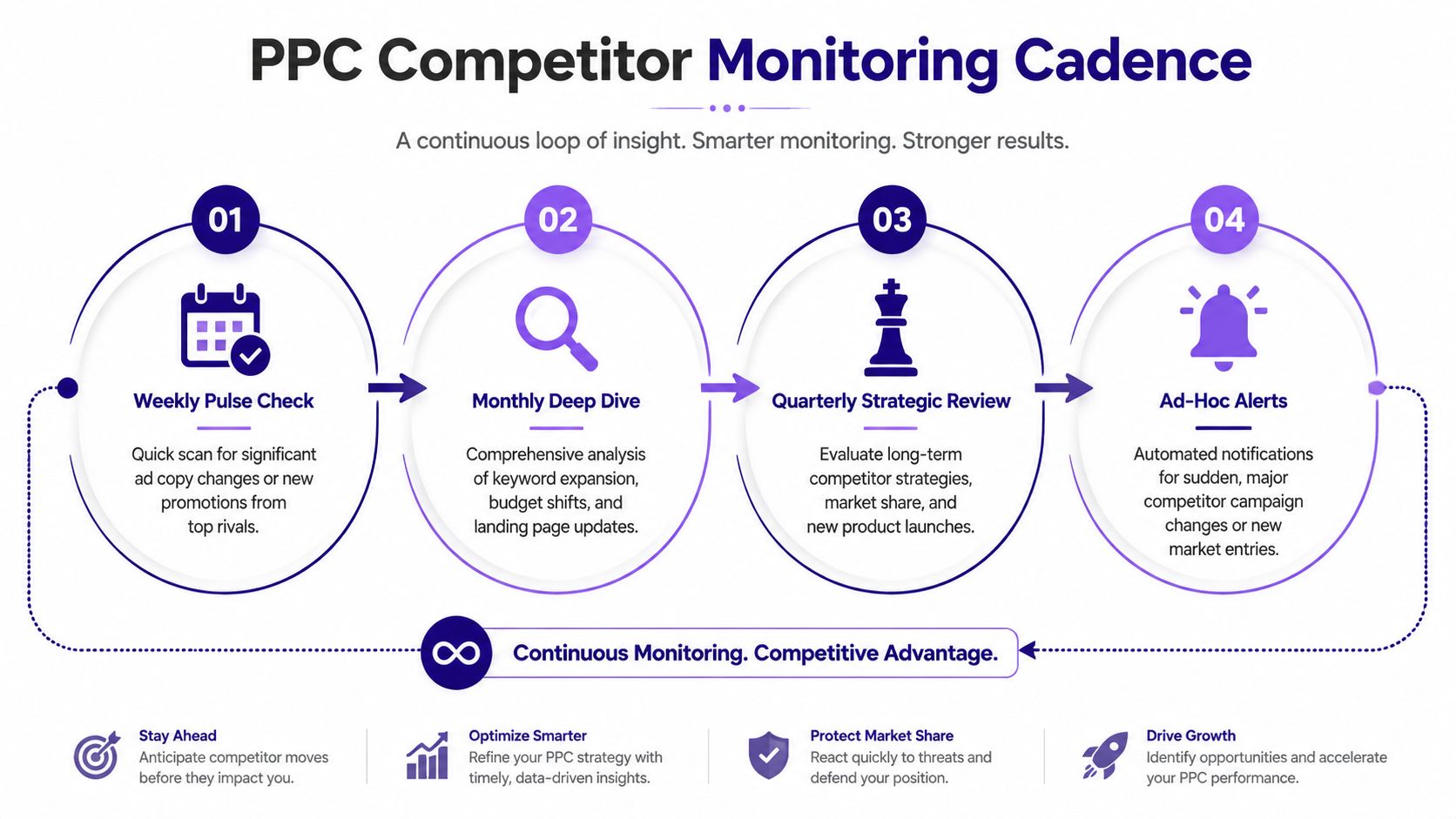
A workable system uses different depths of review at different intervals. The cadence matters as much as the analysis itself.
Use three review speeds
The baseline cadence is clear. Quarterly deep-dives, monthly metric checks, and weekly scans during peak seasons are critical. Failing to increase frequency during peak periods can cause a 15 to 20% drop in impression share as competitors scale spend, according to Swydo's guidance on PPC competitor analysis.
Here's how to make that cadence usable:
| Interval | What to review | What to ignore |
|---|---|---|
| Weekly during high-competition periods | Major ad copy changes, new offers, visible auction shifts | Deep keyword restructuring unless the signal repeats |
| Monthly | Impression share, outranking trends, landing page changes, new keyword themes | Full historical backfill |
| Quarterly | Competitor set, strategic positioning, SEO-paid interaction, device treatment | Minor creative edits |
What should be automated and what should stay manual
Automation is great for detection. It's bad at interpretation.
Automate alerts for visible changes such as new ads, movement in tracked rankings, or fresh keyword appearances. Keep strategic judgment manual. Someone needs to decide whether the competitor is testing, scaling, or merely making noise.
A simple rule helps. If the change affects messaging, funnel path, or auction pressure, review it manually. If it only adds one more creative variant with no strategic pattern, log it and move on.
Build one operating document
Every account should have a living competitor sheet or dashboard. Not a presentation deck that dies after the meeting. A document that records:
- Priority competitors by tier
- Current strategic notes on each rival
- Latest ad and landing page changes
- Observed device differences
- Actions taken in response
- Next review date
If your broader search reporting already lives in a shared system, integrated reporting is helpful. A practical reference for that operating model is a guide to SEO dashboard reporting, especially when your team needs one place to compare movement over time.
Competitor monitoring should feel like account maintenance, not a special project.
The teams that stay calm in volatile auctions usually aren't reacting faster because they're smarter. They're reacting faster because they already know what matters, who matters, and how often each signal deserves attention.
PPC Competitor Research FAQ
What if I'm in a niche market and there isn't much visible competitor data
That happens often in specialized B2B, local service categories, and newer software niches. When hard data is thin, shift from quantitative comparison to pattern reading.
Look at search results manually. Review active ads, offer language, landing page structure, and whether competitors segment by geography, problem, or persona. In small markets, even a few repeated patterns are useful. You're not trying to build a perfect benchmark. You're trying to identify what buyers keep seeing and where you can present a clearer alternative.
What's the best free or low-cost approach
Use the sources that give direct visibility before paying for broad market estimates. Google Ads Auction Insights is the first stop if you're already running campaigns. Then use public ad libraries and manual SERP checks. Add one paid platform only when you need historical depth or faster workflow.
The mistake isn't using fewer tools. The mistake is using too many tools without a clear question.
Should I bid on a competitor's brand name
Sometimes yes. Often no. This decision depends on budget discipline, legal review, intent quality, and your ability to present a credible alternative.
Bid on competitor terms when you have a clear comparison proposition, a dedicated landing page, and enough budget to test without starving your core campaigns. Avoid it when your message is generic, your offer isn't differentiated, or your account still has unresolved waste on non-brand and category terms.
How many competitors should I monitor closely
Fewer than generally believed. Keep a tight core group. A handful of true auction rivals will usually account for most of the pressure you feel. Beyond that, monitor adjacent players lightly and only promote them into the main set when their behavior starts affecting bids, visibility, or conversion paths.
What's the biggest waste of time in PPC competitor research
Copying ad copy line by line.
That work usually produces mediocre clones. A stronger use of research is identifying where competitors are too broad, too generic, too desktop-centric, too offer-heavy, or too disconnected between ad and landing page. Those are strategic gaps. That's where the gains come from.
How do I know whether to react now or wait
Use persistence as your filter. One appearance doesn't mean much. Repeated visibility, repeated messaging, and repeated landing page alignment usually signal commitment.
If the pattern holds, act. If it flashes once and disappears, log it and keep your structure intact.
Nuwtonic fits teams that want competitor research tied to execution, not just reporting. Its platform combines competitor gap mapping, technical SEO, content operations, AI visibility tracking, and review-before-deploy workflows in one workspace, which is useful when your PPC insights need to influence content, landing page updates, and broader search strategy across multiple sites.