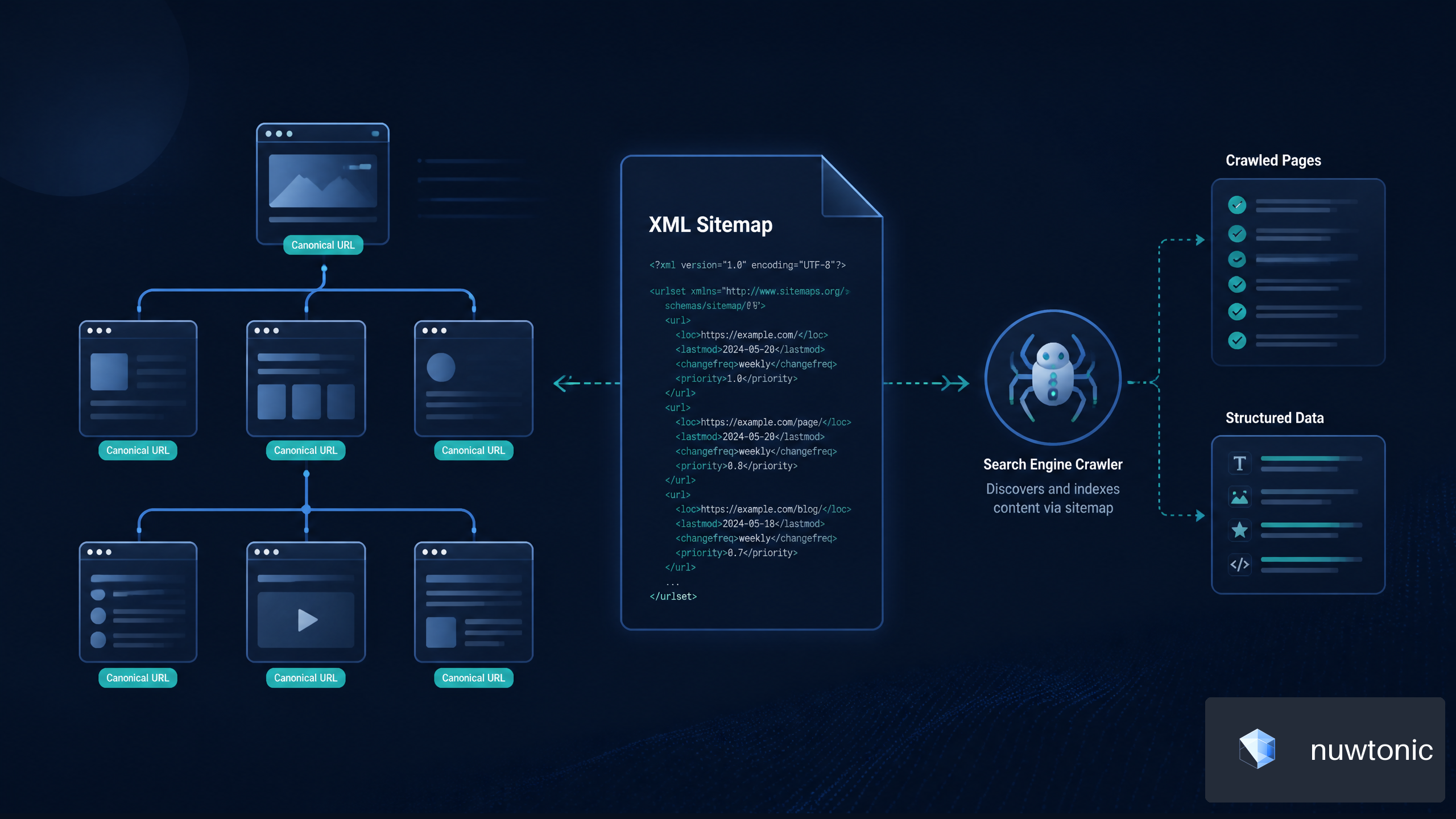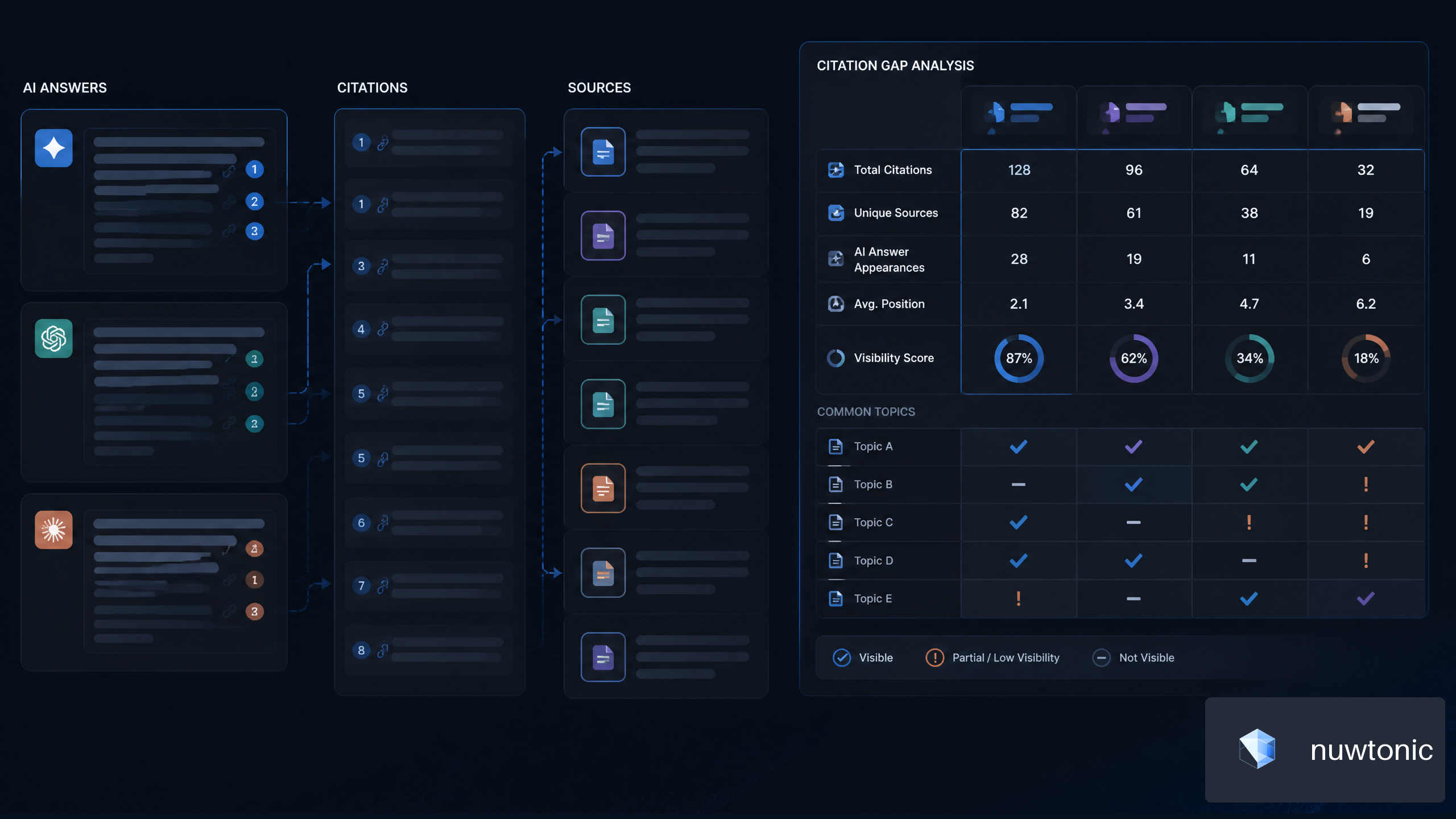
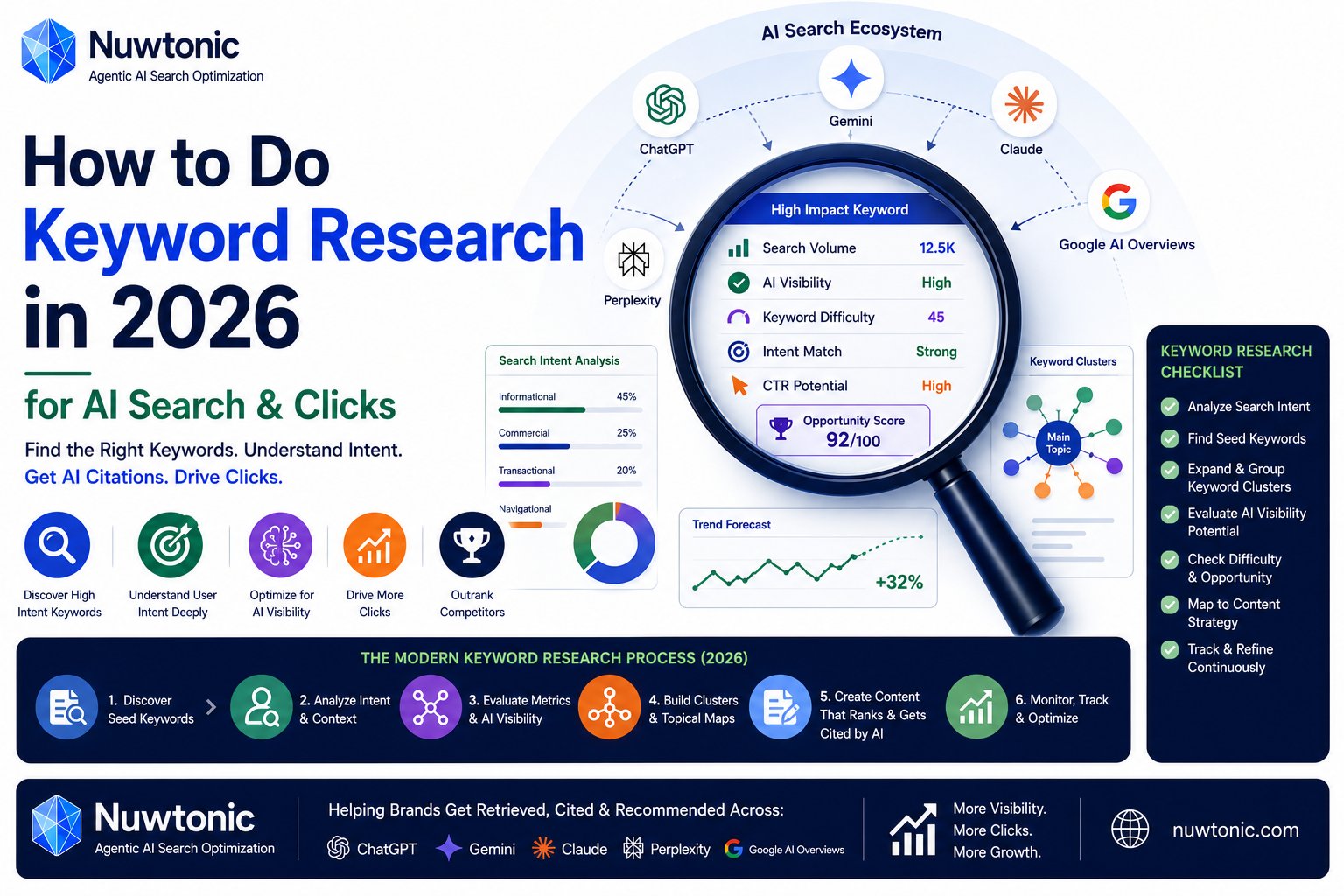
Most advice on how to do keyword research still starts with the wrong question. It asks, “What keywords have the most volume?” That used to be a decent shortcut. It isn't anymore.
Modern keyword research starts with business fit, click potential, SERP intent, and AI visibility. If a query gets searched but the answer is absorbed by the results page, answered by an AI Overview, or mismatched to the page you need to rank, the volume doesn't help much. Good research now is less about building a giant spreadsheet of phrases and more about building a system that finds demand you can capture.
That changes the workflow. You still need seed ideas, competitor research, clustering, and prioritization. But you also need to judge whether a keyword deserves a page, whether that page should exist on your site, and whether the query is likely to produce a click at all.
Table of Contents
- Why Your Keyword Research Strategy Is Already Outdated
- Aligning Keyword Research with Business Objectives
- Building Your Expansive Keyword Universe
- Evaluating Keywords for Clicks and AI Visibility
- From Keyword Lists to an Intelligent Content Map
- Prioritizing Opportunities with Gap Analysis
- Tracking Performance and Creating a Maintenance Loop
Why Your Keyword Research Strategy Is Already Outdated
Keyword research is the process of finding the search terms your audience uses, understanding why they use them, and deciding which pages should target which themes. That definition still holds. What's broken is the old assumption that ranking for a searched term automatically means traffic.
Most keyword research guides are dangerously outdated, treating keyword selection as a static SERP exercise. They fail to address the 2024–2026 shift where 40% of user intent is now resolved by AI overviews (Google SGE) or LLM citations. Traditional SEO metrics like search volume are becoming less predictive of traffic as AI answers suppress clicks, yet most guides still prioritize volume over AI visibility potential.
That's why teams that still use the old workflow often produce content that “makes sense” in a tool and underperforms in reality. They target broad informational phrases, ignore result-page behavior, and publish articles that never had strong click potential in the first place.
A better starting point is to treat keyword research as demand allocation. You're not collecting phrases. You're deciding where your site should compete, where it should educate, and where it should become citation-worthy for AI-first search experiences. If you're working through the AI search implications in more depth, this AI SEO guide from Nuwtonic is useful background reading.
Practical rule: A keyword is only valuable when the query, the SERP, the page type, and the business outcome all line up.
That shift in mindset changes almost every downstream decision. It changes how you build lists, how you filter them, how you cluster them, and how you prioritize what gets written first.
Aligning Keyword Research with Business Objectives
Opening a keyword tool too early is how teams drift into busywork. They build lists that look impressive, then wonder why the pipeline, demos, or sales pages don't move.
Start with revenue not topic ideas
Begin with the business objective, then work backward into search behavior. That means asking a tighter set of questions:
| Business type | Real objective | Keyword research implication |
|---|---|---|
| B2B SaaS | Create qualified pipeline | Favor problem-aware, comparison, workflow, and integration terms tied to product use cases |
| E-commerce | Sell product categories and high-intent SKUs | Prioritize category, modifier, use-case, and comparison queries close to purchase |
| Agency | Generate leads and prove expertise | Build authority around service problems, frameworks, audits, and decision-stage terms |
| Media or publisher | Capture demand across a topic | Expand broader informational coverage, then connect it to monetizable subtopics |
Many keyword strategies fail due to targeting what the company talks about internally, not what the buyer searches when trying to solve an actual problem.
A CRM company doesn't just need “CRM software” ideas. It needs queries around pipeline cleanup, lead routing, attribution confusion, CRM migration, and reporting friction. An e-commerce skincare brand doesn't just need “vitamin c serum.” It needs concern-driven searches, comparison searches, and routine-building searches that reveal buyer intent.
Turn audience pain into keyword criteria
The audience definition has to be specific enough to shape the keyword set. Demographics alone won't do that. You need problem language, decision triggers, and the words buyers use when they're stuck.
Use this sequence:
- Define the actor. Name the buyer or user. Marketing ops lead, Shopify store owner, procurement manager, founder, category manager.
- List the recurring jobs. What are they trying to complete? Migrate data, compare vendors, fix reporting, improve product discovery, reduce manual work.
- Document trigger moments. What makes them search? Tool failure, new initiative, budget pressure, migration, scaling pain, implementation confusion.
- Translate those triggers into query types. Comparisons, implementation guides, alternatives, troubleshooting, templates, category pages, local modifiers.
Buyers rarely search for your internal positioning. They search for the mess they need to clean up.
That's why the best keyword lists feel operational. They're built from customer calls, sales objections, support tickets, onboarding questions, Search Console, subreddit language, and competitor page themes.
Use a simple objective template
A practical keyword objective should fit on a single page. If it takes a slide deck to explain, it's too vague.
Use a template like this:
- Business goal: What outcome matters most right now
- Audience segment: Who must find you
- Conversion event: Demo, purchase, trial, lead form, email capture
- Priority journey stage: TOFU, MOFU, BOFU
- Page types needed: Landing pages, comparison pages, guides, category pages, supporting articles
- Exclusions: Topics that attract traffic but weak buyers
- Success signal: What improvement would prove the strategy worked
Examples:
- SaaS: Grow trial-starting traffic from integration and workflow queries.
- E-commerce: Increase category-page visibility for product + use-case combinations.
- Agency: Own searches around audits, migrations, and platform-specific service demand.
When you know the outcome, keyword selection gets easier. You stop asking, “Does this keyword have volume?” and start asking, “Would winning this query help the business?”
Building Your Expansive Keyword Universe
Good keyword research starts broad. Not because you'll target everything, but because you need enough raw material to spot the non-obvious opportunities.

Start with seed keywords but do not stop there
Seed keywords are still the mechanical starting point. Broad inputs like “email marketing,” “running shoes,” or “inventory management” are what tools need to generate related ideas. The workflow after that matters more.
A practical sequence looks like this:
- Enter a seed keyword into a research tool.
- Pull related terms, questions, modifiers, and variants.
- Validate each promising theme with four checks: search volume, keyword difficulty, CPC, and search intent.
- Keep only terms that look realistic for your site and useful for your business.
That basic workflow is still valid. It's also incomplete if you stop there.
Pull language from search data and competitors
The richer keyword universe comes from sources that reflect how people already search and how competitors already structure demand.
Use these sources in parallel:
- Google Search Console. Export queries by page, especially pages already getting impressions. Look for terms where you're visible but not yet dominant, plus unexpected modifiers that reveal adjacent demand.
- Competitor traffic pages. In Ahrefs Site Explorer, plug in true competitors, meaning sites solving the same problem, not just brands in the same broad market. Look at their top pages and the keywords attached to those pages.
- Subreddits and forums. Search niche communities for repeated question formats, frustrations, comparisons, and language patterns. This is often where commercial-intent wording first appears before tools make it obvious.
- Autocomplete and related searches. Use Google's own suggestions to catch phrasing that keyword databases can lag on.
Ahrefs' keyword research guidance also emphasizes competitor analysis and community mining through forums and subreddits, which is why both methods belong in a serious workflow, not just an “extra ideas” bucket in their keyword research process.
Expand into the long tail on purpose
This is a common area of underinvestment. It's often assumed that low-volume means low value. In practice, a modern strategy often wins by chaining together many precise queries rather than fighting for a tiny set of obvious head terms.
According to Ahrefs, 94.74% of all keywords get 10 or fewer monthly searches, while only 0.0008% get more than 100,000 in their SEO statistics report. That's the clearest reason to widen your universe beyond the terms everyone already sees.
A useful expansion pattern is:
- Head term: project management software
- Use-case variant: project management software for client work
- Buyer modifier: best project management software for agencies
- Comparison variant: Asana vs ClickUp for agencies
- Implementation query: how to structure agency project management workflows
- Entity-rich angle: project management templates for creative operations
The best long-tail keywords often look too specific in the spreadsheet and perfectly matched in the SERP.
If you need a faster way to surface queries tied to AI-first result patterns, an AI Overview keyword finder can help with early discovery. The point isn't to automate judgment. It's to enlarge the pool before you evaluate.
Evaluating Keywords for Clicks and AI Visibility
A raw keyword list is just inventory. The actual work starts when you decide which phrases deserve content, which deserve a landing page, and which deserve nothing.
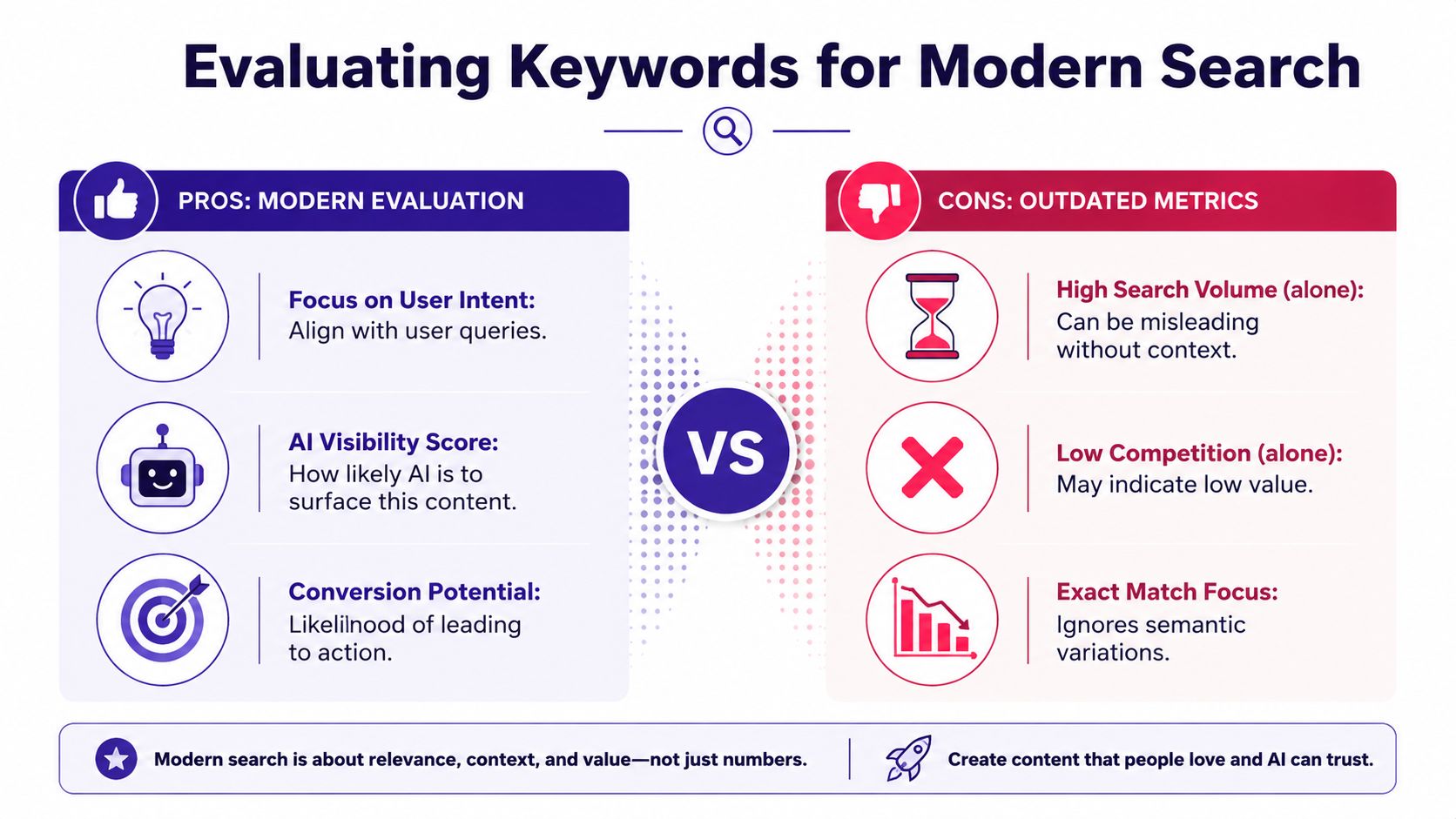
Intent comes before difficulty
Start with search intent. Manually inspect the top results. Don't trust a tool label by itself.
Ask four direct questions:
- Is the SERP informational, commercial, transactional, or mixed?
- What page type is winning? Blog posts, category pages, feature pages, product pages, tools, videos.
- What does the user likely want done, not just known?
- Would your intended page type satisfy that result set?
If the top results are product and category pages, don't target the keyword with a thought-leadership article. If the SERP is full of guides and tutorials, don't expect a service page to break in.
HubSpot's keyword research guidance gets this mechanical part right. Manually inspect the top results, filter for achievable terms, and map keywords to specific pages so multiple URLs don't compete for the same query in their keyword research walkthrough.
Read the SERP like a strategist
The second layer is competitive difficulty, but not as a single score. Read the page.
Check for:
- SERP feature crowding. Ads, shopping boxes, AI summaries, featured snippets, videos, map packs.
- Brand dominance. Are trusted incumbents occupying the first screen?
- Content weakness. Are ranking pages outdated, shallow, badly structured, or mismatched?
- Angle repetition. Are all results saying the same thing, leaving an obvious underserved angle?
Click potential becomes a significant factor. Approximately 58% to 60% of Google searches are now zero-click, and the average CTR for the #1 result is only 25.84%, according to Intergrowth's SEO statistics roundup. That single fact should change how you evaluate every informational keyword on your list.
A keyword can look attractive in a tool and still be weak in practice because:
| Looks good in tool | Fails in reality |
|---|---|
| Solid search volume | AI Overview answers the core question |
| Low difficulty score | Query has weak commercial value |
| Relevant wording | SERP intent favors another page type |
| Ranking possible | CTR is suppressed by crowded SERP features |
Judge AI visibility before you commit
The missing pillar in many workflows is AI visibility. Before assigning a keyword, estimate whether the query is likely to be absorbed into an answer layer or still produce a click.
Use this quick filter:
- Low click potential: definition queries, basic fact lookups, simple “what is” searches, quick calculations
- Medium click potential: broad educational terms where users may want examples, steps, or templates
- High click potential: comparisons, alternatives, implementation guides, platform-specific workflows, purchase research, troubleshooting, deep-dive queries
Then ask a second question. Could your page become citation-worthy even if clicks are reduced? That matters for GEO. Pages with original frameworks, clear entity structure, useful comparisons, and machine-readable organization are better candidates for citation than generic intros.
If the SERP can answer the question in one panel, don't build your strategy around that query alone.
Mangools summarizes a simple but still useful rule for execution: one focus keyword equals one page, with the focus term placed in the title, heading, opening copy, and internal anchors in their keyword research framework. That doesn't mean robotic exact-match writing. It means every page needs a clear retrieval target.
A keyword is worth pursuing when all four pillars line up:
- Intent match
- Achievable competition
- Reasonable click potential
- Some value for AI visibility or business conversion
If one of those is missing, it's usually not a priority.
From Keyword Lists to an Intelligent Content Map
Keywords don't create authority by themselves. Pages do. The move from spreadsheet to site architecture is where strategy either compounds or falls apart.
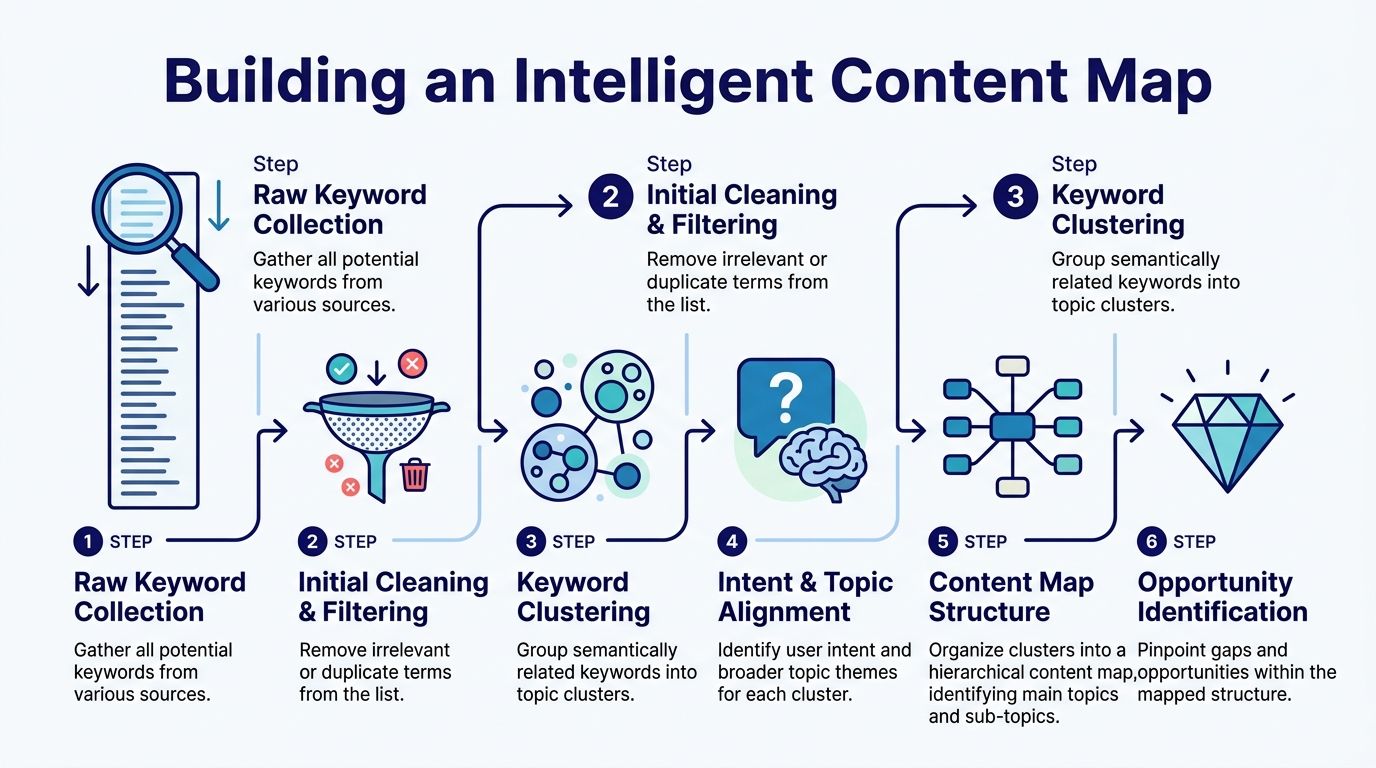
Cluster by shared SERP outcome not shared wording
A common mistake is grouping keywords because they look semantically similar. That creates messy clusters and pages that rank for nothing well.
Failure to align keyword clusters with SERP intent polarity can reduce content efficacy by 35-40%. When content's purpose mismatches the keyword's SERP intent, pages often fail to rank, leading to significant keyword cannibalization.
That's why clustering needs a manual check. Pull the top results for each candidate term and compare the dominant page types. If the same kinds of pages rank and the same user need is being served, those terms probably belong together. If not, separate them even if the words look related.
For a deeper process reference, this guide on keyword clustering is worth reviewing.
Map each cluster to one page and one job
Each cluster should map to a single URL with a clear job:
| Cluster type | Best page format | Primary job |
|---|---|---|
| Broad concept cluster | Pillar guide | Build authority and internal linking hub |
| Comparison cluster | Comparison page | Capture decision-stage traffic |
| Product-use cluster | Landing or feature page | Convert problem-aware visitors |
| Question cluster | Supporting article | Expand topical depth and support the pillar |
| Category cluster | Collection or category page | Capture commercial demand |
That page then gets a primary keyword target and a set of close variants that share meaning and intent. Don't split one intent across three articles because the wording differs slightly.
A short visual walkthrough helps before you build the map:
A simple clustering example
Suppose your raw list includes:
- best help desk software
- help desk software for startups
- Zendesk alternatives
- help desk ticketing workflow
- what is help desk software
- customer support software vs help desk software
A poor map creates six pages. A better map creates a tighter structure:
- Pillar guide targeting the broad concept and category language
- Audience-specific landing page for startup use cases
- Alternatives page for Zendesk replacement intent
- Workflow article for process implementation
- Comparison explainer for support software vs help desk software
Operational test: If two pages would satisfy the same searcher in the same moment, they probably shouldn't both exist.
That's how you avoid cannibalization before it starts. The content map is less about completeness and more about clean coverage.
Prioritizing Opportunities with Gap Analysis
Once the content map exists, the next problem appears. You can't publish everything at once. Prioritization decides whether the strategy produces early wins or stalls under a backlog of “important” ideas.
Run two kinds of gap analysis
Doing only competitor keyword gap analysis is useful, but it's incomplete.
You need two gap views:
Competitor keyword gap
Find terms competitors rank for where you have no page, a weak page, or the wrong page type.Content gap
Find questions, angles, or workflows the market is asking that no one is answering well enough.
The first gives you proven demand. The second gives you differentiation.
A practical competitor workflow looks like this:
- Choose a small set of true search competitors.
- Export their top non-branded pages and associated terms.
- Match those terms against your existing URLs.
- Label each gap as missing page, weak page, or wrong intent page.
- Flag opportunities where the current SERP looks beatable.
The content gap workflow is different. It relies more on forums, Search Console, People Also Ask patterns, support logs, sales calls, and subreddit language. You're looking for repeated friction, not just repeated phrasing.
What to prioritize first
A useful prioritization lens combines three forces:
- Business alignment. Does the query connect to revenue, qualified leads, or strategically important pages?
- SERP weakness. Can you reasonably produce a better page or better angle than what currently ranks?
- Coverage impact. Will this page strengthen a whole cluster through internal links and topical reinforcement?
That often leads to a better queue than pure volume sorting.
Here's a practical priority stack:
| Priority level | What to do |
|---|---|
| Highest | Existing near-ranking pages that need better targeting, structure, or support |
| High | Competitor-winning topics with weak SERPs and strong commercial alignment |
| Medium | Supporting cluster pages that strengthen a pillar or money page |
| Selective | Broad informational topics with citation potential but uncertain click value |
| Low | Isolated keywords with weak business fit |
A page that improves an existing cluster is often more valuable than a brand-new page chasing a disconnected term.
Turn analysis into a working queue
Don't leave this as a spreadsheet graveyard. Convert opportunities into a production queue with clear statuses:
- Patch existing page
- Create net-new page
- Merge overlapping pages
- Retarget page
- Monitor only
For each item, record:
- Target cluster
- Intended page type
- Main conversion or support role
- Primary internal links in and out
- Reason this should exist now
When keyword research becomes operational, the best teams move quickly because they can tell the difference between a page that needs a rewrite, a page that needs consolidation, and a page that never should have been created.
Tracking Performance and Creating a Maintenance Loop
Keyword research isn't a one-time planning exercise. It's a maintenance system. Search behavior changes, pages drift, competitors revise their angles, and AI layers reshape which queries still send traffic.
Track clusters not isolated keywords
Single-keyword rank tracking is too narrow for modern search. A page usually wins across a cluster, not one exact phrase.
Track performance at three levels:
- Cluster visibility. Are the related terms collectively improving?
- Page-level CTR and conversions. Is the page attracting the right visitor and producing action?
- SERP behavior shifts. Has the page lost clicks because the result page changed, not because the content got worse?
A useful review cadence includes:
- Weekly checks for major ranking or CTR changes on priority pages.
- Monthly cluster reviews to spot weak supporting content, missing internal links, and intent drift.
- Quarterly re-mapping to decide which pages should be merged, expanded, or repositioned.
Fix cannibalization like an operator
Cannibalization is one of the most common maintenance failures because teams spot it and then stop. They identify overlap, but they don't execute the fix.
A common but poorly addressed issue is resolving keyword cannibalization, which affects 60% of mid-market sites. Most guides stop at identification, but lack actionable workflows for using AI agents to automatically reassign internal links, update metadata, and consolidate topical authority to fix the problem.
The practical fix workflow is straightforward:
- Identify conflicting URLs in Search Console where the same query rotates between pages.
- Choose the winner based on intent fit, authority, links, and conversion value.
- Decide the action for the weaker page. Merge, redirect, de-optimize, narrow scope, or retarget.
- Update internal links so related pages reinforce the chosen winner.
- Rewrite metadata and headings where needed so each page has a distinct retrieval target.
Cannibalization usually isn't a content quantity problem. It's a page assignment problem.
Build a recurring maintenance rhythm
A stable keyword program needs recurring decisions, not occasional audits.
Keep a lightweight loop:
| Frequency | Maintenance action |
|---|---|
| Weekly | Review top-priority pages for ranking and CTR movement |
| Monthly | Audit clusters for intent drift, content gaps, and page conflicts |
| Quarterly | Refresh the content map and reprioritize based on business goals |
| Ongoing | Add newly discovered search language from GSC, sales, support, and forums |
Teams that treat keyword research as living infrastructure adapt faster. They don't just publish more. They keep the map clean, reinforce what works, and retire what doesn't.
Nuwtonic brings that maintenance loop into one workspace. It connects to Google Search Console, surfaces keyword gaps and cannibalization conflicts, tracks AI search visibility, and gives teams reviewable workflows to update metadata, internal links, content structure, and citation readiness without stopping at a report. If you want a platform built for modern SEO and GEO operations, explore Nuwtonic.