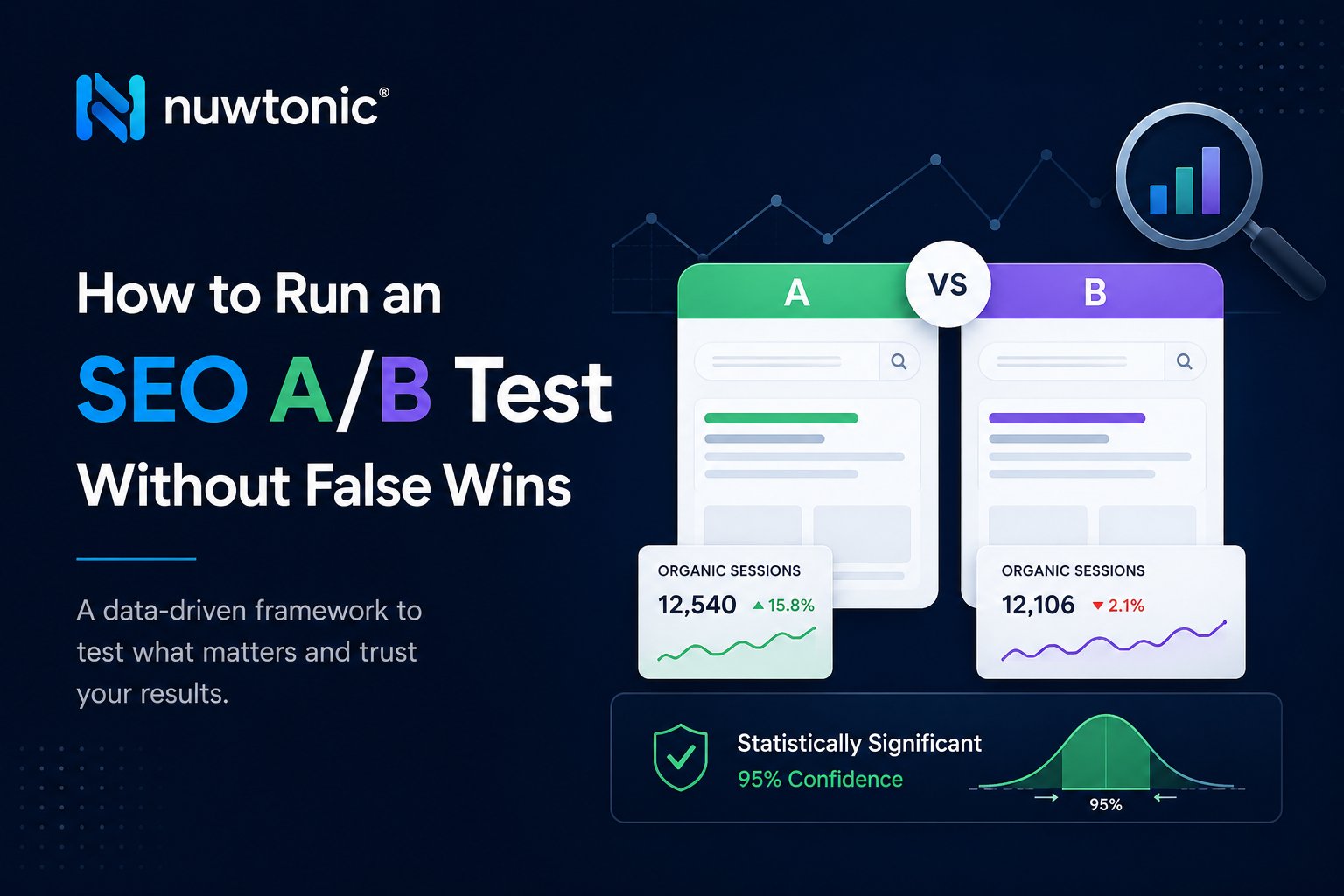
Most SEO A/B tests don't fail because the idea was bad. They fail because the measurement design was weak, the buckets were uneven, or the team mistook normal organic volatility for a real win. If you compare one URL before and after a rewrite, you're not running a clean experiment, you're reading a weather report and calling it strategy.
A proper SEO A/B test is a control problem first and a content problem second. The change matters, but only after you've proven that the test setup can separate signal from crawl lag, query-mix drift, and seasonality. That's why mature testing programs treat the split, the sample window, and the metric definition as the work, not paperwork.
Table of Contents
- Why Most SEO A/B Tests Report Winners That Aren't Real
- Bucketing Control and Variant Pages the Right Way
- Instrumenting Google Search Console the Way Analysts Actually Do
- Statistical Significance for People Who Hate Statistics
- What to Do When You Don't Have Enough Pages to Split
- Extending the Test to AI Search Citations
- A 20-Minute Pre-Rollout Sanity Check
Why Most SEO A/B Tests Report Winners That Aren't Real
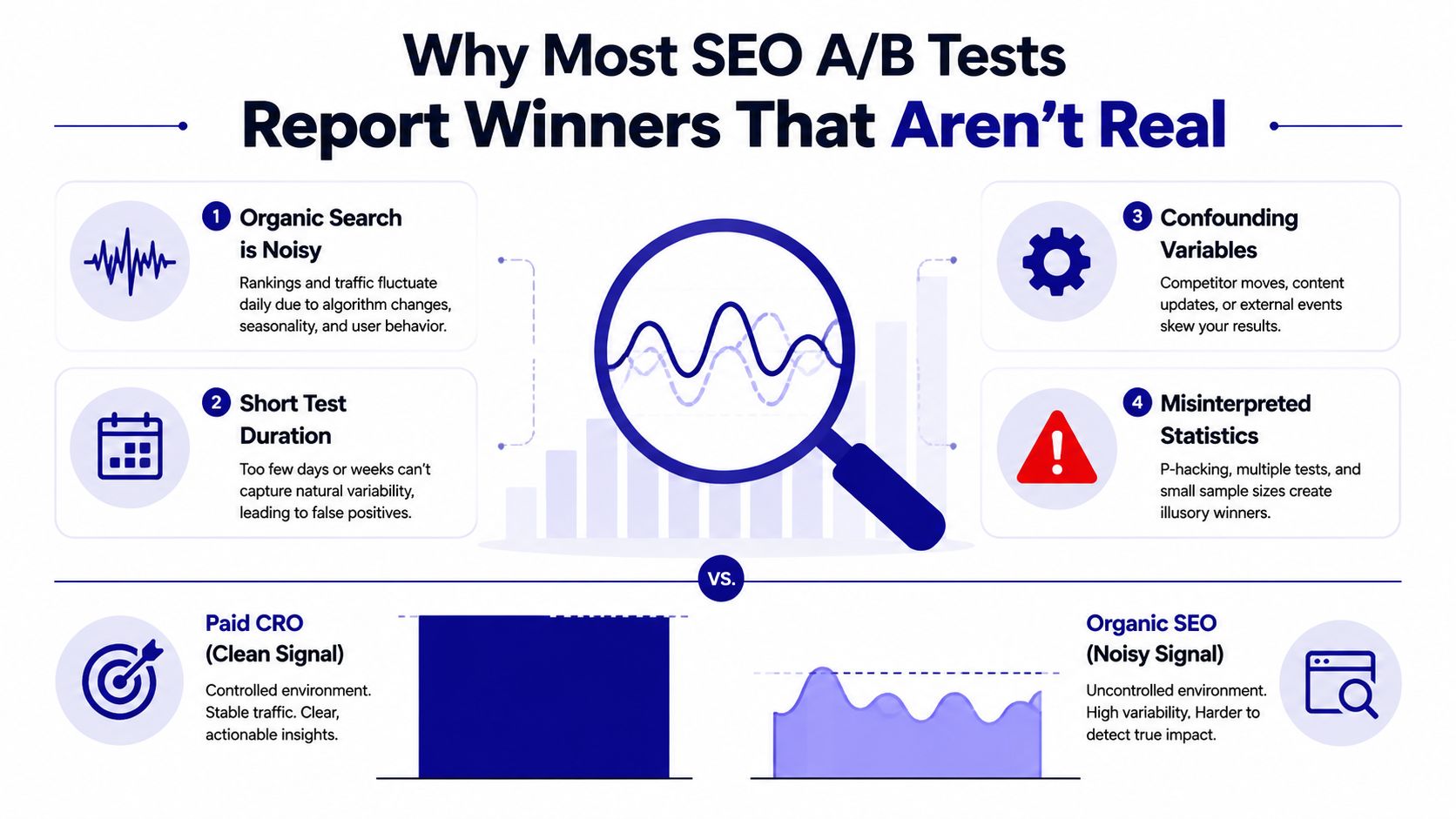
The first mistake is treating organic search like paid CRO. Paid experiments usually get fast feedback from stable traffic and immediate user exposure. Organic tests live inside crawl delays, changing query mix, and ranking swings that can make a weak variant look great for a week and dead the next.
That's why the headline “winner” in many SEO case studies is suspect. A single-page before-and-after comparison can't separate the effect of the rewrite from external movement in the SERP, and it definitely can't prove causality. A real SEO experiment needs a control group, a fixed horizon, and pre-click metrics like impressions and CTR, not just traffic after the fact, as the operational guidance in Google's search testing documentation makes clear.
Practical rule: If the control and variant didn't start from similar traffic and intent, you don't have a test, you have a comparison with a story attached.
Writing a hypothesis that can survive scrutiny
The cleanest way to start is with a hypothesis that names the exact change, the audience, and the metric you expect to move. “Titles should be punchier” isn't testable. “For non-branded commercial queries on product pages, changing the title tag from a generic format to an intent-led format will improve CTR” is testable, because it identifies the page type, the query class, and the measurement target.
That matters because page eligibility comes before creativity. If pages don't share a template and a similar search role, the test gets contaminated by differences in layout, intent, or authority. A product-page title-tag test is a much cleaner candidate than a comparison between a category page and a blog post, because those pages answer different questions and attract different queries.
A good hypothesis also needs a direction, not a wish. You're not just hoping the new title “sounds better.” You're asserting that the variant should lift a specific metric under a defined search condition. If you can't write that down in one sentence, the test isn't ready.
One practical resource that frames this well in the ecommerce context is Tagada ecommerce A/B testing, especially if you're trying to map experimentation language from CRO into SEO without losing the measurement discipline.
A useful working example looks like this. The current product-page title is “Running Shoes, Brand Name.” The variant becomes “Buy Lightweight Running Shoes, Brand Name,” and the expected effect is stronger CTR on non-branded commercial queries because the title matches purchase intent more directly. That's a real hypothesis. It can win, lose, or fail to move the needle, which is exactly what a hypothesis should allow.
Bucketing Control and Variant Pages the Right Way
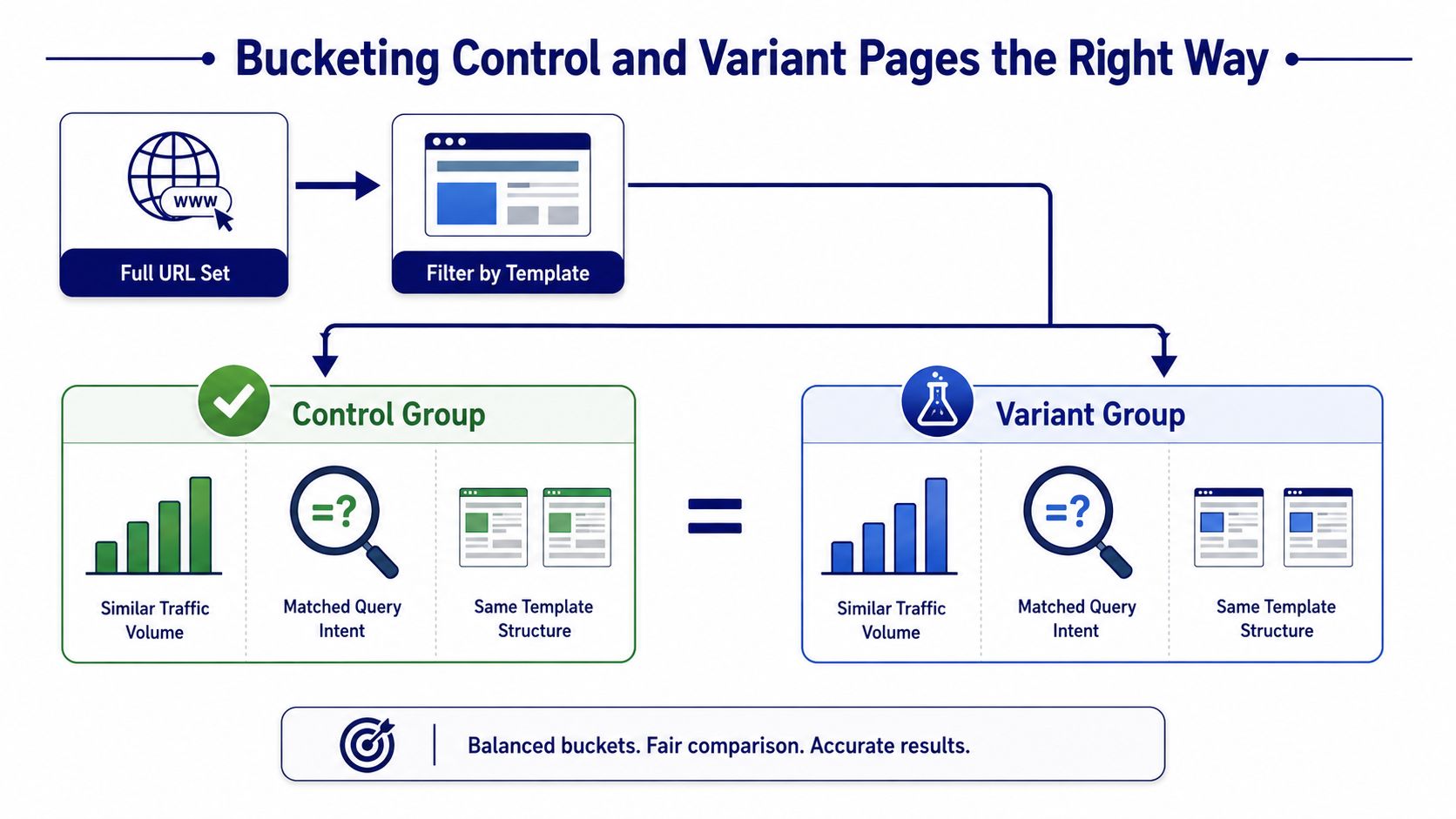
The split is where most tests go wrong. If the control bucket ends up with pages that already attract stronger demand, better average position, or cleaner intent, the variant can't earn a fair reading. Random bucketing at the URL level works best when the pages are interchangeable, like product pages, location pages, or posts built on the same template.
Matching pages before you split them
Start by filtering to one template and one change type. Then bucket the URLs so both groups look similar on baseline impressions and average position before the variant goes live. That pre-flight check is what keeps you from confusing a lucky bucket with a successful test.
For a concrete example, take 240 product pages and split them into 120 control and 120 variant URLs, then verify that impressions and average position are roughly balanced before launch. If one bucket holds the higher-demand pages, reshuffle until the groups look even. If the pages are not interchangeable, don't force a split, because the test will be measuring page differences instead of the change itself.
Google's own testing guidance says to use a 302 temporary redirect when you're sending users from an original URL to a variation URL, and to avoid cloaking so users and Googlebot see the same version for a given URL. That matters more than teams usually admit, because a technically sloppy redirect choice can turn a controlled experiment into an indexing mess.
A variant that's technically “live” but not consistently crawlable isn't live in a testing sense.
A practical way to think about this is simple. If the page set is templated and traffic is reasonably similar, bucket by URL. If the site uses a weirdly heterogeneous set of pages, the test design needs more caution or a different method entirely. In both cases, the goal is the same, keep the only meaningful difference between the groups limited to the one element you're testing.
The internal-linking side deserves the same discipline. If you're testing a title change on a product cluster, don't also change the navigation, the canonical pattern, or the body copy. A separate issue like keyword cannibalization should be resolved before the experiment, not during it, and the operational checklist in this keyword cannibalization guide is relevant when page overlap could blur your result.
Instrumenting Google Search Console the Way Analysts Actually Do
Search Console is the source of truth for organic experiments, but raw clicks by themselves are too blunt to trust. A page can gain clicks because its CTR improved, because impressions expanded, or because rankings shifted. If you don't separate those effects, you'll end up shipping changes for the wrong reason.
Locking the metric set before launch
The metric set should be fixed before the test starts. For most SEO experiments, that means impressions, clicks, CTR, and average position, sliced by query type, device, and country where relevant. Branded queries need to be filtered out, because they usually behave differently and can hide the effect of the test on non-branded demand.
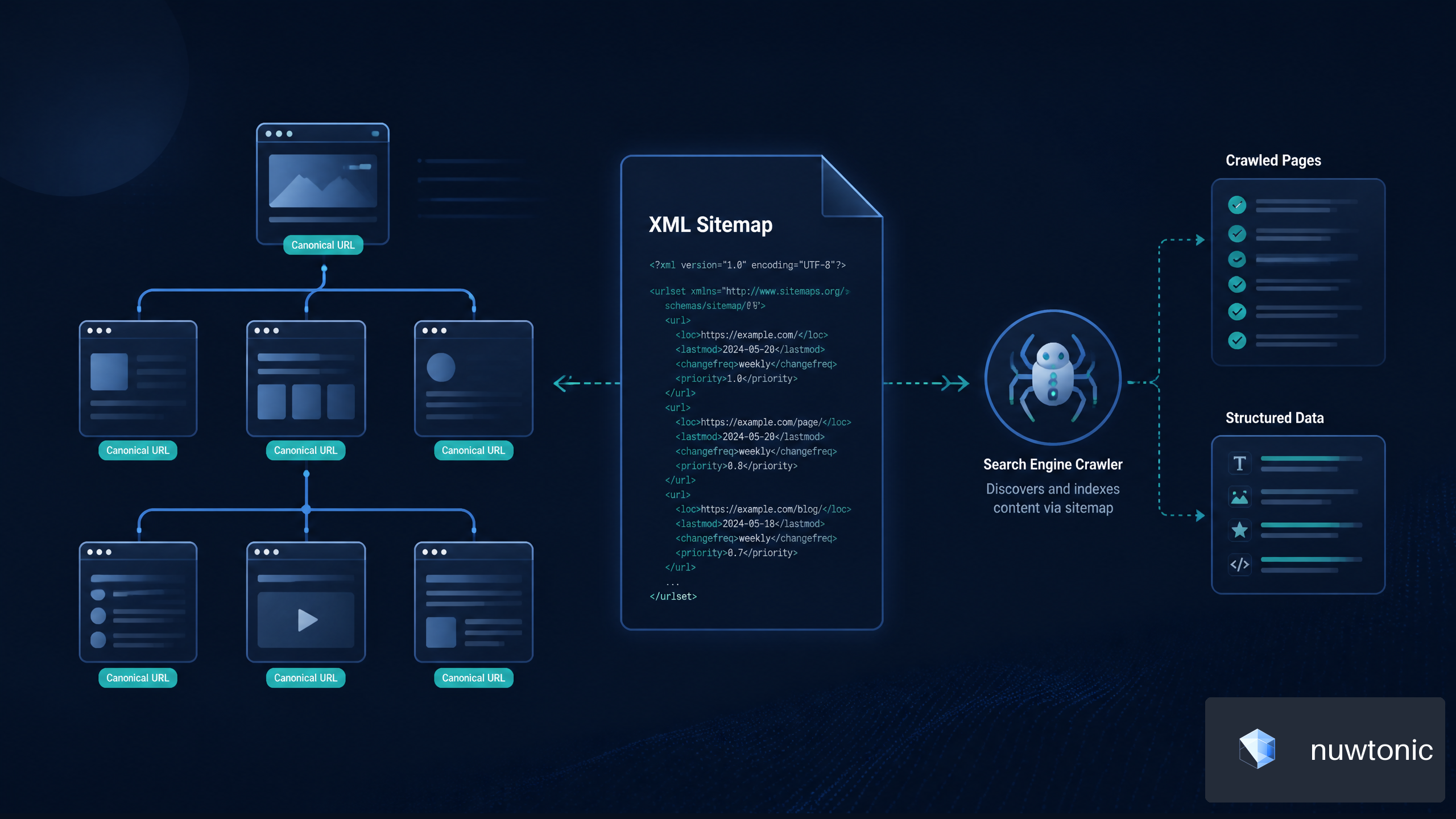
Per-page rollups can also mislead you. A page that looks flat at the URL level might be winning for a tight query set and losing elsewhere, which is why analysts usually export the same date range for control and variant groups and compare the grouped trends rather than staring at a single dashboard tile. The GSC performance workflow in Nuwtonic's dashboard is one example of how teams can keep those views organized without manually rebuilding the same exports every time.
Google Search Console für Shopbetreiber is also a useful reference if your test pages live inside ecommerce templates and you need a practical reminder of how Search Console data behaves across product and category pages.
The crawl-delay issue is real, so the reporting window needs to reflect it. If Google hasn't had enough time to recrawl both buckets, the test is reading partial exposure rather than true performance. That's why the earlier guidance about letting SEO tests run long enough matters, because the search engine has to see the variant before your dashboard can evaluate it.
A clean read usually comes from one locked query set, one locked URL set, and one locked start-and-end window. Anything more flexible than that invites hindsight bias, especially once the first chart looks promising.
Statistical Significance for People Who Hate Statistics
Many marketing teams talk about significance as if it were a trophy. It isn't. A p-value tells you how surprising the data would be if the null hypothesis were true, not whether the uplift is large enough to matter in business terms. A confidence interval shows the range where the true effect is likely to sit, and statistical power tells you whether your test had a decent chance of detecting a real change.
Reading p-values without overclaiming
A CTR test needs a plain reading. If control sits at 2.1% and variant sits at 2.3%, the question is not whether 0.2 percentage points sounds good. The question is whether that difference holds across enough query demand to rise above organic noise.
That is where overreach usually starts. A p-value under 0.05 does not mean the lift is large, durable, or safe to roll out blindly. It only means the result would be unlikely under the null, assuming the test was designed and analyzed correctly.
The backdrop for this is harsh. In mature testing programs, only 19.1% of tests produced a statistically significant winner in one dataset summarized by Conversion Team, and other benchmarks cited there point to similar ranges. That does not mean experimentation is broken, it means good ideas are rare and have to be proven cleanly.
Daily peeking does not rescue a weak test. Sequential checking inflates false positives because you are asking the data to finish the story before the test is done. Let the test reach its planned horizon, then inspect the result once, with the control bucket still intact.
Organic search also resists tidy sample-size rules. CRO teams may talk about 1,000 to 5,000 users per variation as a rough benchmark, but search data is messier because crawl timing and query mix distort the read. Use that range as a warning, not a promise.
Practical rule: If the significance math looks tidy but the search demand is thin, the test is probably underpowered.
What to Do When You Don't Have Enough Pages to Split
Small sites get trapped by advice that assumes hundreds of similar URLs. If you only have a handful of pages, classic bucketing collapses because the sample is too small, the templates are too different, or the query volume just doesn't support a reliable split. Waiting longer often doesn't solve that, because the demand curve may never be large enough to create a clean read.
Using indirect evidence when classic split tests are underpowered
In this situation, the question shifts from “Did the variant win statistically?” to “Is there enough evidence to justify rollout?” That evidence can come from pre/post comparisons adjusted for seasonality, a small holdout group, or a weighted-control approach that borrows structure from CRO but doesn't pretend the sample is bigger than it is. The cleanest decision is often directional, not absolute.
A 12-page B2B SaaS blog is a good example. If one post gets a schema enhancement and the rest of the site is too small to split cleanly, the team can watch impressions, CTR, and query coverage before and after the change while keeping the rest of the page stable. If branded traffic is excluded and the post keeps showing stronger relevance on the same query set, that's more defensible than waiting for impossible significance.
The most important discipline is being honest about uncertainty. A low-volume site can still learn something useful from a controlled rollout, but it shouldn't pretend the result is as clean as a large templated ecommerce test. That's also why the baseline win-rate reality matters. When so many tests fail to produce strong winners, a weak but consistent directional signal is often the best available evidence.
If you need a broader framework for getting more value out of thin traffic, the operational move is to track the same page over a longer window and compare it against the most comparable pages you do have. You're not trying to manufacture certainty. You're trying to avoid a bad decision based on one noisy week.
Extending the Test to AI Search Citations
Blue-link ranking is no longer the whole story. A page can hold its position in classic search and still gain or lose visibility inside AI-generated answers, which means CTR-only testing can miss a real business shift. That's why answer-engine visibility is becoming part of modern SEO experimentation.
Tracking answer-engine visibility alongside blue links
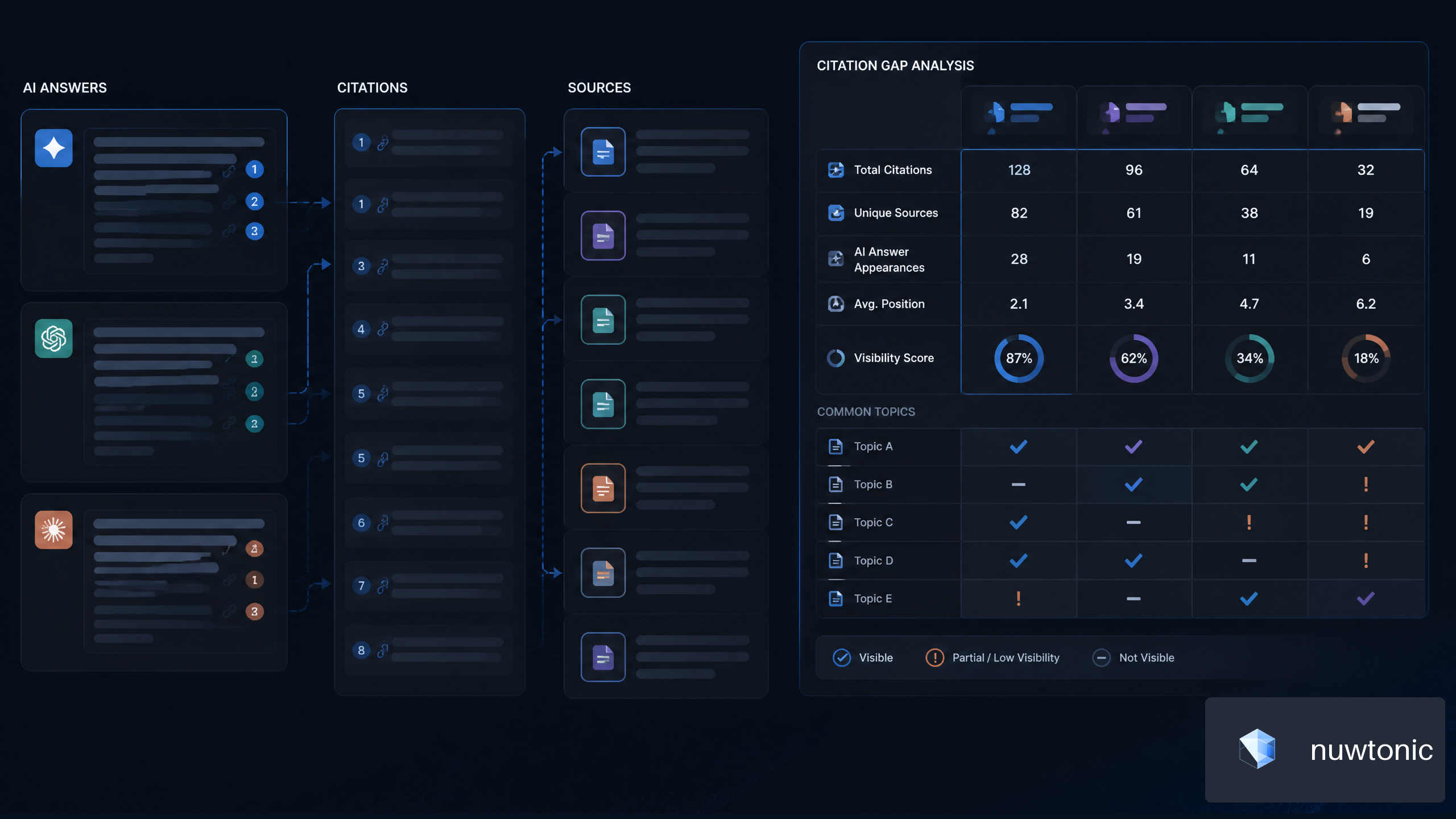
The practical setup is straightforward. Build prompt sets that reflect the questions your page should answer, then check whether the variant is cited, summarized, or mentioned across systems such as ChatGPT, Gemini, Perplexity, and Google AI Overviews. Track inclusion counts, source-attribution patterns, and the stability of those mentions over time rather than relying on a single snapshot.
The page structure matters here. Q&A headings, extractable tables, and structured schema blocks can make it easier for models to pull a page into an answer. That doesn't guarantee inclusion, but it gives the variant a better chance of being machine-readable in the places where AI search now surfaces source material.
A useful resource for this angle is rank in answer engines, especially if you're trying to connect classic organic testing with citation tracking in a way that a legacy SEO dashboard won't handle on its own. The broader citation-gap workflow in this AI citation analysis guide is relevant when the question is whether your content is being selected by the model, not just crawled by search.
A realistic low-traffic example is a variant that adds a tighter definition block, a comparison table, and schema to a key explainer page. The classic search result might barely move, but the page can start showing up more often in answer engines because it's easier to extract. That's a real win if your demand surface includes AI discovery, even when the traditional significance line never lights up.
The caveat is volatility. Model updates, crawl lag, and changing source-selection behavior can all distort the read, so the validation window needs patience and consistency. The right question isn't whether one answer appeared once. It's whether the variant is getting pulled into answers more reliably than the control over a stable observation window.
A 20-Minute Pre-Rollout Sanity Check
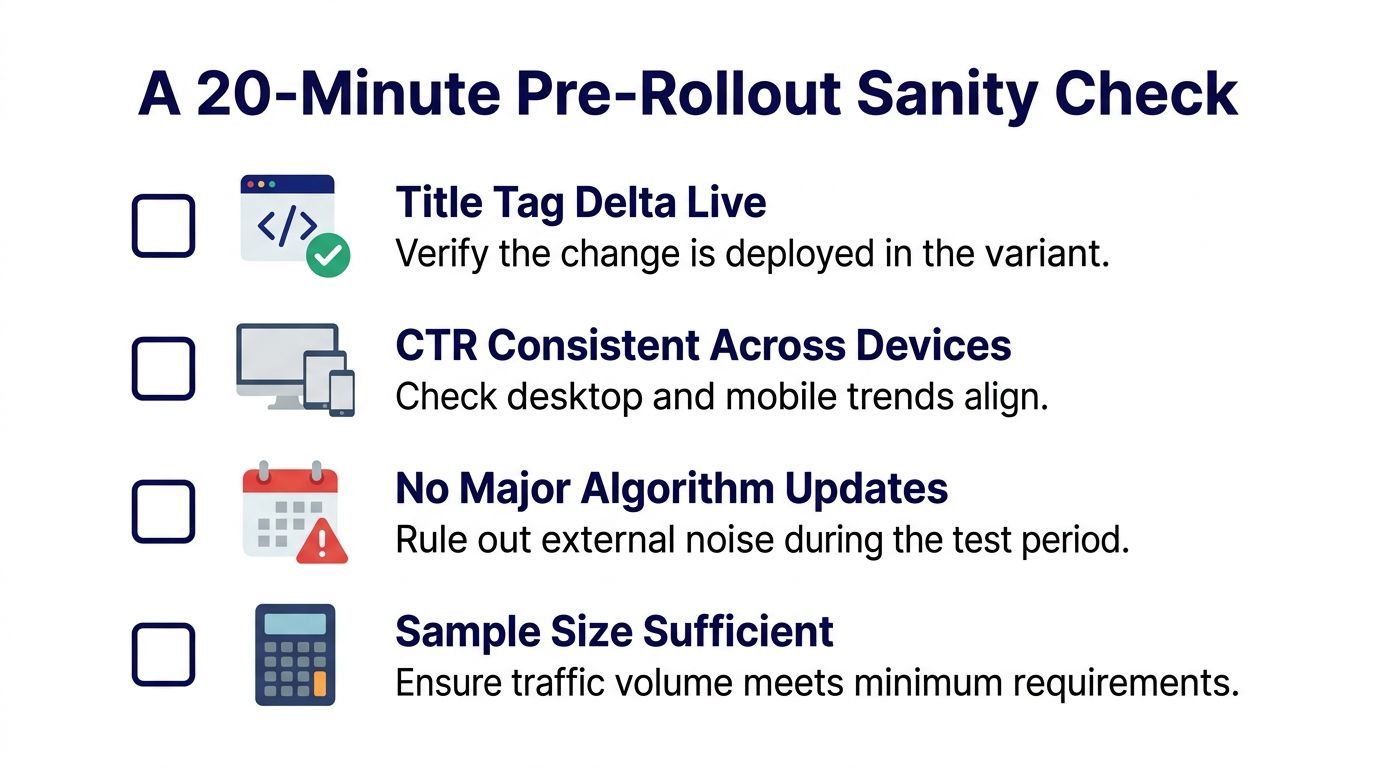
Before any rollout, run a fast triage. Most false wins are boring implementation failures disguised as good news, and this check catches the usual suspects before they spread to the rest of the site. If the variant fails here, shipping it sitewide just scales the mistake.
Deciding whether to ship, stage, or stop
Check one, the title tag delta is live on the variant pages. If the deployed HTML doesn't match the intended change, the test result is garbage no matter how pretty the chart looks. Cache issues, stale templates, and accidental noindex tags create fake confidence fast.
Check two, CTR movement is consistent across devices. If desktop moves but mobile doesn't, or vice versa, the lift may be tied to layout differences, snippet rendering, or device-specific query mix rather than the title change itself. That's one reason segmented GSC views are worth bookmarking.
Check three, average position is stable enough that CTR isn't just following rank. If position improved materially during the test, the CTR change may be a side effect of better ranking rather than proof that the variant's wording worked. That distinction matters when you're defending the rollout in front of stakeholders.
Check four, look for decay in the final week of the window. A real change should show some durability. If the lift collapses late, the first half of the test may have been noise, a temporary query mix shift, or a short-lived ranking bump that won't survive rollout.
A phased rollout is safer than a sitewide jump. Keep the control live somewhere, expand the variant to a larger bucket of similar pages, and watch a second window before full deployment. If the test is inconclusive but harmless, archive it and move on. Don't drag it out indefinitely just to avoid making a decision.
Ship the evidence, not the excitement.
After rollout, keep watching for cannibalization risk, decay, and downstream CTR changes on sibling pages. A good SEO program compounds learning because every test feeds the next one. A noisy one keeps re-running the same title rewrite and wondering why the result won't hold.
If you're building a repeatable SEO experimentation process, Nuwtonic can help you turn Search Console patterns, page-level issues, and AI visibility gaps into reviewable fixes instead of one-off guesses. Visit Nuwtonic to see how its GSC analysis, citation tracking, and change-control workflow can support cleaner testing and faster rollout decisions.