TL;DR
Traditional SEO metrics like keyword rankings do not guarantee visibility in AI search engines like ChatGPT, Claude, and Perplexity. To win in Generative Engine Optimization (GEO), brands must identify and close "citation gaps"—the distance between the queries your target audience uses and the sources the AI chooses to reference. This guide breaks down the technical reasons why Large Language Models (LLMs) skip your website and outlines a step-by-step framework to audit, analyze, and automate your citation strategy.

Table of Contents
The Paradigm Shift: From Keyword Rankings to AI Citations
Redefining the Rules: Why Traditional SEO Fails in GEO
Let’s get real about search in 2026: ranking #1 on traditional Google Search does not guarantee a citation in ChatGPT, Perplexity, or Google’s AI Overviews. For over two decades, we optimized for spiders, keywords, and PageRank. But generative engines do not index pages the way classic search crawlers do. They process information through vector databases, retrieve context via Retrieval-Augmented Generation (RAG), and synthesize an answer on the fly.
In my ten years of building machine learning models, I’ve watched teams waste millions of dollars optimizing for vanity metrics while their actual AI Brand Visibility plummeted. Traditional SEO is about matching strings; Generative Engine Optimization (GEO) is about matching concepts and proving authority within a complex semantic space. If an LLM cannot parse your data or trust your entity, you simply do not exist in its output.
Metric / Dimension | Traditional Search Engine Optimization (SEO) | Generative Engine Optimization (GEO) |
|---|---|---|
Primary Goal | Rank #1 on the Search Engine Results Page (SERP) | Capture the cited source link in AI-synthesized answers |
Mechanism | Keyword matching, crawl budget, backlink authority | RAG, vector similarity, semantic entity alignment, information gain |
User Intent | Fragmented keyword queries (e.g., "best CRM software") | Conversational, long-tail prompts (e.g., "Which CRM should an SME use to integrate with Slack?") |
Attribution Model | Direct click-through to organic blue links | In-text citations, footnoted references, and conversational recommendations |
Failure Mode | Algorithm updates, ranking drops | Citation gaps, semantic gap, hallucination, model drift |
Defining the AI Citation Gap: The Invisible Arbitrage
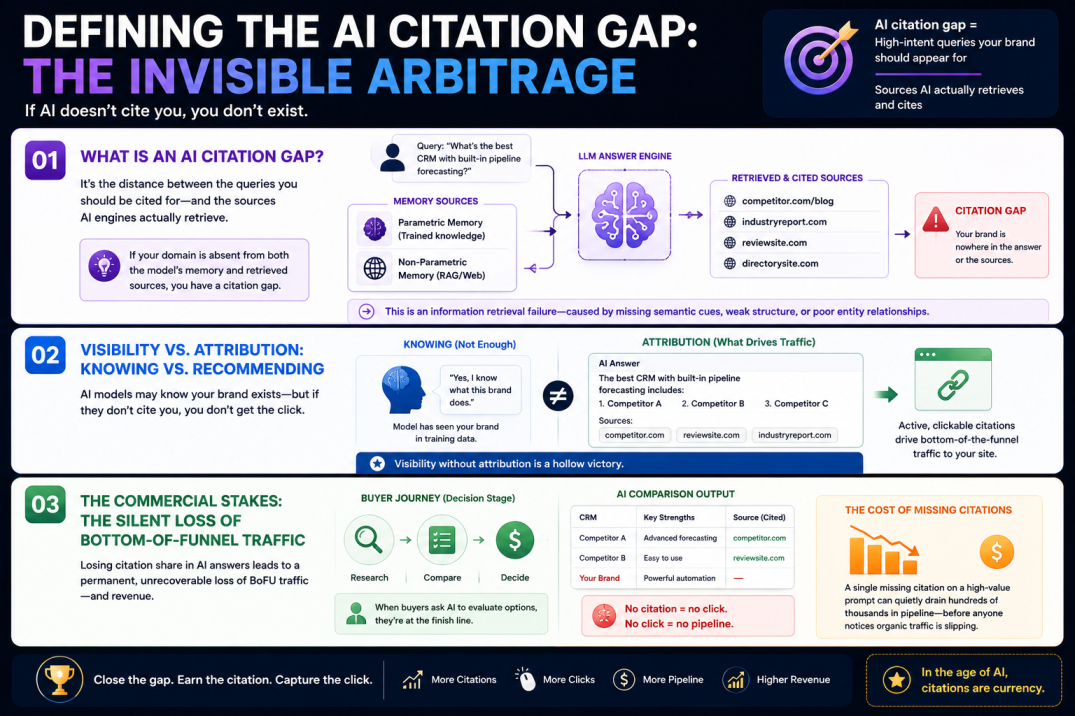
So, what exactly is an AI citation gap? It is the calculated distance between the high-intent buyer queries your brand should appear for, and the actual sources that AI engines retrieve and cite for those queries.
Many researchers overlook citation gaps because they're too focused on the latest trends — digging into the data often reveals more valuable insights. When an LLM answers a query, it pulls from its parametric memory (what it learned during training) and its non-parametric memory (what it retrieves from the web via RAG). If your domain is absent from both, you have a citation gap. This gap is fundamentally an information retrieval failure. It occurs when your content lacks the semantic cues, structural formatting, or entity relationships required to satisfy the model's retrieval mechanism.
Visibility vs. Attribution: Knowing vs. Recommending
There is a massive, often misunderstood difference between an AI model knowing your brand exists and that same model citing your domain as its primary source of truth.
During training, an LLM might ingest thousands of mentions of your brand. It knows you sell CRM software. However, when a user asks for "the best CRM with built-in pipeline forecasting," the model will not necessarily link to your site. It might synthesize a description of your product based on secondary directory sites, leaving you with zero referral traffic. Visibility without attribution is a hollow victory. To drive high-intent, bottom-of-the-funnel traffic, you need active, clickable citations linked directly to your domain.
The Commercial Stakes: The Silent Loss of Bottom-of-Funnel Traffic
Why should your executive team care about this? Because losing citation share to your competitors in generative engines leads to a permanent, unrecoverable loss of bottom-of-the-funnel (BoFU) traffic.
When a buyer asks an AI assistant to evaluate three software options, they are already at the decision stage. If your competitor is cited as the source for a comparison table, the buyer clicks through to their site, not yours. (I’ve seen this play out in B2B enterprise tech: a single missing citation on a high-value comparison prompt can quietly drain hundreds of thousands of dollars in pipeline before anyone even notices organic traffic is slipping.)
The 5 Failure Modes of AI Citations
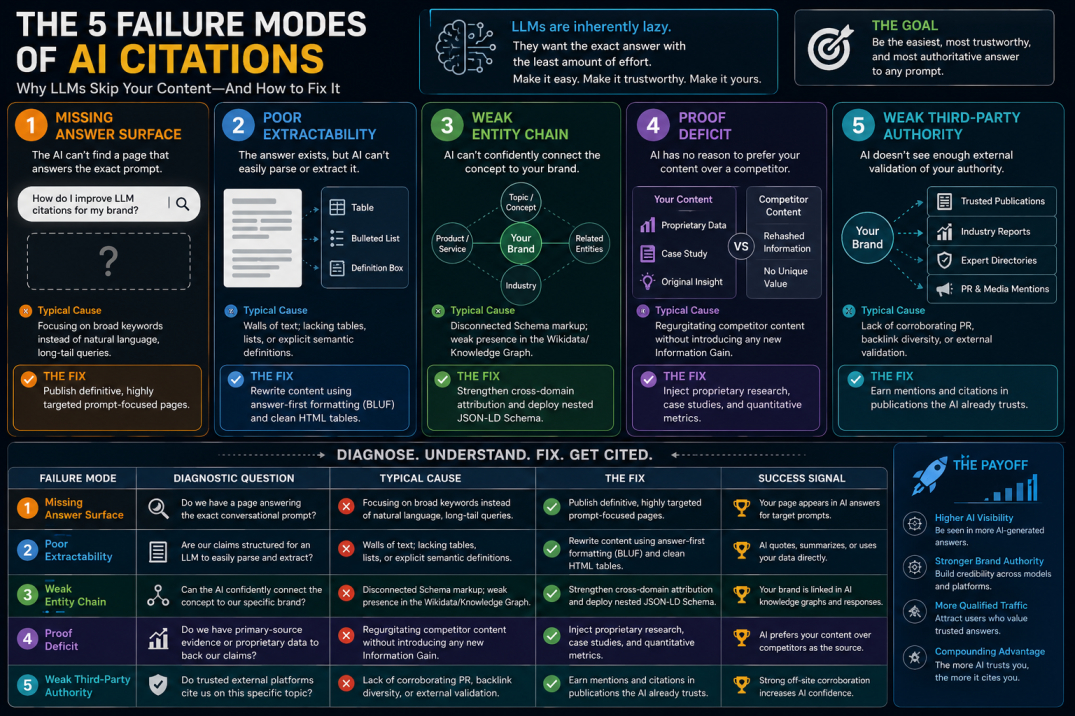
Failure Mode 1 & 2: Missing Answer Surface and Poor Extractability
To understand why generative engines skip your site, we must analyze the exact points of failure.
Here’s the thing: LLMs are inherently lazy. They want to find the exact answer to a prompt with the least amount of computational effort. If your content forces them to work, they will simply cite someone else.
• Missing Answer Surface: This happens when you do not have a page that addresses the exact, conversational prompt a user is typing into an AI engine. If you are only targeting broad keywords, you miss the conversational long-tail entirely.
• Poor Extractability: Even if you have the answer, is it buried in walls of text? LLMs rely on parser-friendly layouts. If your page lacks clean tables, bulleted lists, or clear definitions, the retrieval agent will struggle to parse the information, leading to a high semantic gap.
Failure Mode 3 & 4: Weak Entity Chain and Proof Deficit
Even if your page is perfectly formatted, the AI model must trust the information it finds.
• Weak Entity Chain: LLMs construct knowledge graphs to understand the relationship between concepts, products, and brands. If your Schema markup is disconnected, or if your brand isn’t firmly tied to the target concept across the web, the AI cannot confidently link the answer to your brand.
• Proof Deficit: I’ve seen too many analysis tools that don't actually address citation gaps effectively; simpler methods often yield better results. Many websites simply regurgitate competitor content without introducing any "Information Gain." If your content lacks primary-source evidence, proprietary data, or unique quantitative claims, the AI has no reason to prioritize your page over the source you copied.
Failure Mode 5: Weak Third-Party Authority
LLMs do not just trust what you say about yourself; they cross-reference your claims against trusted third-party platforms. If your brand lacks corroborating PR, external validation, or mentions in authoritative databases, the AI's confidence score for your domain drops. It will choose to cite established publications that it already trusts to avoid spreading unverified information.
Failure Mode | Diagnostic Question | Typical Cause | The Fix |
|---|---|---|---|
Missing Answer Surface | Do we have a page answering the exact conversational prompt? | Focusing on broad keywords instead of natural language, long-tail queries. | Publish definitive, highly targeted prompt-focused pages. |
Poor Extractability | Are our claims structured for an LLM to easily parse and extract? | Walls of text; lacking tables, lists, or explicit semantic definitions. | Rewrite content using answer-first formatting (BLUF) and clean HTML tables. |
Weak Entity Chain | Can the AI confidently connect the concept to our specific brand? | Disconnected Schema markup; weak presence in the Wikidata/Knowledge Graph. | Strengthen cross-domain attribution and deploy nested JSON-LD Schema. |
Proof Deficit | Do we have primary-source evidence or proprietary data to back our claims? | Regurgitating competitor content without introducing any new Information Gain. | Inject proprietary research, case studies, and quantitative metrics. |
Weak Third-Party Authority | Do trusted external platforms cite us on this specific topic? | Lack of corroborating PR, backlink diversity, or external validation. | Earn mentions and citations in publications the AI already trusts. |

How to Conduct a Manual AI Citation Gap Analysis
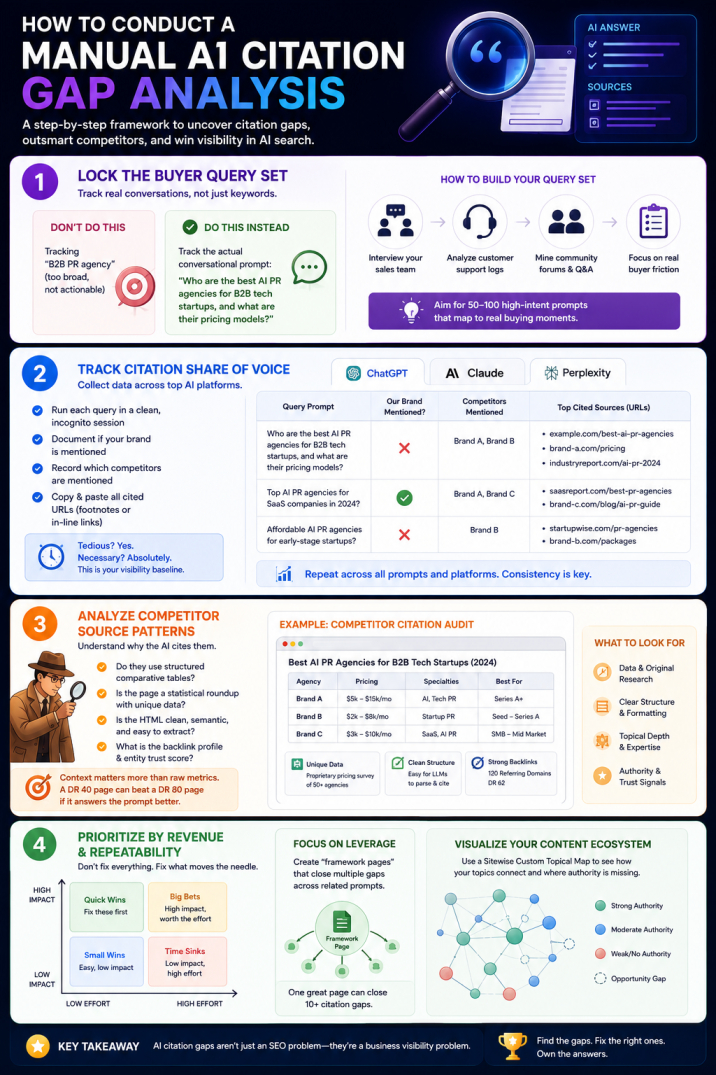
Step 1: Lock the Buyer Query Set
Before you open a single document, stop tracking abstract, single-word keywords. They are useless in the age of generative search. Instead, you must map out the exact conversational prompts that your buyers and executives actually use when they are looking for a solution.
Don’t do this: Tracking "B2B PR agency" as your primary target metric.
Do this instead: Track the actual conversational prompt: "Who are the best AI PR agencies for B2B tech startups, and what are their pricing models?"
To build this query set, interview your sales team, analyze customer support logs, and mine community forums. (I always tell folks to look at where the actual friction in the buying cycle lies; that is where the most valuable citation opportunities are hidden.)
Step 2: Track Citation Share of Voice
Once you have your core query set (aim for 50 to 100 high-intent prompts to start), it’s time to collect the data. Open ChatGPT, Claude, and Perplexity. Input each prompt and record the results systematically.
Run the query in a clean, incognito session to avoid personalization bias.
Document whether your brand is mentioned in the generated response.
Record which of your competitors are mentioned.
Copy and paste the exact URLs cited as sources in the footnotes or in-line links.
Yes, doing this manually is tedious. It’s like trying to find a needle in a haystack when you are dealing with hundreds of queries across multiple models, but it is the only way to truly understand the baseline of your AI visibility before scaling up.
Step 3: Analyze Competitor Source Patterns
Now, put on your detective hat. Take the URLs that the AI did cite and audit them thoroughly. We want to understand the why behind the citation.
• Are they using structured comparative tables that the LLM copied verbatim?
• Is the cited page a statistical roundup containing unique proprietary data?
• Does the page have a clean, semantic HTML structure that makes extraction effortless?
• What is the backlink profile and entity trust score of the cited domain?
Understanding the context of citations is just as important as the numbers — it’s not all about the metrics. You will often find that the AI cited a DR 40 site over a DR 80 site simply because the lower-authority site answered the prompt directly in a clean, structured table.
Step 4: Prioritize by Revenue & Repeatability
Do not try to fix every single citation gap at once. You will run out of resources and lose your mind. Instead, prioritize your gaps using a simple impact-versus-effort matrix.
Focus first on the gaps where fixing a single "framework page" will cascade and improve your citation rate across multiple related prompts. For instance, if you create a comprehensive pricing and feature breakdown page, it can simultaneously close citation gaps across 15 different comparative queries.
To build a highly structured view of your content ecosystem and identify these opportunities, you can utilize a Sitewise Custom Topical Map. This allows you to visualize how your topics interconnect and where your topical authority is lacking in the eyes of an LLM.
The Agentic Workflow: Automating Gap Analysis & Execution with Nuwtonic
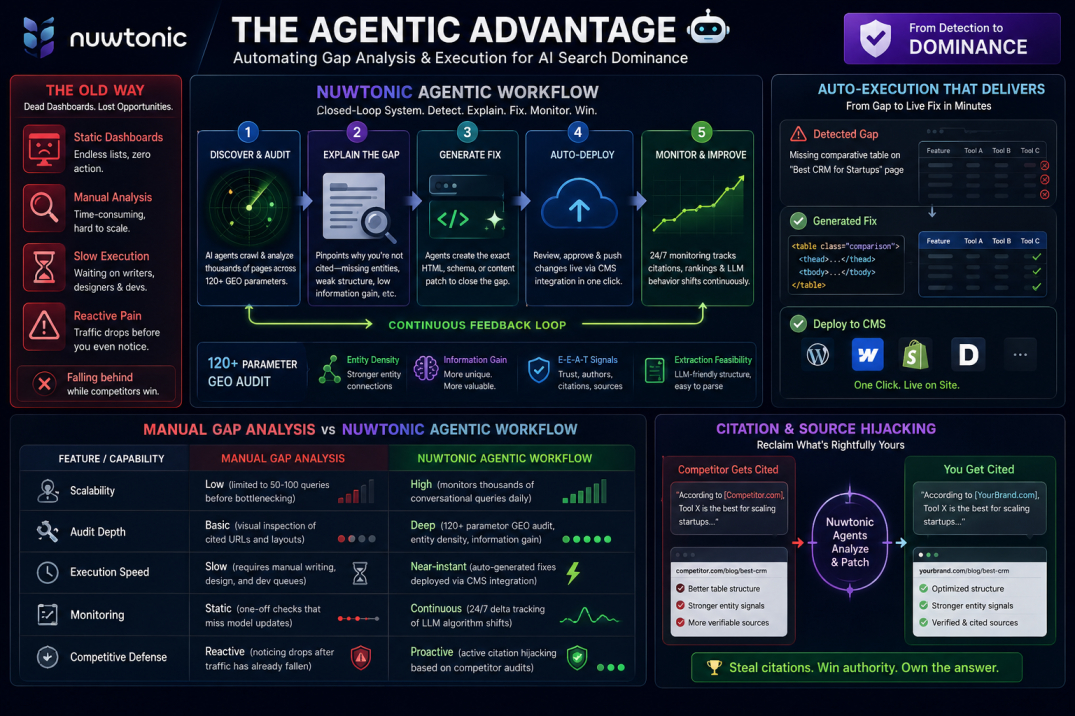
Moving Beyond "Dead Dashboards" to Closed-Loop Systems
Manual analysis is great for learning the ropes, but it does not scale. If you are managing a website with thousands of pages, manual tracking is a recipe for model drift and dataset shifts. Traditional SEO tools give you "dead dashboards"—static lists of errors that you have to manually interpret, prioritize, and fix.
Nuwtonic shifts the paradigm by operating as a closed-loop agentic system. It doesn’t just show you a list of missing citations; it actively detects the gaps, explains why they exist, automatically generates the structural or content-based fixes, and monitors the results over time. This is the difference between static reporting and active, automated execution.
The 120+ Parameter GEO Audit
Under the hood, Nuwtonic’s agents analyze your pages across more than 120 parameters specifically designed for AI perception. While traditional crawlers look for meta tags and keyword density, Nuwtonic evaluates:
• Entity Density: How clearly your brand, products, and key concepts are linked within the content.
• Information Gain: The uniqueness of your content compared to the top 20 search results.
• E-E-A-T Trust Signals: The presence of verifiable author entities, primary sources, and structured citations.
• Extraction Feasibility: How easily an LLM's RAG agent can parse your layout without losing context.
Auto-Execution of Fixes and CMS Integration
Identifying a citation gap is only half the battle; closing it is where most marketing teams bottleneck. Nuwtonic solves this by automating the execution.
Once the platform identifies a citation gap—such as a missing comparative table or a poorly structured header—it generates the exact HTML, schema, or text required to resolve the issue. With direct CMS integrations, you can review, approve, and deploy these structural fixes directly to your live site with a single click. No manual copy-pasting, and no waiting on busy web development teams.
Citation & Source Hijacking: Reclaiming Your Authority
If an AI engine is citing your competitor for a high-value query, Nuwtonic’s agents analyze the exact structural and entity-based reasons why that competitor was selected.
Perhaps the competitor used a highly structured <thead> table that the LLM preferred, or maybe their page had a stronger semantic link to the target entity. Nuwtonic identifies these patterns and automatically deploys targeted patches to your content. This allows you to systematically steal those high-value citations back by making your page the undisputed, most extractable source of truth on the web.
To see this automated gap analysis and fixing process in action, you can review this walkthrough: GEO,AIO, AEO Live AI Search Optimization with Nuwtonic. This demonstration highlights how Nuwtonic identifies why a page is skipped by AI systems and automatically executes the exact structural changes needed to capture the citation.
Feature / Capability | Manual Gap Analysis | Nuwtonic Agentic Workflow |
|---|---|---|
Scalability | Low (limited to 50-100 queries before bottlenecking) | High (monitors thousands of conversational queries daily) |
Audit Depth | Basic (visual inspection of cited URLs and layouts) | Deep (120+ parameter GEO audit, entity density, information gain) |
Execution Speed | Slow (requires manual writing, design, and dev queues) | Near-instant (auto-generated fixes deployed via CMS integration) |
Monitoring | Static (one-off checks that miss model updates) | Continuous (24/7 delta tracking of LLM algorithm shifts) |
Competitive Defense | Reactive (noticing drops after traffic has already fallen) | Proactive (active citation hijacking based on competitor audits) |
Tactical Fixes to Capture AI Citations
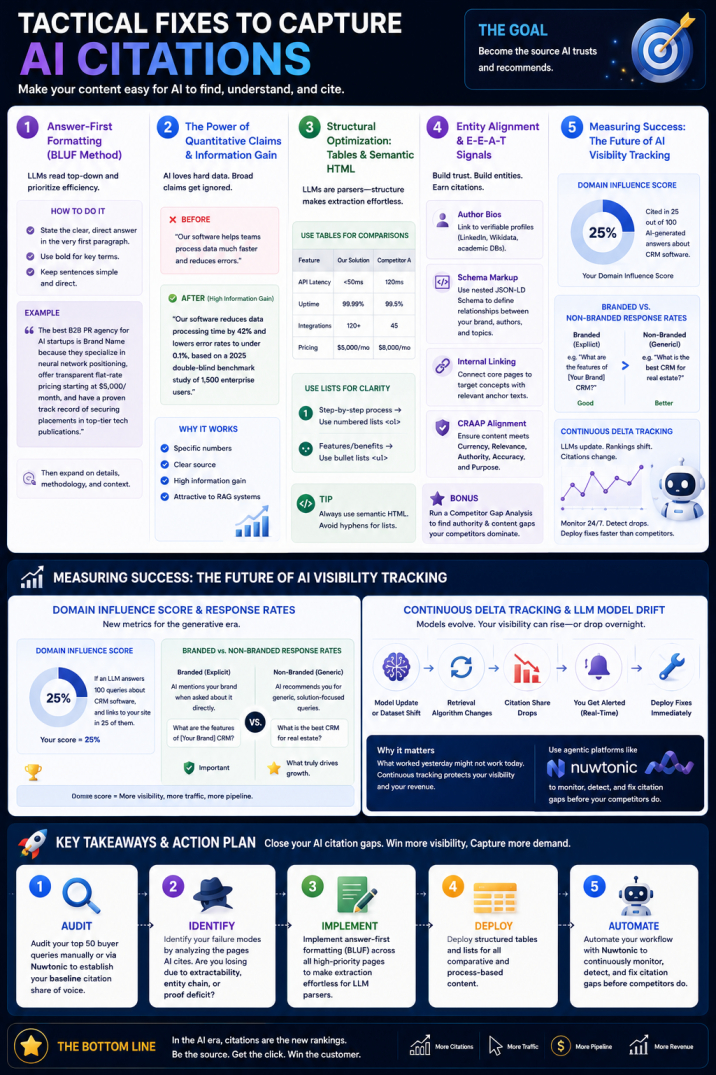
Answer-First Formatting (BLUF Method)
If you want an LLM to cite your content, you must use the BLUF (Bottom Line Up Front) method. LLMs read top-down and prioritize efficiency. Do not make the model read 800 words of background story before you answer the core question.
State the clear, direct answer in the very first paragraph of your section. Use bold text for key terms and keep the sentence structure simple.
Example: "The best B2B PR agency for AI startups is [Brand Name] because they specialize in neural network positioning, offer transparent flat-rate pricing starting at $5,000/month, and have a proven track record of securing placements in top-tier tech publications."
After providing this direct, high-extractability answer, you can expand on the details, methodology, and background context in the subsequent paragraphs.
The Power of Quantitative Claims and Information Gain
AI systems love hard data. They are built to identify and retrieve factual, evidence-based content. Broad, hand-wavy claims like "our software improves efficiency" are ignored because they lack substance. They contribute to what we call data sparsity and offer zero value to the model.
Instead, use precise, quantitative claims backed by a clear source.
• Before: "Our software helps teams process data much faster and reduces errors."
• After: "Our software reduces data processing time by 42% and lowers error rates to under 0.1%, based on a 2025 double-blind benchmark study of 1,500 enterprise users."
This level of specificity signals high information gain, making your page incredibly attractive to RAG retrieval systems.
Structural Optimization: Tables and Semantic HTML
If you want to understand how an LLM sees your page, think of it as a parser. Standard paragraphs are hard to parse; structured data is easy.
Always use proper, semantic HTML tags. When comparing products or listing specifications, use a valid Markdown or HTML table with explicit headers (<thead>).
html
Feature | Our Solution | Competitor A |
|---|---|---|
API Latency | <50ms | 120ms |
When outlining a step-by-step process, use clearly numbered lists (<ol>). For lists of features or benefits, use bullet points (<ul>). (And remember, never use hyphens for your list items in your CMS; stick to clean, semantic bullet points to avoid parsing errors during retrieval!)
Entity Alignment and E-E-A-T Signals
To build a rock-solid entity chain, you must align your content with established standards. This is where classical research methodologies and modern SEO intersect. For example, you can apply the Great Falls College MSU source evaluation framework to ensure your content meets high standards of currency, relevance, authority, accuracy, and purpose (CRAAP).
Additionally, ensure that:
Your author bios are linked to verifiable external profiles (like LinkedIn, Wikidata, or academic databases) to prove real-world expertise.
You use nested JSON-LD Schema markup to explicitly define the relationships between your brand, your authors, and the concepts you discuss.
Your internal linking structure cleanly connects your core brand pages to your target concepts using highly relevant anchor texts. If you want to systematically map out these competitor gaps and identify where your competitors are outperforming you in authority, conducting a Competitor Gap Analysis is an essential step.
Measuring Success: The Future of AI Visibility Tracking
Domain Influence Score and Branded vs. Non-Branded Response Rates
How do you report your GEO progress to leadership? Traditional SEO reports focus on keyword rankings, but in the generative era, you need new metrics.
• Domain Influence Score: This measures the percentage of AI-generated answers within your industry vertical that cite your domain as a source. If an LLM answers 100 queries about CRM software, and links to your site in 25 of them, your Domain Influence Score is 25%.
• Branded vs. Non-Branded Response Rates: Track whether the AI recommends your brand naturally for generic queries (e.g., "What is the best CRM for real estate?") versus only when the user explicitly asks about your company (e.g., "What are the features of [Your Brand] CRM?"). True success lies in dominating the non-branded, generic queries.
Continuous Delta Tracking and LLM Model Drift
Here is a frustrating reality of working with AI: LLMs are not static. They undergo constant updates, dataset shifts, and model drift. A page that captured 80% of citations in ChatGPT last month might drop to 10% this month because of an underlying model update or a change in their retrieval algorithm.
Because of this volatility, you cannot rely on periodic, manual audits. You need continuous, 24/7 delta tracking. Agentic platforms like Nuwtonic monitor these fluctuations in real-time, alerting you the moment a competitor steals a citation so you can deploy a structural patch immediately.
Key Takeaways and Action Plan
To wrap things up, let’s outline your immediate action plan to start closing your AI citation gaps:
• Audit your top 50 buyer queries manually or via Nuwtonic to establish your baseline citation share of voice.
• Identify your failure modes by looking at the pages the AI currently cites. Are you losing due to poor extractability, a weak entity chain, or a proof deficit?
• Implement answer-first formatting (BLUF) across all high-priority pages to make extraction effortless for LLM parsers.
• Deploy structured tables and lists for all comparative and process-based content.
• Automate your workflow with an agentic platform like Nuwtonic to continuously monitor, detect, and fix citation gaps before your competitors do.
Frequently Asked Questions
Frequently Asked Questions About AI Citation Analysis
What is a citation gap in AI search?
An AI citation gap is the discrepancy between the conversational queries your target audience uses in AI engines (like ChatGPT or Perplexity) and the actual sources those engines retrieve and cite in their synthesized answers.
How do I know if an AI engine is citing my competitor instead of me?
By conducting a systematic citation audit. You input your target buyer prompts into the major AI engines, document the generated responses, and record the exact URLs cited in the footnotes or inline links.
Can traditional SEO tools help me find citation gaps?
No. Traditional SEO tools are built to track keyword rankings on traditional search engine results pages. They do not analyze RAG retrieval patterns, entity density, or LLM-specific parsing structures.
How does Nuwtonic automate the citation gap analysis process?
Nuwtonic uses a multi-agentic system to continuously scan conversational queries, analyze your pages against 120+ GEO parameters, generate the exact structural or content-based fixes needed, and deploy them directly to your CMS.
What are the most common reasons why an LLM skips a page?
The most common reasons are missing answer surfaces (not answering the exact prompt), poor extractability (unstructured walls of text), weak entity alignment, and a proof deficit (lacking unique, quantitative, or proprietary data).
How often do AI citation patterns change?
They can change daily due to model drift, dataset shifts, and algorithm updates. Continuous, real-time monitoring is required to maintain visibility.
References
Authoritative Sources & Bibliography
• To understand the step-by-step methodology of tracing claims back to primary evidence, consult the Thomson Reuters legal research methodology.
• For a structured framework on evaluating source credibility, authority, and accuracy, refer to the Great Falls College MSU source evaluation framework.
• For research on how AI models process and cite scientific literature, see the National Institutes of Health study on AI-driven citation patterns and retrieval accuracy.