
If you’re searching for the Best Profound Alternatives, the short answer is this: Promptwatch stands out for end to end GEO workflows, Peec AI is excellent for international teams, Lantern fits B2B SaaS teams on HubSpot, Scrunch AI suits regulated industries, and Otterly.AI remains the easiest budget entry point. That’s the quick fix answer. But I’ve found that too many quick fix solutions lead to more confusion than clarity; a steady approach yields better long term results.
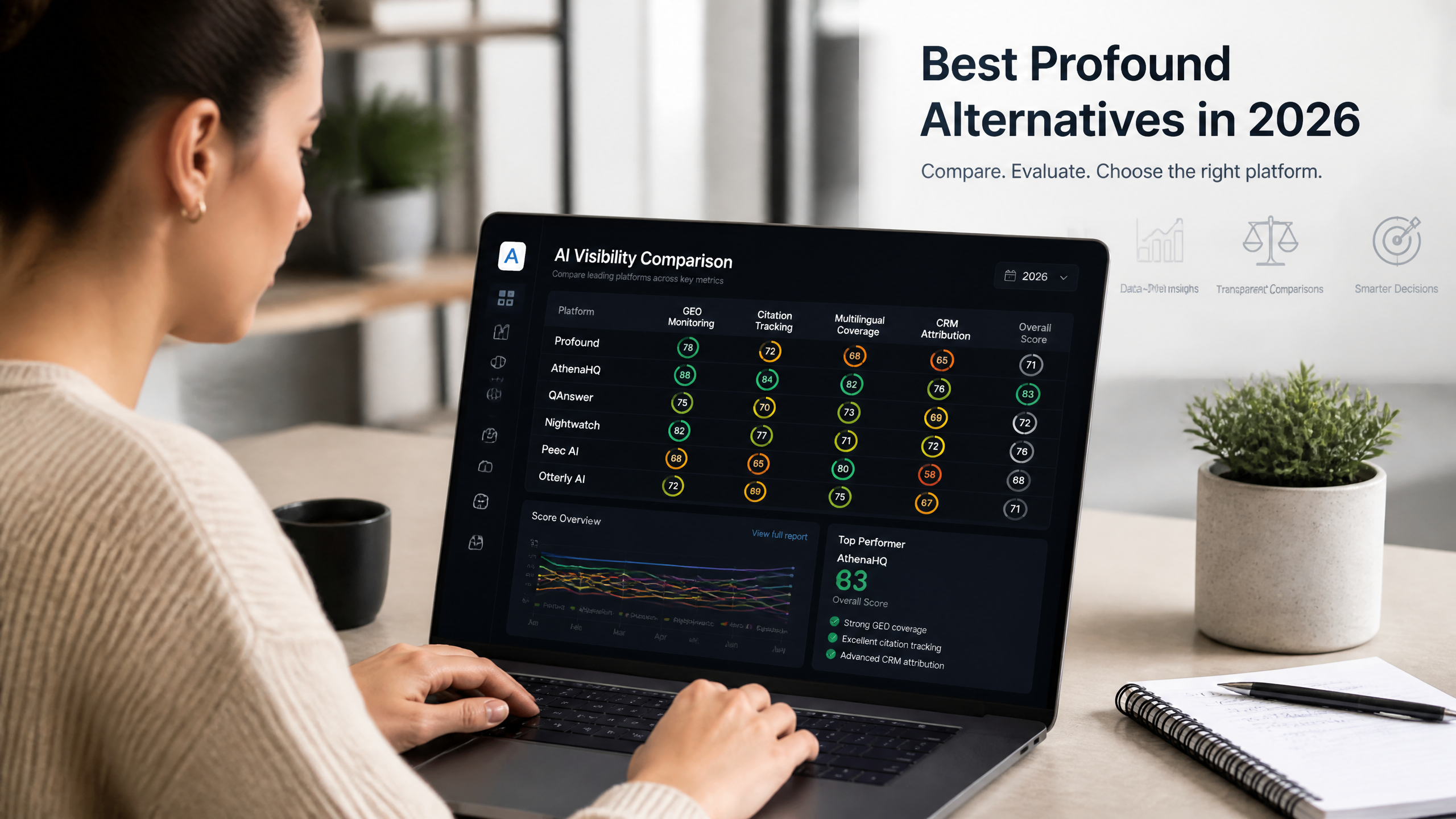
AI search has fundamentally changed how people discover brands.
Instead of clicking through ten blue links, users are increasingly asking ChatGPT, Gemini, Claude, Perplexity, and Google's AI Overviews for recommendations. That shift has created an entirely new category of software focused on AI Search Optimization, Generative Engine Optimization (GEO), and AI visibility monitoring.
One of the most recognized players in this space is Profound. It helps enterprises monitor how their brands appear across AI search engines and large language models (LLMs). But for many businesses, Profound isn't the perfect fit. Some teams need deeper SEO workflows, better content optimization, stronger competitor intelligence, or a more affordable platform.
In this guide, we've compared the best Profound alternatives based on:
AI visibility monitoring
Citation tracking
GEO optimization
SEO capabilities
Competitor analysis
Content optimization
Automation
Pricing value
Best-fit use cases
Rather than simply listing features, we'll help you understand which platform is right for your business and where each tool excels.
Quick Comparison: Best Profound Alternatives
Tool | Best For | AI Visibility | GEO Optimization | SEO Suite | Content Creation | Best Fit |
|---|---|---|---|---|---|---|
Nuwtonic | Complete AI Search + SEO platform | ✅ | ✅ | ✅ | ✅ | Agencies, SaaS, Enterprises |
AthenaHQ | Enterprise AI analytics | ✅ | Partial | Limited | No | Large brands |
Peec AI | AI monitoring | ✅ | Partial | No | No | Enterprise marketing |
Semrush | Traditional SEO | Partial | Limited | ✅ | Partial | SEO teams |
Ahrefs | Backlinks & SEO | No | No | ✅ | Partial | Technical SEO |
BrightEdge | Enterprise SEO | Partial | Partial | ✅ | Partial | Fortune 500 |
Conductor | Content operations | Partial | Partial | ✅ | Yes | Enterprise content teams |
Surfer SEO | On-page optimization | No | No | Partial | Yes | Content marketers |
Clearscope | Content optimization | No | No | Partial | Yes | Publishers |
SE Ranking | Budget SEO suite | Limited | No | ✅ | Partial | SMBs |
How We Evaluated These Profound Alternatives
Unlike many comparison articles that simply repeat feature lists, we evaluated every platform across the workflows that actually matter for AI search success.
Our Evaluation Criteria
AI Search visibility tracking
Citation monitoring
Share of Voice across AI platforms
Prompt tracking
Competitor intelligence
GEO optimization
Content gap analysis
Technical SEO capabilities
Workflow automation
Ease of implementation
Pricing value
Scalability
We also looked at one question that many reviews ignore:
Can the platform help you improve AI visibility—or does it only tell you when you have a problem?
That distinction becomes increasingly important as AI search matures.
1\. Nuwtonic — Best Overall Profound Alternative
Best For
Businesses looking for an all-in-one platform for AI Search Optimization, GEO, SEO, content strategy, and competitive intelligence.
Instead of requiring separate tools for AI visibility monitoring, technical SEO, content planning, competitor research, and GEO optimization, Nuwtonic combines these workflows into a single platform built around your site's actual search performance.
Key Features
AI Search visibility tracking
Prompt monitoring across AI platforms
Citation gap analysis
GEO Audit & Fix recommendations
AI search readiness scoring
Google Search Console integration
32+ automated SEO analyses
Competitor gap analysis
Topic cluster generation
Content planning
AI-assisted article generation
Rank tracking
On-page SEO audits
Before-and-after optimization suggestions
Why Nuwtonic Stands Out
Many AI visibility platforms focus primarily on reporting:
Where you're cited
How often you appear
Which competitors are winning
While this information is useful, it still leaves marketing teams asking:
"What exactly should we change?"
Nuwtonic extends beyond visibility by identifying content gaps, structural gaps, E-E-A-T improvements, competitor gaps, and actionable optimization opportunities for specific URLs. It also provides GEO-focused auditing and recommendations, reducing the manual work required to translate insights into improvements.
Information Gain: Monitoring vs. Execution
One of the biggest differences between AI visibility platforms is whether they support execution.
Capability | Monitoring-Only Platforms | Nuwtonic |
|---|---|---|
Track AI citations | ✅ | ✅ |
Measure Share of Voice | ✅ | ✅ |
Identify content gaps | Partial | ✅ |
Recommend improvements | Limited | ✅ |
GEO-specific audits | Limited | ✅ |
Generate optimized content | Rare | ✅ |
Technical SEO recommendations | Usually separate | ✅ |
Competitor gap workflows | Limited | ✅ |
This distinction matters because visibility metrics alone don't improve rankings. Teams still need to identify why competitors are being cited and how to close those gaps—workflows Nuwtonic aims to streamline.
Pros
Combines GEO and SEO workflows in one platform
Actionable recommendations rather than reporting alone
Built around real Google Search Console data
Strong competitor intelligence
Integrated content planning
Supports AI search and traditional search optimization
Cons
Newer platform compared with long-established enterprise SEO suites
Organizations that only need citation monitoring may not require the broader feature set
Best For
SaaS companies
SEO agencies
Enterprise marketing teams
Content-led businesses
Brands investing in AI search visibility
Why This Matters for AI Search
A growing challenge with AI search is that being absent from AI-generated answers isn't always caused by poor rankings in Google. Citation frequency, topical authority, content completeness, and E-E-A-T signals all influence whether AI systems reference your content.
Platforms that help identify and close those gaps—rather than simply measuring them—can reduce the time between discovering an issue and implementing improvements. That's an important distinction when evaluating alternatives to Profound.
2\. AthenaHQ — Best for Enterprise AI Brand Intelligence
AthenaHQ is designed for organizations that need a high-level view of how their brand appears across AI-powered search experiences. Rather than focusing on traditional SEO metrics, it helps enterprise teams understand how AI assistants interpret, mention, and compare their brand against competitors.
For organizations managing multiple product lines or operating across several markets, this broader visibility can be valuable for executive reporting and strategic planning.
Key Features
AI brand visibility monitoring
Share of Voice tracking
Prompt performance analysis
Competitor benchmarking
Executive dashboards
Enterprise reporting
Pros
Built specifically for AI search monitoring
Strong enterprise reporting capabilities
Useful for brand teams and executives
Good competitive benchmarking
Cons
Limited traditional SEO capabilities
Doesn't replace a complete SEO platform
Content optimization workflows are less comprehensive than all-in-one solutions
Best For
Enterprise marketing teams
Global brands
Corporate communications
3\. Peec AI — Best for AI Citation Monitoring
Peec AI focuses on one problem: helping brands understand whether they're being cited by AI assistants.
Instead of trying to become a complete SEO platform, Peec specializes in AI search analytics.
If your primary objective is measuring visibility across AI platforms rather than optimizing your entire SEO workflow, Peec can be a good fit.
Key Features
Citation monitoring
Prompt tracking
AI visibility reports
Competitor monitoring
AI search analytics
Pros
Clean interface
AI-first reporting
Easy to understand
Fast implementation
Cons
Limited SEO functionality
No comprehensive technical SEO
Content optimization requires external tools
Best For
Marketing teams
AI monitoring
Brand visibility reporting
4\. Semrush — Best All-in-One SEO Platform
Semrush remains one of the most comprehensive SEO platforms available.
Although it wasn't originally built for AI search optimization, Semrush has expanded its capabilities to help marketers adapt to Google's AI-powered search experience.
Its strength lies in providing nearly every SEO workflow in one ecosystem.
Key Features
Keyword research
Position tracking
Competitor research
Site Audit
Backlink analysis
Content optimization
Local SEO
PPC research
Pros
Massive keyword database
Excellent competitive research
Mature ecosystem
Extensive integrations
Cons
AI visibility features are still evolving
Limited AI citation analysis compared to GEO-native platforms
Best For
SEO agencies
Large marketing teams
Digital marketing departments
5\. Ahrefs — Best for Technical SEO & Link Intelligence
Ahrefs is widely recognized for having one of the industry's strongest backlink databases and technical SEO toolsets.
Although it doesn't specialize in AI search visibility, strong topical authority, backlinks, and content quality remain important signals that influence whether AI systems trust and reference your content.
Key Features
Backlink Explorer
Site Audit
Rank Tracker
Keyword Explorer
Content Explorer
Competitor analysis
Pros
Industry-leading backlink data
Excellent technical audits
Powerful keyword research
Outstanding competitor insights
Cons
No dedicated AI visibility monitoring
Requires additional GEO tools
Best For
Technical SEO professionals
Agencies
Publishers
Not Every "AI Search Tool" Solves the Same Problem
One of the biggest misconceptions in this category is assuming every platform serves the same purpose.
They don't.
Most products fall into one of five categories.
Platform Type | Primary Goal | Typical Tools |
|---|---|---|
AI Visibility Monitoring | Measure citations and Share of Voice | Profound, Peec AI |
GEO Optimization | Improve AI search readiness | Nuwtonic |
Traditional SEO Suites | Improve Google rankings | Semrush, Ahrefs |
Enterprise SEO Platforms | Governance and reporting | BrightEdge, Conductor |
Content Optimization | Improve individual articles | Surfer SEO, Clearscope |
Understanding this distinction can prevent teams from purchasing overlapping tools—or expecting one platform to solve problems it's not designed for.
For example:
If your goal is executive reporting, visibility dashboards may be enough.
If your goal is earning more AI citations, you'll also need workflows for content improvement, E-E-A-T enhancement, and technical optimization.
If your goal is managing SEO at scale, an enterprise SEO suite may be the better fit.
This is why many organizations now combine AI visibility monitoring with broader optimization workflows rather than treating GEO as a standalone reporting function.
6\. BrightEdge — Best for Enterprise SEO
BrightEdge has long been a leader in enterprise SEO, offering sophisticated reporting, governance, and workflow management for large organizations.
Its AI capabilities continue to evolve alongside Google's AI-driven search landscape.
Best For
Fortune 500 companies
Enterprise SEO teams
Multi-brand organizations
Strengths
Enterprise governance
Large-scale reporting
Workflow management
Technical SEO
Limitations
Premium pricing
Steeper learning curve
More SEO-focused than AI-search-native
7\. Conductor — Best for Enterprise Content Operations
Conductor combines SEO insights with editorial workflows, making it a strong option for large content teams.
Its collaboration features help marketers, writers, and SEO specialists work together more efficiently.
Best For
Large editorial teams
Content marketing departments
Enterprise publishers
Pros
Excellent collaboration
Content recommendations
Enterprise workflows
Cons
AI visibility isn't the primary focus
More expensive than SMB-focused tools
8\. Surfer SEO — Best for Content Optimization
Surfer SEO remains one of the most popular tools for optimizing individual articles.
It analyzes top-ranking pages and recommends improvements based on content structure, semantic coverage, and topical relevance.
Best For
Freelance writers
Content marketers
SEO agencies
Pros
Strong content editor
NLP-based recommendations
Easy to use
Cons
Doesn't monitor AI visibility
Requires other tools for technical SEO and GEO
9\. Clearscope — Best for Editorial Teams
Clearscope focuses on producing high-quality content that aligns with search intent and topical relevance.
Its straightforward interface makes it popular with publishers and in-house editorial teams.
Pros
Excellent content briefs
Readability optimization
Semantic recommendations
Cons
Limited beyond content optimization
No AI visibility monitoring
10\. SE Ranking — Best Budget Alternative
SE Ranking offers an affordable all-in-one SEO toolkit suitable for small businesses and growing agencies.
It includes keyword tracking, website audits, competitor research, and reporting without the enterprise price tag.
Best For
SMBs
Freelancers
Small agencies
Pros
Affordable
Easy to use
Strong feature set for the price
Cons
Limited AI search capabilities
Fewer enterprise features than larger platforms
Choosing the Right Profound Alternative
Instead of asking, "Which tool has the most features?", ask these five questions:
Do you only need to measure AI visibility, or do you also need to improve it?
Will your team manage SEO, GEO, and content in separate tools, or do you want a unified workflow?
How important is competitor intelligence in your strategy?
Do you need enterprise governance or hands-on optimization?
Will AI search become a core acquisition channel over the next two years?
These questions often narrow the field more effectively than feature checklists alone.
11\. ZeroRank AI — Best for AI Citation Optimization
ZeroRank AI is purpose-built for brands that want to improve their visibility across AI-powered search experiences. Instead of focusing exclusively on traditional search rankings, it emphasizes how AI models discover, interpret, and cite your content.
This makes it particularly relevant for companies investing heavily in AI-driven customer acquisition.
Key Features
AI citation tracking
AI visibility reporting
Prompt monitoring
Competitor benchmarking
GEO insights
Pros
AI-first platform
Focused on generative search
Easy-to-understand reporting
Cons
Narrower feature set than comprehensive SEO suites
Limited technical SEO functionality
May require additional tools for execution
Best For
AI-first marketing teams
SaaS companies
Brands measuring AI search visibility
12\. seoClarity — Best for Enterprise SEO Automation
seoClarity combines enterprise-grade SEO automation with advanced reporting, making it a solid choice for organizations managing thousands or millions of pages.
Best Features
Large-scale SEO automation
Technical SEO
AI-powered insights
Content optimization
Rank tracking
Best For
Large enterprises
Ecommerce
Publishers
Limitations
Expensive
More traditional SEO than AI-native GEO
13\. DemandSphere — Best for Large Multi-Location Businesses
DemandSphere specializes in enterprise and local SEO, making it a good option for businesses managing hundreds or thousands of locations.
Strengths
Local SEO
Enterprise reporting
Automation
Content recommendations
Weaknesses
Limited AI visibility functionality
Not built specifically for GEO
14\. MarketMuse — Best for Topical Authority
One of the strongest signals influencing both Google Search and AI-generated answers is topical authority.
MarketMuse helps publishers identify missing topics, content gaps, and semantic relationships across an entire website.
Why It Matters
AI systems are increasingly citing sources that demonstrate comprehensive topical coverage rather than isolated keyword optimization.
Best For
Publishers
Enterprise blogs
Knowledge websites
Pros
Strong content planning
Topical authority analysis
Semantic optimization
Cons
Doesn't monitor AI citations
Requires complementary SEO tools
15\. Writesonic (SEO AI Agent) — Best for AI Content Production
For teams producing content at scale, Writesonic offers AI-assisted writing combined with SEO workflows.
Although it's not a dedicated AI visibility platform, it helps accelerate content production.
Best For
Marketing agencies
Startups
Content teams
Pros
Fast article generation
SEO workflows
AI assistance
Cons
Limited GEO monitoring
Requires optimization after generation
Complete Comparison Matrix
Platform | AI Visibility | GEO Audit | Competitor Analysis | Technical SEO | Content Optimization | Best For |
|---|---|---|---|---|---|---|
Nuwtonic | ⭐⭐⭐⭐⭐ | ⭐⭐⭐⭐⭐ | ⭐⭐⭐⭐⭐ | ⭐⭐⭐⭐⭐ | ⭐⭐⭐⭐⭐ | Complete AI Search + SEO |
AthenaHQ | ⭐⭐⭐⭐⭐ | ⭐⭐⭐ | ⭐⭐⭐⭐ | ⭐⭐ | ⭐ | Enterprise AI Analytics |
Peec AI | ⭐⭐⭐⭐⭐ | ⭐⭐⭐ | ⭐⭐⭐ | ⭐ | ⭐ | AI Monitoring |
ZeroRank AI | ⭐⭐⭐⭐ | ⭐⭐⭐ | ⭐⭐⭐ | ⭐ | ⭐⭐ | AI Citation Tracking |
Semrush | ⭐⭐⭐ | ⭐⭐ | ⭐⭐⭐⭐⭐ | ⭐⭐⭐⭐⭐ | ⭐⭐⭐⭐ | All-in-One SEO |
Ahrefs | ⭐ | ⭐ | ⭐⭐⭐⭐⭐ | ⭐⭐⭐⭐⭐ | ⭐⭐⭐ | Technical SEO |
BrightEdge | ⭐⭐⭐ | ⭐⭐⭐ | ⭐⭐⭐⭐ | ⭐⭐⭐⭐⭐ | ⭐⭐⭐⭐ | Enterprise SEO |
Conductor | ⭐⭐⭐ | ⭐⭐⭐ | ⭐⭐⭐ | ⭐⭐⭐⭐ | ⭐⭐⭐⭐ | Content Operations |
Surfer SEO | ⭐ | ⭐ | ⭐⭐ | ⭐ | ⭐⭐⭐⭐⭐ | Content Optimization |
Clearscope | ⭐ | ⭐ | ⭐ | ⭐ | ⭐⭐⭐⭐⭐ | Editorial SEO |
SE Ranking | ⭐⭐ | ⭐ | ⭐⭐⭐ | ⭐⭐⭐⭐ | ⭐⭐⭐ | SMB SEO |
The New AI Search Stack
One pattern becomes obvious when comparing today's Profound alternatives:
Most companies no longer rely on one platform.
Instead, they build an AI Search Stack, where different tools solve different parts of the workflow.
Layer 1 — Visibility
Questions answered:
Are we being cited?
Which AI platforms mention us?
Which competitors appear more often?
Examples:
Profound
AthenaHQ
Peec AI
Layer 2 — Diagnosis
Questions answered:
Why aren't we appearing?
Which topics are missing?
Which competitors have stronger topical authority?
Which E-E-A-T signals are weak?
This diagnostic layer is where many organizations spend the most manual effort because visibility alone rarely explains why performance differs.
Layer 3 — Optimization
Questions answered:
Which content should we update first?
What entities are missing?
Which sections need expansion?
How should pages be restructured?
Which citations can realistically be earned?
Platforms that bridge diagnosis and optimization can help reduce the gap between identifying an issue and implementing changes. For example, Nuwtonic combines AI visibility insights with citation-gap analysis, GEO auditing, competitor analysis, and optimization recommendations designed to support both Google Search and AI search workflows.
Layer 4 — Continuous Monitoring
AI search evolves much faster than traditional SEO.
Successful teams monitor:
New prompts
Citation changes
Competitor gains
Topic expansion
AI Overview visibility
Search Console performance
Technical health
Treating AI search as a one-time optimization project is unlikely to be sufficient as models, prompts, and search experiences continue to change.
How to Choose the Best Profound Alternative
Different organizations have different priorities. Use this framework to narrow your options.
Choose Nuwtonic if you…
Want one platform for AI search and SEO
Need actionable recommendations rather than visibility reports alone
Want to identify content, structural, competitor, and E-E-A-T gaps
Use Google Search Console and want recommendations based on your site's own performance
Prefer integrated workflows over stitching together multiple tools
Choose Semrush if you…
Need a mature all-in-one SEO platform
Focus primarily on Google Search
Manage PPC and SEO together
Choose Ahrefs if you…
Prioritize backlink analysis
Run technical SEO audits
Need advanced keyword research
Choose BrightEdge or Conductor if you…
Operate at enterprise scale
Need governance, reporting, and collaboration across large teams
Choose Peec AI, AthenaHQ, or ZeroRank AI if you…
Primarily need AI visibility monitoring
Want executive dashboards and citation reporting
Already have a separate SEO platform
Common Mistakes When Evaluating AI Search Platforms
Avoid these pitfalls when selecting a Profound alternative:
Equating visibility with optimization. Knowing where you're cited is valuable, but it doesn't automatically improve future citations.
Ignoring execution workflows. Consider how insights become content updates, technical fixes, or editorial decisions.
Focusing only on AI metrics. Traditional SEO, technical health, and topical authority still influence AI-generated answers.
Buying overlapping tools. Map your workflow first to avoid paying for duplicate functionality.
Neglecting E-E-A-T. Strong expertise, experience, authority, and trust remain critical for both search engines and AI systems.
These considerations are often missing from competitor listicles but can have a significant impact on long-term success.
Frequently Asked Questions
What is Profound?
Profound is an enterprise AI search intelligence platform that helps organizations monitor how they appear across AI-powered search experiences such as ChatGPT, Google AI Overviews, Perplexity, Claude, and Gemini. It focuses on AI visibility analytics, citation monitoring, Share of Voice reporting, and competitive benchmarking.
Why are businesses looking for Profound alternatives?
The AI search landscape has evolved rapidly, and many organizations now need more than visibility reporting.
Common reasons for switching include:
Needing actionable optimization recommendations instead of dashboards alone.
Combining AI search optimization with traditional SEO in a single workflow.
Reducing costs by consolidating multiple tools.
Improving content creation and optimization processes.
Gaining deeper competitor intelligence.
Connecting AI search insights with Google Search Console and organic performance.
The right alternative depends on whether your primary need is measurement, optimization, or a combination of both.
What should I look for in a Profound alternative?
Instead of comparing feature counts, evaluate platforms based on these capabilities:
AI visibility tracking
Prompt monitoring
Citation analysis
Share of Voice reporting
Competitor intelligence
Content gap analysis
E-E-A-T recommendations
Technical SEO
GEO optimization
Workflow automation
Content optimization
Integration with existing SEO processes
A platform that bridges reporting and execution can reduce the time spent moving between analytics, planning, and implementation.
Is AI Search Optimization replacing SEO?
No.
SEO is evolving—not disappearing.
Traditional SEO focuses on helping webpages rank in search results, while Generative Engine Optimization (GEO) focuses on increasing the likelihood that AI systems cite or reference your content when generating answers.
The strongest strategies combine both.
For example:
Technical SEO improves crawlability.
High-quality content strengthens topical authority.
E-E-A-T improves credibility.
GEO optimizes content for AI retrieval and citation.
Organizations that treat SEO and GEO as complementary disciplines are generally better positioned as search continues to evolve.
Can I use traditional SEO tools instead of a GEO platform?
Traditional SEO tools remain essential, but they typically don't answer questions such as:
Which AI models cite my brand?
How often am I referenced?
Which prompts trigger my content?
Which competitors dominate AI answers?
Why isn't my content being cited?
If AI search is becoming an important acquisition channel, dedicated GEO capabilities can complement your existing SEO stack.
Which Profound alternative is best for agencies?
Agencies typically benefit from platforms that combine:
AI visibility monitoring
Competitor analysis
Content optimization
Technical SEO
Client reporting
Workflow automation
Using multiple disconnected tools often increases operational complexity, especially when managing several clients.
Which profound alternative is best for enterprise companies?
Enterprise organizations should prioritize:
Scalability
Governance
Security
Collaboration
Executive reporting
AI visibility analytics
Workflow automation
Platforms such as BrightEdge, Conductor, AthenaHQ, and Nuwtonic each address different parts of these enterprise requirements, with varying emphasis on SEO, AI visibility, and optimization workflows.
Final Verdict
There isn't a single "best" Profound alternative for every organization.
The right platform depends on your objectives.
Choose Nuwtonic if...
You want an integrated workflow that combines AI search visibility, GEO auditing, competitor analysis, content planning, and SEO optimization in one platform. This is particularly valuable for teams looking to move from identifying issues to implementing improvements without relying on multiple disconnected tools.
Choose Semrush if...
Your primary focus remains traditional SEO, keyword research, PPC, and digital marketing.
Choose Ahrefs if...
Backlink intelligence and technical SEO are your highest priorities.
Choose BrightEdge or Conductor if...
You're managing enterprise SEO across large organizations with complex reporting and governance requirements.
Choose Peec AI or AthenaHQ if...
Your main goal is monitoring AI visibility and Share of Voice rather than broader SEO execution.
Ultimately, as AI-powered search becomes a larger part of the discovery journey, businesses should evaluate not only how well a platform measures visibility but also how effectively it helps improve the factors that influence AI citations.
Key Takeaways
AI search introduces new visibility metrics beyond traditional rankings.
Monitoring alone isn't enough—organizations also need actionable optimization strategies.
SEO, GEO, and E-E-A-T work together to improve discoverability across search engines and AI assistants.
Choose a platform based on your workflow, team size, and optimization goals rather than feature count alone.
As AI search matures, tools that connect visibility insights with implementation are likely to provide greater long-term value than reporting in isolation.