Here’s the deal... I have spent over 8 years in the digital marketing trenches, wrestling with massive e-commerce sites and content-heavy blogs. If there is one thing I have learned, it is that throwing random search terms at a wall and hoping they stick is a recipe for disaster. You need a system. You need to understand "What is Keyword Clustering and how to cluster keywords" if you want to survive the modern search landscape.

Most people overthink keyword clustering — it’s really about understanding user intent and grouping them accordingly. When you get this right, you stop competing against yourself and start dominating the search engine results pages (SERPs).
TL;DR Summary
• Keyword clustering groups related search terms by intent or meaning so you can target them on a single page.
• Methods vary: You can cluster by SERP overlap, Natural Language Processing (NLP), or broad categories.
• AI tools like ChatGPT can help cluster small lists, but they struggle with scale and often delete valuable long-tail keywords.
• Nuwtonic offers an automated, scalable solution that processes thousands of keywords using SERP data, RPA, and AI to build actionable content clusters.
Table of Contents
- What is Keyword Clustering and Why Does It Matter?
- What NOT to Do: The Old Way of Grouping Keywords
- Types of Keyword Clustering Techniques
- How to Cluster Keywords for Free Using AI
- The Nuwtonic Solution: Automated, Scaleable Clustering
- Frequently Asked Questions (FAQ)
What is Keyword Clustering and Why Does It Matter?
Alright, let’s break this down... Keyword clustering is the practice of grouping related search terms into thematic buckets. Instead of creating one page for "best running shoes" and another for "top running sneakers," you group these terms together and target them with a single, comprehensive piece of content.
The Core Definition
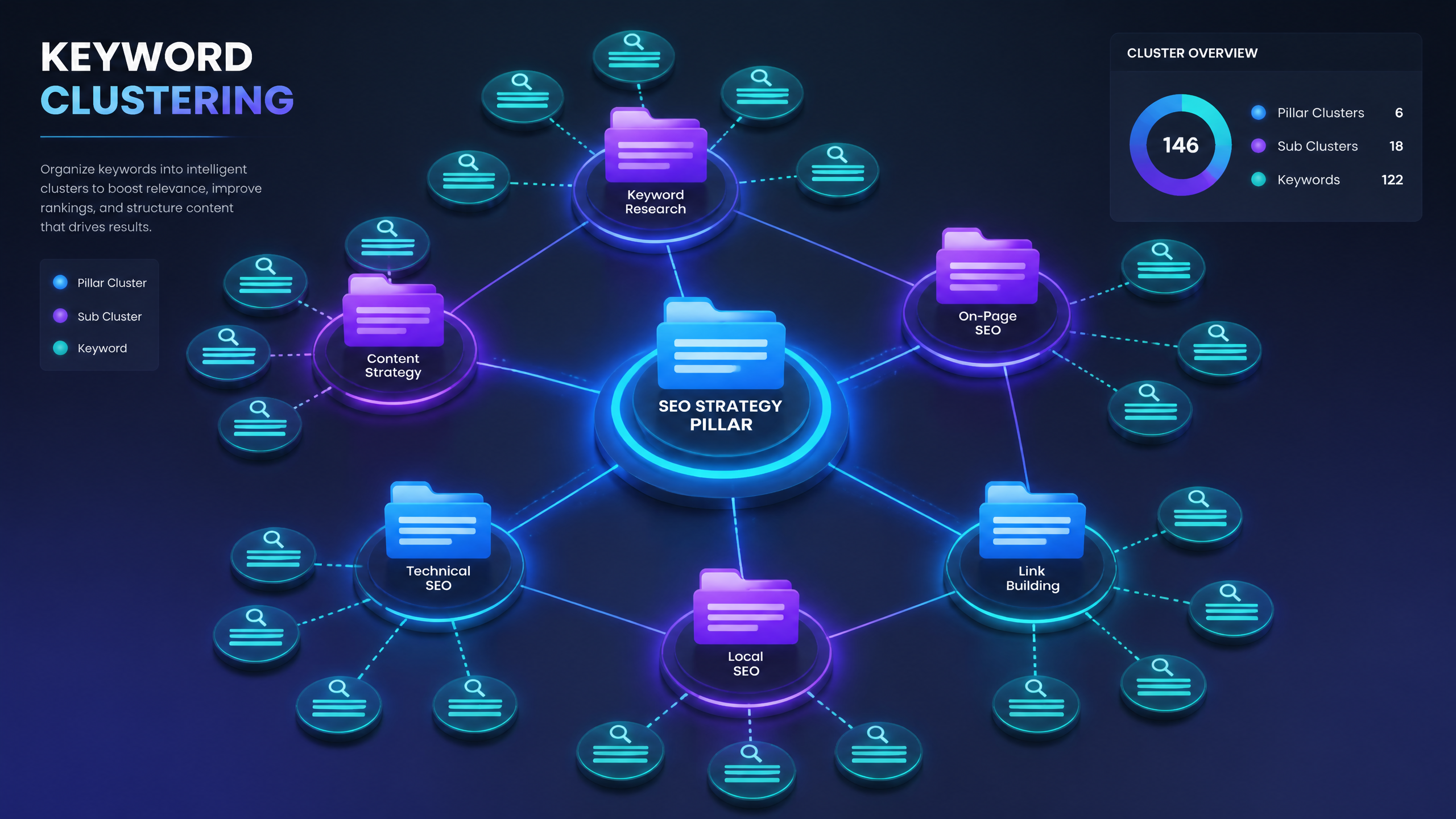
At its core, keyword clustering maps multiple keywords to a single search intent. Search engines have gotten incredibly smart. They understand that "how to tie a tie" and "tie a tie tutorial" mean the exact same thing. Clustering helps you build a robust silo structure where your primary pages (pillars) and supporting pages (clusters) work together to build topical authority.
Why Content Clusters Are Mandatory
I’ve seen sites miss out on major traffic because they neglect the power of content clusters. When you group keywords effectively, you naturally include LSI keywords (Latent Semantic Indexing) and long-tail keywords without forcing them. This context-rich approach signals to search engines that you are an authority on the topic. If you are still confused about where to start, understanding the difference between SEO and keyword research is a crucial first step.
The Risk of Keyword Cannibalization
Let me share a quick cautionary tale. Back in 2018, I was managing an e-commerce blog. I thought I was being clever by creating 15 different articles targeting slight variations of "affordable camping gear." The result? None of them ranked. They cannibalized each other. Keyword clustering prevents this by ensuring every page has a distinct, non-overlapping primary intent.
What NOT to Do: The Old Way of Grouping Keywords
Before we get into the right way to cluster, let's look at the mistakes that will absolutely tank your on-page SEO.
Ignoring Search Intent
Do not group keywords just because they share a word. "Apple nutrition facts" (informational) and "buy apple watch" (transactional) share the word "apple," but the search intent is galaxies apart. Putting them in the same cluster is a massive error.
Creating a Page for Every Synonym
Do not create separate pages for singular and plural variants. If you have a page for "dog bed" and another for "dog beds," you are wasting crawl budget and splitting your link equity.
Keyword Stuffing (Yes, It Still Happens)
Keyword stuffing is still a thing, and it doesn’t work; focus on context instead. Do not take your newly formed cluster and jam every single variation into your headers. Write naturally. If your cluster includes "cheap laptops," "budget laptops," and "affordable laptops," use them contextually where they make sense.
Types of Keyword Clustering Techniques
Not all clustering methods are created equal. Depending on your goals and the size of your site, you will likely use one of these three primary techniques.
SERP-Based Keyword Clustering
This is the gold standard. SERP-based clustering looks at the actual Google search results. If the keyword "CRM software" and "customer relationship management tools" return 4 or more of the same URLs on page one, they belong in the same cluster. It relies on real-time data rather than guesswork.
NLP-Based (Semantic) Keyword Clustering
NLP-based clustering uses machine learning to group keywords based on semantic meaning and linguistic relationships. It is great for finding topical relevance, but it sometimes ignores the reality of the SERP. Two words might mean the same thing linguistically, but Google might serve different intents for them.
Category-Based Keyword Clustering
This is a more manual, structural approach. You group keywords based on your website's existing taxonomy or e-commerce categories. It is useful for mapping out a broad site architecture but lacks the granular precision of SERP or NLP methods.
| Clustering Type | Primary Metric | Best Used For | Accuracy Level |
|---|---|---|---|
| SERP-Based | Shared URLs on Page 1 | Content mapping, avoiding cannibalization | Very High |
| NLP-Based | Semantic similarity | Brainstorming, finding LSI keywords | Medium-High |
| Category-Based | Site taxonomy | E-commerce navigation, broad silos | Medium |
How to Cluster Keywords for Free Using AI
If you have zero budget, you can use AI tools like ChatGPT or Claude to cluster your keywords. However, AI cannot handle thousands of keywords at once. It will time out, hallucinate, or just give up. Here is the exact workflow to do it right.
Step 1: Data Cleaning and Deduplication
Before feeding anything to an AI, you must clean your data.
• Direct Duplicates: Remove exact match duplicates from your CSV.
• Semantic Duplicates: Filter out obvious plurals or stop-word variations (e.g., "shoes for running" vs "running shoes").
• Location Modifiers: If you are doing local SEO, standardize your city tags. For a deeper dive on this, check out how to do keyword research for multiple locations.
Step 2: Bucketing the Long List
You cannot paste 5,000 keywords into ChatGPT. You need to bucketize them first. Sort your master spreadsheet alphabetically or by a primary modifier (like "how to" or "best"). Break your list into chunks of 150-200 keywords maximum.

Step 3: Prompting ChatGPT or Claude
Take your small chunk of cleaned data and use a highly specific prompt.
"Act as an expert SEO Specialist. Group the following 150 keywords into semantic clusters based on search intent. Provide a primary keyword for each cluster, and list the supporting long-tail keywords beneath it. Present the output in a markdown table."
The Downsides of Using AI Directly
Fair warning: this free method has severe limitations.
• Data Loss: AI frequently drops or skips valuable keywords during the formatting process.
• No SERP Validation: ChatGPT does not check live Google results to see if the keywords actually share the same intent.
• Time-Consuming: Copy-pasting 50 different chunks of keywords and stitching the tables back together in Excel will drain hours of your week.
The Nuwtonic Solution: Automated, Scaleable Clustering
If you are managing client sites or a growing brand, the manual AI method is not sustainable. This is where Nuwtonic steps in to completely automate the heavy lifting.
Processing Thousands of Keywords Instantly
Nuwtonic provides advanced keyword research features that handle thousands of keywords simultaneously. You do not need to manually bucket or chunk your data. The platform ingests your raw lists and processes them at scale.
Advanced SERP and RPA Integration
Unlike basic AI chatbots, Nuwtonic uses a sophisticated blend of live SERP analysis, Robotic Process Automation (RPA), and AI systems. It actually looks at the search results to see which URLs overlap, ensuring your clusters are based on real-world Google data, not just semantic guesses.
Actionable Content Mapping
The output isn't just a spreadsheet of grouped words. Nuwtonic provides actionable, cleaned-up clusters that map directly to your content strategy, telling you exactly which pillar pages to build and which supporting articles need to be written to establish topical authority.
Frequently Asked Questions (FAQ)
How many keywords should be in a cluster?
• It varies wildly based on the topic.
• A hyper-niche cluster might only have 3-5 keywords.
• A broad pillar page cluster could contain 50-100 long-tail variations.
• Focus on intent overlap, not an arbitrary number.
How often should I update my clusters?
• Search intent shifts over time.
• Review your core clusters every 6-12 months.
• If rankings for a specific supporting keyword drop while the rest of the cluster stays strong, it might be time to break that keyword out into its own dedicated page.
Should I cluster by search intent or semantic similarity?
• Always prioritize search intent.
• Semantic similarity is helpful for finding related terms, but intent dictates whether those terms belong on the same page.
• If the user wants to buy something for term A, but wants a tutorial for term B, they need separate pages, even if the words are similar.