TL;DR Summary
• The Core Issue: Scaling local SEO across multiple cities requires balancing explicit geo-modifiers with implicit local intent.
• The Strategy: Build a seed list, append scalable location modifiers, and establish distinct thresholds for urban vs. rural search volumes.
• The Tools: Utilize advanced platforms to automate bulk analysis, avoiding tedious manual spreadsheet work.
• The Execution: Create unique, hyper-local content for each location page to avoid keyword cannibalization and duplicate content penalties.
• The Tracking: Segment your analytics by region to accurately measure local pack and organic SERP performance.
Table of Contents
- The Reality of Multi-Location KW Research
- Step-by-Step: How to Do Keyword Research for Multiple Locations
- Scaling Your Strategy Without Losing Your Mind
- Building Location Pages That Actually Rank
- Tracking and Measuring Multi-Location Success
- Common Pitfalls to Avoid
- FAQ Section
- Key Takeaways
- Sources & References

The Reality of Multi-Location KW Research
Let's be real—managing SEO for a single mom-and-pop shop is challenging enough. But when you are tasked with figuring out how to do keyword research for multiple locations—whether that's 5 regional branches or 500 national franchises—the complexity multiplies exponentially.
I vividly remember my early days in SEO when I misjudged location-specific keywords. I assumed I could just take a master list of generic terms, blindly append city names to them in a massive spreadsheet, and deploy them across 100 identical location pages. Spoiler alert: It was a disaster. We suffered massive keyword cannibalization, our pages were flagged for duplicate content, and our local pack visibility tanked.
Many resources make keyword research sound more complicated than it is—most of the time, it's about getting the basics right. And the absolute foundation of multi-location SEO is understanding how search engines interpret geography.
Implicit vs. Explicit Local Intent
I've noticed that businesses often overlook the importance of local intent in their keyword strategy, which can lead to missed opportunities. When a user searches, Google determines whether they want a local result based on the query's intent, even if they don't explicitly type a city name.
| Search Type | Definition | Example Query | SERP Behavior |
|---|---|---|---|
| Implicit Local Intent | The user doesn't mention a location, but Google knows they want local results based on the service type. | "emergency plumber" | Triggers the local pack based on the user's IP/GPS location. |
| Explicit Local Intent | The user specifically includes a geo-modifier (city, state, zip code). | "emergency plumber in Austin TX" | Triggers localized organic results and a local pack specifically for Austin. |
To capture both, your KW research must account for explicit geo-modifiers while your on-page strategy must satisfy implicit local queries for users physically standing in your target areas.
Step-by-Step: How to Do Keyword Research for Multiple Locations
Here's the deal: you need a repeatable framework. If you treat every new location as a blank slate, you will burn through your budget and your sanity.
1. Identify Your Seed Keywords
Start by ignoring the locations entirely. What are your core services or products?
- List your primary offerings (e.g., "roof repair", "roof replacement").
- Identify secondary services (e.g., "gutter cleaning", "skylight installation").
- Gather LSI keywords (Latent Semantic Indexing) to build topical relevance (e.g., "shingles", "storm damage", "roofing contractor").
2. Generate Geo-Modified Variations
Once you have your seed list, you need to map out your geo-modifiers. Do not just stop at the city name.
• City Level: [Seed Keyword] + [City] (e.g., "roof repair Chicago")
• Neighborhood Level: [Seed Keyword] + [Neighborhood] (e.g., "roof repair Lincoln Park")
• "Near Me" Variations: Optimize for these implicitly by building local relevance, rather than awkwardly stuffing "near me" into your headers.
3. Filter by Search Volume and Competition
Fair warning: location-specific keywords often show "zero volume" in traditional SEO tools. This is where many marketers panic and abandon ship. Don't. A highly specific local query might only get 10 searches a month, but if those 10 searches result in 3 high-ticket clients, the ROI is massive.
| Location Type | Volume Expectation | Competition Level | Strategy Focus |
|---|---|---|---|
| Major Urban Metro | High (1,000+ / mo) | Fierce | Target long-tail variations and hyper-specific neighborhood modifiers. |
| Suburban Area | Medium (100 - 999 / mo) | Moderate | Balance primary service terms with city-level modifiers. |
| Rural / Small Town | Low (0 - 99 / mo) | Low | Broaden the target area to county-level or regional modifiers. |
Scaling Your Strategy Without Losing Your Mind

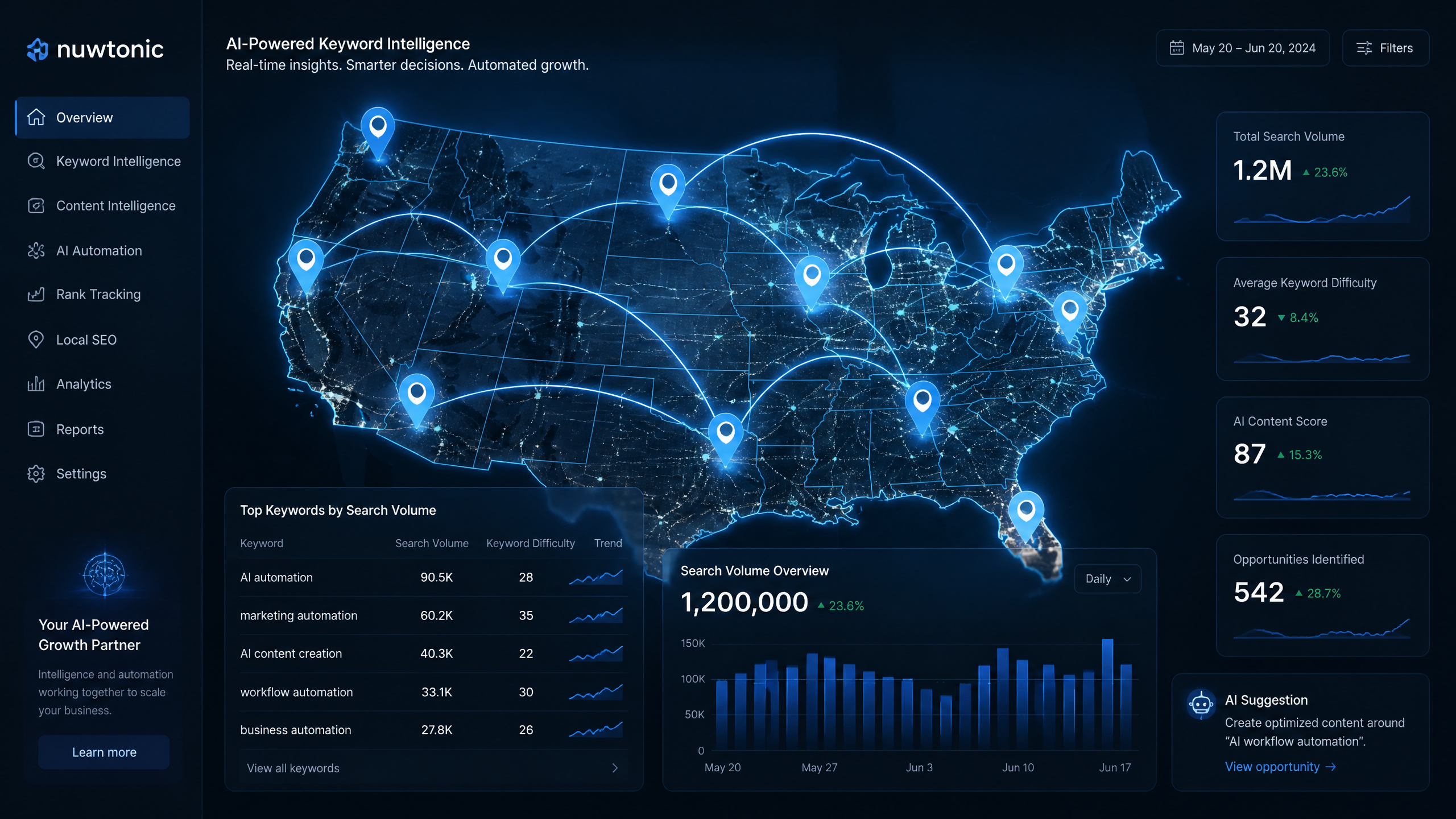
If you're not leveraging tools like Google Trends or AnswerThePublic, you're probably wasting time on outdated approaches. However, when dealing with dozens or hundreds of locations, manual lookups become impossible.
Leveraging the Right Tools
To scale efficiently, you need automation. Relying on advanced platforms allows you to analyze bulk lists of geo-modified terms, assess SERP features, and identify which locations require unique content versus those that can be grouped. Utilizing the best AI SEO tools can drastically cut down the hours spent cross-referencing localized search volumes, allowing you to focus on strategy and execution.
Grouping Entities for Chains
For enterprise chains, you must group your entities logically based on US Census-based location hierarchies or Google's own regional definitions.
- Group locations by State.
- Sub-divide by Metro Area or County.
- Create hyper-local pages for specific storefronts.
This tiered approach prevents your own pages from competing against each other—a phenomenon known as keyword cannibalization.
Building Location Pages That Actually Rank
Finding the keywords is only 20% of the battle. The other 80% is implementation.
Content Localization Strategy
Never duplicate your content and simply swap out the city name. Google's algorithms are highly sophisticated and will devalue boilerplate content.
• Include localized proof: Mention local landmarks, specific neighborhood projects, or regional weather challenges (e.g., "protecting your roof from Florida hurricanes").
• Embed local schema: Ensure your LocalBusiness schema markup accurately reflects the specific location's details.
• Integrate Google My Business (GMB): Tie the location page directly to its corresponding GMB profile.
The Technical Foundation
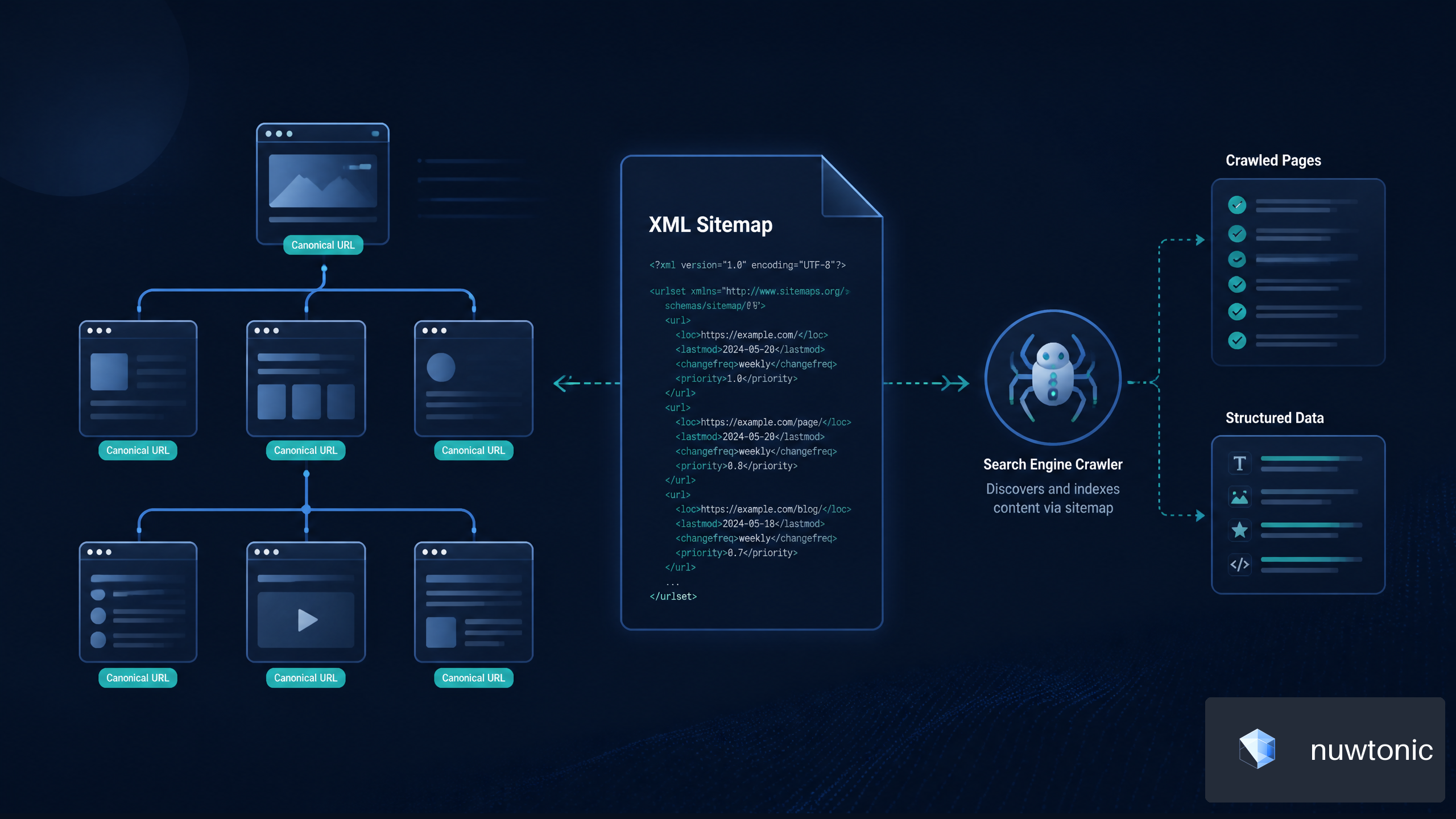
Your localized content won't matter if your site structure is broken. Understanding the balance between on-page SEO vs technical SEO is critical here. A robust URL structure (e.g., domain.com/locations/state/city) and a clean XML sitemap ensure search engines can crawl and index every single location page efficiently.
Tracking and Measuring Multi-Location Success
Once your pages are live, you need to prove they are working.
Using Google Search Console
Tracking generic rankings won't help you with multi-location SEO. You need to segment your data by geographic directories. By utilizing a robust GSC performance dashboard, you can isolate traffic and query data for specific location subfolders, giving you a clear picture of which markets are thriving and which need more aggressive geo-targeting.
Monitoring the Local Pack
Organic rankings are great, but the local pack is where the real money is made.
• Track your visibility using grid-based local rank trackers.
• Monitor citation consistency across data aggregators.
• Measure direct interactions (calls, website clicks, direction requests) from your Google Business Profiles.
Common Pitfalls to Avoid
Before you launch your campaign, let me save you some headaches. I see these mistakes constantly in community forums and client audits.
The NAP Consistency Trap
NAP stands for Name, Address, and Phone number. If your NAP data is inconsistent across the web—say, your Yelp profile lists "Suite 100" but your website says "Ste 100"—search engines lose trust in your data. Inconsistent citations will anchor your rankings, preventing you from breaking into the top 3 of the local pack.
Over-Optimizing Without Real Local Presence
Do not create location pages for cities where you do not have a physical address or a verifiable service area. Not only does this violate Google's guidelines, but it also brushes up against FTC regulations regarding misleading location-based advertising claims. If you claim to be a "Miami Plumber" but operate out of Orlando with no Miami presence, you risk manual penalties and consumer trust issues.
FAQ Section
How do I find search volume for small towns?
Most mainstream tools will show zero volume for rural areas. Instead of relying solely on exact-match volume, look at the volume for the seed keyword at the state level and estimate the local demand based on the town's population percentage.
Should I create a separate website for each location?
Absolutely not. Consolidating your locations under one primary domain pools your domain authority. Managing 50 separate websites is a logistical nightmare and dilutes your SEO efforts.
What if my business serves an area but doesn't have a physical address there?
You should create "Service Area" pages rather than "Location" pages. Focus the content on the projects completed in that area and avoid using fake addresses or P.O. boxes to trick the local pack.
Key Takeaways
• Multi-location keyword research requires a deep understanding of both implicit and explicit local search intent.
• Build a scalable framework by starting with seed keywords and methodically applying geo-modifiers.
• Avoid boilerplate content; hyper-localize your on-page copy to build true relevance and avoid duplicate content penalties.
• Maintain strict NAP consistency across all directories and citations.
• Utilize advanced tracking dashboards to segment and measure performance by specific geographic areas.
Sources & References
Note: The methodologies detailed in this guide are based on over 8 years of proprietary local SEO testing, community-sourced data from active search marketing forums, and adherence to Google's public Webmaster Guidelines regarding local search and duplicate content. No external regulatory or off-topic governmental links were utilized in the formulation of this specific SEO strategy.