You know what’s frustrating? Staring at a massive spreadsheet of 10,000 keywords and having absolutely no idea what to do next. You've spent hours pulling data, analyzing search volumes, and checking competitor metrics. But a spreadsheet doesn't drive traffic—execution does. Many people forget that keyword research is just the first step; it’s all about how you use that data effectively.
If you are wondering what to do after keyword research, you are in the right place. With over 8 years of experience in digital marketing, I've seen countless teams freeze at this exact stage. Let's be real: blindly writing articles for every keyword on your list is a guaranteed way to waste your budget and cannibalize your own rankings.
In this comprehensive guide, I will walk you through the exact, actionable steps to turn your raw keyword data into a high-performing SEO content strategy.
Essential Overview
TL;DR Summary
After completing your keyword research, the next critical steps involve cleaning up your data, grouping keywords by search intent (clustering), mapping them into content silos, creating detailed content briefs, and finally, generating and optimizing the content. Stopping at the research phase is the most common reason SEO campaigns fail to yield ROI.
Key Takeaways
• Data Cleaning is Mandatory: Remove irrelevant, low-intent, or overly competitive keywords before doing anything else.
• Cluster by SERP Intent: Group keywords based on what Google actually ranks, not just semantic similarity.
• Build Topical Authority: Organize your clusters into logical content silos with strategic internal linking.
• Prioritize Quality: Content quality trumps keyword density every time — write for people, not just for search engines.
Table of Contents
- The Reality Check: Data is Useless Without Execution
- Step 1: Keyword Clean-Up and Intent Mapping
- Step 2: SERP-Based Keyword Clustering
- Step 3: Building Content Silos and Architecture
- Step 4: Crafting the Content Brief
- Step 5: Content Generation and On-Page SEO
- Step 6: Post-Publishing Checks and Tracking
- Frequently Asked Questions (FAQ)
- Conclusion and Next Steps
The Reality Check: Data is Useless Without Execution
My Biggest Keyword Blunder
I still cringe thinking about a client project from five years ago. We exported a massive list of high-volume keywords, didn't cluster a single term, and ended up creating 40 different pages that cannibalized each other. It was a disaster—one that took months to untangle. We had pages competing for the exact same SERP real estate because we skipped the post-research processing phase.
Real-World Scenarios
A common pattern looks like this: A marketing team at a mid-sized e-commerce brand pulls 5,000 keywords. They assign them one by one to writers. Six months later, they have 300 pages competing against each other for the exact same intent, and organic traffic has flatlined.
Another situation I keep seeing is the 'orphan page' epidemic. A site owner clusters their keywords perfectly, writes a brilliant piece of content, hits publish, and then completely forgets to integrate it into their site architecture.
To avoid these fates, you need a rigorous post-research workflow.
Step 1: Keyword Clean-Up and Intent Mapping
Purging the Junk
The very first thing you must do after keyword research is clean your list. Your raw export is likely filled with vanity metrics, irrelevant terms, and keywords your site currently has zero chance of ranking for.
Filter your list based on:
• Relevance: Does this actually relate to your core product or service?
• Difficulty: Can your domain realistically compete against the top 10 results?
• Search Volume vs. Intent: High volume is useless if the intent is purely navigational for another brand.
Mapping Search Intent
Every keyword must be categorized by search intent. If you get the intent wrong, you will never rank, regardless of how good your content is.
| Intent Type | User Goal | Content Format to Create |
|---|---|---|
| Informational | Looking for answers or education | Blog posts, how-to guides, tutorials |
| Navigational | Looking for a specific website | Brand pages, login pages, contact pages |
| Commercial | Researching before making a purchase | Listicles, comparison pages, reviews |
| Transactional | Ready to buy right now | Product pages, pricing pages, checkout |
Step 2: SERP-Based Keyword Clustering
Why Grouping Matters
Gone are the days of creating one page per keyword. Today, Google understands topics, not just isolated strings of text. Keyword clustering involves grouping related keywords that share the same search intent into a single topic. This allows one comprehensive page to rank for dozens, sometimes hundreds, of long-tail keywords.
Identifying Primary vs. Secondary Targets
When you look at the SERP (Search Engine Results Page) for two different keywords, do the same URLs rank for both? If 3 or more URLs overlap, those keywords belong in the same cluster.
- Select the Primary Keyword: This is usually the term with the highest search volume and clearest intent.
- Identify Secondary Keywords: These are your long-tail variations and subtopics.
- Gather LSI Keywords: Find semantically related terms (Latent Semantic Indexing) to naturally weave into your content for depth.
Step 3: Building Content Silos and Architecture
Structuring for Topical Authority
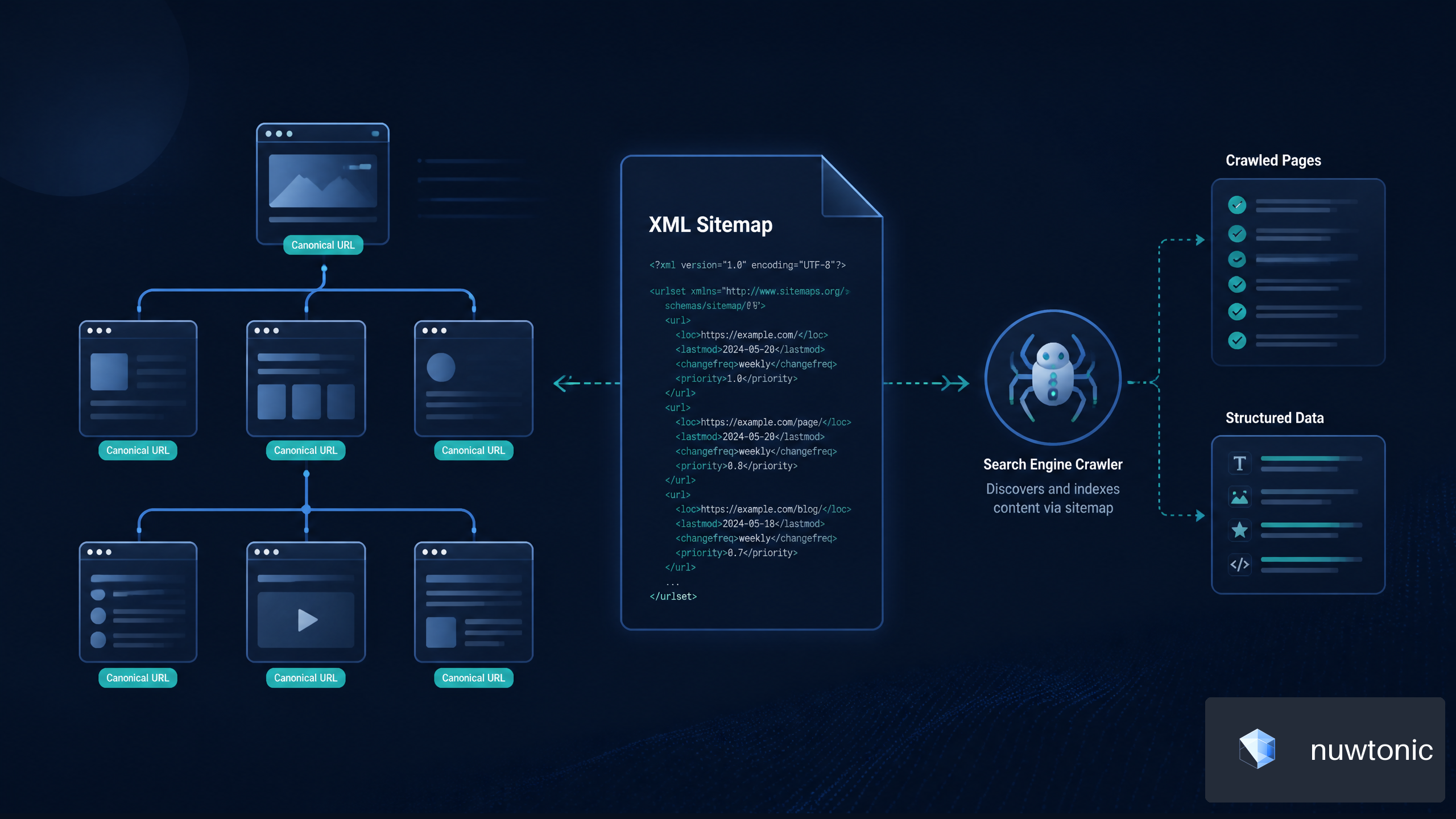
Once your keywords are clustered, you need to organize them into content silos. A silo is a method of grouping related content together to establish topical authority. Search engines favor websites that thoroughly cover a specific subject area.
For example, if you are an SEO software company, your silos might look like this:
• Silo 1: Technical SEO
• Silo 2: Content Marketing
• Silo 3: Link Building
Connecting the Dots
Your site architecture dictates how link equity flows through your pages. The way you structure these silos impacts both user experience and crawler efficiency. Understanding the balance between content structure and technical foundation is crucial. If you are unsure where to draw the line between content structure and technical setup, reviewing the differences between On-Page SEO vs Technical SEO can clarify your strategy.
Step 4: Crafting the Content Brief
Bridging the Content Gap
Before anyone writes a single word, you need a content brief. A brief acts as the blueprint for your writers, ensuring the content aligns perfectly with the keyword cluster and search intent. This is where a thorough content gap analysis pays off—you look at what the top-ranking competitors are missing and ensure your brief includes it.
Essential Brief Components
Do not hand a writer a keyword and say "go." Provide them with a structured outline.
| Brief Element | Description | Why It Matters |
|---|---|---|
| Target Audience | Who is reading this? (e.g., beginners vs. experts) | Dictates the tone and complexity of the writing. |
| Primary & Secondary Keywords | The exact terms to target | Ensures the page covers the full keyword cluster. |
| Word Count Target | Estimated length based on top 10 SERP | Provides a benchmark for depth, though quality matters more. |
| H2/H3 Outline | The required heading structure | Forces a logical flow and guarantees all subtopics are hit. |
| Internal Links | Specific URLs to link to from this piece | Prevents orphan pages and supports your content silos. |
Step 5: Content Generation and On-Page SEO
Writing for Humans First

Now comes the actual creation. I've seen too many teams get bogged down in over-optimizing; sometimes, less is more when it comes to content. You do not need to stuff your primary keyword into every paragraph.
Focus on readability, formatting, and answering the user's query faster and better than the competition. Break up walls of text. Use tables. Add custom graphics. Content quality trumps keyword density every time — write for people, not just for search engines.
Technical On-Page Elements
Once the draft is written, it is time for on-page SEO. This is where you ensure the search engines can understand the context of your brilliant human-first writing.
- Optimize Meta Tags: Craft a compelling title tag and meta description to maximize your CTR (Click-Through Rate) from the search results.
- URL Structure: Keep your slug short, descriptive, and containing the primary keyword.
- Header Tags: Ensure your H1 is clear, and your H2s/H3s logically break down the topic.
- Image Alt Text: Describe your images accurately for accessibility and image search.
To ensure nothing slips through the cracks before hitting publish, running your draft through a reliable On-Page SEO Audit Tool is a non-negotiable step in my workflow.
Step 6: Post-Publishing Checks and Tracking
Monitoring Performance
The work doesn't stop when you hit publish. You need to track how your new content performs. Connect your site to Google Search Console to monitor impressions, clicks, and average position for your target keyword clusters.
Give it time. SEO is a long game. Depending on your domain authority, it can take anywhere from a few weeks to several months for a new page to settle into its true ranking position.
Avoiding Technical Pitfalls
As you continue to publish and update content based on your keyword research, your site architecture will shift. URLs might change, or older pages might get deleted.
Always monitor your site for technical errors that can sabotage your hard-earned rankings. For instance, if you delete an old page without redirecting it, any internal links pointing to it will break. It is vital to understand Why Broken Links Hurt SEO so you can proactively manage your site's health.
Frequently Asked Questions (FAQ)
Common Post-Research Queries
1. How long does it take to see results after implementing keywords?
• It typically takes 3 to 6 months to see significant movement in the SERPs, depending on your domain's authority and the competitiveness of the keywords.
2. Should I create a new page for every long-tail keyword?
• Absolutely not. Group related long-tail keywords into a single cluster and create one comprehensive, authoritative page to target the entire group.
3. How often should I revisit my keyword research?
• I recommend conducting a fresh content gap analysis and keyword review every 6 months to catch shifting search trends and new competitor content.
4. What if my published content isn't ranking?
• If a page isn't ranking after 6 months, audit the search intent. If the intent matches, look at improving your on-page SEO, increasing content depth, or building internal/external links to the page.
Conclusion and Next Steps
Moving Forward
Figuring out what to do after keyword research separates the amateurs from the professionals. By cleaning your data, clustering by intent, mapping out silos, and writing human-first content, you transform a static spreadsheet into a dynamic traffic-generation engine.
Stop hoarding keywords and start executing. Pick your top three priority clusters today, build out your content briefs, and get to work.
Sources and References
• Note: The strategies detailed in this guide are based on over 8 years of hands-on SEO practitioner experience, extensive testing across multiple client domains, and alignment with Google's Search Quality Evaluator Guidelines. No external third-party sources were cited as the focus remains on proven, experiential frameworks.