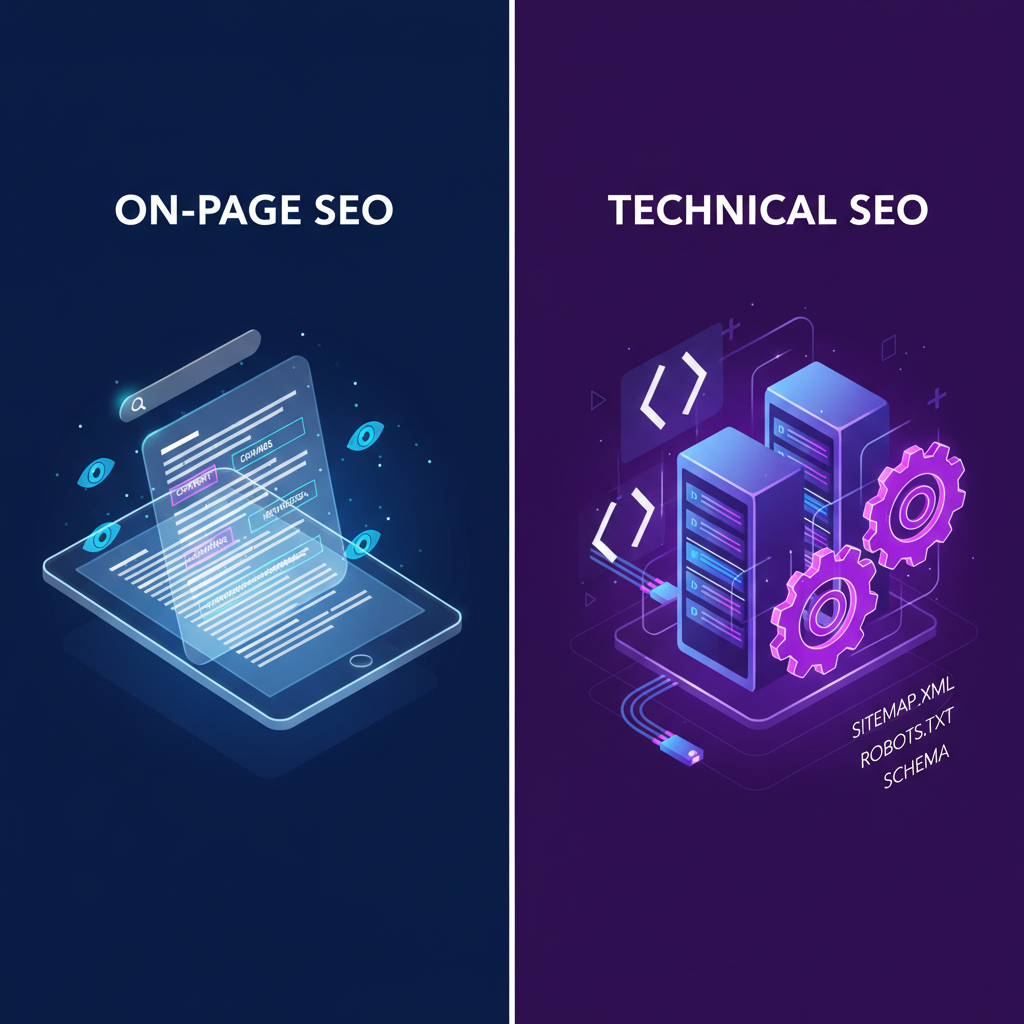
In our years of auditing digital infrastructure and content pipelines, we consistently encounter a fundamental misunderstanding regarding on page seo vs technical seo. Website owners often treat them as interchangeable buzzwords or isolate them into silos. The reality is far more integrated. To dominate search engine results pages (SERPs) in 2026, you must understand where one discipline ends and the other begins, and exactly how they rely on each other to generate visibility.
TL;DR Summary: On-page SEO focuses on optimizing the content and structure of individual web pages for user intent and relevance. Technical SEO focuses on the backend infrastructure, ensuring search engines can efficiently crawl, render, and index your website. You cannot succeed without both.
Key Takeaways
• On-page SEO communicates relevance and value directly to the user and the search engine.
• Technical SEO ensures the search engine can actually access and process that value without friction.
• Both disciplines require distinct toolsets, metrics, and skill levels to execute properly.
• Nuwtonic bridges the gap by automating technical audits while generating highly relevant, AI-optimized content.
Table of Contents
- Defining the Core: On Page SEO vs Technical SEO
- Detailed Comparison: Content vs. Infrastructure
- Executing a Flawless On-Page Strategy
- Building a Bulletproof Technical Foundation
- How Nuwtonic Bridges the Gap in 2026
- Frequently Asked Questions (FAQ)
- Sources and References
Defining the Core: On Page SEO vs Technical SEO
To make strategic decisions, we first need to isolate the mechanics of each discipline. They serve different masters—one primarily serves the human reader, while the other primarily serves the machine crawler.
What is On-Page SEO?
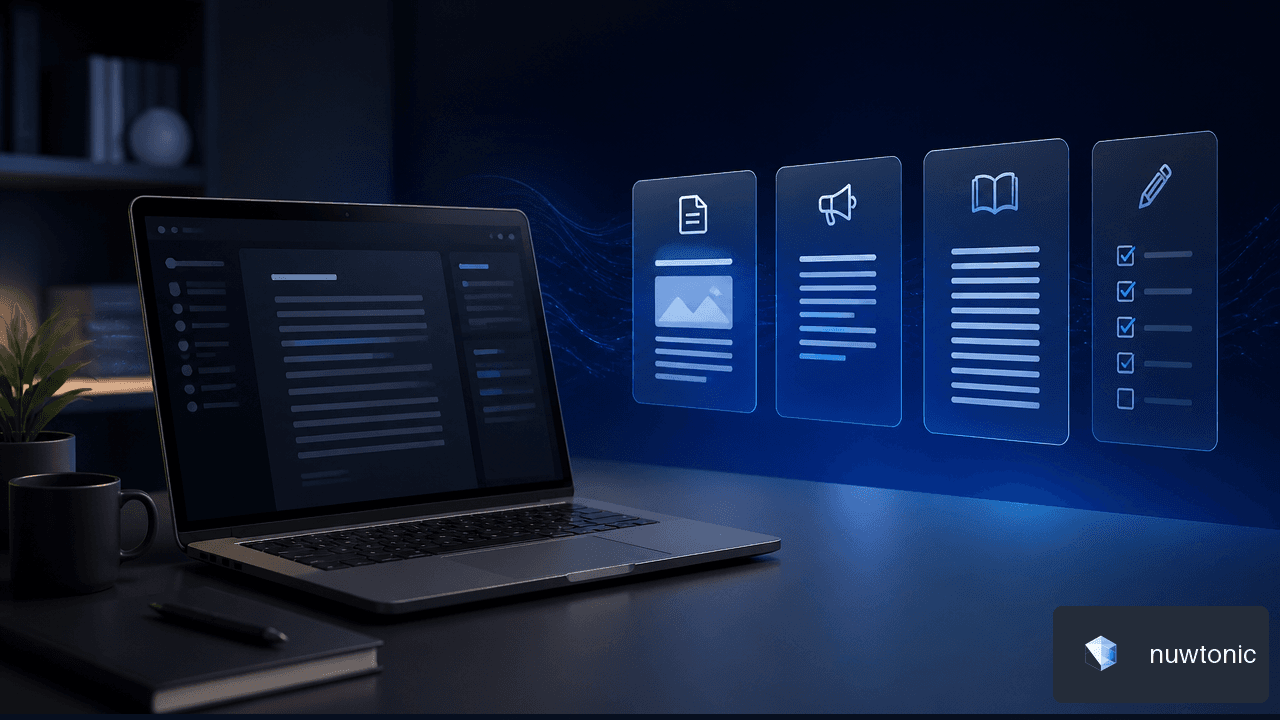
On-page SEO encompasses all the actions we take directly within the content and HTML of a specific page to improve its ranking for specific queries. When we analyze a page, we look at the exact words used, the formatting, the headers, and the overall user experience. Our goal is to prove to Google that this specific URL is the most relevant, helpful answer to a user's query.
This involves optimizing title tags, structuring content with logical headers, embedding multimedia, and ensuring semantic keyword richness. For teams looking to streamline this process, utilizing dedicated Page SEO Tools is essential for scaling content production without sacrificing quality.
What is Technical SEO?
Technical SEO happens under the hood. It is the practice of optimizing your website's server, architecture, and code so that search engine spiders can crawl and index your site effectively. If on-page SEO is the interior design of a house, technical SEO is the foundation, plumbing, and electrical wiring.
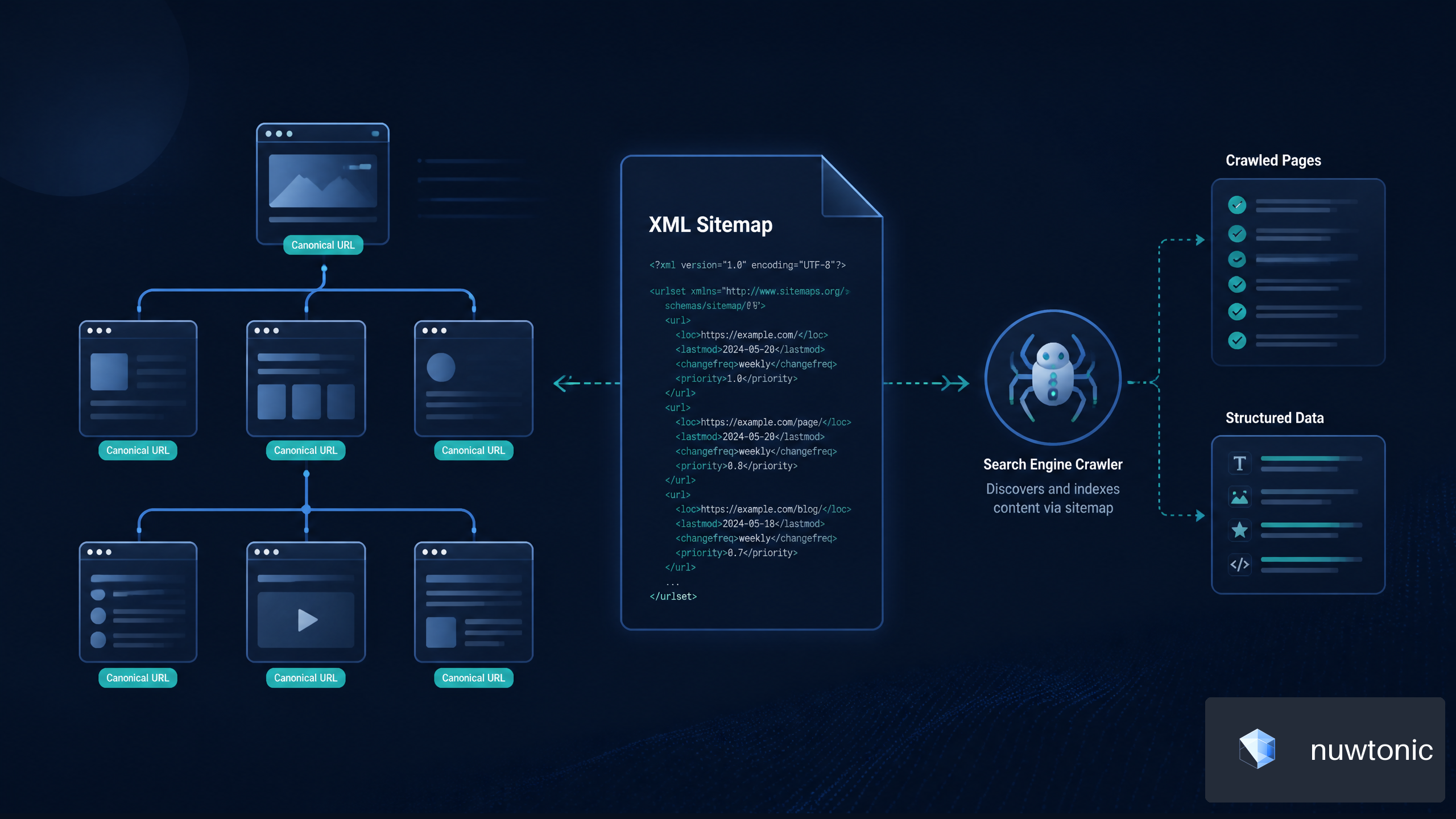
We focus on server response times, JavaScript rendering, XML sitemaps, canonical tags, and mobile responsiveness. A single misconfigured robots.txt file can completely neutralize the best on-page content in the world. This is why we heavily rely on specialized Technical SEO Tools to monitor infrastructure health.
The Intersection of Both Disciplines
While distinct, these two areas overlap significantly. For example, internal linking is an on-page strategy (it helps users navigate and distributes authority), but it is also a technical strategy (it establishes site architecture and crawl paths). In our analysis, treating them as a single, unified ecosystem is the only way to achieve sustainable growth.
Detailed Comparison: Content vs. Infrastructure
To clearly delineate the responsibilities, we have mapped out the core differences.
Primary Focus and Goals
| Feature | On-Page SEO | Technical SEO |
|---|---|---|
| Primary Goal | Maximize relevance and user engagement | Maximize crawlability and indexation |
| Target Audience | Human readers and semantic AI models | Search engine crawlers (Googlebot) |
| Key Elements | Keywords, Headings, Copy, Images | Site Speed, Schema, Server Logs, Robots.txt |
| Update Frequency | High (Content decays and requires refreshing) | Low (Infrastructure remains stable once fixed) |
| Skillset Required | Copywriting, Content Strategy, UX | Web Development, Server Administration |
Skillsets and Implementation Requirements
Executing on-page optimization requires a deep understanding of human psychology, search intent, and topical authority. It is highly creative. Conversely, technical optimization is analytical and binary. A canonical tag is either implemented correctly or it is not.
Timelines for ROI and Impact
We typically see technical SEO fixes yield rapid, step-function improvements in traffic—especially if a major crawlability issue is resolved. On-page SEO tends to compound over time as the content gains traction, earns backlinks, and establishes historical authority.
Executing a Flawless On-Page Strategy
When we build an on-page strategy, we move beyond simple keyword insertion. The modern search algorithm requires nuance, depth, and explicit proof of experience.
Keyword Placement and Semantic Density
We no longer practice keyword stuffing. Instead, we focus on semantic density—using related entities and natural variations of the primary topic. If we are writing about coffee, we must naturally include terms like "roast profile," "extraction," and "barista." This context vectoring signals topical authority to Google.
User Experience and Intent Matching
Does the user want to buy something, learn something, or find a specific website? Matching the format of our content to the user's intent is critical. If the intent is informational, we provide comprehensive guides. If the intent is transactional, we optimize product pages with clear calls-to-action.
Measuring Success
To ensure our content hits the mark, we run every URL through a rigorous On Page SEO Audit. This allows us to score the content against top-ranking competitors, ensuring our headings, word count, and entity density are fully calibrated for success.
Building a Bulletproof Technical Foundation
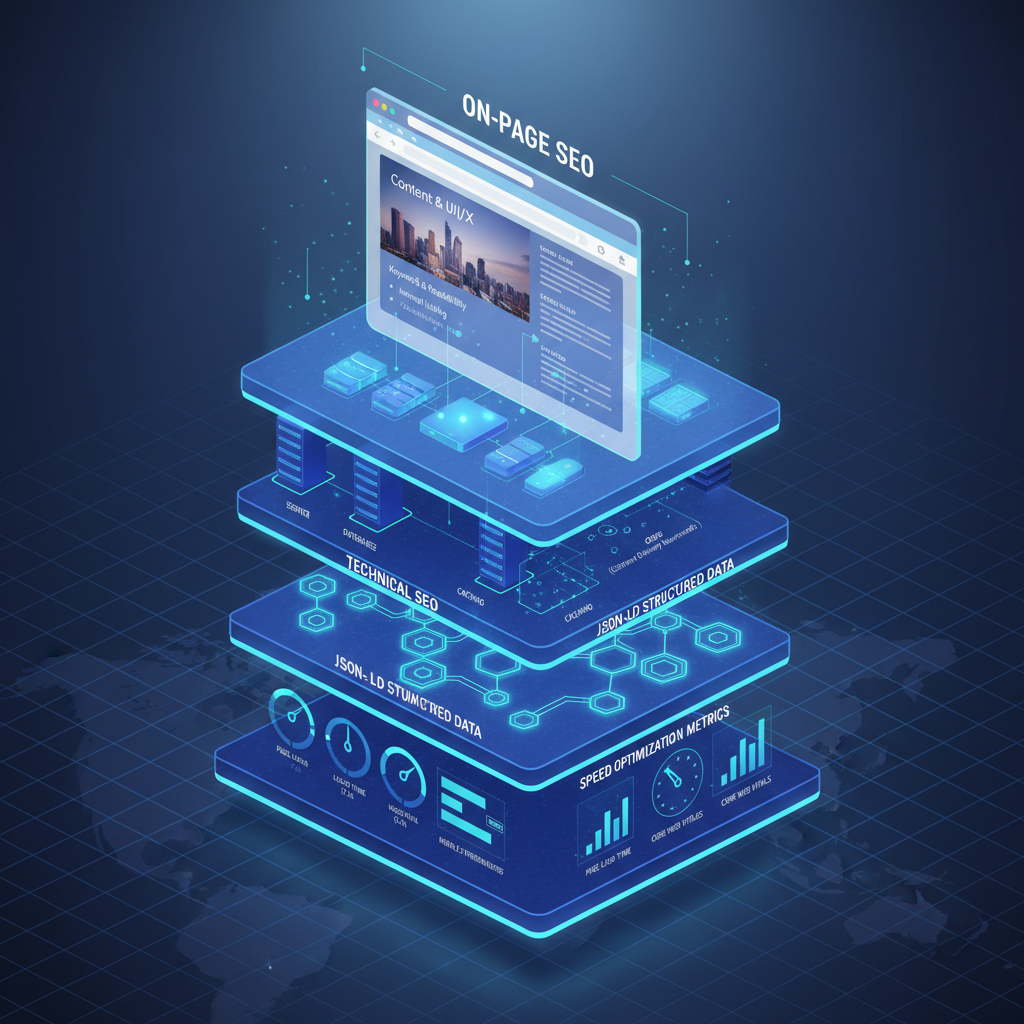
Without a solid technical foundation, content optimization is a wasted effort. We prioritize three core pillars when auditing a site's infrastructure.
Crawlability and Indexation Mechanics
Search engines operate on a "crawl budget." If our server is slow or our site architecture requires ten clicks to reach a page, Googlebot will abandon the crawl. We optimize internal linking structures to ensure a flat, efficient architecture. We also meticulously manage our XML sitemaps and robots.txt files to direct crawlers exactly where we want them to go.
Site Speed and Core Web Vitals
Google has explicitly made user experience metrics a ranking factor. We optimize Time to First Byte (TTFB), Largest Contentful Paint (LCP), and Cumulative Layout Shift (CLS). This involves compressing images, minifying CSS/JS, and leveraging content delivery networks (CDNs).
Structured Data and AI Visibility
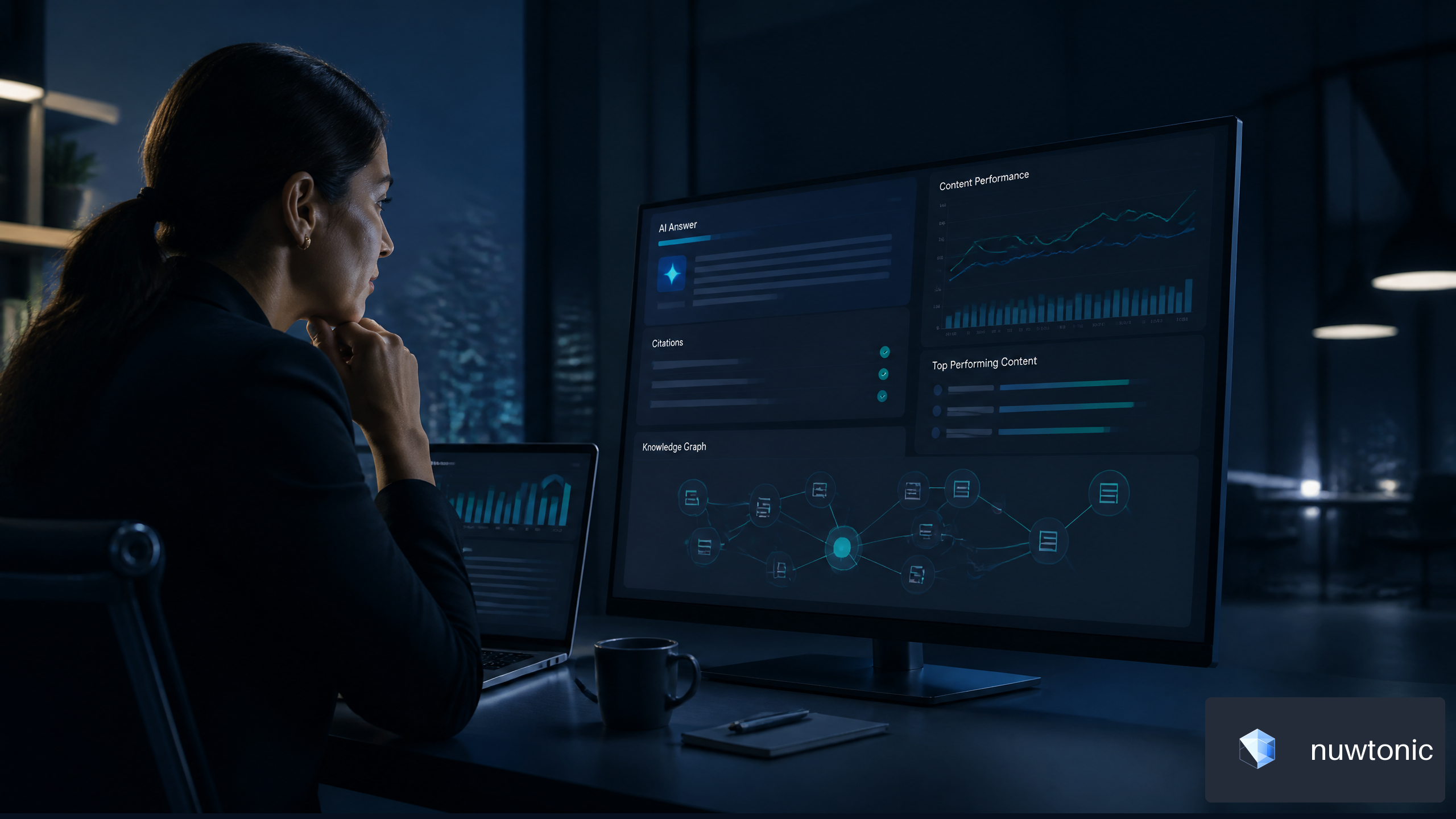
In 2026, marking up our content with JSON-LD structured data is non-negotiable. This translates our content into a machine-readable format, directly feeding information to Google's Knowledge Graph and AI Overview systems. We strictly adhere to the Schema.org Structured Data Vocabulary to ensure maximum compatibility.
How Nuwtonic Bridges the Gap in 2026
Managing the dichotomy of on page seo vs technical seo traditionally required disjointed software stacks and massive manual effort. At Nuwtonic, we designed our platform to unify these processes.
Automating the Audit Process
Our AI-powered engine continuously crawls your digital properties, identifying technical bottlenecks—like broken canonicals or render-blocking scripts—while simultaneously evaluating the semantic depth of your content. We flag issues before they impact your organic traffic.
AI-Driven Content and Technical Fixes
We do not just report problems; we execute solutions. Nuwtonic generates high-ranking, E-E-A-T optimized content that inherently follows on-page best practices, while our technical modules provide one-click deployments for complex infrastructure fixes.
Frequently Asked Questions (FAQ)
Which is more important: on-page or technical SEO?
Neither is inherently more important; they are co-dependent. Excellent technical SEO allows your site to be indexed, but without strong on-page SEO, that indexed page will not rank. We recommend fixing critical technical blockers first, then scaling on-page efforts.
Can I rank with good on-page but poor technical SEO?
It is highly unlikely in competitive niches. If search engines cannot crawl your site, or if your page takes ten seconds to load, your high-quality content will never be seen by users.
How often should I audit my site?
We recommend the following cadence:
• Weekly for technical crawl errors (404s, server errors).
• Monthly for on-page performance and keyword decay.
• Quarterly for comprehensive technical architecture reviews.
Sources and References
Industry Standards and Documentation
To ensure our strategies remain aligned with global standards, we reference the following authoritative guidelines:
- The official Google SEO Starter Guide for baseline indexation and ranking mechanics.
- The WCAG Accessibility Standards for ensuring our technical and on-page elements meet global usability requirements.