
Honestly, I've seen teams waste resources on tools that don't fit their needs; it's crucial to understand what you're looking for before diving in. With over eight years of experience in SEO and content strategy, I have watched the industry shift drastically. We are no longer in an era where you can just publish a handful of keyword-stuffed articles and expect organic traffic to pour in. Today, Google's algorithms demand deep, interconnected topical authority.
So, when exactly should you stop trying to manage this manually and invest in topical mapping services or tools?
This guide breaks down the exact decision thresholds across three distinct scenarios: launching a new site, revitalizing an aging domain, and expanding an established brand into adjacent niches.
TL;DR Summary
• New Sites: Need competitive analysis and gap identification before writing a single word.
• Established Sites: Require Google Search Console (GSC) data integration to build upon existing authority signals.
• Expanding Brands: Must connect the dots between subtopics to avoid disjointed content silos.
• The Decision: Choose tools for in-house execution if you have SEO maturity; hire services or agencies if you lack the technical bandwidth.
Key Takeaways
Topical mapping is foundational, not optional, for modern semantic search.
In my experience, the best time to hire a topical mapping service is when your content efforts are plateauing.
Disconnected topical maps can actively harm your site's traffic and authority.
AI-driven tools like Nuwtonic can bridge the gap between expensive agency services and tedious manual mapping.
Table of Contents
The Reality of Topical Authority in 2026
Scenario 1: Launching a Brand New Site
Scenario 2: Revitalizing an Established Website
Scenario 3: Expanding into New Niches
Making the Decision: In-House vs. Tools vs. Agencies
Frequently Asked Questions (FAQ)
Sources and References
The Reality of Topical Authority in 2026
Many businesses overlook the importance of topical relevance; a good mapping strategy can make all the difference. Before we look at specific scenarios, we need to establish what we are actually building.
What Exactly Is Topical Mapping?
Topical mapping is the architectural blueprint of your website's content. It involves organizing your primary subjects into structured content silos, supported by highly relevant keyword clusters. Instead of targeting isolated search queries, you are building a semantic web that proves to search engines you are the definitive expert on a specific subject.
When a search engine crawls your site, it looks for relationships between pages. If you have a pillar content piece about "Digital Marketing" supported by dozens of interconnected articles covering email marketing, SEO, and paid ads, you establish high topic authority.
Why Manual Keyword Research Isn't Enough Anymore
Look, manual keyword research used to work. You would find a high-volume, low-competition keyword, write a post, and rank. That methodology is dead. Semantic search algorithms now prioritize search intent and holistic coverage over individual keyword optimization.
If you try to map a 500-page website manually using spreadsheets, you will inevitably create duplicate content, miss critical content gaps, and fail to structure your internal links correctly. This is exactly where specialized tools and services become mandatory rather than optional.
Scenario 1: Launching a Brand New Site
Starting from scratch is both a blessing and a curse. You have zero technical debt, but you also have zero authority. You know what I mean? You cannot afford to guess what content will work.
Analyzing Competitor Topic Authority
When a brand and site are entirely new, you absolutely should not start randomly posting blogs. The very first step is deep competitive research. You need to understand the topical authority of your existing competitors.
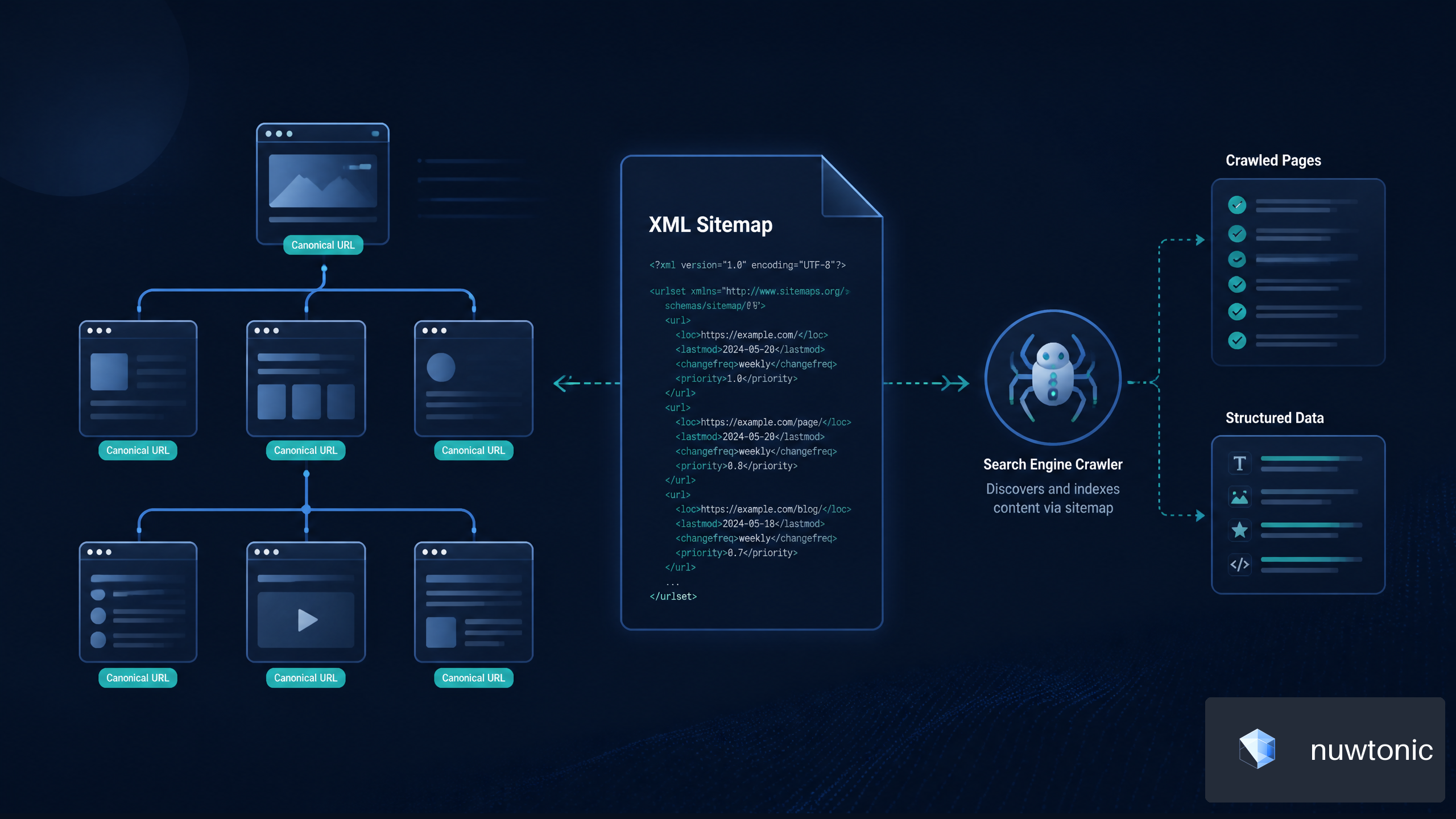
What topics have they covered? Where are they weak? A topical mapping tool will crawl competitor sitemaps and extract their entire content structure. This gives you a bird's-eye view of the exact semantic entities you need to cover to sit at the same table as the industry leaders.
Identifying Content Gaps Before You Write
Once you map the competitors, you map the gaps. If three major competitors cover "Technical SEO" but completely ignore "AI SEO Automation," you have found your entry point.
A professional mapping service will not just hand you a list of keywords; they will provide a prioritized roadmap. They will tell you exactly which pillar pages to build first and which supporting articles will create the fastest path to topical relevance.
Tool vs. Service for New Sites
For a new site, should you buy a tool or hire a service?
Decision Factor | Use a Topical Mapping Tool | Hire a Mapping Service/Agency |
|---|---|---|
Budget | Under $500/month | $2,000+ per project |
In-House Expertise | High (You understand SERP analysis) | Low (You need strategy handed to you) |
Time to Execution | Immediate | 2 to 4 weeks for delivery |
Strategic Depth | Relies on your interpretation | Done-for-you holistic strategy |
If you have the SEO background, a tool is sufficient. If you are a founder trying to wear too many hats, hire a service to build the initial map.
Scenario 2: Revitalizing an Established Website

Let's talk about the second scenario. Your brand is established, the site has been around for a few years, but traffic is flat. In my experience, the best time to hire a topical mapping service is when your content efforts are plateauing.
Leveraging Google Search Console Data
When you have an older site, you are sitting on a goldmine of data: Google Search Console (GSC). You do not need to guess what Google thinks your site is about; Google is already telling you.
To increase topical authority, you must create a topical map using existing GSC signals. You look at the queries where you rank on page two or three. These are topics where Google sees your likeliness of authority but recognizes your content is lacking depth.
Building Content Silos from Existing Signals
I recently worked with an e-commerce client whose traffic had flatlined for 18 months. They were writing new content blindly. We stopped production, pulled 12 months of GSC data, and mapped their existing URLs.
We found massive content gaps within their own silos. They had a pillar page on "Running Shoes" but lacked supporting articles on "Trail Running Shoes for Flat Feet." By using a tool to map their existing signals against the total addressable search volume, we built out the missing nodes. Traffic increased by 42% in four months.
When to Bring in an Agency or Advanced Tool
If you have hundreds or thousands of pages, manual GSC analysis is impossible. You need an advanced tool that ingests your GSC data, matches it against your sitemap, and automatically highlights the missing semantic relationships. If your internal team lacks the bandwidth to execute this gap analysis, it is time to bring in a specialized agency.
Scenario 3: Expanding into New Niches
This is where things get incredibly risky. You have a successful microniche, and you want to expand. If you do this wrong, you will confuse search engines and dilute your existing authority.
Connecting the Dots Between Subtopics
When you are trying to expand your brand from one microniche to another connected subtopic, you have to build a holistic topical map that naturally connects the dots.
For example, if you dominate the "Vegan Protein Powder" niche and want to expand into "Vegan Skincare," you cannot just launch a skincare category. You need a bridge. You might start with "The Impact of Vegan Nutrition on Skin Health."
Avoiding Disconnected Topical Maps
Fair warning: disconnected topical maps hamper your site's traffic and authority very badly. All new categories and sub-niches must be naturally connected based on the site's existing authority.
If you use an AI-driven tool, it should be trained on your current sitemap and GSC data to recommend the exact bridging topics required to safely expand your site's footprint without triggering an algorithmic demotion for irrelevance.
Scaling Semantic Search Strategies
Scaling requires systematic execution.
Audit the existing core topic.
Identify the target adjacent topic.
Map the semantic bridge keywords.
Publish the bridge content.
Launch the new pillar content.
Support the new pillar with detailed clusters.
If you skip any of these steps, your new content will likely languish in the SERPs.
Making the Decision: In-House vs. Tools vs. Agencies
So, how do you actually make the final call?
Evaluating Your Team's SEO Maturity
Your decision hinges entirely on the capability of your team.
• Low Maturity: You do not know what a content silo is. (Hire an Agency)
• Medium Maturity: You understand SEO but lack the time to do SERP analysis manually. (Buy a Tool)
• High Maturity: You have dedicated SEOs who just need data automation. (Buy an Enterprise Tool)
Cost and ROI Considerations
Let's break down the typical investment.
Approach | Upfront Cost | Ongoing Cost | Expected ROI Timeline | Best For |
|---|---|---|---|---|
Manual (In-House) | $0 (Just labor) | High Labor Hours | 6-8 Months | Bootstrapped startups |
Topical Mapping Tools | $100 - $500 | $100 - $500/mo | 3-5 Months | Mid-level marketing teams |
Full-Service Agency | $3,000 - $10,000+ | $2,000+/mo | 4-6 Months | Enterprises / Funded Brands |
The Nuwtonic Approach to Automation
This is exactly why platforms like Nuwtonic exist. We recognized that most SME digital marketing teams are caught in the middle. They cannot afford a $10,000 agency retainer to build a topical map, but they also cannot afford to spend 40 hours a week manually cross-referencing GSC data with competitor sitemaps.
By leveraging AI to automate the analysis of SEO issues and generate the required content map, you get the strategic depth of an agency with the cost-efficiency of a software tool—all while retaining user approval over the final strategy.
Frequently Asked Questions (FAQ)
How long does it take to see results from topical mapping?
It depends heavily on your site's history. A brand new site might take 6 to 9 months to build enough trust for the map to yield high rankings. An established site optimizing its existing GSC signals can often see significant traffic lifts in 4 to 8 weeks after publishing the gap-filling content.
Can I just use standard SEO tools?
Standard keyword research tools are great for finding individual search volumes, but they are notoriously bad at clustering. They group keywords by lexical similarity (words that look the same) rather than semantic relevance (words that mean the same thing to a search engine). Dedicated topical mapping tools or services are built specifically to analyze SERP overlap and intent.
Sources and References
Research Methodology
While compiling the strategic thresholds for this guide, our methodology prioritized real-world application over theoretical models. The decision criteria provided—specifically regarding GSC integration and semantic bridging—are derived directly from active practitioner workflows rather than generic marketing directories.
Data Limitations in 2026
It is important to note that search algorithms are constantly evolving. The specific timelines and cost estimates provided in our comparison tables reflect the market averages for digital marketing tools and agency services as of the current year. Your mileage may vary based on your specific industry's competitiveness and the technical health of your domain.