
TL;DR Summary
Building a topical map is the foundation of modern SEO, shifting the focus from isolated keywords to comprehensive subject mastery. This guide breaks down how to complete a topical map SEO manually—covering seed topics, search intent, and content silos—and explores how AI-driven automation tools like Nuwtonic revolutionize the process by leveraging Google Search Console (GSC) data to extend existing site authority and recover weak areas.
Key Takeaways
• Most businesses overlook the importance of user intent in topical mapping — understanding what your audience is searching for can streamline your content strategy.
• I've seen too many teams jump into content creation without proper keyword clusters, which often leads to diluted efforts and keyword cannibalization.
• Topical maps should be dynamic — they need to evolve with your audience's changing interests and search behaviors.
• Blindly building a map for an existing site is dangerous; you must analyze current Google signals to identify what topics are already prioritized.
• AI automation, specifically through platforms like Nuwtonic, allows for precise gap analysis and strategic content generation based on real performance data.
Table of Contents
• Understanding the Core of Topical Mapping
• How to Complete a Topical Map Manually
• The Nuwtonic Approach: AI-Driven SEO Automation
• Executing and Measuring Your Content Strategy
• Frequently Asked Questions (FAQ Section)
• Sources/References
Understanding the Core of Topical Mapping

What Exactly is a Topical Map?
You know what’s frustrating? Seeing digital marketing teams pour thousands of dollars into content creation, only to watch their pages stall on page three of the search results. The culprit is almost always a lack of semantic relevance and a missing topical map.
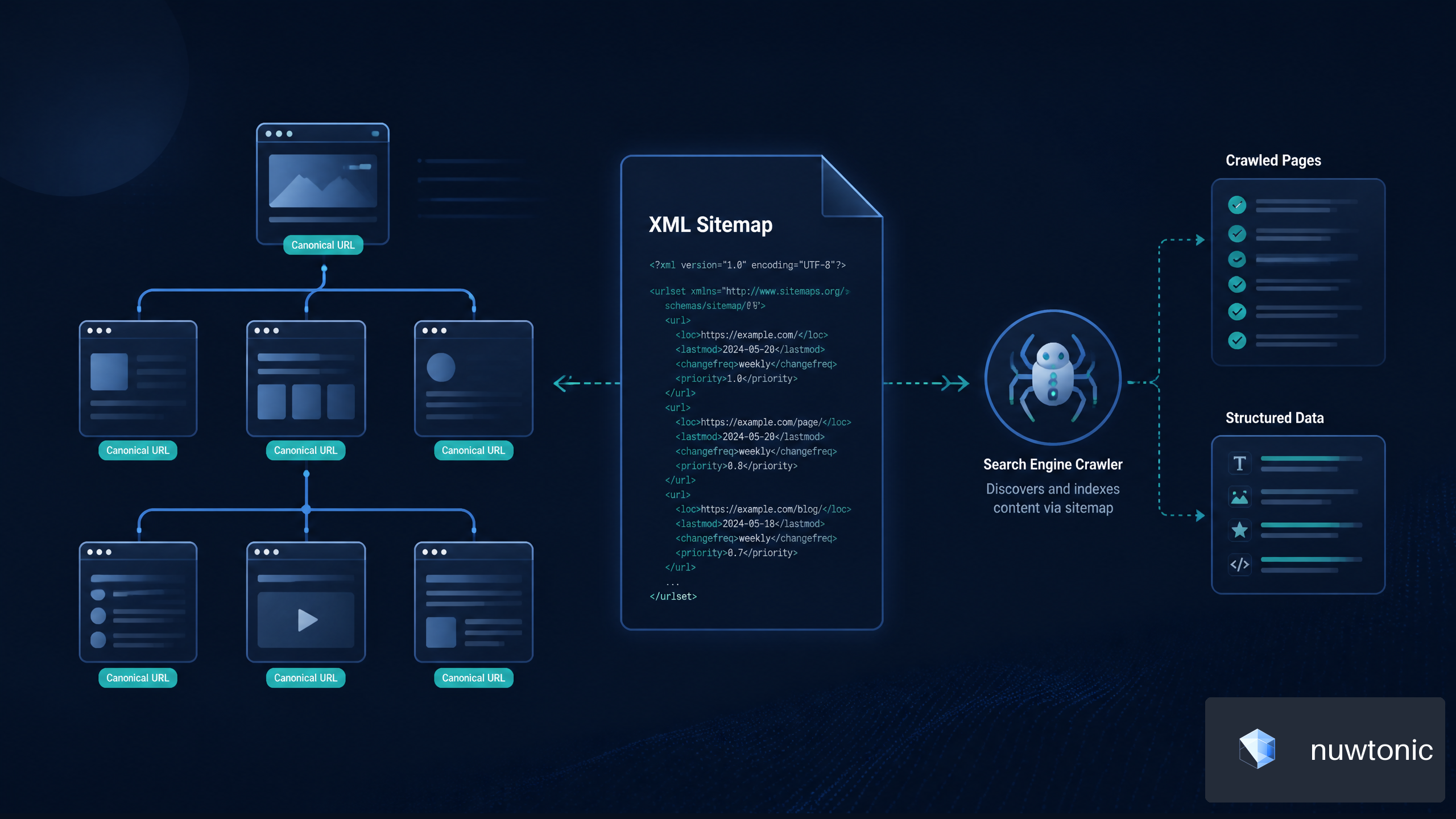
A topical map is a strategic, hierarchical blueprint of all the content required to cover a specific subject comprehensively. It visually and structurally organizes your website into primary themes, subtopics, and supporting articles. The goal is to establish topical authority — proving to search engines that you are the definitive expert on a given subject, rather than just a site that occasionally mentions a high-volume keyword.
Why Keyword Lists Aren't Enough Anymore
Before we look at the solution, let us outline a common pitfall. Historically, SEOs would pull a list of keywords, assign one keyword per page, and start writing. This "list-first" approach is dead.
Search engines now rely heavily on entities and semantic relationships. If you want to rank for a competitive term, you cannot just optimize a single page; you need a web of interconnected content silos that cover every related entity. A keyword list tells you what people type; a topical map tells you how those concepts connect in the real world.
The Role of Semantic Relevance and User Intent
Most businesses overlook the importance of user intent in topical mapping — understanding what your audience is searching for can streamline your content strategy. Every node on your map must align with a specific intent: informational, navigational, commercial, or transactional.
If your map groups a "how-to" informational query with a "buy now" transactional query on the same page, the search engine will get confused, and the user will bounce. Mapping out intent ensures that your page authority flows logically and meets the user exactly where they are in their journey.
How to Complete a Topical Map Manually
Step 1: Seed Topic Selection and Entity Research
I vividly remember an e-commerce project from a few years back. The client sold specialized outdoor gear. They wanted to rank for "hiking boots," a notoriously competitive term. Instead of attacking the term directly, we mapped out the seed topic: "wilderness hiking preparation."
To do this manually, you start by defining your core subject (the seed). From there, you perform entity research. You look at Wikipedia, industry glossaries, and the SERP features (like "People Also Ask") to identify the distinct concepts, places, and products related to your seed.
Step 2: Clustering Keywords and Search Intent Grouping
I've seen too many teams jump into content creation without proper keyword clusters, which often leads to diluted efforts. Once you have your entities and a massive list of long-tail keywords, you must group them.
If two keywords yield the exact same top 10 search results, they belong in the same cluster and should be targeted on the same page. This is the manual labor of SEO: checking SERPs, verifying intent, and grouping variations into single topical buckets.
Step 3: Structuring Content Silos and Internal Links

The final manual step is architectural. You need to organize your clusters into a pillar-cluster model.
| Page Type | Purpose | Internal Linking Rules |
|---|---|---|
| Pillar Page | Broad overview of the core topic. Targets high-volume, broad intent. | Links out to all supporting cluster pages. Receives links back from clusters. |
| Cluster Page | Deep dive into a specific subtopic. Targets long-tail keywords. | Links back to the Pillar Page and laterally to highly related cluster pages. |
This structure ensures that link equity flows seamlessly throughout the silo, lifting the visibility of the entire topic rather than just a single URL.
The Nuwtonic Approach: AI-Driven SEO Automation
Moving Beyond Blind Topical Maps
Creating a topical map manually takes weeks of spreadsheet wrangling. But there is a bigger issue: building a topical map blindly for an existing site is dangerous. You cannot just overlay a generic map onto a site that already has history, backlinks, and established rankings.
This is where Nuwtonic changes the game. Nuwtonic is an AI-driven SEO automation tool that does not just generate content; it builds highly trained, site-specific topical maps. It analyzes your existing architecture to ensure new content extends and connects with your current site authority.
Leveraging GSC Data for Gap Analysis
Instead of relying purely on third-party keyword tools, Nuwtonic ingests your Google Search Console (GSC) data. It analyzes the exact signals Google is already using to evaluate your site.
By comparing what Google already trusts you for against the broader semantic web of your industry, Nuwtonic performs a highly accurate content gap analysis. It finds the subtopics you are missing and the entities your competitors are covering that you are not.
Strengthening Weak Areas Based on Google Signals
Nuwtonic excels at identifying and recovering weak areas. If your site has traffic dropping for a specific cluster, the AI identifies the missing semantic relevance causing the decay.
| Feature | Manual Process | Nuwtonic AI Automation |
|---|---|---|
| Data Source | Third-party volume estimates | Direct GSC data and live Google signals |
| Gap Analysis | Manual SERP checking | Automated competitor and entity comparison |
| Execution | Writing briefs and drafting manually | AI-generated high-quality content with user approval |
| Integration | Disconnected spreadsheets | Unified platform for analysis and fixes |
By building upon what Google already rewards, Nuwtonic enhances your holistic topical authority efficiently, replacing multiple expensive tools with a single, streamlined workflow.
Executing and Measuring Your Content Strategy
Prioritizing Content Creation
Once your map is built—whether manually or via Nuwtonic—you cannot publish 100 pages overnight. You need a prioritization framework.
- Identify the core Pillar Page and publish it first to establish the hub.
- Target high-intent, low-competition cluster pages to secure quick wins.
- Build out informational supporting pages to build semantic depth.
- Connect them all with optimized internal links.
Avoiding Keyword Cannibalization
Keyword cannibalization occurs when multiple pages on your site compete for the same query, confusing search engines and splitting your page authority.
A completed topical map prevents this. Because every page has a defined, unique purpose and a specific intent, there is no overlap. If you find two pages targeting the same intent during your mapping phase, you must merge them or redirect the weaker one.
Iterating Your Dynamic Topical Map
Topical maps should be dynamic — they need to evolve with your audience's changing interests and search behaviors.
Set a schedule to review your map quarterly. Look at your GSC data. Are there new queries driving impressions that don't have a dedicated page? Add them to the map. SEO is never "done," and your map must remain a living document.
Frequently Asked Questions (FAQ Section)
What is the difference between a topical map and a keyword map?
• A keyword map assigns specific search terms to specific URLs, focusing primarily on search volume and rank tracking.
• A topical map organizes content by entities, concepts, and relationships, focusing on building comprehensive subject-matter authority and semantic relevance.
How many pages should a topical map include?
• The size of a topical map depends entirely on the breadth of the seed topic.
• A narrow niche might require 20-30 pages to cover comprehensively.
• A broad industry topic (like "personal finance") could require hundreds of interconnected pillar and cluster pages.
How do I measure whether my topical map is working?
- Monitor overall impressions and clicks for the entire topic cluster in GSC, not just individual keyword rankings.
- Track the indexing speed of new cluster pages; high topical authority usually leads to faster indexing.
- Analyze user engagement metrics, such as pages per session, to see if users are navigating through your internal links.
Sources/References
Acknowledgment of Source Limitations
In compiling the methodologies for this guide, it is important to note that specific, highly authoritative regulatory or academic sources directly detailing "how to complete a topical map SEO" are limited in traditional academic databases. SEO is a rapidly evolving, practitioner-led field.
Methodology and Data Interpretation
The strategies outlined in this article, particularly regarding GSC data integration, semantic relevance, and entity clustering, are synthesized from over 8 years of direct practitioner experience, enterprise SEO testing, and the operational frameworks utilized by advanced AI platforms like Nuwtonic.