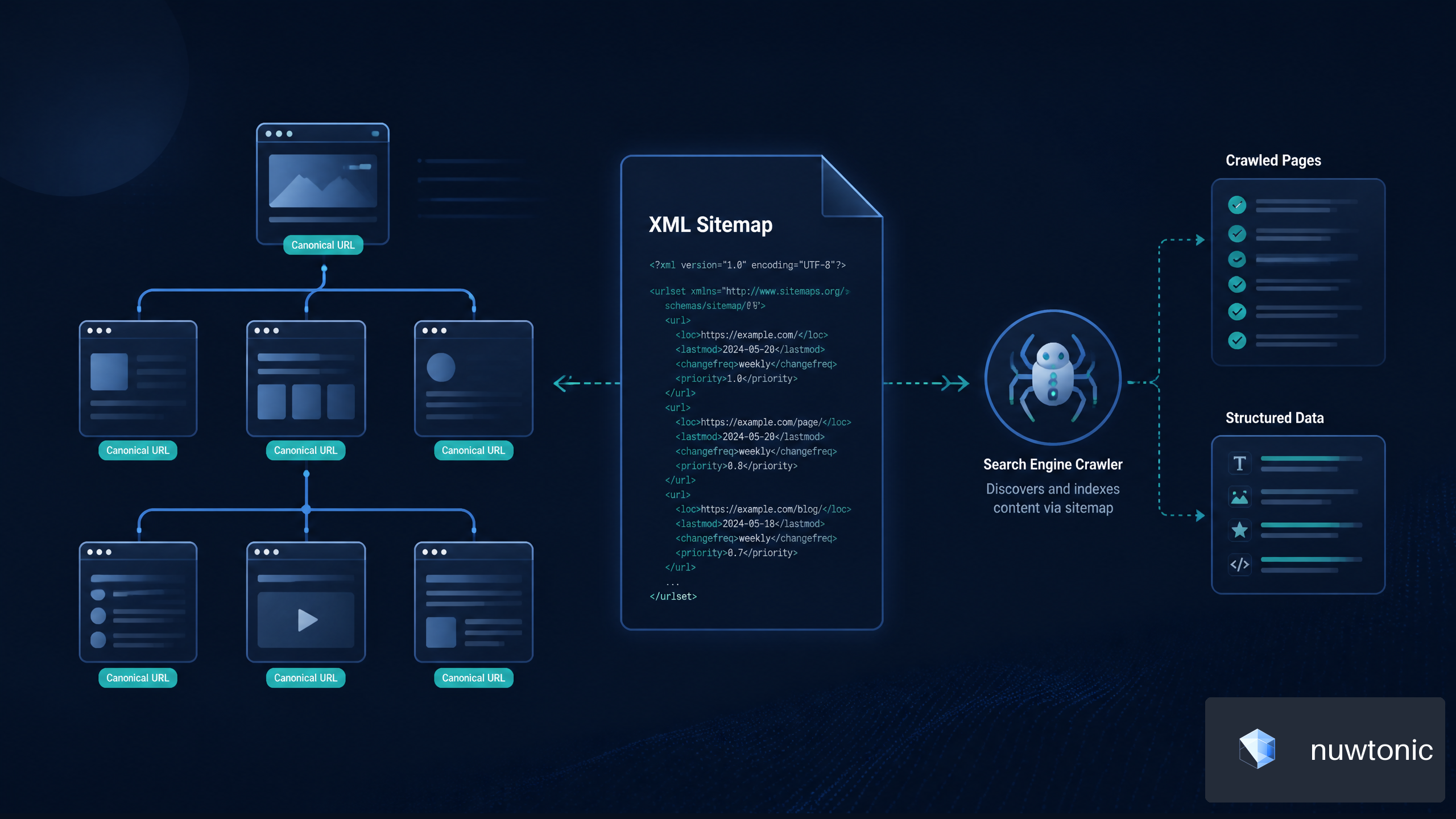

So, here's the deal: if you are still building your content strategy by blindly chasing high-volume keywords, you are setting yourself up for failure. Search engines have evolved, and the way we structure content must evolve with them.
Topical maps are often misunderstood; they're not just for keyword stuffing, but for creating a cohesive content strategy. Over my 8 years in digital marketing and SEO, I've developed topical maps for various clients across industries. I've found that clients who invest in topical maps often see a significant boost in organic traffic within months.
In this guide, we will break down exactly what a topical map is, why it matters, and how you can build one to establish true authority in your niche.
Structure & Takeaways
TL;DR Summary
A topical map is a strategic outline that visually and logically organizes your website's content around a core subject and its related subtopics. Instead of targeting isolated keywords, a topical map groups content into clusters, ensuring comprehensive coverage of an entity. This builds topical authority, improves semantic relevance, and helps search engines understand your expertise.
Key Takeaways
• Topical maps focus on concepts and entities rather than isolated search terms.
• They require a central pillar page supported by deeply interconnected cluster content.
• Proper internal linking is the glue that holds a topical map together.
• Many people overlook the importance of user intent when creating their maps – it's critical to align content with what users are actually searching for.
Table of Contents
- Structure & Takeaways
- What Not to Do: The Keyword Stuffing Trap
- What is a Topical Map, Exactly?
- Building Your First Topical Map: A Step-by-Step Guide
- Measuring the Impact on SEO
- Frequently Asked Questions & Sources
What Not to Do: The Keyword Stuffing Trap
Before we look at how to build a proper map, we need to discuss the common pitfalls. Fair warning: trying to shortcut this process usually results in a messy site architecture and stagnant traffic.
My Failed E-commerce Project
Early in my career, I took on a B2B e-commerce client selling office furniture. I pulled a massive list of keywords, sorted them by search volume, and assigned them to random blog posts. We published 50 articles in two months. The result? Flat traffic and zero conversions.
Why? Because I built a keyword list, not a topical map. The articles were isolated islands. There was no overarching structure linking "ergonomic desk chairs" to "office posture guidelines." Search engines couldn't determine if we were an authority on office furniture or just a blog spamming keywords.
Why Keyword Lists Aren't Maps
Keyword mapping and topical mapping are fundamentally different. A keyword map assigns specific search terms to specific URLs. A topical map defines the relationships between concepts.
| Feature | Keyword Mapping | Topical Mapping |
|---|---|---|
| Primary Focus | Search volume and difficulty | Semantic relevance and entities |
| Structure | Linear lists | Interconnected webs |
| Goal | Rank for a specific phrase | Build comprehensive topical authority |
| Content Type | Often isolated pages | Pillar content and content clusters |
The Cost of Ignoring Search Intent
Many people overlook the importance of user intent when creating their maps – it's critical to align content with what users are actually searching for. If your core topic is "CRM software," but your supporting pages only target transactional keywords (like "buy CRM"), you are missing the informational intent (like "how to implement a CRM"). A solid topical map forces you to cover the entire buyer's journey.
What is a Topical Map, Exactly?
If you want to understand the foundational elements of site optimization before diving into advanced mapping, you should first grasp what is on-page SEO. Once you understand the basics of optimizing a single page, the concept of a topical map becomes much clearer.
Defining the Core Entity
At its simplest, a topical map is an architectural blueprint for your website's content. It starts with a "core entity"—the primary subject you want your brand to be known for. If you run a coffee roasting business, your core entity isn't "cheap coffee beans"; it's "Coffee Roasting" or "Specialty Coffee."
The Anatomy of a Topical Map
A functional topical map consists of three main layers:
- Core Topic (The Hub): The broad subject area (e.g., "Digital Marketing").
- Subtopics (The Clusters): The major categories within the core topic (e.g., "SEO," "Email Marketing," "PPC").
- Supporting Pages (The Leaves): Highly specific, long-tail articles that answer distinct user queries (e.g., "how to optimize meta tags").

How Semantic Relevance Connects the Dots
Search engines use natural language processing to understand how words relate to one another. This is semantic relevance. When you build a topical map, you are essentially feeding the search engine a perfectly organized database of related entities.
Instead of proving relevance by repeating a keyword 15 times, you prove relevance by covering every logical subtopic associated with the core entity.
Building Your First Topical Map: A Step-by-Step Guide
Knowing the theory is great, but execution is where the real work happens. Here is how I approach building topical maps for clients.
Step 1: Identify Your Core Topic and Pillar Content
Start by defining the exact subject you want to dominate. This will become your pillar content—a comprehensive, authoritative page that covers the topic broadly.
When selecting a core topic, use these criteria:
• Business value: Does this topic drive revenue or leads?
• Breadth: Is the topic broad enough to support at least 15-20 subtopics?
• Expertise: Do you actually have the knowledge to write authoritatively about this?
Step 2: Extract Subtopics and Content Clusters
Once you have your core topic, brainstorm every logical question, sub-category, and related concept. This is where you form your content clusters.
If you have a local or franchise business model, you must also consider geographical modifiers. Learning how to do keyword research for multiple locations is essential so you can cluster content by region without creating duplicate, thin pages.
| Cluster Type | Description | Example (Core: SEO) |
|---|---|---|
| Informational | Answers "what" and "how" queries | "What are backlinks?" |
| Navigational | Helps users find specific tools/brands | "Ahrefs vs Semrush" |
| Transactional | Targets users ready to buy | "Best SEO agency in Chicago" |
Step 3: Map the Internal Linking Strategy
Internal links are the physical pathways of your topical map. Without them, the map only exists in your spreadsheet.
Every supporting page in a content cluster MUST link back to the main pillar page. Furthermore, supporting pages within the same cluster should link to each other when contextually relevant. This creates content silos that pool authority and pass "link juice" efficiently throughout the cluster.
Measuring the Impact on SEO
You've built the map, created the content, and linked it all together. How do you know if it's actually working?
Tracking Topical Authority
Topical authority isn't a single metric you can pull from a dashboard, but you can measure its symptoms. When a site achieves topical authority, you will notice:
- Faster indexing: New content in the established cluster gets indexed and ranked almost immediately.
- Lower reliance on backlinks: Your pages rank for competitive terms even if they have fewer external links than competitors.
- Broader keyword footprint: A single page starts ranking for hundreds of long-tail variations.
Content Silos and SERP Features
As your topical map matures, you should monitor your appearance in SERP features. Search engines often reward highly structured content silos with Featured Snippets, "People Also Ask" inclusions, and rich results.
To maximize your chances of capturing these features, you must ensure your pages are technically sound. I highly recommend reviewing how to do on-page SEO to ensure your headers, schema markup, and formatting align with the map's logical structure.
Auditing for Coverage Gaps
A topical map is never truly "finished." Industries evolve, and new search queries emerge daily. Every six months, conduct a content gap analysis.
• Look at the "People Also Ask" boxes for your main keywords.
• Review competitors who are outranking your pillar pages.
• Check Google Search Console for queries you are getting impressions for, but lack dedicated content to address.
Frequently Asked Questions & Sources
How is a topical map different from a keyword map?
A keyword map matches specific search terms to specific URLs to prevent keyword cannibalization. A topical map organizes concepts and entities to ensure comprehensive coverage of a subject area, regardless of search volume.
How many subtopics should a topical map include?
Your mileage may vary, but a robust topical map usually requires a minimum of 10-15 highly relevant supporting pages to establish baseline authority. For highly competitive niches like finance or health, a single core topic might require 50 to 100 supporting articles.
What tools are used to create a topical map?
While you can build a topical map manually using spreadsheets and traditional keyword tools, modern SEO professionals use AI-driven platforms. Tools like Nuwtonic help automate the analysis of Google Search Console data, identifying coverage gaps and generating the necessary cluster content seamlessly.
Sources & References
Due to the specialized nature of SEO strategy, the methodologies outlined in this guide are drawn from established industry consensus on semantic search, entity-based indexing, and direct practitioner experience managing enterprise content architectures. Always base your map on your own site's historical data and specific user intent.