Most content distribution advice starts with the wrong question: Which channels should we use? That question produces channel lists, not results. The harder and more valuable question is operational: Who owns distribution, how quickly does it happen, what changes for each audience, and which feedback determines the next action?
Publishing is only the handoff point between production and discovery. A content distribution strategy works when it turns a finished asset into a sequence of deliberate placements, adaptations, conversations, and measurable outcomes. It fails when a team publishes a strong article, shares the same link once, and waits for analytics to explain why nobody saw it.
B2B teams already understand that one destination isn't enough. In the 2025 B2B Content Marketing Benchmarks, Budgets, and Trends report, 89% of marketers used organic social media for content distribution, the most widely used channel among 1,229 global respondents (benchmark summary). The strategic lesson isn't just “post on social.” It's that distribution has become a coordinated operating model across social, search, email, communities, events, and owned properties.
Table of Contents
- Why Most Content Fails Before Distribution Even Starts
- The Owned Earned and Paid Channel Framework
- Mapping Your Audience to the Right Channels
- Repurposing and Syndication Workflows That Scale
- Distribution for AI Search and Answer Engines
- Building a Repeatable Distribution Operations System
- KPIs and Dashboards That Actually Inform Decisions
Why Most Content Fails Before Distribution Even Starts
The publish-and-pray model treats distribution as a promotional task assigned after the work is complete. By then, the headline is fixed, the format may be unsuitable for the intended channel, subject-matter experts have moved on, and nobody has reserved time for outreach or follow-up. The content team calls it published. The audience experiences it as absent.
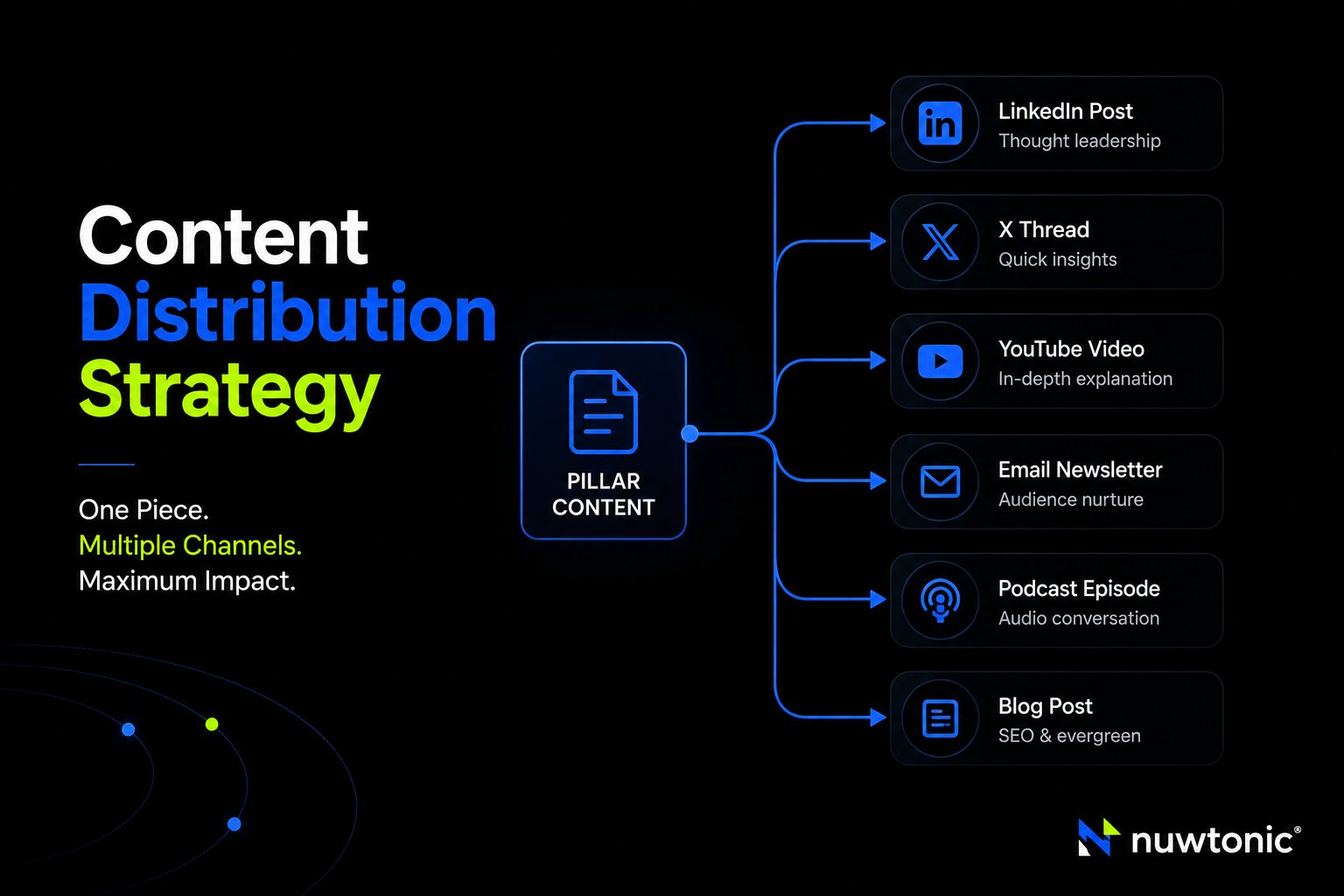
A better model makes distribution part of the brief. Before drafting, the team decides which audience problem the asset addresses, where that audience already seeks answers, what action matters, and which derivatives will make the idea useful in each environment. A technical guide might become a search landing page, a sales enablement reference, a newsletter lesson, a community answer, and a set of expert-led social posts. Those aren't copies of the article. They're separate entry points into the same point of view.
Practical rule: If nobody can name the first audience, first channel, owner, and first follow-up action before production begins, the asset isn't ready for production.
Design the distribution before the draft
Start every brief with a distribution block containing:
- Audience problem: State the question, objection, or decision the content will help resolve.
- Primary destination: Choose the owned page, resource, webinar, or other asset that should retain attention and conversion.
- Reach channels: Identify where new people might encounter the idea, such as organic social, search, communities, partnerships, or paid placements.
- Conversion channels: Define the deeper interaction, such as an email signup, consultation, event registration, or sales conversation.
- Derivative formats: Assign the people responsible for adapting the core idea rather than copying its text.
- Measurement plan: Add tracking conventions and the signal that will trigger a refresh, repurpose, or escalation.
This planning discipline changes the editorial brief itself. Writers use evidence and language that can survive extraction into a post or answer. Designers create visual moments that can stand alone. Subject-matter experts know when their participation is needed, instead of being asked to promote an unfamiliar asset at the last minute.
For channel-specific tactics, a practical guide to reach strategies for marketers can help teams think beyond publishing a link. The larger principle is more important than any individual tactic: distribution is infrastructure. It needs owners, service-level expectations, reusable templates, approval rules, and feedback loops. Without those components, even a channel mix becomes a collection of irregular favors.
The Owned Earned and Paid Channel Framework
The owned, earned, and paid model remains useful because it separates control, credibility, and reach. It also prevents a common budgeting mistake, treating every channel as if it performs the same job.
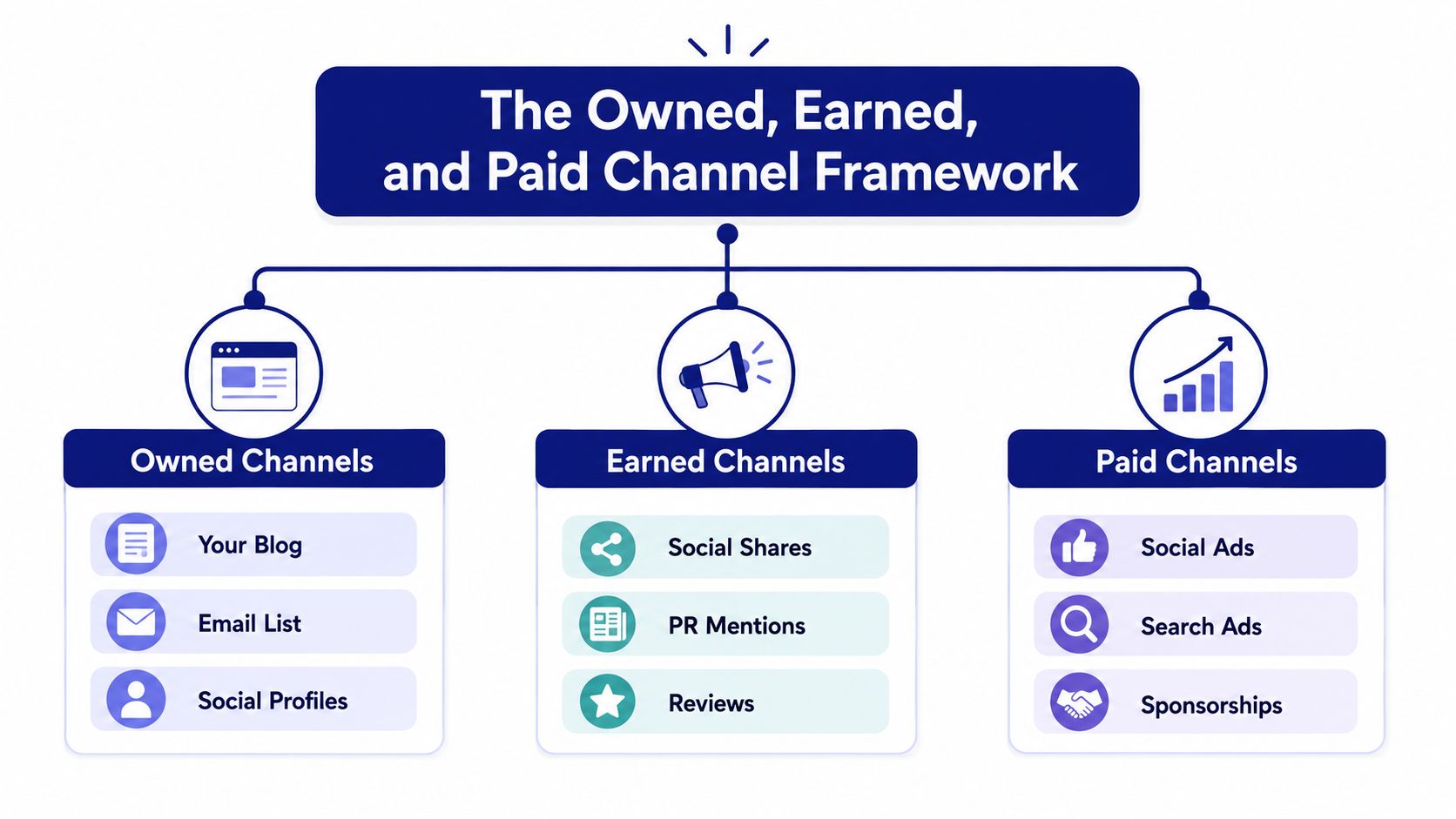
Owned channels include your website, blog, email list, resource center, and branded social profiles. You control the message, publishing schedule, calls to action, and first-party measurement. Owned distribution is the foundation for durable demand because it gives every campaign a stable destination. It also requires maintenance. A neglected newsletter or poorly structured blog won't become valuable merely because the brand owns it.
Earned channels include PR coverage, guest contributions, reviews, community mentions, organic sharing, and partner distribution. You don't control the final framing or timing, but third-party participation can add credibility and expose the asset to an established audience. Earned reach usually depends on relevance, evidence, relationships, and the willingness to contribute value before asking for attention.
Paid channels include search ads, social ads, sponsored content, and syndication networks. Budget can accelerate exposure, but payment can't repair weak positioning, a mismatched landing page, or an offer that doesn't fit the audience's intent. Paid activity works best when the team already knows which message and audience deserve amplification.
The 2025 benchmark data illustrates the distinction between usage and effectiveness. Marketers reported using organic social at 89%, corporate blogs at 84%, and email newsletters at 71%. Yet in-person events at 52% and webinars at 51% were viewed as the most effective channels, ahead of email at 42%, organic social at 42%, blogs at 41%, and newsletters at 37% (Content Marketing Institute research). Reach channels can seed awareness, while deeper formats can capture intent.
Use a decision matrix, not a default stack
| Situation | Prioritize | Why |
|---|---|---|
| Limited budget and an immature audience | Owned first, earned selectively | Build a destination and learn which messages attract response before buying reach. |
| Strong expertise but limited visibility | Earned partnerships and community participation | Borrow relevant distribution while demonstrating credibility. |
| Proven offer and clear conversion path | Paid amplification around validated assets | Scale a message that already earns engagement and action. |
| Complex B2B purchase | Owned education plus events or webinars | Give buyers accessible research, then create a deeper interaction. |
| Search-led demand | Structured owned content plus expert distribution | Capture existing questions while creating discovery beyond search results. |
Audit the last campaign by asking what each channel contributed. If social generated attention but the webinar generated qualified conversations, don't judge both by traffic. Assign each channel a role, then fund and staff it according to that role.
Mapping Your Audience to the Right Channels
Channel knowledge is not audience knowledge. A platform can be popular in your category and still be wrong for a particular segment, buying stage, or content format. Build the map from observed behavior rather than assumptions.
Run the mapping exercise
Begin with audience segments defined by a meaningful difference in problem, role, buying authority, or urgency. For each segment, collect three types of evidence:
- First-party behavior: Review referral paths, search queries, landing-page entries, email clicks, assisted conversions, and CRM notes. Look for repeated patterns, not isolated visits.
- Community language: Read relevant discussions on professional communities, forums, review sites, and social threads. Record the exact vocabulary people use to describe the problem and the objections they raise.
- Competitive presence: Examine where comparable brands receive substantive engagement. A competitor's presence is a clue, not proof. Check whether people respond with questions, save the material, visit the site, or merely react briefly.
Then run a controlled channel test. Keep the topic and call to action stable while changing the format and placement. A useful test might compare an expert explanation in a professional feed with a practical answer in a community, or an educational email with a short video introduction. The point isn't to crown a permanent winner from one experiment. It's to learn which combination of audience, context, format, and intent produces a meaningful response.
Complete the matrix before committing resources
| Audience Segment | Primary Channel | Secondary Channel | Content Format Preference | Engagement Signal | Priority Score |
|---|---|---|---|---|---|
| Problem-aware prospects | Search-led owned content | Expert social posts | Detailed guide and short extract | Qualified page visit | High, medium, or low |
| Existing subscribers | Resource center | Lesson, checklist, or sequence | Click to a relevant next step | High, medium, or low | |
| Technical evaluators | Specialist communities | Webinar or event | Evidence-led answer and demonstration | Follow-up question or registration | High, medium, or low |
| Decision-makers | Partner introductions | Executive social | Brief point of view and proof | Meeting or referral | High, medium, or low |
Use the Priority Score as a planning judgment, not a fake precision metric. Rate each channel according to audience presence, contextual fit, ability to reach the segment, conversion proximity, and internal capacity. A channel that scores well on reach but poorly on ownership may deserve a test, not a full program.
The matrix should also expose gaps. If a segment has a primary channel but no responsible owner, the channel isn't part of your operating system yet. Assign the owner, define the format, establish the approval path, and record the signal that determines whether the test continues.
Repurposing and Syndication Workflows That Scale
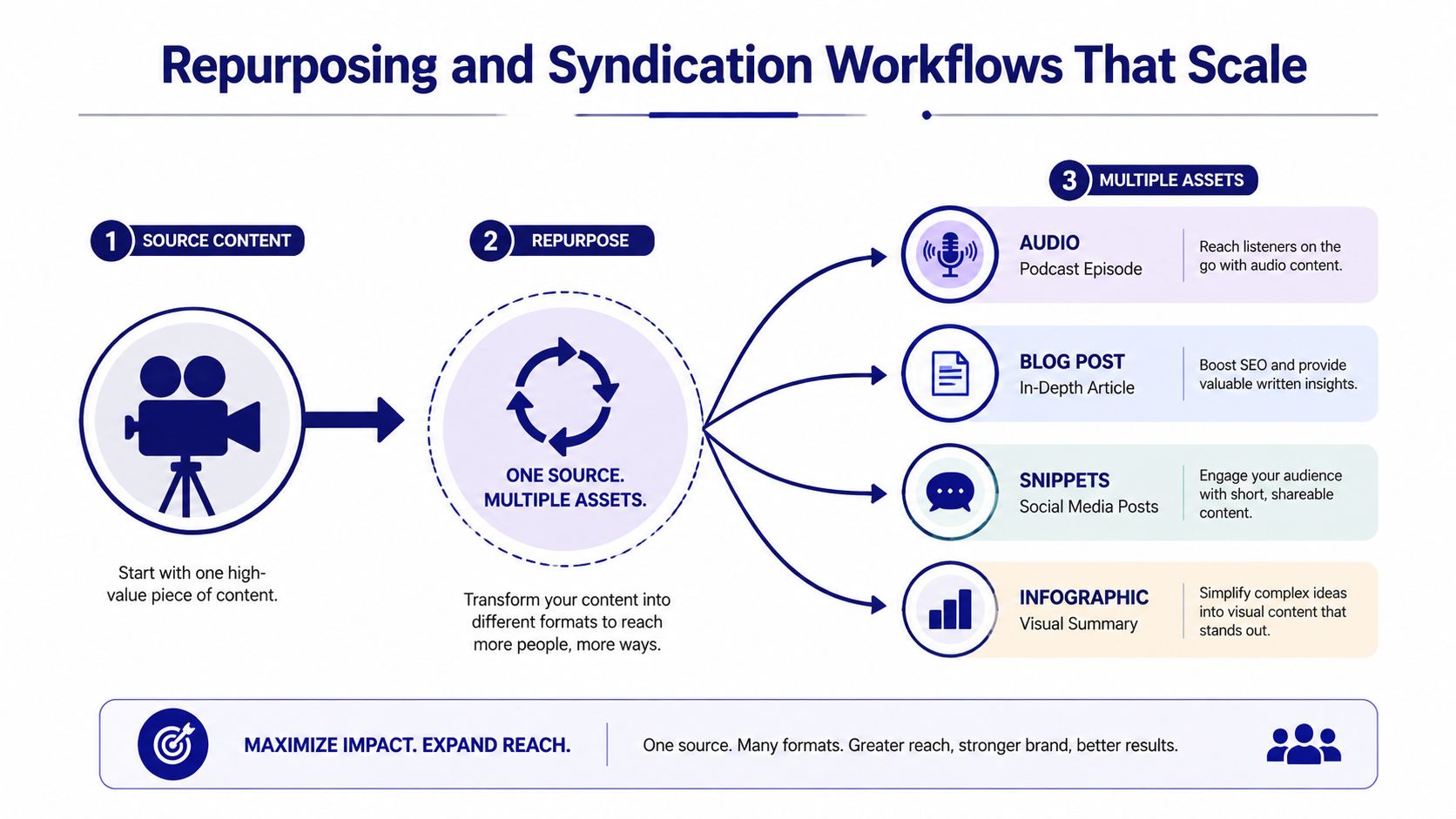
Copying the same link and caption across every platform creates fatigue because each environment rewards a different behavior. Repurposing should preserve the core insight while changing the entry point, pacing, proof, and call to action.
Build a source-to-derivative workflow
- Extract the source intelligence. Mark the article's central argument, supporting evidence, objections, definitions, examples, process steps, and strongest lines. Store them in a structured content record, not only inside a document.
- Match ideas to formats. Turn a sequence of steps into a carousel, an argument into a professional social post, an objection into an email, and a detailed explanation into a webinar segment or podcast talking point.
- Rewrite for the environment. A thread needs progression and standalone context. A carousel needs visual hierarchy. An email needs a single reason to click. A short-form video script needs an immediate problem and spoken rhythm.
- Add a distinct action. Some derivatives should drive to the source. Others should invite discussion, collect a question, promote an event, or support sales enablement.
- Tag every derivative. Record the source asset, segment, channel, format, publication date, campaign, and call to action. This makes performance comparable without treating every interaction as a separate campaign.
A single core asset can support a substantial derivative library, but quantity isn't the goal. The useful question is whether each format solves a different discovery or consumption problem. A guide to turning one article into platform posts provides additional practical ideas for adapting source material without flattening it into identical copies.
Sequence releases and protect measurement
Release the primary owned asset first, then use derivatives to create discovery and conversation around it. Schedule follow-up adaptations after the initial launch rather than exhausting every format on the same day. The exact cadence should follow audience behavior, approval capacity, and the asset's shelf life.
For syndication, choose a publication whose audience overlaps with your target segment and whose editorial standards protect the content's context. Agree on source attribution and ensure the republished version points clearly to the original. Where the publisher supports it, use a canonical reference to the source article. Otherwise, preserve attribution and a descriptive link back to the original, then monitor whether the syndicated version attracts useful referral traffic or merely duplicates exposure.
Memo's sample analysis found 41.8% higher article readership on aggregator sites than on original articles, which means syndication produced 141.8% of the readership that would have existed without republishing in that sample (Memo's syndication analysis). Treat that finding as a reason to test strong networks, not as a guarantee for every publication.
Use separate campaign identifiers for the source and each derivative. Report unique users, engaged sessions, conversions, and assisted pipeline at the source level, then analyze derivative contribution separately. This avoids adding a social interaction, an email click, and a syndicated visit together as if they represented three independent people.
For the technical meaning of attribution and republishing controls, document the rules in your content syndication reference and make them part of the approval checklist.
Distribution for AI Search and Answer Engines
Traditional distribution optimizes for a click from a feed or a result page. AI-mediated discovery adds another outcome: your brand, page, or expertise may be surfaced inside an answer even when the user never visits the source. That changes both the content structure and the measurement model.
AI systems need clear relationships between entities, claims, sources, and context. A page that buries its answer under broad introductory copy is harder for people and machines to interpret. Structure important definitions plainly, identify the subject and organization consistently, support claims with accessible evidence, and use appropriate schema markup without treating structured data as a substitute for useful writing.
Make distribution machine-readable
Create a source record for every priority topic that includes the target audience, named entities, primary question, supporting sources, product or service relationship, author expertise, update history, and approved claims. Use that record to align the website page, social explanations, partner contributions, and community answers. Consistent terminology helps models connect related references across surfaces.
Practical checks include:
- Answer clarity: Put the direct response near the relevant heading, then explain the reasoning and limits.
- Entity consistency: Use the same organization, product, person, and category names across owned and earned placements.
- Citation readiness: Make important claims specific, attributable, and easy to locate on the page.
- Technical accessibility: Validate indexing, internal links, structured data, rendering, and page experience.
- Prompt coverage: Track real customer questions across ChatGPT, Gemini, Perplexity, Claude, Google, and Grok, then record whether the answer mentions your brand and cites your URL.
A broader trend signal shows why this matters. Current coverage reports 81% AI adoption in content marketing, while content distribution apps are used by 51% of B2B marketers, indicating a gap between AI-assisted production and deliberate distribution infrastructure (Merca20 trend coverage). The operational response isn't to generate more material. It's to distribute authoritative material into the places that answer engines can discover, interpret, and connect.
Use a dashboard with three layers: traditional search visibility, channel engagement and referral behavior, and AI answer inclusion with source citations. Review changes by URL and prompt category. A page that loses clicks but gains qualified AI citations may need a different interpretation than a page that loses both rankings and answer-engine visibility. The AI search optimization guide offers a useful framework for connecting structural improvements with this broader discovery environment.
Building a Repeatable Distribution Operations System
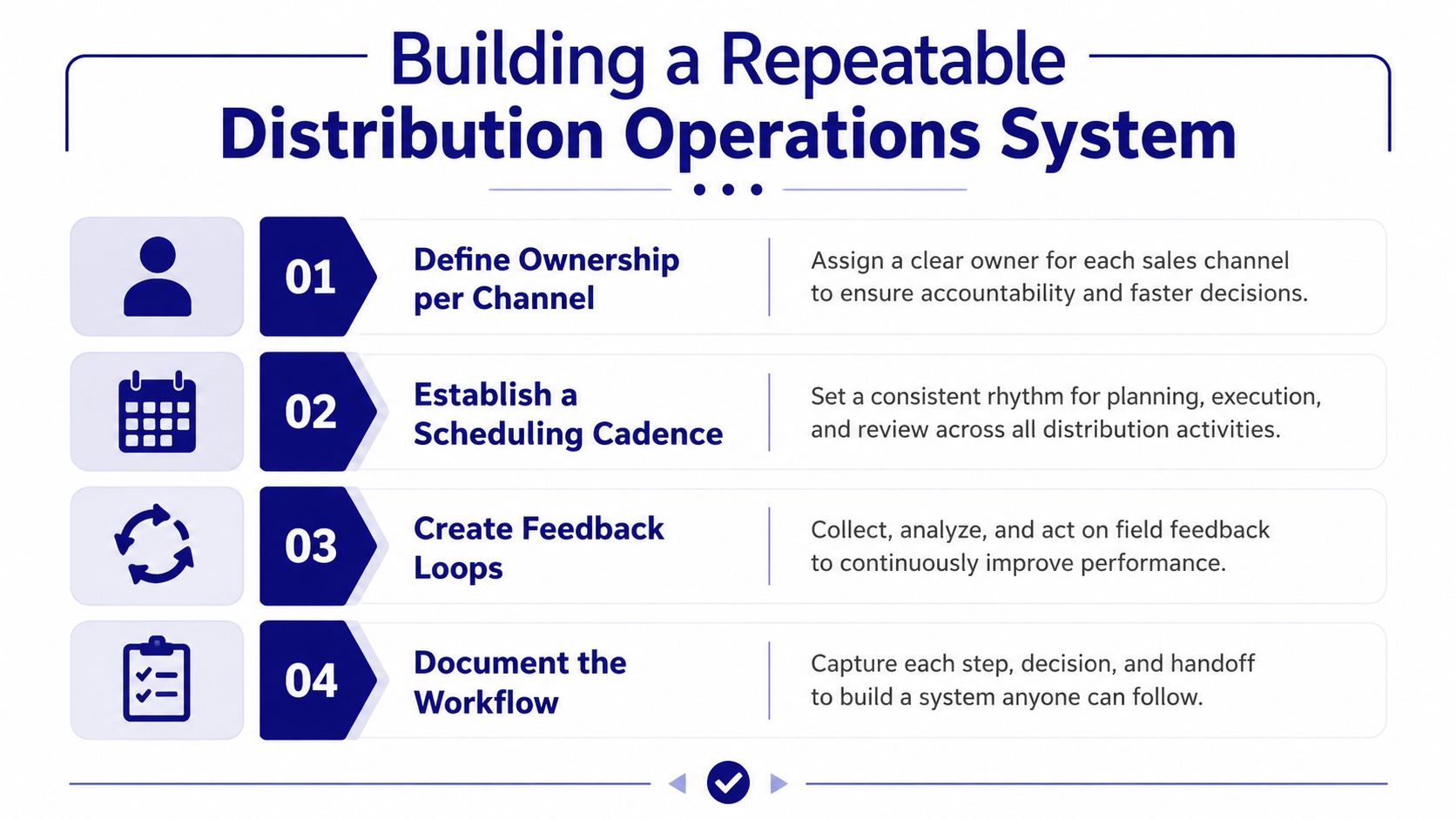
A strategy becomes reliable only when someone can execute it during a busy launch week. Distribution needs the same operational discipline as content production, including ownership, dependencies, service-level expectations, approvals, and recovery procedures.
Assign work at the channel level
Create a responsibility matrix for every recurring action:
- Content owner: Confirms the source asset, audience, message, and call to action.
- Channel owner: Adapts the asset, schedules publication, and moderates responses.
- Approver: Checks factual accuracy, brand risk, legal requirements, and links.
- Analyst: Applies tracking, reviews performance, and records the next decision.
- Escalation owner: Decides what happens when a launch misses its distribution commitment or underperforms.
Don't assign a channel to a department without naming a person accountable for the handoff. “Marketing owns social” is too vague to protect a launch. The calendar should show the asset, derivative, owner, status, approval dependency, destination, campaign tag, and planned action.
Define service levels and recovery paths
Set an internal SLA for the time between publication readiness and the first distribution action. The value of an SLA is clarity, not an arbitrary speed target. Define what counts as ready, who starts the clock, what blocks publication, and who receives an escalation when the owner can't complete the task.
A workable workflow includes:
- Intake: The content owner submits the source asset and distribution brief.
- Preparation: Channel owners create native derivatives and tracking links.
- Review: The approver checks claims, destinations, accessibility, and brand fit.
- Launch: The channel owner publishes according to the shared calendar.
- Monitoring: The analyst records early signals, questions, errors, and audience language.
- Decision: The team refreshes, repurposes, increases support, or retires the activity.
Run a weekly review that focuses on decisions rather than screenshots. Ask which assets earned qualified attention, which channel created meaningful conversations, which handoff failed, and what the team will change before the next launch. Document the answer in the workflow so learning survives staff changes and competing priorities.
Recent operational coverage emphasizes integrated systems, secure delivery, and clear responsibility across teams (distribution operations analysis). The practical implication is straightforward: a distribution calendar is not a list of publishing dates. It's a production pipeline with inputs, owners, controls, and outputs.
KPIs and Dashboards That Actually Inform Decisions
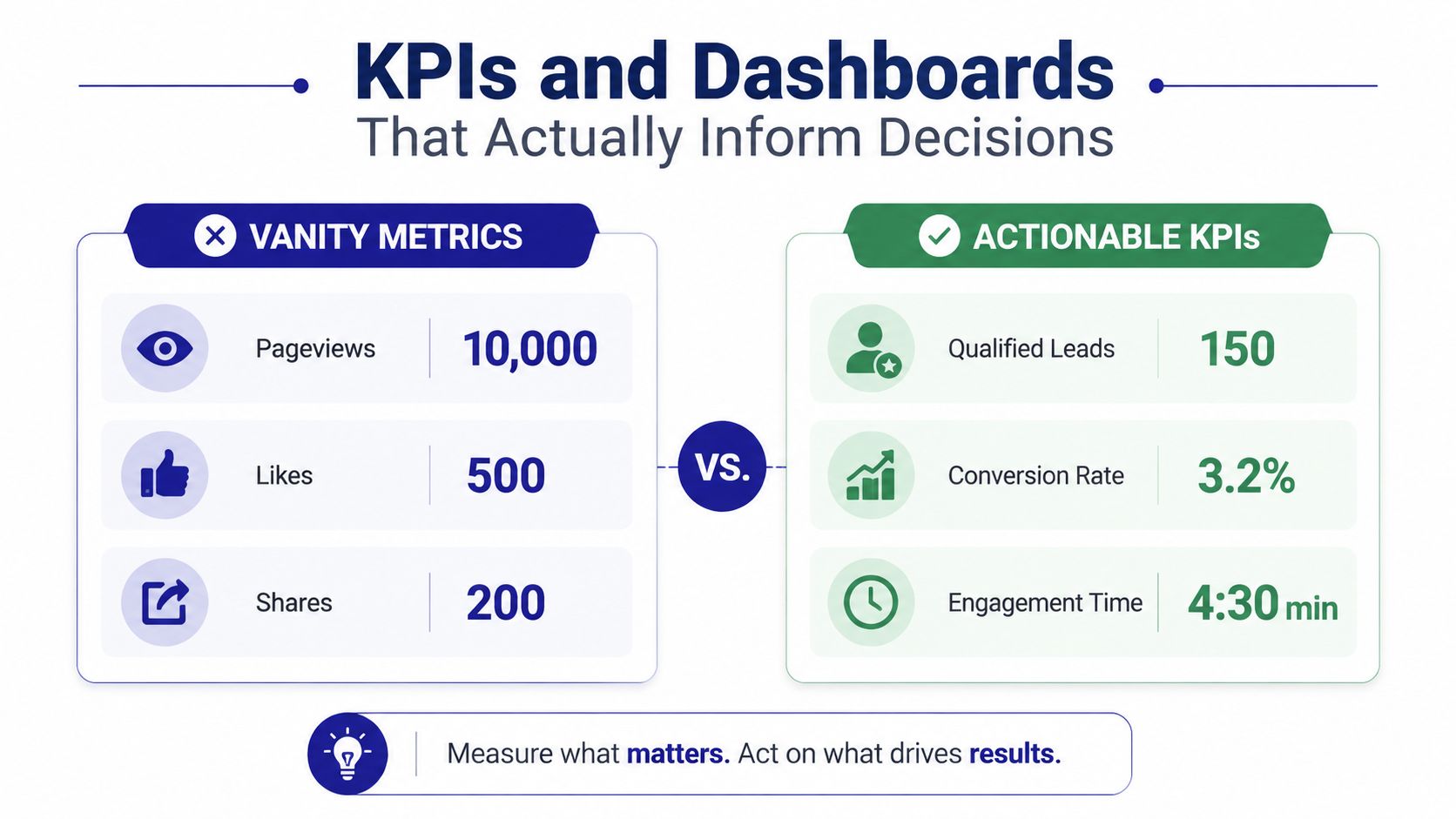
A dashboard full of pageviews, likes, and shares can report activity without explaining business value. Those signals may help diagnose reach or creative resonance, but they shouldn't be the final score for a content distribution strategy.
Separate leading signals from business outcomes
Leading indicators show whether distribution is working early enough to adjust it:
- Qualified reach: Visits or interactions from the intended segment, not undifferentiated exposure.
- Engaged consumption: Scroll depth, return visits, completed video sections, meaningful replies, or time spent with the material.
- Channel response: Click-through behavior, saves, registrations, replies, and referral quality by placement.
- Distribution reliability: On-time execution, derivative completion, approval delays, and missed handoffs.
Lagging indicators connect those activities to value:
- Conversion rate by channel: Compare the same action across source, format, audience, and placement.
- Cost per qualified visitor: Divide channel spend by visitors who meet your qualification rule, not total clicks.
- Content-assisted pipeline: Record whether the asset influenced an opportunity, while keeping first-touch and last-touch views separate.
- AI citation inclusion: Track how often priority prompts surface the brand or source URL, then classify whether the mention is accurate and useful.
- Retention or expansion influence: For existing customers, connect educational content to product adoption or renewal conversations where your systems can support that analysis.
The 2025 benchmark summary reports that 84% of marketers distribute content through at least three channels simultaneously (channel distribution benchmark). That makes consistent tagging essential. Without a shared campaign taxonomy, teams can't distinguish a strong channel from an asset that benefited from multiple unrecorded exposures.
Design dashboards around decisions
Give every metric an owner and a response rule. If qualified visits rise but conversion falls, inspect message-to-landing-page alignment. If email engagement is strong but assisted pipeline is absent, review audience fit and the next-step offer. If a derivative earns attention but no source visits, decide whether its purpose is awareness, conversation, or referral, then judge it accordingly.
For reporting systems that need to serve multiple stakeholders, guidance on agency client reporting that scales can help organize recurring summaries without drowning decision-makers in raw activity. Keep the executive view focused on outcomes and material risks, while channel owners retain diagnostic detail.
Use SEO dashboard reporting to connect search queries, rankings, click behavior, and content actions in one review process. Nuwtonic offers an AI-native workspace that connects technical audits, content operations, Google Search Console signals, scheduling, and AI prompt tracking, so teams can review search and answer-engine visibility alongside distribution execution.
The goal isn't a prettier dashboard. It's a shorter path from signal to action. If a metric doesn't change a publishing decision, channel allocation, content update, or workflow priority, move it to a supporting report or remove it.
Nuwtonic helps SEO and content teams operationalize distribution through content workflows, scheduled publishing, technical fixes, competitor intelligence, and AI search prompt tracking. Visit Nuwtonic to connect content execution with search and answer-engine visibility, then turn the next distribution review into a prioritized action plan.