You've probably seen this happen. A strong article goes live on your site, a partner publication republishes it, and suddenly the team is asking whether the new visibility is a win or a warning sign. That tension is the core of content syndication meaning in SEO, because syndication can expand reach, attract referrals, and build authority, but only if the republished version is handled with clear attribution and the right indexation signals.
The phrase gets used loosely, which is why teams talk past each other. Some people mean a straight republishing agreement, while others mean a lead-gen distribution network that trades content for contacts. Those are not the same play, and the SEO controls are not the same either.
Table of Contents
- What Content Syndication Actually Means
- The Republishing Model Explained Step by Step
- Four Syndication Models You Will Actually Encounter
- SEO Controls Every Syndication Deal Must Specify
- Three Real Examples of Syndication Done Right
- Risks, Misconceptions, and When Syndication Backfires
- Best Practice Checklist and KPIs for SEO Teams
- Putting It All Together for Your Next Campaign
What Content Syndication Actually Means
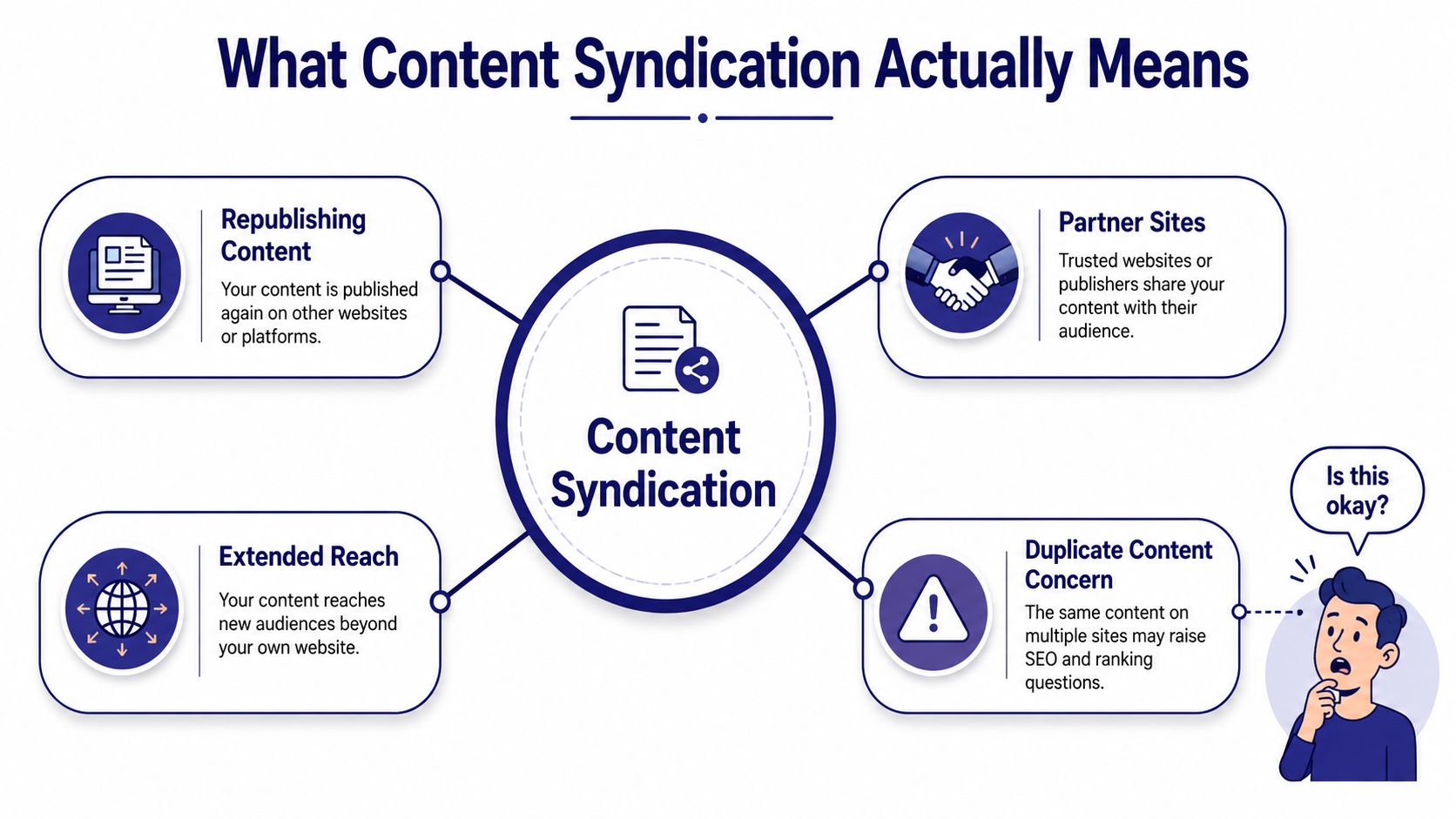
A marketer publishes a piece, then spots the same article on a larger industry site. The first reaction is usually a mix of pride and panic. That reaction makes sense, because content syndication is deliberate republishing on another website, usually with attribution and a backlink to the original source, and it can look a lot like duplication if the rules aren't obvious IntoTheMinds.
What makes it syndication instead of scraping
Syndication is negotiated, not stolen. The original publisher gives permission for reuse, and the host site agrees to show credit in a way that points back to the source. That difference matters because search engines need a signal that the copy is authorized, not a duplicate posted to game rankings.
The term also covers more than articles. Modern syndication includes blog posts, infographics, videos, and whitepapers, which is why the old mental model of “newswire reprints” is too narrow for SEO teams today HubSpot. The asset can live on more than one property, but the original still has to be identifiable.
Why the SEO team should care
In practice, syndication is a distribution strategy with search implications. It's used to extend reach beyond owned channels and expose the same asset to a larger audience on third-party platforms, while still keeping the original URL in control when attribution and canonical handling are set correctly IntoTheMinds. That makes it useful for brands that need audience access more than another isolated pageview.
This is also why glossary definitions often miss the core issue. The useful question isn't “Can this content appear elsewhere?” It's “Who is the source, what is the permission model, and how do we preserve authority?” A republished article with clear source credit is a distribution deal. A copied article with no permission is plagiarism.
Practical rule: if the partner page can't clearly point back to the original, treat the arrangement as incomplete until the attribution piece is fixed.
The Republishing Model Explained Step by Step
Think of the classic model like lending a finished book to another library while keeping the original copy on your shelf. The other library can introduce your work to a new audience, but your copy still matters as the source edition. That's the simplest way to understand the republishing form of content syndication meaning.
How the flow usually works
First, your team creates the original asset on your site. That asset should be strong enough to stand on its own, because the host site is borrowing value, not rescuing weak content. Next, you choose partner sites that already serve the audience you want, ideally ones with similar or higher authority and a relevant readership Semrush.
Then the two sides negotiate reuse rights. That agreement should cover whether the full article is republished, whether an excerpt is used, and how attribution appears on-page. The host site publishes the piece, usually with a byline or source note that points back to the original URL, and then your team monitors referral traffic and downstream engagement.
The original publisher owns the asset. The host site owns the placement. If that distinction gets blurry, so does the SEO outcome.
There's also a sequencing decision that matters. Many teams publish on their own domain first, then syndicate later so the original URL gets a head start in discovery and indexing. The delay is a practical safeguard, not a magic trick, and it helps reduce the chance that a partner page becomes the first version search engines see.
Questions to ask before signing the deal
- Who controls attribution: Does the partner page show the original source in visible copy, not just in hidden metadata?
- How much of the piece is reused: Is it the full article, a summary, or a selective excerpt?
- Which audience is the host site serving: Is the readership close to your buyer profile, or just broad?
- What happens after publication: Will the partner update the canonical, the bio, or the link once the article goes live?
For teams that want a broader technical backdrop on redirection logic and status handling, the explanation of the 301 HTTP code is worth keeping nearby because it helps distinguish move signals from syndication signals.
Four Syndication Models You Will Actually Encounter
Teams often say “let's syndicate this” without agreeing on which game they're playing. That's where problems start, because editorial republishing, lead-gen syndication, paid placement, and co-marketing all look similar from ten thousand feet, but they behave differently in search, attribution, and measurement.
The four buckets
| Model | Primary Goal | Typical Host | Attribution Style |
|---|---|---|---|
| Editorial republishing for reach | Audience expansion and referral traffic | Industry publication, niche blog, community platform | Original source note, canonical, backlink |
| B2B syndication network | Lead generation | Syndication network or lead portal | Brand credit plus form capture on the host |
| Paid placement | Visibility through media buying | Publisher recommendation units or sponsored placements | Sponsored labeling, ad-style disclosure |
| Co-marketing partnership | Shared authority and mutual distribution | Another brand's owned channels | Shared bylines, co-branded credits |
Why the distinction matters
Editorial republishing is the closest to the classic meaning. You already own the content, and you allow another site to carry it with credit. B2B syndication networks work differently. The host often captures the lead on-site before passing attention to the original publisher, so the business objective is demand generation rather than pure distribution DemandScience.
Paid placement is another animal. The content may be promoted to a large audience, but the mechanics look more like media buying than republishing, and SEO control is usually weaker. Co-marketing sits in between, because two brands create or distribute the asset together, so authority and audience are shared instead of borrowed one-way.
The key is to match the request to the model. If a teammate asks for canonicals on a lead-gen network, that may be the wrong fix because the host's job is to capture contacts, not index a duplicate article. If someone says they want “exposure,” that might mean editorial republishing, or it might mean a paid recommendation unit. The word is the same, the workflow isn't.
SEO Controls Every Syndication Deal Must Specify
The technical side starts with one simple question, which URL should search engines treat as the source? The answer depends on the controls you negotiate before publication, not after the partner page is already live. That's why canonical tags, noindex, backlinks, and delay timing need to be part of the agreement, not a last-minute cleanup.
Canonical and noindex are not interchangeable
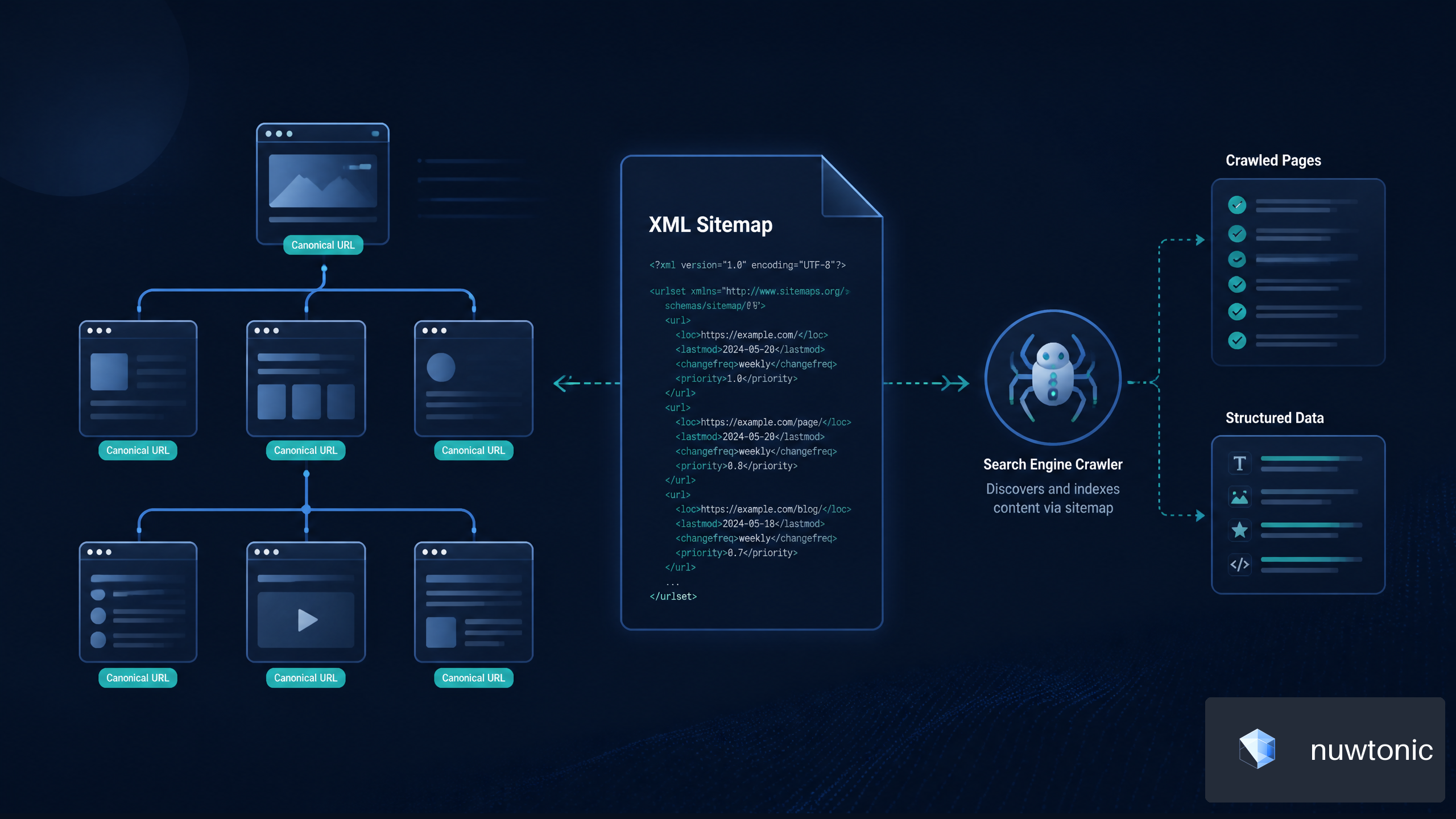
A rel=canonical tag points search engines from the syndicated copy to the original URL, which helps consolidate indexing and ranking signals around the source page Semrush. A noindex directive does something different, it tells search engines not to index the partner page at all HubSpot. Canonical preserves visibility on the partner page while clarifying source; noindex removes the partner page from the index entirely.
That distinction matters when you're weighing reach against control. If the host wants its page to be discoverable, canonical is usually the more cooperative option. If the host is happy to host the content but you want to keep search equity tightly centered on the source, noindex is cleaner.
The link-back rules that should not be vague
A visible backlink is not just a courtesy, it's part of the signal set. The best placements put the source link near the top of the article, use anchor text that clearly identifies the original piece, and avoid burying the credit below the fold. If the host treats the link as sponsored, that should be disclosed, especially in paid distribution contexts.
For teams trying to scale outreach and partnerships around syndicated content, a useful companion tactic is to scale your link building efforts through structured outreach lists and relationship tracking instead of ad hoc email threads.
Timing can protect the source
“Publish first, syndicate later” is still the safest operating rule. A delay of a short window before reposting gives the original URL time to establish itself and reduces the odds of a partner page becoming the version that gets attention first. That isn't about manipulating search engines, it's about making the source order obvious.
If a partner insists on immediate reposting, make the attribution and canonical plan non-negotiable before you agree to the placement.
For teams comparing tag-level controls, the overview of the x-robots-tag can help when the noindex decision needs to move from page markup to header-level implementation.
Three Real Examples of Syndication Done Right
A republished Medium post, a gated whitepaper, and an embedded video all count as syndication, but they don't behave the same way. The right setup depends on whether the host is carrying the full asset, gating the lead, or embedding the media with a source trail.
A blog post republished on Medium
A long-form article can be republished on Medium with the original byline and a canonical link back to the source domain. In that setup, the Medium version acts like a distribution surface, not a separate editorial asset. The source note should be visible, and the original URL should remain the primary destination if someone wants the canonical version.
Measurement here is straightforward. Watch referral traffic from Medium, branded searches that follow the repost, and whether the source page keeps its organic position over time. If the republished version starts taking attention away from the original, the attribution or delay plan probably needs tightening.
A whitepaper distributed through a syndication network
A B2B whitepaper often appears on a partner network where the host captures the lead first, then delivers the asset. This is less about public indexing and more about contact exchange. The SEO question is not only whether the PDF is duplicated, it's whether the host page is built to transfer authority or only harvest leads.
For this model, the main signals are lead quality, conversion rate, and how quickly the sales team can work the contacts. The content may never need to rank publicly at all, which is why the hosting agreement should reflect demand-gen goals rather than editorial republishing goals DemandScience.
A product explainer video embedded on a partner blog
Video syndication usually works best when the partner embeds the original upload, adds a descriptive link, and points structured data or description copy back to the source URL. That gives the partner something useful for its audience without pretending the embedded player is a fresh asset. The host page can still drive discovery, but the original video platform or source page remains the authority anchor.
If you're aligning this kind of campaign with broader evergreen planning, the logic in the evergreen content strategy framework helps because videos and guides with long shelf lives are usually the easiest assets to syndicate responsibly.
Risks, Misconceptions, and When Syndication Backfires
The biggest myth is that duplicate content automatically triggers a penalty. That's not the useful way to think about it. The primary risk is copied content without permission, attribution, or source signals, because legitimate syndication with proper controls is treated differently from plagiarism BrightEdge.
Where the real problems show up
The first problem is rank displacement. A syndicated page can outrank the original if the host has stronger authority or the source signals are weak. The fix is usually a mix of delayed posting, clear source linking, and a canonical that points to the original.
The second problem is brand drift. If readers spend all their time on the host site and barely notice your name, the partner may own the memory of the content even when you wrote it. A visible byline, a top-of-page attribution note, and a source page that's easy to find help keep the brand attached to the asset.
The third problem is lead leakage. If the host collects the form fill and your team doesn't get clean handoff data, the content may generate activity without usable contacts. That's especially common in demand-gen syndication, where the partner's operations model is built around lead capture.
Mitigation rule: every syndication agreement should state who captures the lead, who owns the attribution, and which page search engines should treat as primary.
Know the line between syndication and plagiarism
Syndication says, “we agreed to reuse this, and here's who made it first.” Plagiarism says, “we took it and tried to pass it off as ours.” That line sounds obvious, but it gets crossed fastest when teams rush placement and skip the attribution language.
If the host won't show source credit, won't honor a canonical, and won't discuss indexation behavior, the placement isn't just risky. It's unfinished.
For situations where copied material needs to be removed or contested, the professional guide to content removal is a practical reference point because not every reused page is an authorized syndication deal.
Best Practice Checklist and KPIs for SEO Teams
A good syndication workflow is boring in the best possible way. The decision points are clear, the attribution is written down, and the reporting tells you whether the asset earned reach without sacrificing control.
Campaign checklist
Choose the model first. Decide whether the campaign is editorial republishing, lead-gen syndication, paid placement, or co-marketing. Don't choose the host before the business goal.
Pick the host for fit, not size alone. A relevant audience and sensible authority profile matter more than a vanity name if you want useful traffic.
Lock the attribution language. Write the source note, backlink placement, and byline format before the first draft is exported.
Set the indexation rule. Use canonical when the partner page should remain visible, or noindex when the partner page should not compete in search.
Agree on timing. Publish on the original domain first, then syndicate after the source has had time to establish itself.
Check the live page. Confirm the source link is visible, the canonical or noindex is present, and the partner didn't alter the credit during publishing.
KPIs that tell you whether it worked
For demand generation, track lead volume, lead quality, conversion rate, and sales cycle length. Those are the metrics that tell you whether the syndication channel is producing actual pipeline, not just clicks DemandScience.
For SEO, look at referral traffic, branded search movement, indexed URL behavior, and ranking stability on the original page. If the source page stays stable while the syndication pages send useful traffic, the setup is doing its job. If the partner version starts dominating the query space, revisit the canonical or delay strategy.
Putting It All Together for Your Next Campaign
If the goal is reach, use editorial republishing and protect the original with a canonical and visible source credit. If the goal is leads, use a B2B syndication network and treat the host's form experience as part of the campaign, not a nuisance. If the goal is authority, co-marketing usually makes more sense because both brands can lend credibility to the asset.
If the goal is pure visibility, paid placement may fit better than republishing, even though it gives you less control over source equity. That's the core lesson behind the phrase content syndication meaning, it isn't one tactic, it's a family of distribution plays with different SEO trade-offs. Teams that separate those plays early make cleaner decisions and waste less time fixing mismatched expectations later.
AI search is starting to raise the stakes again, because citation patterns and source recognition are becoming more visible in how content gets surfaced. In 2026, the partners worth the risk will be the ones that help your content stay attributable, crawlable, and credible across both search results and AI-driven answers.
If you want help turning syndication into a cleaner part of your content system, Nuwtonic can help your team connect technical SEO, content operations, and AI visibility in one workflow. It's a useful fit when you need to protect source authority while scaling distribution, and it can help you spot the pages and signals that matter before the next syndication push goes live.