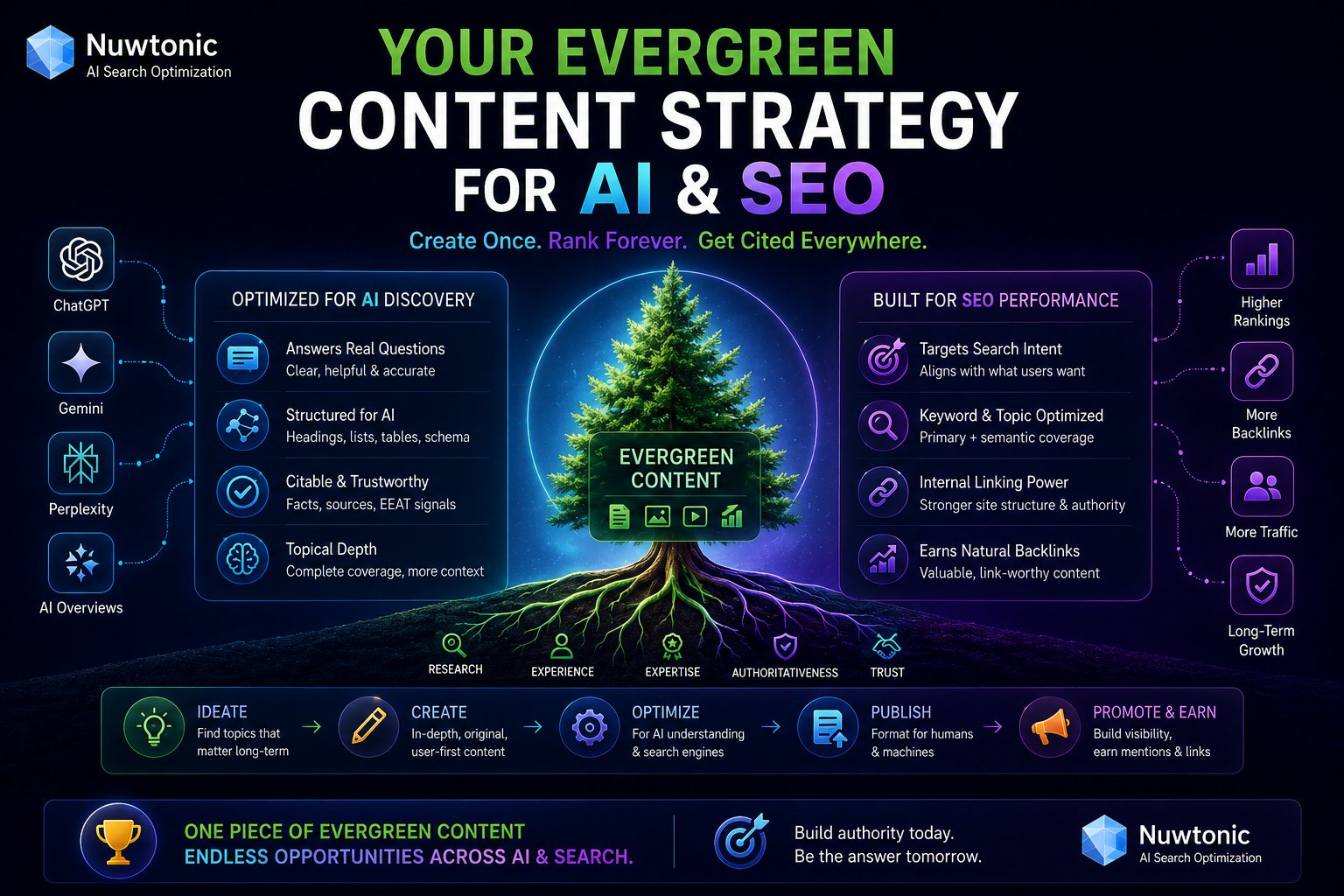
Most advice on an evergreen content strategy is stuck in an older search model. It assumes that if a topic is timeless, the page will stay valuable with occasional cosmetic updates. That assumption doesn't hold anymore.
AI search changed the failure mode. Your page can still target a durable topic, still rank for legacy queries, and still lose usefulness because it no longer matches how people ask the question now. This is the core problem. Falls & Co. reported that 68% of evergreen content loses relevance within 9 months due to conceptual staleness, not broken links, because teams don't redesign content in modular ways that let sections evolve over time, according to Falls & Co.'s analysis of why evergreen content isn't enough anymore.
A lot of marketers still treat evergreen assets like published artifacts. Write the guide. optimize the title. add a few links. revisit it next quarter if traffic drops. That workflow was already weak for SEO. For AI-driven discovery, it's worse.
Two terms matter now.
Conceptual staleness means the page's core framing falls behind, even if the underlying topic is still relevant. The definitions, examples, workflows, and objections on the page no longer reflect how buyers think or how AI systems summarize the topic.
Prompt decay is related but more specific. People don't just search differently over time. They ask models different variants, with different context, constraints, and expectations. A static page written for one keyword set won't reliably answer those newer prompt patterns.
Evergreen doesn't mean fixed. It means durable under change.
That shifts the job. A modern evergreen content strategy isn't about publishing timeless articles. It's about building adaptive assets that can keep answering the same core problem as query language, interfaces, and search surfaces evolve.
That changes what you prioritize:
- Not just topic durability: You need prompt durability.
- Not just keyword research: You need intent variation mapping.
- Not just updates: You need structural refreshes.
- Not just rankings: You need visibility in AI answers, summaries, and citations.
Teams that ignore this usually make one of two mistakes. They either chase trends and never build depth, or they publish “ultimate guides” that become rigid and expensive to maintain. Neither approach creates a durable search asset.
The better model is simpler to operate than it sounds. Pick foundational questions. Build pages in modules. Write for entities and answer patterns, not just blue links. Refresh on a schedule. Track where AI answers drift away from your page. Then patch the page before it decays.
Table of Contents
- Introduction Beyond Timeless Topics
- What Is an Adaptive Evergreen Content Strategy
- The 5-Part Framework for Adaptive Evergreen Content
- KPIs and Monitoring Your Evergreen Engine
- The Nuwtonic Playbook for Scaling Your Strategy
- Common Pitfalls in Evergreen Strategies and How to Avoid Them
- Conclusion Building Your Content Moat
Introduction Beyond Timeless Topics
The old definition of evergreen content was too shallow. It reduced the idea to topic longevity, as if the subject alone determined long-term performance. That was never fully true, and AI search exposed the weakness.
A page doesn't stay evergreen because the topic is broad, educational, or non-newsworthy. It stays evergreen because it continues to answer the question in the format, depth, language, and structure that users and machines can still use. That's a much higher bar.
Why timeless topics still fade
A “how to” guide can become stale without becoming inaccurate. That's the trap. The answer may still be technically correct, but the examples are dated, the use cases are narrow, the product comparisons are old, and the framing no longer reflects the current decision path.
That kind of content often looks healthy on the surface. It may still attract some impressions. It may still hold branded visibility. But it becomes easier for competitors, aggregators, and AI-generated summaries to replace because it stops being the best source to cite.
Here's what usually causes the drop:
- Rigid structure: The article is written as one continuous essay, so updates require rewriting the whole asset.
- Shallow intent coverage: It answers the primary keyword but misses adjacent questions, objections, and edge cases.
- Weak machine readability: The content is understandable to a person, but not clearly structured for extraction, summarization, and citation.
- Maintenance debt: Teams update dates and stats, but they don't rework sections that no longer fit how the audience asks the question.
The new standard for evergreen
An evergreen content strategy now has to satisfy two systems at once. It has to perform in traditional search and remain usable in AI-mediated discovery. Those systems overlap, but they don't reward exactly the same things.
Traditional SEO still cares about relevance, authority, internal links, crawlability, and depth. AI answer systems also care about whether your page contains clean, extractable answers, entity clarity, current examples, and enough conceptual coverage to support citation.
Practical rule: If a section can't be updated independently, it isn't built for modern evergreen performance.
This is why the phrase “set it and forget it” should disappear from any serious content workflow. Evergreen assets need less reinvention than trend content, but they need more disciplined maintenance than is commonly planned for.
The upside is that when you build them correctly, they become much harder to displace. They don't just collect rankings. They accumulate trust, links, references, and reuse across multiple discovery surfaces.
What Is an Adaptive Evergreen Content Strategy
Evergreen content is not “publish once and rank forever.” That model was shaky before AI search. Now it fails faster because answer interfaces compress, remix, and replace weak pages long before rankings fully collapse.
An adaptive evergreen content strategy treats content as a maintained asset with a stable intent and a changing delivery layer. The core question stays relevant. The page evolves as terminology shifts, examples age, product categories change, and AI systems start favoring different phrasing or evidence.
That distinction matters because evergreen traffic is rarely spread evenly across a site. Ahrefs' original study on how pages gain search traffic over time found that a small share of pages drives a disproportionate share of organic visits, which is the business case for treating a few durable topics like infrastructure instead of treating every post like a campaign. The practical lesson is simple. Build fewer evergreen assets, but build them to hold up under revision.
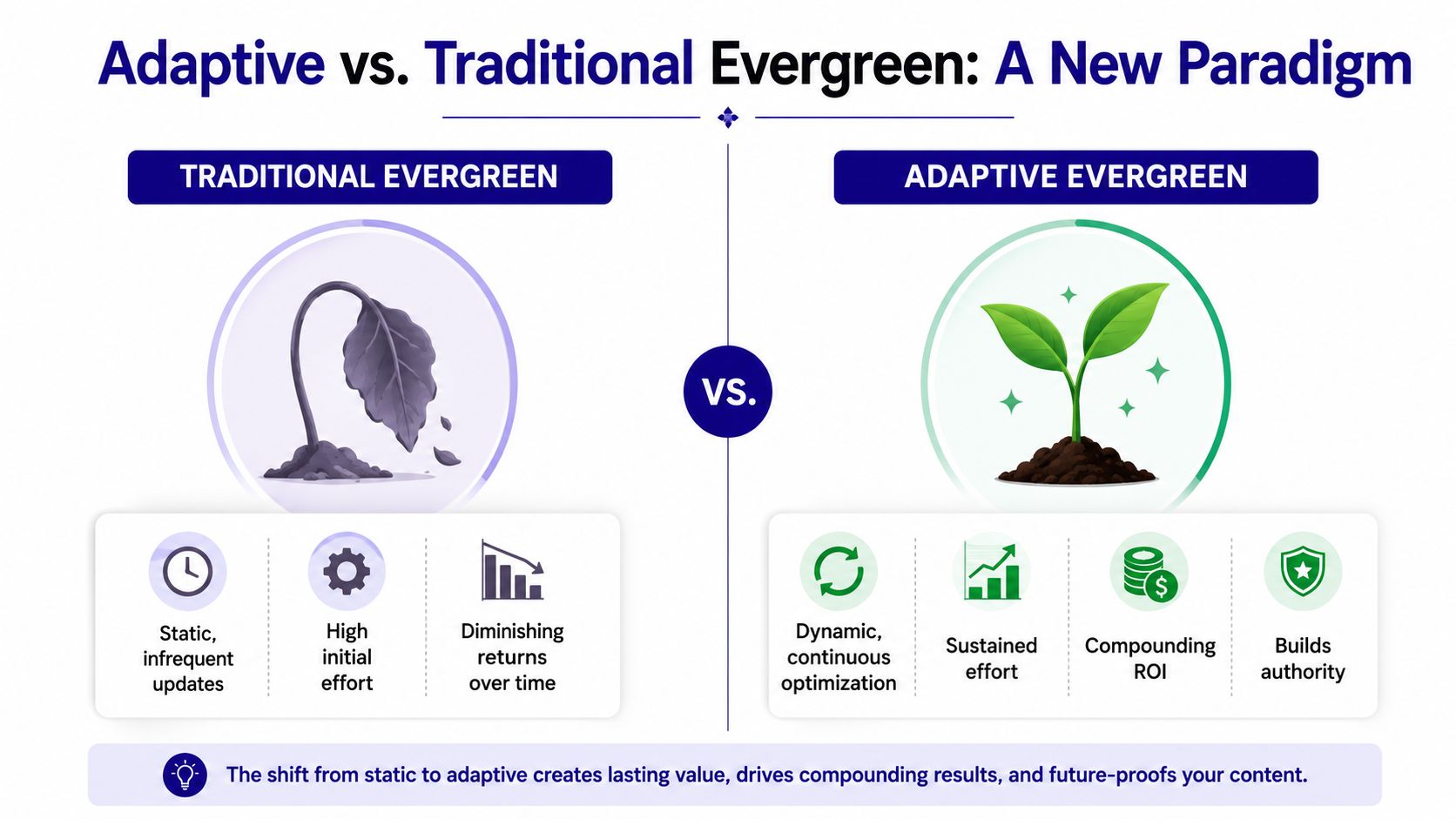
Static evergreen versus adaptive evergreen
Static evergreen content assumes the original framing will keep working with light edits. Adaptive evergreen content assumes the framing itself may need adjustment, even if the topic does not.
A static page is usually written as a finished article. An adaptive page is structured more like a maintained reference asset. It still targets a foundational question, but it is built so sections can be revised without breaking the whole page.
That matters more in AI search because prompt patterns decay. Users stop asking the question the way your keyword tool recorded it six months ago. AI systems also prefer pages that make extraction easy. If your answer is buried in a long intro, mixed with outdated examples, or written with fuzzy entity references, it becomes less useful for both citation and summarization. Teams working on how to optimize content for AI search are already seeing this shift.
A practical adaptive asset usually includes:
- A stable core answer: The explanation that should remain true unless the market itself changes.
- Replaceable sections: Examples, tools, screenshots, FAQs, and comparisons that can be updated independently.
- Explicit entities and relationships: Clear naming of products, concepts, audiences, and use cases so search engines and AI systems can interpret the page correctly.
- Defined refresh points: Sections likely to age first, such as workflows, references, interface details, and prompt-led query variants.
What this changes in execution
The old evergreen playbook rewarded length and patience. The current one rewards structure, revision discipline, and distribution across multiple discovery surfaces.
That changes how teams should work. Instead of publishing ten adjacent posts that partially answer the same question, create one primary asset with room for updates, then support it with internal links, examples, and narrower companion pages. Instead of refreshing only the publish date, rewrite sections that no longer match how buyers evaluate the problem.
The strongest evergreen pages keep their core position while adapting at the edges. They stay useful to readers, interpretable to machines, and connected to the rest of the site's authority.
A timeless topic alone is not enough. A topic can stay relevant for years and still be a weak asset if it does not connect to product intent, first-hand expertise, or a cluster you can effectively own. Adaptive evergreen content lasts because it is designed to compound, not because it avoids change.
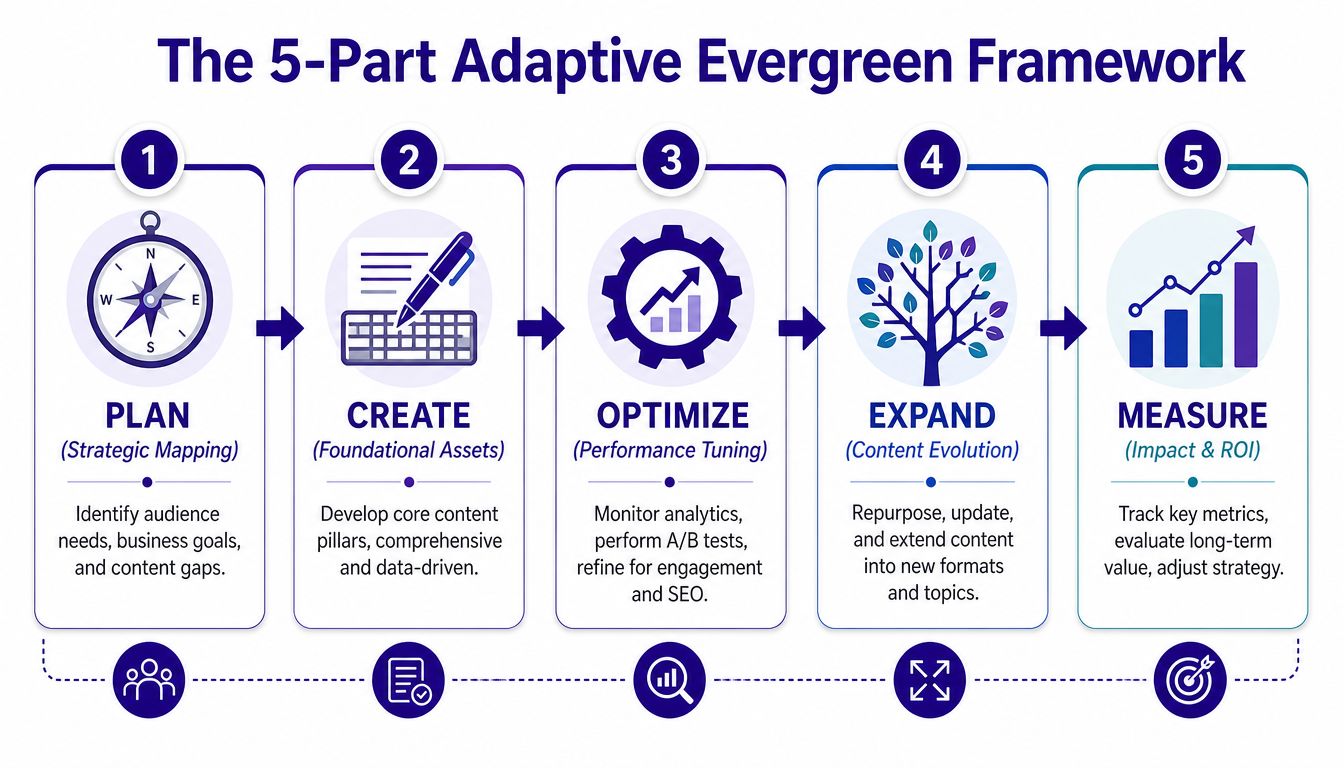
The 5-Part Framework for Adaptive Evergreen Content
Most content teams don't need more ideas. They need a workflow that prevents good evergreen pages from becoming expensive dead weight. The framework below is the one that holds up best when you care about both SEO and AI visibility.
Topic Selection and AI Intent Mapping
Start with foundational questions, not vanity phrases. The most reliable evergreen topics usually come from direct-question patterns like how, why, what, and who, because those queries stay relevant longer and keep a stable informational core, as explained in Econsultancy's guide to why you need an evergreen content strategy.
Then pressure-test them with keyword tools. To identify valid evergreen topics, use AI-powered SEO platforms such as Semrush or Clearscope to find long-tail terms with consistent search volume over time and avoid jargon or slang that ages quickly, based on Core dna's guidance on evergreen content.
Don't stop there. Keyword consistency is only the first filter. You also need to map how the same core topic appears in different prompt styles. A traditional query might be “evergreen content strategy.” An AI prompt version could be “build a content system that keeps ranking and gets cited in AI search.” Same need. different language.
Create an intent map with four layers:
Core question
The durable problem, such as how to build an evergreen content strategy.Decision context
Who's asking and why. A founder, SEO lead, agency strategist, and content manager often need different angles.Prompt variants
Conversational rewrites, scenario-led questions, comparison asks, and “best way to” formulations.Remediation triggers
Signals that tell you the page is drifting, such as missing subtopics, outdated examples, or weak AI answer pickup.
Modular Content Architecture
Most evergreen pages fail at the document level. They're too linear.
Write the asset in blocks that can be revised independently. A strong modular layout usually includes an intro definition, a principle section, a step-by-step method, a decision table, FAQs, examples, and a refreshable “what changed” layer when the topic needs it.
Here's a simple way to think about structure:
| Module | Job | Typical update frequency |
|---|---|---|
| Core definition | Anchor the topic | Low |
| Process steps | Explain execution | Medium |
| Tool examples | Keep the page current | High |
| FAQs | Capture new question variants | High |
| Comparisons | Address decision-stage intent | Medium |
This is also where your AI search planning belongs. If you need a practical checklist for formatting pages around extractable answers, entity clarity, and structural completeness, study approaches used to optimize content for AI search.
Entity-First Content Creation
Entity-first writing is more dependable than keyword stuffing because it mirrors how search engines and AI systems interpret topics. Instead of obsessing over phrase repetition, define the important nouns, relationships, categories, and use cases on the page.
If you're writing about evergreen content strategy, the page should naturally connect related entities such as topical authority, internal linking, schema, prompt tracking, refresh cycles, comparison pages, how-to guides, FAQs, and Google Search Console. That gives the content more semantic range and makes extraction easier.
A few practical habits matter:
- Name the thing clearly: Avoid cute labels when a plain term is stronger.
- Use descriptive headings: Headings should signal the exact question or subproblem being answered.
- Answer early: Put the direct answer near the top of a section before the nuance.
- Keep lists meaningful: Lists should map real distinctions, not filler variations.
Strategic Distribution
An evergreen page doesn't become authoritative just because it exists. You have to route attention and relevance into it.
That means distributing it across your own site first. Build supporting articles that answer narrower questions and link back to the core asset with specific anchor text. Then repurpose the guide into email sequences, short-form posts, webinar talking points, enablement docs, and community answers. The goal isn't reach for its own sake. It's repeated exposure around the same concept cluster.
A pillar page without supporting distribution is just a well-written orphan.
External promotion still matters, especially when the asset includes a distinctive framework or original synthesis. But the first job is to make the page unavoidable inside your own ecosystem.
A useful explainer on the maintenance side is below.
The Refresh and Remediation Cycle
At this stage, most evergreen strategies often fail, unnoticed.
A technical must is the quarterly audit and refresh cycle. When rankings decline, updating outdated statistics, replacing old screenshots, and improving elements such as title tags, meta descriptions, and H2s can restore visibility. GWI also notes that this process is important for aligning with Google's E-E-A-T expectations in explanatory content, as outlined in GWI's evergreen content strategy guidance.
Refreshes shouldn't be random. Review pages on a repeating cadence and look for three distinct issues:
- Accuracy decay: Old data, discontinued tools, outdated references.
- Coverage decay: Missing subtopics, changed objections, new prompt variants.
- Structure decay: Thin headings, unclear answer blocks, weak internal routing.
When you update, explicitly replace outdated information. That includes refreshing statistics and case-study references with current authoritative material and removing references to discontinued products, following Semrush's evergreen content update recommendations.
KPIs and Monitoring Your Evergreen Engine
Evergreen content doesn't reveal its value on a campaign timeline. If you evaluate it like a launch asset, you'll kill good pages too early and keep weak ones for the wrong reasons.
To measure ROI correctly, monitoring has to run over a 12 to 24 month horizon because evergreen content compounds through sustained traffic growth, long-term backlink accumulation, stronger rankings, and lower customer acquisition costs over time, according to Arfadia's explanation of evergreen content ROI measurement.
What to measure monthly
Monthly review is for movement, not verdicts. You're checking whether the asset is healthy, discoverable, and keeping pace with query behavior.
Use a monthly pass to review:
- Topic-cluster organic traffic: Not just one URL. Look at the page plus its supporting articles.
- Click-through trend: Falling CTR can signal title mismatch, prompt drift, or SERP displacement.
- AI citation presence: Whether your page is being surfaced or paraphrased in AI answers for priority prompts.
- New query variants: Questions entering Search Console that your page doesn't address well.
If reporting is messy, build a repeatable dashboard first. A simple workflow for that lives in this guide to SEO dashboard reporting.
What to review quarterly
Quarterly review is where you make decisions. This is the point to compare pages against one another, prioritize refreshes, and decide which assets deserve expansion.
A clean monitoring table helps:
| KPI | Primary Tool | Monitoring Cadence | Purpose |
|---|---|---|---|
| Aggregate organic traffic by topic cluster | Google Search Console | Monthly | Check whether the full evergreen cluster is growing or flattening |
| Backlink acquisition trend | Ahrefs or Semrush | Quarterly | See whether the asset is earning authority over time |
| Conversion rate from evergreen pages | GA4 and CRM | Monthly | Measure whether informational traffic turns into pipeline or leads |
| AI citation rate for priority prompts | AI search visibility tracker | Monthly | Track whether the page appears in AI answers and summaries |
| Query drift and new question variants | Search Console plus prompt tracking | Monthly | Identify content gaps before traffic loss compounds |
| Refresh impact after remediation | Rank tracker and page-level analytics | Quarterly | Validate whether updates restored visibility and engagement |
If a page keeps traffic but stops earning links, answering new variants, or driving conversions, it may still look alive while losing strategic value.
The strongest KPI set mixes search performance, business outcomes, and AI-surface visibility. Pageviews alone won't tell you when a once-great asset is slipping.
The Nuwtonic Playbook for Scaling Your Strategy
Teams can execute an adaptive evergreen model with a stack of disconnected tools, but the operational drag is real. Topic research sits in one place. prompt checks in another. technical fixes in another. publishing in another. That fragmentation is usually why maintenance slips.
The better way to scale is to turn the whole lifecycle into one repeatable system.

Map opportunities before you write
Start with topical mapping, not a spreadsheet of isolated keywords. A tool like SiteWise can organize Google Search Console patterns into topic clusters so you can see where foundational questions already have traction, where supporting content is missing, and where multiple URLs compete for the same intent.
Evergreen winners typically emerge from topic systems rather than one-off posts. Therefore, you want to identify:
- Foundational opportunities: Questions broad enough to anchor a core page.
- Support gaps: Missing subtopics that should feed the main asset.
- Cannibalization risks: Cases where existing pages blur intent and split authority.
- Authority paths: Internal routes that help one page become the reference asset for a concept.
A lot of teams skip this and immediately generate content. That leads to duplication, muddy internal linking, and weak page roles.
Track prompt drift and citation gaps
Prompt tracking is the modern addition many older evergreen playbooks miss. Standard keyword methods aren't enough because they don't show when audience language shifts while rankings remain stable.
Teachable's 2025 analysis argued that static keyword matching misses query drift in evergreen topics and noted that this gap causes 30% of agencies to lose share of voice despite high organic rankings, which is why prompt-tracking systems need to connect changing audience questions to content remediation, according to Teachable's article on evergreen content strategy.
In practice, that means monitoring prompt classes such as:
- Beginner asks: Definitions, first steps, common mistakes
- Evaluation asks: Comparisons, alternatives, trade-offs
- Execution asks: Templates, workflows, process questions
- Context-heavy asks: Questions with industry, role, budget, or platform constraints
When a page stops covering these variants cleanly, visibility in AI answers usually softens before the team notices in standard reporting.
Build modular assets faster
Execution speed matters, but speed without structure creates cleanup work later. The better workflow is to build with templates that already assume modularity.
Use entity-first generation to draft core definitions, process blocks, comparison sections, FAQs, and supporting snippets as separate units. Then edit for voice, expertise, and product reality. In this way, content operations become much cleaner. You aren't rewriting giant drafts. You're assembling and refining components.
A scalable setup usually includes:
- A pillar brief that defines the core question, business angle, and required entities.
- Section modules for definitions, process steps, objections, examples, and FAQs.
- Internal linking instructions that specify feeder pages and return links.
- Review checkpoints for factual updates, brand voice, and citation readiness.
- A publishing queue that turns the pillar and support pieces into a coordinated release.
If you're comparing systems that can support this kind of workflow end to end, look at what a modern SEO automation platform should handle beyond just reporting.
Operationalize remediation
The hardest part of an evergreen content strategy isn't publishing. It's keeping the library healthy without creating a manual treadmill.
A workable remediation loop pulls in Search Console shifts, page-level ranking changes, AI citation drops, and on-page issues, then translates them into concrete fixes. Those fixes should be reviewable before deployment. That's important for SEO teams working across multiple stakeholders, CMS environments, or client approvals.
The most useful actions tend to be specific:
- Patch missing answer blocks: Add sections for new question variants that the page doesn't yet address.
- Repair extractability: Tighten headings, definitions, tables, and concise answer summaries.
- Refresh evidence and visuals: Replace outdated statistics, screenshots, and examples.
- Strengthen entity coverage: Clarify related concepts and relationships the page only implies.
- Re-route internal links: Push more relevant supporting pages into the asset and remove weak or redundant paths.
Good maintenance isn't broad rewriting. It's targeted intervention tied to a visible signal.
That operating model is what lets teams manage large evergreen libraries without turning every quarter into a content rewrite project.
Common Pitfalls in Evergreen Strategies and How to Avoid Them
Most evergreen failures aren't caused by bad writing. They're caused by bad decisions earlier in the process.

Picking stable but commercially weak topics
A topic can be durable and still not matter.
Teams often choose “safe” informational subjects that have broad appeal but weak relevance to buyer intent, product context, or category authority. The result is traffic that looks decent in isolation but doesn't strengthen the rest of the site.
The fix is simple. Choose foundational questions that sit close to your expertise and connect naturally to product-aware or solution-aware follow-up content.
Treating refreshes like proofreading
A lot of refresh cycles are basically copy edits. Swap a date. change a screenshot. tweak the title. That helps only when the issue is minor.
When a page loses relevance because the framing is outdated, proofreading won't rescue it. You need structural edits. Add missing sections. rewrite weak answer blocks. expand coverage where user questions changed.
Ignoring the internal link layer
A single evergreen page rarely becomes dominant on its own. It needs support.
If the asset isn't fed by narrower pages, FAQ pages, comparison pages, and contextual links from related posts, it stays isolated. That weakens both authority consolidation and crawl understanding. Treat internal linking like architecture, not cleanup.
Optimizing for keywords instead of live question patterns
Static keyword targeting is still useful, but it's incomplete. People ask the same topic in changing ways, especially in AI tools where prompts carry more context than traditional searches.
If you optimize only for the historical keyword set, your page slowly stops matching real audience language. The remedy is to review query variation regularly and patch the page with new subheadings, FAQs, scenarios, and answer formats that reflect those live patterns.
A practical reset looks like this:
- Audit page role: Decide what the page should own and what supporting pages should handle.
- Rebuild modules: Separate stable concepts from high-change sections.
- Expand prompts: Add direct answers for fresh question variants.
- Tighten links: Connect the asset to the rest of the cluster with specific anchors.
Conclusion Building Your Content Moat
Evergreen content is not "publish once and rank forever." That model is already breaking under AI search, changing query formats, and prompt decay.
A real content moat comes from assets that keep their usefulness as discovery shifts. The page still needs to rank in traditional search. It also needs to be easy for AI systems to extract, quote, summarize, and trust. That changes how teams should define evergreen in the first place.
The strongest moat is usually smaller than expected. A handful of well-maintained assets will beat a bloated library of aging guides almost every time. The goal is not volume. The goal is durable ownership of a category's core questions.
That means treating flagship content like a product line:
- Choose foundational topics with lasting demand
- Build pages in update-friendly modules
- Write clear answer blocks that survive extraction
- Review query and prompt shifts on a schedule
- Refresh structure, not just wording, when relevance drops
This is the part many teams miss. Content decays in two ways now. Rankings slip in search results, and answer visibility fades inside AI interfaces because the page no longer matches how people ask the question. A moat holds only if the asset adapts on both fronts.
Teams that operate this way get more than steady traffic. They get reusable authority. One strong evergreen asset can support sales conversations, internal linking, adjacent topic expansion, and AI citation visibility for years, provided it is maintained with discipline.
As noted earlier, the return profile of evergreen content can be unusually strong. The upside does not come from publishing generic "ultimate guides." It comes from building a tighter library of adaptive assets that keep earning attention after the initial launch.
If you want to operationalize this kind of evergreen content strategy without stitching together separate tools for audits, prompt tracking, content updates, and AI visibility, Nuwtonic gives teams one workspace to manage SEO and GEO execution from discovery through remediation.