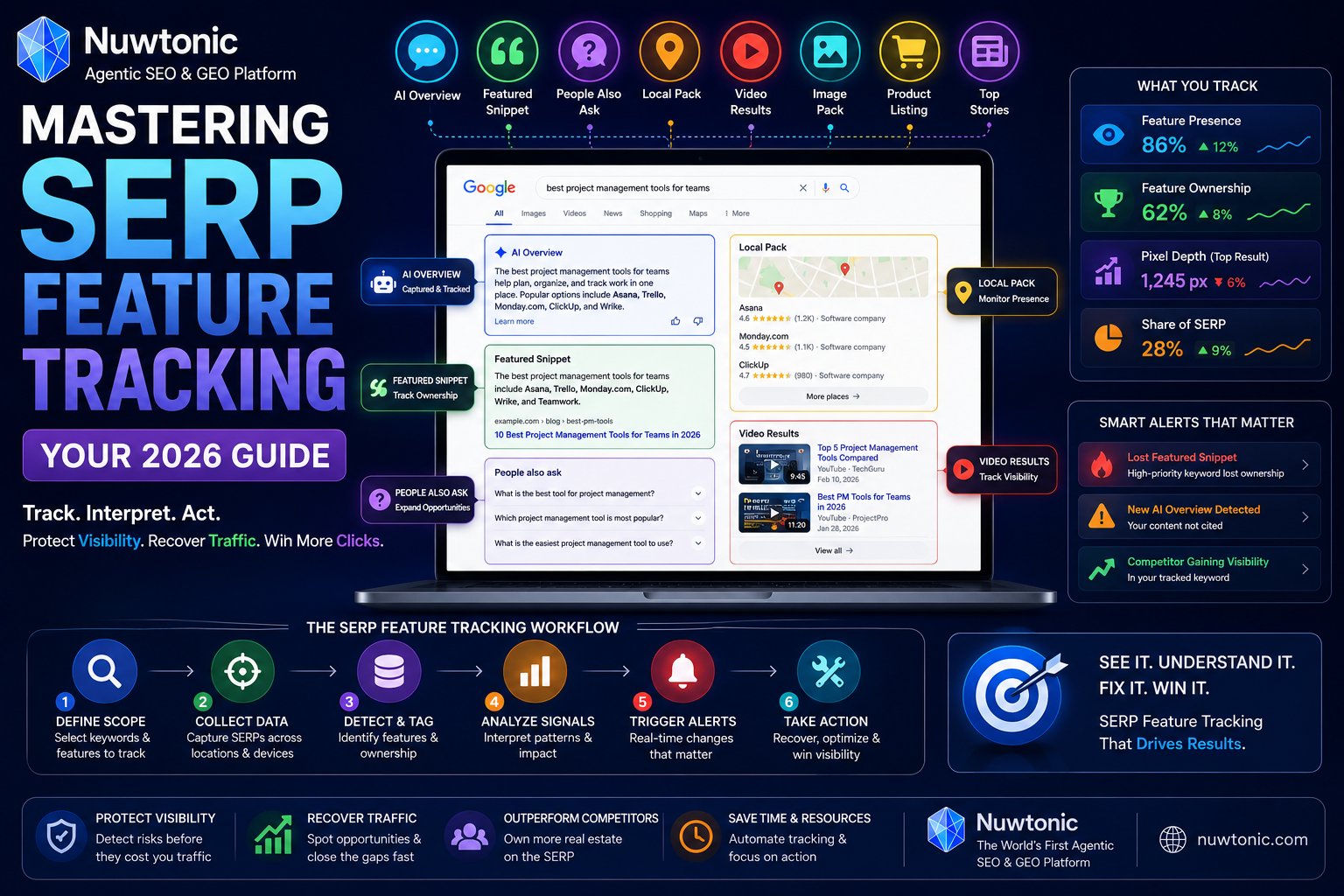
Your traffic is down, leads are soft, and the rank tracker still shows green arrows. That mismatch is where teams often realize their measurement model is broken. They're still tracking a list of blue links while Google is serving a layered interface of answer boxes, AI summaries, maps, carousels, and commercial modules that change what users see.
That's why SERP feature tracking can't sit in a side dashboard anymore. It has to become an operating system. If you want to recover traffic, protect branded demand, and understand why a cluster stopped converting, you need a pipeline that captures page layout, ownership, pixel visibility, and the changes that matter enough to trigger action.
Table of Contents
- Why Traditional Rank Tracking Is Obsolete
- Defining Your Tracking Scope Features and Data Sources
- Instrumenting Your SERP Tracking System
- Building Actionable Dashboards and Alerts
- Interpreting Signals and Prioritizing Remediation
- Executing Recovery and Optimization Workflows
Why Traditional Rank Tracking Is Obsolete
A traffic drop with stable rankings usually means one thing. The SERP changed shape before your content changed rank.
The biggest mistake I still see is treating position as visibility. It isn't. A page can hold a strong organic placement and still lose clicks because a richer element now sits above it, absorbs intent faster, or pushes the clickable result below the fold.
The position-zero Google Answer Box featured snippet appears in nearly 20% of all search queries, which is exactly why ordinal rank fails as a standalone metric, according to SEOClarity's SERP feature visibility analysis. The same source notes that AI Overviews, introduced by Google in 2024, aggregate insights from multiple sources into a single response, which changes both ownership logic and click behavior.
That shift is the dividing line between old SEO reporting and a modern visibility model. If you're still comparing this week's rank against last week's rank, you're measuring one layer of a much larger page. Teams navigating traditional SEO vs AI SEO already know that search performance now depends on whether you appear in the answer environment, not only whether you rank below it.
Practical rule: If CTR drops while rank stays flat, investigate the page layout first, not the content brief.
A better metric than rank alone
Use share of SERP as the mental model. That means tracking:
- Feature presence: Whether AI Overview, featured snippet, local pack, video, or PAA exists.
- Ownership: Whether your domain owns the feature, a competitor owns it, or Google synthesized it.
- Pixel depth: Where your first clickable asset appears on the screen.
- Screen occupancy: How much space your brand controls relative to everyone else.
A green rank report can hide a red business outcome. That's why SERP feature tracking isn't an advanced layer anymore. It's the baseline for explaining traffic loss, defending share of voice, and seeing the actual page your buyers saw.
Defining Your Tracking Scope Features and Data Sources
A common pitfall is tracking too little on the page and too much in the tool. Scope first. Tool second.
If the tracking plan doesn't mirror how buyers search, the reporting won't tell you what to fix. Start with the features most likely to intercept clicks, reshape intent, or redirect users before they ever reach your result.
What you actually need to track
At minimum, your feature inventory should include People Also Ask, image packs, video results, Top Stories, product listings, carousels, maps, knowledge panels, and AI-driven results like AI Overview, because these features vary by query, industry, and device, as outlined in Pi Datametrics' overview of SERP features.
I group these into four operational buckets:
Answer features
Featured snippets and AI Overview belong here. These matter most for informational and comparison intent because they can satisfy the query before a click happens.Interactive features
People Also Ask and some carousel behaviors fit this class. They expand the search journey inside the SERP and often reveal adjacent questions you should cover in-page.Rich media features
Video results, image packs, and Top Stories are format-driven. If your page type can't produce media assets, you need to know early that your “ranking opportunity” is structurally limited.Commercial and local features
Product listings, maps, and other transaction-oriented modules often sit closest to money. These deserve their own segment because they compete directly with bottom-funnel organic traffic.
A separate watchlist should include sitelinks and review-enhanced snippets. Moz's SERP feature guide notes that branded searches can trigger up to 10 sitelinks, and that pack can occupy five organic positions, which massively changes how branded real estate should be evaluated.
If a feature changes user path, it belongs in the tracking system even if it doesn't belong in your content strategy.
How to choose your data sources
No single source gives the full picture. Each one answers a different operational question.
| Data Source | Feature Coverage | Granularity | Cost | Best For |
|---|---|---|---|---|
| Google Search Console | Limited and indirect | Query, page, CTR, impressions | Low | Diagnosing impact after visibility changes |
| Dedicated rank tracker | Broad, depending on parser set | Daily positions, feature presence, competitor movement | Medium | Ongoing monitoring and ownership tracking |
| SERP API or raw capture pipeline | Highest if configured well | Full-page layout, screenshots, HTML, custom parsing | Higher technical overhead | Teams building internal dashboards and workflows |
Here's the decision framework I use:
- Use Search Console to validate impact. It tells you whether clicks and CTR changed after the page layout changed.
- Use a rank tracker when you need repeatable daily monitoring across many keywords and competitors.
- Use an API or your own collection layer when you need page evidence, screenshot archiving, custom feature classification, or integration into internal BI.
The wrong move is buying a tracker before deciding the business question. The right move is defining what your reporting has to answer: lost snippet ownership, new AI module presence, commercial displacement, local pack entry, or screen-share erosion. If you're comparing platforms, this review of AI visibility tracking tools is useful because it frames tools around measurement depth rather than feature checklists.
Instrumenting Your SERP Tracking System
A SERP tracking system fails long before reporting fails. It breaks at collection time, when requests are inconsistent, location handling is loose, and the parser records positions without preserving the page state that produced them.
If the goal is traffic recovery or feature ownership gains, instrumentation has to support three jobs at once: capture the SERP accurately, classify what appeared, and store enough evidence to trigger remediation later. Rank alone cannot do that.
Segment keywords by feature behavior
Topic groupings help with reporting. They are weak collection logic.
Build keyword sets around the layouts Google tends to return for them. That gives you cleaner alerting thresholds, better parser rules, and a faster path from detection to action.
Useful buckets include:
- Snippet targets: Question-led queries where concise answer blocks often appear.
- PAA clusters: Queries that trigger follow-up question modules and multi-step discovery behavior.
- Local pack queries: Searches with location sensitivity, map visibility, or strong proximity bias.
- Media-heavy queries: Terms dominated by video, image, or news modules.
- Commercial layout queries: Searches where product listings and mixed transaction elements reduce classic organic visibility.
Each bucket needs different success criteria. A local query is about pack inclusion, distance from the centroid, and review visibility. A commercial query often comes down to total screen share across listings, organic results, and brand-owned assets. That mismatch is when teams often realize their rank tracker has been measuring the wrong outcome.
Control location, language, and device inputs
Collection rules need to be explicit. Every request should define:
- Country and language
- Device type
- Location down to coordinates where local intent matters
- Clean-browser conditions
- Scheduled recrawl frequency
Location handling deserves extra care. City-level targeting is often too coarse for local packs because results can shift across neighborhoods, not just markets. Google's own documentation on local results and prominence factors is a useful baseline for deciding when coordinate-level sampling is necessary.
Personalization is another common failure point. If one request runs from a logged-in browser profile and the next runs from a clean environment, trend lines stop being trustworthy. If you have not standardized collection yet, start with this guide to isolating search results from browser personalization bias.
Clean inputs matter more than polished dashboards. Personalized requests produce analysis you cannot trust.
Store ownership and page evidence
The collection layer should store the full event, not just the rank number. For every keyword snapshot, keep:
- Feature presence by type
- Owning domain or URL
- Whether your domain appears above or below the fold
- Screenshot or rendered page evidence
- Timestamped SERP HTML or structured parser output
This is the difference between monitoring and operating a system. When traffic drops, the SEO lead needs to confirm whether a featured snippet disappeared, whether an AI module entered the page, whether a competitor replaced your listing, and whether the change happened on mobile, desktop, or both.
A short walkthrough helps illustrate the setup logic:
Store history as events, not flat daily rows. You need to know when a feature first appeared, when ownership changed, who replaced you, and what the page looked like at that moment. That event history is what makes automation possible. It lets the system detect a loss, map it to the affected template or keyword cluster, and hand the right remediation task to content, local SEO, or product teams without manual triage.
Building Actionable Dashboards and Alerts
A SERP dashboard should answer one question fast. Where did visibility change in a way that threatens traffic or creates recoverable upside?
Most dashboards fail because they chart too many ranks and too few decisions. If the interface can't tell an SEO lead what deserves action today, it's a reporting artifact, not a command center.
What belongs on the dashboard
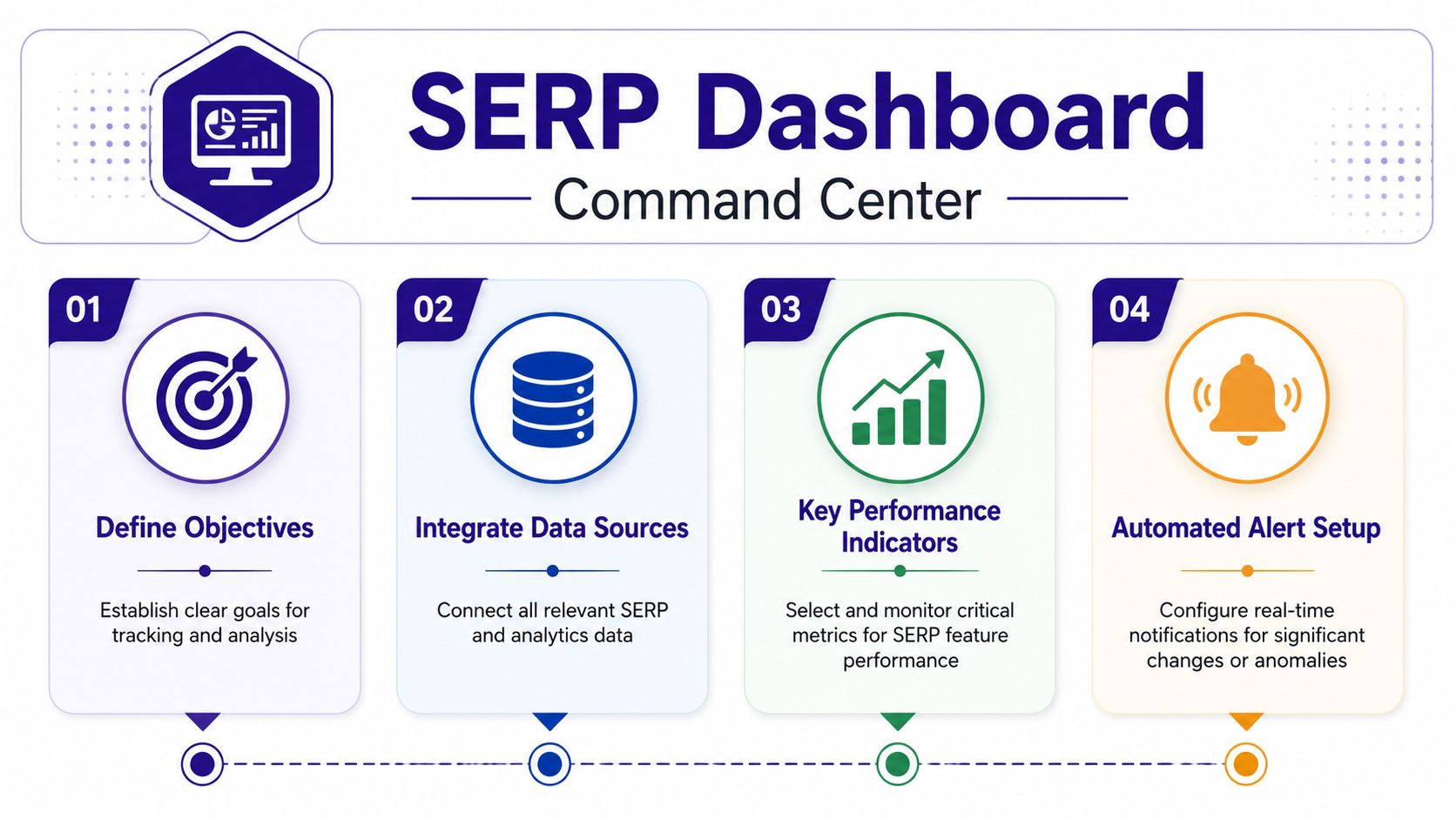
Build around modules, not vanity charts.
A solid layout includes:
Visibility share by feature
Show how much page real estate your domain owns across organic, snippet, local, media, and AI-driven elements.Owned versus competitor feature trends
This is where you catch feature flips. If a competitor starts winning PAA or takes over snippet ownership for a high-value cluster, you want the trendline immediately.Above-the-fold exposure
Separate overall appearance from meaningful appearance. A result buried below multiple modules is present, but often strategically weak.CTR decay risk panel
Pair Search Console CTR trends with SERP layout changes. Stable rank with worsening CTR is usually where hidden loss appears.New feature emergence log
Track when a keyword set starts generating a feature that wasn't there before, especially AI or local layouts.
The guiding benchmark should be Visibility Share, not classical position. Topical Map's analysis of SERP tools points out that a common pitfall is focusing on organic rankings while ignoring features, and that modern benchmarking prioritizes “Visibility Share” based on real estate occupied on the page.
Alert for events not noise
The same source also stresses setting clear, meaningful alert thresholds. That's the part often skipped.
Don't alert on every movement. Alert on events that change likely business outcomes:
| Alert type | Trigger | Why it matters |
|---|---|---|
| Lost snippet ownership | Your URL no longer owns the snippet for a priority keyword | Often tied to immediate CTR decline |
| New AI result appeared | A tracked query now shows an AI-driven answer block | Organic click path may weaken |
| Competitor entered local feature | New domain appears in local or map-driven area | Signals local demand capture risk |
| Feature disappeared | A feature you owned is no longer present | Can create recovery or expansion opportunity |
Good thresholds are selective. Bad thresholds spam Slack until nobody reads them.
A dashboard should reduce checking behavior. Alerts should create action, not anxiety.
The final layer is accountability. Every alert should map to an owner, a due date, and a verification step. Otherwise the system tells you what broke and nobody closes the loop.
Interpreting Signals and Prioritizing Remediation
Raw visibility data tells you that something changed. It doesn't tell you what to do first.
Strong SEO teams operate differently from busy ones. They don't jump from chart to content edit. They read the pattern, confirm the mechanism, and only then choose the fix.
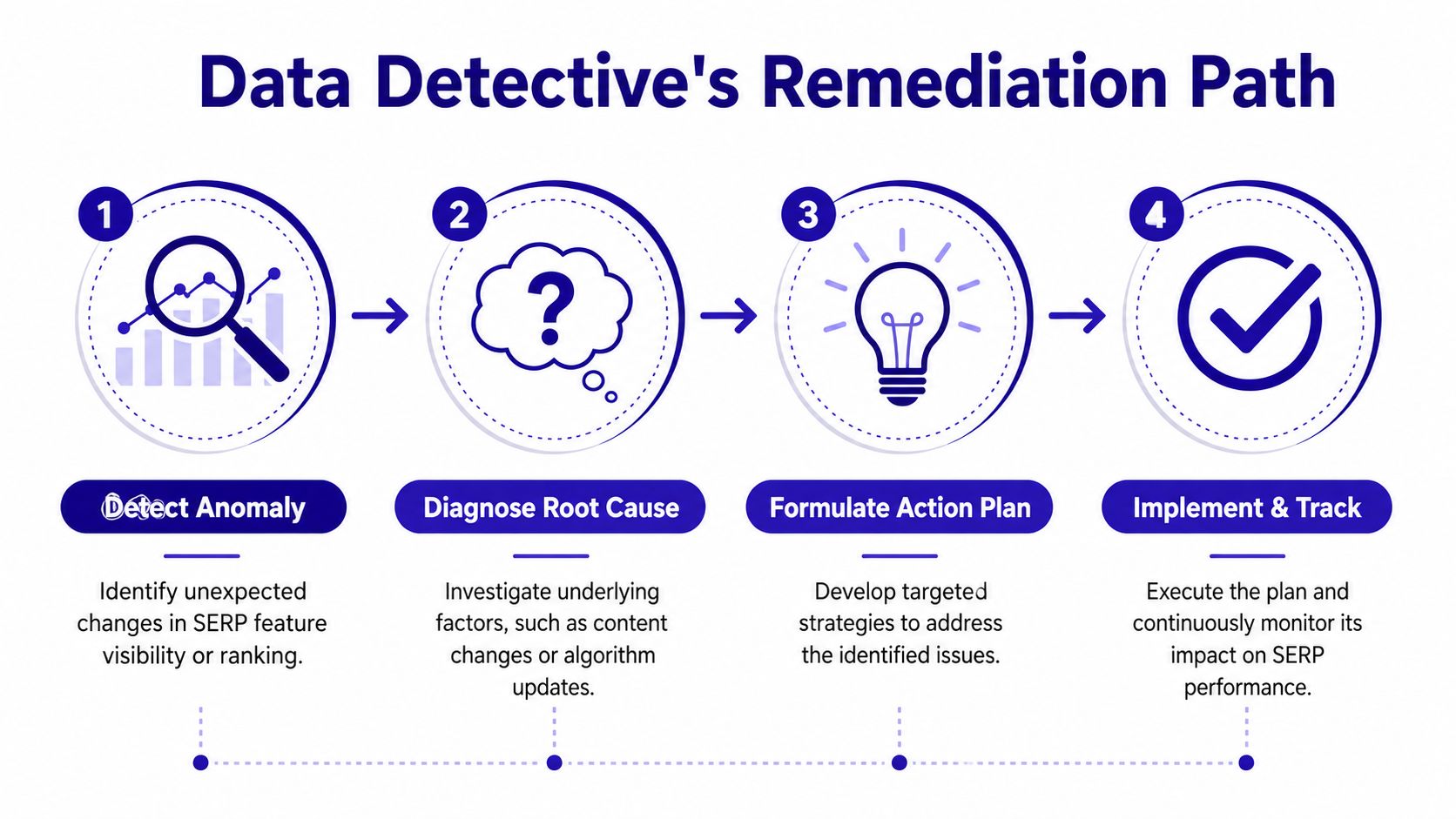
Read the pattern before touching the page
Here are common signal combinations and the likely diagnosis.
Stable rank, falling CTR
Check whether a new answer feature appeared above the result. This often means the issue isn't ranking loss. It's reduced click opportunity caused by a denser page layout.
Traffic vanished from a keyword cluster overnight
Check ownership history. If the cluster depended on a snippet, local feature, or media block you no longer control, the loss may be concentrated in one high-visibility asset rather than spread across rankings.
Impressions hold, clicks weaken
That usually points to reduced attractiveness or reduced prominence, not disappearance. Review screenshot evidence and feature placement first.
Competitor gains without your rank collapsing
This often happens when they add a second touchpoint on the page. They may not outrank your blue link, but they may own the snippet, PAA presence, or media module that captures attention earlier.
Prioritize by business impact
For revenue-focused SERP feature tracking, you need to monitor every result type on the page, measure how often each appears, whether it sits above or below the fold, and how much of it you own versus competitors, starting with the 1,000–2,000 buyer queries closest to purchase, according to GrowByData's guide to tracking SERP features.
That gives you a practical prioritization sequence:
Start with buyer-intent queries
Don't begin with broad head terms. Begin where a visibility recovery can protect pipeline or sales.Check above-the-fold loss first
A modest rank movement can matter less than losing top-screen presence.Score by ownership gap
If a competitor owns more than one feature on the same query, that query deserves attention faster.Validate with Search Console behavior
Confirm whether CTR and clicks moved in the same window as the SERP change.Choose the smallest fix with the largest likely upside
Sometimes that's content reformatting. Sometimes it's schema repair. Sometimes it's adding the right media asset to become eligible for a different feature.
The fastest wins usually come from reclaiming visibility on keywords that already convert, not from chasing new informational volume.
Many teams waste cycles. They pursue content expansion when the actual issue is layout displacement, or they rewrite an article when the missing piece is a concise answer block, image eligibility, or improved entity clarity. Signal interpretation protects execution capacity.
Executing Recovery and Optimization Workflows
A SERP tracking system proves its value when it shortens the time between visibility loss and a verified fix. If a revenue page loses a featured snippet on Monday, the team should know what changed, which template to update, who owns the fix, and how to confirm recovery after release.
That requires a workflow, not a checklist. Detection feeds diagnosis. Diagnosis maps to a remediation pattern. Deployment triggers re-crawl and post-release validation. Anything less turns feature tracking into reporting instead of recovery.
Featured snippet recovery workflow
A lost snippet can cut CTR fast, even if the underlying rank barely moves. The right response is controlled and specific.
Use this sequence:
Pull the before-and-after SERP snapshot
Compare the old winning result, the current winner, and your page. Look for a structural change first. Google may have switched from a paragraph answer to a list, table, or definition block.Rewrite the extraction layer, not the whole article
Add or revise the answer block directly under the relevant heading. Keep it tight, literal, and aligned to the query phrasing. For process terms, use steps. For comparisons, use a table. For definitions, use a short paragraph.Clean up heading and section boundaries
Snippet candidates usually have one clear heading, one direct answer, and supporting detail underneath. If the section buries the answer inside long copy or mixes multiple intents, extraction gets harder.Add the next layer of context
The answer block gets eligibility. The supporting section keeps the click. Include examples, exceptions, and decision criteria so the page still satisfies the visit after the snippet appears.Check schema, canonical signals, and indexability
Schema does not win snippets by itself, but broken markup, duplicate canonicals, or weak page signals can slow recovery or send Google to the wrong URL.Recheck after crawl and SERP refresh
Recovery work needs a validation window. Monitor the feature owner, CTR, and pixel depth after deployment so you can separate a successful fix from normal SERP volatility.
Formatting matters here, but so does restraint. Teams often overreact and rewrite an entire page when the underlying issue is a weak answer block, the wrong format, or a cleaner competitor section.
AI Overview targeting workflow
AI Overview work should run as a governed system. These results change often, and the wrong automation creates review debt faster than it creates visibility.
A practical workflow starts with extraction readiness. Pages need explicit entities, stable terminology, concise summaries, and enough supporting depth to answer follow-up questions. Thin pages with vague structure can still rank organically, but they are weaker candidates for citation or synthesis.
Then move to cluster coverage. AI-generated layouts often reflect topic completeness across related pages, not just the strength of a single URL. If one page explains the concept but the rest of the cluster lacks comparisons, examples, pricing context, or implementation detail, inclusion tends to be inconsistent.
The execution pattern is simple:
Patch the target page first
Improve summaries, entity references, and section clarity on the URL already closest to inclusion.Close cluster gaps second
Add or strengthen supporting pages that cover adjacent intents, common follow-up questions, and commercial qualifiers.Queue human review for every AI-suggested change
Let the system draft answer blocks, schema fixes, and content patches. Publish only after editorial and SEO review.Validate against live SERP changes
Track whether your brand is cited, whether competitors gained ownership, and whether organic CTR changed after the overview appeared or disappeared.
End-to-end systems outperform manual tracking. The system can detect a feature loss, classify the likely cause, generate a recommended fix, assign it to the right owner, and measure recovery after release. Analysts still make the final call. The speed comes from removing handoffs, not from skipping judgment.
The teams that recover fastest usually have fewer tools and tighter operating rules. If every feature change has a known playbook, recovery becomes routine.
If you want that loop in one place, Nuwtonic is built for it. It combines SERP tracking, GSC-driven prioritization, technical audits, AI visibility monitoring, and reviewable remediation workflows so you can move from “we lost visibility” to a shipped fix without stitching together separate tools.