Traffic is down. AI answers cite competitors. Standard SEO dashboards show the problem, but they do not help a team fix it.
Google is pushing AI Overviews into core search behavior, and tools like ChatGPT are becoming part of how buyers research software, services, and categories. As noted in Search Engine Land's GEO guide, AI systems are already sending meaningful referral traffic and reshaping discovery. Search teams now have to care about citation likelihood, content structure, entity clarity, and speed of execution, not just rank position.
That shift changes what a generative engine optimization tool needs to do. A monitoring product can tell you that your brand was missing from an answer. An execution-focused platform helps you identify why, update the weak page, improve structure, publish the fix, and confirm whether visibility improves on the next crawl cycle. That difference is the core buying decision.
I see teams get stuck here all the time.
They buy a tracker, collect screenshots, and build weekly reports on lost visibility. Then the work still falls back to spreadsheets, manual page audits, and slow editorial queues. If your team needs a starting point before evaluating vendors, this guide on how to start with generative engine optimization lays out the operational basics.
This list is built around that real divide. Some tools are point solutions for detection and reporting. Others, including platforms such as Nuwtonic, add an execution layer that helps teams turn findings into changes on the page. The right choice depends on your workflow, your technical resources, and whether you need better visibility data or a faster path from issue to fix.
Table of Contents
- 1. Nuwtonic
- 2. Ahrefs Brand Radar
- 3. Semrush AI Visibility toolkit + AI Overviews Visibility Checker
- 4. BrightEdge Generative Parser and AIO tracking
- 5. seoClarity AI Overviews tracking
- 6. Conductor AI Search Performance AEO/GEO
- 7. Similarweb Rank Tracker with AI Overviews detection
- 8. Authoritas AI brand visibility & AIO tracking
- 9. Lumar GEO analytics module
- 10. Morningscore AI Overviews Tracker
- Top 10 Generative Engine Optimization Tools Comparison
- Your Next Move in the Generative Search Era
1. Nuwtonic
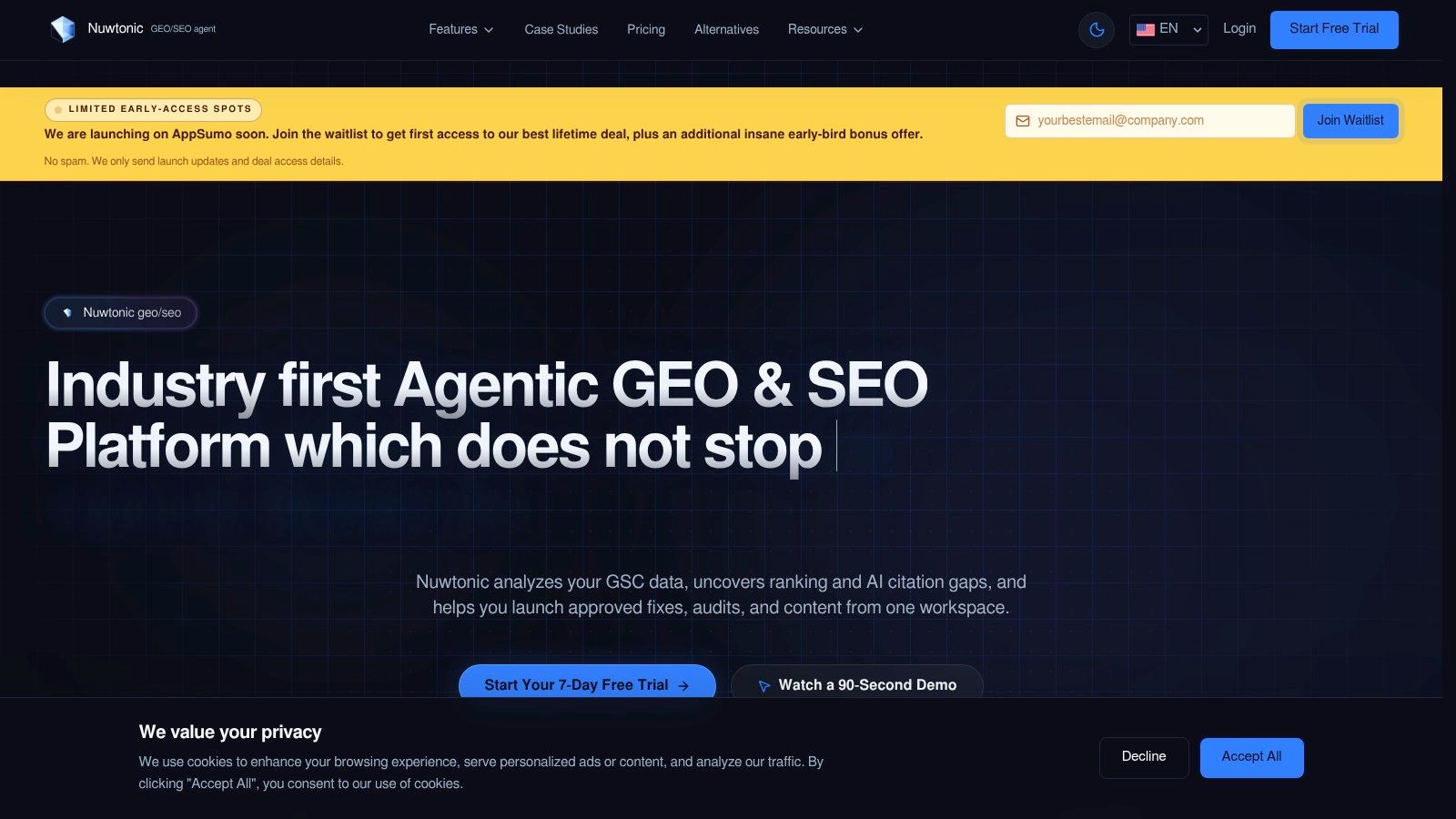
A common GEO failure looks like this. The team can see that AI answers cite the wrong pages, miss high-converting URLs, or pull weak summaries from outdated content. Then the work stalls between audit findings, content briefs, dev tickets, and schema updates. Nuwtonic is built for that handoff problem.
It combines Google Search Console inputs, prompt tracking across major LLMs, GEO audits, on-page recommendations, content operations, and CMS-ready fixes in one workspace. SitePoint's review of the category made a similar point: many GEO tools are strong at reporting, but the main bottleneck is implementation. Nuwtonic is designed to close that gap, as discussed in SitePoint's analysis of GEO tools.
Why Nuwtonic is different
The practical difference is simple. Nuwtonic connects visibility monitoring to actual remediation.
Its AI Search Agent tracks brand visibility and prompt performance across ChatGPT, Gemini, Perplexity, Claude, Google, Grok, and other environments. Its GEO audit checks page structure, extractability, schema coverage, entity clarity, and other signals tied to citation eligibility, then turns those findings into reviewable fixes your team can act on.
That page-level workflow is what separates an execution platform from a dashboard. In real programs, brand mentions alone do not tell you whether the right commercial page, help doc, or category URL is getting cited. Teams need to know which page should win, which page is being surfaced now, and what needs to change to improve the result. The workflow described in this guide to starting with generative engine optimization aligns with that reality.
Practical rule: If a tool cannot show the eligible URL, the cited URL, and the next fix, it is still a monitoring tool.
Nuwtonic also pulls in work that often lives across several SEO and content products. Teams get competitor gap analysis, click-decay detection, rank tracking, cannibalization views, AI-assisted editing, topical mapping, bulk scheduling, and Content Autopilot. That matters in practice because GEO issues rarely start and end inside one report. A citation gap often traces back to thin topic coverage, weak internal linking, missing schema, or a page built for the wrong intent.
Where it fits best
Nuwtonic fits teams that need to move from diagnosis to deployment without adding another layer of coordination. Agencies, lean in-house teams, B2B SaaS marketers, and ecommerce operators usually benefit most because they are already balancing content changes and technical fixes in the same sprint.
A few trade-offs matter:
- Best strength: It supports action, not just reporting. Teams can review fixes and move toward deployment from the same system.
- Best workflow advantage: GSC-informed prioritization helps teams focus on pages with real search impact instead of cleaning up low-value issues first.
- Main limitation: The credit model needs active management for teams running large volumes of audits, optimizations, and AI content work.
- Main adoption caveat: Setup quality affects output quality. The platform is strongest when CMS connections and GSC data are configured correctly.
Nuwtonic is a strong fit if your current stack already tells you what is wrong, but your team still has to translate that insight into tickets, briefs, schema patches, and page updates by hand. That is the line between GEO visibility software and GEO execution software.
2. Ahrefs Brand Radar
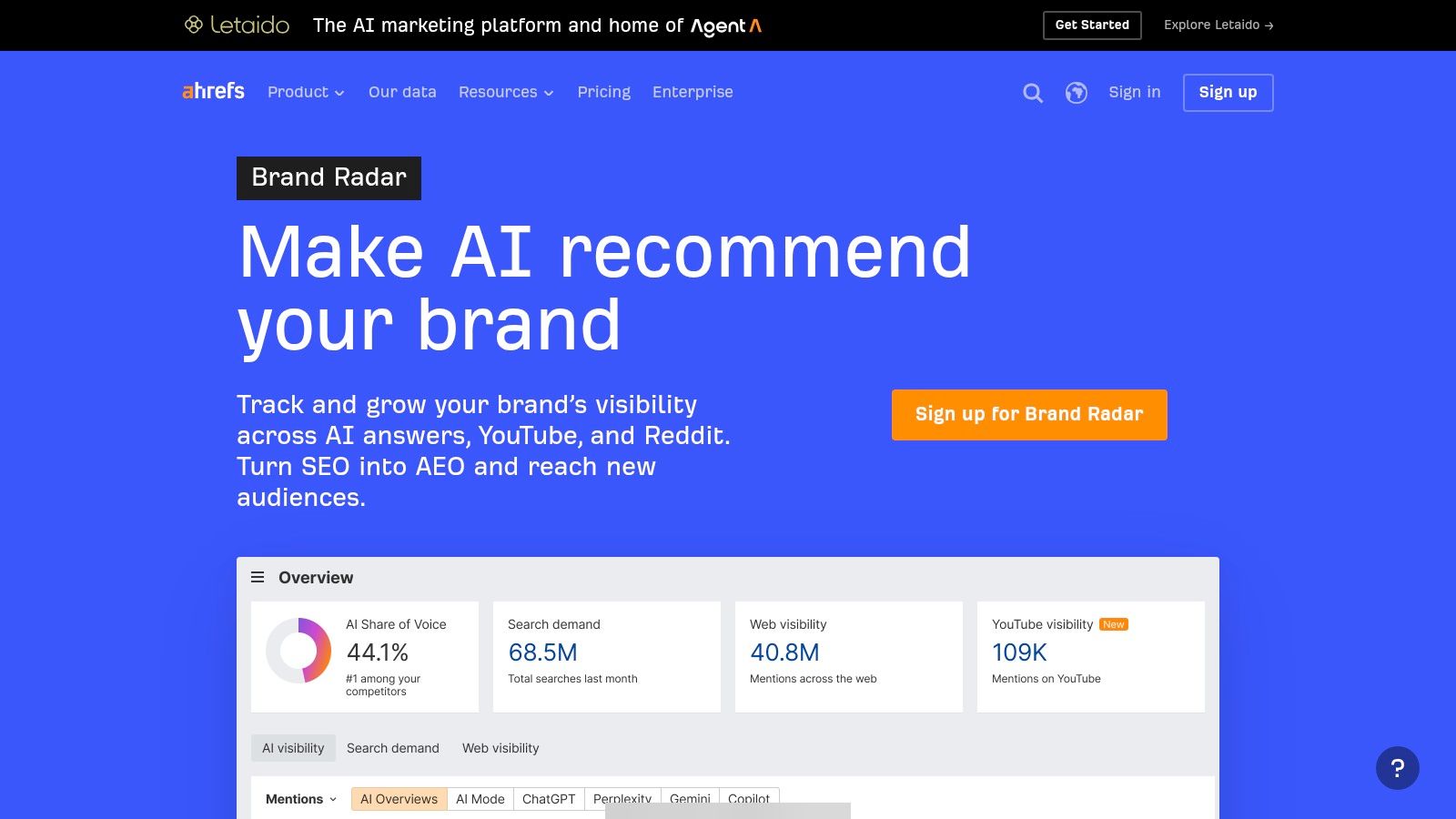
A common GEO review starts like this: the CEO asks why competitors keep showing up in ChatGPT and Google AI answers, and the marketing team has three different dashboards but no clean comparison. Ahrefs Brand Radar is useful in that moment. It gives you a single view of brand mentions, citations, and share of voice across major AI surfaces, then ties that view back to the search and link data many teams already use inside Ahrefs.
That positioning is its real strength. Brand Radar works well for teams that need benchmarking first, especially if GEO is still being justified internally and leadership wants evidence before funding content, PR, or technical fixes.
What Ahrefs does well
Ahrefs gives AI visibility data more context than a standalone mention tracker. If your brand is weak in AI answers for a topic, you can check whether the gap lines up with thin coverage, weak backlinks, poor keyword presence, or stronger competitor authority. That makes Brand Radar more useful than a report that only says you were cited less often.
The underlying GEO pattern is straightforward. AI systems often cite sources that already have strong authority, strong topical relevance, and wide web visibility. That overlap is one reason Ahrefs fits naturally into an existing SEO workflow.
In practice, I would use Ahrefs Brand Radar for three jobs:
- Benchmarking competitors: Compare which brands appear most often across ChatGPT, Perplexity, Gemini, Copilot, and Google AI surfaces.
- Finding likely causes: Check whether visibility gaps track back to authority signals, missing topic depth, or weak off-site presence.
- Tracking progress over time: Watch whether mentions improve after content updates, link acquisition, or digital PR work.
The trade-off is clear. Ahrefs is an intelligence layer, not a remediation system.
That distinction matters more in GEO than many teams expect. Once Brand Radar shows that your category pages are rarely cited, someone still has to rewrite the copy, expand entity coverage, improve internal links, add supporting content, and tighten structured data. Teams that already have editors, SEOs, and developers in place can move from insight to action without much friction. Lean teams often stall there, which is why execution-focused workflows matter. If you need a practical playbook for the content side, this guide on how to optimize content for AI search is a useful next step.
Ahrefs is a strong fit if you already trust its broader dataset and want GEO reporting inside the same operating environment. It is a weaker fit if your main problem is implementation speed. In that case, an all-in-one platform that helps generate fixes, organize updates, and push changes live will usually create more value than another visibility dashboard.
You can review the product at Ahrefs Brand Radar.
3. Semrush AI Visibility toolkit + AI Overviews Visibility Checker
A common scenario: the traffic drop is real, rankings have not collapsed, and the culprit is Google AI Overviews absorbing the click. For teams already running search through Semrush, this is one of the faster ways to confirm what changed and which queries are getting rewritten by Google's AI layer.
That built-in advantage matters. You are not starting from zero or stitching together another reporting stack. Semrush connects AI Overview checks to the keyword, competitor, and position-tracking workflows many SEO teams already use, which makes it easier to spot where classic rankings still look healthy but visibility has shifted.
Where Semrush helps most
Semrush is a practical fit when Google is still the main battlefield and the team wants execution priorities to come from the same system they use for everyday SEO work. It is especially useful for in-house teams that need to answer three questions quickly: which queries trigger AI Overviews, which competitors get cited, and which pages lose attention once the overview appears.
The trade-off is straightforward. Semrush helps you diagnose the problem inside a familiar environment. It does not close the loop for you.
A workable process looks like this:
- Find affected queries: Use the AI Overviews Visibility Checker and your existing tracking setup to isolate terms where AI results change click behavior.
- Review citation patterns: Check which domains and page types show up in the overview so you can see whether Google prefers explainers, product pages, reviews, or third-party sources.
- Turn patterns into edits: Rewrite weak sections, tighten entity coverage, improve internal links, and add missing supporting content. This guide to optimizing content for AI search is a solid reference for that step.
- Push changes into the backlog: Assign owners across content, SEO, and development. Without that handoff, the insight usually dies in a dashboard.
The split between monitoring tools and execution platforms becomes obvious. Semrush gives you useful visibility and a sensible starting point for prioritization. If your team already has writers, editors, and developers ready to act, that may be enough. If implementation is the bottleneck, an all-in-one GEO platform that helps generate fixes and ship updates will usually create more value than another layer of reporting.
Check the tool at Semrush AI Overviews Visibility Checker.
4. BrightEdge Generative Parser and AIO tracking
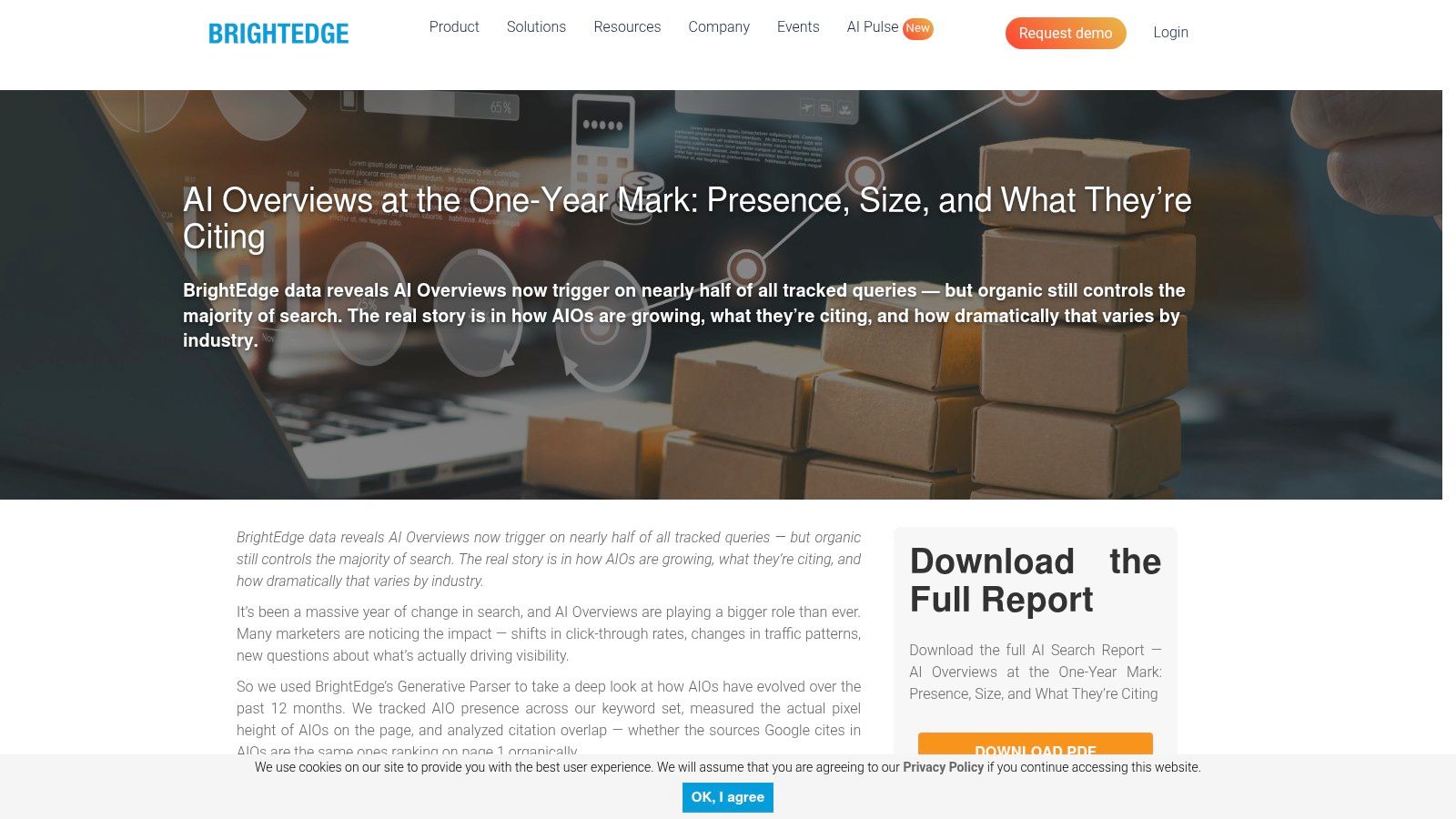
BrightEdge is built for enterprise teams that need disciplined reporting on Google AI Overviews. Its Generative Parser helps organizations identify which queries trigger AIOs, what content gets cited, and how AI Overview behavior changes across categories.
This isn't the tool I'd pick for a small team trying to figure out cross-LLM visibility quickly. It is the kind of system large organizations use when they need repeatable reporting, category tracking, and a clear line between research, stakeholder communication, and mitigation planning.
Best use case
BrightEdge works best when Google is the center of the problem and the organization already has a mature enterprise SEO operation. Teams in regulated spaces, publisher environments, and large multi-business-site organizations often need that kind of consistency.
The upside is reporting depth. The downside is breadth. BrightEdge's public positioning is still much more focused on Google AIO than on multi-engine brand recommendation tracking. That's fine if your business risk is mostly tied to Google surfaces. It's less ideal if you need equal coverage across ChatGPT, Perplexity, Gemini, and other environments.
Large organizations often need a parser, not just a dashboard. They need to know which query patterns changed, which citations appeared, and which teams own the response.
Another trade-off is buying motion. BrightEdge is quote-based, enterprise-oriented, and usually sits inside a longer procurement cycle. That can be right for the buyer. It can also be too much software for teams that just need rapid visibility tracking and executional fixes.
You can review BrightEdge's AI Overview work at BrightEdge Generative Parser resources.
5. seoClarity AI Overviews tracking
A familiar reporting problem shows up after Google rolls out AI Overviews on a query set. Rankings look stable enough, but clicks slide anyway. seoClarity is useful in that situation because it helps teams isolate whether the change came from classic rank movement or from the SERP itself changing.
The product is built for diagnosis. It tracks whether AI Overviews appear for a keyword, lets teams compare that over time, and connects the shift to URL and CTR patterns. If the question is, “Which keyword groups started underperforming after AIO appeared?”, seoClarity usually gives a cleaner answer than platforms that treat AI features as a loose SERP annotation.
How teams use it
This is a strong fit for analysis-heavy SEO teams. A practical workflow looks like this: segment affected keywords, identify the landing pages losing clicks, then decide whether the response is content revision, intent realignment, snippet testing, or stakeholder reporting. That makes seoClarity a good point solution for finding impact and explaining it internally.
It also fits teams that are still sorting out the difference between AI Overview tracking, answer engine optimization, and broader generative search visibility. If that taxonomy is still muddy inside your org, this breakdown of GEO vs AIO vs AEO helps clarify what seoClarity does well and where it stops.
Practical strengths:
- Keyword-level AIO history: Useful for tracked query sets where teams need to see when AI Overviews appeared and how behavior changed.
- Page-level impact checks: Helpful for explaining traffic drops on specific URLs instead of treating every decline as a ranking issue.
- Recurring reporting: Well suited to teams that need repeatable updates for SEO leads, content teams, and executives.
The trade-off is execution. seoClarity helps teams spot the pattern, quantify the impact, and report on it. It does not position itself as an all-in-one GEO platform that automatically pushes fixes across content, structured data, and multi-engine visibility workflows. If you need Google AIO diagnosis, that can be enough. If you need software that moves from detection to remediation across ChatGPT, Perplexity, Gemini, and Google, you will need broader tooling or a second layer in the stack.
You can explore it at seoClarity AI Overviews tracking.
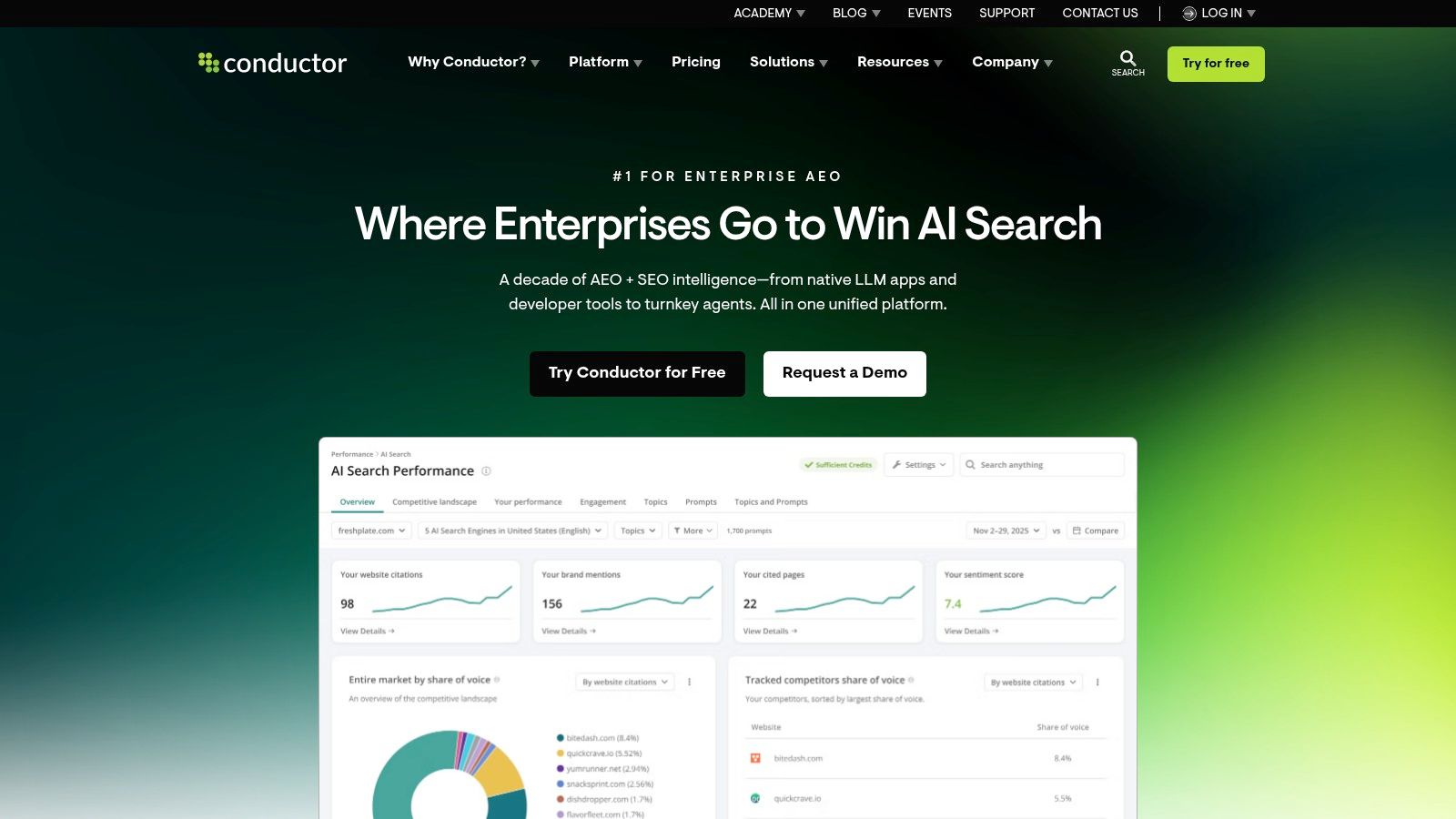
6. Conductor AI Search Performance AEO/GEO
Conductor's pitch is more mature than most GEO tooling because it doesn't treat AI visibility as a side panel. It treats it like a system of record that should connect to content production, internal data flows, and business reporting.
That's important if you're managing enterprise content operations. A lot of teams don't need another dashboard. They need a workflow that routes prompts, topics, mentions, citations, and competitive gaps back into the content engine already used by writers, strategists, and stakeholders.
Why Conductor stands out
Conductor covers multiple AI engines and emphasizes API and connector-based data handling, which is a more durable enterprise approach than brittle scraping-heavy setups. It also ties visibility data back into content execution paths through its own ecosystem.
That makes Conductor a reasonable choice for organizations already thinking in AEO, GEO, and AI Overview terms together. The naming confusion in this market is real, and if your team still debates how those buckets differ operationally, this explanation of GEO vs AIO vs AEO is useful background because tool selection changes depending on whether you're tracking recommendation presence, Google summary inclusion, or answer-structured content performance.
Conductor is strongest in three scenarios:
- Enterprise workflow alignment: AI search insights can be routed into existing content teams.
- Cross-engine governance: You need one reporting layer across several AI environments.
- Internal data portability: API and BI connectors matter as much as the UI.
The downside is fit. Conductor makes the most sense when you already operate at enterprise scale. Smaller teams can find it heavy, especially if they need faster hands-on remediation instead of broad organizational reporting.
You can review the platform at Conductor.
7. Similarweb Rank Tracker with AI Overviews detection
Similarweb is useful when your question isn't only “Are we visible in AI Overviews?” but also “What's happening in the broader market around that visibility?” Its AI Overview detection lives inside a platform built for competitive traffic intelligence, category analysis, and share-of-search views.
That combination is the reason to buy it. Similarweb won't be the deepest GEO specialist, but it gives market context that pure GEO tools often miss. If AI Overviews are appearing more often in a category and traffic patterns are shifting at the same time, Similarweb helps connect those dots.
When Similarweb makes sense
This is a good fit for strategic SEO teams, category managers, and enterprise marketers who already use Similarweb for market intelligence. They can layer AIO detection onto data they already trust rather than adding a standalone AI visibility platform.
It's most useful for:
- SERP feature analysis plus market context: You see not only that AIO exists, but what category demand and traffic patterns look like around it.
- Competitive review: You can place AI Overview incidence alongside broader share and traffic intelligence.
- Enterprise governance: Similarweb's existing data discipline matters for larger organizations.
The trade-off is obvious. Similarweb is still more about Google AIO presence than full cross-LLM recommendation analysis. It tells you a lot about SERP dynamics. It tells you less about how ChatGPT or Perplexity talk about your brand across real buyer-style prompts.
For teams already inside Similarweb, though, adding this layer is efficient. You can review it at Similarweb Rank Tracker with AI Overviews detection.
8. Authoritas AI brand visibility & AIO tracking
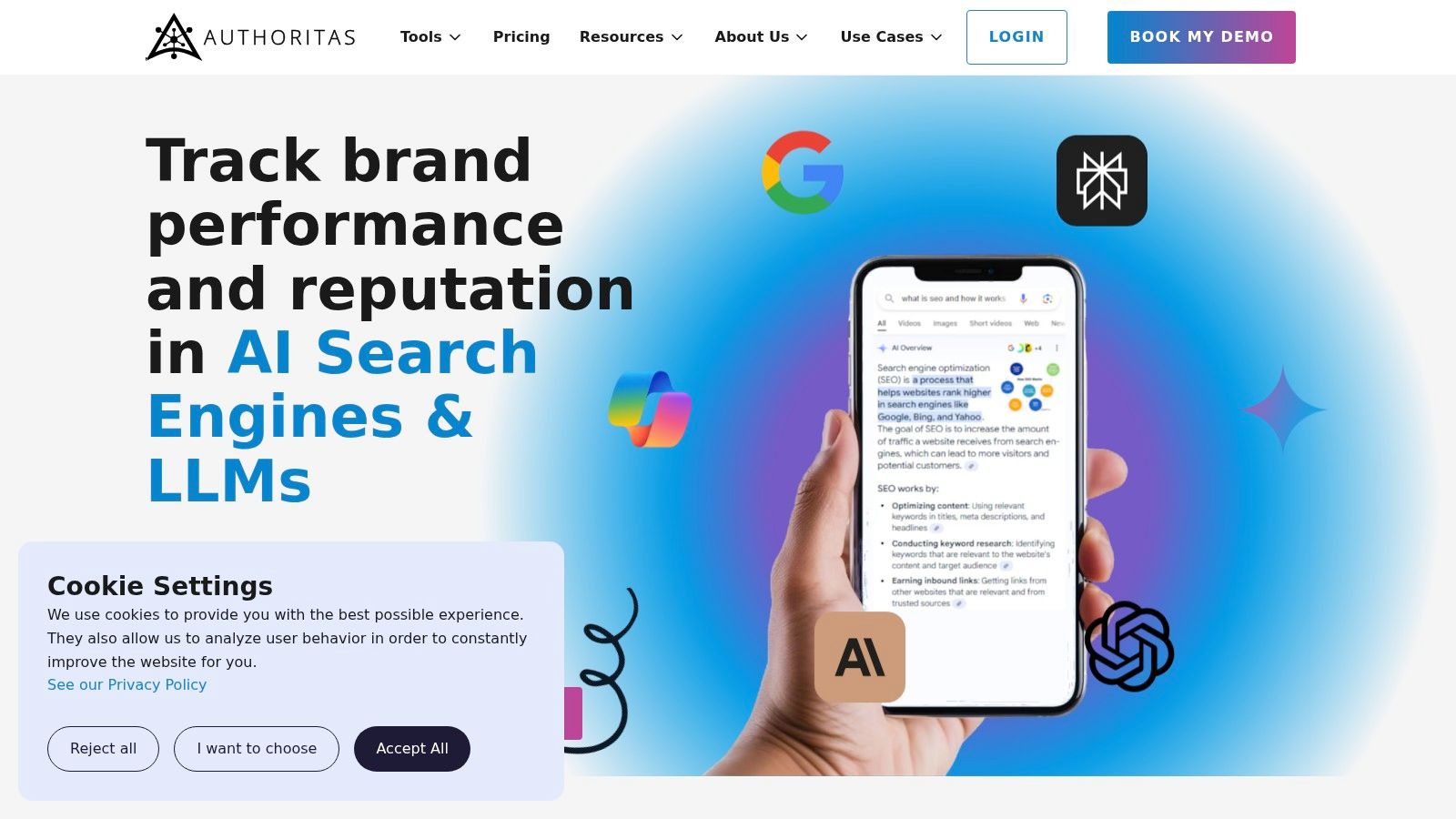
Authoritas is one of the more interesting middle-ground options because it extends a known SEO stack into multi-engine AI visibility. It tracks mentions and citations across ChatGPT, Perplexity, Gemini, Claude, Bing Copilot, and Google AI Overviews, and it gives users persona-based question builders that better reflect real buyer journeys than generic prompt lists.
That matters more than it sounds. A lot of GEO tracking still uses shallow prompt sets. If your prompts don't mirror how actual customers ask, compare, or narrow choices, your visibility data looks cleaner than reality.
Where Authoritas is strongest
Authoritas stands out for teams that want AI visibility attached to SERP anatomy and rank tracking rather than treated as a separate software category. That's particularly useful in ecommerce, where retail teams need product, category, and buyer-journey framing together.
There's also a practical measurement angle. Research summarized by Contently argues that URL-level citation strategy is still underrepresented in the market, even though AI engines often cite URLs directly and many guides still focus too heavily on generic brand mentions, as noted in Contently's review of GEO tools. Authoritas benefits from being closer to page-level SEO workflows than many purely brand-monitoring products.
A few real trade-offs:
- Good fit: Retail and SEO teams that already care about SERP behavior, prompt realism, and page-level visibility.
- Less ideal: Buyers who want highly public detail on enterprise-scale AI analytics before talking to sales.
- Workflow implication: You still need a separate execution discipline to implement fixes.
Authoritas works well as an insight layer with pragmatic prompt construction. You can review it at Authoritas AI search visibility tracking.
9. Lumar GEO analytics module
Your AI visibility report says the content should be showing up. Engineering asks why the pages still get skipped, misread, or cited inconsistently. That is the kind of problem Lumar is built for.
Lumar comes from technical SEO, and its GEO module reflects that. Instead of centering on brand mentions or prompt share, it focuses on the site conditions that determine whether machines can access, parse, connect, and trust your content in the first place.
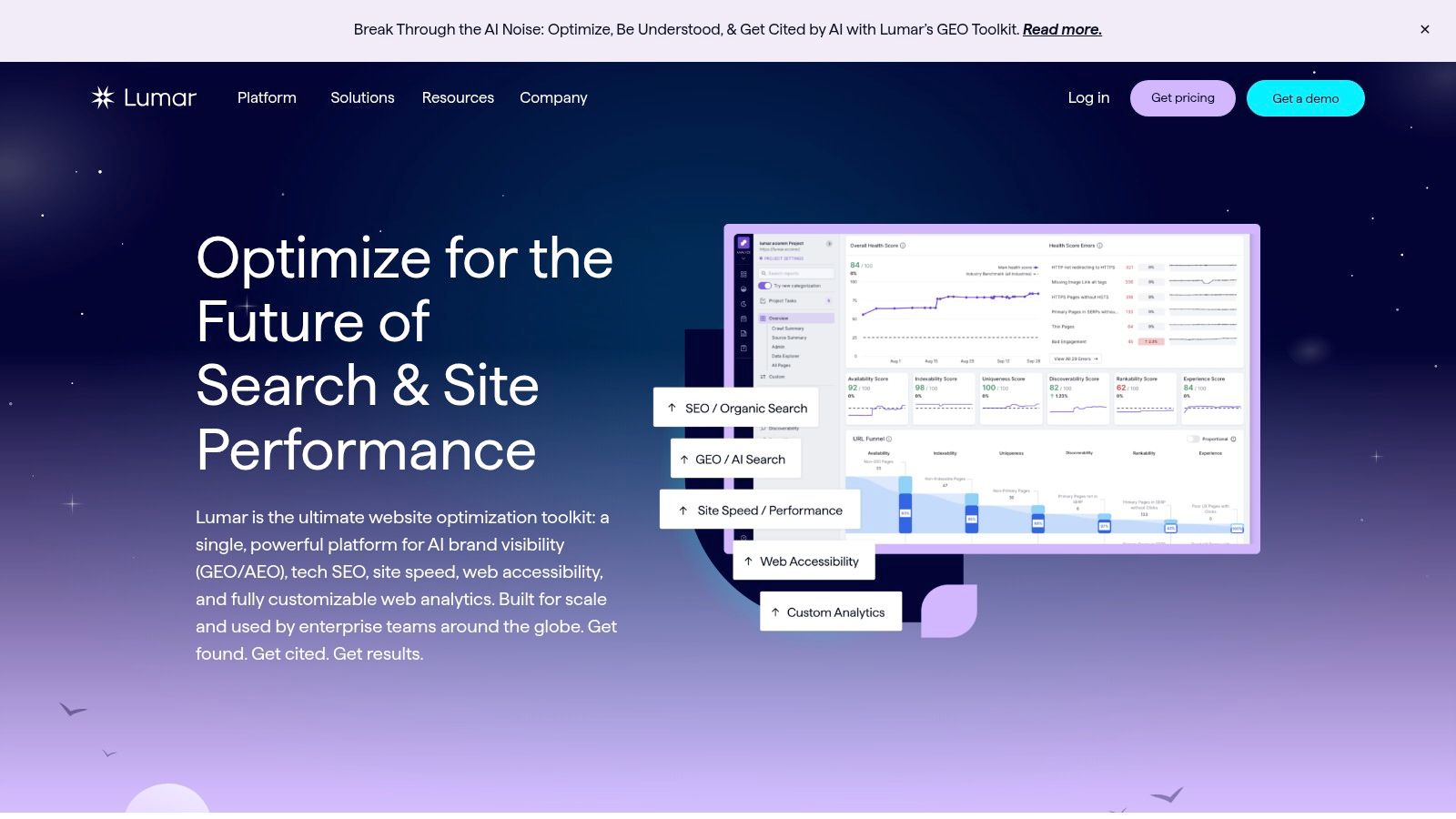
That matters more than many teams want to admit. A lot of GEO problems are still technical SEO problems with new symptoms. Weak internal linking, inconsistent canonicals, thin entity signals, rendering issues, and fragmented content systems all reduce the odds that AI systems will retrieve the right page and treat it as reliable.
Where Lumar fits in an execution workflow
Lumar is a strong fit when SEO, engineering, and web governance already work from crawl data. The practical value is not just detection. It is prioritization. Teams can tie GEO and AEO signals back to indexability, structure, performance, and accessibility issues they already know how to fix.
That makes Lumar more useful than many visibility-only tools for one specific job: diagnosing why a site is hard for machines to understand. If a page is eligible in theory but still absent from AI answers, Lumar gives technical teams a place to start. Review crawl paths, canonical conflicts, schema coverage, orphaned pages, duplicate templates, and content relationships. Then fix the underlying site issue instead of running another round of prompts and hoping for a different result.
This is also the trade-off. Lumar helps teams find and prioritize technical blockers. It does not replace competitive GEO monitoring across multiple LLMs, and it does not automate the remediation path the way an execution-first platform like Nuwtonic aims to. If your main requirement is cross-engine share of voice with workflow automation attached, Lumar will feel incomplete. If your main requirement is technical diagnosis at scale, it is much closer to the right tool.
Use Lumar when the core question is simple: why can't machines interpret this site consistently, and what should engineering fix first?
You can explore the platform at Lumar.
10. Morningscore AI Overviews Tracker
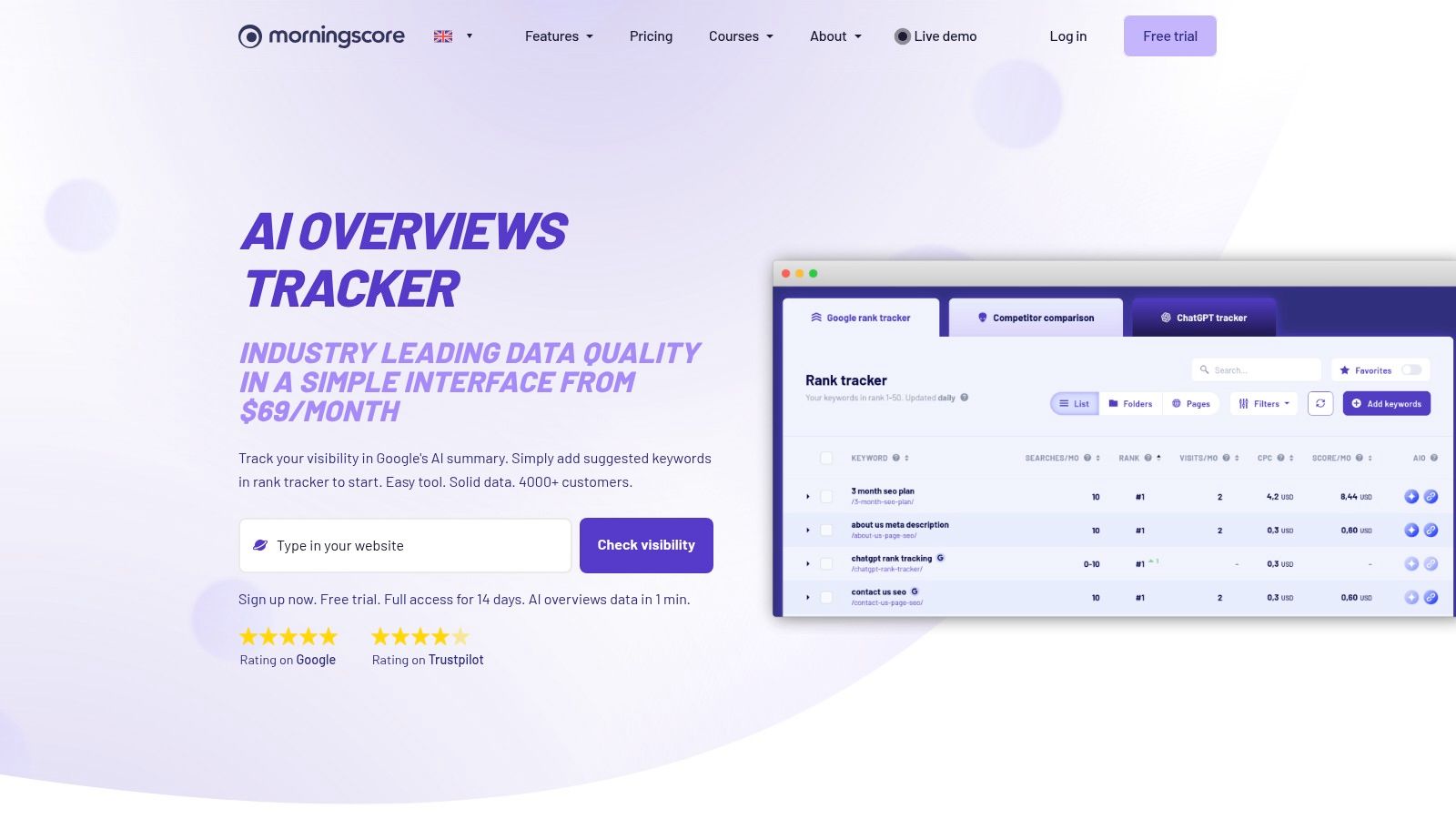
Morningscore is the lightweight option on this list. It doesn't try to be an enterprise GEO system. It gives smaller teams a simpler way to see which keywords trigger Google AI Overviews and whether their brand is mentioned or cited inside those summaries.
That lighter approach is valuable because a lot of SMBs don't need a full AI visibility command center. They need a quick way to validate whether AIO is affecting their tracked queries, and they need that inside a tool they can set up without a long onboarding process.
Who should choose it
Morningscore fits small businesses, lean agencies, and in-house marketers who want affordable AIO monitoring with familiar SEO basics attached. Its cached preview and mention checking are practical features for teams that just need a straightforward answer.
The limitation is depth. This is Google-focused, not a true cross-LLM GEO platform. If your buying journey depends heavily on ChatGPT, Perplexity, or Gemini recommendations, Morningscore won't give enough range.
Still, there's a role for tools like this. Not every team should buy enterprise software. Sometimes the right move is to confirm that AI Overviews are affecting your query set, identify the impacted pages, and then decide whether deeper GEO investment is justified.
You can try it at Morningscore AI Overviews Tracker.
Top 10 Generative Engine Optimization Tools Comparison
| Product | Core capabilities | AI / GEO visibility | Execution & workflow | Target audience | Pricing & value |
|---|---|---|---|---|---|
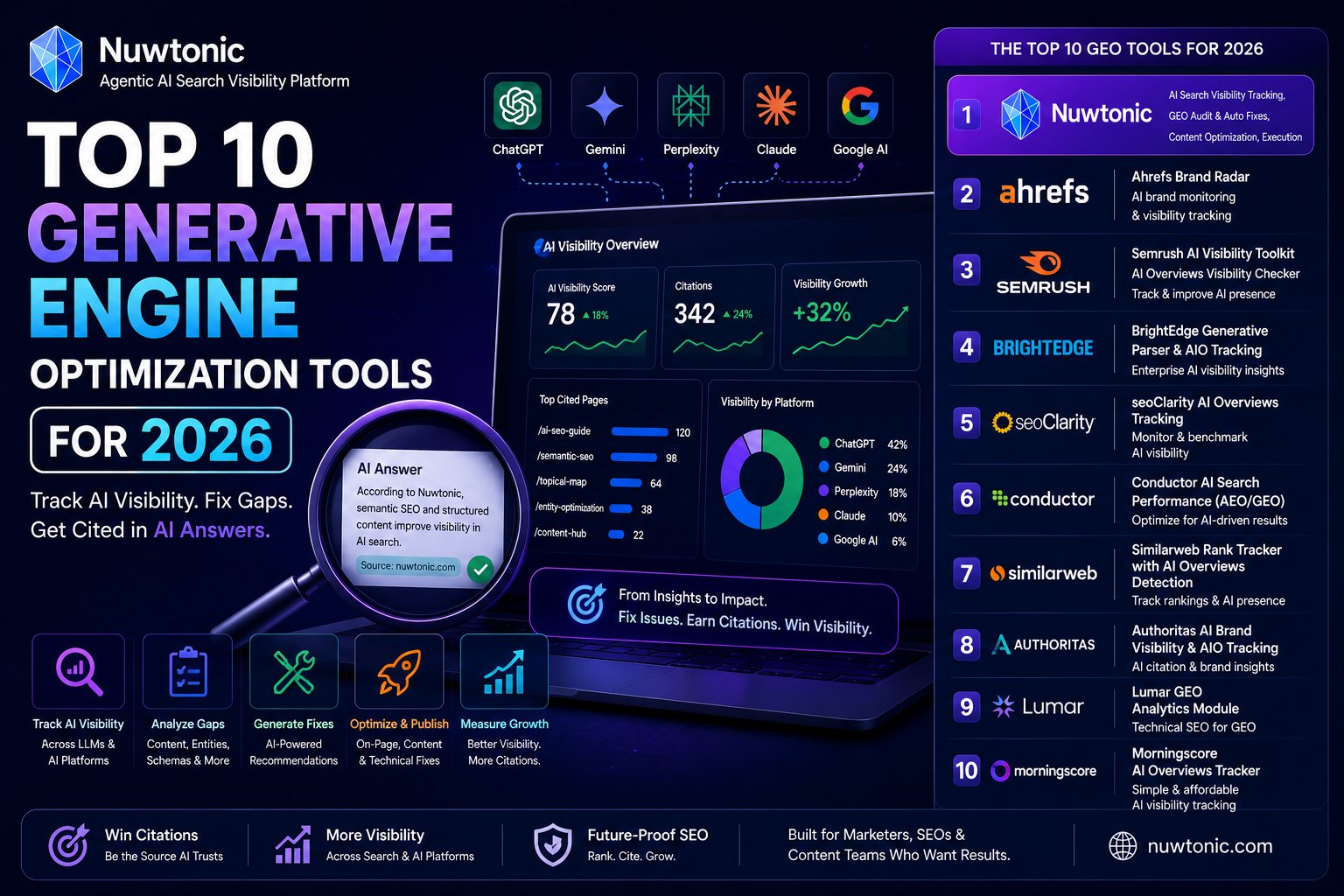
| Nuwtonic (Recommended) | AI-native SEO + GEO platform; GSC integration; entity-first content & schema | Cross-LLM prompt tracking (ChatGPT, Gemini, Perplexity, Claude, Grok); 120+ GEO checks; URL-level citation tracking | Execution-first: agent-driven fixes, one-click CMS pushes, Content Autopilot; review/permission controls | SEO agencies, in-house SEO/content teams, e-commerce, SMBs | Starter $99/mo; Silver $199/mo; 7-day free trial; replaces ~12 tools, cost-saving claim |
| Ahrefs, Brand Radar | Brand & search monitoring built on Ahrefs datasets | Cross-engine visibility (ChatGPT, Perplexity, Gemini, Copilot, Google AI) with large prompt corpus | Monitoring & benchmarking; no built-in auto-remediation | SEOs, agencies, enterprises using Ahrefs | Add-on within Ahrefs; pricing tied to Ahrefs plans |
| Semrush, AI Visibility toolkit | Classic SEO suite + AI visibility tools; competitor context | AI Overviews detection; share & gap analysis | Guided workflows linking insights to content tasks; integrated with Semrush tools | Agencies and in-house teams familiar with Semrush | Toolkit/add-on pricing; can increase cost for multi-site teams |
| BrightEdge, Generative Parser | Enterprise SEO research with AI parsing | AIO presence tracking; identifies cited content in AI Overviews | Enterprise reporting + guidance modules; ties insights into enterprise SEO modules | Large enterprises & category owners | Quote-based enterprise pricing; sales cycle |
| seoClarity, AI Overviews tracking | Keyword-level AIO detection and impact analysis | Detects AIO per keyword; ties AIO to URL & CTR trends | Operational reporting for recovery and optimization | Enterprise SEO teams tracking AIO impact | Sales-assisted pricing; enterprise focus |
| Conductor, AI Search Performance | Enterprise AEO/GEO system of record; content ops | Cross-engine brand mentions & citations (multi-LLM) | Insight → Conductor Creator content workflow; API/data connectors | Enterprises with mature SEO + content ops | Quote-based pricing; enterprise onboarding |
| Similarweb, Rank Tracker + AIO | Rank tracking + market intelligence | Flags keywords that trigger Google AIO; SERP-feature filters | Rank + market insights; AIO detection often an add-on | Market intelligence teams, enterprises | AIO detection as subscription add-on; contact sales |
| Authoritas, AI brand visibility | SEO stack extended with LLM visibility & persona tools | Per-engine mention & citation tracking incl. AIO | Persona-driven prompt builders; retail-focused views | Retail/ecommerce teams and Authoritas customers | Module pricing via vendor; contact sales |
| Lumar, GEO analytics module | Technical SEO and site health with GEO metrics | GEO dashboards and inclusion-readiness scores | Fix-level guidance for engineering; integrates with crawl & accessibility | Technical SEO teams and engineering-focused orgs | Module availability/pricing by contact |
| Morningscore, AI Overviews Tracker | Lightweight SEO + AIO monitoring for SMBs | Detects Google AI Overviews and brand mentions/citations | Simple, affordable setup; rank + intent integration | Small teams, SMBs testing AIO monitoring | Affordable self-serve plans; built for smaller budgets |
Your Next Move in the Generative Search Era
A common GEO scenario looks like this: the team has dashboards, weekly reports, and a growing list of AI visibility problems. Three weeks later, the same pages still have weak entity signals, missing schema, thin comparison copy, and nothing new for models to cite. The bottleneck usually is not awareness. It is implementation.
That distinction matters when choosing a tool.
The category is getting crowded, and as noted earlier, market growth is pulling in more vendors. Some products are built to tell you where you are losing ground. Others are built to help your team fix the underlying causes. Those are different jobs, and buying the wrong type creates a slow, expensive workflow.
Teams with strong editorial discipline, technical SEO support, and a reliable release process can do well with monitoring-first products. Ahrefs, Semrush, BrightEdge, seoClarity, Similarweb, Authoritas, Lumar, Conductor, and Morningscore each cover parts of the visibility problem. They help you see citation trends, prompt exposure, AI Overview presence, and competitive movement. If your organization already ships changes fast, that may be enough.
Many teams do not have that setup.
In practice, GEO underperformance usually comes from a broken handoff between insight and execution. Recommendations sit in a deck. Engineering tickets slip. Content briefs never turn into updated pages. The result is predictable: the site keeps getting measured while the same issues stay live. Practitioners see this constantly, especially in companies using separate tools for rank tracking, crawling, content planning, and reporting.
The better evaluation question is simple. Will this product change what your team publishes, fixes, or deploys in the next 30 days?
If the answer is yes, it deserves serious consideration. If the answer is no, treat it as a reporting layer and budget for the operational work somewhere else.
That is also the right way to think about GEO metrics. Ranking alone is too narrow. Strong teams watch whether their pages are being cited, whether key URLs appear in AI-generated answers, whether entity associations are getting clearer, and whether model visibility improves after specific page updates. GEO is cumulative work. Clean structure, sourceable claims, stronger topic coverage, and technical clarity tend to reinforce each other over time.
The practical upside is still large. Many companies are early here. Some are barely tracking AI visibility, and others are tracking it without a process to act on what they find. That leaves room for teams willing to do the less glamorous work consistently: tighten schema, clarify entities, improve page specificity, add citation-worthy sections, and review outputs at the URL level instead of relying on a single domain-wide score.
If you want one platform that handles both measurement and execution, Nuwtonic is a strong starting point. It combines GSC data, AI prompt tracking, technical audits, content operations, and CMS-ready fixes in a single workflow, which addresses the main failure point in GEO programs built on disconnected point solutions.