You know, one thing I've learned is that every time Google updates its algorithm, the digital marketing industry panics. But the shift to AI-driven search experiences—like Perplexity, ChatGPT, and Google's AI Overviews—isn't just another update. It's a fundamental rewrite of the rules. If you are asking yourself, "how do i start with generative engine optimization?", you are already ahead of 90% of your competitors.
Traditional SEO focused on ranking blue links. Today, Generative Engine Optimization (GEO) is about winning citations inside AI-generated answers. If an AI engine synthesizes an answer to a user's query and doesn't cite your brand, you don't exist to that buyer.
Let's cut through the theoretical fluff and build a practical, repeatable workflow to optimize your content for the AI era.

Key Takeaways
• Shift from Keywords to Prompts: AI engines use natural language processing (NLP) to understand intent, meaning you must optimize for conversational queries rather than static keywords.
• Prioritize Information Gain: To win citations, your content must provide unique data, proprietary frameworks, or expert quotes that cannot be easily replicated.
• Structure for Machine Reading: Use "Bottom Line Up Front" (BLUF) layouts, clean HTML tables, and robust schema markup to make your content easily extractable.
• Automate the Feedback Loop: Leverage modern tools like Nuwtonic to continuously track your AI Share of Voice (SoV) and auto-fix structural gaps.
Table of Contents
Demystifying Generative Engine Optimization (GEO)
Phase 1: Set Your Baseline with AI Visibility Tracking
Phase 2: Identify the Leaks via Citation Gap Analysis
Phase 3: Run an Engine-Specific AI Audit
Phase 4: Deploy the Fixes via Agentic Auto-Fixing
Designing a Multi-Format Content Strategy for AI Ingestion
Common GEO Mistakes to Avoid
Frequently Asked Questions (FAQ)
Sources and References
TL;DR summary
Generative Engine Optimization (GEO) is the practice of making your website's content highly extractable and authoritative so that AI engines (like ChatGPT, Claude, Gemini, and Perplexity) cite your brand in their synthesized answers. Starting with GEO requires a four-part continuous loop: tracking your brand's visibility across AI models, analyzing citation gaps where competitors are winning, auditing your content's technical and semantic structure, and deploying automated fixes to align with LLM retrieval mechanisms.
Demystifying Generative Engine Optimization (GEO)
What is GEO and Why Does It Matter in 2026?
Generative Engine Optimization (GEO) is the next evolution of search marketing. Instead of optimizing solely for Google's traditional search engine result page (SERP), GEO focuses on the retrieval systems used by large language models (LLMs). When a user inputs a complex prompt, these engines search the web in real-time, retrieve a handful of relevant sources, and synthesize a single, cohesive answer.
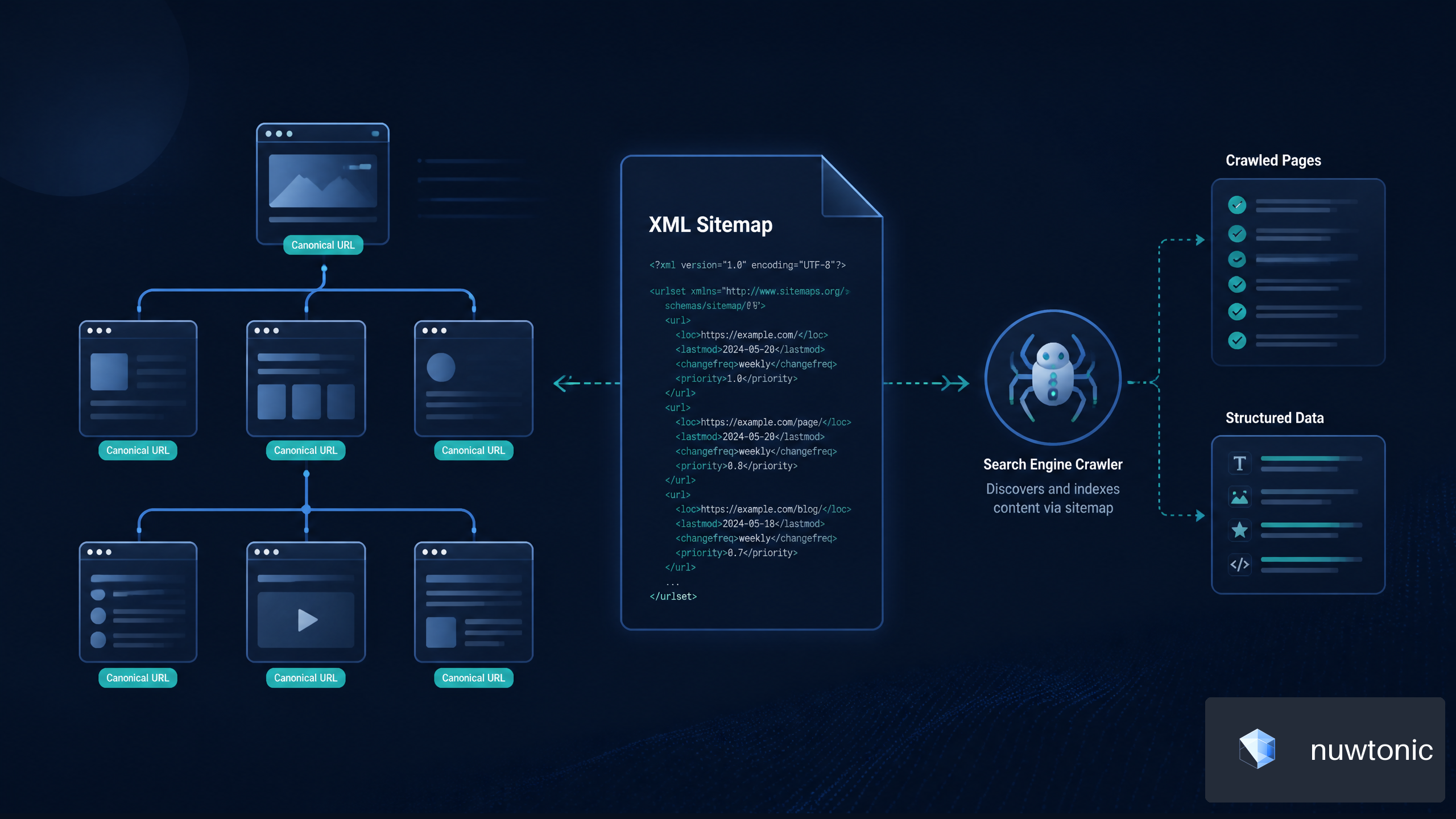
If you want your brand to be recommended, your content must be easily discoverable by these retrieval systems. A lot of people think generative AI is a magic bullet for SEO, but it really needs to complement a solid foundation first. Your site still needs basic crawlability and indexability; otherwise, AI scrapers cannot access your content to begin with.
Traditional SEO vs. GEO: The Paradigm Shift
The differences between traditional SEO and GEO lie in how search intent is processed and how success is measured. Traditional SEO heavily prioritizes click-through rate (CTR) from high-volume keywords. GEO, on the other hand, prioritizes citation share and brand sentiment within conversational answers.
When comparing Traditional SEO vs AI SEO, the metrics change entirely. You are no longer just fighting for position #1; you are fighting to be the primary source that the AI trusts to build its response.
Optimization Step | Traditional Manual Approach | The Nuwtonic Agentic Workflow |
|---|---|---|
Tracking | Checking keyword rankings on SERPs manually or via legacy software. | AI Visibility Tracking monitors live conversational AI outputs 24/7. |
Gap Analysis | Reviewing competitor backlinks and guessing why they rank. | Automated Gap Analysis maps out exactly which URLs the AI cites instead of yours. |
Auditing | Checking meta tags and keyword density. | A 120+ Parameter AI Audit analyzes your content's semantic extractability for LLMs. |
Execution | Sending content briefs to writers; waiting weeks for manual edits. | Auto-Fix agents generate and deploy targeted structural patches straight to your CMS. |
Phase 1: Set Your Baseline with AI Visibility Tracking
Mapping the Prompt Matrix and Intent
To start with GEO, you must move away from isolated keyword lists. AI search is conversational. Users don't just type "best CRM"; they type, "What are the security compliance risks of open-source LLMs when integrated with a CRM?"
I've noticed that many practitioners overlook the importance of keyword intent when using AI tools — understanding what users truly want can make all the difference. You need to map out a "Prompt Matrix" that reflects the actual conversational paths your buyers take. If you're wondering Why Use AI for Keyword Research, it's because AI tools excel at predicting these multi-turn conversational queries and grouping them into semantic content clusters.
Tracking Cross-Model Visibility
Different AI models have different retrieval preferences. For instance, Google's Gemini heavily favors structured data and sources within the Google Ecosystem. OpenAI's ChatGPT and Anthropic's Claude value deep editorial nuance, information gain, and authoritative source material.
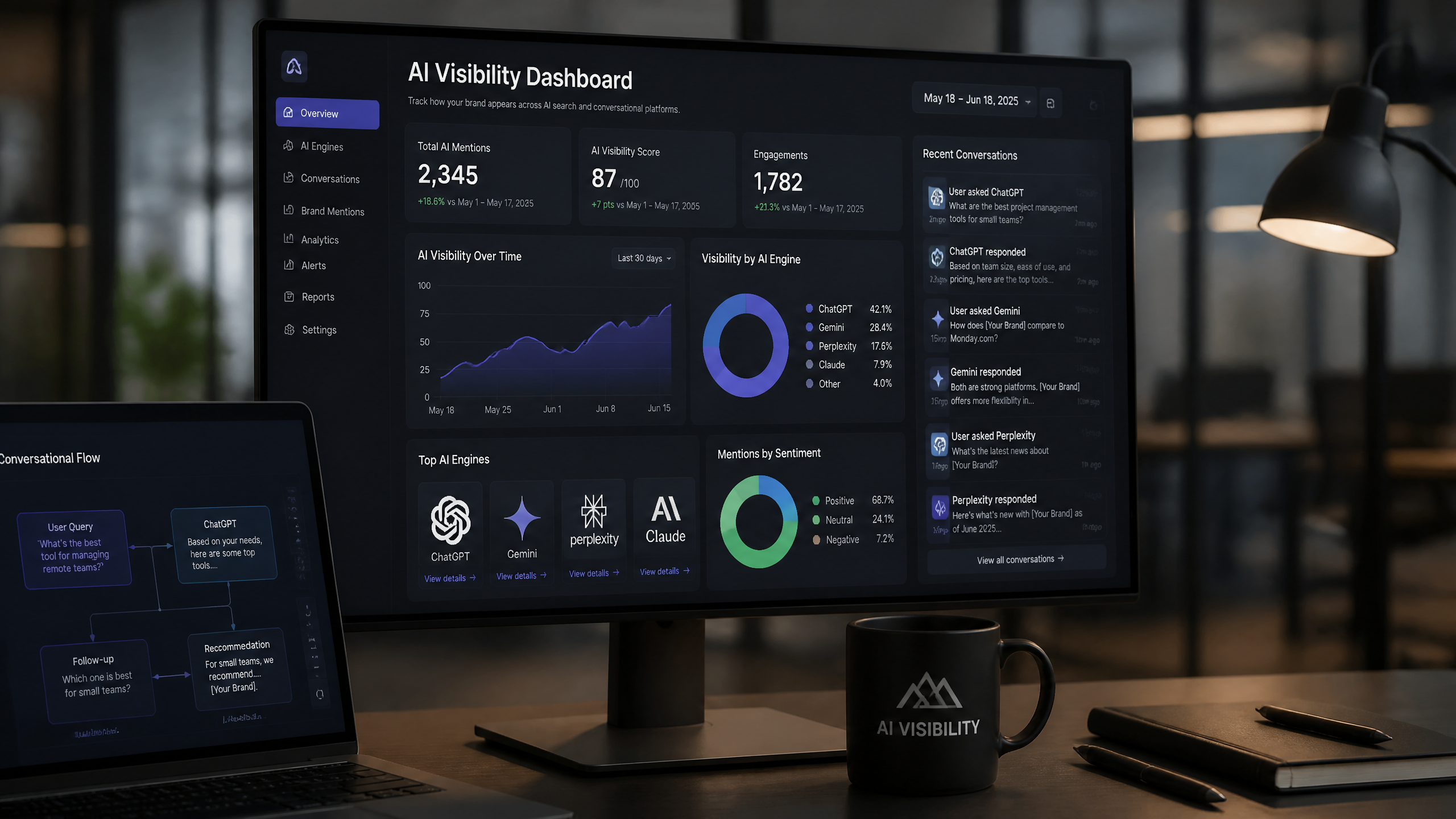
To track this manually, you would have to type hundreds of prompts into multiple interfaces daily—a complete waste of time. Instead, Nuwtonic's AI Visibility Tracking automates this process. It simulates thousands of real-time user prompts across ChatGPT, Perplexity, and AI Overviews, providing you with a unified dashboard that displays your true AI Share of Voice (SoV).
Phase 2: Identify the Leaks via Citation Gap Analysis
Uncovering Source Attribution
When an AI model answers a prompt in your industry, it cites its sources. Your job is to figure out who is winning those citations. Are the engines citing your direct competitors, independent review platforms, or academic papers?
Understanding how these engines attribute their sources is critical. According to academic guidelines on GenAI citations, modern AI systems rely on structured retrieval-augmented generation (RAG) to pull facts from external indexes. If a competitor's blog post is constantly cited, it means their page contains highly extractable facts that match the engine's retrieval query.
The Information Gain Deficit
Why does the AI choose a competitor's page over yours? In my experience, it usually comes down to an "Information Gain" deficit. If your page simply repeats the same generic advice found on ten other websites, the AI has no reason to cite you.
AI engines favor unique data. Consider this scenario: I was working with a B2B SaaS client last year who couldn't get cited in Perplexity for any of their core topics. We realized their content was highly optimized for traditional keywords but lacked original insights. We conducted a proprietary industry survey, published the raw data, and within three weeks, Perplexity began citing our data table as the primary source for industry benchmarks.
Nuwtonic's automated Gap Analysis does this at scale. It scans your topic clusters, isolates the high-intent prompts where competitors are cited, and tells you exactly what kind of data or framework your page is missing.

Phase 3: Run an Engine-Specific AI Audit
Evaluating the 4 Core AI Metrics
Before rewriting your content, you must run an audit to see how "digestible" your website is to an LLM's parser. Traditional SEO crawlers look for keyword placement and meta tags; AI search engines evaluate content based on four core metrics:
Extractability: How easily can an LLM's parser extract facts from your page without wading through fluff?
Entity Density: Does your page clearly connect your brand name (the subject entity) to the core concepts?
Data Structuring: Are your comparisons, statistics, and steps organized into clean HTML tables or lists?
Authority Signals: Are your author credentials, expert quotes, and E-E-A-T signals transparent and machine-readable?
To evaluate these metrics, engines apply strict criteria similar to traditional source evaluation criteria, prioritizing accuracy, authority, and currency.
Analyzing Entity Density and Schema Markup
Machine learning models understand the world through entities—defined concepts, brands, people, and places—and the relationships between them. If your content doesn't use precise terminology, the engine's natural language processing (NLP) algorithms won't associate your brand with the topic.
Implementing detailed schema markup (like Organization, Product, or Article schema) acts as a translator for the AI. It explicitly tells the crawler: "This is our brand, this is the service we offer, and this is the expert who wrote the article."
Phase 4: Deploy the Fixes via Agentic Auto-Fixing
Transitioning from Analysis to Action
Most guides make generative SEO seem more complex than it is; the best approach is often to start small and iterate. The biggest bottleneck in GEO isn't finding the issues—it's fixing them. Manually updating hundreds of pages to fit LLM preferences can take months, and by the time you finish, the AI models have updated their algorithms again.
This is where agentic workflows shine. Instead of handing you a massive spreadsheet of tasks, Nuwtonic's Auto-Fix feature uses multi-agent workflows to write structural patches, optimize headers, inject missing entity definitions, and push those updates directly to your CMS.
[Nuwtonic Tracking] ➔ [Detects Citation Gap] ➔ [Audits Structural Flaws] ➔ [Auto-Fixes via CMS]
Implementing the BLUF Framework
One of the most effective manual or automated fixes you can deploy immediately is the BLUF framework (Bottom Line Up Front). LLMs are designed to summarize. If you hide your main answer on paragraph five, the parser will likely skip it.
Place a concise, 2-3 sentence summary of the answer directly beneath your H1 or H2 headings. This makes it incredibly easy for the AI's retrieval system to extract your answer and cite your page as the source.
Designing a Multi-Format Content Strategy for AI Ingestion
Structuring Data for Machine Readability
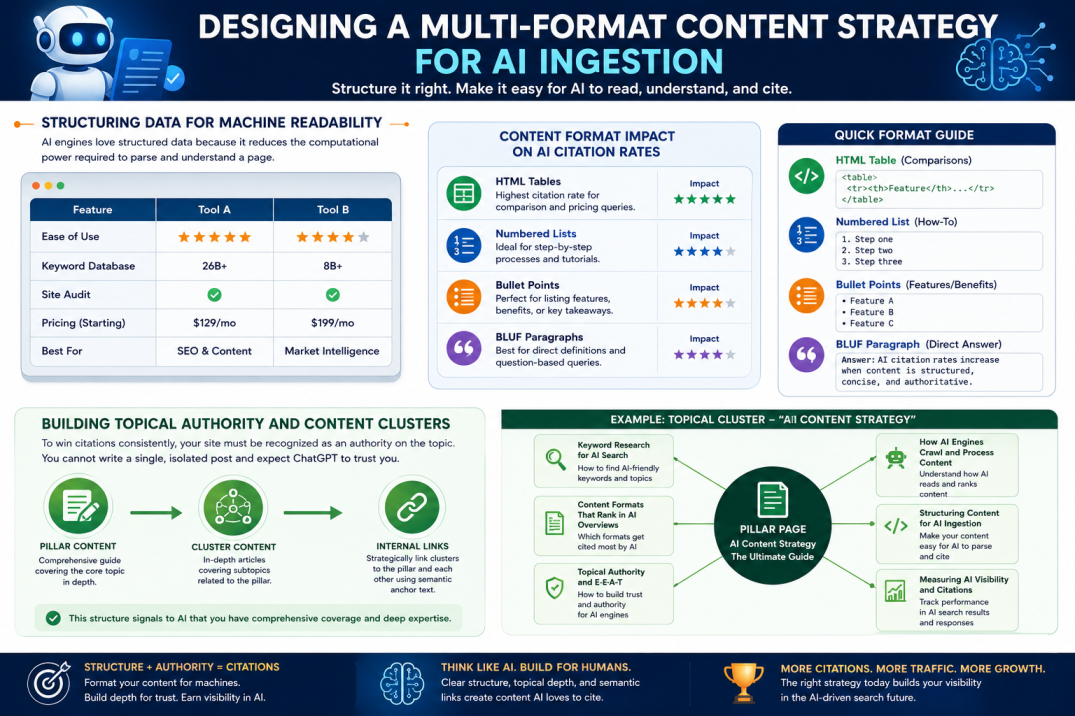
AI engines love structured data because it reduces the computational power required to parse and understand a page. If you are comparing two software tools, do not write long, narrative paragraphs. Use a clean HTML table.
Let's look at how content structure affects AI citation rates based on our internal testing:
• HTML Tables: Highest citation rate for comparison and pricing queries.
• Numbered Lists: Ideal for step-by-step processes and tutorials.
• Bullet Points: Perfect for listing features, benefits, or key takeaways.
• BLUF Paragraphs: Best for direct definitions and question-based queries.
Building Topical Authority and Content Clusters
To win citations consistently, your site must be recognized as an authority on the topic. You cannot write a single, isolated post and expect ChatGPT to trust you. You must build out cohesive content clusters.
To build this successfully, you need to understand How to Create a Topical Map for AI Search to establish authority. By linking related articles together using clear, semantic anchor texts, you show the AI's crawler that you have comprehensive coverage of the entire subject area.
Common GEO Mistakes to Avoid
The Do's and Don'ts of Generative Engine Optimization
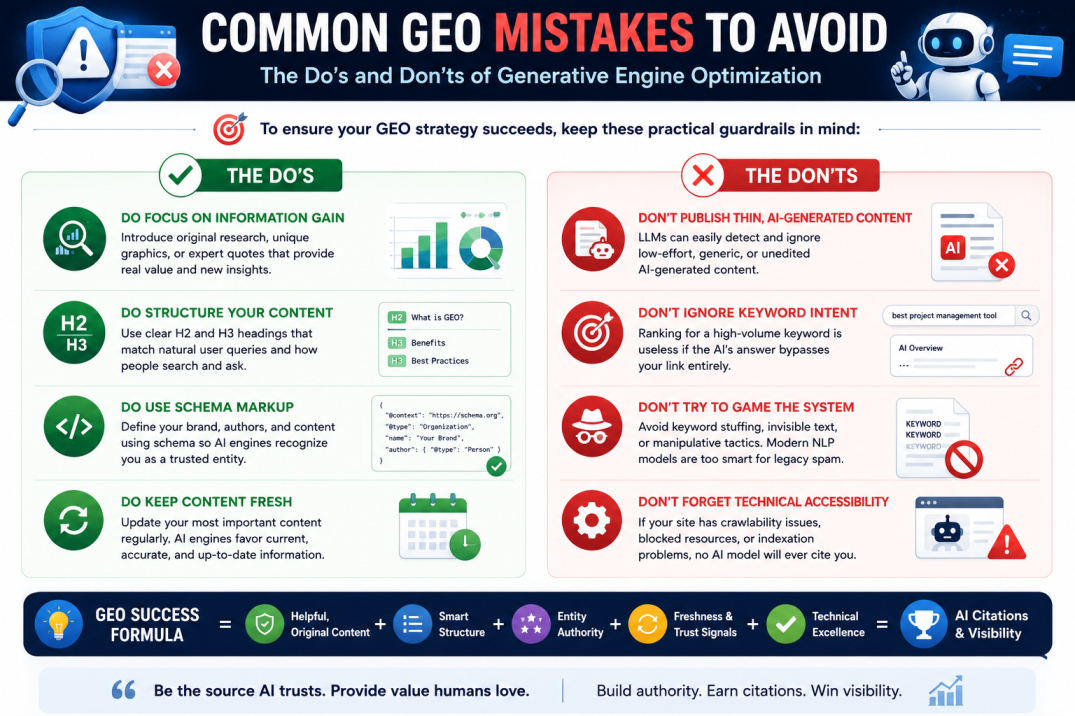
To ensure your GEO strategy succeeds, keep these practical guardrails in mind:
The Do's:
• Do focus on information gain by introducing original research, unique graphics, or expert quotes.
• Do structure your content with clear H2 and H3 headings that match natural user queries.
• Do use schema markup to define your brand and authors as recognized entities.
• Do keep your most important content fresh and updated regularly, as AI engines favor current data.
The Don'ts:
• Don't publish thin, AI-generated content without human editing; LLMs can easily detect and ignore low-effort content.
• Don't ignore keyword intent; ranking for a high-volume keyword is useless if the AI's answer bypasses your link entirely.
• Don't try to game the system with keyword stuffing or invisible text; modern NLP models are too smart for legacy spam tactics.
• Don't forget technical accessibility; if your site has crawlability issues, no AI model will ever cite you.
Frequently Asked Questions (FAQ)
What is Generative Engine Optimization?
Generative Engine Optimization (GEO) is the process of optimizing website content so that it is easily retrieved, understood, and cited by AI-powered search engines and answer engines like ChatGPT, Gemini, and Perplexity.
How is GEO different from traditional SEO?
While traditional SEO focuses on ranking blue links on search engine results pages (SERPs) by optimizing for keywords and backlinks, GEO focuses on winning citations inside synthesized AI answers by optimizing for entity density, extractability, and information gain.
What should I optimize first if I am starting from scratch?
Start by identifying your top-performing organic pages and restructuring them using the BLUF (Bottom Line Up Front) framework. Add clear HTML tables for comparison data, and ensure your brand name and key concepts are clearly defined as entities.
How do I measure GEO success?
Because traditional rank trackers cannot see inside AI chats, you must use specialized tools like Nuwtonic to track your AI Share of Voice (SoV). This metric measures how often your brand is cited or recommended across various LLM prompts.
Can small websites compete in GEO?
Yes, absolutely. Because AI engines prioritize highly specific, authoritative answers and original data (information gain), a small niche site with proprietary data or deep expert insights can easily win citations over a massive directory site that only republishes generic information.
Sources and References
• For academic guidelines on GenAI citations, refer to the University of Florida Business Library GenAI FAQ.
• For understanding source evaluation and credibility standards, see the Great Falls College MSU Source Evaluation Guide.