Let's face it, the days of exporting a massive CSV from a basic tool, sorting by search volume, and blindly assigning phrases to pages are over. If you are still doing that in 2026, you are already behind.
With over eight years of experience in digital marketing, I have watched the industry evolve from basic string-matching to highly complex semantic search algorithms. Honestly, keyword research shouldn't be a guessing game; AI can sift through data far better than any manual effort. The reality is that search engines no longer look for exact keyword density. They look for intent, entity salience, and comprehensive topical coverage.
If you are wondering why use AI for keyword research today, the answer is simple: human analysts simply cannot calculate multidimensional SERP overlaps and entity relationships at the scale required to compete.
TL;DR Summary
• The Shift: Keyword research has moved from lexical matching (words) to latent semantic intent (concepts).
• The Solution: AI automates the mathematically heavy lifting of vector embeddings and SERP overlap calculations.
• The Benefit: Eliminates keyword cannibalization, identifies zero-volume entity opportunities, and builds a precise topical authority structure.
Table of Contents
The Mechanical Failure of Manual Research
Why Legacy Methods Fall Short
For years, the standard operating procedure was to find a seed keyword, generate a list of long-tail keywords, and map them to individual pages. We called it keyword mapping, and it worked—until it didn't.
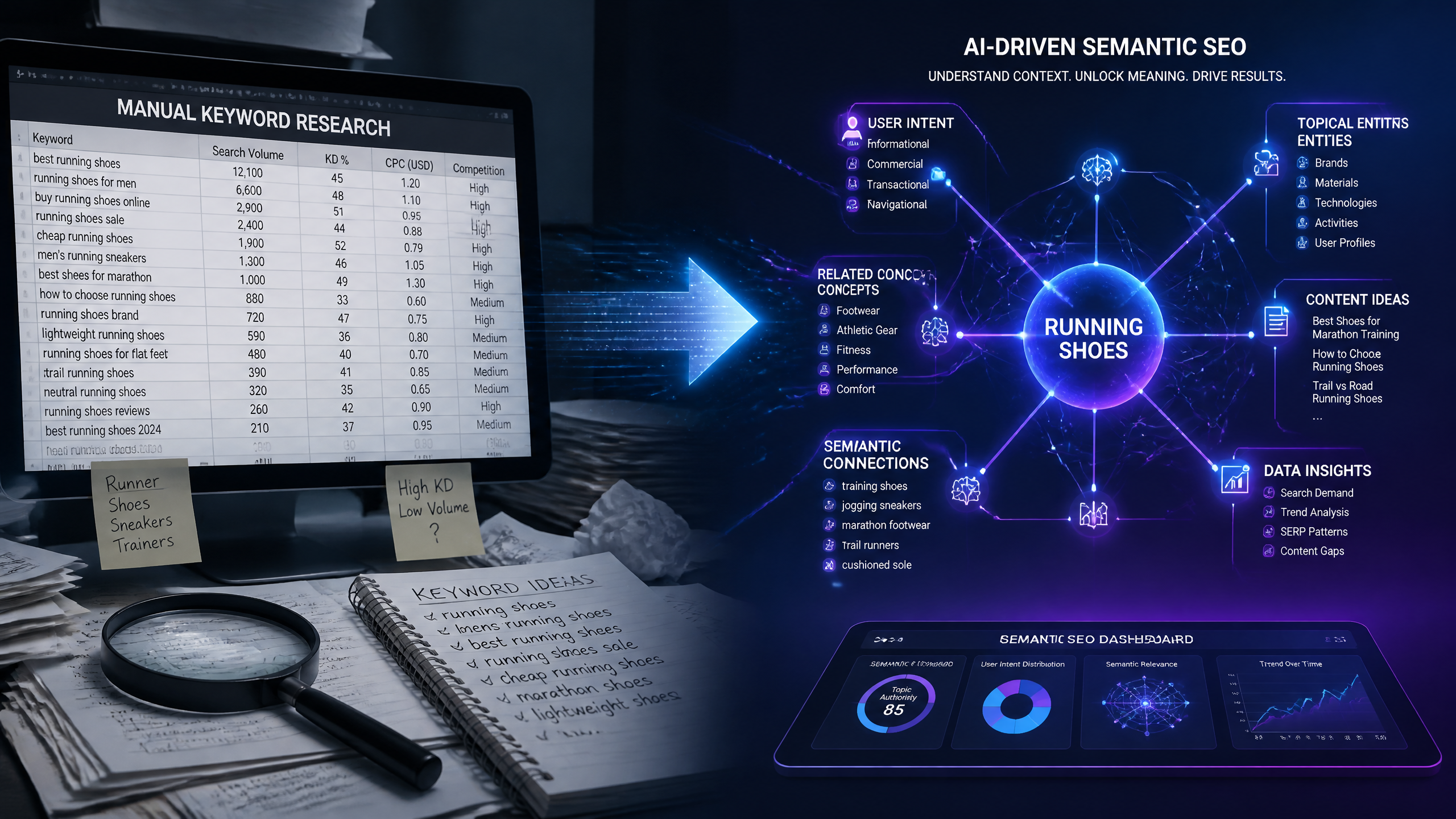
Traditional keyword research fails today because it treats keywords as isolated strings. When you compare traditional SEO vs AI SEO, the glaring difference is how data is grouped. Manual research groups terms by shared root words. AI groups terms by mathematical relationships in a vector space.
Comparing the Methodologies
To truly understand the gap, let's look at the technical specifications of both approaches.
Metric / Feature | Legacy Manual Research | AI-Driven Intelligence |
|---|---|---|
Data Foundation | Historical Search Volume (Lagging) | Real-time Semantic Relationships (Leading) |
Grouping Logic | String Match / Root Word | Intent Adjacency / SERP Overlap |
Discovery Depth | Limited to Seed Variations | Infinite via Latent Topic Expansion |
Optimization Target | Keyword Density | Entity Completeness & Retrieval Score |
Analysis Speed | Linear (Hours/Days) | Exponential (Seconds via Agentic Clusters) |
Using AI for keyword research can save time and reveal opportunities that traditional methods might miss. When an AI processes your keyword list, it doesn't just look for variations; it analyzes the underlying entities.
Search Intent and Semantic Clustering
The Importance of Search Intent
Many marketers overlook the importance of search intent — it’s not just about volume, but what users actually want. I once had an e-commerce client who insisted on targeting a massive, broad keyword. We spent months trying to rank a product page, only to realize the SERP was entirely populated by informational blog posts. The intent was educational, not transactional.
If you are figuring out how to do keyword research for ecommerce, understanding this distinction is critical. AI models utilize Natural Language Understanding (NLU) to instantly classify whether a query is informational, navigational, commercial, or transactional by analyzing the current ranking pages.
Leveraging Vector Embeddings
Modern search algorithms use Vector Space Modeling. They plot concepts mathematically. The relationship between two queries is calculated using Cosine Similarity. AI keyword tools mimic this process, allowing you to see exactly how closely related two topics are in the eyes of the search engine.

Scaling SERP Overlap Analysis
The Cannibalization Problem
One situation I keep seeing across dozens of client audits is severe keyword cannibalization. A company will have five different pages targeting slight variations of the same topic.
How AI Solves It
AI-driven keyword clustering automatically groups search queries based on intent-based SERP overlap rather than shared character strings.
Here is how the automated workflow operates:
Input: Feed thousands of seed keywords into the AI.
Analyze: The AI pulls the Top 10 URLs for every single query.
Compare: It calculates the overlap. If Query A and Query B share 60% or more of the same ranking URLs, the AI merges them into a single semantic node.
Execute: You now know exactly which terms require their own dedicated pages and which should be combined, ensuring your site architecture perfectly mirrors the search engine's knowledge graph.
Information Gain and the Volume Trap
Moving Beyond Search Volume
We have been conditioned to worship search volume. But high-volume keywords in the AI era are often "retrieval-saturated." Everyone is targeting them, and the SERPs are static.
True growth lies in Zero-Volume Entities. These are highly specific terms, LSI variations, and emerging concepts that haven't registered in traditional third-party databases yet but are trending in real-time Google Search Console (GSC) data.
Auditing for Salience
AI tools run a "Salience Audit" against the current Top 3 ranking pages. They identify which technical entities those pages have omitted. By inserting these missing entities into your content, you trigger an "Information Gain" signal. You aren't just matching the competition; you are providing net-new value to the algorithm. This is why utilizing the best AI SEO tools is no longer optional for serious marketers.
Automating with Nuwtonic
The Agentic Execution System
The manual execution of SERP overlap calculations is computationally expensive and prone to human bias. Nuwtonic’s SERP-Based Clustering Engine automates this entirely.
Instead of guessing which keywords belong together, Nuwtonic’s Semantic Deduplication Engine identifies intent-equivalent queries and prunes redundancy. Furthermore, its Agentic Execution System monitors GSC-native intelligence to detect traffic decay in real-time, identifying new hidden opportunity keywords before your competitors even know they exist. It bridges the gap between raw data and executed strategy.
Frequently Asked Questions
Common Concerns Addressed
• Will AI replace human SEO strategists? No. AI handles the mathematical scale and pattern detection. Humans are still required for business alignment, brand voice, and final strategic approval. It is a collaboration.
• How does AI handle long-tail keywords? Exceptionally well. AI excels at finding low-volume, high-intent phrases by mapping latent semantic relationships that traditional tools filter out.
• Is AI keyword research accurate? Yes, because it relies on real-time SERP data and vector similarity rather than lagging historical search volume metrics. However, human oversight is necessary to ensure the AI's suggestions align with your specific product offerings.
Key Takeaways & Conclusion
Final Thoughts
• AI transitions keyword research from lexical guessing to mathematical certainty.
• SERP overlap analysis prevents keyword cannibalization and streamlines site architecture.
• Focusing on search intent and entity salience drives higher CTR and better conversions.
• Tools like Nuwtonic automate the tedious data processing, freeing you up to focus on content quality and strategy.
If you want to dominate the SERPs, you have to play the semantic game. Stop relying on outdated spreadsheets and start leveraging AI to build a truly authoritative content structure.
Sources & Methodology
Research Constraints
Note: The insights provided in this analysis are based on established technical SEO methodologies, vector space modeling principles, and practical application data from over eight years of industry experience. While specific third-party empirical studies on "AI keyword research benchmarks" are currently sparse in public academic databases, the mechanical shift toward Large Language Model (LLM) retrieval and Natural Language Understanding (NLU) in search engine algorithms is widely documented by search engine patents and industry consensus.