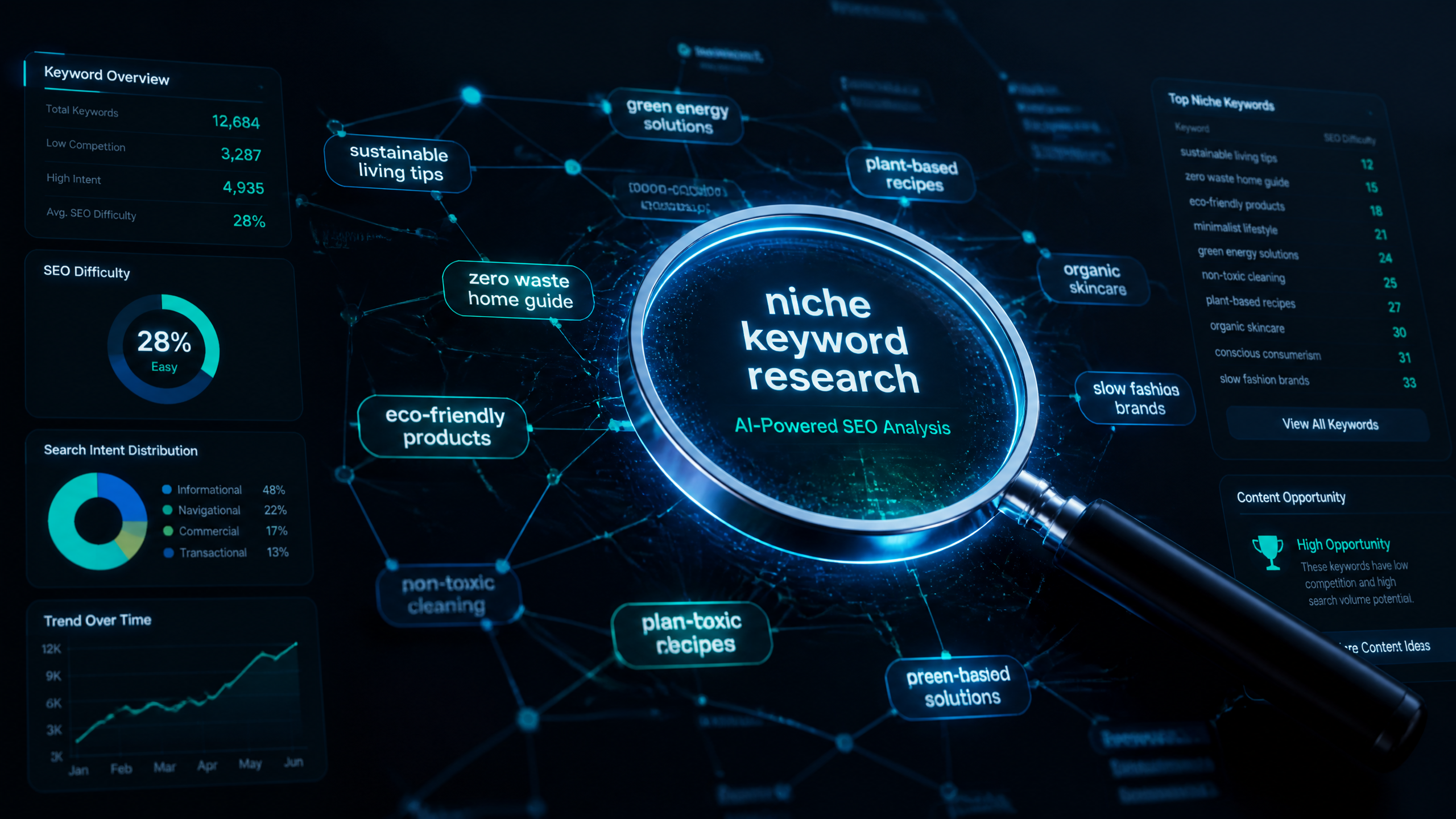
TL;DR Summary: Learning how to research keywords for a niche requires shifting focus from raw search volume to high-intent, long-tail queries. This manual provides a rigid, technical workflow to extract seed terms, map search intent, and validate commercial viability using community data and SERP analysis.
Key Takeaways:
• Search volume is a lagging indicator; focus on commercial intent and community validation.
• Long-tail keywords often convert at a significantly higher rate than broad head terms.
• Semantic clustering prevents keyword cannibalization and builds topical authority.
• Leveraging GSC-native intelligence streamlines the discovery of untapped content gaps.
Table of Contents:
The Technical Specification Table
Phase 1: Search Intelligence & Intent Alignment
Phase 2: The Technical Workflow
Phase 3: Semantic Density & Clustering
Pro-Level Insights: Common Failure Points
FAQ Section
Sources & References
The Technical Specification Table
Specification | Broad Market Research | Niche Market Research |
|---|---|---|
Primary Metric | High Search Volume | Search Intent & Conversion Potential |
Keyword Target | Head Terms (1-2 words) | Long-tail keywords (3+ words) |
Competition Level | High Keyword Difficulty | Low to Medium Keyword Difficulty |
Data Validation | Standard Keyword Tools | Community Forums, Reddit, SERP Analysis |
Content Focus | General Information | Hyper-Specific Solutions & Pain Points |
Let's break this down. Too many guides make keyword research seem like rocket science — it can be straightforward if you stick to the basics. But a cautionary note before we dive in: applying broad-market tactics to a hyper-specific niche will drain your budget and yield zero conversions. You need a surgical approach.
Phase 1: Search Intelligence & Intent Alignment
Summary: Aligning search intelligence requires identifying the specific sub-segments of your target audience and mapping their unique terminology to distinct search intent categories, ensuring your content satisfies the exact mechanical need of the user.
Defining the Query Delta
Many people overlook the importance of understanding search intent — it's crucial for effective keyword research. The "Query Delta" is the gap between what a user types into Google and the actual technical solution they need. In a niche, users often lack the exact vocabulary for their problem.
(I've found that focusing on long-tail keywords often yields better results than chasing high-volume head terms because long-tail phrases reveal the exact Query Delta). Instead of targeting "SEO tools," a niche researcher targets "automated technical SEO audit software for agencies."
Search Intent Classification
To dominate a niche, you must classify every keyword into an intent bucket. If you mismatch intent, your page will not rank, regardless of your domain authority.
Intent Type | User Goal | Niche Example | Content Strategy |
|---|---|---|---|
Informational | Seeking knowledge | "how to calibrate a 3D printer bed" | Step-by-step guides, tutorials |
Commercial | Comparing options | "best resin 3D printers for miniatures" | Listicles, comparison reviews |
Transactional | Ready to purchase | "buy Elegoo Mars 3 pro" | Product pages, optimized checkout |
Navigational | Finding a specific site | "Elegoo support forum" | Brand pages, contact info |
Phase 2: The Technical Workflow
Summary: Executing a niche keyword strategy involves extracting seed terms, performing SERP gap analysis, and mapping long-tail variations to build a comprehensive topical map that targets underserved user queries.
Step 1: Seed Keyword Extraction
Start by identifying the core entities of your niche. If you are figuring out how to do keyword research for ecommerce, your seed terms are your primary product categories.
Extract proprietary jargon from niche communities (Discord, Reddit, specialized forums).
Input these authentic community terms into your primary SEO tool to generate broad match ideas.
Filter out any query with a Keyword Difficulty (KD) above your site's current authority threshold.

Step 2: SERP Competitor Gap Analysis
You might be wondering how to spot the gaps your competitors missed. The manual process looks like this:
• Identify the top 3 direct competitors in your specific niche.
• Run a domain overlap analysis to find keywords they rank for, but you do not.
• Filter for informational intent queries that lack dedicated, high-quality answers on the current SERP.
• Note: If you are expanding regionally, understanding how to do keyword research for multiple locations is essential to finding localized content gaps that national competitors ignore.
Phase 3: Semantic Density & Clustering
Summary: Keyword clustering groups semantically related terms to prevent cannibalization and establish topical authority. Leveraging automated SERP-based clustering ensures content aligns with Google's entity understanding.
Building the Knowledge Graph
Once you have a raw list of keywords, you must group them by SERP overlap. If two keywords return the same top-ranking pages, they belong in the same cluster and should be targeted on the same page.
This is where manual KW research breaks down. Instead of guessing user intent, Nuwtonic’s SERP-Based Clustering Engine automates this process by analyzing live search results and grouping terms exactly how Google's algorithm sees them. This ensures your on-page SEO is perfectly aligned with current ranking factors.
Integrating LSI Keywords
Latent Semantic Indexing (LSI) terms provide the necessary context for your primary target. If your niche is "hydroponic strawberry farming," your LSI keywords should include "nutrient film technique," "EC levels," and "grow lights." Inject these naturally into your content to increase entity salience and prove topical depth.
Common Failure Points
Summary: The most frequent failures in niche keyword research stem from ignoring zero-volume keywords, misjudging commercial intent, and failing to plan the post-research content execution phase.
The Zero-Volume Trap
A common pattern I keep seeing across dozens of client audits is marketers abandoning highly specific niche terms because traditional tools report "0 monthly searches." In my experience, these zero-volume keywords often drive the most qualified leads. Keyword tools simply lag behind emerging niche trends. Always validate demand in community forums rather than relying solely on tool metrics. If people are asking the question on Reddit, there is search demand.
The "What Next" Paralysis
Another situation I frequently observe: a team builds a massive, beautiful spreadsheet of perfect niche keywords and then... nothing happens. Knowing what to do after keyword research is the actual differentiator. You must map these keyword clusters to a content calendar, assign them to writers, and begin executing immediately.
FAQ Section
Summary: This section addresses the most critical questions practitioners face when conducting keyword research for highly specialized or emerging niche markets.
1. What is a realistic search volume for a niche keyword to be worth targeting?
There is no universal threshold. In high-ticket B2B niches, a keyword with 20 monthly searches can generate millions in revenue. Focus on CPC (Cost Per Click) and commercial intent rather than raw volume.
2. How do I find long-tail and question-based keywords specific to my niche?
• Scrape "People Also Ask" boxes on Google SERPs.
• Monitor niche-specific subreddits and Quora spaces for recurring questions.
• Analyze the internal site search data from your own Google Search Console.
3. How do I factor in search intent when researching niche keywords?
Analyze the current SERP. If the top 10 results are all listicles, Google has determined the intent is commercial comparison. Do not try to rank a transactional product page for that query; you must match the content format Google is already rewarding.
Sources & References
Summary: generic SEO advice has been excluded from this technical manual and this manual is presented based on the Pure expertise of my 8 years of implementations and research and experiments , helping you with exact steps and phases so that you can take corrective actions and plan your niche authority building where Nuwtonic Agentic SEO and GEO platform can definitely help automating the whole process starting from the Niche research to keyword research to whole months and years of content generation , SEO and GEO optimization , Auto SEO analysis, Performance monitoring and Auto fixing