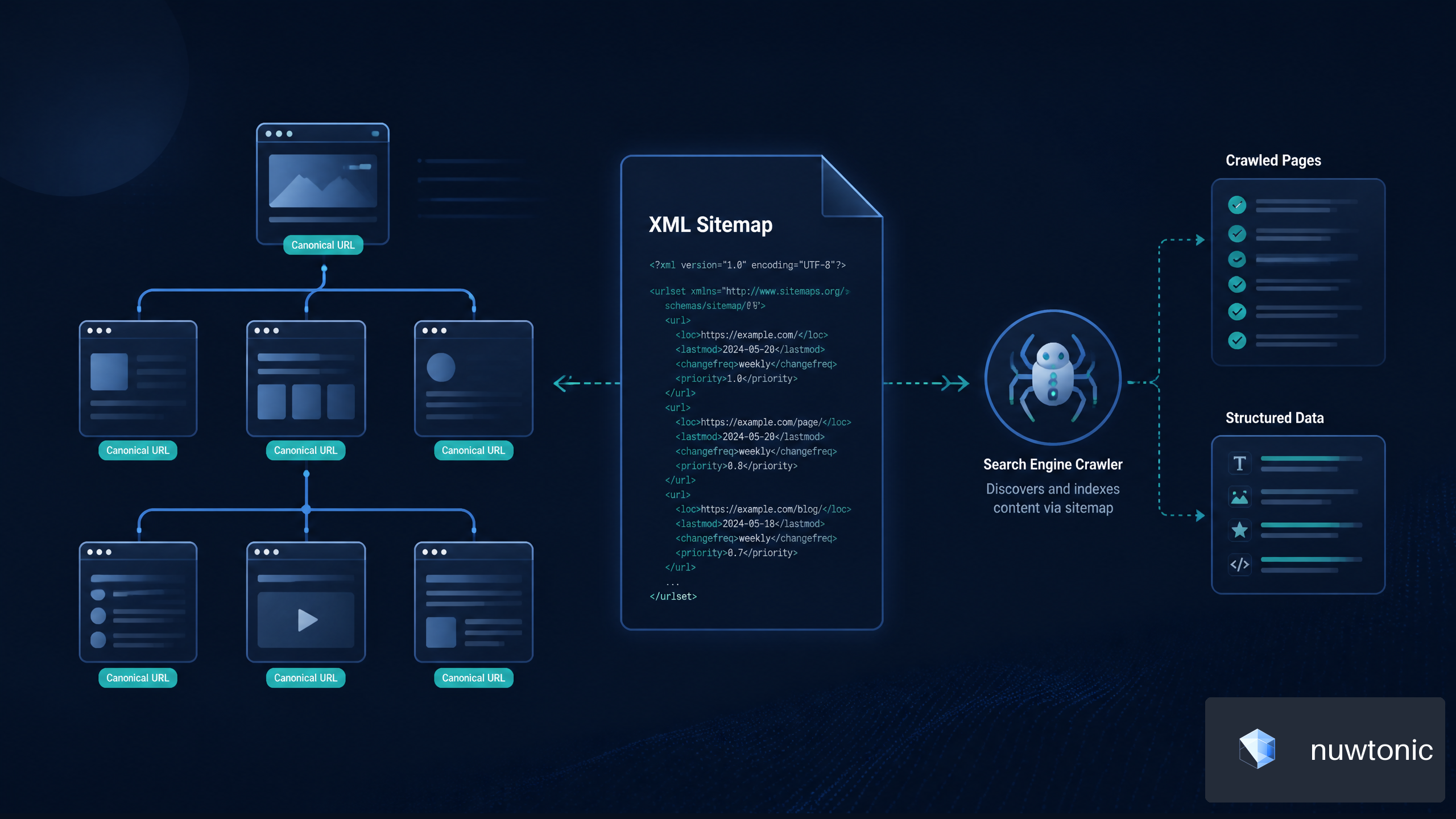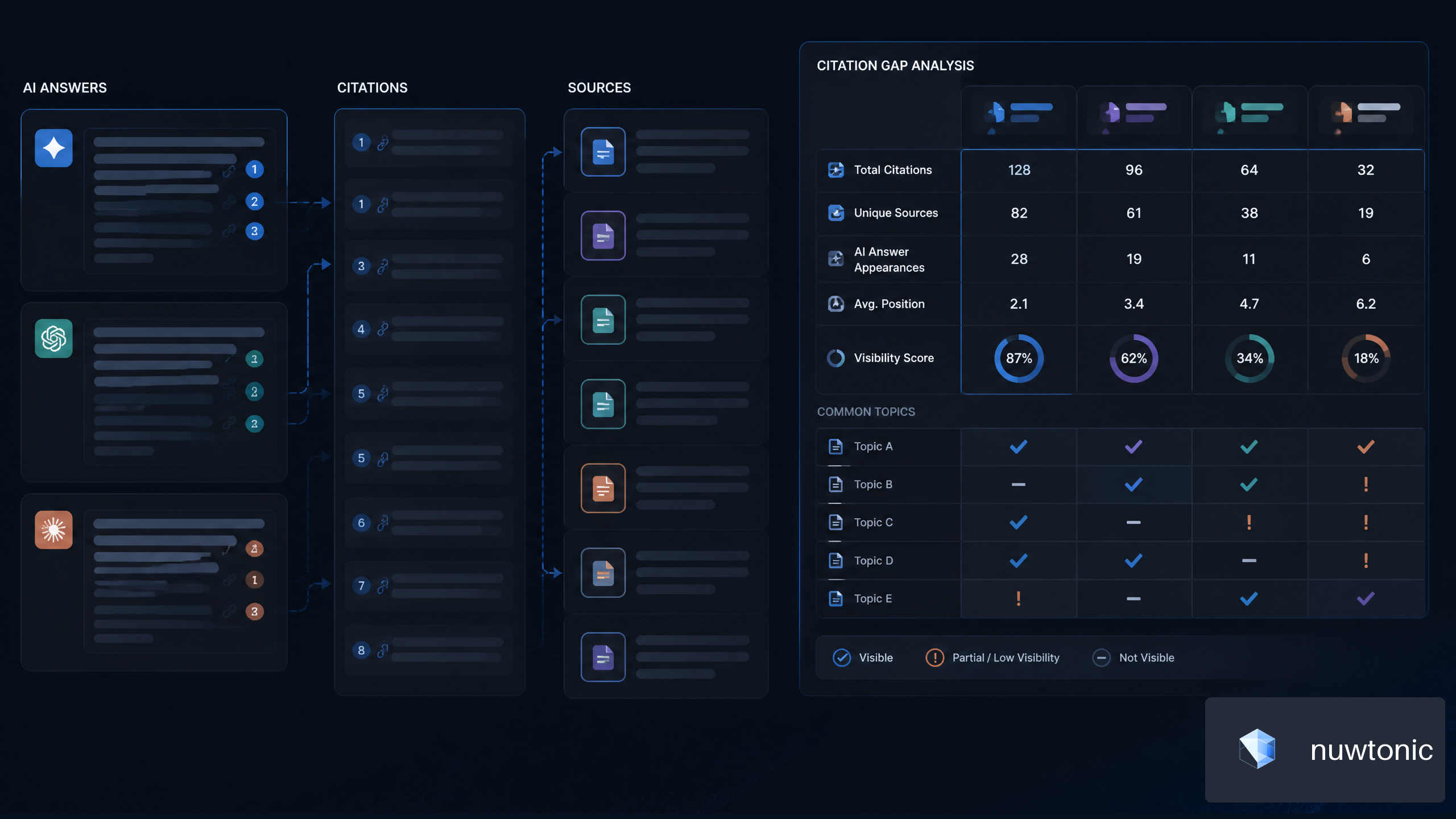

TL;DR Summary
• Traditional keyword research is dead; modern ecommerce SEO requires optimizing for semantic clusters and AI retrieval.
• Search intent dictates your page structure: map transactional keywords to product pages and commercial investigation terms to category pages.
• Stop chasing raw search volume. Focus on high-converting long-tail modifiers that align with your specific product catalog.
• Leverage Google Search Console (GSC) data to find hidden ranking opportunities rather than relying solely on static third-party databases.
Key Takeaways
• Understand the four pillars of ecommerce intent to avoid ranking the wrong pages for the right terms.
• Build an entity-driven category taxonomy to establish topical authority.
• Use AI-driven tools to automate the identification and fixing of technical SEO blockers while generating optimized content.
• Implement a retrieval-first mindset to capture visibility in AI Overviews and zero-click search environments.
Table of Contents
• Why Traditional Ecommerce Keyword Research is Dead in 2026
• Decoding Search Intent for Product and Category Pages
• Building a Modern Ecommerce Keyword System
• Leveraging AI and GSC for Search Intelligence
• The Step-by-Step Execution Framework
• FAQ Section
• Sources/References
Why Traditional Ecommerce Keyword Research is Dead in 2026
Okay, here's the deal to set the stage for practical advice: if you are still just downloading a CSV of high-volume terms and stuffing them into your Shopify product descriptions, you are playing a game that ended years ago.
With over 8 years of experience in ecommerce SEO, I've helped brands overhaul their product listings and dominate their niches. But the rules have changed. Today, search engines and AI assistants don't just look for strings of text; they look for entities, context, and semantic relationships.
The Shift from Keywords to Semantic Ecosystems
Early in my career, I made a classic keyword blunder. I spent weeks optimizing a sports retailer's site for "best running shoes." We hit page one, and traffic exploded. The problem? Sales flatlined completely. Why? Because we sold $250 specialized trail-running spikes, but the searchers wanted $60 daily trainers.
I've seen too many brands chase trendy keywords instead of building a solid keyword foundation that aligns with their products. You cannot treat keywords as isolated phrases anymore. You must build a semantic ecosystem where your category pages and product pages support each other contextually.
How AI Overviews Changed the Game
AI Overviews have fundamentally shifted how users discover products. Generative AI summarizes answers, compares products, and extracts data directly from your site — meaning zero-click commerce is a reality. To win, your keyword research must focus on "retrieval optimization." This means structuring your content so that AI can easily extract factual data, product specs, and direct answers.
Volume vs. Relevance
Many guides miss the mark by focusing too much on volume; relevance is key for ecommerce success. A keyword with 10,000 monthly searches that converts at 0.1% is mathematically inferior to a highly specific long-tail keyword with 500 searches that converts at 5%. Don't just guess at keywords — dig deeper for insights!
Decoding Search Intent for Product and Category Pages
A lot of businesses overlook the importance of search intent — it’s not just about the keywords, but what the searchers want. If you try to rank a product page for an informational query, Google will ignore you.
The Four Pillars of Ecommerce Intent
To map your strategy, you need to understand the four primary types of queries. Here is how they break down:
| Query Type | Intent Definition | Best Page Type | Funnel Stage |
|---|---|---|---|
| Informational | Seeking general knowledge or guides | Blog Post / Buying Guide | Top of Funnel |
| Commercial Investigation | Comparing options, reading reviews | Category Page / Collection | Middle of Funnel |
| Transactional | Ready to buy a specific item | Product Page | Bottom of Funnel |
| Post-Purchase / Support | Seeking help with a bought item | FAQ / Support Hub | Retention |
Why Transactional Intent is Your North Star
Transactional queries are where the money is. These users have their credit cards out. They aren't searching for "shoes"; they are searching for "buy men's waterproof trail running shoes size 11." Your keyword research must prioritize these high-intent modifiers (buy, discount, near me, specific SKUs) and map them directly to highly optimized product pages.
Navigating Commercial Investigation Queries
When users search for "best mechanical keyboards under $100," they are in the commercial investigation phase. They want options. This is where your category and collection pages shine. By optimizing category pages for these broader, comparative terms, you capture users right before they make their final decision.
Building a Modern Ecommerce Keyword System
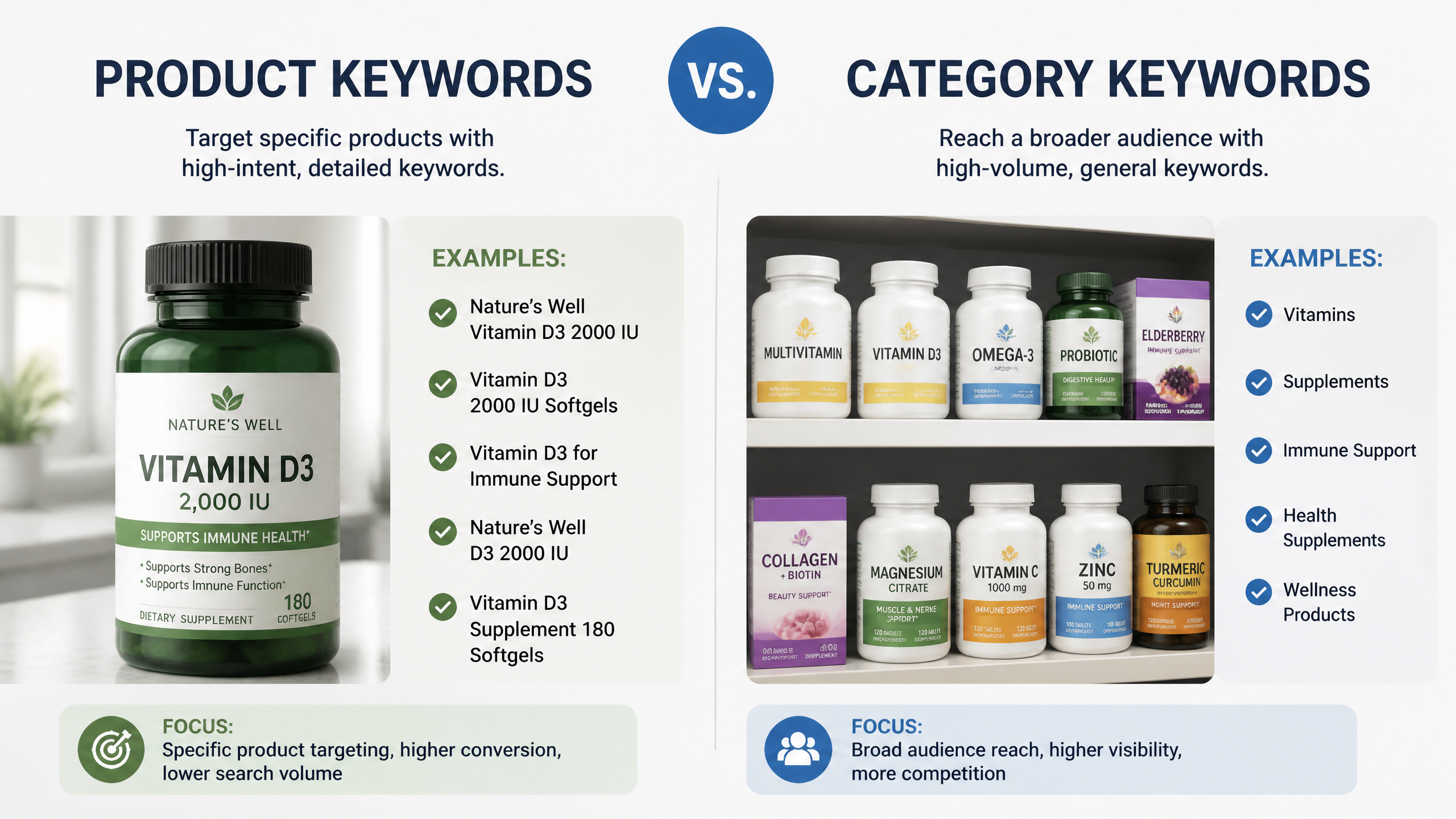
To build a scalable architecture, you need to separate your strategy into distinct buckets. Mixing product and category keywords is a recipe for cannibalization.
Category vs. Product Keywords
Understanding the difference between category and product targeting is non-negotiable. Here is a quick comparison:
| Keyword Type | Example | Target Page Type | Search Intent Focus |
|---|---|---|---|
| Category Keywords | "organic dog food" | Collection / Category Page | Browsing, comparing options, broad interest |
| Product Keywords | "Acme Beef Recipe Dog Food 15lb" | Specific Product Page | Immediate purchase, highly specific needs |
Finding High-Converting Long-Tail Keywords
Long-tail keywords and LSI keywords (Latent Semantic Indexing) are the backbone of a high-converting store. Tools like Google Keyword Planner are fine for basics, but you need to look at autocomplete suggestions, "People Also Ask" boxes, and competitor gap analyses to find terms with low keyword difficulty but high buyer intent.
Integrating Search Console Data
Your most valuable keyword tool isn't a paid subscription; it's your own Google Search Console. GSC shows you exactly what terms you are already getting impressions for but aren't quite ranking on page one for yet. By identifying these "striking distance" keywords, you can make minor tweaks for massive gains. For a real-world example of how powerful this is, check out this ecommerce GSC page recovery case study.
Leveraging AI and GSC for Search Intelligence
Modern ecommerce catalogs are too massive to manage manually. You need infrastructure that scales your intelligence.
Moving Beyond Static Databases
Relying solely on third-party keyword databases means you are looking at historical, estimated data. You need real-time, GSC-native intelligence. This is where modern infrastructure comes into play. Nuwtonic is an AI-driven SEO automation tool designed to fix technical SEO issues and generate high-quality content that ranks well on search engines. It leverages Google Search Console data to streamline the SEO workflow and improve website performance — allowing you to stop guessing and start executing.
Structuring Your Topical Commerce Graph
Search engines reward topical authority. If you want to rank for "vegan protein powder," you need a supporting cluster of informational content (e.g., "benefits of vegan protein," "whey vs. plant protein"). This semantic clustering proves to Google that you are an authority in the space. To see how content clustering drives revenue, review this breakdown on ecommerce content generation category growth.
Technical Foundations for Keyword Success
You can have the best keyword strategy in the world, but if your site architecture is broken, you won't rank. Keywords rely on on-page SEO (like title tags and headers), but they also require a flawless technical foundation (like fast load times and clean schema markup). Understanding the balance between on-page SEO vs technical SEO is critical before you start writing product descriptions.
The Step-by-Step Execution Framework
Ready to get to work? Follow this exact sequence to map your ecommerce keyword strategy.
Step 1: Map Your Product Taxonomy
Before opening a single tool, map your site's hierarchy.
- Start with your primary parent categories (e.g., Men's Apparel).
- Break them down into subcategories (e.g., Men's Jackets).
- List the specific product types beneath them (e.g., Men's Waterproof Hiking Jackets).
Step 2: Extract GSC Opportunities
Next, perform a deep competitor analysis and cross-reference it with your GSC data.
- Export your last 3-6 months of GSC query data.
- Filter for queries ranking in positions 11-25.
- Identify queries with high impressions but low clicks.
- Check Google Trends to ensure these terms aren't seasonal fads.
Step 3: Semantic Clustering and Entity Alignment
Group your keywords by intent, not just string similarity.
- Take your target keyword (e.g., "ergonomic desk chair").
- Group it with related entities (e.g., "lumbar support," "adjustable armrests," "posture correction").
- Assign this entire cluster to a single, comprehensive category page rather than creating five thin pages that compete with each other.
Step 4: Retrieval Optimization for AI Search
Finally, format your pages so AI can read them easily.
- Use clear, descriptive H2 and H3 headers.
- Include comparison tables for product specs.
- Write concise, definitive answers to common customer questions at the bottom of your category pages.
FAQ Section
What keywords are best for ecommerce?
The best keywords for ecommerce are transactional, long-tail terms with high commercial intent. Rather than broad terms like "laptops," focus on specific modifiers like "buy 15-inch gaming laptop under $1000."
How do ecommerce sites find low-competition keywords?
Ecommerce sites can find low-competition keywords by:
• Mining Google Search Console for striking-distance queries.
• Analyzing the "People Also Ask" section on the SERP.
• Targeting hyper-specific product attributes (e.g., material, size, specific use-case).
How do AI Overviews affect ecommerce SEO?
AI Overviews shift the focus from traditional blue links to zero-click discovery. Ecommerce sites must optimize for "retrieval" by using structured data, clear comparison tables, and factual, dense product descriptions that AI models can easily extract and cite.
Conclusion
Keyword research for ecommerce is no longer about collecting a massive list of search terms. It is about engineering semantic commerce ecosystems, optimizing for AI retrieval systems, and building topical authority based on actual search intent. Stop relying on outdated tactics and static databases.
If you are ready to modernize your approach, see how modern search intelligence platforms map ecommerce topics, AI visibility, retrieval signals, and topical authority automatically. By leveraging tools like Nuwtonic, you can automate the heavy lifting of GSC analysis and technical fixes, leaving you free to focus on growing your revenue.
Sources/References
• Nuwtonic Internal Case Studies & Proprietary SEO Frameworks (2026)
• First-hand practitioner data from 8+ years of ecommerce SEO execution.