
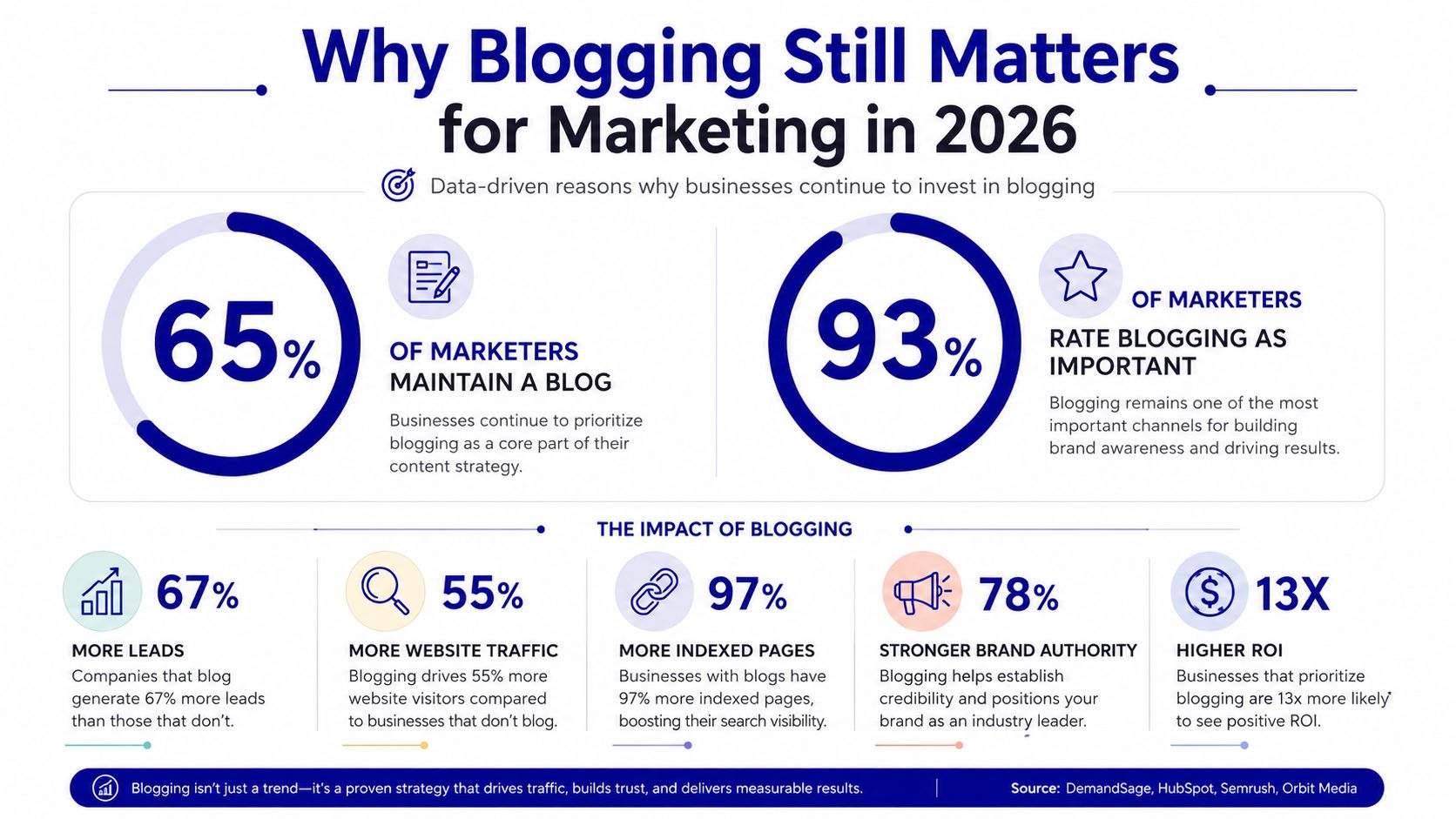
Blogging is still one of the few marketing channels where teams can build both demand capture and demand creation in the same asset, and the data backs that up. HubSpot's 2025 State of Blogging Report found that 65% of marketers work at companies that maintain blogs, 93% of those marketers rate blogging as important or very important, and 50% said blogging delivered higher ROI in 2024 than in the prior year (HubSpot's 2025 State of Blogging Report). The catch is that the bar is much higher now, because around 600 million blogs worldwide and roughly 7.5 million posts published every day make generic publishing easy to ignore (blogging statistics overview).
Table of Contents
- Why Blogging Still Matters for Marketing in 2026
- Building a Strategy Around Search Intent and Audience Jobs
- Editorial Planning and the Content Ops Workflow
- Optimizing Posts for Google and AI Search Visibility
- Distribution Beyond Social Media That Actually Works
- Measuring What Blogging Actually Drives
- A 90-Day Execution Plan and Maturity Roadmap
Why Blogging Still Matters for Marketing in 2026
What's evident in the HubSpot numbers is not that blogging survived. It's that teams are treating it like a budgeted acquisition channel with measurable ROI, not a publishing habit they maintain when they have spare time. If 93% of marketers at blog-maintaining companies say it matters, and 50% reported higher ROI in 2024 than the year before, that signals active management, not nostalgia (HubSpot's 2025 State of Blogging Report).
That matters because content teams are no longer competing in a small editorial pool. With roughly 600 million blogs and about 7.5 million posts going live every day, visibility comes from sharper topic selection, better internal linking, and a post design that can hold attention longer than a quick skim (blogging statistics overview). In practice, the market now rewards blogs that behave like productized assets, each post has a job, a target reader, and a path to conversion.
What the numbers mean operationally
The strongest teams stop asking whether they should blog and start asking what the blog needs to do inside the acquisition mix. For B2B SaaS, that usually means supporting search demand around problems, comparisons, and use cases. For ecommerce, it often means category education, buying guides, and post-purchase retention content that keeps the brand in the consideration set.
Practical rule: if a post can't point to a next step, it's probably being managed as a traffic asset instead of a marketing asset.
That shift changes the standard. A good blog program now sits alongside paid search, lifecycle email, and sales enablement because it can feed all three when the editorial system is disciplined. The work is less about publishing often and more about building a library of posts that compounds, ranks, gets cited, and converts.
The competitive bar is higher than “publish more”
Volume still matters, but volume without structure just adds more noise to an already crowded market. The teams that win are the ones that choose topics around customer jobs, build content clusters, and revisit older posts before they decay. A blog that grows slowly but keeps converting is more valuable than a high-output feed that never produces pipeline.
That's a realistic benchmark in 2026. Blogging belongs on the plan if it has ownership, a measurable role in acquisition, and a review process that treats each post like a revenue-supporting asset.
Building a Strategy Around Search Intent and Audience Jobs
Most weak blogs fail before the draft starts. The team picks a keyword, writes a post, and hopes the traffic shows up, but search behavior rarely works that cleanly. Strong programs start by matching intent to a real audience job, then working backward from the question the reader is trying to solve.
Start with the job, then the keyword
A useful topic is not just a phrase with volume. It's a problem, comparison, or decision the reader is already in the middle of making. That's where underserved opportunities usually live, especially when you look beyond keyword volume into demand shifts, seasonal patterns, and geographic concentration, the same approach recommended in content strategy guidance on finding underserved angles (content strategy guidance on ineffective blogs).
The research sequence should be simple:
- Map the intent to the funnel stage, informational, evaluative, or purchase-supportive.
- Group related entities instead of chasing one phrase at a time.
- Build a pillar and cluster structure so each post supports a larger topic.
- Define the conversion path before drafting, even if the CTA is soft.
That sequence keeps the content from drifting into generic advice. It also helps the writer choose the right angle. A post aimed at someone comparing tools should look very different from a post aimed at someone trying to solve a first-time implementation problem.
Test the SERP before you commit
The live search results tell you what the market already rewards. If every result is a definitional explainer, a deep how-to might not be the right fit. If the page one results already include FAQs, comparison pages, and product-led content, then the post needs a clearer edge than a basic summary.
A practical way to judge topic quality is to ask whether you can add evidence, firsthand nuance, or a better decision framework than what's already ranking. If you can't, the topic probably needs to be reframed. That's especially true for teams that want search traffic to become leads, because the reader has to see a next step, not just a better-written version of what already exists.
If the SERP is crowded, the gap is rarely another keyword. It's usually a better angle, a clearer audience, or a more useful conversion path.
For a deeper method on research structure, use this keyword research guide as a companion when you're turning raw queries into topic clusters.
Editorial Planning and the Content Ops Workflow
A blog becomes operational when the work stops living in someone's head. The useful model is a repeatable pipeline, topic sourcing, brief creation, drafting, review, optimization, publish, and post-publish update. Without that sequence, teams end up with ad hoc writing, inconsistent voice, and a backlog nobody trusts.
Assign ownership before production starts
A small team can run the same workflow as a larger agency, but the roles need to be explicit. One person can source topics, draft briefs, write, and publish. A larger team can split those jobs across strategy, writing, editing, SEO, and design, but each handoff still needs a clear owner and a deadline.
A finished brief should contain:
- The audience and intent, so the writer knows who the post is for.
- The target entity set, so the draft stays topical instead of drifting.
- The conversion goal, even if it's only a newsletter signup or related article click.
- The required proof points, examples, internal links, and brand voice notes.
- The update trigger, so the post can be revisited after performance data comes in.
Keep the workflow visible
The most common breakdown is not writing quality. It's unclear status. A Kanban view, a shared brief template, and a review gate stop half-finished work from moving into publish. That matters because content operations get messy fast once multiple stakeholders start commenting in different tools.
Nuwtonic fits naturally here as one example of a unified workspace that combines planning, content generation, and AI checks inside a single process, including review-before-deploy controls. Used well, a platform like that reduces the time teams lose switching between docs, spreadsheets, audit tools, and the CMS.
Practical rule: the blog pipeline should answer three questions at every stage, what's next, who owns it, and what makes it done.
A sensible weekly cadence is straightforward, planning at the start of the week, drafting in the middle, review and optimization next, then distribution and updates after publish. That rhythm works for a solo operator and scales to an agency team because the workflow stays the same even when the roles change.
Optimizing Posts for Google and AI Search Visibility
Blog optimization used to mean ranking in search. Now it also means getting surfaced in AI-generated answers, which changes how a post needs to be structured. Google still cares about clarity, links, and content quality, but generative engines also reward source readability, entity richness, and clear evidence paths.
Build for machine readability without writing like a machine
The basics still matter: metadata, headings, image alt text, internal links, and schema. The difference is that entity-first writing now helps both search engines and answer engines understand what the post is about. That means naming tools, concepts, workflows, and relationships directly instead of hiding behind vague phrasing.
For practical SEO writing guidance on this kind of structure, Lumi Humanizer writing tips are useful because they focus on cleaner content patterns that still read like a human wrote them. The same principle applies to blog posts aimed at AI visibility, if the page is easy to parse, it's easier to cite, summarize, and reuse.
Use a GEO audit to catch what traditional SEO misses
A traditional audit checks crawlability, metadata, schema, and page experience. A GEO audit goes further by checking whether the content is structurally ready to appear in AI answers, which is why Nuwtonic's workflow includes 120+ AI visibility checks and URL-level citation tracking. That matters more than mention counts, because a brand can be referenced loosely without ever being used as a source.
Useful structural additions include:
- Author markup, so the page has a clear ownership signal.
- FAQ schema, where the question-and-answer format matches search behavior.
- Outbound citations, so the post participates in the evidence graph instead of just talking about it.
- Internal links to related cluster pages, so the topic authority is obvious.
- Clear subheads with direct answers, so snippets and answer engines can lift the right passages.
For teams working on AI search readiness, this guide to optimize content for AI search is a practical companion to the structural work above.
If you're handling this manually, push the fixes into the CMS only after review. If you're using an automation layer, the point is still the same, move from diagnosis to implementation, then verify what changed.
Distribution Beyond Social Media That Actually Works
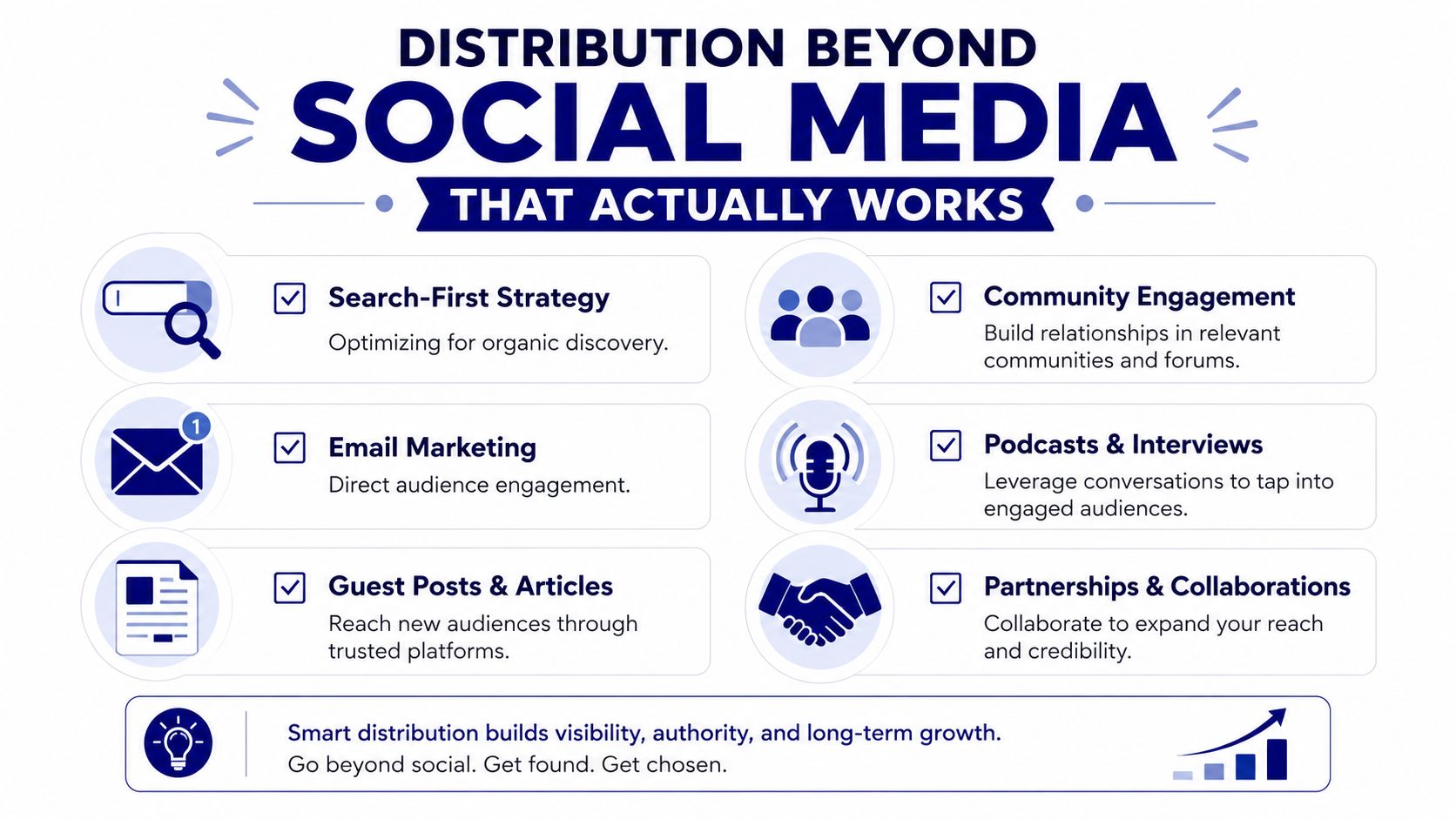
Social media isn't the center of gravity for a blog program anymore. It can help, but it's optional, especially for teams that need predictable acquisition instead of feed-dependent reach. The more durable stack is search, email, and discovery surfaces that keep working after the post stops circulating.
Build the repurpose stack around owned channels
The first distribution pass should always serve the channels you control. Email is the most obvious one, but search and evergreen platforms matter just as much because they compound. For brands that want long-lived discovery, Pinterest can work as an evergreen surface, while search remains the primary compounding channel and email handles retention and repeat reads.
A clean repurpose checklist after publish usually includes:
- Newsletter version, trimmed to the problem and the payoff.
- Internal links to related posts, so the audience keeps moving.
- A short social or community excerpt, if those channels are worth the effort.
- A downloadable or gated upgrade, when the topic is strong enough to support one.
- A refresh note for later, especially if the article can benefit from new examples or updated screenshots.
That's also where syndication and partnerships fit. If a post already solves a real problem, republishing excerpts through relevant communities or partner sites can extend its life without rewriting the whole asset. For teams that need link growth as part of distribution, build backlinks for AI startups is one route to explore when the post deserves external amplification.
Push harder where the demand is already visible
Not every post deserves the same distribution effort. High-intent pages with strong SERP gaps or clear click decay deserve more push than broad thought leadership. The fastest way to decide is to look at how the topic behaves in search, where users are dropping off, and whether the post can be repackaged into a useful email or partner asset.
Practical rule: if a post can't be reused in at least one owned channel, it probably wasn't planned as a marketing asset.
For a deeper framework on content repurposing and downstream use, this content syndication guide is a useful reference. The main point is simple, durable distribution comes from channels you can repeat, not from a platform mood swing you can't control.
Measuring What Blogging Actually Drives
Blogging graduates from habit to channel when the team stops measuring only pageviews. Pageviews can tell you whether a topic got attention, but they don't tell you whether the post moved a buyer toward revenue. The metrics that matter are the ones that connect content to downstream actions.
Track the signals that reach beyond traffic
The core set is straightforward, assisted pipeline, demo or signup conversions per post, branded search lift, and AI citation frequency. Those tell you whether the content is helping people discover you, trust you, and return through a recognizable path. Search Console, rank tracking, and prompt monitoring should all feed the same review loop.
A useful dashboard should answer three questions:
- What topics are gaining or losing visibility?
- Which posts are creating conversions or assisted conversions?
- Where is the content showing up in AI answers, or failing to show up at all?
That's where Nuwtonic's GSC Performance Dashboard and AI search agent fit in as operational tools, because they turn query, CTR, and trend data into prioritized fixes and track prompt-level visibility across models. The value isn't the dashboard itself, it's the action list it creates.
Use a comparison table to avoid vanity metrics
| Metric | What It Tells You | Where to Find It |
|---|---|---|
| Assisted pipeline | Whether the post contributes to revenue over time | CRM and attribution reporting |
| Demo or signup conversions per post | Whether the content actually moves readers to act | Analytics and conversion events |
| Branded search lift | Whether the blog is making the brand more discoverable | Search Console and search trend tools |
| AI citation frequency | Whether generative engines are using the post as a source | Prompt monitoring and AI visibility tools |
| Query growth and CTR | Which topics deserve updates or expansion | Search Console Performance data |
| Cannibalization signals | Whether multiple posts are competing for the same intent | Sitewide content audits |
| Mobile versus desktop gaps | Where rankings or CTR are underperforming by device | Search performance segmentation |
A monthly review should end with a concrete fix list, not a slide deck. That means consolidating overlapping posts, patching pages with weak CTR, and improving content that's close to being cited but not quite source-worthy yet.
A 90-Day Execution Plan and Maturity Roadmap
The first 90 days should build proof, not perfection. If a team can publish consistently, improve a few posts, and wire distribution and measurement into the workflow, the program is already moving in the right direction. The benchmark worth keeping in view is that businesses publishing 16 or more blog posts per month get almost 3.5× more traffic and 4.5× more leads than businesses publishing 4 or fewer (blogging frequency and traffic benchmark).
Break the quarter into three operating phases
Foundation, days 1 to 30. Audit the current blog, define pillar topics, write the brief template, and build the first content backlog. This is also where you identify old posts worth updating instead of replacing.
Build, days 31 to 60. Move into production cadence, publish the first wave, apply on-page and GEO fixes, and set up the distribution sequence. The objective is repeatability, not volume for its own sake.
Scale, days 61 to 90. Tighten the measurement loop, patch underperforming posts, and start using AI citation data and Search Console trends to choose the next wave of topics. That's when the blog starts acting like a managed system instead of a content sprint.
Know what maturity looks like
At the Launch stage, the team has topics, drafts, and a publish rhythm, but limited measurement. At the Operational stage, briefs, review, and optimization run predictably, and old posts get maintenance. At the Compounding stage, content updates, internal links, AI visibility, and conversion tracking all feed one decision loop.
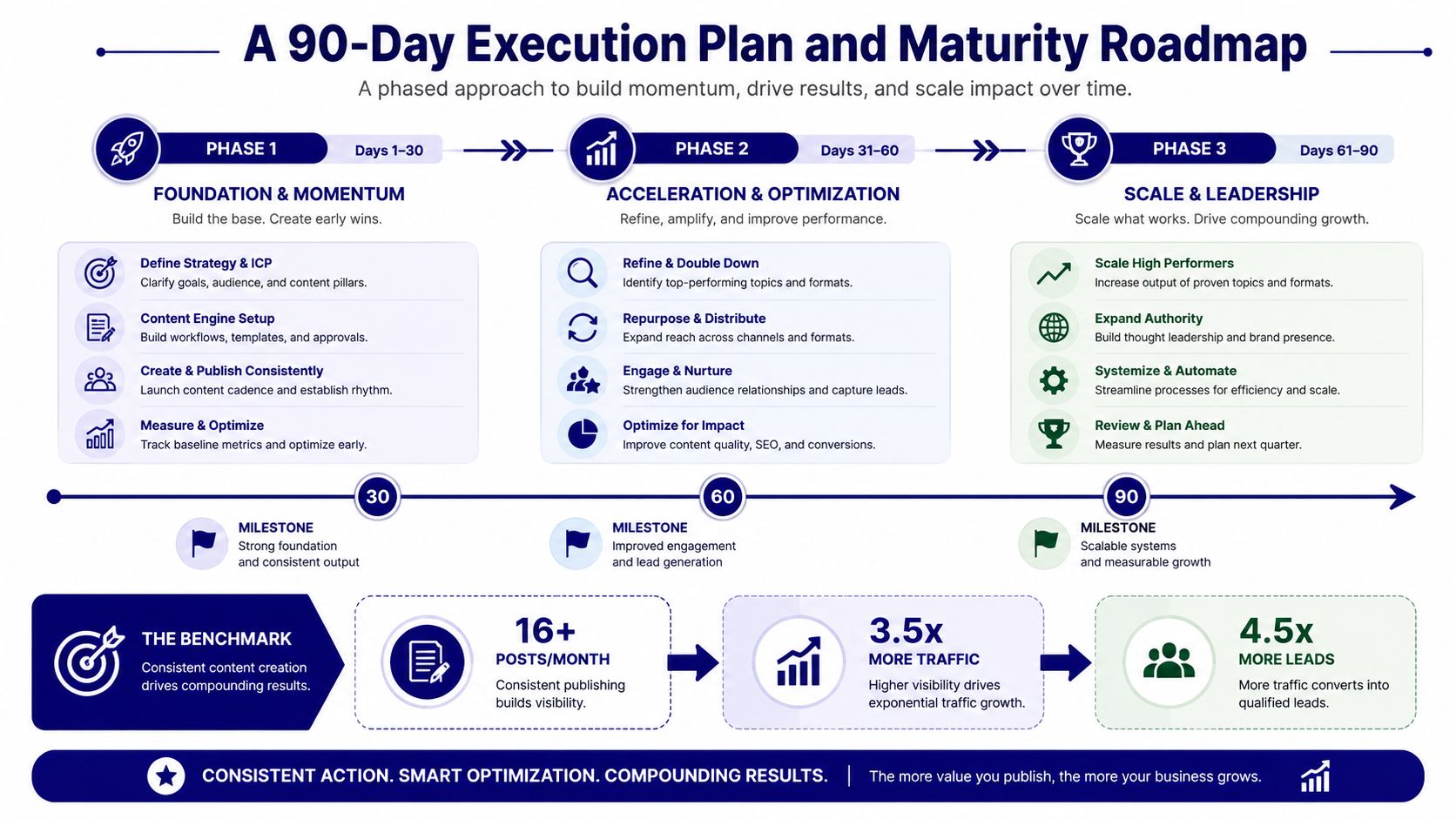
The point of the roadmap is simple. If the blog is treated as a conversion asset, every month should produce clearer topics, cleaner pages, and better proof that the channel deserves budget. If it doesn't, the issue is usually process, not effort.
Nuwtonic brings keyword research, content briefs, GEO audits, AI visibility tracking, and CMS-ready fixes into one workflow, which makes it easier to run a blog as a conversion asset instead of a traffic hobby. If you're building a serious blogging program for marketing, visit Nuwtonic and see how the workflow fits your team.