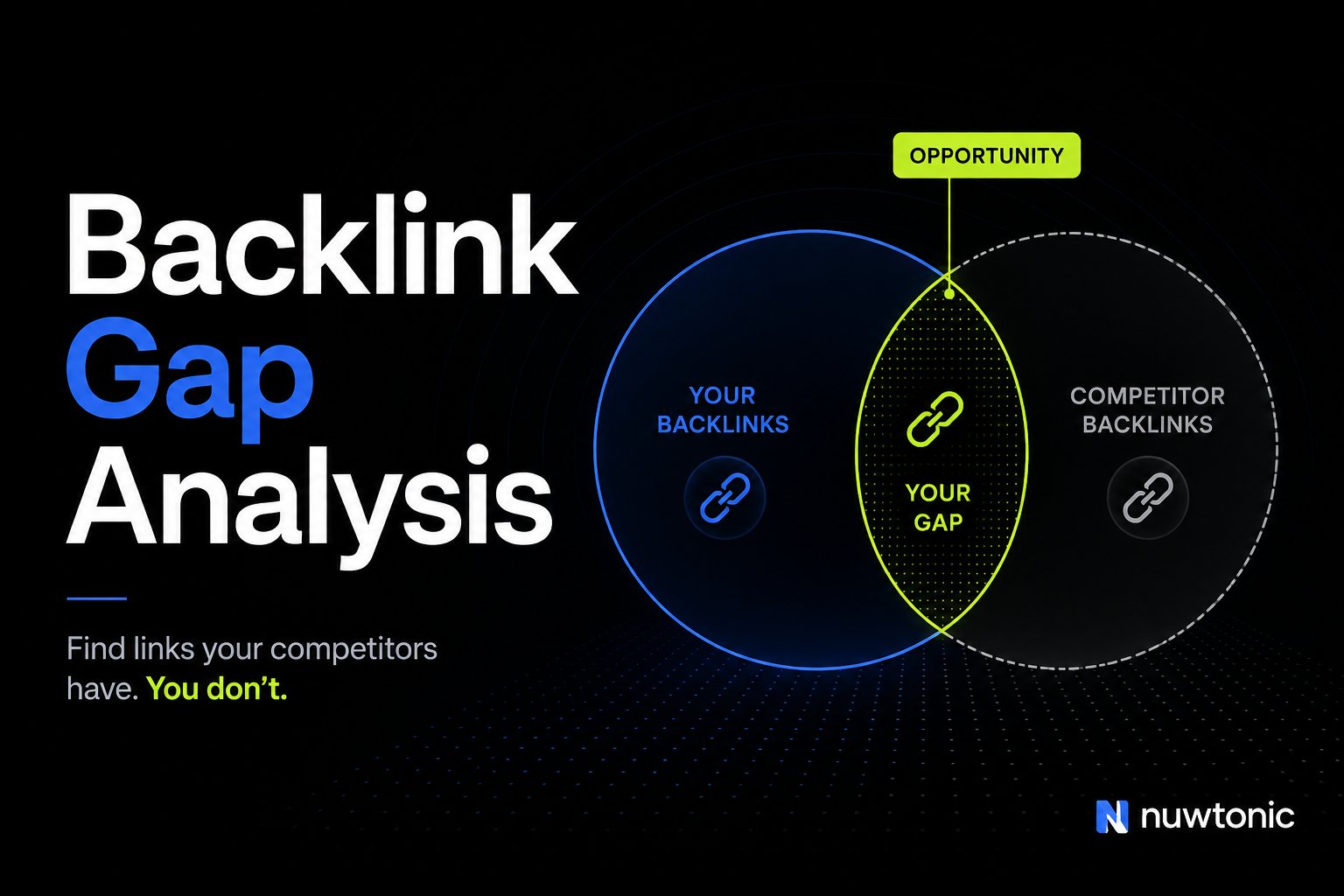
Most advice about backlink gap analysis gets the priority backward. The goal isn't to collect the biggest list of referring domains and congratulate yourself on volume, it's to find the few domains that are worth earning, because comparative scale and link velocity decide whether the gap is real or just noisy. If you don't frame the work that way, you end up with a spreadsheet full of “opportunities” that never move rankings.
The practical difference shows up fast. A site can trail competitors in referring domains, but if those competitors earned links faster, from better pages, and from overlapping authorities, the gap isn't just larger, it's more expensive to close. That's why practitioners treat backlink gap analysis as a market-mapping exercise, not a link dump, and why the useful unit of analysis is usually the unique referring domain, not the raw backlink count, as described in Semrush's Backlink Gap documentation and CXL's analysis of backlink gaps.
Table of Contents
- Why Most Backlink Gap Analyses Fail to Deliver Results
- Building a Statistically Useful Competitor Set
- Running the Link Intersect Analysis and Filtering Noise
- Scoring and Prioritizing Backlink Prospects by Impact
- Executing Outreach and Operationalizing the Workflow
- Measuring Success and Maintaining Competitive Advantage
Why Most Backlink Gap Analyses Fail to Deliver Results
A backlink gap report fails when teams treat missing referring domains as a target list, then sort by authority and fire off generic outreach with no clear reason to expect a reply. The useful goal is to find the few domains worth earning, because comparative scale and link velocity tell you whether the gap is real or just noise.
More domains doesn't automatically mean more opportunity
The comparison that matters is who has acquired the most useful referring domains, and how quickly. CXL's guidance frames gap size as the difference in referring domains between your site and the sites you want to outrank, and it recommends checking quality tiers such as DR > 70, DR ≥ 30, and DR < 30 before deciding whether the gap deserves attention. That matters because a site with fewer but stronger links can be harder to beat than a site with a larger but weaker profile. CXL's backlink gap guide is one of the clearest examples of that comparative view.
The next failure point is treating every referral as equally useful. A directory listing, a sidebar badge, and a cited statistic page can all show up in the same export, but they do not deserve the same outreach angle or the same level of effort. If you do not separate them early, your team burns time trying to recreate links that were never editorial in the first place.
Practical rule: if you cannot explain why a competitor earned a link in one sentence, do not put it at the top of the outreach queue.
The gap is only useful when it matches your content strategy
Competitor gaps become actionable when the missed domains line up with pages you can realistically create or improve. That means the work should sit next to content planning, because the best prospects often point to resource pages, expert roundups, or citation-heavy articles that already fit your editorial model. The historical shift from broad link audits to explicit link-intersect logic made the workflow repeatable, but it only works when your pages are credible substitutes for the pages that earned those links.
If your team wants a broader competitive lens, the Icypeas guide to CI is a useful companion to the link work, because it helps you define the market before you chase the links. For a more execution-focused view of how SEO teams map competitors and opportunities, the Nuwtonic SEO competitive intelligence guide shows how gap thinking connects to the rest of the SEO stack.
Building a Statistically Useful Competitor Set
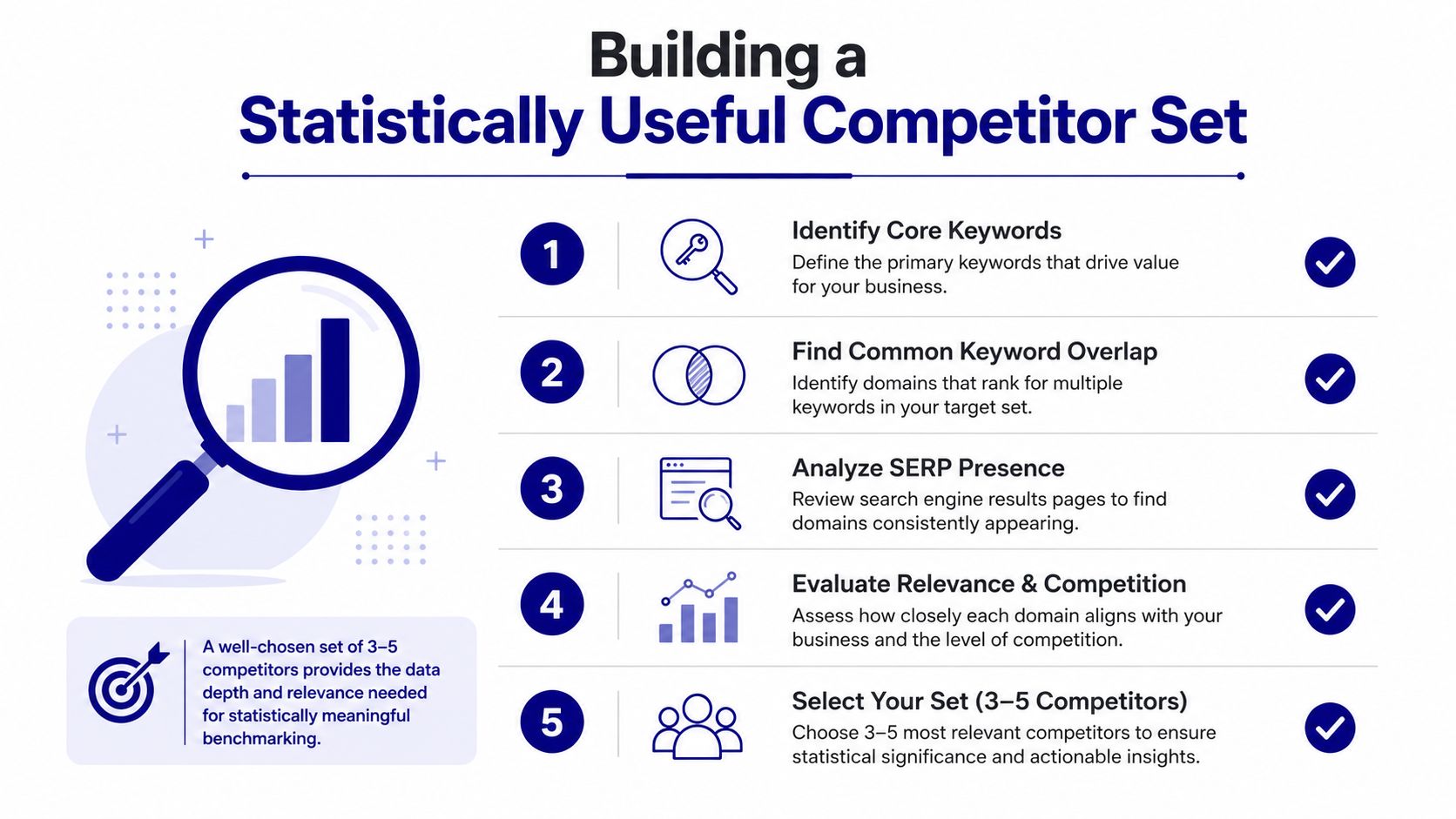
The quality of backlink gap analysis rises or falls with the competitor set. Pick the wrong sites and the export turns into a pile of links that reflect someone else's market position, not yours. The useful starting point is 3 to 5 search competitors, meaning the sites that rank for the keywords you want to win, not the brands your sales team mentions in meetings.
Search competitors beat brand competitors
Start with SERP overlap, not intuition. Pull your target keyword list, look at the pages that keep appearing on page one, and build the set from those domains. That keeps the link-gap work tied to actual ranking competition, which is what makes the intersect data worth acting on. The documented ceiling of five competitors fits the structured nature of analysis rather than ad hoc research. Analyze.ai's backlink gap overview makes the same point in plain language.
For B2B SaaS, search competitors often differ by product category, use case, or intent cluster. A workflow tool may not compete with a larger umbrella brand, but it can compete hard with niche products that own the same comparison queries. For e-commerce, the set usually needs category overlap and SERP overlap, because a merchant can be large in one product line and invisible in another.
How to keep the set useful by business model
Content publishers need the tightest topical discipline. If the site publishes educational content, pick domains that rank for the same informational clusters, not just sites in the same industry. SE Ranking notes that competitor definitions vary in practice, with some teams using two competitors for efficiency and others extending to five, but the useful version is always the one that matches the search environment. SE Ranking's Backlink Gap Analyzer overview is helpful here because it shows how flexible the set can be.
A clean way to validate the set is simple:
- Check keyword overlap first. If a domain does not rank for the topics you care about, it is probably not a useful anchor for gap discovery.
- Look for cluster alignment. Adjacent competitors make sense when they own the same topical cluster, not just the same business category.
- Avoid scale bias. Big national brands can overwhelm the export with links that are impossible to replicate, which makes the gap look more dramatic than it is.
- Sanity-check the intersect output. If the report is full of irrelevant domains, the competitor set is wrong, not the tool.
For teams doing broader market mapping, the Icypeas guide to CI and the SEO competitive intelligence workflow are useful references for keeping the competitor set grounded in real rankings instead of internal assumptions. The result should be a list that produces a usable intersect report, not just a longer one.
Running the Link Intersect Analysis and Filtering Noise
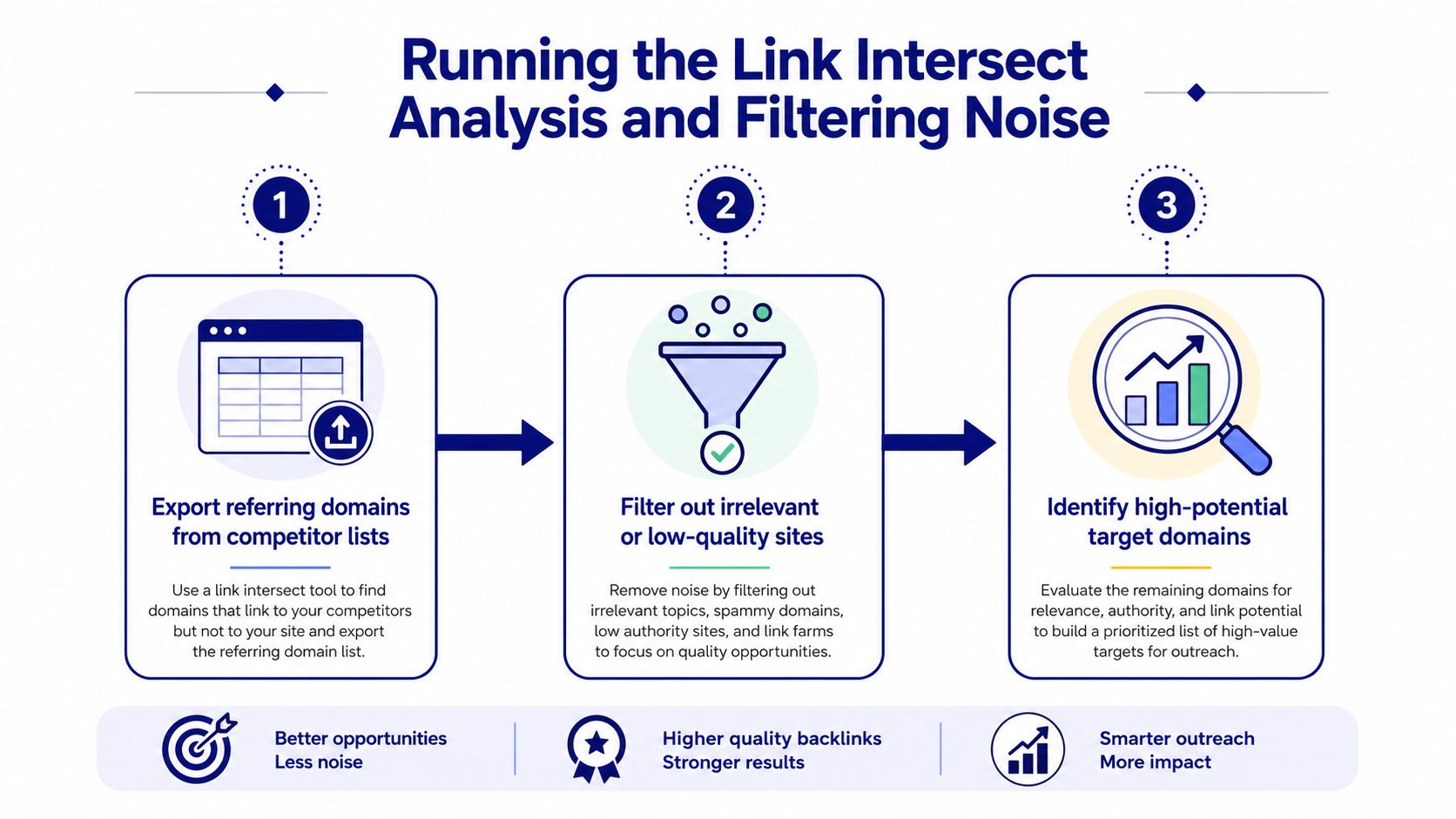
Once the competitor set is right, the technical work starts. Exporting raw referring domains is easy. Turning that export into a list an outreach team can use is where most workflows break down. The standard move is to run the intersect in referring-domains mode, then isolate domains that link to at least one competitor, or preferably multiple competitors, but not to your site.
What to export and what to discard
The first clean-up pass should remove obvious noise. That means low-trust directories, auto-generated pages, and placements that exist only because a site accepted every submission it could. A practical filter is DR >= 30 as a starting point before outreach, because weak domains tend to clutter the export without adding much value. Backlynk's backlink gap analysis guide also recommends filtering for trust, dofollow status, and relevance before serious outreach begins.
Traffic is still a useful sanity check, even if you are not treating it as a ranking proxy. If a site appears in the intersect export but shows no sign of being read, it is usually a weak prospect unless there is a very specific citation angle. That is especially true for pages that look built to host links rather than content.
Deduplication matters more than many teams expect. Exported reports often surface the same domain through multiple URLs, and if you do not collapse them early, the scoring layer gets noisy fast. Deduplicate at the domain level first, then keep the page-level URL in a separate column so you do not lose context.
Why overlap matters more than raw count
The strongest prospects are usually the domains that link to 2 or more competitors. Overlap is the fastest signal that a site already publishes category-relevant content, and the intersect tool is designed to surface that pattern. The same logic is reflected in Semrush's share-of-voice framework, where overlap across visible competitors is used to judge how concentrated or fragmented a market signal really is.
That does not mean every multi-competitor domain belongs at the top. Overlap can bias the list toward broad editorial properties and away from niche sites that send fewer but more valuable links. Keep the overlap signal, then layer on page context and fit before you send anything.
A workable export structure looks like this:
| Field | Why it matters |
|---|---|
| Referring domain | Primary unit for deduplication |
| Competitor overlap count | Tells you whether the domain links to 1, 2, or more rivals |
| DR or equivalent | Quick quality filter |
| Dofollow status | Screens out weak placements |
| Page URL | Reveals why the link exists |
| Notes | Outreach angle, format, or content type |
The page-level view is where the most value lies. A domain-level gap tells you who links, but page-level analysis tells you why they link, whether that is a resource page, a statistic citation, a broken link replacement, or a simple editorial mention. That difference decides whether your outreach feels targeted or generic.
Scoring and Prioritizing Backlink Prospects by Impact
A clean export still isn't a campaign. It's a pile of prospects that need ranking by likelihood and effort, because the team that chases everything usually closes very little. The most workable scoring model is a three-part check on relevance, reachability, and context.
A scoring model that survives real outreach
Relevance asks whether the domain publishes content in your topical area. Reachability asks whether the site accepts guest posts, resource submissions, expert quotes, or some other form of contribution. Context asks what earned the competitor link, because a resource-page placement and a casual editorial mention need completely different outreach angles.
If you need a practical contact-enrichment layer, platforms like Hunter.io for prospecting are useful when the team is moving from domain list to contact list and doesn't want to waste time searching manually. The point isn't just finding an email, it's making sure the right person receives the right pitch.
| Factor | High Score (3) | Medium Score (2) | Low Score (1) |
|---|---|---|---|
| Relevance | Publishes in your exact topical cluster | Adjacent topic fit | Weak or generic fit |
| Reachability | Clear contributor, resource, or contact path | Some contact signals, unclear process | No visible path to contact |
| Context | Page type is obvious and repeatable | Link reason is partly clear | Reason for the link is vague |
A lot of teams over-score authority and under-score context. That usually produces a list of impressive domains that are hard to win because nobody can explain the link's origin, or the page type doesn't support a sensible ask. A site that links to competitors from a citation-heavy resource page can be easier to approach than a stronger domain with a one-off mention buried in a news article.
The fastest prospects are the ones where the page itself tells you what to pitch.
Use the score to build tiers, not just a ranked list. Tier 1 should be obvious fits with clear outreach angles. Tier 2 can include relevant domains with weaker contact signals or less obvious page types. Tier 3 becomes a backlog of longer-shot opportunities or content ideas you might build later.
For teams thinking about how these links affect broader performance, share of voice planning is the right adjacent frame, because link acquisition only matters when it supports the pages and topics you're trying to own. The score should tell you where to spend effort first, not where to stop thinking.
Executing Outreach and Operationalizing the Workflow
The jump from prospect list to acquired link is where discipline matters most. Strong outreach doesn't start with clever copy, it starts with matching the ask to the page type and the prospect tier. If the context says resource page, pitch a resource fit. If it says expert mention, lead with a contribution angle. If it says broken-link replacement, make the replacement obvious.
How to move from list to live links
The easiest campaigns to run are the ones with one clear action per prospect tier. Tier 1 can use a highly personalized note, Tier 2 can use a lighter template with custom context, and Tier 3 should usually wait until the team has a stronger content asset or a better angle. That's where workflow tools earn their keep, because they reduce the time spent moving prospects between statuses, drafting variations, and watching replies without forcing the pitch itself to become robotic.
Mail Merge for Gmail's outreach guide is a solid reference for the mechanics of structured follow-up, especially if your team is building sequences by hand and needs a clean system for tracking touchpoints. The useful lesson isn't volume, it's consistency. A campaign falls apart when no one knows who was contacted, who replied, and who still needs a follow-up.
A practical outreach loop looks like this:
- Personalize the opening line. Reference the exact page, format, or topic that earned the competitor link.
- Match the ask to the context. Don't pitch a guest post to a site that only publishes resource lists.
- Track every response in one place. Rejections, soft yeses, and “send me more info” all need different next actions.
- Use the same logic for follow-up. Follow-up should add value, not repeat the original email with a new subject line.
Content operations should stay close to the outreach queue. If a pattern appears in the gap data, such as a recurring resource-page format or a citation-heavy article type, that's a signal to create or update a matching asset before the outreach goes out in bulk. Otherwise, you're asking publishers to link to something that doesn't yet fit their editorial use case.
The cleanest campaigns build relationships, not one-off placements. A useful reply today often becomes a second opportunity later, especially when the publisher already knows the site and the topic area. That's the part most generic outreach misses, because it treats every domain as a transaction instead of a recurring source of authority.
Measuring Success and Maintaining Competitive Advantage
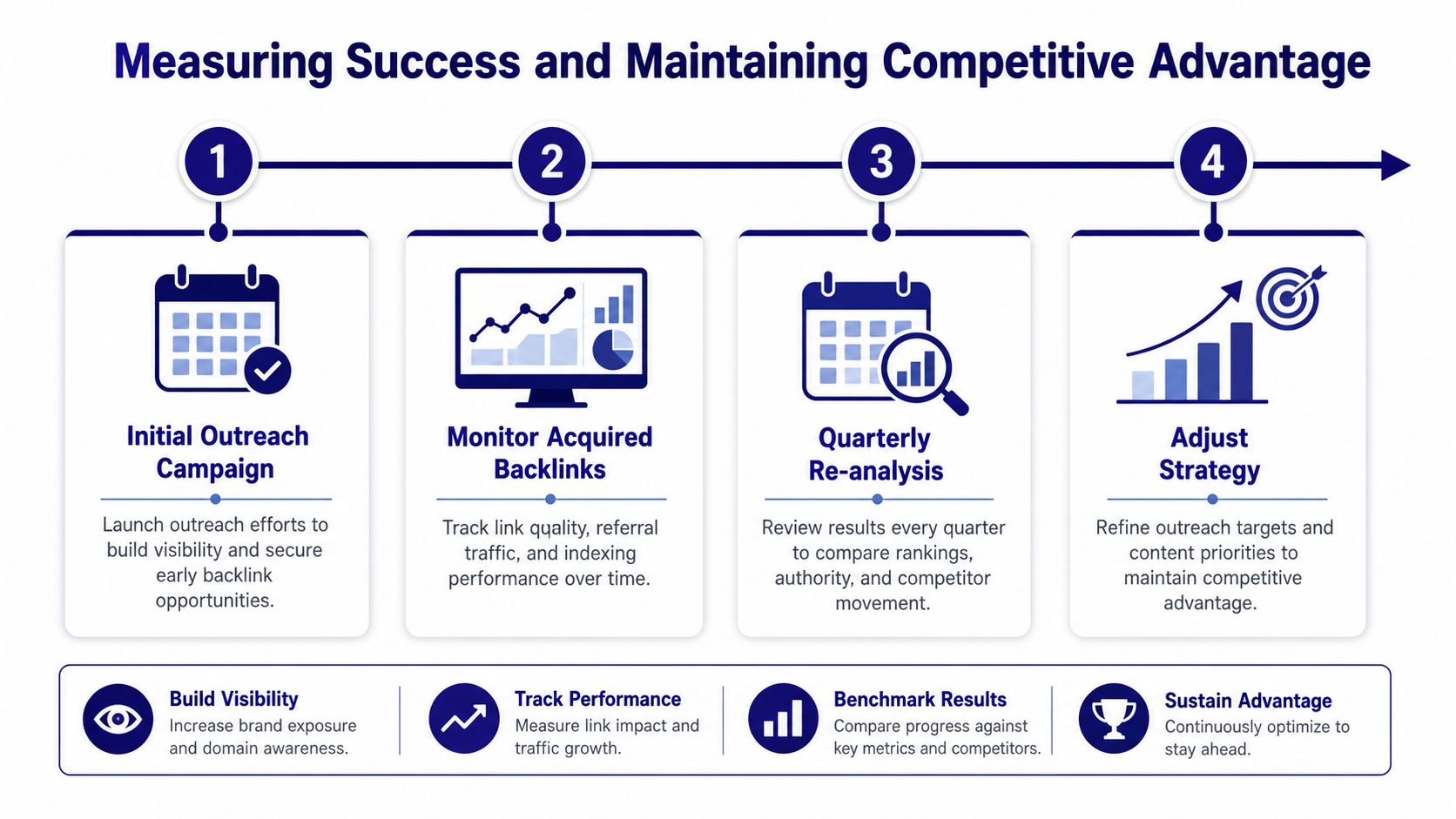
Backlink gap analysis pays off only when it becomes part of an ongoing competitive workflow. Run it once and the competitor set starts aging immediately, the overlap shifts, and the export is stale before the next outreach wave finishes. A better approach is a regular full review, paired with lighter checks in between so the team can catch changes in both your backlink profile and the sites you are tracking.
Cadence, re-analysis, and long-term defense
Measure the signals that show whether the gap is closing in the right places. Compare referring-domain growth against your competitors, watch whether the prospect list gets narrower over time, and track movement in the keyword set that justified the competitor selection in the first place. Link velocity is worth monitoring too, because a useful comparison depends on acquisition pace, not just a static snapshot. Use the same time window each cycle so you can see whether one site is building links faster, losing them faster, or changing sources.
The list also needs to account for competitor decay. Some links you are trying to match will disappear, shift to another page, or stop carrying the same value, and that creates openings if someone is watching for them. A fuller review catches structural changes in the market, while lighter monitoring helps the team spot issues before the next planning cycle. That is the difference between reacting to an old export and working from current data.
The reporting layer matters here because the team needs a place where link work sits next to the rest of SEO activity. SEO dashboard reporting gives that operational view, since it keeps competitor link changes tied to rankings, content updates, and broader visibility monitoring. Backlink gap analysis should drive decisions, not sit in a folder as a one-time export.
What matters most is not just closing the gap. It is seeing when the gap opens somewhere else. If a competitor is building authority through a small cluster of high-quality domains, a volume-first approach will miss the point. If they are widening the lead through repeated citations across related pages, that overlap signal deserves more attention. Keep the competitor set, the filters, and the scoring model updated so the workflow reflects what is happening now, not what was true in the last report.