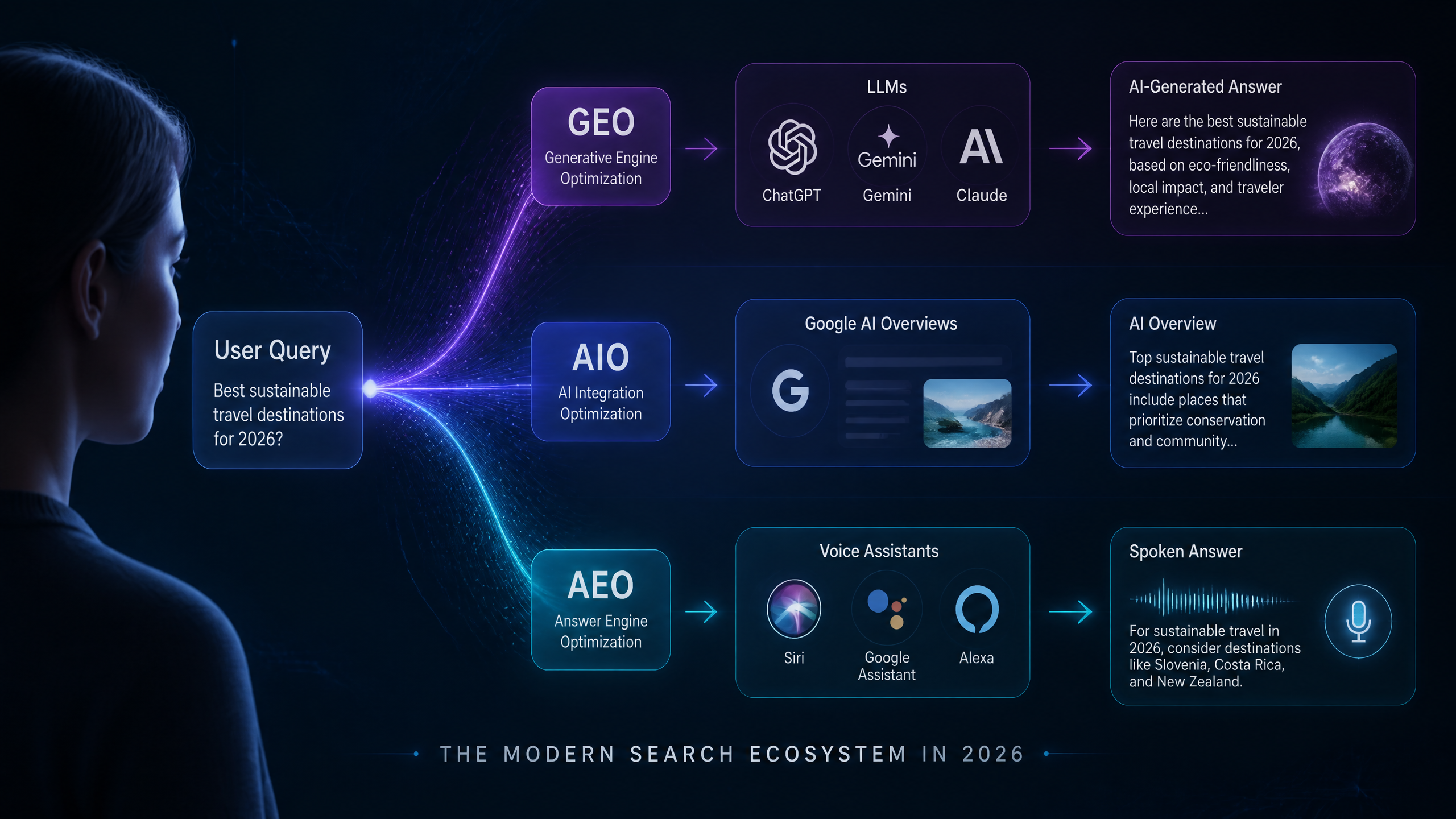
Look, let's be real, if you are still optimizing your website like it is 2022, you are essentially ghostwriting for an empty room. The classic search engine results page (SERP) we grew up with is dying a slow, algorithmic death. Today, we are forced to play in a fragmented sandbox dominated by Large Language Models (LLMs), AI-driven summaries, and conversational interfaces.
As a Senior SEO Analyst who has spent the last eight years watching Google move the goalposts, I have seen too many teams focus only on AIO features when the foundation of local SEO is often neglected. To survive in 2026, you must understand the distinct mechanics of GEO (Generative Engine Optimization), AIO (AI Optimization), and AEO (Answer Engine Optimization). They are not just trendy buzzwords; they are entirely different retrieval layers.

TL;DR: The Quick Breakdown of GEO vs AIO vs AEO
Why the Search Paradigm Shifted in 2026
So, here's the deal: search engines are no longer just indexing documents; they are synthesizing answers. In the past, our primary goal was to rank in the top blue links and secure a solid click-through rate (CTR). Now, we are optimizing for systems that read, summarize, and often answer the user's query without ever sending them to our website.
When we look at traditional SEO versus AI SEO, the gap is defined by how search engines retrieve and display information. Traditional SEO focused on keywords and links. Modern search optimization focuses on entities, structured data, and information gain.
Key Takeaways: Your Cheat Sheet
Answer Engine Optimization (AEO) is defined as the process of optimizing content to be extracted as the single, definitive answer for voice assistants and conversational search snippets.
Generative Engine Optimization (GEO) refers to the strategy of structuring content so Large Language Models (LLMs) like ChatGPT, Claude, and Perplexity cite your website as an authoritative source.
AI Optimization (AIO) is a holistic search strategy designed to secure visibility within native AI search features, such as Google's AI Overviews, while maintaining overall domain authority.
Understanding AEO (Answer Engine Optimization): The Micro-Answer Layer
The Core Objective and Mechanism of AEO
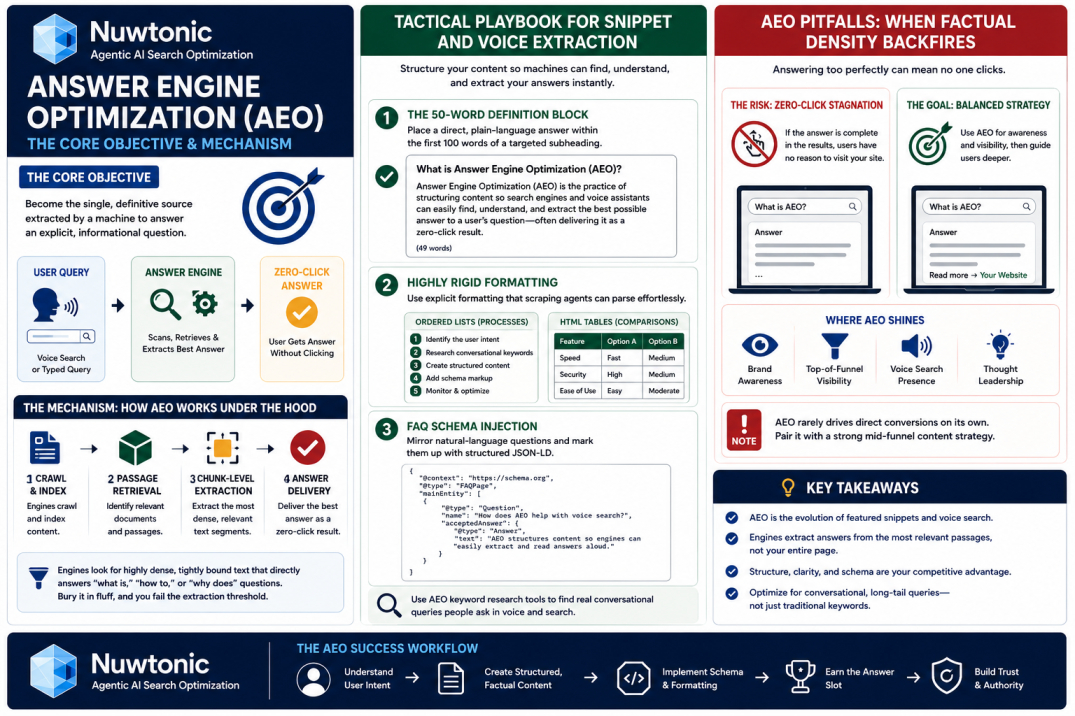
Answer Engine Optimization is the direct descendant of traditional featured snippets and voice search. The sole purpose of AEO is to become the single, definitive source extracted by a machine to answer an explicit, informational question. When someone asks their smart speaker or types a highly specific query, AEO determines who gets the "zero-click" slot.
Under the hood, AEO relies heavily on passage retrieval and chunk-level extraction. Traditional search engines do not always index or serve your page as a holistic document; instead, their parsing layers scan for highly dense, tightly bound text segments that answer a "what is," "how to," or "why does" question. If your content is buried in narrative fluff, it fails the extraction threshold.
Tactical Playbook for Snippet and Voice Extraction
To win the AEO game, you have to stop writing like a novelist and start writing like an encyclopedia. I have spent years analyzing why certain pages lose their featured snippets, and it almost always comes down to formatting.
The 50-Word Definition Block: Position a direct, plain-language answer within the first 100 words of a targeted subheading. Keep it between 40 and 60 words.
Highly Rigid Formatting: Use explicit formatting (ordered lists for processes, HTML tables for comparisons) that a scraping agent can parse effortlessly.
FAQ Schema Injection: Mirror the exact natural-language patterns consumers use when speaking into devices, explicitly tied together with structured JSON-LD data. Finding the best tools for AEO keyword research is critical to identifying these conversational, long-tail keywords.
AEO Pitfalls: When Factual Density Backfires
Fair warning: the biggest risk with AEO is "zero-click" stagnation. If you answer the question too perfectly, the user has no reason to click through to your site. This is why AEO is highly effective for brand awareness and top-of-funnel visibility, but it rarely drives direct conversions unless paired with a strong mid-funnel content strategy.
In my experience, AEO is the future, but many still cling to outdated SEO practices that don't leverage voice search or conversational query patterns. You cannot just optimize for head terms anymore.
Deep Dive into GEO (Generative Engine Optimization): The Citation & Retrieval Layer
How RAG Pipelines Select Sources
Generative Engine Optimization is the discipline of structuring your brand’s digital footprint so conversational web-crawlers—such as ChatGPT Search, Perplexity AI, Claude, and Gemini—synthesize and cite your content.

GEO operates within a RAG (Retrieval-Augmented Generation) framework. When a user executes a complex prompt, the AI engine pulls information chunks from multiple live web indices, evaluates their truthfulness and contextual alignment, synthesizes a summary, and attributes the facts to specific URLs. The win condition in GEO is not ranking first; it is earning an in-text citation or source recommendation within the AI’s generated response.
Information Gain and Source Hijacking Frameworks
AI models actively penalize repetitive, generic copy. If your article looks exactly like the top ten results on Google, an LLM has zero incentive to cite you. To be cited, your content must offer high Information Gain—unique empirical data, primary case studies, unique quotes, or proprietary industry statistics.
If an AI engine currently cites a competitor, you can use a "source hijacking" framework. Analyze the structural and semantic gaps in their content. By injecting highly specific decision-making rules, constraints, or distinct structural comparison frameworks, you can often force the model's retrieval system to swap their URL for yours because your data is demonstrably more accurate or comprehensive.
Off-Site Corroboration and Brand Mentions
Look, let's be real—GEO extends far beyond your own domain. Because LLMs look for consensus across their training sets and live web caches, your brand must be consistently mentioned across high-authority third-party vectors.
If your brand is not talked about on Reddit, LinkedIn, G2, or Wikipedia, generative engines will assume you do not exist or are not trusted. I have seen clients spend thousands optimizing their on-page content for GEO, only to be completely ignored by Perplexity because their off-site digital footprint was non-existent.
Deep Dive AIO (AI Optimization): The Holistic Search Ecosystem Strategy
Google's AI Overviews and the Entity Graph
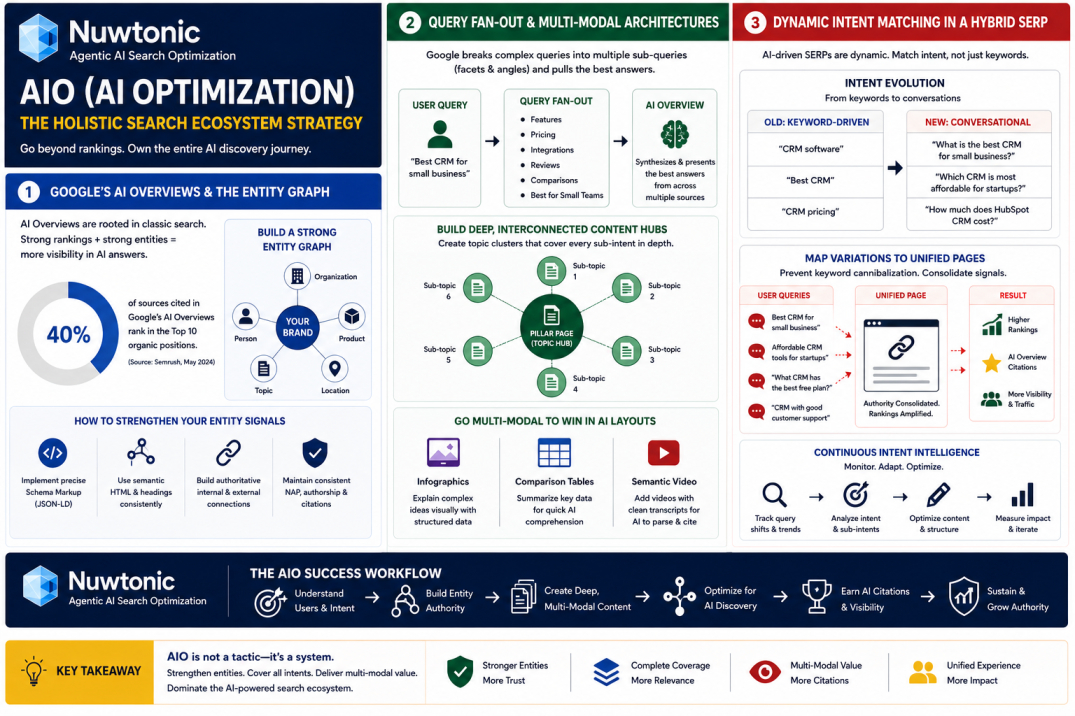
AI Optimization (AIO) is the broader, multi-surface umbrella strategy. While some practitioners use "AIO" specifically to define optimization for Google's proprietary AI Overviews, in a broader sense, it encompasses your entire brand footprint across the overarching AI discovery ecosystem.
Google's AI Overviews do not operate in a vacuum—they are heavily tethered to classic search algorithms. Data shows that roughly 40% of the sources cited in Google's AI Overviews rank within the top 10 traditional organic positions. AIO leverages these connections, reinforcing your domain's fundamental entity graph through precise schema markup and semantic HTML.
Query Fan-Out and Multi-Modal Architectures
Google’s algorithms break complex queries down into multiple parallel sub-queries (facets and angles) via a process called Query Fan-Out. To optimize for this, your site's internal architecture must host highly deep, interconnected hub pages (content clusters) that answer every sub-intent.
Furthermore, Google's AI layouts are highly visual. AIO requires a multi-modal approach:
• Accompany your technical text with optimized, structured infographics.
• Use contextual comparison tables that summarize complex data.
• Implement semantic video blocks with clean transcripts for crawlers to parse.
Dynamic Intent Matching in a Hybrid SERP
Traditional keyword targeting is too rigid for an AI-driven SERP. AIO requires dynamic intent matching. You must constantly monitor shifts in search queries from traditional keywords to long-tail, conversational variations, and map them to unified URLs to prevent keyword cannibalization.
GEO vs AIO vs AEO: The Ultimate Comparison Matrix
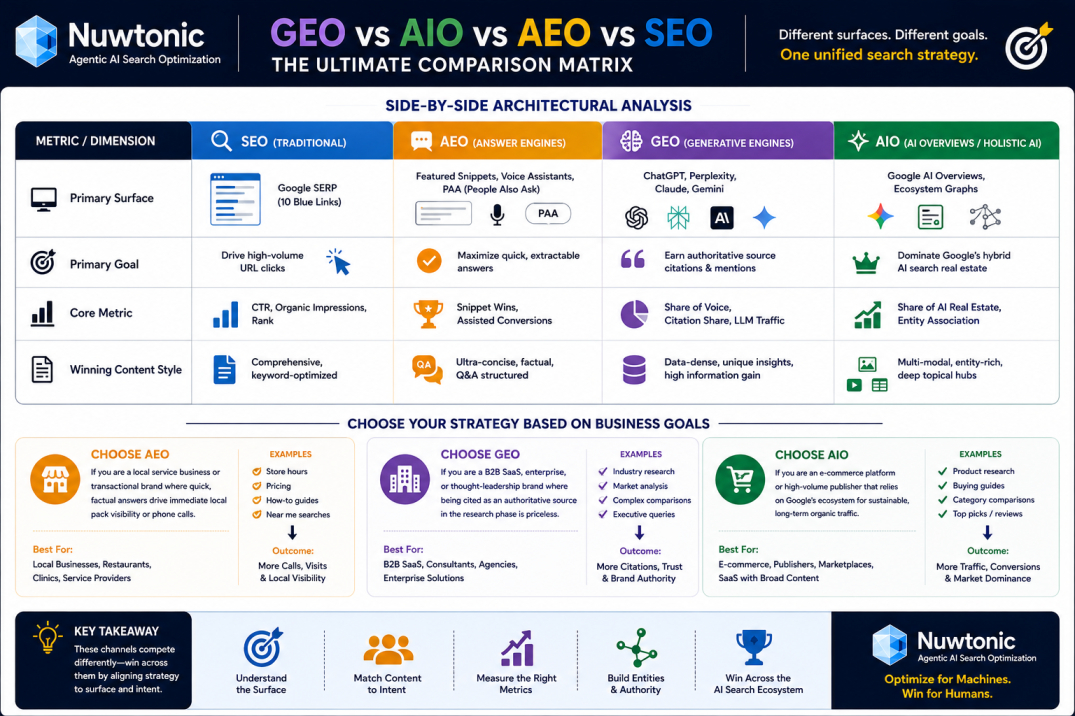
Side-by-Side Architectural Analysis
To properly allocate resources, it is essential to look at where each optimization discipline lives, how success is measured, and how they stack against each other:
Metric / Dimension | SEO (Traditional) | AEO (Answer Engines) | GEO (Generative Engines) | AIO (AI Overviews / Holistic AI) |
|---|---|---|---|---|
Primary Surface | Google SERP (10 Blue Links) | Featured Snippets, Voice Assistants, PAA | ChatGPT, Perplexity, Claude, Gemini | Google AI Overviews, Ecosystem Graphs |
Primary Goal | Drive high-volume URL clicks | Maximize quick, extractable answers | Earn authoritative source citations & mentions | Dominate Google’s hybrid AI search real estate |
Core Metric | CTR, Organic Impressions, Rank | Snippet Wins, Assisted Conversions | Share of Voice, Citation Share, LLM Traffic | Share of AI Real Estate, Entity Association |
Winning Content Style | Comprehensive, keyword-optimized | Ultra-concise, factual, Q&A structured | Data-dense, unique insights, high information gain | Multi-modal, entity-rich, deep topical hubs |
Choosing Your Strategy Based on Business Goals
Your choice of strategy should depend entirely on your business model and target audience.
Business Model | Primary Strategy | Key Focus Area | Expected Outcome |
|---|---|---|---|
Local & Transactional | AEO (Answer Engine Optimization) | Concise Q&A, structured data, voice search patterns | Direct zero-click answers, local pack visibility |
B2B SaaS & Enterprise | GEO (Generative Engine Optimization) | Information gain, unique data, off-site consensus | Authoritative citations in LLM research paths |
E-commerce & Publishers | AIO (AI Optimization) | Entity graph integration, multi-modal assets, hub pages | Dominance in Google AI Overviews and hybrid SERPs |
Agentic Automation for GEO , AEO & AIO
Step 1: The Technical SEO Foundation
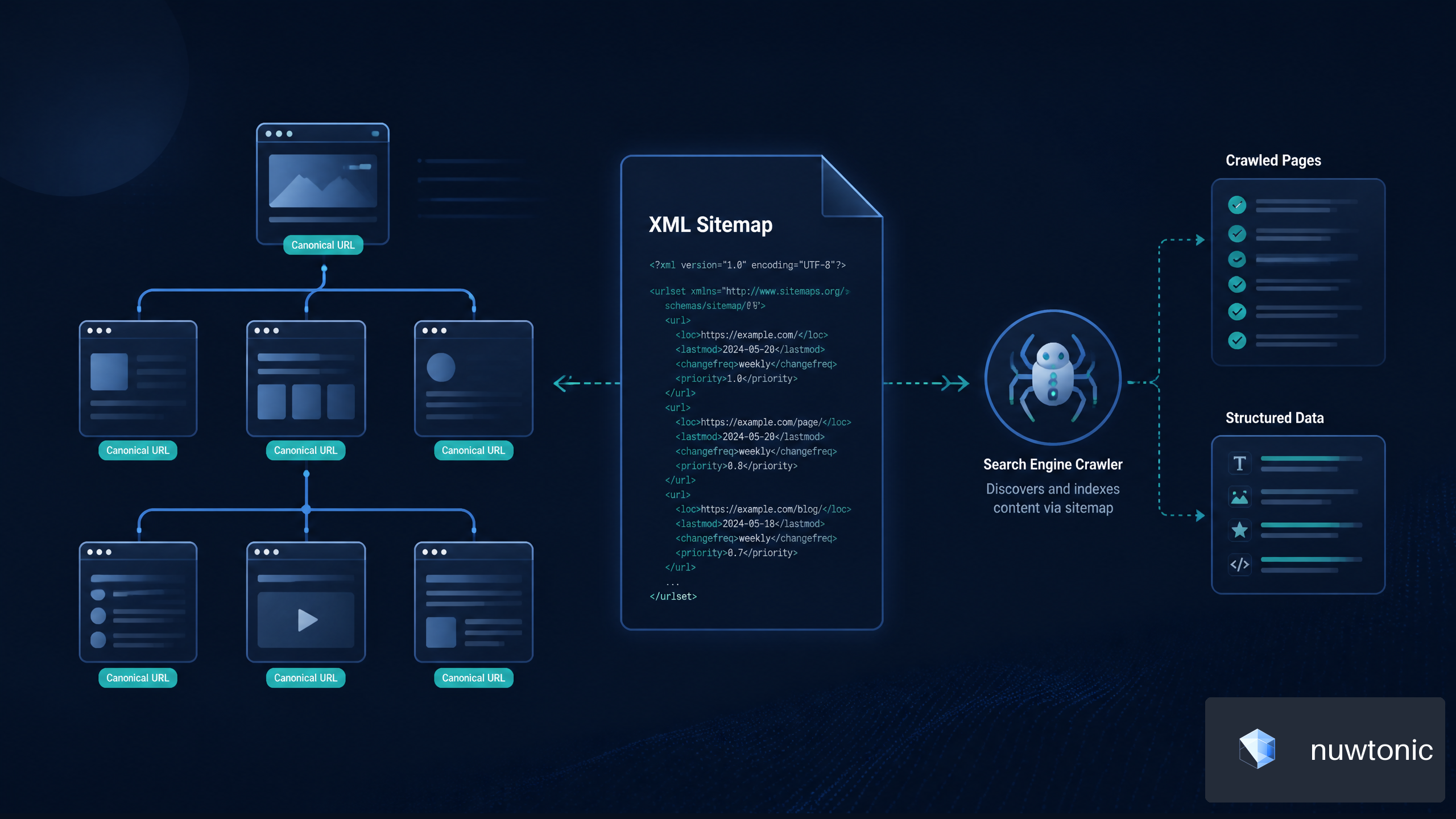
Successfully navigating this new reality does not mean abandoning traditional SEO. If your technical architecture, page speed, and core indexability are broken, neither Google nor external AI crawlers can discover your content in the first place. You must ensure your XML sitemaps, robots.txt, and canonical tags are flawless before attempting advanced optimizations.
Step 2: Semantic Formatting and RAG Alignment
Once your technical foundation is solid, restructure your high-performing pages. Introduce clear, bite-sized answer blocks and definition headers right at the top of your content. Infuse your articles with non-commodity data, expert perspectives (E-E-A-T), and distinct insights that AI models cannot easily replicate.
Step 3: Transitioning to Agentic GEO , AIO , AEO Automation
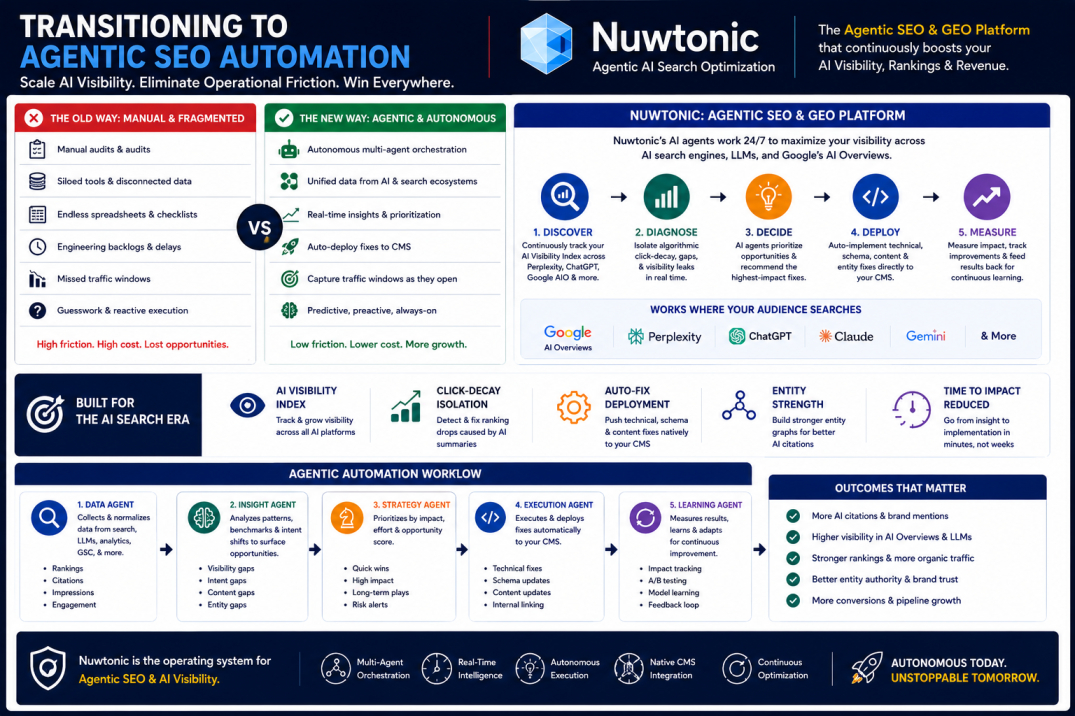
Manually executing this multi-layered framework across hundreds or thousands of pages introduces massive operational friction, leading to severe engineering backlogs and missed traffic windows. This structural bottleneck is exactly why the industry has shifted toward agentic automation.
Platforms leading this transition, such as Nuwtonic, offer an elegant solution, as an Agentic SEO & GEO Platform, Nuwtonic eliminates the operational friction of modern search optimization. Rather than generating endless checklists, its autonomous multi-agent orchestration continuously tracks your brand's AI Visibility Index across platforms like Perplexity and Google AIO, isolates algorithmic click-decay, and directly deploys technical, schema, and entity-level fixes natively to your CMS.
We recently analyzed a case study on AIO and GEO visibility showing a massive lift in organic search real estate when these processes are automated. By automating the tedious mechanics of source hijacking defense, semantic formatting, and RAG alignment, it allows brands to secure an unfair share of voice in both classic search engine results and conversational AI responses seamlessly.
Frequently Asked Questions (FAQ)
What is the main difference between GEO and AIO?
GEO (Generative Engine Optimization) focuses on optimizing for third-party conversational LLMs like ChatGPT, Claude, and Perplexity, where success is measured by citations and source mentions. AIO (AI Optimization) is a broader strategy focused on Google's ecosystem, specifically optimizing for Google's AI Overviews and maintaining visibility across Google's Knowledge Graph.
Does traditional SEO still matter in an AI-first world?
Yes, absolutely. Traditional SEO is the foundation upon which AEO, GEO, and AIO are built. AI engines and LLMs rely on search engine web indexes to find real-time information. If your site is not technically optimized and indexed by Google or Bing, AI crawlers will not be able to retrieve or cite your content.
How do I measure the success of my GEO strategy?
Measuring GEO requires shifting away from traditional rank tracking. Instead, you must monitor "Citation Share" or "Share of Voice" within generative engines. This involves tracking how often your brand is cited or recommended in response to industry-specific prompts on platforms like ChatGPT and Perplexity.
To effectively track your GEO performance, monitor these four critical metrics:
Citation Share: The percentage of times your brand is cited as a source across a standardized set of industry prompts on ChatGPT, Perplexity, and Gemini.
AI Visibility Index: Your overall footprint within generative summaries compared to direct competitors.
Assisted Conversions: Referral traffic originating from conversational search engines that converts on-site.
Snippet Win Rate: The frequency with which your structured content blocks are extracted for direct answers.
Why do most clients underestimate geo-targeting in modern search?
Most clients underestimate the importance of geo-targeting—it can make or break local visibility. In modern search, AI engines heavily personalize answers based on the user's implicit location, meaning local entity optimization is critical even for digital-first brands.
Sources and References
This guide is built upon authoritative search documentation and academic research on retrieval systems:
Google Search Central: Google Search Essentials — Guidelines on fundamental crawlability, indexability, and search feature eligibility.
Google Search Central: Structured Data General Guidelines — Standards for valid semantic markup and snippet extraction.
W3C / Schema.org: Schema.org Vocabulary Guidelines — Industry-standard vocabulary for entity-rich content parsing.
NIST: AI Risk Management Framework (AI RMF 1.0) — Standards for trustworthy, transparent, and verifiable AI outputs.
Google Research: Generative Engine Optimization: How to Optimize for Generative AI Search Engines — Academic framework detailing citation behavior and RAG retrieval mechanics.