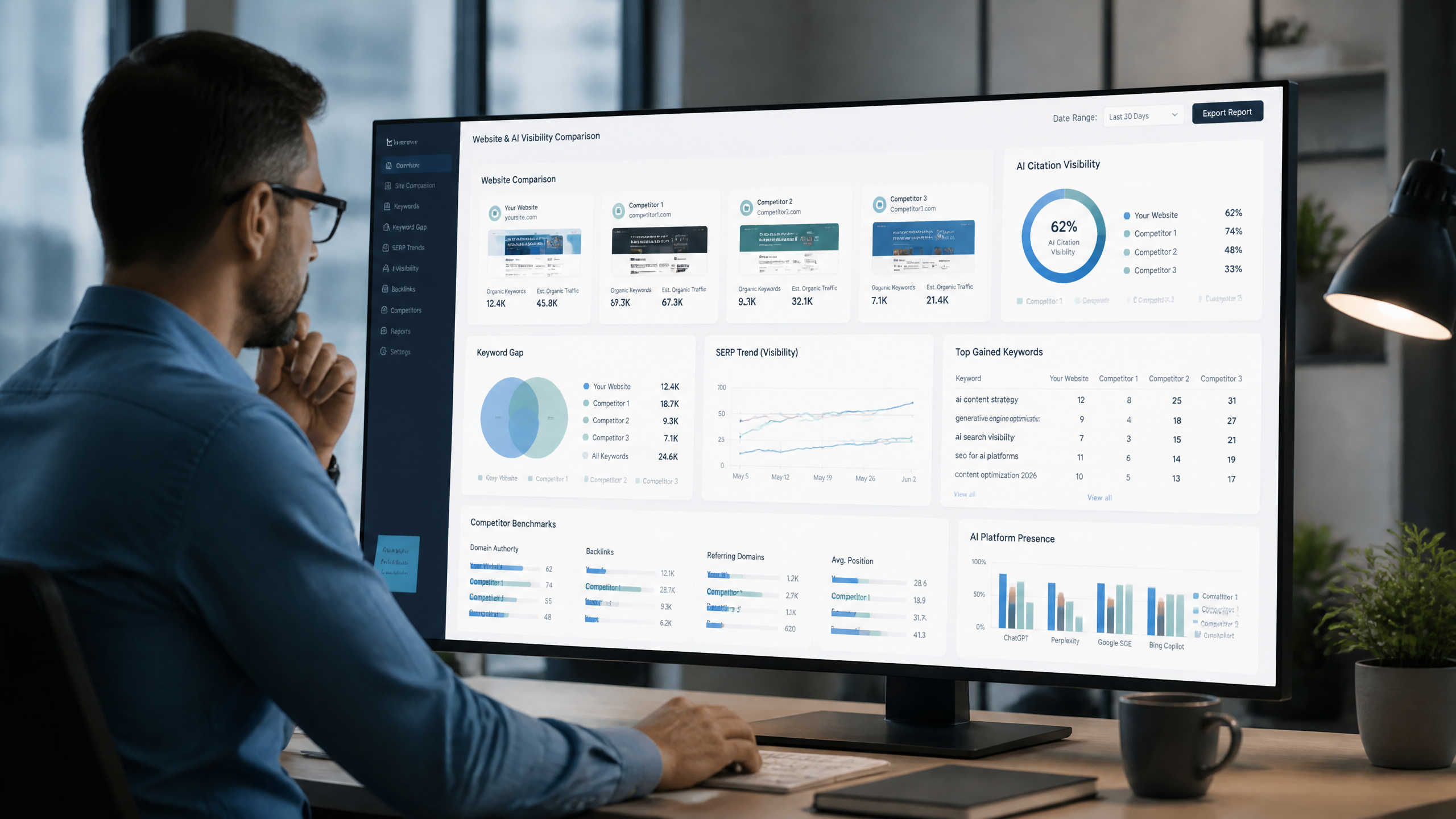
Can AI compare my site with competitors? Yes—and honestly, it’s one of the most practical uses of AI in SEO right now.
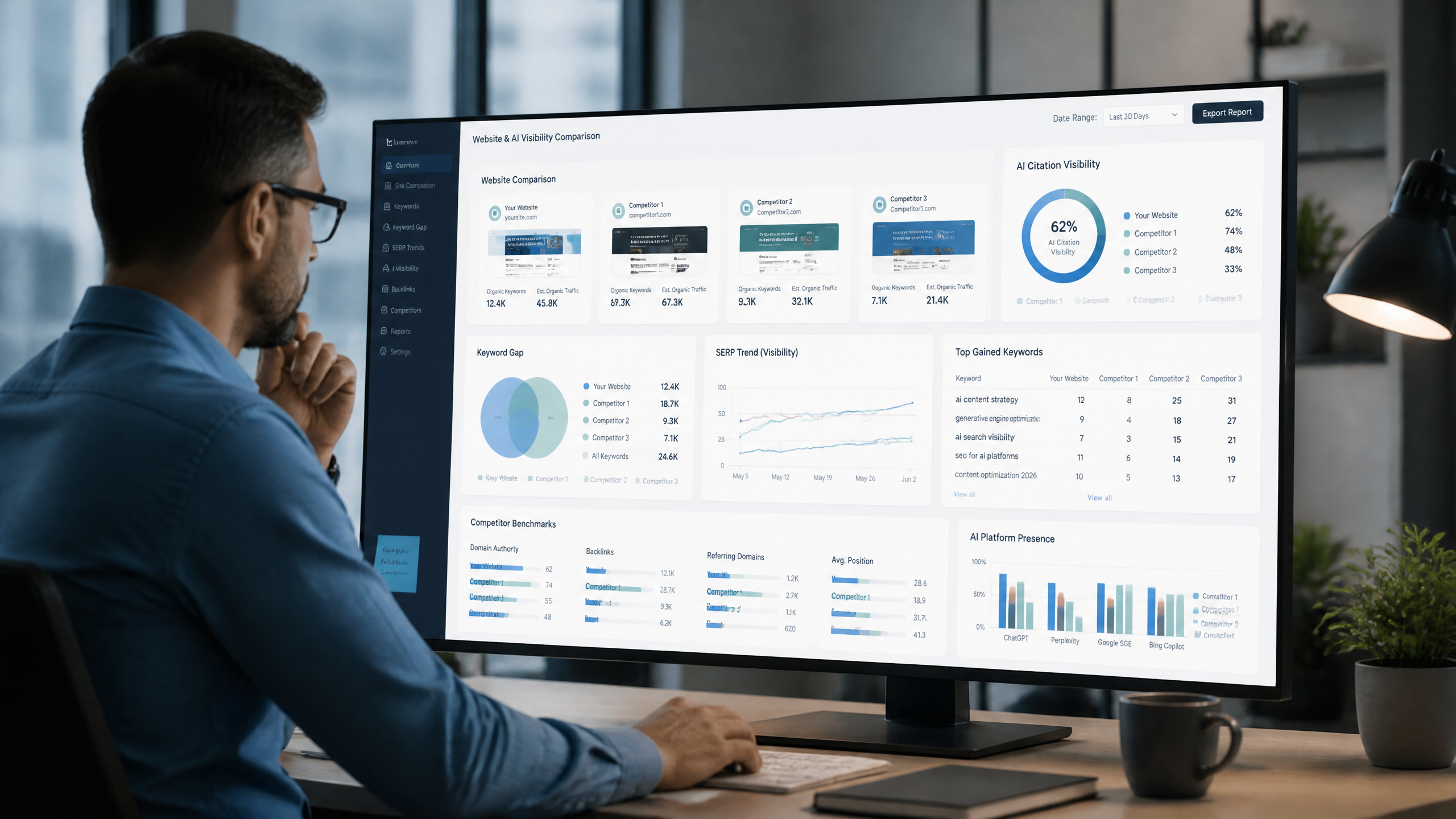
Look, many people overestimate the complexity of comparing sites; with the right tools, it's often a straightforward process. The hard part is not collecting data anymore. The hard part is figuring out which differences matter, which gaps are actually winnable, and what to fix first.
That’s exactly where Nuwtonic fits.
Instead of making you juggle rank trackers, spreadsheets, technical audit tools, and half-finished competitor notes, Nuwtonic uses your Google Search Console data, competitor gap analysis, and AI search visibility monitoring to show where your site is falling behind competitors—and what to do about it. That matters because AI-powered competitor analysis can benchmark digital presence in under 10 minutes with structured reports and recommendations, as Emax Studio reported in 2026 [4]. And Frase’s 2025 guide breaks the comparison into four core areas: keywords, content, backlinks, and technical SEO [11].
In my experience, that framework is right—but not every platform helps you act on it. Nuwtonic is strongest when the goal is comparing your site against competitors to uncover ranking, content, and citation gaps you can actually fix.
TL;DR Summary
• Yes, AI can compare your site with competitors across keyword gaps, content depth, on-page SEO, technical issues, and AI search citations.
• Nuwtonic is especially useful when you want to compare competitor performance against your real site data from Google Search Console rather than broad estimates alone.
• Its most relevant capabilities for this problem are:
• Competitor gap analysis
• Quick-win keyword discovery
• AI search visibility tracking
• Citation gap analysis
• URL-level audit and fix recommendations
• Content planning based on existing topical authority
• What you definitely don’t want to do is trust raw AI output without validation. Search Engine Land’s 2026 guidance recommends spot-checking 10% to 15% of AI classifications to push draft accuracy from roughly 85% to 95%+ [6].
• If your goal is simple: find where competitors are beating you and get specific recommendations, Nuwtonic is a strong fit.
Key Takeaways
• AI comparison works best when you define a clear scope: your domain, the right competitor set, and the exact pages or topics you care about.
• Nuwtonic helps by identifying actual niche competitors, not just the brands you assume are competitors.
• The biggest wins usually come from keyword overlap, citation gaps, and pages with ranking potential but weak CTR.
• AI search visibility is now part of competitor analysis—not just Google rankings. Metrics like citations and Share of Voice matter increasingly, especially for AI Overviews and similar systems [7].
• Human review still matters. I’ve found that while AI can provide valuable insights, human intuition still plays a crucial role in interpreting data accurately.
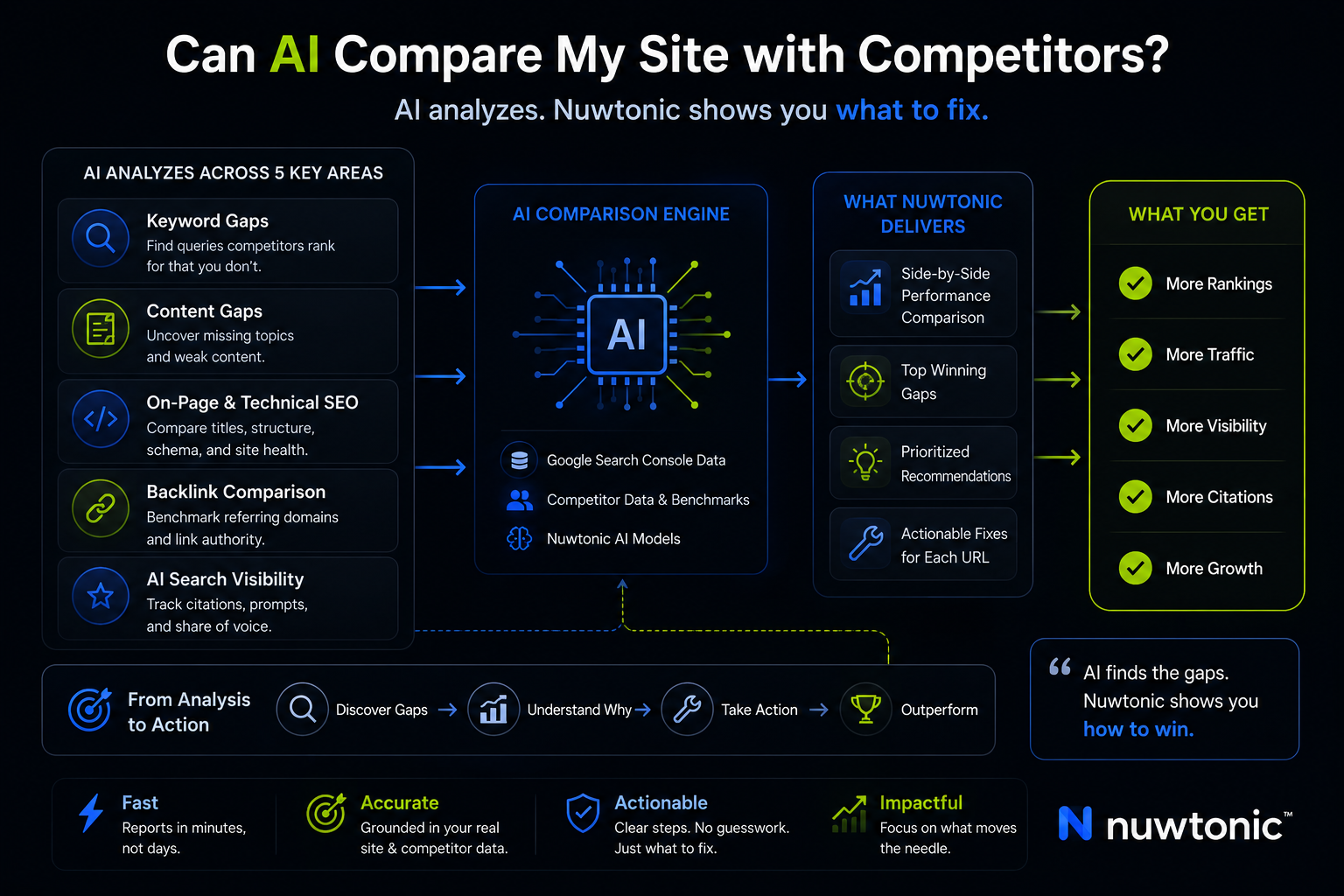
Table of Contents
What AI site comparison actually means
AI compares patterns, not just pages
Honestly, when people ask, “Can AI compare my site with competitors?” they usually mean one of three things:
Which keywords do competitors rank for that I do not?
Why does their page outperform mine?
Why is their brand showing up in AI answers while mine is missing?
Meev.ai’s SEO comparison framework is useful here because it defines competitor comparison as evaluating metadata, structure, schema, and content depth side by side [2]. That’s a better definition than the vague “AI analyzes your market” pitch you see everywhere.
AI does not magically understand strategy. What it does well is process a huge amount of structured and semi-structured data quickly—something Visualping highlighted in 2026 when it noted that AI tools can process far more data than manual review and catch subtle signals people often miss [13].
The categories that matter most
For this topic, I’d narrow the comparison down to the areas Nuwtonic actually helps with most directly.
Comparison area | What AI looks at | Why it matters | Nuwtonic relevance |
|---|---|---|---|
Keyword gaps | Missing queries, overlap, quick wins | Finds ranking opportunities | High |
Content gaps | Missing topics, weak depth, low authority coverage | Helps you build pages that match search demand | High |
On-page differences | Titles, structure, topical coverage, intent alignment | Improves CTR and relevance | High |
AI citation gaps | Missing mentions in AI results, weak visibility by prompt | Expands AI search presence | High |
Technical SEO | Site issues affecting crawlability or page quality | Supports rankings and page performance | Moderate to high |
Backlink benchmarking | Authority and referring domains | Important, but not Nuwtonic’s most central angle here | Lower focus for this article |
Why traditional competitor analysis breaks down
Look, the old workflow is a mess.
• Export keyword data from one tool
• Check GSC in another tab
• Crawl pages somewhere else
• Review AI visibility with yet another platform
• Build a spreadsheet nobody updates after week two
I’ve seen teams spend days building “competitive analysis” decks that were already stale before the meeting started. A 2026 report cited in the research noted AI tools can turn that into a structured report in under 10 minutes [4]. That speed matters—but only if the output is tied to execution.
That is the practical difference with Nuwtonic: it connects analysis to action.
Where Nuwtonic helps most
Competitor gap analysis based on actual opportunities
Nuwtonic’s competitor gap section is the clearest answer to the question. It identifies your actual competitors by niche, maps keyword overlap, highlights quick wins, and flags what to target versus skip.
That “skip” part deserves more respect than it gets.
One of the biggest mistakes I see is teams chasing keywords they’ll never realistically win—especially branded competitor terms. Search Engine Land’s 2026 guidance specifically warns that AI outputs can mistakenly surface unrealistic opportunities if you do not cross-reference target keywords against competitor page exports [6].
So if a tool tells you to target a rival’s branded query as a top opportunity, that’s not insight. That’s noise dressed up as confidence.
AI search visibility tracking, not just SEO rankings
This is where Nuwtonic starts separating itself from basic SEO comparison tools.
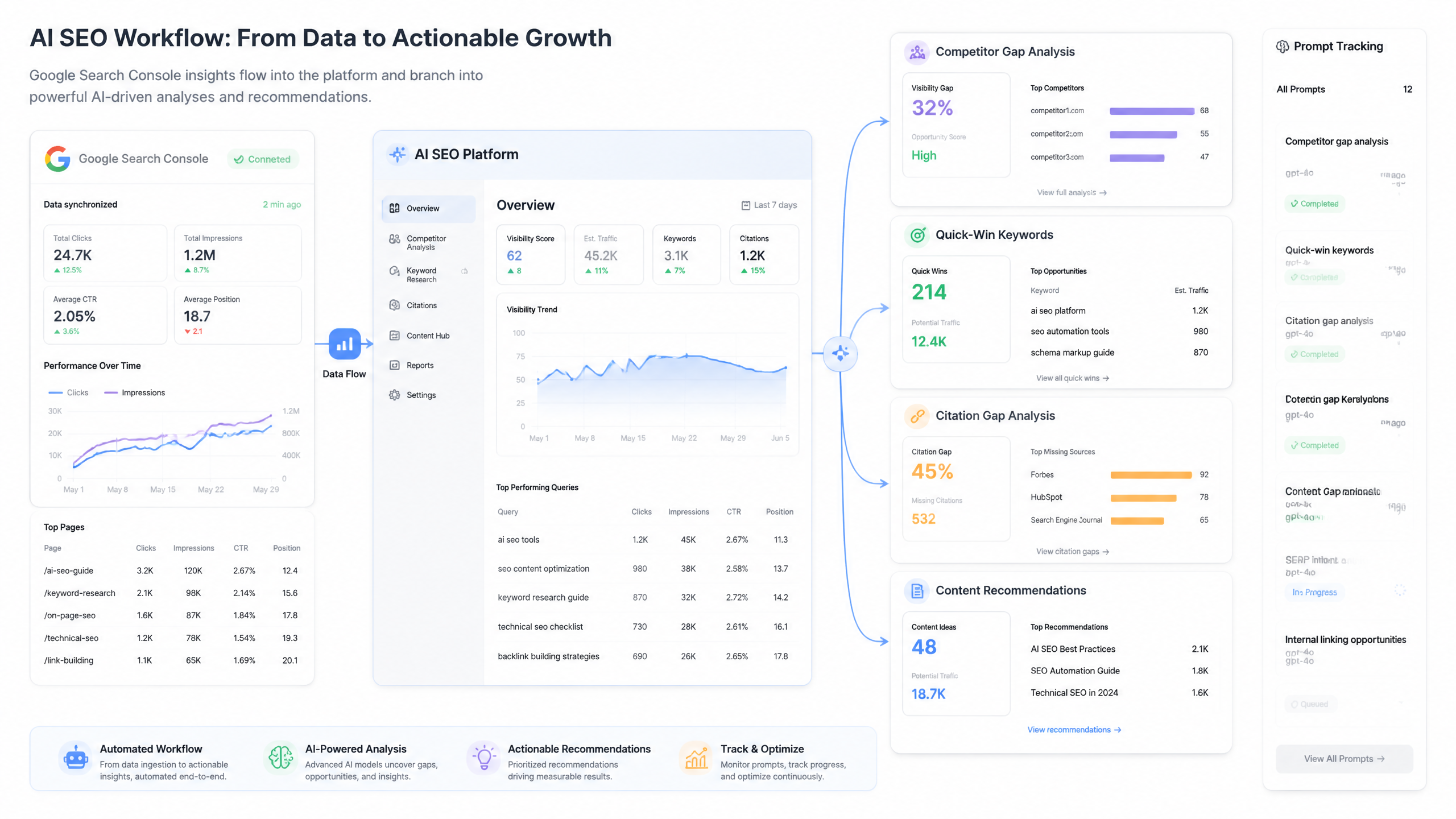
Its AI search visibility section lets you add prompts you care about and track:
• Whether your site is being cited
• Where you rank across AI platforms
• What your Share of Voice looks like
Ahrefs’ Brand Radar framework backs up why this matters: serious benchmarking for AI search requires tracking mentions, citations, impressions, and Share of Voice across AI platforms [7]. If you only compare blue-link rankings and ignore AI answer visibility, your competitor analysis is incomplete in 2026.
Citation gap analysis at the URL level
Honestly, this is the capability I’d prioritize first if your site already has content but is underperforming in AI search.
When your page is not showing up for a tracked prompt, Nuwtonic lets you run a citation gap analysis on that specific URL. It surfaces:
• Content gaps
• Structural gaps
• E-E-A-T gaps
• Competitor gaps
That matters because the problem is rarely “write more words.” Usually, the issue is one of these:
Your page does not answer the prompt clearly enough.
Your structure makes extraction harder.
Your supporting signals are weaker than competitor pages.
Your authority coverage is too thin for the topic cluster.
Actionable fixes instead of generic recommendations
What you definitely don’t want to do is receive a competitor report that ends with “improve content quality.” Thanks, very helpful.
Nuwtonic’s value is that it tells you what to add, where to add it, and why—then supports audit and fix workflows through its GEO Audit & Fix feature. For this specific topic, that means the platform is not just comparing your site with competitors. It is translating those differences into page-level actions.
How Nuwtonic compares your site with competitors
Step 1: It starts with your own search data
Most comparison tools begin with estimated competitor data. Nuwtonic begins with your Google Search Console connection, which is a smarter starting point for prioritization.
Why? Because GSC gives context around:
• Queries you already appear for
• Pages with impressions but weak CTR
• Mobile versus desktop ranking gaps
• Cannibalization patterns
• Topic clusters and trust signals
That means competitor analysis is not happening in a vacuum. It is anchored to what your site is already close to winning.
Data source | What it tells you | Why it matters in competitor comparison |
|---|---|---|
Google Search Console | Current impressions, clicks, CTR, queries | Shows where you are already in the race |
Competitor gap analysis | Missing and overlapping keywords | Reveals where rivals are ahead |
AI prompt tracking | Citation and visibility status | Shows AI search gaps beyond Google |
URL audits | Structural and content-level weaknesses | Turns diagnosis into fixes |
Step 2: It maps overlap and identifies quick wins
Look, this is where teams save the most time.
Instead of manually sorting thousands of keywords, Nuwtonic identifies keyword overlap and quick-win opportunities. Frase’s 2025 guide recommends analyzing competitor rankings, top pages, and content patterns to identify what’s driving performance [11]. Nuwtonic effectively shortens that workflow by surfacing the opportunities first.
A quick-win keyword, in practical terms, is usually one where:
• The competitor ranks well
• You already have some topical relevance
• The SERP is not dominated by impossible incumbents
• A page update or new article could realistically move the needle
I once made the mistake of prioritizing a massive keyword cluster purely on volume. Great spreadsheet. Terrible outcome. The site had no authority in that subtopic, the SERP intent was off, and we wasted six weeks producing content no one was going to rank with. Since then, I trust winnability more than volume—and that’s the right mindset for Nuwtonic users too.
Step 3: It expands from keyword gaps into content gaps
Keyword gaps are useful, but they are only the symptom.
The real issue is content coverage.
Nuwtonic’s content writer is built on your existing topical authority and GSC data. So once a competitor gap is identified, you can generate content that extends from what Google already trusts your site for—instead of guessing at random topics.
This is a better workflow than broad AI writing because it aligns content creation with actual competitive opportunity.
A common pattern I keep seeing is this:
• A team runs AI competitor analysis with no supporting context
• The first draft misses 40% of meaningful feature or topic gaps
• They then add stronger competitor materials or data inputs
• Accuracy jumps into the 90% range, and they save 15+ hours of manual review
That pattern mirrors community reports in product marketing research, where adding competitor context improved comparison accuracy from roughly 70% to 92% or 95%, while cutting analysis time from 4 hours to 45 minutes in some cases [5]. The lesson is simple: AI performs better when grounded in real inputs. Nuwtonic’s integration with your site data helps do exactly that.
Step 4: It checks whether competitors are winning in AI search
This is the part many articles still gloss over.
SEO competitor analysis used to end at rankings. Now it also needs to answer:
• Which competitor pages are getting cited in AI-generated answers?
• Which prompts trigger your competitors but not you?
• Is your content missing the structure or trust signals needed for citation?
Ahrefs’ AI search competitor analysis guidance recommends defining the scope carefully and comparing brands or domains directly to benchmark citations across AI search platforms [7]. Nuwtonic operationalizes that idea with prompt tracking and citation gap analysis.
So instead of just knowing “Competitor X outranks us,” you can learn “Competitor X is being cited for these prompts, our URL is absent, and the likely causes are structural and topical.” That’s much more actionable.
What results you can realistically expect
Speed is real, but accuracy depends on setup
Yes, AI can move fast. The research points to reports generated in under 10 minutes [4]. But fair warning: fast does not automatically mean reliable.
Results depend heavily on:
• Whether you chose the right competitors
• Whether the keyword set matches your business model
• Whether page types are correctly classified
• Whether branded terms were filtered properly
• Whether somebody reviews the weird edge cases
Brand Armor AI’s website comparison guidance emphasizes defining the scope before running analysis—entity, URL set, or campaign slice—so your comparisons remain consistent over time [3]. That is not busywork. It is what keeps month-over-month benchmarking from turning into nonsense.
The best outcomes tend to look like this
Based on the research and what I’ve seen in real workflows, good AI comparison outcomes usually fall into these buckets:
Outcome type | What changes | Typical impact |
|---|---|---|
Keyword gap resolution | New pages or refreshes target missing terms | More qualified impressions and rankings |
CTR improvement | Better alignment of intent, titles, and page structure | More clicks from existing visibility |
AI citation growth | Pages become more citable for tracked prompts | Better AI search presence |
Content scaling | Teams publish faster around proven opportunity areas | Faster topical expansion |
Prioritization clarity | Teams stop chasing low-value keywords | Better ROI on content work |
Realistic scenarios worth paying attention to
Honestly, the most useful evidence here is not polished vendor case studies. It is the repeat patterns.
One situation I keep seeing is a team comparing messaging and content without enough competitor context. The first output looks confident but misses pricing nuance or key differentiators. Then they add better source material, rerun the comparison, and suddenly the analysis catches 95% of the gaps, saving around 15 hours versus manual review [5]. The lesson: context quality shapes AI quality.
Another common pattern involves media format gaps. A team compares competitor blogs and promotional assets, discovers competitors lean heavily on video testimonials, and notices those pages driving noticeably stronger engagement. After adding three videos, they see a 15% engagement lift in one month [5]. That is a reminder that competitor comparison is not only about keywords. Format matters.
Then there’s the validation scenario—my personal favorite because it is unglamorous and effective. A strategist spot-checks 15 out of 125 pages—about 12%—finds 7 misclassifications, corrects them, reruns the model, and improves accuracy from 85% to 96% [6]. Not flashy. Very useful.
How to validate AI competitor analysis
Validation is not optional
Look, if you skip validation, you are basically outsourcing judgment to a probability engine.
Search Engine Land’s 2026 recommendation is one I agree with strongly: spot-check 10% to 15% of AI classifications to improve accuracy from draft-level output to 95%+ reliability [6].
That should be standard operating procedure, especially when the analysis influences content budgets or SEO roadmaps.
A practical validation workflow for Nuwtonic users
Confirm the competitor set
• Make sure the domains are true search competitors, not just business competitors.
• If needed, use branded comparison query research to identify who users actually compare you against—a method Ahrefs recommends through queries containing your brand plus terms like “vs” [7].Review quick-win keywords manually
• Check SERP intent.
• Remove unrealistic branded opportunities.
• Confirm that your site has at least some topical alignment.Spot-check page classifications
• Review 10% to 15% of outputs.
• Pay special attention to subdomains, blog content, and product pages—these are common error zones [6].Audit a few losing URLs deeply
• Use Nuwtonic’s citation gap or GEO audit features on pages that should be competitive but are not.
• Compare recommendations against actual ranking pages.Re-run after fixes
• Measure whether rankings, CTR, and citations improve after the changes.
Common mistakes to avoid
Mistake | Why it causes problems | Better approach |
|---|---|---|
Choosing the wrong competitors | Output becomes strategically irrelevant | Use actual SERP competitors and niche overlap |
Chasing branded rival terms | Opportunity is often fake | Filter and validate manually |
Treating all keyword gaps equally | Volume can distract from winnability | Prioritize intent and authority fit |
Ignoring AI visibility | You miss citation-level competition | Track prompts and citations |
Trusting first-pass classifications | Errors compound into bad strategy | Spot-check 10% to 15% |
When Nuwtonic is the right fit—and when it is not
When Nuwtonic makes a lot of sense
Nuwtonic is a good fit if your main question is not just “Can AI compare my site with competitors?” but “Can it compare them and help me act on the findings quickly?”
It is especially useful when you need:
• Competitor gap analysis tied to real GSC performance data
• Quick-win SEO opportunities instead of giant export files
• AI search visibility monitoring by prompt
• Citation gap analysis on specific URLs
• Content generation aligned to existing topical authority
• Actionable recommendations on what to fix and where
When you may need something else alongside it
Honestly, if your primary need is deep backlink prospecting or feature-by-feature product intelligence, you may still want additional specialized tools in the stack.
That is not a knock on Nuwtonic. It is just a scope issue.
Frase’s framework includes backlinks and technical SEO in AI competitor analysis [11], and some tasks in those categories can require more specialized workflows depending on your team. Your mileage may vary.
The short buying logic
If your goal is... | Nuwtonic fit |
|---|---|
Find keyword gaps and content opportunities | Strong |
Compare AI citation visibility with competitors | Strong |
Turn competitor findings into page-level fixes | Strong |
Build content from competitive opportunities | Strong |
Run pure backlink outreach campaigns | Partial |
Conduct non-SEO product-market competitive intelligence | Partial |
FAQ
Can AI automatically detect keyword gaps between my site and competitors?
Yes. Frase’s 2025 guide identifies keywords as one of the four core areas of AI SEO competitor analysis [11]. Nuwtonic’s competitor gap section is built for this exact use case, showing overlap, quick wins, and what to avoid chasing.
Can AI compare on-page signals like metadata and schema?
Yes. Meev.ai specifically defines SEO competitor comparison around metadata, structure, schema, and content depth [2]. Nuwtonic addresses this through URL-level audits and recommendations, especially where citation readiness or content structure is weak.
Can AI benchmark my visibility in AI search tools like ChatGPT or AI Overviews?
Yes, with the right setup. Ahrefs notes that AI visibility benchmarking should track mentions, citations, impressions, and Share of Voice across AI search platforms [7]. Nuwtonic supports this through prompt tracking, citation monitoring, and gap analysis.
How fast can AI compare my site with competitors?
Research cited from 2026 suggests AI-powered tools can generate structured competitor reports in under 10 minutes [4]. In practice, that speed is realistic for first-pass analysis. The real timeline depends on how much validation and implementation you need afterward.
How accurate is AI competitor analysis?
It varies. Search Engine Land’s 2026 guidance suggests first-pass classification can sit around 85% accuracy, and manual spot-checking of 10% to 15% of outputs can push that to 95%+ [6]. In my experience, that’s a sensible benchmark.
Does AI competitor analysis replace human review?
No. I’ve found that while AI can provide valuable insights, human intuition still plays a crucial role in interpreting data accurately. AI is excellent at surfacing patterns. Humans are still better at resolving ambiguity, filtering nonsense, and deciding what is strategically worth doing.
How should I choose which competitors to include?
Start with search competitors, not just commercial rivals. Ahrefs recommends using comparative brand queries with modifiers like “vs” to identify who your audience actually compares you against [7]. Then keep the comparison scope stable over time, which Brand Armor AI also recommends for consistency [3].
Sources and references
• Ahrefs AI search competitor analysis
• Frase AI competitor analysis guide
• Brand Armor AI website comparison tool
Final answer
Yes, AI can compare your site with competitors, and for most SEO teams, it should. The better question is whether the tool helps you move from comparison to execution.
Honestly, that’s where Nuwtonic is most relevant.
It does not just tell you that competitors are ahead. It helps you identify keyword gaps, understand AI citation gaps, uncover content and structural weaknesses, and prioritize quick wins using your actual GSC data. If your team wants fewer disconnected tools and more direct answers about why competitors are winning and what to fix next, that is the practical value here.
If you are tired of stitching together spreadsheets, rank trackers, and AI search reports just to answer a simple question, Nuwtonic gives you a cleaner path: compare, diagnose, fix, and publish—without leaving the workflow.