Most advice on semantic SEO is already outdated. It still treats the finish line as a top Google ranking, as if search were still a list of blue links and nothing more. That misses the actual visibility problem teams face now. Your page can rank, get crawled, and still be absent from the answer users read in ChatGPT, Gemini, Perplexity, or Google AI Overviews.
That shift changes what semantic search optimization means in practice. It's no longer just about helping a search engine classify a page. It's about making your content clear enough, structured enough, and authoritative enough that an AI system selects it as a source.
The operational gap is where organizations often falter. They've heard about entities, topic clusters, and schema. They haven't turned those ideas into a citation-focused workflow. They still optimize pages for ranking position first, then hope AI systems pick them up as a side effect. That's the wrong sequence.
If you want to understand what is semantic search optimization in 2026, start with this premise: rankings matter, but being citable matters more.
Table of Contents
- Beyond Rankings The New Reality of Search
- From Keywords to Concepts The Semantic Search Revolution
- The Engines New Brain How Semantic Search Understands Content
- The Dual Payoff Winning in Google and AI Answers
- Your Hands On Semantic SEO Implementation Plan
- From Plan to Action Scaling Semantic SEO with Nuwtonic
- Measuring True Visibility and Avoiding Common Pitfalls
Beyond Rankings The New Reality of Search
The old model was simple. Pick a keyword, build a page, rank it, collect traffic. That model still exists, but it no longer captures the full outcome of search visibility.
Users increasingly ask full questions. AI systems synthesize an answer before the click happens. In that environment, the strongest page isn't always the one that wins attention. The page that gets cited inside the answer often does.
That's why semantic search optimization has moved from a relevance problem to a retrieval and citation problem. Search engines and AI assistants don't just parse words. They look for pages that are easy to interpret, topically complete, and structurally explicit.
The visibility target has changed
A lot of SEO work still aims at rank trackers and position reports. Those tools remain useful, but they don't tell you whether your brand appears when someone asks an AI system for a recommendation, a comparison, or a summary.
What matters now is whether your content can serve as a source. That means:
- Clear entity definition: The page has to make obvious what company, product, person, or concept it's about.
- Intent match: The answer format has to match the question being asked.
- Machine readability: Headings, semantic HTML, schema, and internal linking all have to reduce ambiguity.
- Source credibility: The page needs enough topical depth that an AI system treats it as dependable.
Practical rule: If a model can summarize your page but can't confidently cite it, your semantic optimization is incomplete.
Ranking is still useful, but insufficient
This isn't an argument against Google rankings. Strong rankings still create discovery, links, and revenue. The point is that rankings are now one layer of visibility, not the whole system.
Teams that keep optimizing as if search ends at the SERP are building for yesterday's interface. Teams that treat semantic search optimization as preparation for both retrieval and citation are building for the way search works now.
From Keywords to Concepts The Semantic Search Revolution
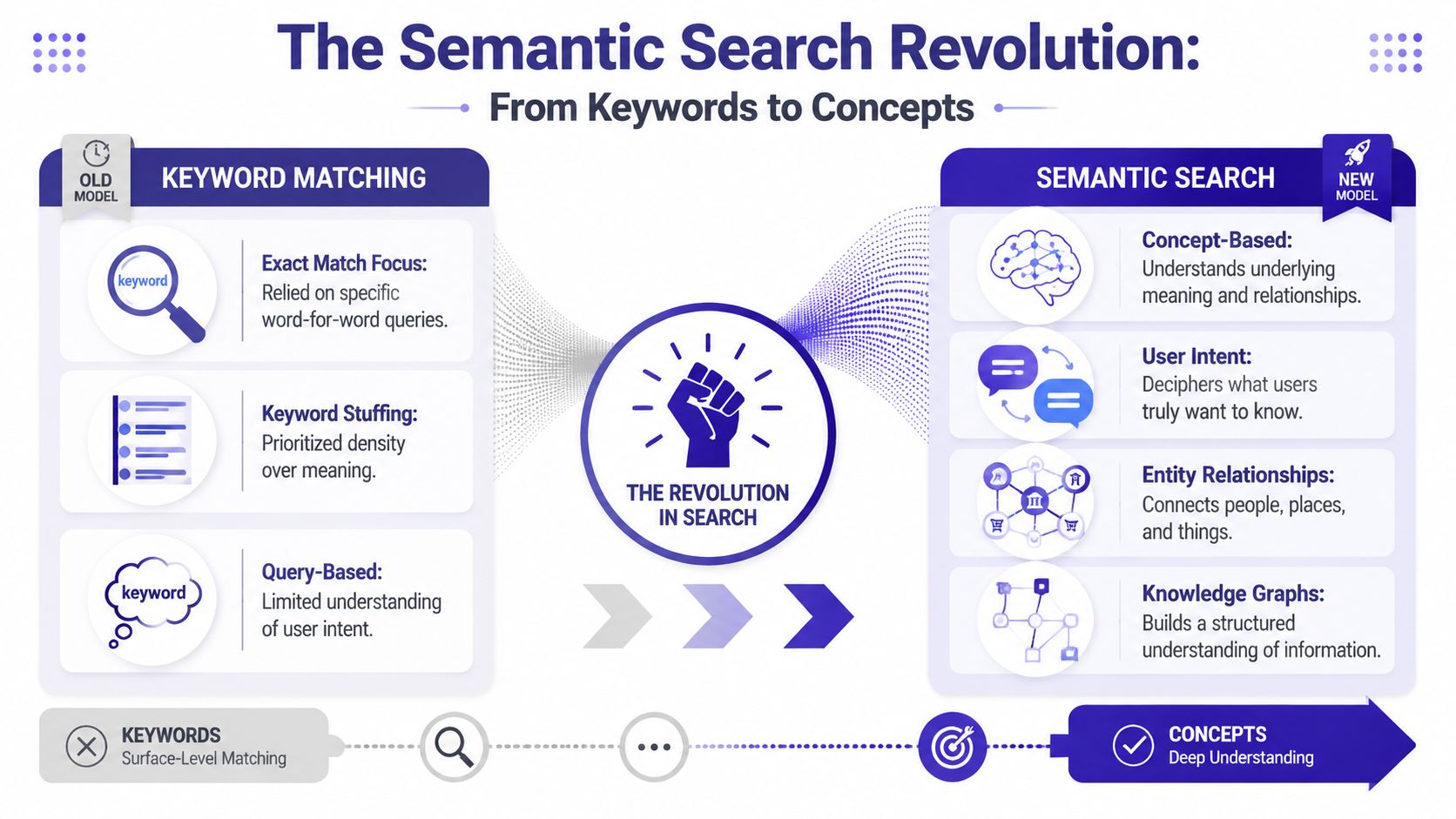
A traditional search engine behaves like a library clerk who only knows book titles. If you ask for the exact phrase, you get a result. If you ask with different wording, the system struggles.
A semantic search engine behaves more like a librarian who understands the subject matter. It knows that books about budgeting, personal finance, and cost control may all help the same reader. It recognizes topics, relationships, and intent.
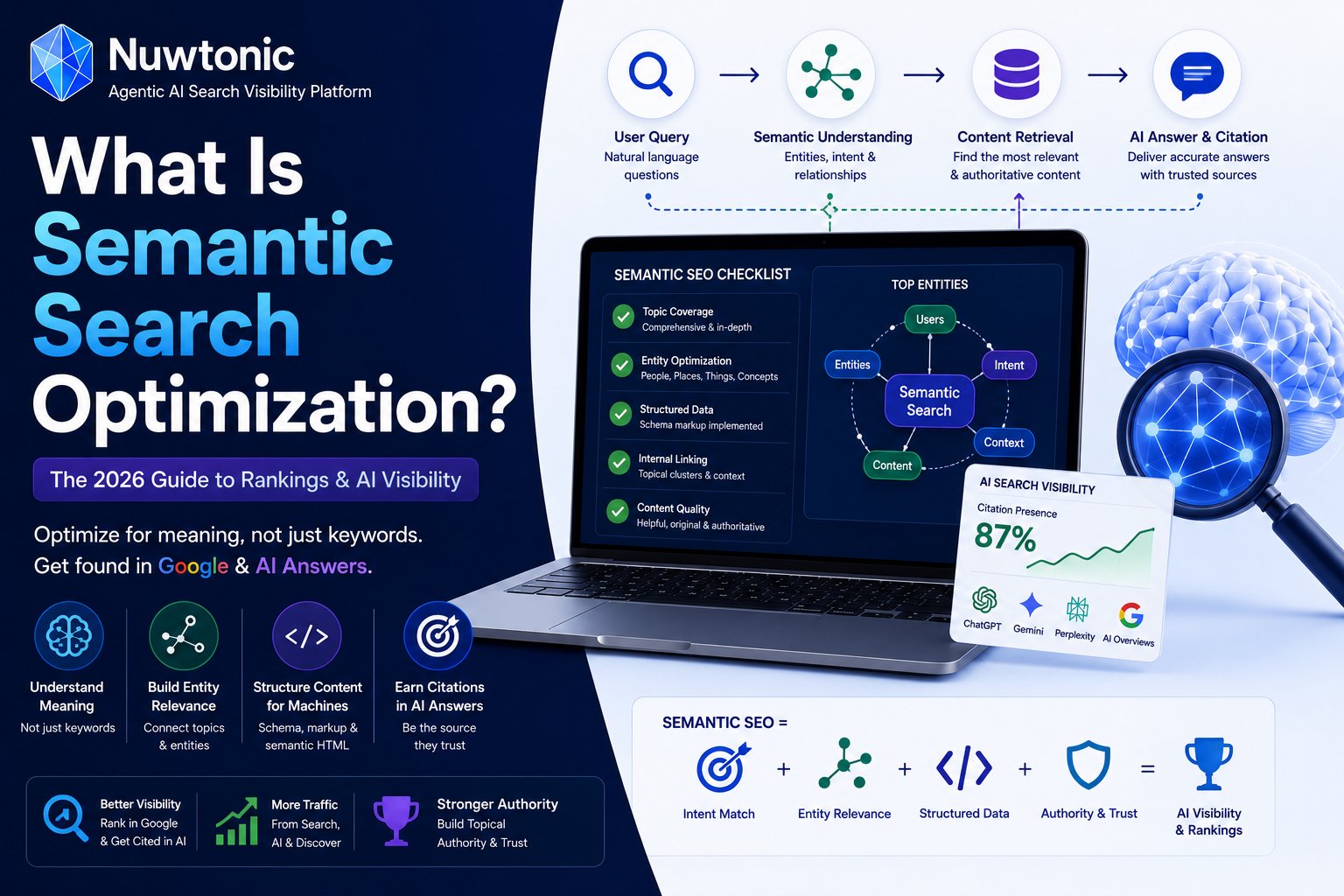
That's the simplest answer to what is semantic search optimization. It's the practice of making your content understandable at the level of concepts, entities, and relationships instead of isolated keyword strings.
Why keyword targeting broke down
Keyword research still matters. You still need demand signals, query phrasing, and intent clues. But the old habit of mapping one page to one exact phrase is too narrow for modern retrieval.
If a buyer searches for “best CRM for small sales teams,” the engine doesn't only hunt for that exact wording. It can retrieve pages about lightweight pipeline software, startup CRM tools, or sales workflow platforms if the content aligns semantically. That's why good keyword research workflows for modern SEO now have to feed topic models, not just term lists.
The weak approach looks like this:
| Approach | What happens |
||---|
| Exact match targeting | Content becomes rigid and repetitive |
| Keyword density focus | Writing gets worse without improving meaning |
| Separate pages for minor variations | Cannibalization increases and authority fragments |
What semantic optimization actually changes
Semantic optimization changes how you plan, write, and mark up content.
Instead of asking, “Did we include the target phrase enough times?” ask these questions:
- Did we define the core entity clearly?
- Did we cover the surrounding concepts users expect?
- Did we match the actual intent behind the query?
- Did we structure the page so a machine can extract a clean answer?
Semantic search rewards pages that resolve ambiguity. It punishes pages that merely repeat phrases.
In practice, that leads to a different content shape. You stop publishing thin variants and start publishing consolidated resources, comparison pages, glossary content, FAQs, and supporting articles that reinforce one another. You stop treating headings as formatting and start treating them as semantic labels.
The result is better relevance in traditional search and a much stronger chance of inclusion when AI systems assemble answers from multiple sources.
The Engines New Brain How Semantic Search Understands Content
Many professionals know the phrase “semantic search” but can't explain the mechanics. You don't need a machine learning degree to work effectively here, but you do need to understand the three components that drive retrieval decisions.
Entities are the units of meaning
An entity is a specific thing a machine can identify. A company. A product. A person. A place. A medical condition. A software category.
If your page mentions “Apple,” the engine has to infer whether you mean the company or the fruit. If your page says “Apple Inc., the iPhone maker,” you've removed ambiguity. That's semantic clarity.
Many pages often fail. They include surface keywords but don't establish entity context early enough. A semantic engine has less work to do when the page spells out the entity and its role directly.
Knowledge graphs connect those entities
A knowledge graph is the relationship layer. It tells the engine that one entity is linked to another through attributes or associations.
For example, a graph can connect a software platform to its founder, category, integration partners, pricing model, and use cases. Those relationships let search systems understand not just what something is, but where it fits.
That matters because queries are often relational. Users ask for alternatives, comparisons, use cases, compatibility, definitions, and recommendations. The engine needs those relationship signals to match the right source to the right question.
A page that explains a topic in isolation is harder to use. A page that places the topic inside a clear network of related entities is easier to trust and retrieve.
Embeddings help engines match meaning
The final piece is embeddings. The core technical mechanism of semantic search relies on converting text into dense vector representations to map semantic similarity. This architecture allows engines like Google and ChatGPT to interpret relationships between words to deliver accurate results even when queries use varied phrasing or synonyms, as explained in Couchbase's overview of semantic search.
That's why a page can rank or get cited for a concept it never states in the exact words a user typed. The machine is evaluating meaning, not just overlap.
A practical way to consider this:
- Keywords are labels.
- Entities are the identifiable things.
- Knowledge graphs describe how those things connect.
- Embeddings help the system judge whether the page means what the query means.
For teams building content systems, this is the key shift. You're not just writing for lexical match. You're building machine-readable meaning. If you need a deeper operational view, this guide to an AI search knowledge graph is useful for understanding how those connections influence retrieval.
The Dual Payoff Winning in Google and AI Answers
Higher rankings are no longer the full win.
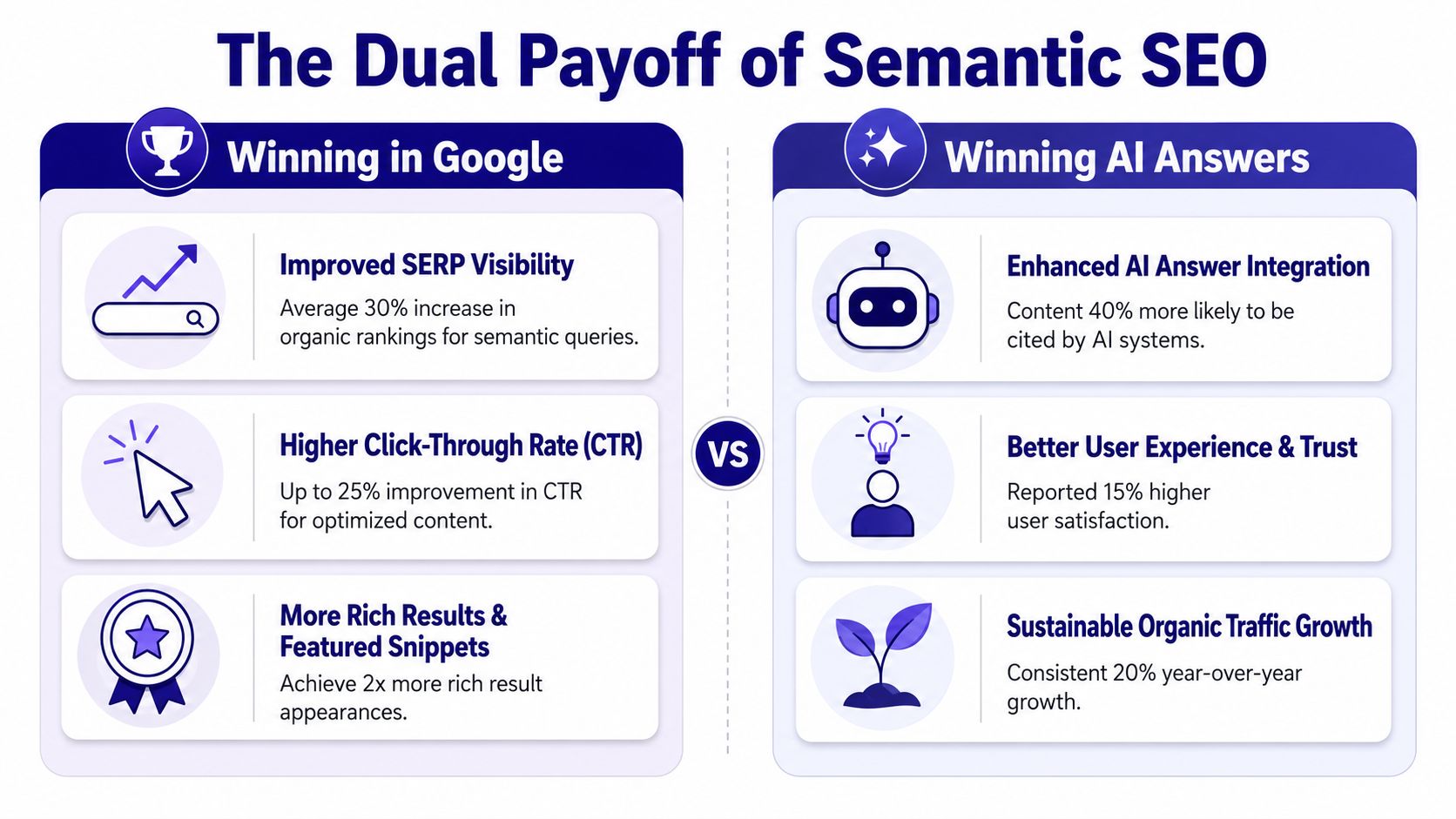
Semantic SEO now has two jobs. It still helps pages perform in Google's core results. It also improves the odds that those same pages get pulled into AI-generated answers as cited sources. That second outcome demands more than traditional SERP thinking, and many teams still treat it like a side effect instead of a separate optimization target.
Why citation rate is now a business metric
The budget shift makes the change hard to ignore. According to Onely's research on semantic SEO for AI search, mid-market brands are putting meaningful annual budget behind AI search optimization, enterprises are spending far more, recommended allocation can reach 20 to 30% of total SEO and search budget, and top-performing brands target citation rates above 30% on core queries.
That matters because rank tracking does not tell you whether an AI system used your page to answer the question.
Citation rate does.
If your content ranks in Google but never appears in AI answers, you have visibility in one search surface and a gap in the one gaining user attention. For teams planning content around both outcomes, this guide on how to optimize content for AI search is a useful operational companion.
Here's the practical difference:
| Metric | What it tells you | What it misses |
|---|---|---|
| Keyword rank | Your position in a traditional SERP | Whether AI systems cite your content |
| Organic traffic | Visits from search surfaces | Whether answer engines used your pages as sources |
| Citation rate | Inclusion in AI answers for target queries | Direct click volume by itself |
This is the reporting gap many SEO dashboards still miss. A team can show ranking gains, traffic stability, and healthy CTR while losing source visibility inside ChatGPT, Gemini, Perplexity, and Google's AI Overviews.
Before the next point, this short video gives a useful visual overview of the shift in search behavior.
What content formats AI systems prefer
Content format shapes citation probability. Onely's analysis found that comparative list-driven formats such as “X vs Y” and “best X for Y” account for 32.5% of AI citations.
That aligns with how answer engines assemble responses. Users ask for evaluation, not just explanation. They want options, differences, use-case fit, and a clear recommendation path. Pages built for those jobs are easier for AI systems to extract, summarize, and cite than broad awareness content with loose structure.
Formats that tend to perform well:
- Comparison pages: Clear distinctions between tools, approaches, audiences, and trade-offs.
- Best-for pages: Ranked or curated options tied to a specific scenario.
- Definition and how-to support content: Useful for follow-up questions and factual extraction.
Formats that often underperform:
- Keyword-stuffed category copy: It targets terms without adding decision-grade substance.
- Abstract opinion pieces: The claims are harder to verify and excerpt.
- Weakly structured pages: Thin formatting makes extraction harder.
The strategic shift is simple. Traditional semantic SEO helps you rank for the concept. Generative Engine Optimization helps you become the source an AI system trusts enough to cite. Those are related goals, but they are not the same content brief.
The page format should match the answer shape. If a user asks for a comparison, publish a comparison the model can cite.
Your Hands On Semantic SEO Implementation Plan
The theory only matters if it changes how you build pages. A workable semantic SEO process starts before writing and continues through markup, structure, and internal links.
Start with an entity first content model
Open a new content brief and identify the primary entity before you look at headings. Write it at the top of the document in plain language.
For example:
- Primary entity: “customer data platform”
- User intent: compare vendors for B2B use
- Supporting entities: integrations, identity resolution, warehouse sync, privacy controls, pricing model, activation channels
This forces the article to revolve around meaning instead of phrase repetition.
A useful drafting workflow looks like this:
- Name the entity clearly in the introduction. Don't make the engine infer the topic from scattered mentions.
- List adjacent entities and attributes. Features, use cases, audiences, alternatives, constraints.
- Map the intent. Is the searcher learning, comparing, validating, or buying?
- Build headings that answer those intent layers. Not decorative headings. Extractable ones.
If you can swap your target keyword with a close synonym and the article still makes perfect sense, that's usually a sign the topic model is strong.
Add schema in the rendered page output
Structured data is not optional if you want better machine readability. Pages incorporating structured data and semantic HTML exhibit a 30 to 40% higher probability of being selected as canonical sources in AI-generated responses compared to unstructured content, according to Search Atlas on semantic search optimization.
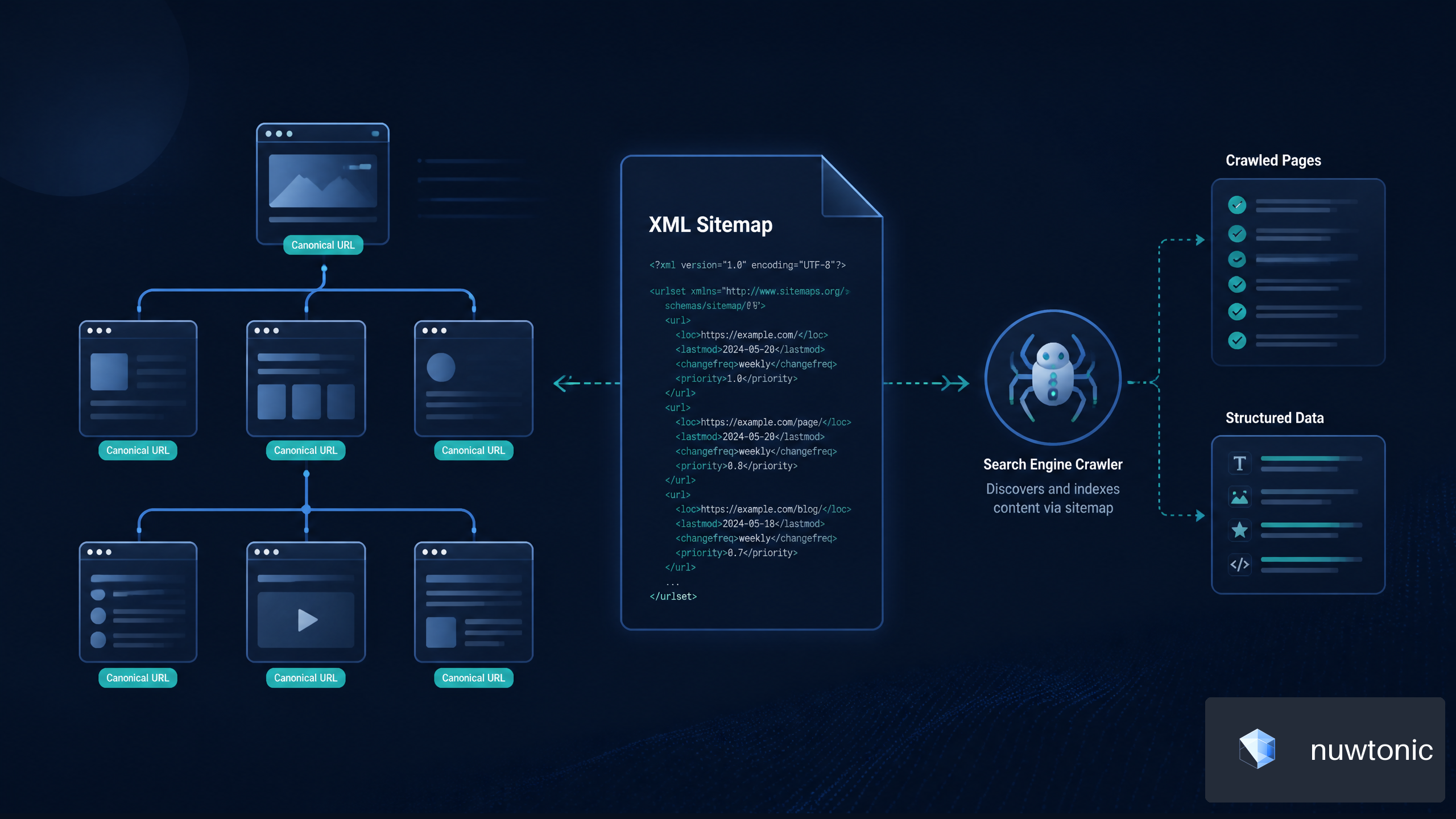
The key implementation point is simple. Put schema in the rendered HTML the crawler receives. Don't rely on client-side injection if you can avoid it.
Basic examples:
<script type="application/ld+json">
{
  "@context":"https://schema.org",
  "@type":"Organization",
  "name":"Example Company",
  "url":"https://example.com"
}
</script>
<script type="application/ld+json">
{
  "@context":"https://schema.org",
  "@type":"Person",
  "name":"Jane Doe",
  "jobTitle":"Head of Product"
}
</script>
<script type="application/ld+json">
{
  "@context":"https://schema.org",
  "@type":"Article",
  "headline":"What Is Semantic Search Optimization",
  "author":{
    "@type":"Person",
    "name":"Jane Doe"
  }
}
</script>
Schema alone won't save a weak page. But when the page is already clear, schema removes friction for crawlers and answer engines.
Build clusters and internal links that reinforce meaning
Topical authority doesn't come from one article. It comes from a system.
Create a pillar page for the broad topic, then connect it to narrower pages that answer related questions. Use descriptive anchors that communicate semantic relationship, not generic anchors like “learn more.”
A simple cluster for semantic search optimization might include:
- Core guide: definition, mechanics, implementation
- Comparison page: semantic SEO vs traditional SEO
- How-to page: schema implementation for AI search
- Measurement page: citation tracking and prompt monitoring
- Entity page: glossary of AI search and retrieval concepts
Field note: Internal links should explain why two pages belong together. If the anchor could point to any page on the site, it's too vague.
Keep the links directional and intentional. If a page supports the main topic, link upward to the pillar and laterally to sibling pages where the user would logically go next. For a more detailed workflow on preparing pages for answer engines, this guide on how to optimize content for AI search is a practical reference.
From Plan to Action Scaling Semantic SEO with Nuwtonic
It is possible to execute semantic SEO manually on a handful of pages. The friction appears when trying to scale it across a site, across markets, or across clients.
Where manual workflows break
The usual pattern looks familiar. A strategist defines topics in a spreadsheet. A writer drafts in Docs. A developer adds schema when there's time. Someone checks Search Console. Someone else runs prompts in multiple AI tools to see whether the brand appears. The work happens, but it doesn't happen as a system.
That's the main reason the market still has an execution gap. The critical gap in today's strategies is optimizing for AI citation visibility. While most guides focus on SERPs, 78% of B2B marketers now prioritize AI visibility but lack a tactical framework for securing URL-level citations in LLMs like ChatGPT and Gemini, according to Incend Media's analysis of semantic search optimization.
When a team can't connect auditing, content production, technical fixes, and citation measurement, semantic SEO remains inconsistent.
What a unified workflow looks like
One option is to consolidate those tasks into a single operating layer. Nuwtonic combines GEO audits, entity-first content workflows, topical mapping, AI visibility tracking, and review-before-deploy updates in one workspace.
The practical value of that model isn't “automation” in the abstract. It's tighter execution on the jobs semantic optimization requires:
- GEO auditing: Find structural issues that block AI visibility.
- Topical maps: Build connected coverage instead of random article production.
- Entity-first generation: Draft around concepts and supporting entities, not just phrases.
- Prompt and citation tracking: Check whether target URLs are being surfaced by AI systems.
That closes the loop. A team can identify gaps, update the page, ship the fix, and verify whether the content appears in target answer environments. Without that loop, semantic SEO drifts into theory.
Measuring True Visibility and Avoiding Common Pitfalls
If you still judge success mainly by keyword rankings, you'll miss the most important signals. Semantic search optimization changes both the work and the scoreboard.
Metrics that reflect actual semantic visibility
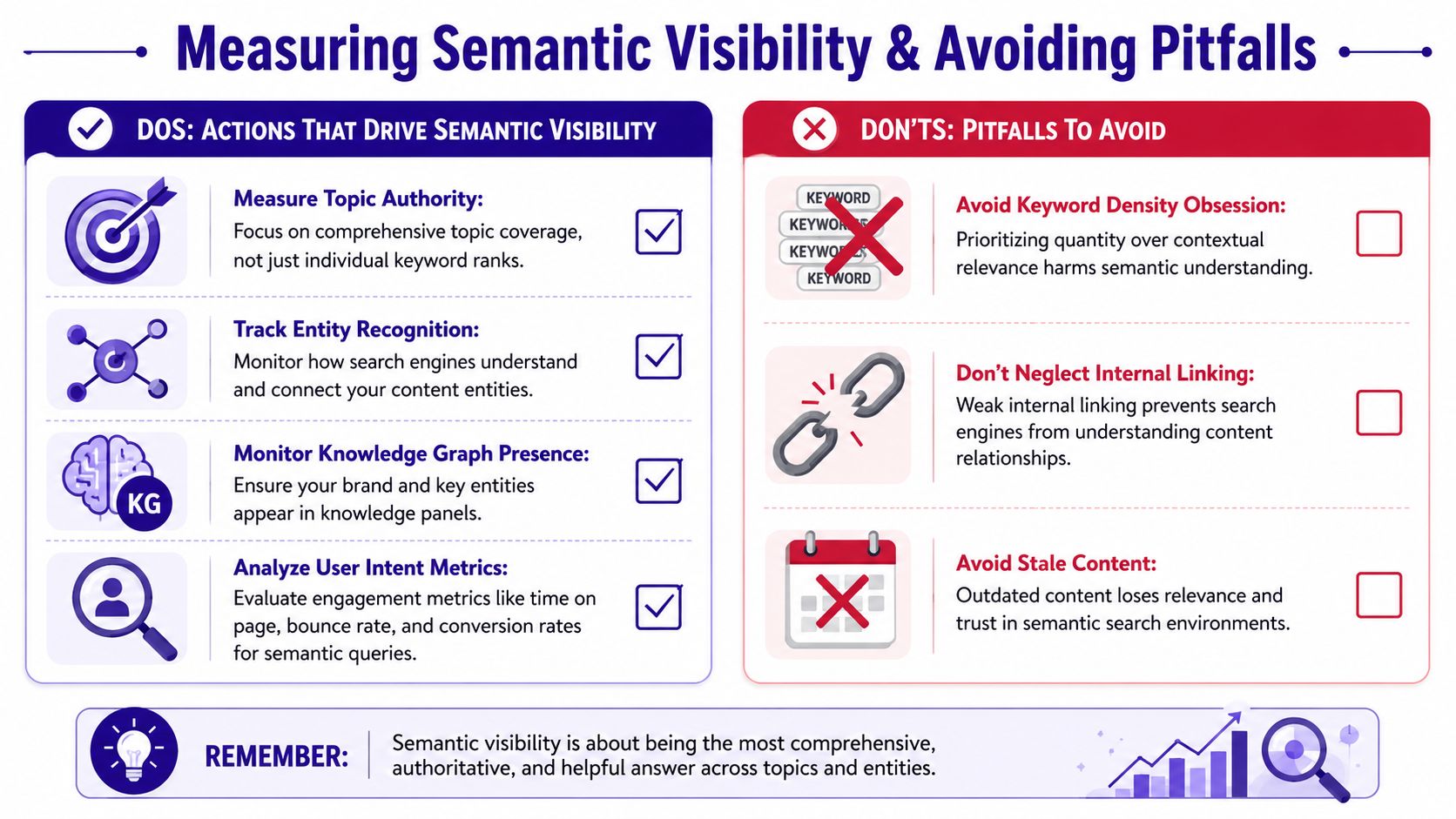
The first metric is citation rate. That's the clearest indicator that an AI system sees your page as a source candidate for relevant prompts.
The second is entity coverage. Semantic search optimization requires aligning 90% of a page's entities directly with primary user intent to ensure AI models recognize the content as the most direct source, with a binary decision score exceeding 0.5 confirming on-topic relevance, according to iPullRank's AI search metrics framework.
That doesn't mean stuffing every related term onto the page. It means most entities on the page should reinforce the main intent rather than dilute it.
A simple review table helps:
| Metric | Good question to ask |
||---|
| Citation rate | Are our URLs appearing in AI answers for core prompts? |
| Entity coverage | Do most named concepts on the page support the primary intent? |
| Topical authority | Does our site have connected depth around the subject, not just one page? |
Mistakes that block inclusion in AI answers
Teams usually miss semantic visibility for predictable reasons.
- They write for phrases, not questions. The content sounds optimized but doesn't resolve an actual user task.
- They separate content from technical implementation. Strong copy on a weak page template still creates machine-readability problems.
- They ignore site-level context. A single good page on an otherwise thin topic area is harder to trust.
- They publish without checking extraction quality. If headings, tables, and summaries are messy, the model has less to work with.
- They over-expand the page. Too many off-topic entities dilute the central meaning.
A page can be long and still be semantically weak. Coverage is not the same as coherence.
The practical checklist is straightforward. Make the primary entity explicit. Keep the supporting entities tightly aligned to intent. Use semantic HTML. Implement schema in rendered output. Build internal links that explain topical relationships. Then measure inclusion where modern search happens.
That's the answer to what is semantic search optimization. It's the discipline of making content understandable enough to rank, structured enough to extract, and trustworthy enough to cite.
Search visibility now spans Google, AI answer engines, and the systems that decide which URLs deserve to be quoted. If your team needs one workspace to audit technical gaps, build entity-first content, track prompt-level visibility, and improve URL-level citation performance, Nuwtonic is built for that operating model.