You're probably staring at a messy backlink spreadsheet, a handful of outreach tabs, and the same question every SEO team asks in 2026, which free backlink sites are worth the time and which ones are just busywork. The good news is that backlink analysis and link placement have become more standardized, so you can judge opportunities with the same core metrics across tools, and the same basic logic applies across media requests, profile citations, and launch platforms. Semrush's free checker reports total backlinks, referring domains, and dofollow percentage, Moz's Link Explorer offers 10 free queries per month, and Ahrefs' free checker surfaces referring domains, backlinks, Domain Rating, and Ahrefs Rank (Semrush backlink analytics, Moz Link Explorer, Ahrefs backlink checker).
That matters because “free” doesn't mean “low value.” The strongest free backlink opportunities now live in PR platforms, expert communities, and entity citations, not in spammy directories or bulk profile farms. A practical way to think about them is simple, PR platforms can earn editorial mentions, expert communities can turn your answers into in-content references, and entity citations can anchor your brand in trusted third-party systems. If you want the broader link-building context behind those choices, understanding backlink types and impact helps separate true authority links from profile assets and referral sources.
Table of Contents
- 1. Source of Sources (SOS) by Peter Shankman
- 2. Qwoted
- 3. Featured Formerly Terkel
- 4. Help a B2B Writer
- 5. SourceBottle
- 6. Connectively HARO Successor Branding
- 7. Crunchbase Company Profile
- 8. Google Business Profile GBP
- 9. GitHub Organization Profile
- 10. Product Hunt Launch Page
- Top 10 Free Backlink Sources Comparison
- Taking Action on Your Backlink Strategy
1. Source of Sources (SOS) by Peter Shankman
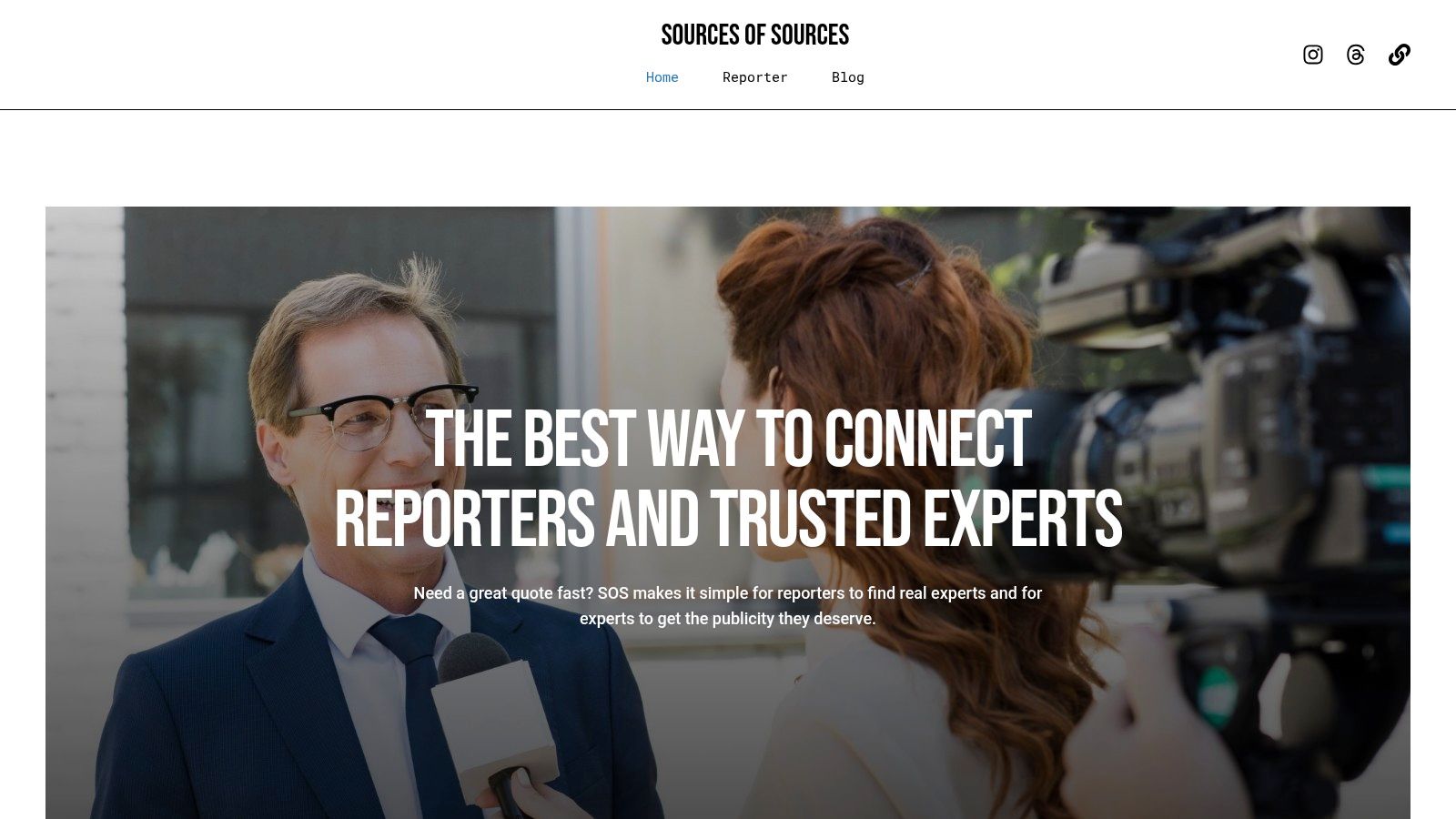
SOS is the cleanest starting point if you want editorial links without paying for a PR suite. It's a free journalist-source email list founded by the original HARO founder, and it sends reporter queries directly to experts who can reply without a platform layer getting in the way. The value here is not volume, it's speed and relevance. If your expertise matches the request, a tight response can land a mention in media that carries far more credibility than a random profile link.
What makes SOS useful
The workflow is straightforward. You get free daily digests, with up to 3 per day, you reply directly to reporters, and the platform enforces quality to reduce spam and off-topic pitches. That combination makes SOS feel lighter than a full PR tool, but it still behaves like a real media-request channel rather than a generic backlink list. The trade-off is obvious, it's competitive and there's no guarantee your response will be picked up.
Practical rule: treat SOS like a newsroom, not a directory. If your answer doesn't help a reporter finish a piece quickly, it probably won't travel.
How to use it well
Lead with the one point that proves you're useful, then offer a concise angle or a data-free observation the journalist can quote. Don't send a brand pitch first, and don't pad the reply with background your reader already knows. If you need a refresher on why editorial context matters to link value, this backlinks-in-SEO guide pairs well with SOS-style outreach.
- Reply fast: Reporter windows close quickly, so speed matters more than polished prose.
- Stay on brief: Match the exact topic and format the query asks for.
- Keep proof handy: A short bio, role, and one concrete credential usually beat a long company description.
2. Qwoted
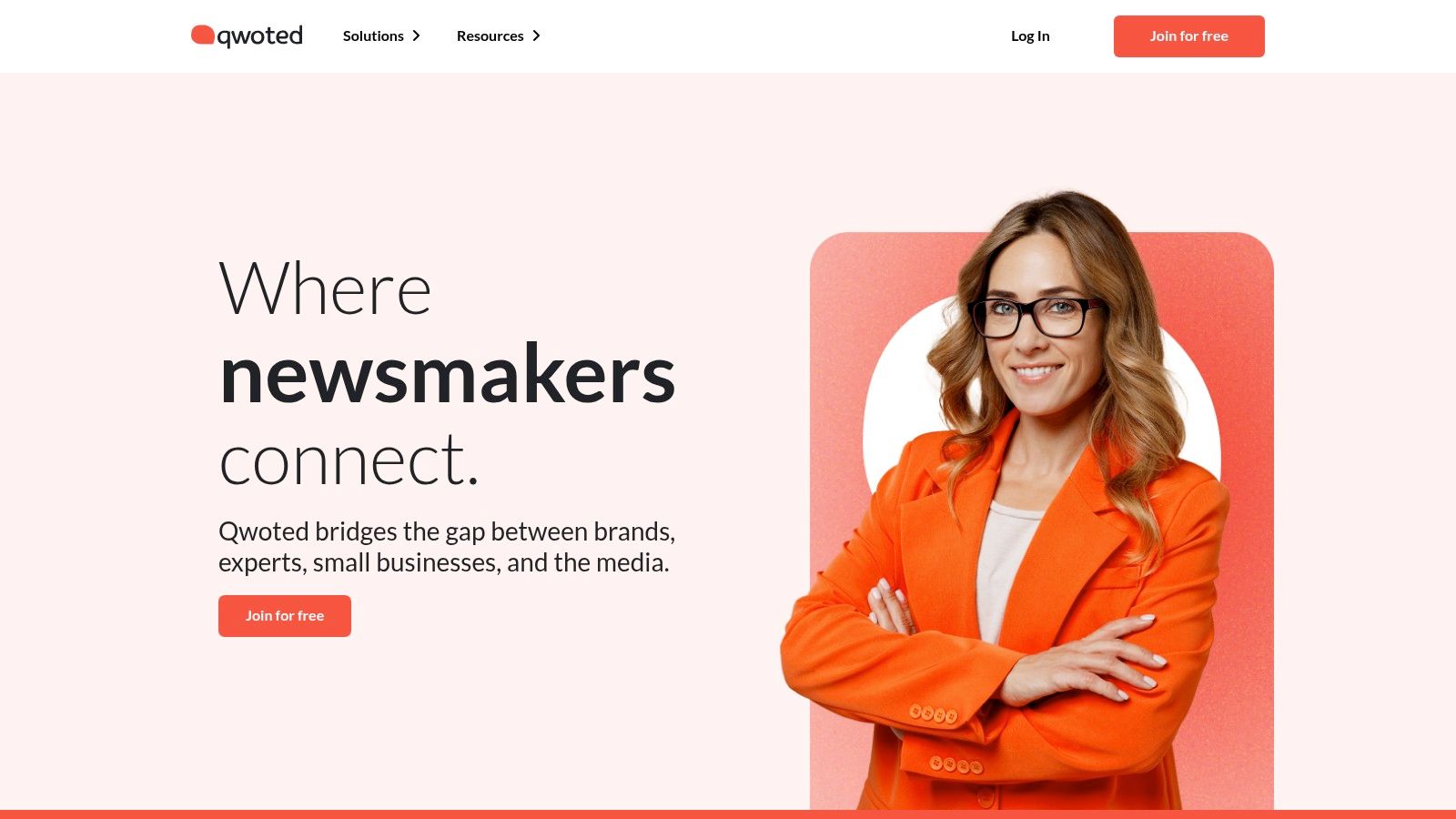
Qwoted is a cleaner alternative when your team wants structured media requests without the clutter of older journalist lists. Experts can appear in the database on a free plan, pitch requests, and optionally upgrade for more visibility. The pitch quality tends to be better than spam-heavy inbox lists because the platform organizes requests around profiles and structured media needs.
Why it's worth a slot in your workflow
Qwoted works best for teams that can answer with specificity. If you serve SaaS, professional services, or technical B2B categories, your profile can support legitimate editorial placements in trade and mainstream outlets. The downside is visibility, the free plan keeps you in the game, but it doesn't do the work for you. You still need a response that's sharper than everyone else's.
What to watch
Turnaround times can be short, so the platform rewards teams that already have subject-matter experts mapped to topic buckets. It also helps to keep your profile clean, because a weak bio lowers response quality before you even pitch. Use one sentence that explains what you know, one sentence that proves it, and one sentence that answers the prompt.
A good Qwoted response reads like a useful quote, not a miniature sales page.
The best responses usually include a usable point of view, a simple example, and a sentence that lets the editor trim cleanly. That's the difference between a mention that gets ignored and a mention that survives editing.
3. Featured Formerly Terkel
Featured is a strong fit when you want a repeatable quote pipeline instead of one-off PR scrambles. It's a writer-led Q&A platform where editors publish prompts and experts answer them for mentions and links. Because the prompts are curated across industries, the platform feels more controlled than open journalist-request feeds, which helps teams that need consistency.
Where Featured fits
The biggest advantage is workflow clarity. You see the prompt, you know the topic, and you can answer with enough context for the writer to lift a quote or summary. Featured also gives you an expert profile, which is useful when you want to build recurring credibility in niche and B2B publications. Some accepted quotes include followed links, some don't, so you should judge it on placement quality, not on link assumptions.
How to make submissions count
Write for the editor first. Short answers that are specific, opinionated, and easy to attribute usually outperform broad marketing language, especially when the request asks for a practical take. If your team buys extra answer credits, use them only on prompts that map directly to a product, service line, or topical pillar you care about.
- Match the prompt exactly: Off-topic answers waste submission capacity.
- Lead with the conclusion: Writers can trim the rest if they need to.
- Avoid generic advice: “Focus on quality” is forgettable, “use customer language pulled from support tickets” is not.
The free allowance can feel tight during active campaigns, but that constraint can help teams stay selective. In practice, Featured works best as a steady source of earned mentions, not as a place to spray answers across every category.
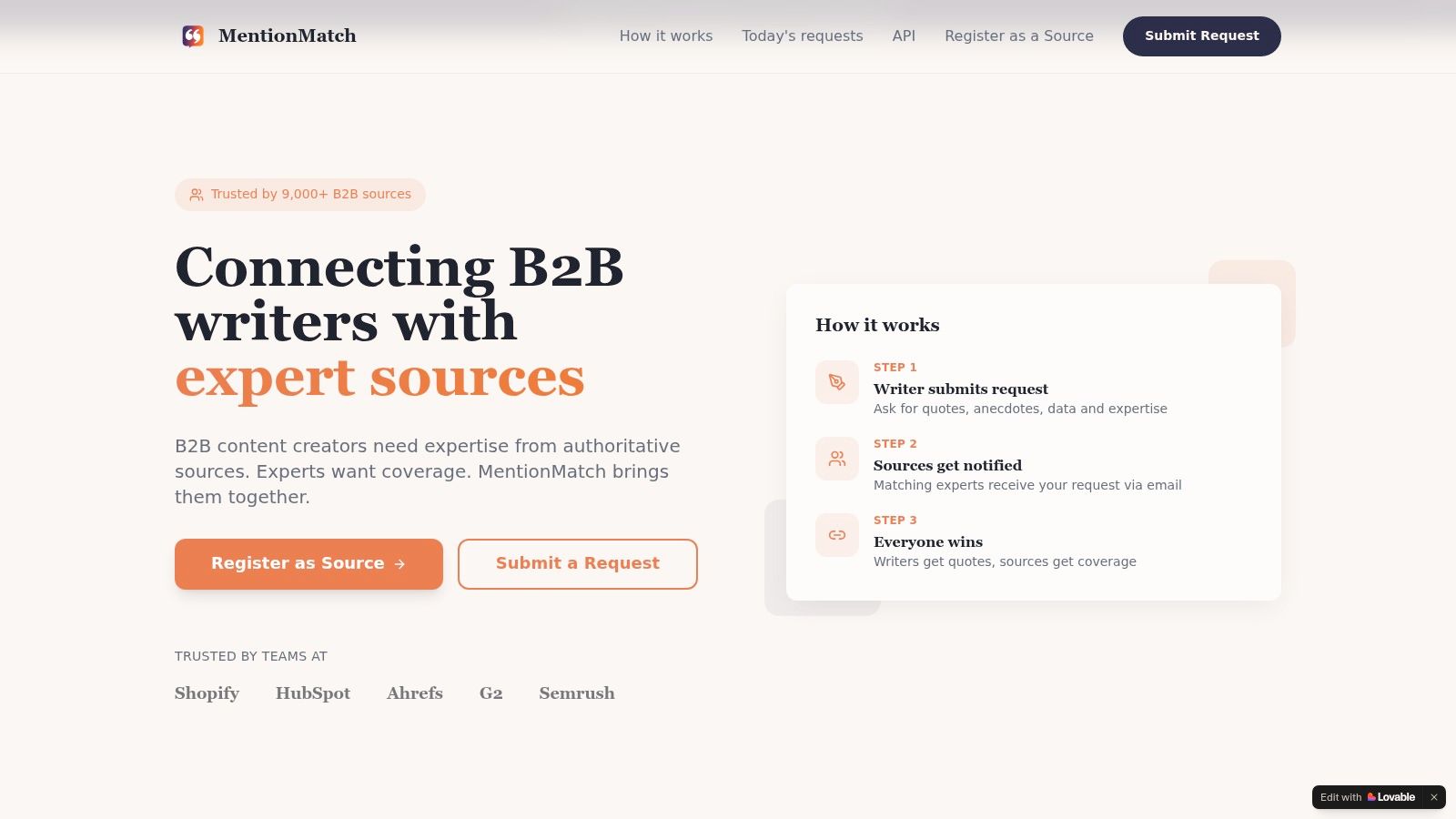
4. Help a B2B Writer
Help a B2B Writer is one of the better niche tools for teams that live in SaaS, AI, data, and MarTech. That category focus matters because topical fit usually beats raw platform size when the goal is a contextual mention inside a B2B article. It's a digest-based system, and sources can reply by form or email, which makes it easy to slot into an existing content process.
Why B2B teams care
The requests are narrower than general PR platforms, and that's a strength. A SaaS marketer doesn't need to sort through consumer lifestyle asks to find one relevant question, and a writer covering search or product marketing usually wants a source who understands the terminology. That raises the odds of getting a contextual mention that sits naturally inside the article, not a token quote buried at the end.
What to expect in practice
Volume is lower than broad journalist-request ecosystems, so it's not a high-throughput source for teams chasing daily placements. Quality also varies by writer and outlet, which means your internal vetting still matters after the quote is accepted. Use this platform when a topic already lines up with a strong POV, a customer pattern, or a product insight you can explain without handholding.
Practical rule: if your answer sounds like a blog post intro, rewrite it. Writers want a quote they can publish, not a page you want them to canonize.
The best replies are compact, technical when needed, and obviously written by someone who works in the category rather than someone borrowing the jargon.
5. SourceBottle
SourceBottle is a long-running journalist-source service with a stronger footprint in Australia, New Zealand, and the UK, while still seeing U.S. usage. It's especially useful when you want roundups, expert commentary, or international placements that can diversify your backlink profile beyond U.S.-only publications. The platform's daily alerts and topic selection make it easier to keep your responses aligned with active requests.
Where it helps and where it doesn't
The best thing about SourceBottle is persistence. If your niche doesn't generate a flood of media requests, a steady alert feed can keep opportunities visible without a lot of manual prospecting. The downside is that many placements are nofollow, so the asset is often stronger as a citation and credibility signal than as a direct PageRank lever.
That distinction matters. A nofollow mention can still drive referral traffic, help with branded search visibility, and reinforce entity trust, especially if the journalist or outlet is respected in your market. But if your only goal is link equity, SourceBottle should sit behind more effective editorial channels.
How to pitch it
Use the geographic angle when it fits, especially for locally relevant stories, regional trends, or cross-market commentary. Keep the email short, state the exact quote you can provide, and make the journalist's job easier by attaching a one-line credential that explains why your perspective is legitimate. If the story is strong, the quote can become a citation in a roundup, a feature, or a larger explainer.
A practical SourceBottle pitch usually works when it answers three things fast, who you are, why you fit this query, and what the journalist can use immediately.
6. Connectively HARO Successor Branding
Connectively is useful if your team wants a familiar HARO-style workflow with category and keyword alerting layered on top. It's a reactive PR tool, and that makes it valuable for brands that can answer quickly when a relevant query appears. The free tier includes pitch limits, with paid options available if you need more volume.
Why teams still use it
The core advantage is still the same as classic HARO workflows, you can land into editorial coverage by responding to journalist demand rather than cold outreach. That can be efficient when your team has subject-matter experts on standby, because the right response at the right time can produce a placement that's hard to manufacture any other way. The keyword alerts help with discovery, so you're not limited to scanning broad categories all day.
You should still treat availability carefully. Program details and access have changed over time, so confirm current regional access before you build a recurring workflow around it. Reactive PR only works when the platform is live, the alerts are relevant, and the turnaround speed matches the journalist's deadline.
Build the habit, not just the account
Use the platform with a repeatable response structure. One line for the point, one line for the proof, one line for the context. If your team already publishes off-page content, this off-page SEO guide can help you connect reactive PR to broader authority-building instead of treating it as a one-off tactic.
- Set keyword alerts tightly: Broader alerts create noise faster than they create placements.
- Pre-write expert bios: Short bios speed up approvals and reduce friction.
- Answer only where you can add signal: Empty commentary gets buried.
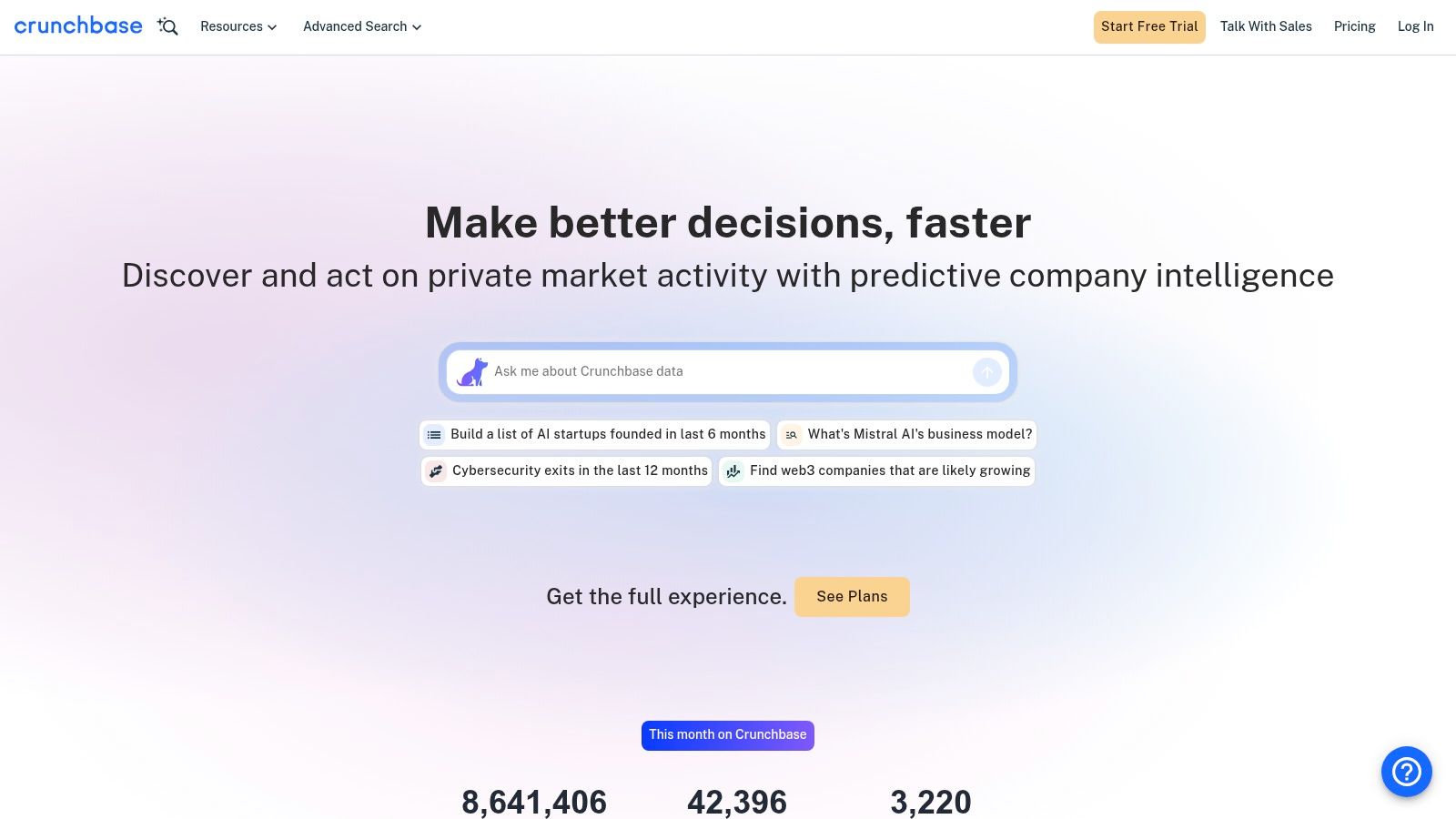
7. Crunchbase Company Profile
A Crunchbase company profile is less about link equity and more about entity trust. You can create or claim a free profile, add your official website, and keep organization data consistent in a place that journalists, investors, and data aggregators already reference. That consistency matters because search engines and knowledge systems rely on repeated identity signals across the web.
Why it's a citation asset, not a classic backlink play
The link is typically nofollow, so you should treat the profile as an authority and citation layer rather than a PageRank source. That doesn't make it weak. It means the value comes from being a reliable third-party record of your company name, website, and core organization details, which helps when people research your brand or when other systems try to reconcile your identity.
Make the profile do real work
Fill in the profile with the same brand name, website, and positioning you use everywhere else. Don't leave the page half-empty, because incomplete data weakens the citation signal and makes the profile look abandoned. If your team already knows how entity consistency affects local trust, the same logic applies here, just at a broader company-data layer.
Practical rule: use Crunchbase to reduce ambiguity about who you are, not to chase anchor text.
Moderation can slow edits, so plan for update lag instead of expecting instant changes. The best profiles are the ones that stay accurate as your company grows, because stable entity data is more valuable than a rushed listing.
8. Google Business Profile GBP
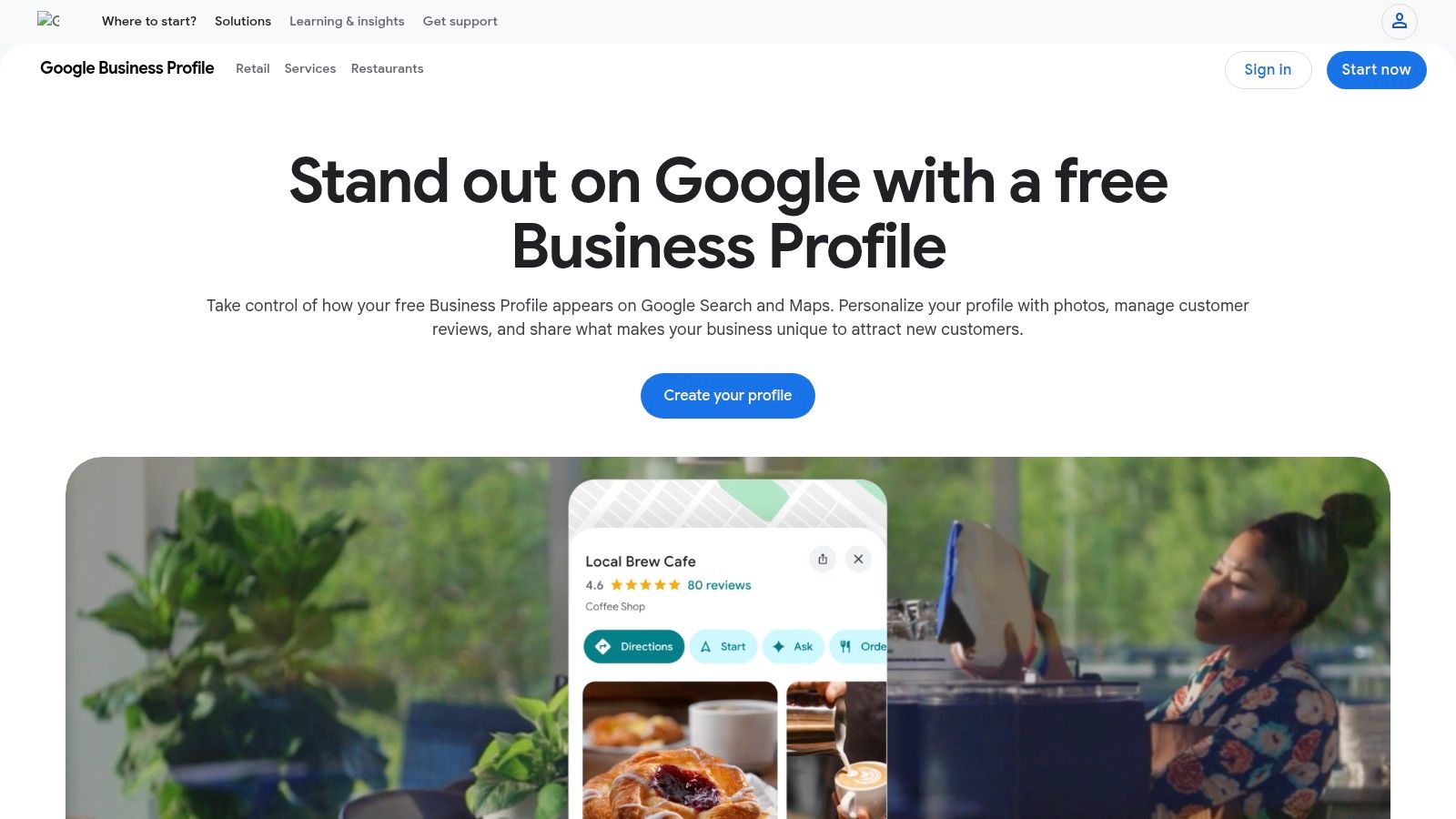
Google Business Profile is one of the most important free backlink sites for local and service-area brands because it anchors your business where buyers already search. You can add your website, categories, attributes, services, posts, and FAQs, and the profile can surface in both Search and Maps. That makes it part citation, part discovery asset, and part conversion surface.
What GBP actually does for SEO
GBP's value is strongest around entity trust, branded visibility, and local discovery. The website link itself is usually nofollow, so this is not the place to chase PageRank fantasies. It is the place to make sure Google and your customers both see a coherent, active business with the right category, services, and supporting content.
What to keep current
Maintenance matters more here than on almost any other free listing. Reviews, profile completeness, service updates, and post activity all affect whether the profile feels alive to users and useful to Google. If your local team needs a deeper operating view, this Google Business Profile SEO guide will help you connect the listing to broader local visibility work.
- Keep NAP consistent: Your name, address, and phone details should match your site exactly.
- Use the FAQ area well: Answer the questions buyers ask.
- Refresh services and posts: An active profile tends to support discovery better than a static one.
GBP isn't glamorous, but for local and service brands it's often the highest-confidence free citation you can maintain. If you only do one entity asset well, make it this one.
9. GitHub Organization Profile
GitHub is one of the cleanest free backlink sites for technical brands because it combines trust, public visibility, and practical usage. A GitHub organization profile includes a Website field, and domain verification can strengthen the organization's credibility. If you have open-source work, SDKs, docs, or developer-facing resources, GitHub can support both your entity story and your technical authority.
Why technical brands get more from GitHub
The platform works because it looks and behaves like a real product ecosystem, not a fake link dump. Public repos, README files, and organization metadata can all reference your site naturally, especially when the repo exists for genuine code, documentation, or tooling. Search engines and developers both read that as a stronger signal than a hollow profile built only to host a URL.
How to use it without looking spammy
Keep the organization page complete and consistent. Add the website field, use a clean description, and only link from public files when the repository itself has a legitimate purpose. If you have open-source assets, include the site link where it helps users find docs, releases, or support, not where it feels pasted in for SEO alone.
A GitHub profile is strongest when it backs up something tangible, like a public library, an integration guide, or a developer resource page. That's why technical teams can get more value from one good GitHub presence than from a dozen empty profiles elsewhere.
10. Product Hunt Launch Page
Product Hunt is one of the few free backlink sites that can produce real discovery traffic and secondary mentions if the launch is strong enough. Anyone with a personal account can submit a product, and the launch page gives you a primary website link, a description, gallery assets, and updates. The link itself is usually user-generated and often nofollow, but the referral and visibility upside can still be meaningful.
Why launch pages matter beyond the link
Product Hunt works because it can trigger the next layer of coverage. If makers, operators, or niche newsletters notice the launch, they may write about it, and that's where the secondary links often show up. In other words, the Product Hunt page is sometimes less valuable as a direct SEO asset and more valuable as a catalyst for broader brand exposure.
What strong launches have in common
Launch preparation matters more than the listing itself. A weak description, thin gallery, or half-finished update cadence won't get much traction. A focused launch with a clear value proposition, a polished visual story, and active community engagement stands a much better chance of generating attention that leaves the platform and reaches blogs, newsletters, and social discussions.
The link is the entry point. The launch is the asset.
Treat Product Hunt as a visibility event, not just a backlink event. If your audience includes founders, buyers, or developers, the platform can become a useful top-of-funnel channel that does more than add one more line to your link profile.
Top 10 Free Backlink Sources Comparison
| Item | Core offer / key features | Quality & UX (spam, workflow, credibility) | Best for / target audience | Price / Notes |
|---|---|---|---|---|
| Source of Sources (SOS) | Free daily journalist digests; direct replies to reporters; quality enforcement | Founder-backed credibility; fast pace; minimal platform tooling | Experts seeking quick editorial mentions and authoritative citations | Free; https://www.sourceofsources.com; highly competitive |
| Qwoted | Expert database; structured requests; paid visibility tiers | Clean UX; lower spam than legacy lists; professional request format | PR pros and experts targeting trade & mainstream outlets | Freemium (paid tiers); https://www.qwoted.com |
| Featured (formerly Terkel) | Curated prompts; expert profiles; optional paid answer credits | Writer-led curation; efficient Q&A workflow | Niche and B2B placements; consistent contributor programs | Free + paid credits; https://featured.com; follow vs nofollow varies |
| Help a B2B Writer | B2B-specific digests (SaaS, AI, MarTech); reply via form/email | High topical fit; lower request volume; simple workflow | B2B SaaS, MarTech, and SEO teams seeking contextual links | Free; https://helpab2bwriter.com |
| SourceBottle | Topic selection; daily alerts; shareable expert profiles | Long-running service; steady call-outs; regional skew (AU/NZ/UK) | International placements and roundup opportunities | Free; https://www.sourcebottle.com; many nofollow placements |
| Connectively (HARO successor) | HARO-style queries; category & keyword alerts; pitch limits on free tier | Familiar HARO workflow; competitive; platform details may vary by region | Reactive PR and teams chasing high-authority editorial links | Freemium; https://www.connectively.us; check regional access |
| Crunchbase company profile | Free company profile; organization data for knowledge graphs | High-trust citation; used by journalists and data aggregators | Startups, investors, and brands needing authoritative entity signals | Free to create; https://www.crunchbase.com; usually nofollow |
| Google Business Profile (GBP) | Business listing with website link, posts, services & FAQs; Maps visibility | Powerful local discovery; requires ongoing maintenance and reviews | Local/service-area businesses and branded search optimization | Free; https://www.google.com/business; links typically nofollow |
| GitHub organization profile | Org page with website field; domain verification; public repos | Trusted by developer communities; strong technical credibility | Developer-centric brands and projects with open-source assets | Free; https://github.com; links usually nofollow |
| Product Hunt launch page | Product listing with primary URL, gallery, updates; community launch tools | High referral traffic on launch; needs active community prep | Product launches seeking visibility, early users, and secondary coverage | Free to submit; https://www.producthunt.com; UGC/nofollow links |
Taking Action on Your Backlink Strategy
The right move now is to stop chasing every free backlink site on the internet. Pick two that fit your business model, one from the PR platform group and one from the entity citation or expert community group, then build a repeatable process around them. SaaS and B2B teams usually get the best mix by pairing a journalist-request platform with a company profile or developer profile. Local and service-based businesses usually do better with GBP plus one media-request channel, because that combines trust with discovery.
Use the same verification mindset every time a link goes live. Independent guidework emphasizes checking the final URL, HTTP status, redirect chain, target href, anchor text, rel value, canonical URL, noindex state, screenshot, approval date, recheck date, and referral traffic after placement, and it also warns against PBNs, expired-domain networks, auto-created profiles, exact-match anchor swaps, comment spam, paid followed placements, and directories that exist only to sell links (post-placement verification checklist). That standard matters because a free link that cannot be verified adds clutter, not authority.
Your outreach copy should stay short, specific, and easy to scan. For media requests, say who you are, why your perspective fits, and what the journalist can quote. For entity citations, keep the details consistent, complete, and relevant across profiles. For launch platforms, make sure the public page gives people a reason to click through, stay, and reference you elsewhere.
Ready-to-use outreach helps here, too. A media request can read, “I cover this topic regularly, and I can share a clear example, a process, or a data point your readers can use.” A profile update can say, “Please use this business name, website, and description so our citations match across the web.” If you are building outreach lists, follow best practices for email scraping so your data collection stays compliant and your deliverability does not take a hit.
A practical backlink program does not depend on luck. It depends on a small number of credible placements, clean follow-up, and the discipline to skip easy spam traps. If you want a workspace that helps you connect link opportunities to actual SEO execution, Nuwtonic brings audits, content operations, and AI search visibility into one system so your team can spot citation gaps, prioritize fixes, and move faster on the pages that matter.