
Honestly, offpage seo is where a lot of sites either build real authority or waste months chasing junk metrics. You can have clean technical SEO and solid content, but if no one references your brand, links to your pages, or talks about your business beyond your own site, rankings usually stall.

Google Search Essentials frames off page signals as external indicators of quality, and Moz defines off page SEO as actions taken outside your website, such as earning backlinks and brand mentions, that help improve rankings. That lines up with what I have seen over the last 8 years: search engines trust sites that other credible sites and people seem to trust.
TL;DR Summary
• Offpage SEO is everything you do outside your website to improve trust, authority, visibility, and rankings.
• The biggest ranking levers are still high quality backlinks, relevant referring domains, brand mentions, PR, reviews, and local citations.
• Social activity can help distribution, but I have seen too many teams overestimate social signals. Quality backlinks still outweigh social shares.
• A healthy backlink profile is usually diverse in source, anchor text, page type, and intent.
• Most sites should expect 3 to 6 months to see measurable impact from solid off page work, though competitive niches can take longer.
• Tactics like guest posting, digital PR, broken link building, and local citation cleanup work best when they fit your site’s maturity, budget, and content quality.
• Cheap links, private blog networks, and manipulative anchor text usually create more cleanup work than growth.
Table of Contents
What offpage SEO actually means
Off page SEO vs on page SEO
Why offpage SEO affects rankings
Core off page SEO techniques
How to do offpage SEO step by step
Off page SEO checklist
Ranking factors and measurement
Using Ahrefs for offpage SEO
FAQ
Sources and references
Key Takeaways
• Authority is external. Your site does not get to declare itself trustworthy. The web does that for you.
• Relevance beats raw volume. One strong backlink from a topically aligned site can outperform dozens of weak links.
• Brand signals matter more than many older guides admit. Search Engine Journal and LinkedIn reporting in 2023 pointed to the growing value of unlinked brand mentions and broader authority signals.
• Local businesses need citation accuracy, not directory spam. I keep seeing businesses submit to 50 directories when 5 accurate local citations and a few reviews do more.
• Link quality is contextual. Domain authority helps as a filter, but topical relevance, page quality, placement, and editorial intent matter just as much.
What offpage SEO actually means
A clear definition
Look, the truth is, offpage SEO covers all SEO activities that happen outside your website and influence how search engines evaluate your credibility, relevance, and authority.
Moz’s 2024 guidance describes it as link building, brand mentions, and content marketing that improve rankings. Yoast puts it even more simply: it is everything you do outside your site to gain trust and credibility. Helium SEO’s 2024 study also emphasized that the central goal is to show search engines your website is valuable, trustworthy, and relevant.
That means offpage SEO is not just backlinks.
It includes:
• Backlinks from other websites
• Unlinked brand mentions
• Digital PR coverage
• Reviews and reputation signals
• Local citations and NAP consistency
• Influencer collaborations
• Guest authoring
• Forum and community participation
• Content syndication
• Social distribution that amplifies reach
What offpage SEO is not
Before I talk tactics, here is what not to do:
• Do not confuse offpage SEO with technical fixes on your own site
• Do not assume every mention needs a followed backlink to matter
• Do not buy low cost links from random sellers and call it strategy
• Do not treat domain authority as Google’s metric. It is a third party estimate, useful but imperfect
In my experience, a lot of weak SEO programs fail because they treat off page work like a spreadsheet exercise. More rows. More domains. More anchors. That is not authority. That is just activity.
Why search engines care about external signals
If on page SEO tells search engines what your content is about, off page SEO helps confirm whether anyone else believes it deserves attention.
Marketing Illumination’s reporting notes that backlinks act like endorsements. Coursera’s 2023 overview similarly highlighted that relevant, authoritative backlinks remain a critical step in SEO marketing. That tracks with the old idea of link juice—not a formal Google term, but a useful shorthand for authority passed through links.
A practical way to think about it:
Signal | What it tells search engines | Typical SEO value | Common mistake |
|---|---|---|---|
Editorial backlink | Another site recommends your content | Very high | Chasing quantity over relevance |
Brand mention | Your brand is being discussed | Medium to high | Ignoring unlinked mentions |
PR feature | Trusted publication recognizes your brand | High | Treating PR as separate from SEO |
Review signal | Users trust the business | Medium, especially local | Letting negative reviews pile up |
Social distribution | Content is being seen and shared | Indirect but useful | Expecting shares alone to boost rankings |
Off page SEO vs on page SEO
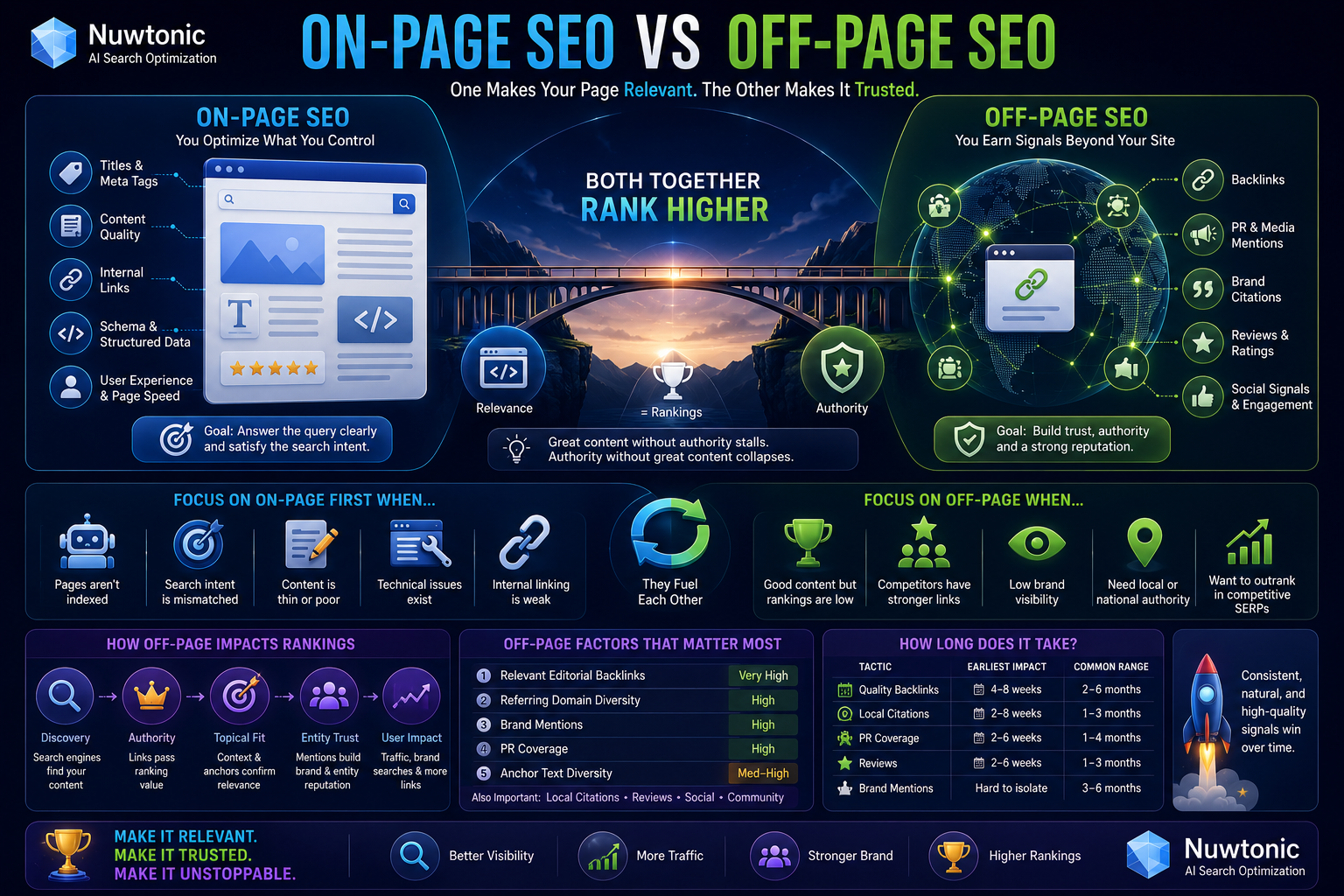
The difference between onpage and offpage SEO
Honestly, this is one of the easiest distinctions to explain and one of the most commonly blurred in practice.
SEO Type | Happens where | Main goal | Examples |
|---|---|---|---|
On page SEO | On your website | Improve relevance, clarity, and usability | Title tags, content optimization, internal links, schema, UX |
Offpage SEO | Outside your website | Improve trust, authority, and reputation | Backlinks, PR, mentions, citations, reviews |
On page SEO says, this page answers the query.
Offpage SEO says, other people seem to agree.
You need both. I have worked on sites with excellent content and poor off page signals that plateaued on page 2. I have also seen heavily linked sites underperform because their pages were thin, misaligned, or technically messy.
Why offpage SEO is critical for ranking
Be Found Online’s explanation of off page SEO highlights link building, PR, and social engagement as ways to extend reach, while Moz notes the broader goal is building a digital footprint that shows why your site deserves to rank.
That is the key phrase: deserves to rank.
Search engines are trying to reduce risk. If two pages are equally relevant, the page attached to the stronger reputation usually wins.
When on page matters more than off page
Fair warning: not every ranking problem is an off page problem.
Choose on page and technical work first when:
• Your pages are not indexed correctly
• Search intent is mismatched
• Content quality is poor
• Core templates are broken
• Internal linking fails to surface important pages
Choose off page as the main lever when:
• Your content is solid but stuck below competitors
• Competitors have stronger referring domains
• You have low brand visibility
• You need local trust signals or national authority signals
How both work together
A strong backlink profile can push authority into your domain, but your internal linking structure decides where that authority flows. So yes, internal linking is technically on page, but it supports off page gains by distributing earned authority to money pages and high intent content.
Why offpage SEO impacts website rankings
The mechanism behind ranking improvement
Look, the truth is, off page SEO affects rankings through comparative trust. Search engines are not scoring your site in a vacuum. They compare your entity, your pages, and your backlink profile against others competing for the same SERPs.
A backlink can help because of several layers at once:
Discovery
• Search engines find and revisit pages through links.Authority transfer
• Strong pages can pass ranking value through links.Topical reinforcement
• Relevant surrounding content and anchor text help confirm subject alignment.Entity validation
• Brand mentions and references build a broader reputation footprint.User behavior side effects
• PR and mentions can drive real traffic, branded searches, and secondary links.
The ranking factors that matter most
A 2024 Helium SEO study identified high quality backlinks, social presence, and positive brand mentions as major off page factors. In practice, I would weight them a bit differently.
Offpage factor | My practical weighting | Why it matters | Risk level |
|---|---|---|---|
Relevant editorial backlinks | Very high | Strongest direct authority signal | Low if earned ethically |
Referring domain diversity | High | Reduces overreliance on a few sources | Low |
Brand mentions | High | Supports entity authority and trust | Low |
PR coverage | High | Earns links, mentions, and reputation at once | Low to medium |
Anchor text diversity | Medium to high | Prevents manipulation patterns | Medium if over optimized |
Local citations | High for local SEO | Reinforces business legitimacy | Low |
Reviews | Medium to high for local | Improves trust and conversions | Low |
Social shares | Low direct, medium indirect | Helps reach and link attraction | Low |
Forum/community participation | Medium indirect | Can drive mentions and awareness | Low if authentic |
Most people overestimate the impact of social signals on SEO. I am slightly skeptical whenever someone claims their rankings jumped because a post got shared 2,000 times. Usually, the real effect came from the backlinks, brand searches, or press pickup that followed.
How long offpage SEO takes to work
This depends heavily on competition, crawl frequency, site age, and the quality of the links or mentions.
A realistic benchmark:
Tactic | Earliest visible impact | Common range | Notes |
|---|---|---|---|
New quality backlinks | 4 to 8 weeks | 2 to 6 months | Competitive keywords take longer |
Local citations cleanup | 2 to 8 weeks | 1 to 3 months | Faster in lower competition markets |
PR coverage | 2 to 6 weeks | 1 to 4 months | Often drives referral and branded search first |
Review acquisition | 2 to 6 weeks | 1 to 3 months | Stronger impact in local packs |
Brand mention growth | Harder to isolate | 3 to 6 months | Measurement is messy |
I have seen one guest post link influence a mid tier keyword cluster in under a month. I have also seen enterprise campaigns need a full quarter before movement showed up cleanly. Your mileage may vary.
The best off page SEO techniques in 2026
Link building that is still worth doing
Honestly, if I had to narrow offpage SEO down to the most reliable white hat techniques, I would start here:
Digital PR
• Best when you have data, original research, founder insight, or a useful angle.Guest posting on relevant sites
• Best when you can provide genuinely strong expertise.Broken link building
• Best when you already have a quality replacement resource.Linkable asset promotion
• Best for guides, tools, calculators, original studies, or templates.Brand mention reclamation
• Best when people already talk about your brand without linking.Niche partnerships and resource pages
• Best for B2B, SaaS, associations, and local organizations.
A great outreach strategy is less about quantity and more about building real relationships with site owners. I learned that the hard way years ago after sending a few hundred generic outreach emails for a client in a crowded finance niche. Open rates looked decent. Replies were awful. Once we rewrote the process around relevance, article fit, and actual value, acceptance rates improved even with fewer emails.
Tactics that usually disappoint
Before the better ideas, here is what I generally tell teams to avoid:
• Mass directory submissions outside local SEO
• Low quality paid guest posts on irrelevant sites
• PBN links unless you enjoy long term cleanup risk
• Exact match anchor text campaigns at scale
• Social bookmarking as a serious ranking tactic
• Comment spam and forum profile links
One pattern I keep seeing matches community reports almost perfectly: someone buys a cheap link package, ends up with 200 spammy backlinks, then spends 6 weeks or more trying to recover after using Google’s Disavow tool. That is not efficient SEO. It is expensive rework.
Local off page SEO techniques
If the business serves a geography, local off page work matters a lot.
Local tactic | When to use it | What success looks like | Common failure |
|---|---|---|---|
Google Business Profile review growth | Any local business | More trust, better local visibility | Asking once and stopping |
NAP citation cleanup | Inconsistent listings | Stable local relevance signals | Inconsistent business data |
Local PR | Regional brands, service businesses | Local links and mentions | Generic national outreach |
Sponsorships and community mentions | Local presence matters | Branded mentions and local trust | Paying for irrelevant exposure |
Local directories | Selective use only | Accurate citations on trusted sites | Submitting to dozens of junk directories |
A local business case I have seen more than once looks like this: the owner thinks they need 50 directory listings, submits manually, and only a fraction get indexed. Meanwhile, rankings barely move. Then they tighten NAP consistency across 5 good local citations, add 3 Google reviews, and improve local positions within about 2 months. That is a much more normal outcome than the directory spam fantasy.
Influencer outreach, syndication, and communities
These can work, but only under the right conditions.
Tactic | Best for | SEO upside | What to watch |
|---|---|---|---|
Influencer reviews | Consumer products, niche tools | Referral traffic, mentions, possible links | Check real authority and audience fit |
Content syndication | Thought leadership, B2B reach | More visibility, occasional backlinks | Use canonical or clear source attribution where needed |
Forums and communities | Expert brands, niche products | Natural mentions, demand generation | Do not force links |
One failed outreach example still annoys me a little. A team paid around $500 for an influencer review because the creator looked active on social media. The site behind the review had weak authority and poor topical relevance, so the backlink did almost nothing for rankings. Traffic bumped briefly, then disappeared. The lesson was simple: evaluate the website, not just the personality.
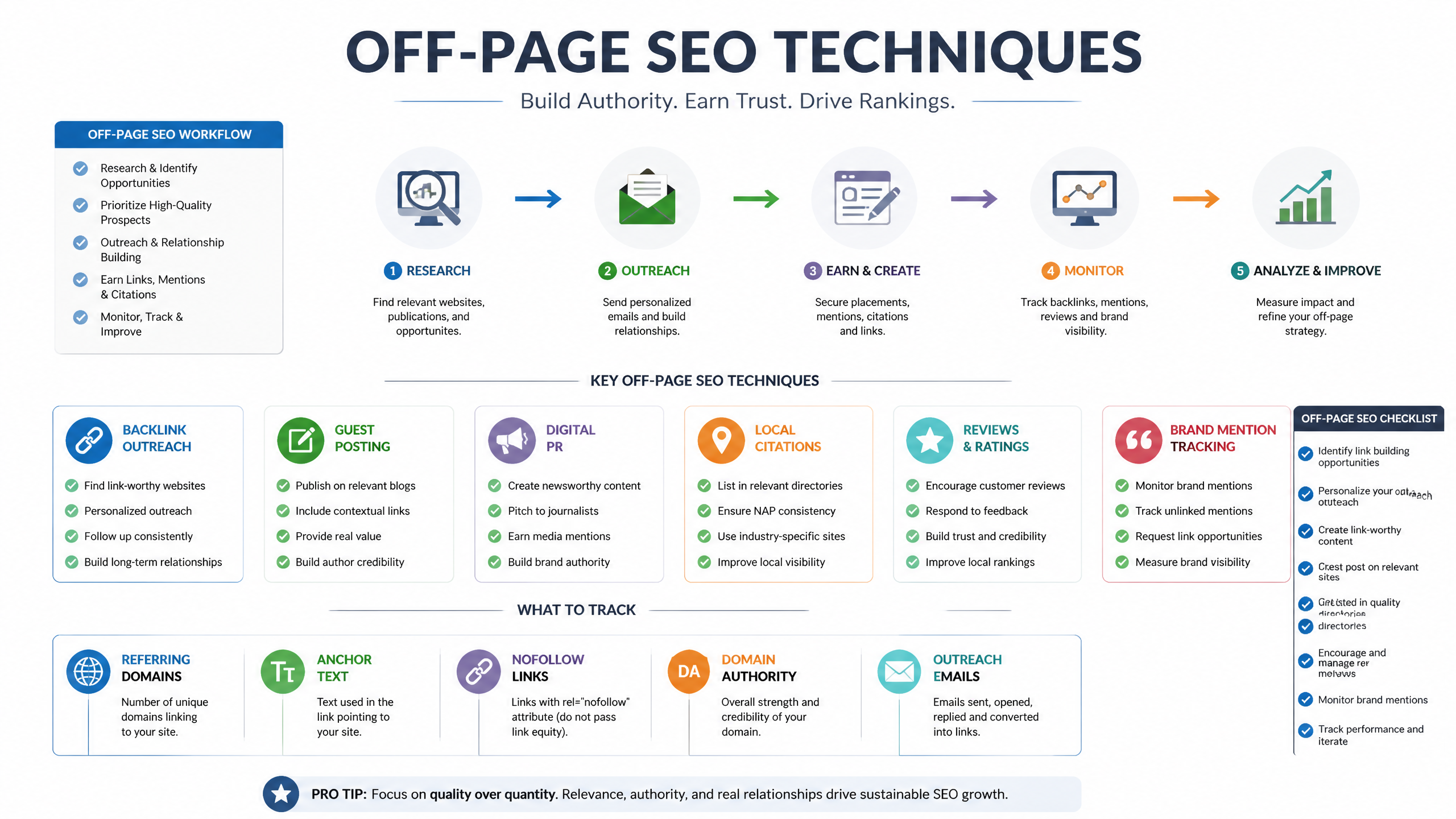
How to do offpage SEO step by step
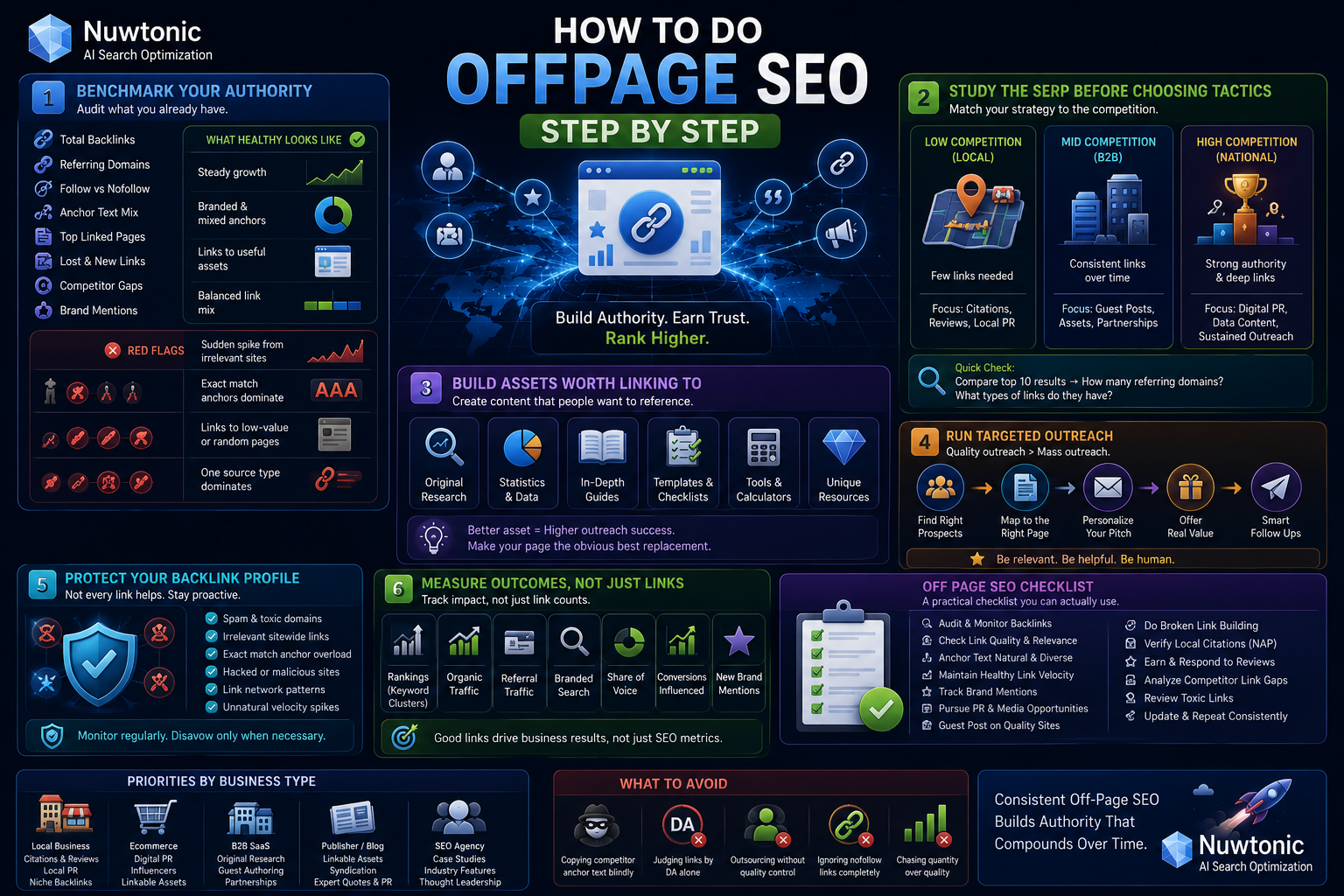
Step 1: Benchmark your current authority
Before building anything, audit what you already have.
Use tools such as Ahrefs, Moz, or Semrush to review:
• Total backlinks
• Referring domains
• Followed versus nofollow links
• Anchor text distribution
• Top linked pages
• Lost backlinks
• New backlinks
• Competitor link gaps
• Brand mentions if your stack supports them
I look for patterns first, not vanity numbers.
For example:
Metric | Healthy sign | Red flag |
|---|---|---|
Referring domains | Steady growth from relevant sites | Sudden spike from unrelated domains |
Anchor text | Branded and mixed anchors dominate | Exact match anchors dominate |
Top linked pages | Links point to useful assets and core pages | Most links hit random low value pages |
Link type mix | Editorial, citations, mentions, nofollow links mixed | Almost all links from one source type |
I have seen too many businesses neglect the importance of a diverse backlink profile. Balance is key.
Step 2: Study the SERP before choosing tactics
Do not ask, “How many backlinks do I need?” in isolation. Ask, “What kind of authority do the top results have?”
There is no universal number, but you can estimate ranges by comparing competitors.
Keyword difficulty situation | Typical off page need | Better tactic choice |
|---|---|---|
Low competition local term | Few quality citations and a handful of links | Local citations, reviews, local PR |
Mid competition B2B term | Consistent relevant links over months | Guest posts, linkable assets, partnerships |
High competition national term | Strong domain authority and deep link profile | Digital PR, data content, sustained outreach |
If the top 10 results have 80 to 200 referring domains to their ranking pages, your 3 links will probably not close the gap. If they have 10 to 20 relevant referring domains and weak content, then yes, you may have a real opening.
Step 3: Build assets worth linking to
Look, the truth is, outreach fails when the target page is weak.
Create pages that deserve links:
• Original research
• Statistics roundups with clear sourcing
• Deep guides
• Comparison pages
• Templates and checklists
• Free tools or calculators
• Strong category or service pages with unique value
Broken link building is a great example. It only works well if your replacement page is genuinely better than the dead resource. I have watched campaigns get rejected by 80% of prospects because the replacement page was thin. Then the team improved the page, switched part of the effort toward guest posting, and landed 1 featured placement out of 5 outreach emails within about 3 weeks. That kind of pivot is normal.
Step 4: Run targeted outreach
My basic outreach process looks like this:
Build a narrow prospect list
• Prioritize topical relevance and editorial quality.Map each prospect to a specific page
• Do not pitch your homepage if the fit is really a guide.Personalize the reason for contact
• Mention context, broken links, article gaps, or audience fit.Lead with value
• Offer a useful update, replacement, quote, or contribution.Follow up carefully
• A small number of useful follow ups beats aggressive chasing.
Step 5: Protect your backlink profile
Not all links help.
Monitor for:
• Obvious spam domains
• Sitewide links from irrelevant sites
• Exact match anchor overload
• Hacked site links
• Link network patterns
• Sudden link velocity spikes that do not make business sense
Toxic links are not always catastrophic, and Google ignores a lot of junk on its own. But if you have a history of manipulative link building, cleanup may be necessary.
Step 6: Measure outcomes, not just links
A backlink report is not a strategy report.
Track:
• Rankings by page and keyword cluster
• Organic traffic growth
• Referral traffic from acquired links
• Branded search growth
• Share of voice in your niche
• Conversions influenced by off page landing pages
• New brand mentions over time
Off page SEO checklist
A practical checklist you can actually use
Honestly, most checklists are too vague to help. So here is the version I would hand to a team.
Area | Checklist item | Status goal |
|---|---|---|
Backlink profile | Audit referring domains and top linked pages | Monthly |
Link quality | Review relevance, placement, and authority | Monthly |
Anchor text | Keep branded and natural anchors dominant | Monthly |
Link velocity | Look for steady, believable growth | Monthly |
Brand mentions | Track linked and unlinked mentions | Monthly |
PR | Pitch data stories, expert commentary, or news angles | Ongoing |
Guest posting | Build a shortlist of credible niche sites | Quarterly refresh |
Broken links | Find dead resources you can replace | Monthly |
Local citations | Verify NAP consistency across core listings | Quarterly |
Reviews | Request and respond to reviews | Weekly |
Competitors | Analyze link gaps and new mentions | Monthly |
Toxic links | Flag suspicious domains for review | Monthly |
Off page SEO checklist by business type
Business type | Priority 1 | Priority 2 | Priority 3 |
|---|---|---|---|
Local service business | Citations and reviews | Local PR | Niche backlinks |
Ecommerce brand | Digital PR | Influencer collaborations | Linkable assets |
B2B SaaS | Original research | Guest authoring | Partnerships |
Publisher or content site | Linkable assets | Syndication | Expert quotes and PR |
SEO agency | Case studies | Industry features | Thought leadership guest posts |
What to avoid during checklist execution
• Do not copy competitor anchor text patterns blindly
• Do not judge a link only by domain authority
• Do not outsource outreach without clear quality controls
• Do not ignore nofollow links entirely. Some nofollow links still drive visibility, traffic, and secondary links
Offpage SEO ranking factors and how to measure them
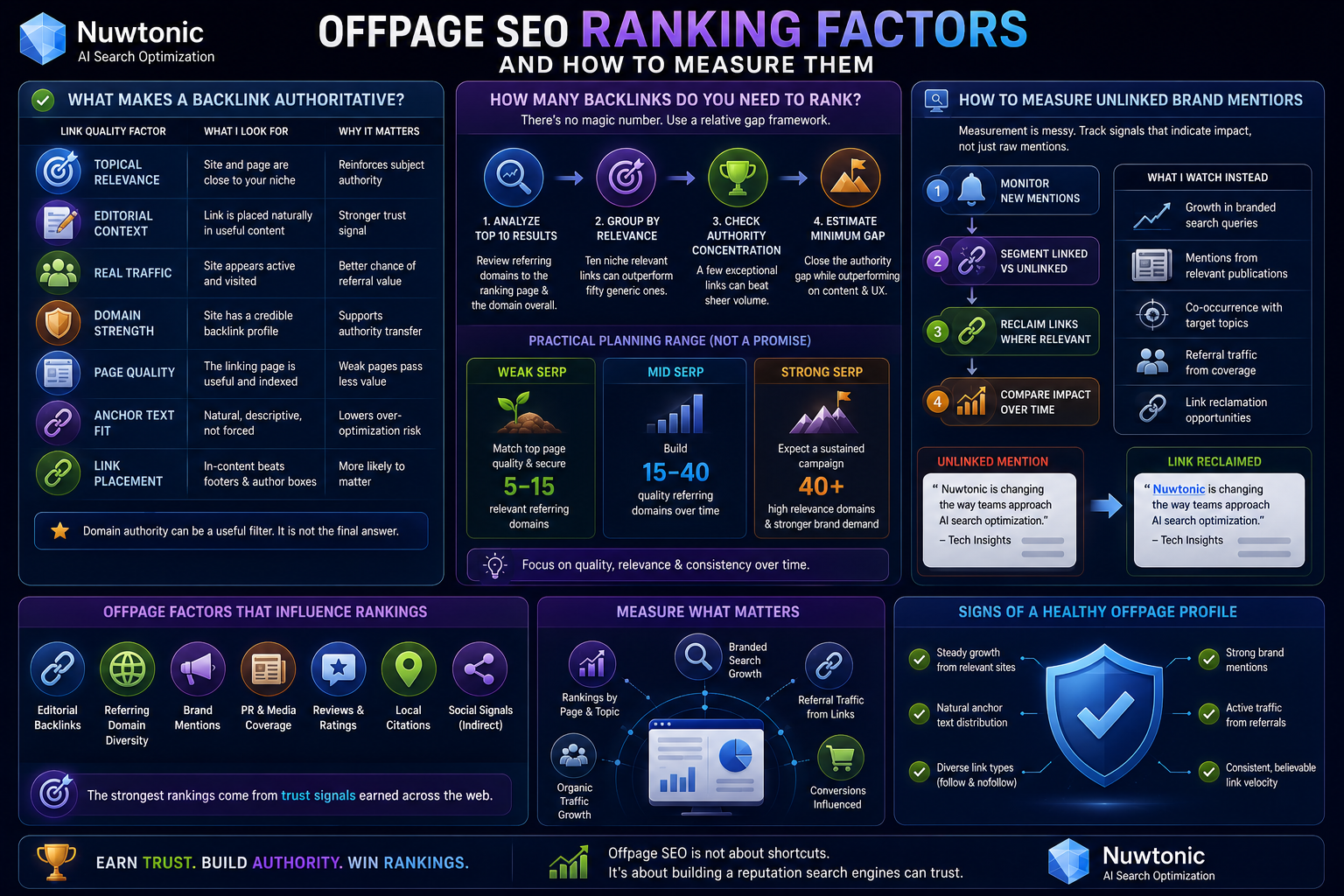
What makes a backlink authoritative
A backlink is usually worth pursuing when it checks most of these boxes:
Link quality factor | What I look for | Why it matters |
|---|---|---|
Topical relevance | Site and page are close to your niche | Reinforces subject authority |
Editorial context | Link is placed naturally in useful content | Stronger trust signal |
Real traffic | Site appears active and visited | Better chance of referral value |
Domain strength | Site has credible backlink profile | Supports authority transfer |
Page quality | The actual linking page is useful and indexed | Weak pages pass less value |
Anchor text fit | Natural, descriptive, not forced | Lowers over optimization risk |
Link placement | Main content beats footers and author boxes | More likely to matter |
Domain authority can be a useful filter. It is not the final answer.
How many backlinks do you need to rank
This is the question everyone asks, and I get why. But no honest SEO should give you one fixed number.
A more useful framework:
Compare the top 10 results
• Review referring domains to the ranking page and the domain overall.Group by relevance, not just count
• Ten niche relevant links can outperform fifty generic ones.Check authority concentration
• If one competitor has a few exceptional links, volume alone may not beat them.Estimate a minimum viable gap
• Aim to close enough of the authority gap while outperforming on content and UX.
If you need a practical rule of thumb, I usually estimate by relative gap rather than fixed volume:
Competitive context | Relative target |
|---|---|
Weak SERP | Match top page quality and secure 5 to 15 relevant referring domains |
Mid SERP | Build 15 to 40 quality referring domains over time |
Strong SERP | Expect a sustained campaign, often 40 plus high relevance domains and stronger brand demand |
That is not a promise. It is a planning range.
How to measure unlinked brand mentions
This is one of the weakest areas in most off page SEO articles, so let me be blunt: measurement here is messy.
You can track brand mentions using SEO suites, media monitoring tools, and manual search workflows, but isolating their ranking impact is difficult because mentions often overlap with PR, branded search growth, and earned links.
What I watch instead:
• Growth in branded search queries
• Mentions from relevant publications
• Co occurrence with target topics
• Referral traffic from coverage
• Link reclamation opportunities from unlinked mentions
The cleanest workflow is often:
Monitor new brand mentions.
Segment linked versus unlinked.
Reclaim links where editorially appropriate.
Compare mention growth with branded search and ranking stability over time.
How to use Ahrefs for offpage SEO
The Ahrefs reports that matter most
Honestly, Ahrefs is one of the most practical tools for offpage SEO because it helps you move from raw backlink data to decisions.
Here is how I use it:
Ahrefs report | Use case | What to look for |
|---|---|---|
Site Explorer Overview | Snapshot of authority | Referring domains, traffic trend, DR |
Backlinks report | Evaluate individual links | Relevance, anchor text, placement |
Referring Domains | Check source diversity | Concentration risk, niche fit |
Anchors | Review anchor text mix | Over optimized patterns |
Best by Links | Find your strongest assets | Pages attracting links naturally |
Broken Backlinks | Recover lost opportunities | Reclaim or redirect value |
Link Intersect | Find competitor gap opportunities | Domains linking to competitors but not you |
New and Lost Backlinks | Track campaign momentum | Wins, decay, churn |
A simple Ahrefs workflow for improving offpage SEO
Audit your current backlink profile
• Export referring domains and anchors.Review competitor link gaps
• Use Link Intersect for 3 to 5 direct competitors.Sort opportunities by topical relevance
• Ignore low fit sites, even if DR looks attractive.Map opportunities to content assets
• Assign the best target page for each prospect.Watch link growth monthly
• Track gains, losses, and anchor text changes.
What Ahrefs cannot tell you on its own
Ahrefs is excellent, but it cannot fully replace judgment.
It cannot perfectly tell you:
• Whether a publisher is trustworthy in practice
• Whether a mention came from genuine brand interest
• Whether a site owner will actually respond to outreach
• Whether a link will produce business value beyond rankings
That last point matters. I have seen nofollow links from strong publications produce more qualified traffic and secondary coverage than some followed links from mediocre blogs.
FAQ
What is offpage SEO in simple terms?
Offpage SEO is the work you do outside your website to improve how trustworthy and authoritative it appears in search. That includes backlinks, mentions, PR, reviews, and citations.
What is the difference between onpage and offpage SEO?
Area | On page SEO | Offpage SEO |
|---|---|---|
Focus | Relevance and usability | Authority and trust |
Location | Your website | Other websites and platforms |
Examples | Content, titles, internal links | Backlinks, PR, reviews, mentions |
How does offpage SEO impact website rankings?
It improves rankings by giving search engines external evidence that your site is credible, useful, and worth surfacing. Backlinks remain the clearest signal, but brand mentions, PR, local citations, and reviews all contribute.
Are social shares a ranking factor?
Not in the simple way many people think. Social shares can expand reach and help content earn links, but I would not treat them as a primary direct ranking factor. Quality backlinks still carry more weight.
What are the best off page SEO techniques?
The most reliable techniques are:
• Digital PR
• Guest posting on relevant sites
• Broken link building
• Brand mention reclamation
• Linkable asset promotion
• Local citation management
• Review generation for local businesses
What is broken link building?
It is the process of finding dead links on other sites and suggesting your relevant page as a replacement. It is safe when your content is genuinely useful and the outreach is honest.
How do I improve offpage SEO without a big budget?
Focus on:
• Link worthy content
• Brand mention reclamation
• Guest posts on niche sites
• Expert quote pitching
• Local citations and reviews
• Partnerships with relevant organizations
What are toxic backlinks?
Toxic backlinks are spammy or manipulative links that may signal low quality or link scheme behavior. Examples include obvious link networks, hacked site links, and irrelevant mass placed links. If they are severe or self created, review removal and disavow options carefully.
Can negative SEO hurt my site?
Sometimes, but not every spam link blast causes damage. Google can ignore a lot of junk. The bigger risk is a site with an already messy backlink profile or a history of manipulative links. Monitor regularly and keep evidence if cleanup is needed.
Is content syndication safe?
Usually, yes, when handled properly. Syndicating to places like Medium or LinkedIn can expand reach and occasionally attract backlinks. Just be careful with attribution, duplication concerns, and the business goal behind the effort.
Sources and references
• Google Search Essentials
• Moz
• Yoast
• Search Engine Journal
• Helium SEO
• Marketing Illumination
• Coursera
• Be Found Online
• LinkedIn reporting referenced in the research brief
Final takeaway
Look, the truth is, offpage seo is not about collecting backlinks like trophies. It is about building enough external trust that your site earns stronger visibility over time.
If I were prioritizing this for a real business in 2026, I would keep it simple:
Fix obvious technical and content issues first.
Audit the current backlink profile.
Study the competitors actually winning your SERPs.
Build a few assets worth linking to.
Run focused outreach and PR.
Track rankings, mentions, referral traffic, and conversions.
Avoid shortcuts that create cleanup work later.
Honestly, the teams that win off page SEO are usually not the loudest. They are the most consistent, the most selective, and the least tempted by easy looking link schemes.
If you want better rankings, think less about “getting links” and more about earning recognition from the right corners of the web.