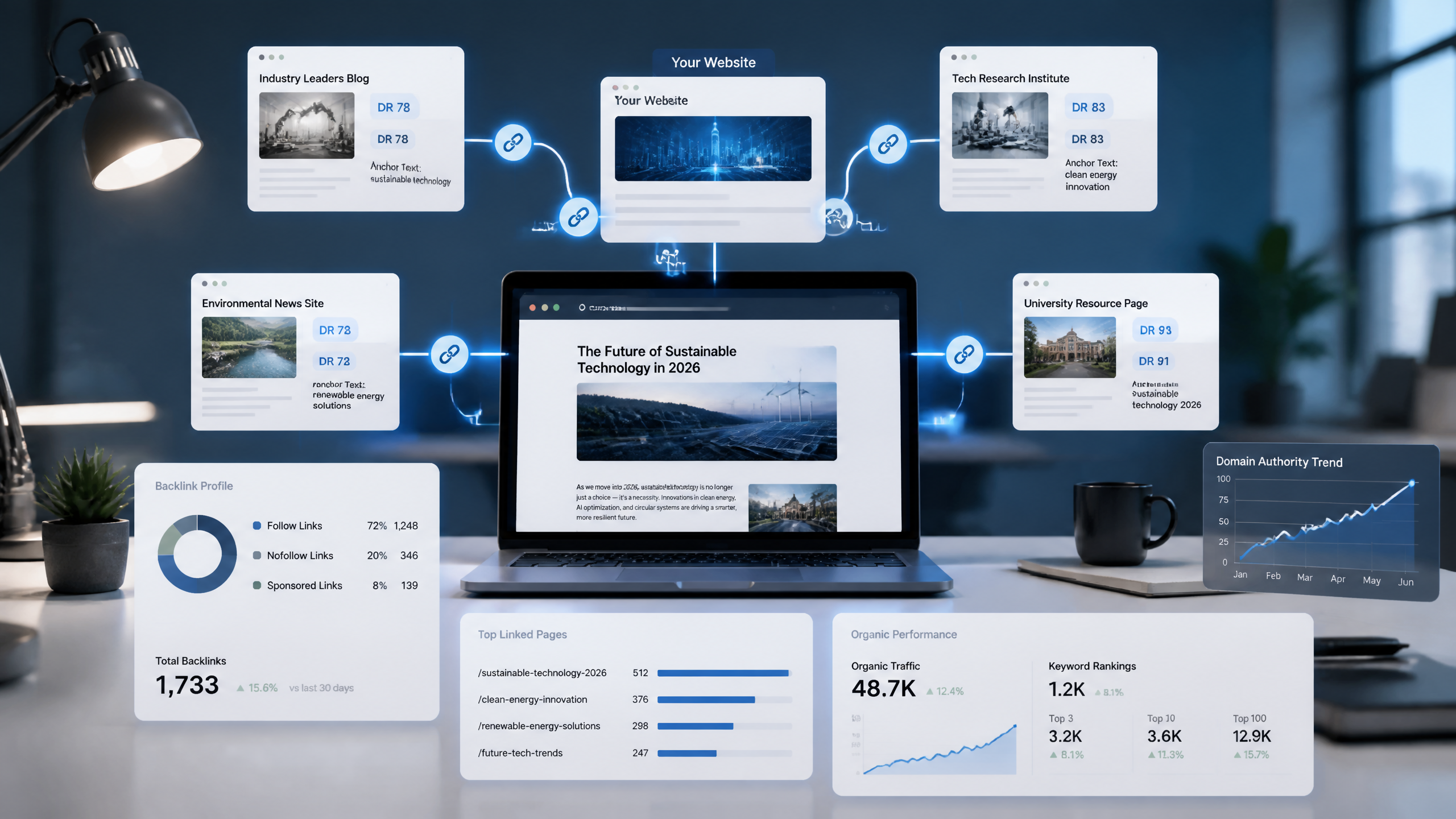
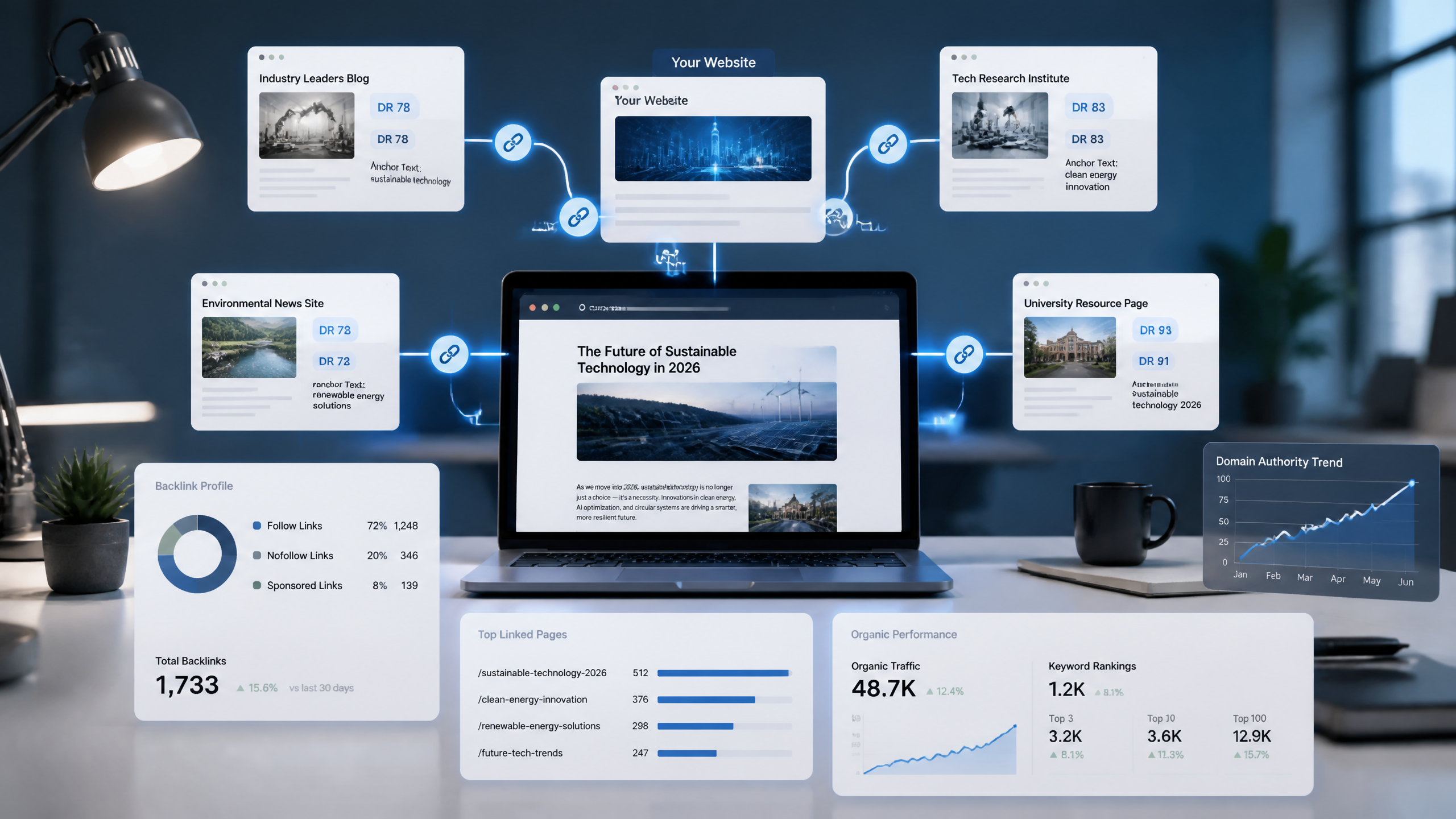
Backlinks in SEO still matter, a lot but not in the cartoonish “get 1,000 links fast” way many people imagine. If you want rankings, referral traffic, and stronger authority, you need relevant, trustworthy referring domains—not a pile of random links. I’ve watched sites waste months chasing cheap placements, only to get outranked by competitors with a dozen better links.
TL;DR Summary
• Backlinks are links from other websites to yours, and search engines use them as authority and relevance signals.
• Quality beats quantity. A single relevant, high authority backlink can outperform dozens of weak ones.
• Context matters. In content links usually pass more value than footer, sidebar, or comment links.
• Not all links should be follow links. A healthy profile usually includes dofollow, nofollow, sponsored, and UGC links.
• Topical relevance matters as much as raw authority. A DR 40 niche site can be more useful than a DR 80 unrelated site.
• Bad patterns create risk: paid links, PBNs, spammy guest posts, comment spam, and unnatural link velocity.
• Useful assets earn links best. SpyFu’s 2026 data found list posts, how to posts, and infographics attract the most backlinks.
• There is no universal “safe number” of links per month. Link velocity depends heavily on site age, brand demand, industry, and campaign type.
Key Takeaways
• Backlinks in SEO are off page trust signals, but they only work well when relevance, placement, and intent line up.
• Anchor text diversity is not optional. People often overlook the importance of anchor text diversity — it's not just about having links, but how they are presented.
• Deep links often deserve more attention than homepage links because they help the exact pages you want to rank.
• Nofollow links are not useless. They can drive referral traffic, diversify your profile, and support brand visibility.
• Toxic links are not defined by one metric alone. Spam score, source quality, index status, topic mismatch, and placement all matter.
• A healthy profile is mixed, not “perfect.” If every link has exact match anchor text from guest posts, that’s not healthy. That’s a footprint.
Table of Contents
What backlinks in SEO really are
Definition: backlink vs internal link
A backlink is a hyperlink from another website to your website. Moz describes backlinks as trust signals or “votes of confidence,” which is still one of the clearest simple explanations I’ve seen in SEO. If you want the baseline definition, Moz’s guide to backlinks and SEO authority is a solid starting point.
An internal link is different. That’s a link from one page on your own site to another page on your own site.
Here’s the quick distinction:
Link type | Comes from | Main SEO role | Example |
|---|---|---|---|
Backlink | Another domain | Builds authority, trust, referral traffic | Industry blog links to your guide |
Internal link | Your own domain | Distributes link juice, supports crawling, clarifies site structure | Blog post links to your service page |
Why backlinks matter for off page SEO
Off page SEO is basically your reputation outside your own website. Backlinks are one of the clearest signals in that reputation system.
Mailchimp notes that the more high quality backlinks a site earns, the better its chance to rank higher in search results. That lines up with what I’ve seen across campaigns: pages rarely break into competitive SERPs on content quality alone when the backlink gap is huge.
What backlinks can do:
• Increase perceived authority
• Reinforce topical relevance
• Send referral traffic from real audiences
• Help important pages get discovered and revisited
• Strengthen E E A T signals indirectly through trusted mentions
How search engines use backlinks as ranking signals
Search engines don’t treat all links equally. Under the hood, they’re evaluating things like:
• Who is linking
• What topic that site covers
• Where the link appears on the page
• What anchor text is used
• Whether the link looks editorial or manufactured
• How your site’s overall backlink profile grows over time
Google’s 2026 guidance, as summarized in industry documentation, continues to tie link quality to Experience, Expertise, Authoritativeness, and Trustworthiness. In plain English: links help when they look like real endorsements from relevant sources.
Here’s the thing—search engines are not just counting links anymore. They’re interpreting them.
The ranking impact most beginners miss
Many beginners think backlinks are all about quantity, but quality is what truly drives results. A 2026 American Eagle report highlighted that one high authority, relevant backlink can be more effective than many low quality links. That’s not just theory.
I’ve seen a page jump more from 3 contextual links on respected niche sites than from 40 directory submissions. Why? Because the first set looked like genuine recommendations. The second looked like someone with too much coffee and too little restraint.
Why backlinks affect rankings and trust
Quality vs quantity: the part that changes outcomes
If you remember one thing from this article, make it this: the best backlink is not the strongest domain on paper; it is the strongest relevant endorsement in context.
This is where people get hung up on DA, DR, PA, Trust Flow, and every shiny metric in their dashboard.
Metrics help, but they are proxies.
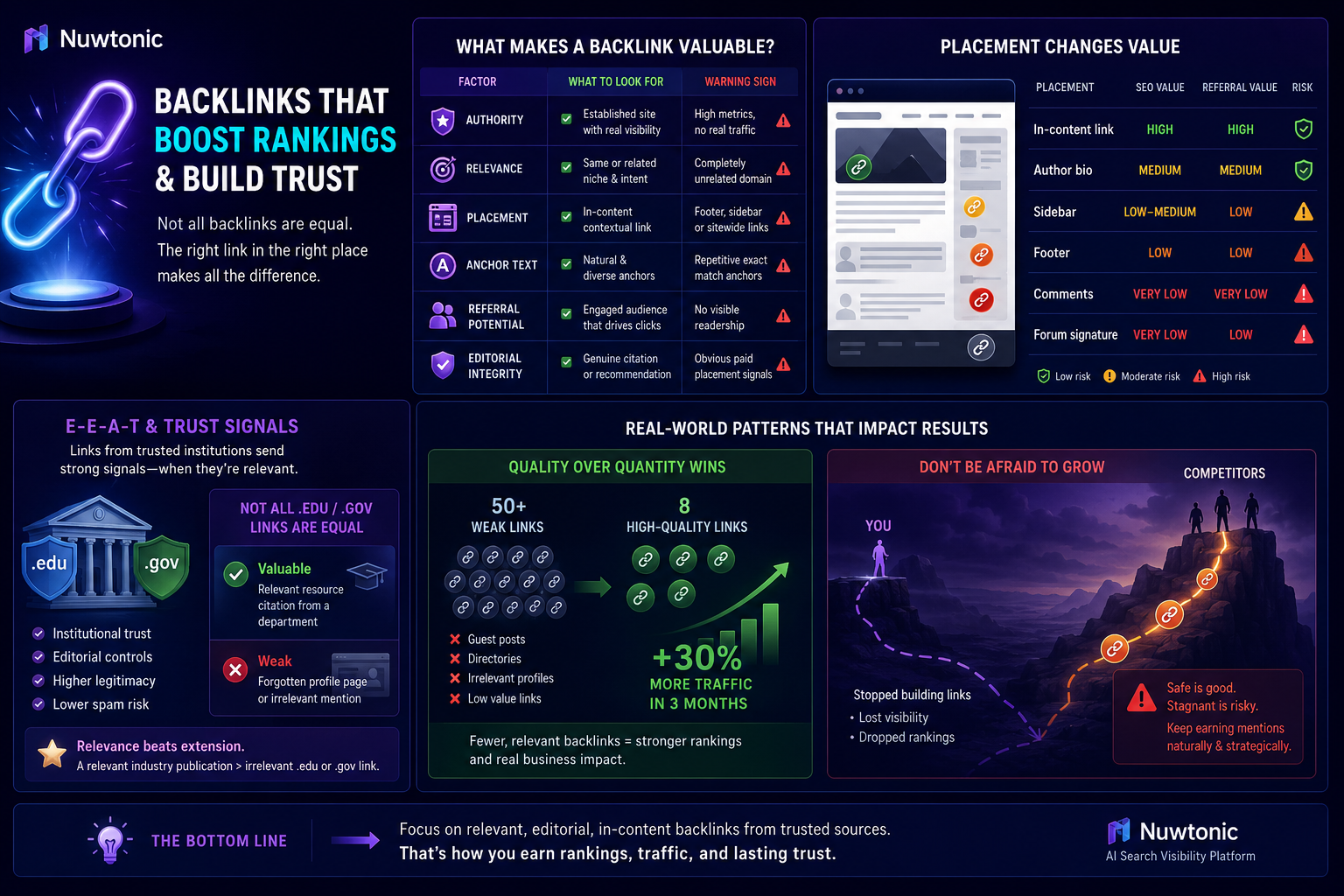
Factor | Why it matters | What to look for | Warning sign |
|---|---|---|---|
Authority | Suggests site strength | Established site with real visibility | Inflated metrics, no traffic |
Relevance | Aligns topic and intent | Same niche or adjacent niche | Completely unrelated domain |
Placement | Affects link value | In body contextual link | Footer, sidebar, sitewide |
Anchor text | Provides topical hint | Natural, diverse anchors | Repetitive exact match anchors |
Referral potential | Sends real visitors | Engaged audience | No visible readership |
Editorial integrity | Signals trust | Genuine citation or recommendation | Obvious paid placement footprint |
E E A T, trust, and why .edu and .gov links get attention
Straight North’s 2026 reporting notes that links from .edu and .gov domains often send strong trust signals. I’d add an important caveat: not every .edu or .gov link is magical. A forgotten student profile page is not the same as a relevant resource citation from a university department.
So what makes these links valuable?
• Institutional trust
• Editorial controls
• Higher likelihood of legitimacy
• Lower spam prevalence compared with random low quality sites
Still, I’d choose a highly relevant industry publication over an irrelevant .gov mention every time.
Link placement changes value
Moz has repeatedly emphasized that links within the main body content tend to carry more weight than links in footers, sidebars, or comment sections. That matches reality. A contextual mention inside an article passes stronger relevance and usually better click through behavior.
Placement | Typical SEO value | Referral value | Risk level |
|---|---|---|---|
In content contextual link | High | High | Low if editorial |
Author bio | Medium | Medium | Usually low |
Sidebar | Low to medium | Low | Can look templated |
Footer | Low | Low | Can become sitewide footprint |
Comments | Very low | Very low | High spam association |
Forum signature | Very low | Low | High if overused |
Real world patterns I keep seeing
One situation I keep seeing is this: a site has 50 plus backlinks but rankings barely move. Then you look closer and most links are weak guest posts, irrelevant directories, or profile pages. I saw a version of this pattern in community discussions where a marketer shifted away from aggressive paid and guest post style links toward original research and infographics. After earning just 8 highly relevant backlinks, traffic increased 30% in 3 months. That ratio tells you everything.
Another pattern is the opposite. A business slows down its link building because they think “fewer is safer,” then disappears from competitive SERPs because competitors keep earning mentions naturally. Fair warning: safe doesn’t mean stagnant.
Backlinks by follow attribute
Dofollow, nofollow, sponsored, and UGC
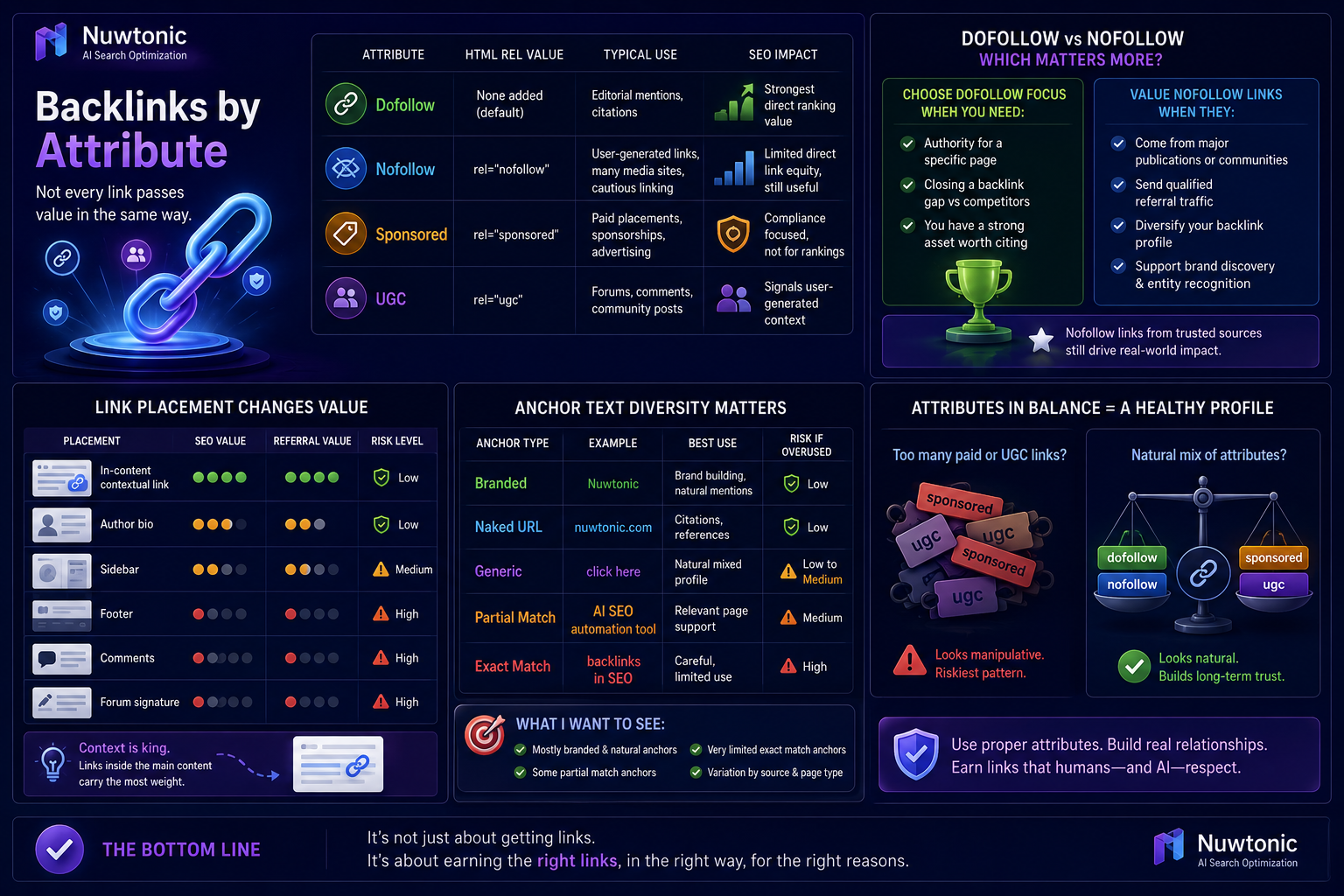
Not every backlink passes value in the same way.
Attribute type | HTML rel value | Typical use | SEO impact |
|---|---|---|---|
Dofollow | None added or standard crawlable link | Editorial mentions, citations | Usually strongest direct ranking value |
Nofollow | rel="nofollow" | User generated links, many media sites, cautious linking | Limited direct passing of link equity, still useful |
Sponsored | rel="sponsored" | Paid placements, sponsorships, advertising | Compliance focused, should not be used to manipulate rankings |
UGC | rel="ugc" | Forums, comments, community posts | Signals user generated context |
A lot of people ask me whether dofollow is always better. For direct ranking transfer, yes, usually. For overall profile health, no, not always.
Dofollow vs nofollow: which matters more?
This depends on your objective.
Choose dofollow focused outreach when:
• You need authority for a specific page
• You’re closing a backlink gap against ranking competitors
• You have a strong asset worth citing
Value nofollow links when:
• They come from major publications or communities
• They send qualified referral traffic
• They diversify your backlink profile
• They support brand discovery and entity recognition
Mailchimp points out that backlinking ultimately supports higher rankings and traffic. A nofollow link from a trusted media outlet can still help in very practical ways, even if it doesn’t pass classic link juice like a clean editorial follow link.
When sponsored and UGC links matter
Sponsored and UGC links matter most for compliance and pattern realism.
If you pay for placement, use proper disclosure. If a link comes from a forum or comments section, proper UGC tagging is a sensible signal. The real issue is not whether these links exist. It’s whether your backlink profile depends on them too heavily.
Anchor text types and why diversity matters
People often overlook the importance of anchor text diversity — it's not just about having links, but how they are presented.
Anchor text type | Example | Best use | Risk if overused |
|---|---|---|---|
Branded | Nuwtonic | Brand building, natural mentions | Low |
Naked URL | nuwtonic.com | Citations, references | Low |
Generic | click here | Natural mixed profile | Low to medium |
Partial match | AI SEO automation tool | Relevant page support | Medium |
Exact match | backlinks in SEO | Careful, limited use | High |
What I usually want to see:
• Mostly branded and natural anchors
• Some partial match anchors
• Very limited exact match anchors
• Variation by source and page type
If every new link says the exact same keyword, that’s not optimization. That’s a footprint wearing a fake mustache.
Backlinks by source and placement
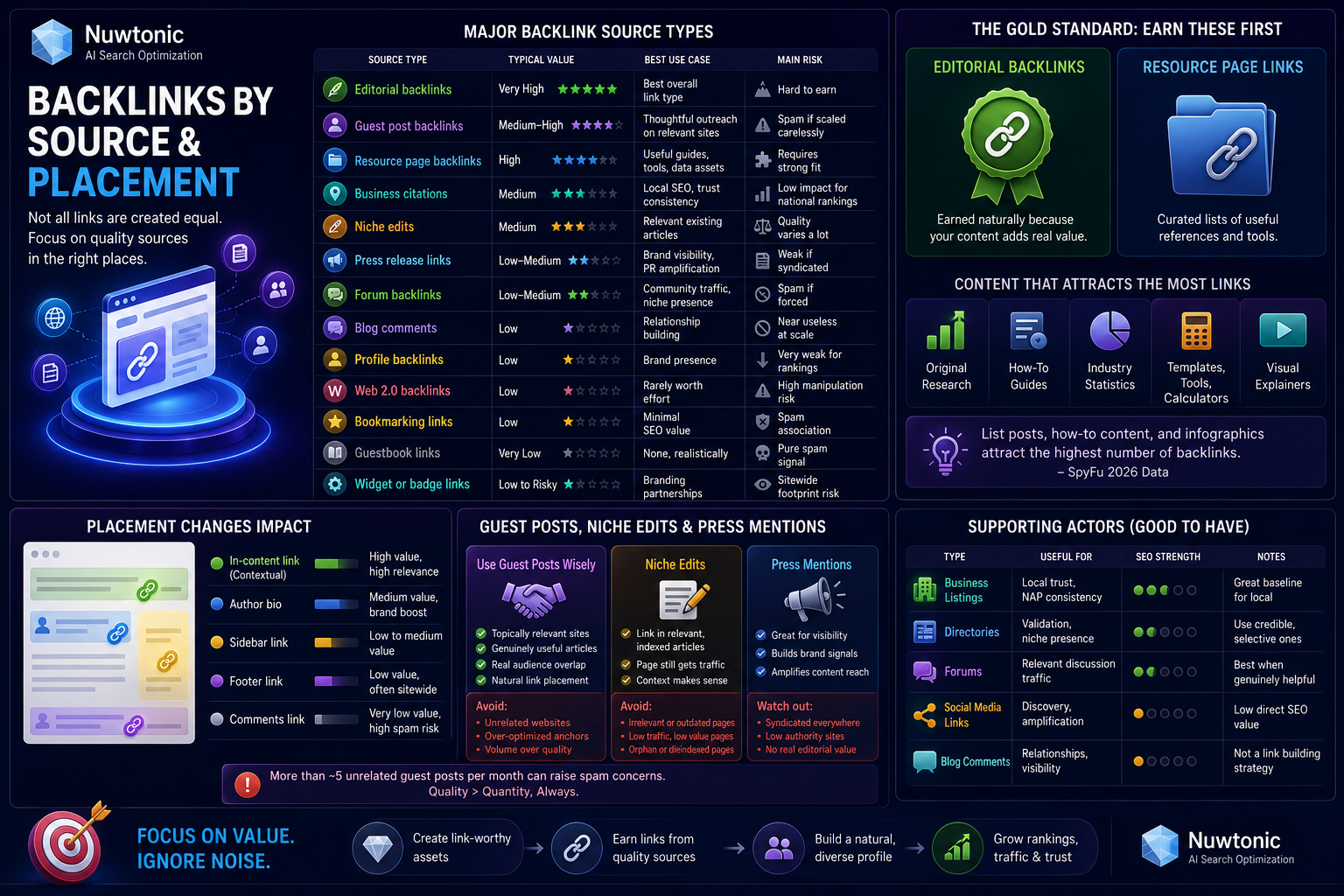
The major backlink source types
The user question here is usually: Which link types are worth pursuing? Not all of them equally.
Source type | Typical value | Best use case | Main risk |
|---|---|---|---|
Editorial backlinks | Very high | Best overall link type | Hard to earn |
Guest post backlinks | Medium to high | Thoughtful outreach on relevant sites | Spam if scaled carelessly |
Resource page backlinks | High | Useful guides, tools, data assets | Requires strong fit |
Business citations | Medium | Local SEO, trust consistency | Low impact for national rankings alone |
Niche edits | Medium | Relevant existing articles | Quality varies a lot |
Press release links | Low to medium | Brand visibility, PR amplification | Weak if syndicated everywhere |
Forum backlinks | Low to medium | Community traffic, niche presence | Spam if forced |
Blog comments | Low | Relationship building at best | Near useless at scale |
Profile backlinks | Low | Brand presence | Very weak for rankings |
Web 2.0 backlinks | Low | Rarely worth effort | High manipulation risk |
Bookmarking links | Low | Minimal SEO value | Spam association |
Guestbook links | Very low | None, realistically | Pure spam signal |
Widget or badge links | Low to risky | Branding partnerships | Sitewide footprint risk |
Editorial backlinks and resource page links
These are usually the gold standard.
An editorial backlink happens when someone links because your content genuinely improves their page. A resource page backlink is similar, but often comes from a curated list of useful references.
These work best when you publish:
• Original research
• Detailed how to content
• Industry statistics roundups
• Templates, calculators, or tools
• Highly visual explainers
SpyFu’s 2026 original data found that list posts, how to posts, and infographics consistently attract the highest backlink volumes. Their data on content formats that earn backlinks is useful because it gives content teams something actionable instead of vague “make better content” advice.
Guest posts, niche edits, and press mentions
Guest posting still works. It just stops working when you treat it like vending machine SEO.
Use guest posts when:
• The site is topically relevant
• The article is genuinely useful
• The audience overlap is real
• The link fits naturally
Avoid guest posts when:
• You’re publishing on unrelated sites
• Every post uses commercial exact match anchor text
• You’re pushing volume over quality
Community reports and agency observations in 2026 suggest that more than 5 unrelated guest posts per month can start to trigger spam concerns. I would not treat that as a universal law, but it’s a practical warning range.
Niche edits can work too, but they’re tricky. A link insertion into an old article is only useful if the page is relevant, indexed, and still getting traffic. Otherwise, you’re buying a dusty shelf in a library nobody visits.
Citations, directories, forums, and social links
These links are usually supporting actors, not stars.
Type | Useful for | SEO strength | Notes |
|---|---|---|---|
Business listings | Local trust, NAP consistency | Medium for local | Good baseline for local businesses |
Directories | Validation, niche presence | Low to medium | Only use credible, selective ones |
Forums | Relevant discussion traffic | Low to medium | Best when genuinely helpful |
Social media links | Discovery, amplification | Low direct SEO value | Great for reach and engagement |
Blog comments | Relationships, visibility | Low | Not a link building strategy |
You know, people often waste a lot of time on links that are easy to create because they feel productive. Easy links are usually the weakest links.
Backlinks by content and acquisition method
Content types that attract links best
Based on SpyFu’s 2026 findings and what I’ve seen in campaigns, these content formats tend to earn the best backlinks:
List posts
How to guides
Infographics
Original research and statistics pages
Case studies
Tool roundups or comparison assets
Templates and checklists
Content type | Link attraction strength | Why it works | Best for |
|---|---|---|---|
List post | High | Easy to cite and skim | Top of funnel visibility |
How to guide | High | Solves a clear problem | Authority building |
Infographic | High | Visual and embeddable | Outreach campaigns |
Original research | Very high | Unique data creates citations | PR and editorial links |
Case study | Medium to high | Proof and specificity | B2B trust |
Video or podcast notes | Medium | Multi format reach | Brand authority |
Testimonials | Medium | Reciprocal exposure | Partner ecosystems |
Natural backlinks vs manual outreach vs self created links
This is where definitions get fuzzy, so let’s make them practical.
Acquisition method | What it means | Value level | Risk level |
|---|---|---|---|
Natural or organic | Someone links without being asked | Very high | Low |
Manual outreach | You pitch a relevant site or journalist | High | Low to medium |
Self created | You place your own link on profiles, forums, comments | Low | Medium to high |
Reciprocal | You link to me, I link to you | Medium in moderation | High if excessive |
Paid placement | You buy the link | Variable short term, risky long term | High |
What not to do first:
• Don’t start with mass self created links
• Don’t buy random homepage links
• Don’t chase high DA with zero topical fit
What to do instead:
Build one genuinely useful asset
Prospect highly relevant referring domains
Personalize outreach
Offer a specific reason your asset improves their page
Track outcomes by link quality, not just raw count
Broken link building, skyscraper, HARO style PR, and link reclamation
These are still among the most effective white hat SEO methods.
Tactic | How it works | Best when | Common failure point |
|---|---|---|---|
Broken link building | Replace dead links with your relevant page | You have close content match | Weak prospecting |
Skyscraper technique | Create something 5 to 10 times better than ranking content | Existing topic has linkable demand | Better content still needs outreach |
HARO style PR | Provide expert quotes to media | You have expertise and speed | Low response rate |
Link reclamation | Turn unlinked mentions into links | Brand already gets mentions | Poor monitoring |
Competitor gap outreach | Target domains linking to competitors | Clear opportunity mapping | Sending generic pitches |
SpyFu’s 2026 analysis found that the Skyscraper technique still increases backlink acquisition when the asset is meaningfully better, not just longer. That distinction matters. More words do not equal better content. I learned that one the annoying way after publishing an enormous guide years ago that looked impressive and earned exactly three links. Once we cut fluff, added original charts, and did sharper outreach, links finally moved.
Branded backlinks vs targeted backlinks
This distinction gets skipped far too often.
Type | Definition | Example | Main benefit |
|---|---|---|---|
Branded backlink | Link using your brand name or homepage oriented mention | “Nuwtonic” linking to homepage | Builds overall authority and trust |
Targeted backlink | Link to a specific page with topic aligned anchor text | “technical SEO automation checklist” linking to a guide | Supports keyword and page level rankings |
American Eagle’s 2026 guidance suggests balancing branded and targeted backlinks. I agree. If every link points to your homepage, your money pages may stay weak. If every link points to exact match landing pages, your profile starts looking engineered.
Good vs bad backlinks
Characteristics of high quality backlinks
A strong backlink usually checks several boxes at once:
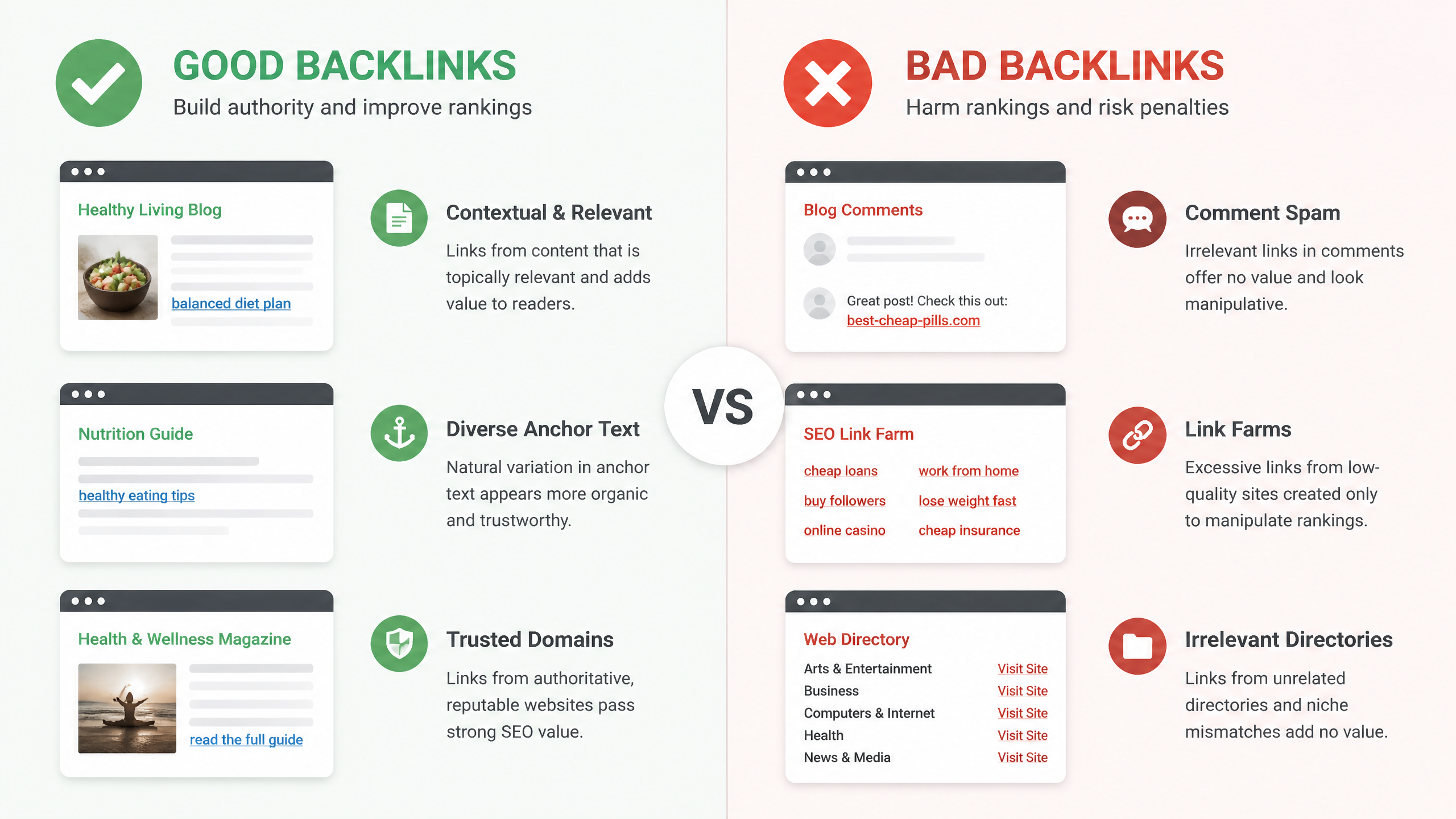
• Comes from a relevant site or page
• Appears naturally inside body content
• Uses sensible anchor text
• Sends some real referral traffic or could reasonably do so
• Comes from a page that is indexed and maintained
• Fits editorially without awkward forcing
Moz’s case evidence in 2026 connected 12 high authority backlinks from .edu and industry blogs with a 45% increase in organic traffic for a B2B software company. That’s a good reminder that a small number of excellent links can move the needle fast.
Characteristics of low quality, spammy, or toxic backlinks
This is one of the biggest content gaps online, so let me be direct: there is no universal toxic score that magically tells you what to disavow. Different tools estimate different risk patterns.
That said, toxic links often show these traits:
• Unrelated topic or language mismatch
• Thin, scraped, or auto generated content
• Obvious link farm behavior
• Sitewide footer placements across many pages
• Repetitive exact match anchor text
• Deindexed or barely indexed domains
• Paid link footprints with no editorial value
• Massive outbound links to unrelated industries
Link signal | Usually good | Usually bad |
|---|---|---|
Topic match | Same niche or close adjacency | Unrelated niche |
Page quality | Original, useful content | Thin or spun content |
Placement | Contextual body link | Footer, sidebar, comments |
Anchor text | Mixed and natural | Repetitive exact match |
Site behavior | Selective outbound links | Outbound links to everything |
Traffic pattern | Real audience | No visible audience |
PBNs, paid links, link farms, and comment spam
Black hat tactics can work briefly. That’s the part people don’t like to admit. But I’m skeptical of quick fixes for a reason: what works fastest often breaks hardest.
PBNs, link farms, and comment spam create patterns that are easier to detect over time. Paid links are especially risky when they are undisclosed and manipulative.
A pattern I’ve seen more than once looks like this:
A site buys 15 to 30 cheap links
Rankings bump slightly
Growth stalls or reverses
Cleanup begins with audits and disavows
Months are lost repairing trust signals
One community example mirrored this exactly. After a site was hit by a penalty linked to 15 toxic directory backlinks, the team used Ahrefs to identify and disavow them, then shifted toward branded links and digital PR. Rankings recovered in about 2 months. That’s a painful way to learn restraint.
White hat vs black hat vs grey hat
Approach | Description | Upside | Downside |
|---|---|---|---|
White hat | Earned, editorial, guideline aligned links | Sustainable, lower risk | Slower, harder |
Grey hat | Tactics that may not be explicitly forbidden but are manipulative in spirit | Faster | Ongoing risk and inconsistency |
Black hat | Deliberate manipulation like PBNs, link farms, spam | Fastest short term movement | High penalty risk |
I stick with white hat SEO because it compounds. It also lets you sleep like a functioning adult.
How to evaluate a backlink profile
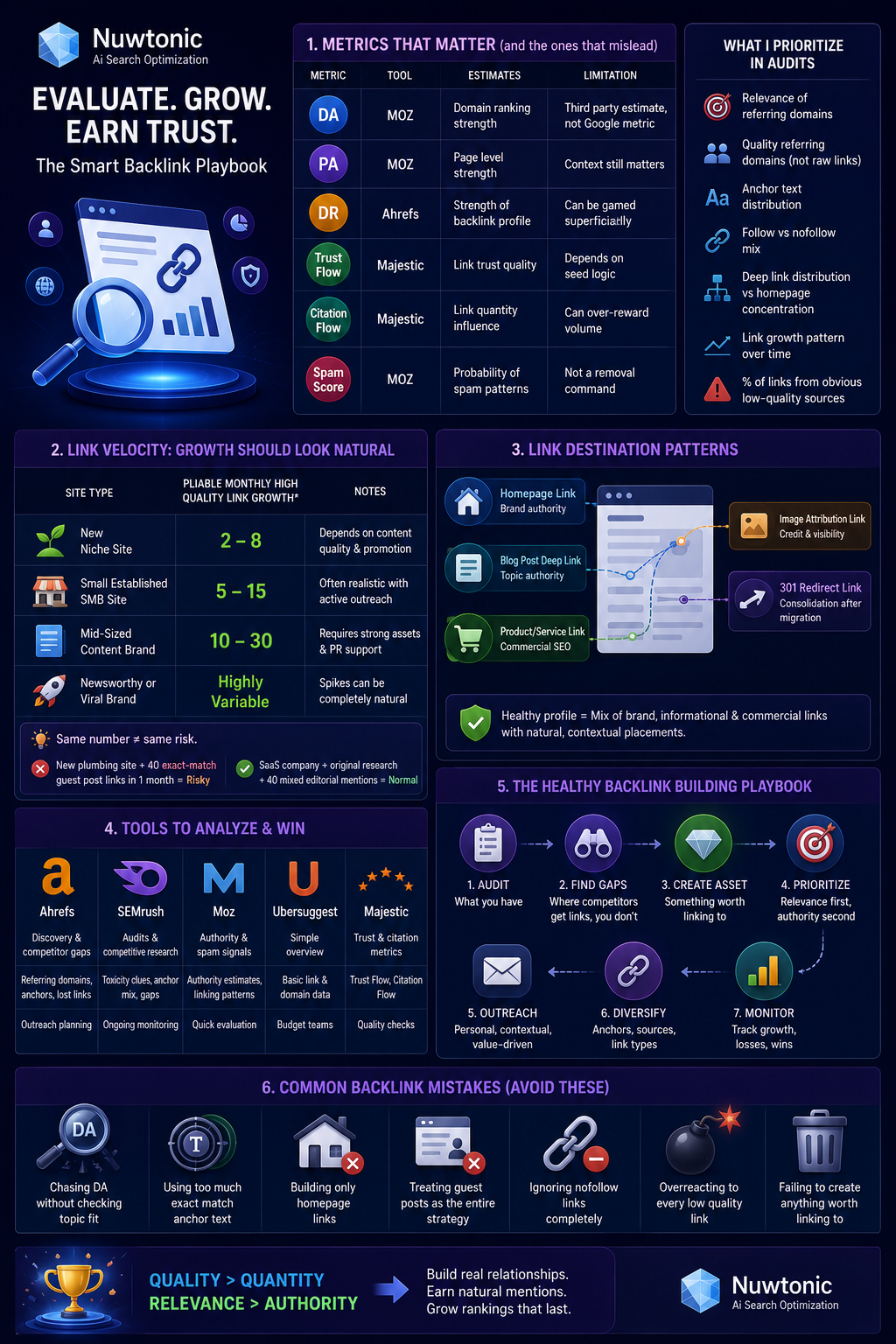
The metrics that matter, and the ones that mislead people
You’ll hear a lot about DA, DR, PA, Trust Flow, Citation Flow, spam score, and so on. Useful? Yes. Definitive? No.
Metric | Tool association | What it estimates | Limitation |
|---|---|---|---|
DA | Moz | Domain ranking strength | Third party estimate, not Google metric |
PA | Moz | Page level strength | Context still matters |
DR | Ahrefs | Strength of backlink profile | Can be gamed superficially |
Trust Flow | Majestic | Link trust quality | Depends on seed logic |
Citation Flow | Majestic | Link quantity influence | Can over reward volume |
Spam score | Moz | Probability of spam patterns | Not a removal command by itself |
What I prioritize in audits:
Relevance of referring domains
Number of quality referring domains, not raw links
Distribution of anchors
Follow vs nofollow mix
Deep link distribution vs homepage concentration
Link growth pattern over time
Percentage of links from obvious low quality sources
Link velocity: how fast should you gain backlinks?
This is the question everyone wants a neat number for, and honestly, the industry still lacks a universal benchmark.
American Eagle’s 2026 reporting stresses that link velocity should remain natural. Community and agency evidence suggests that mid sized sites often look healthier when growth is steady rather than spiky.
A practical range I use as a working heuristic, not a rule:
Site type | Plausible monthly high quality link growth | Notes |
|---|---|---|
New niche site | 2 to 8 | Depends on content quality and promotion |
Small established SMB site | 5 to 15 | Often realistic with active outreach |
Mid sized content brand | 10 to 30 | Requires strong assets and PR support |
Newsworthy or viral brand | Highly variable | Spikes can be natural |
Important caveat: the same number can be safe for one site and suspicious for another.
Example:
• A new plumbing site gaining 40 exact match guest post links in one month looks unnatural.
• A SaaS company launching original industry research and earning 40 mixed editorial mentions in one month may look completely normal.
I’ve seen a client reduce velocity from 20 links per month to 8, diversify sources, and lower risk while improving stability. That matches a 2026 American Eagle scenario where slower, more diversified growth reduced link penalty risk.
Deep links, homepage links, and contextual links
Not all destination patterns are equal.
Link destination type | Best use | SEO impact |
|---|---|---|
Homepage link | Brand authority | Good for overall domain trust |
Deep link to blog post | Topic authority | Excellent for informational rankings |
Deep link to product or service page | Commercial SEO | Strong if context is natural |
Image attribution link | Credit and visibility | Varies by placement |
Redirect backlink via 301 | Consolidation after migration | Can preserve some value if mapped well |
A healthy profile usually includes:
• Homepage links for brand credibility
• Deep links to key informational assets
• Some targeted commercial page links when they are editorially justified
Tools, best practices, and FAQs
Tools to analyze backlink types and quality
There’s no single perfect tool, which is mildly annoying but true.
Tool | Best for | What it shows | Best use case |
|---|---|---|---|
Ahrefs | Backlink discovery, competitor gaps | Referring domains, anchors, lost links | Outreach planning |
SEMrush | Audits and competitive research | Toxicity clues, anchor mix, gaps | Ongoing monitoring |
Moz | DA, spam signals, backlink basics | Authority estimates, linking patterns | Quick evaluation |
Ubersuggest | Simpler overview | Basic link and domain data | Budget conscious teams |
Majestic | Trust and citation metrics | Trust Flow, Citation Flow | Supplementary quality checks |
If you want a broader tool overview, Straight North’s guide to SEO tools for backlink audits covers the main platforms. For teams balancing links with content performance, SEMrush’s article on why content quality drives SEO results is also relevant because good link acquisition rarely happens without good content.
How to build a healthy backlink profile
This is the practical playbook I recommend most often.
Audit what you already have
• Check referring domains, anchors, link types, and weak patternsIdentify competitor gaps
• Find domains linking to several competitors but not to youCreate one or two linkable assets
• Research page, statistics post, comparison guide, infographic, or detailed how toPrioritize prospects using relevance first, authority second
• I’d usually take a relevant mid authority site over a powerful irrelevant oneRun focused outreach
• Personalize the pitch, suggest exact placement context, and explain reader valueDiversify naturally
• Mix branded, naked URL, and partial match anchorsMonitor growth and decay
• Links disappear, pages get updated, and campaigns need maintenance
Common backlink mistakes
• Chasing DA without checking topic fit
• Using too much exact match anchor text
• Building only homepage links
• Treating guest posts as the entire strategy
• Ignoring nofollow links completely
• Overreacting to every low quality link with panic disavows
• Failing to create anything worth linking to
You know, I’ve watched sites struggle for months trying to hack their way to the top when a solid link-building strategy would have made all the difference.
FAQ Section
What are the 4 types of backlinks?
The four most common backlink types by attribute are:
Dofollow
Nofollow
Sponsored
UGC
If you mean by acquisition style, people also commonly group them as:
Natural
Manual outreach
Self created
Paid or exchange based
What is the most powerful type of backlink?
Usually, the most powerful backlink is a contextual editorial dofollow link from a highly relevant, authoritative page. Relevance and placement often beat raw DA alone.
Dofollow vs nofollow: which is better?
For direct ranking influence, dofollow is usually better. For a realistic profile, referral traffic, and brand visibility, nofollow still has value. The best profile includes both.
Are nofollow links useless?
No. They can:
• Send referral traffic
• Build brand awareness
• Support profile diversity
• Lead to secondary follow links later
What is a natural backlink?
A natural backlink is one earned because someone chose to cite your content without being paid or pressured. These are typically the most sustainable links.
How many backlinks do I need to rank higher?
There is no universal number. It depends on:
• Keyword difficulty
• Competitor referring domains
• Content quality
• Search intent alignment
• Authority of the links you earn
A page may rank with 5 strong links in one niche and need 50 plus in another. The better question is: how many quality referring domains do the top ranking pages have, and what kind are they?
Is guest posting still a good strategy for backlinks?
Yes, when it is relevant, selective, and useful. No, when it becomes scaled article dumping on unrelated sites.
Can I buy backlinks without hurting SEO?
You can buy them. That doesn’t mean you should. Paid links can create short term gains, but they carry obvious guideline and pattern risks, especially when they are manipulative or undisclosed.
How do I remove toxic backlinks from my site?
A practical process looks like this:
Audit the profile using Ahrefs, Moz, or SEMrush
Flag links with multiple spam indicators
Try removal if appropriate
Use disavow only when there is a real pattern of harmful manipulation or penalty concern
Replace weak links by earning better ones
What role do backlinks play in E E A T?
Backlinks support Authoritativeness and Trustworthiness when they come from credible, relevant sources. They do not replace genuine expertise or quality content, but they reinforce both.
Sources and references
• Moz, Backlinks
• Mailchimp, What Is Backlinking and Why Is It Important for SEO?
• SpyFu, Which Types of Content Gain the Most Backlinks?
• Straight North, Guide to SEO Tools
• SEMrush, Importance of Content in SEO
Final thoughts
Backlinks in SEO are still one of the clearest competitive separators in organic search, but they only work well when they look earned, relevant, and useful. That’s the boring truth people try to avoid.
If I were starting from scratch today, I would not begin with mass outreach or paid placements. I’d begin with one link worthy asset, one realistic prospect list, and one clean evaluation framework for relevance, authority, placement, and anchor text. That approach is slower than shortcuts for about five minutes—and then much faster over the next year.
If your backlink profile feels messy, start with an audit. If it feels weak, start with better assets. If it feels artificial, stop forcing patterns and earn links that make sense to real humans first. Search engines usually catch up to that logic pretty well.