Most advice on DeepSeek vs ChatGPT is wrong for SEO teams because it treats this like a leaderboard contest. It isn't. A model that wins a benchmark can still waste your budget, miss citation opportunities, or break your workflow when you need schema fixes, multilingual content review, or AI answer visibility.
For search teams, the useful question is narrower. Which model gives you the best output for the job in front of you. A technical audit, a programmatic content pass, an entity-rich article draft, a citation gap review, and a visual content workflow do not need the same model. They need different strengths.
That distinction matters more now because GEO has changed the standard. You aren't only trying to rank pages. You're trying to become a cited source inside AI-generated answers. That shifts model choice from "best chatbot" to "best production system." If you're refining your thinking on AI search behavior, Busylike offers AI SEO insights that pair well with this more practical lens.
Table of Contents
- DeepSeek vs ChatGPT The Showdown for SEOs
- Understanding the Core Architectural Divide
- Performance Face-Off for Core SEO Workflows
- Comparing Ecosystems and Multimodal Capabilities
- Winning in AI Answers The GEO and Citation Angle
- Analyzing Cost-Efficiency and Real-World ROI
- Building Your Hybrid AI Strategy with Nuwtonic
DeepSeek vs ChatGPT The Showdown for SEOs
SEO teams usually compare DeepSeek and ChatGPT the same way consumers compare phones. They look at popularity, interface polish, and general output quality. That misses the operational question. Search teams need to know which model reduces manual review, which one scales audits without burning budget, and which one improves the odds of becoming a cited source in AI answers.
For that reason, DeepSeek vs ChatGPT should be judged on five criteria.
- Core architecture: The model design affects cost, inference efficiency, and how well it handles repetitive logic-heavy work.
- Task fit: Technical audits, structured extraction, creative briefs, and long-form content aren't the same workload.
- Ecosystem maturity: Desktop apps, voice, image handling, collaboration, and scheduling change adoption inside agencies and in-house teams.
- Citation behavior: GEO isn't only about accuracy. It's also about whether a model tends to cite broadly or selectively.
- Total cost of ownership: API pricing matters, but so do review time, routing logic, and failure risk on sensitive topics.
The wrong buying decision
A lot of teams still make a single-model decision. They standardize on one assistant and push every workflow through it. That sounds efficient, but it usually creates hidden waste. The creative team wants multimodal support and better brand voice control. The technical SEO lead wants stronger reasoning for schema debugging, regex help, and page-level issue triage. The GEO lead wants the model most likely to surface and cite source-rich pages.
Practical rule: Don't ask which model is best overall. Ask which model is cheapest and most reliable for the output you need to ship this week.
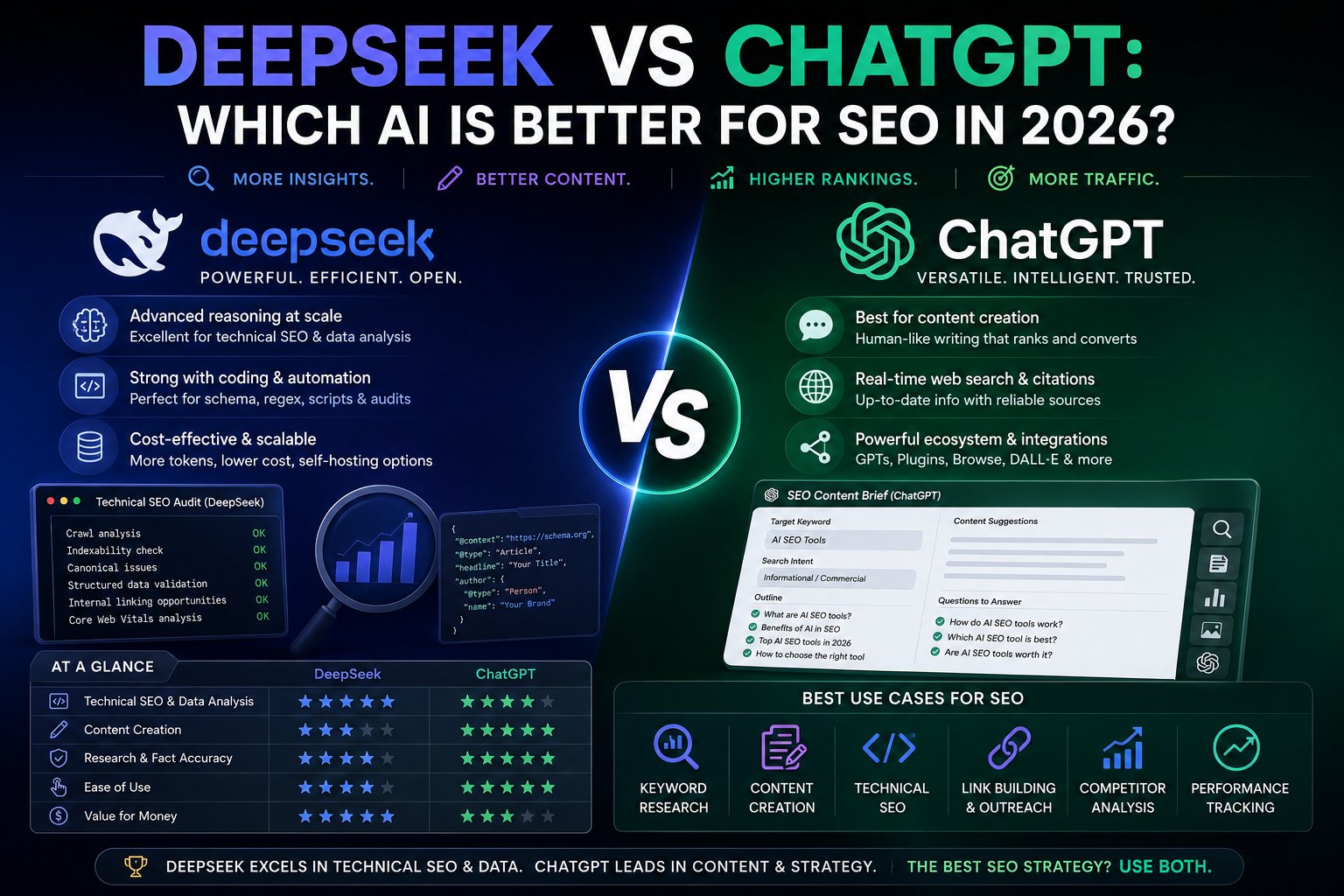
There is no universal winner. ChatGPT has the more mature product environment and better multimodal breadth. DeepSeek is often stronger where structure, reasoning, and cost per audit matter more than interface polish.
What this means in daily SEO work
If you're running large audit queues, evaluating internal linking rules, extracting entities from messy pages, or generating technical markup candidates, the decision can change your operating margin. If you're building content calendars, briefing writers, validating visual assets, or working across many languages, the answer can flip.
That is why practitioners should stop debating brand prestige and start thinking in routing logic. The advantage comes from assigning the right tasks to the right model, then enforcing review standards so output quality stays consistent across the workflow.
Understanding the Core Architectural Divide
The biggest practical difference isn't branding or UX. It's architecture.
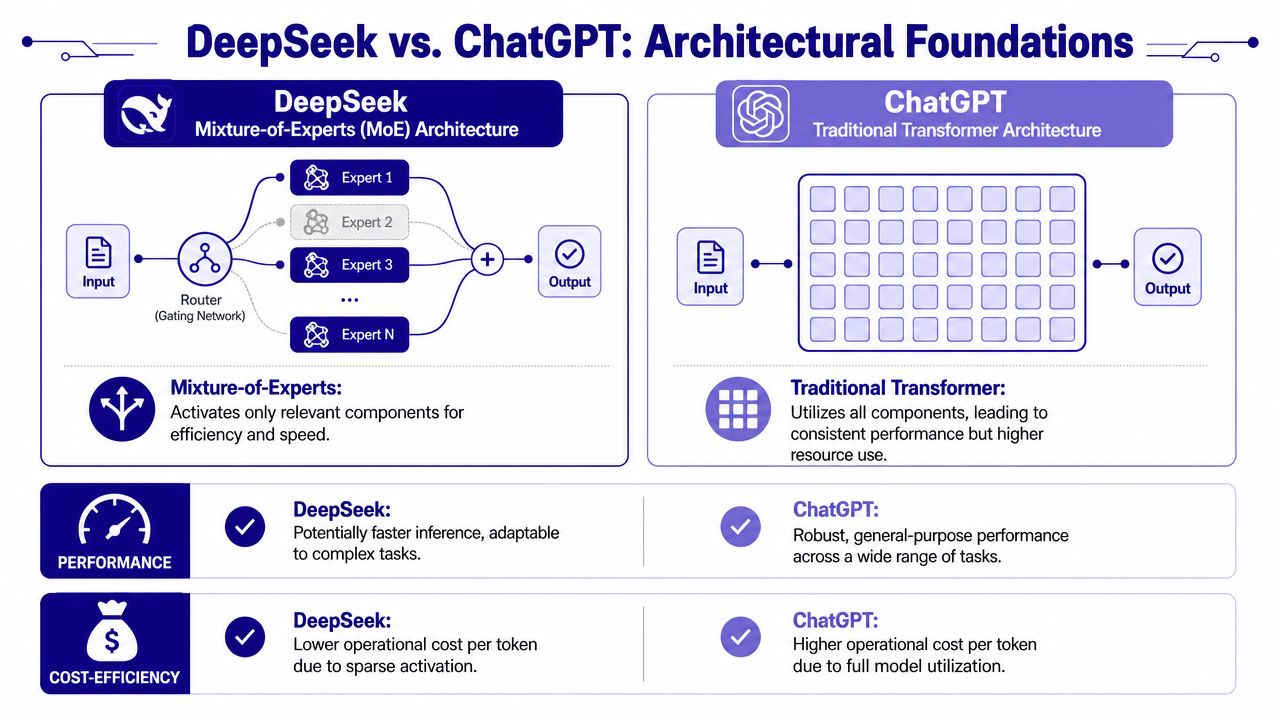
DeepSeek R1 uses a Mixture-of-Experts (MoE) design with 671 billion total parameters but activates only 37 billion per query, and that setup reached approximately 90% accuracy on advanced mathematics benchmarks compared to GPT-4o's 83% according to the LLMDevs comparison on Reddit. For SEO operators, that matters because logic-heavy tasks behave more like math than like casual conversation.
Why architecture changes SEO economics
Think of ChatGPT as a huge reference library where the system consults the full institution for each task. Think of DeepSeek as a building full of specialists where only the relevant experts step in for the query. That doesn't make one universally smarter. It changes how efficiently each system handles specific workloads.
For SEO, this shows up in jobs like:
- Template analysis: Reviewing repeated title structures, canonicals, schema patterns, or faceted navigation logic.
- Data extraction: Pulling entities, product attributes, FAQs, and content blocks from large page sets.
- Reasoning chains: Debugging code snippets, spotting logical conflicts in redirects, or checking structured data syntax.
When a model activates only the relevant parts of itself, repeated technical workloads become cheaper to run at scale. That doesn't guarantee better writing. It does create a strong operational advantage for bulk reasoning tasks.
A simple mental model for practitioners
Use this rule. If the task needs precise logic, pattern recognition, or repeatable technical consistency, architecture matters a lot. If the task needs presentation quality, creative range, or multimodal interaction, product experience matters more.
The hidden mistake is treating model architecture as a purely engineering detail. In SEO operations, architecture changes what you can afford to run every day.
This is why DeepSeek often feels strong in structured audits and code-adjacent tasks. It isn't just "cheaper AI." Its design is built to avoid spending full-model effort on every prompt. That makes it a practical engine for teams that need repeated technical outputs, not a novelty comparison point.
Performance Face-Off for Core SEO Workflows
Benchmarks only matter when they map cleanly to real work. SEO work is messy. It includes keyword grouping, schema generation, content ideation, title rewrites, topical gap analysis, internal linking suggestions, and debugging page-level issues. The model that helps with one may slow you down on another.
A useful summary comes from G2's DeepSeek vs ChatGPT analysis, which notes anecdotal Reddit sentiment that DeepSeek delivered better answers 95% of the time for technical queries while ChatGPT was cited for providing false information more frequently in logic-heavy applications. That's not a universal verdict. It is a strong signal for technical SEO use cases.
DeepSeek vs ChatGPT at a glance for SEO tasks
| Feature | DeepSeek | ChatGPT | Winner for SEO |
|---|---|---|---|
| Technical schema generation | Strong logical consistency for structured tasks | Good, but may need more verification on logic-heavy outputs | DeepSeek |
| Regex and code debugging | Better suited to step-by-step reasoning | Useful, but less dependable for strict logic workflows | DeepSeek |
| Keyword clustering | Solid when prompts are structured well | Strong for broader grouping and explanation | Depends on workflow |
| Creative blog drafting | More rigid, less polished | Better conversational nuance and creative flow | ChatGPT |
| Brand voice adaptation | Functional but less refined | Better for voice consistency and editorial shaping | ChatGPT |
| Entity extraction from pages | Strong for structured extraction | Good, but less cost-efficient for scale | DeepSeek |
| Visual content planning | Limited | Better due to multimodal support | ChatGPT |
| AI answer citation targeting | Useful when source-rich pages are involved | Useful, but different citation behavior | Depends on GEO strategy |
Where each model actually helps
DeepSeek is the stronger pick for technical content pipelines. That includes API documentation drafts, code explanation blocks, schema variants, redirect logic review, and page-level extraction tasks. It also fits programmatic QA where the output must follow a stable pattern rather than sound persuasive.
ChatGPT is better for top-of-funnel content ideation, narrative refinement, and content that has to sound natural without heavy editing. It tends to work better when a strategist wants to shape audience language, simplify complex explanations, or build a usable draft from a loose brief.
Use this split in practice:
- Send logic-first work to DeepSeek.
- Send voice-first work to ChatGPT.
- Keep a human review layer for anything that will ship publicly, especially YMYL or branded pages.
A strong SEO workflow doesn't depend on a single model being brilliant. It depends on predictable routing, prompt discipline, and review standards.
Comparing Ecosystems and Multimodal Capabilities
A model can produce great text and still be the wrong operational choice. Teams don't just buy model quality. They buy workflow fit.
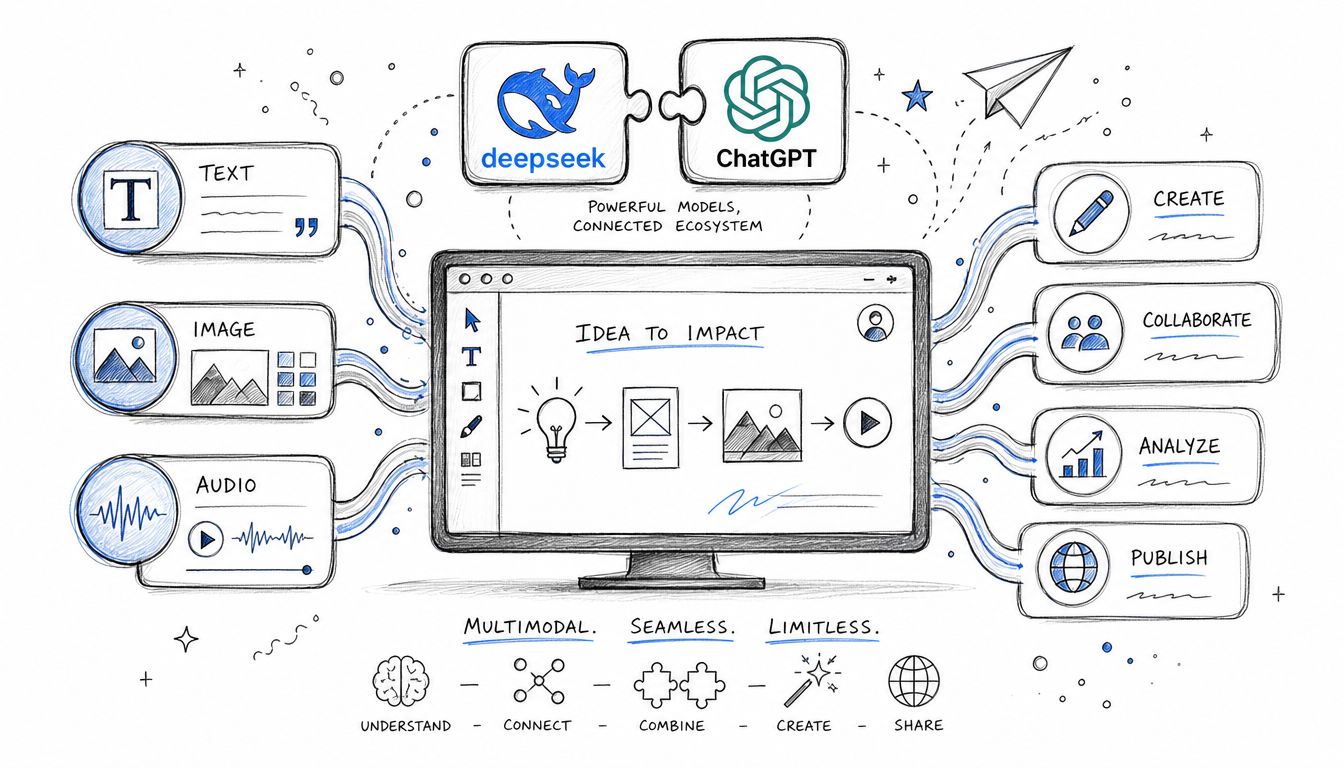
According to Exploding Topics' comparison of DeepSeek and ChatGPT, ChatGPT outperforms DeepSeek in multimodal capabilities, offering native image understanding, voice mode with live interruption, image generation via DALL·E 3, and support for over 50 languages, while DeepSeek's hosting in China may introduce content censorship or regional data limitations.
Why the surrounding product matters
This matters more than people admit. SEO and content teams rarely work in pure text. They work with screenshots, charts, SERP captures, product visuals, PDF documents, editorial workflows, and multilingual briefs. A model that can analyze images, respond in multiple languages, and fit into desktop or collaborative environments reduces task switching.
ChatGPT's broader environment makes it easier to do jobs like:
- Reviewing visual SERP assets: chart screenshots, page layouts, content blocks
- Creating creative content systems: outlines, rewrites, hooks, positioning angles
- Cross-functional collaboration: editors, strategists, and marketers often need a polished interface
If you're thinking about how teams test model-driven planning in real editorial environments, this ChatGPT experiment for content strategy is a useful companion read.
Where ChatGPT has the operational edge
For agencies running international campaigns, multilingual support changes more than copy quality. It affects briefing speed, QA, and localization workflows. For content strategists, image understanding matters because modern content production includes visual evidence, page screenshots, and layout analysis.
If your workflow already depends on GEO monitoring stacks, it also helps to review specialized generative engine optimization tools rather than relying on a general chatbot alone.
DeepSeek is more focused. That can be good when you want a lean technical engine. It becomes limiting when your team needs voice, visual analysis, or a polished all-in-one workspace. For creative and collaborative operations, ChatGPT's ecosystem removes friction that otherwise gets pushed onto humans.
Winning in AI Answers The GEO and Citation Angle
The overlooked question in DeepSeek vs ChatGPT isn't who writes better prose. It's who changes your odds of becoming a cited source in AI answers.
Most SEO teams still optimize for factual completeness and topical coverage, then hope AI systems will pick them up. That isn't enough. Citation behavior varies by model. If one system cites more aggressively, your content format should adapt to that behavior.
The clearest signal comes from SE Ranking's research on DeepSeek, ChatGPT, and YMYL topics, which found DeepSeek cited 27 sources versus ChatGPT's 10. That changes GEO strategy because citation-heavy systems reward pages that are easy to quote, easy to verify, and rich in attributable claims.
Why citation density matters
This creates what I think of as the citation-backlink opportunity. A page doesn't just need to be correct. It needs to be structurally citable.
That means building pages with:
- Claim-and-proof formatting: Put the assertion next to the supporting evidence, not several scrolls away.
- Source-visible sections: Use clean headings, concise definitions, and scannable evidence blocks that an AI system can lift cleanly.
- Entity clarity: Name tools, people, brands, standards, and concepts explicitly so the model doesn't have to infer relationships.
- Quoteable phrasing: Short, precise passages often outperform vague long-form copy in AI answer inclusion.
A local SEO team can apply the same principle to location pages and listings support content. For example, a practical local business GBP management guide works well because it answers task-based questions in a citation-friendly structure.
For teams operationalizing this, a framework for analyzing citation gaps in AI is more useful than another generic ranking checklist.
Editorial takeaway: GEO content should be written for retrieval and quotation, not only for ranking and readability.
The censorship risk global brands can't ignore
There is another GEO issue most comparisons underplay. The same SE Ranking research found that ChatGPT maintained a 100% response rate on sensitive topics, while DeepSeek responded to 90% of politically or legally sensitive queries, with restrictions related to China or its government.
That matters for global brands, agencies handling YMYL content, and any team that can't afford silent failure on sensitive prompts. A censored or withheld response doesn't just reduce usefulness. It can break trust in internal QA, leave content gaps undiscovered, or create inconsistent market coverage.
For domestic technical SEO work, this may not change your model choice. For regulated sectors and international brands, it should absolutely influence routing policy.
Analyzing Cost-Efficiency and Real-World ROI
Saying DeepSeek is cheaper doesn't help a search lead defend a tooling decision. Budget conversations need operational consequences.
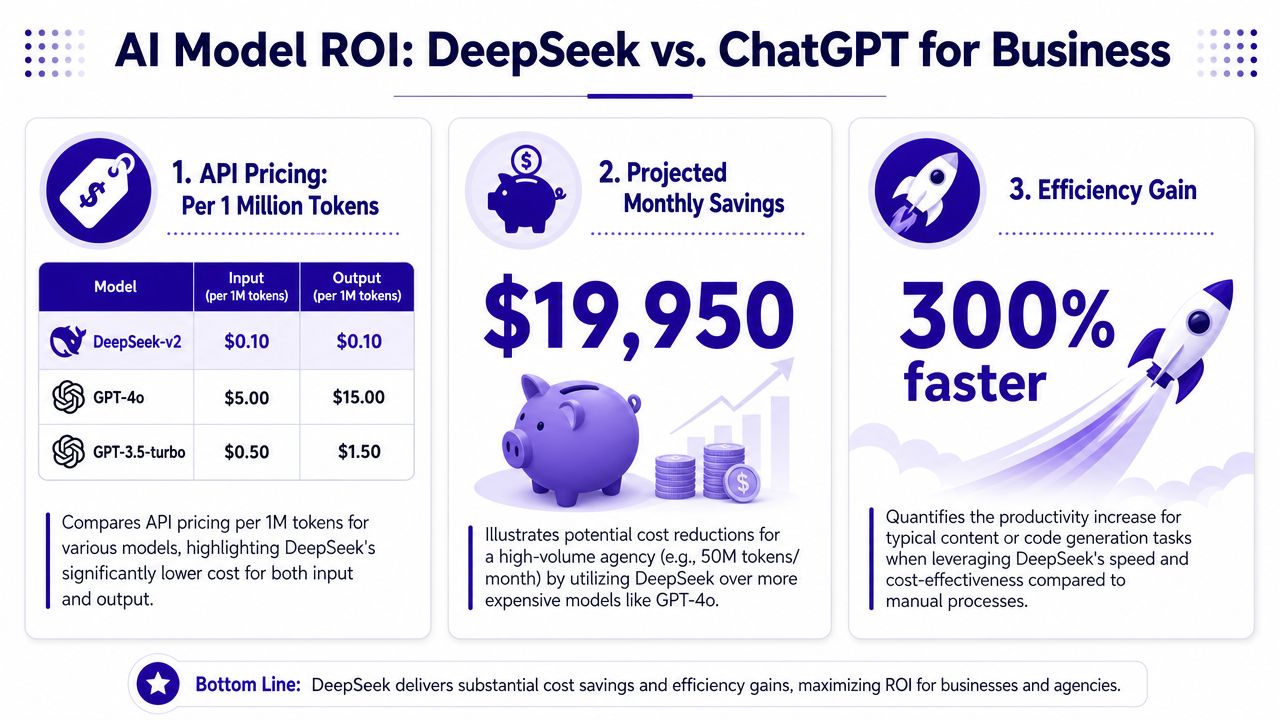
The most actionable price point in this comparison comes from ClickRank's DeepSeek vs ChatGPT pricing review, which states that DeepSeek costs $0.14 per million input tokens while ChatGPT o1 costs $7.50 per million tokens, making DeepSeek roughly 50x cheaper for high-volume input processing.
What cheaper actually changes
That difference matters most when the team runs repetitive, reasoning-heavy workloads:
- Bulk page audits: Reviewing titles, headings, schema presence, internal links, content gaps, and extraction patterns across many URLs
- Programmatic QA: Checking templated pages, category copy blocks, location pages, or product page variants
- Competitive parsing: Feeding large text inputs from competing pages, product catalogs, or documentation libraries
In those situations, low token cost changes behavior. Teams stop rationing prompts. They run additional checks, compare more variants, and iterate deeper on technical outputs. That usually improves final quality because the team can afford better review loops.
Where a hybrid budget beats a single-model policy
For agency leaders, the smarter budget model is often simple:
- Use DeepSeek for bulk audit logic, extraction, debugging, and first-pass technical transformations.
- Use ChatGPT for final narrative shaping, creative packaging, and multimodal collaboration.
- Reserve manual specialist review for regulated, branded, or strategically sensitive pages.
This avoids the common mistake of paying premium rates for work that doesn't need a premium creative environment. It also avoids forcing creative teams into a text-only system that slows editorial production.
If your workload is mostly structured and repetitive, the cheapest model often produces the highest margin because it allows more iterations before review.
The ROI isn't just lower API cost. It's the ability to widen the audit surface, test more prompts, and keep senior SEO staff focused on decisions instead of repetitive parsing.
Building Your Hybrid AI Strategy with Nuwtonic
A practical AI stack for SEO doesn't pick a winner and stop there. It routes work based on task type, risk level, and publishing intent.
The execution layer matters because the failure point is typically not in generating outputs, but in turning those outputs into reviewed changes, tracked improvements, and repeatable workflows. That's where a platform approach becomes useful, especially if you need technical audit actions, content production, and AI visibility work to live in one system. A good starting point is understanding what Nuwtonic is.
A practical operating model
Here is the workflow I recommend for agencies and in-house teams.
- Audit with logic-first AI: Run technical checks, page evaluations, entity extraction, and structural issue detection using the lower-cost reasoning engine.
- Draft with creativity-first AI: Shape landing pages, blog posts, title options, meta descriptions, and angle variations in the stronger editorial environment.
- Track AI visibility separately: Don't assume ranking reports explain AI answer inclusion. Monitor prompts, citations, and competitor presence at the URL level.
- Require approval before deployment: AI should accelerate implementation, not bypass review.
This operating model fits the way modern teams already work. Technical SEO, content ops, and GEO are no longer separate projects. They're connected production layers.
What the workflow looks like in practice
One useful pattern is to start with a ranked issue queue from Search Console-connected data, push technical pages through logic-heavy review, then send approved opportunities into content or fix workflows. That shortens the distance between diagnosis and implementation.
Later in the process, teams also need a way to manage editorial throughput, compare citation visibility, and coordinate updates without jumping across disconnected tools. A unified workspace then becomes more than a convenience.
For a quick product walkthrough, this overview is worth watching:
The strongest strategy isn't DeepSeek alone or ChatGPT alone. It's a reviewable workflow that uses each where it performs best, then turns that output into measurable search improvements.
Nuwtonic brings that workflow into one place. It helps teams run technical audits, generate entity-first content, track AI search visibility, surface citation opportunities, and push approved fixes without relying on a patchwork of separate tools. If you want a practical way to operationalize the DeepSeek vs ChatGPT decision instead of debating it in theory, explore Nuwtonic.