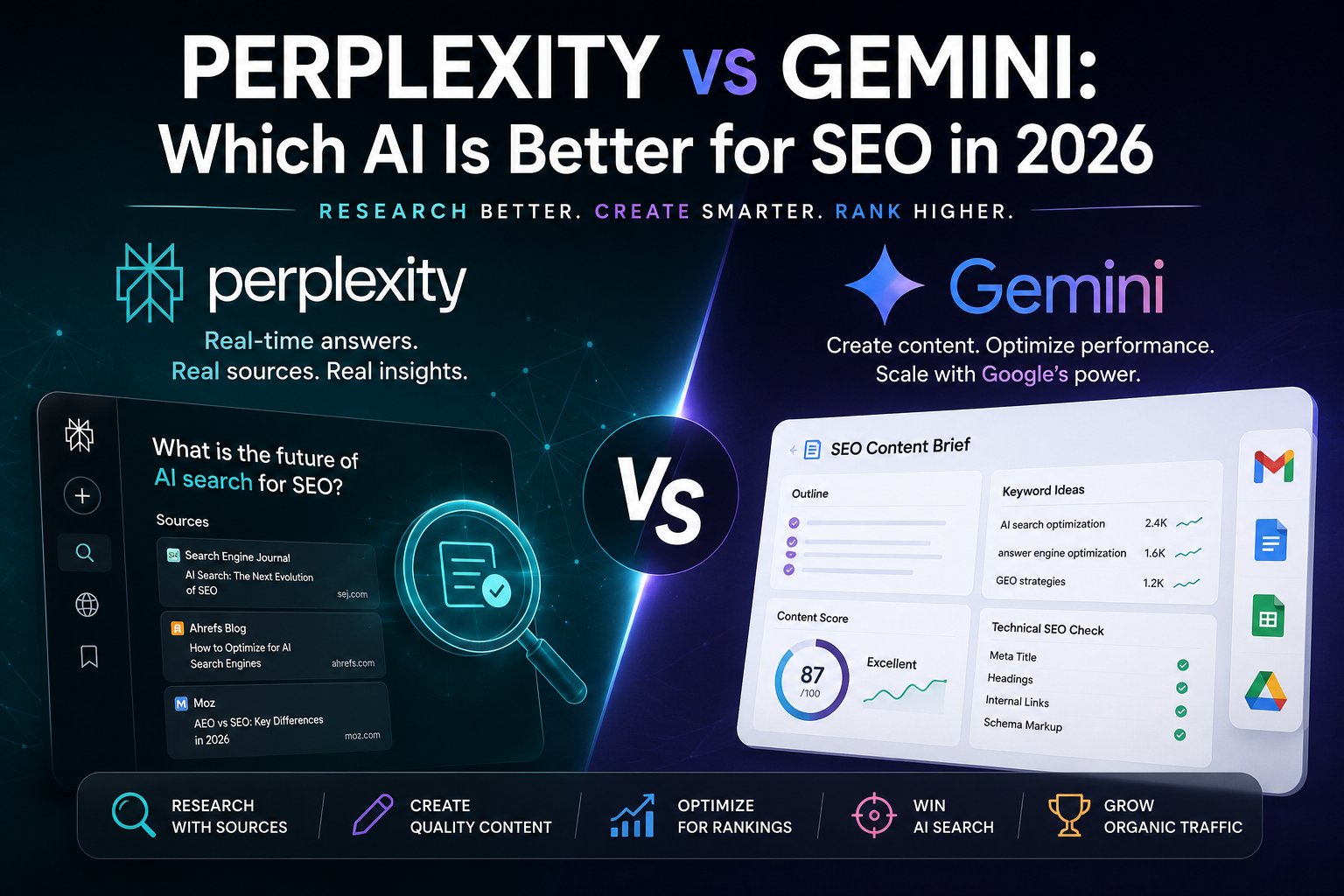
Most advice on Perplexity vs Gemini gets the buying decision backward. People compare them like two standalone chatbots fighting for the same job. That misses the operational reality SEOs and GEO teams deal with.
If your work depends on verifiable claims, source-level visibility, and brand inclusion inside AI answers, the main question isn't “Which model is smarter?” It's “Which system gives me the right output for this task, with the lowest verification burden and the best chance of surfacing my brand accurately?” Those are different questions, and they lead to different winners.
For marketing teams, the distinction matters because search behavior is splitting. Some tasks require live web retrieval and citation discipline. Others require long-context reasoning across PDFs, decks, webinar transcripts, spreadsheets, images, and internal docs. Treating Perplexity and Gemini as interchangeable is how teams end up with pretty drafts, weak sourcing, and unreliable AI mentions.
Table of Contents
- The Core Question Is Wrong
- Answer Engine vs Reasoning Engine
- Showdown on Factual Accuracy and Sourcing
- Multimodal Powers and Massive Context
- The Hidden Risk of Confident Wrong Answers
- The Verdict A Task-Based Playbook for SEOs
- Frequently Asked Questions
The Core Question Is Wrong
Teams often compare Perplexity and Gemini like they are two standalone models competing on the same axis. For SEO and GEO work, that framing leads to bad decisions.
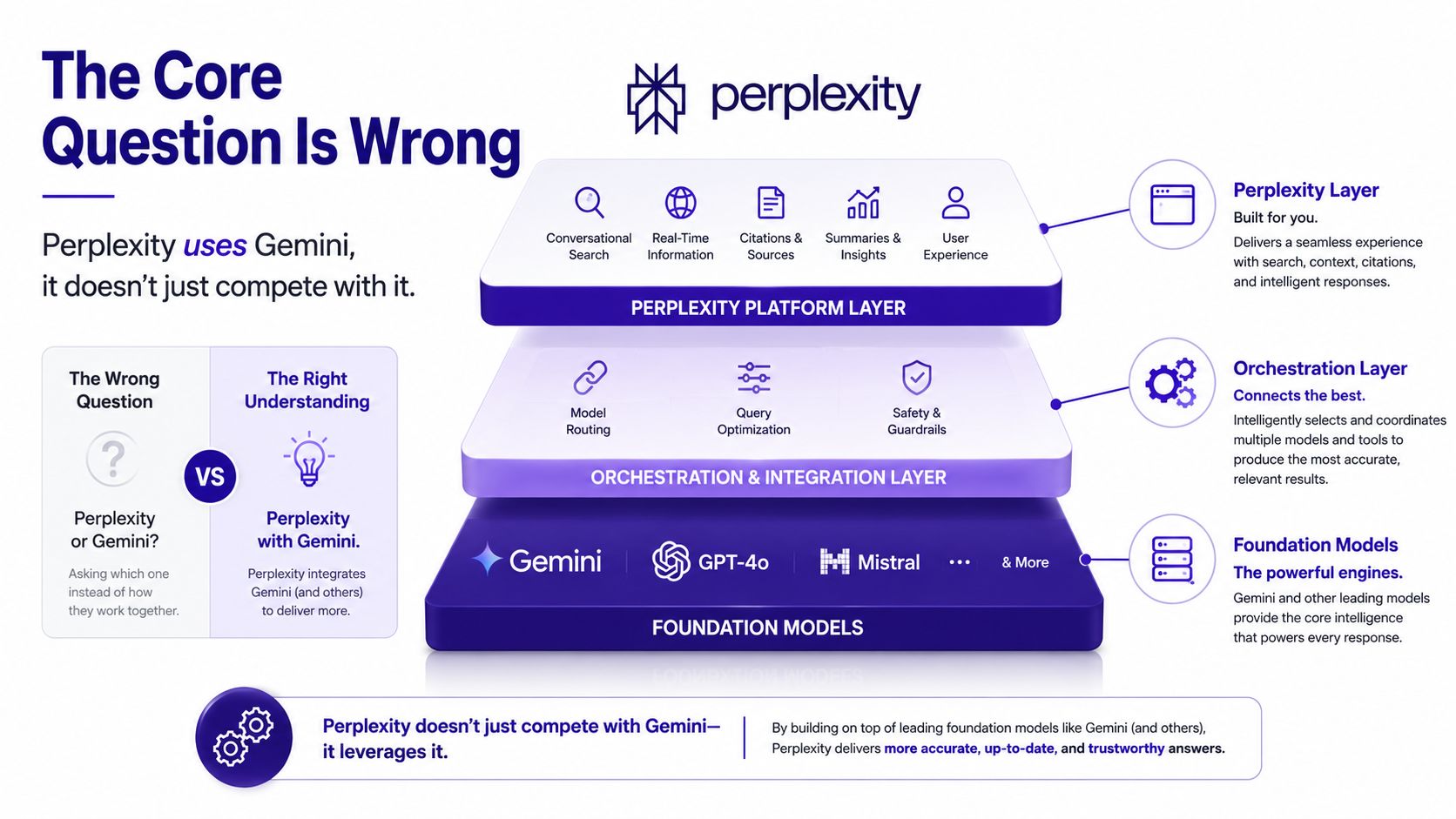
Perplexity is a research product with a model-routing layer, a retrieval layer, and a citation layer. Gemini is a foundation model family with strong reasoning, multimodal analysis, and tight integration across Google's ecosystem. If the job is brand visibility inside AI answers, the question is not “Which model is smarter?” The question is “Which system decides what gets cited, summarized, and shown to the user?”
That difference shows up fast in practice. A brand can rank well in Google, have strong content, and still get weak visibility inside Perplexity because Perplexity chooses and displays sources through its own retrieval and citation workflow. The reverse also happens. We have seen pages earn mention in answer engines because they are easy to extract, quote, and attribute, even when they are not the strongest traditional ranking asset on the site. If your team is tracking how AI search engines surface and cite content, this is the operational issue to solve.
LLMrefs has a useful breakdown on choosing AI for content creation if you want a deeper model-selection lens.
Quick decision table
| Workflow need | Better fit | Why it wins |
|---|---|---|
| Fast fact-checking on the live web | Perplexity | Built around source-grounded answers and inline citations |
| Drafting from large internal documents | Gemini | Better suited for long-context reasoning and synthesis |
| Verifying whether a claim is supported by a cited page | Perplexity | Lower friction for source checking |
| Reviewing video, audio, and image inputs | Gemini | Native multimodal analysis is the stronger lane |
| Google Docs, Gmail, Drive-heavy execution | Gemini | Workspace integration makes the workflow smoother |
| GEO work focused on citation presence and answer inclusion | Perplexity | Citation-first output aligns better with verification and source tracking |
What SEO teams miss in this comparison
The practical mistake is treating output quality and visibility as the same thing. They are not.
In a real GEO workflow, an analyst may ask Gemini to synthesize internal research, customer interviews, and a product brief into messaging options. That is useful upstream work. But if the goal is to see whether a brand appears in AI-generated answers with attributable citations, Perplexity is usually the better testing environment because the citation behavior is exposed to the user. That makes it easier to audit which pages are being pulled in, which claims survive summarization, and where your content loses position to a competitor.
Working rule: Choose the system that controls the answer format you need to measure. For SEO and GEO, citation behavior often matters more than raw model capability.
Answer Engine vs Reasoning Engine
The practical difference is simple. Perplexity is better at finding, citing, and defending claims from the open web. Gemini is better at working through large inputs you already have, then turning them into a usable output.
That split matters more for SEO and GEO than it does for casual prompting. In search-facing work, the question is not just which model sounds smarter. The question is which system helps your team trace a claim back to a source, understand why a brand was included in an AI answer, and decide what to fix next.
What Perplexity is actually optimized to do
Perplexity is built around retrieval and citation. It pulls from live web sources and shows its references inline, which reduces verification time during research, competitive analysis, and answer audits.
For SEO teams, that changes the workflow. If an analyst is checking whether a competitor's claim is supported by a source, or whether a publisher page is likely to be cited in an AI answer, Perplexity usually gets to a verifiable result faster. You can inspect the source path inside the same session instead of copying claims into a second tool and trying to reconstruct where they came from.
That makes Perplexity more useful for tasks like:
- validating market claims before they enter a brief
- checking whether a page is citation-worthy
- reviewing which sources appear in AI-generated answers
- pressure-testing GEO content against competing pages
If your team is adapting content for AI-mediated discovery, this overview of SGE impact on SEO strategies adds context on why citation visibility now affects more than traditional rankings.
What Gemini is optimized to do instead
Gemini is stronger after the source-gathering stage. Give it a product brief, sales call transcripts, positioning notes, customer research, and a draft deck, and it will usually do the higher-order synthesis better.
That advantage shows up in work such as long document review, message architecture, editorial planning, multimodal analysis, and Google Workspace-heavy production. In practice, I use Gemini when the problem is interpretation, not evidence collection.
A common SEO example is content strategy development. Feed Gemini a cluster brief, internal SME notes, persona research, and existing landing pages, and it can identify gaps, tensions, and positioning options across the whole set. Perplexity can contribute upstream research, but Gemini is usually the better system for turning that material into a plan your team can execute.
For teams studying how these interfaces shape discovery, this guide to AI search engine behavior is useful because it frames answer systems as visibility channels, not just productivity tools.
Use Perplexity to answer, "What sources support this claim, and will an AI interface cite them?" Use Gemini to answer, "Given everything we know, what should the page, brief, or strategy say?"
Marketers get burned by a predictable mistake
The mistake is assigning the wrong job to the wrong system.
Ask Gemini for unsupported market facts, and you may get polished language with weak source traceability. Ask Perplexity for nuanced messaging strategy, and you often get an acceptable draft that lacks structure, brand judgment, or prioritization.
Neither result is surprising. Perplexity is optimized for retrieval-first answers. Gemini is optimized for reasoning across large, mixed inputs.
In real marketing workflows, the cleanest setup is sequential. Use Perplexity to gather claims, sources, and citation patterns. Then move the validated material into Gemini to build a content brief, angle set, messaging hierarchy, or campaign plan. That division of labor reduces hallucination risk, cuts editorial review time, and gives SEO teams a clearer view of how brand visibility is earned in AI answers.
Showdown on Factual Accuracy and Sourcing
Polished copy is cheap. Verifiable claims are expensive.
For SEO and GEO, that difference matters more than tone, structure, or speed. Teams do not lose time because a model wrote an awkward paragraph. They lose time because a clean-sounding answer cannot be traced back to a source, or because a cited page does not support the claim. That is the point where AI output stops being useful and starts creating editorial drag.
What actually matters in review
In client work, I judge these tools on one question first. How fast can a strategist or editor verify the answer?
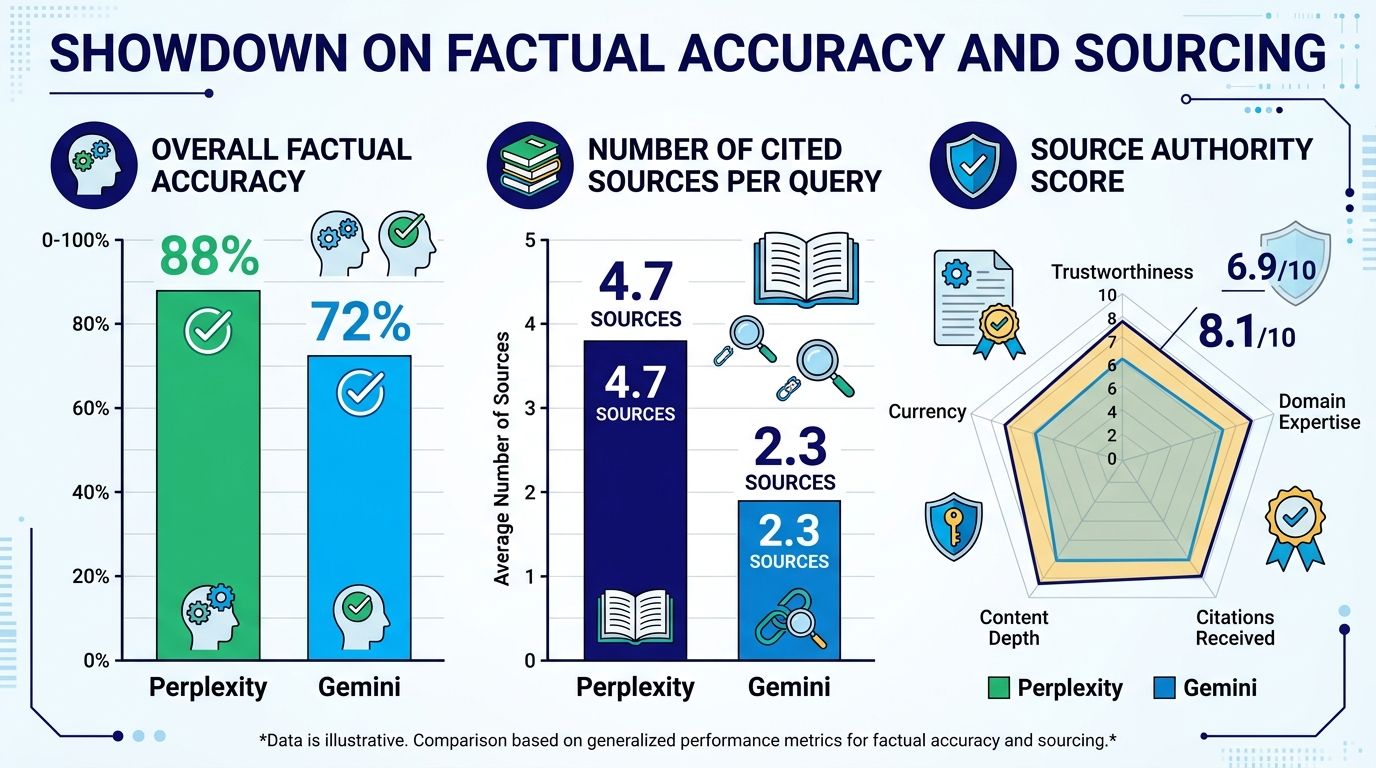
Perplexity usually wins that test because it is built to retrieve and present sources alongside the response. For citation-sensitive tasks, that changes the workflow in a practical way. You can inspect the source set, compare supporting pages, and decide whether the model is summarizing evidence or smoothing over gaps.
Gemini is stronger at synthesis than traceability. It often produces a cleaner explanation on the first pass, but the sourcing chain is less explicit. That forces a second review step. Someone has to pull apart the answer, isolate the factual claims, and confirm which statements came from actual published sources versus model inference.
That difference becomes obvious on SEO research prompts tied to brand visibility in AI answers.
What it looks like on a real GEO query
Use a prompt like, “What recent changes in AI search affect whether a brand gets cited in answer engines?”
Perplexity typically returns a source-forward answer with references attached to individual points or clusters of claims. That format is not perfect, but it shortens QA. A strategist can click through, check whether the page supports the statement, and flag weak evidence before the idea makes it into a brief or client deck.
Gemini often gives the more coherent summary. It is better at combining threads into a higher-level explanation. But if the goal is to defend every factual point in front of an editor, legal reviewer, or client, the extra synthesis can work against you. The answer reads finished before it has been fully checked.
Here is the trade-off in simple terms:
| Task after output | Perplexity | Gemini |
|---|---|---|
| Check source support | Faster | Slower |
| Trace a specific claim to a page | Easier | Less direct |
| Reuse for citation-sensitive writing | Safer starting point | Needs more manual review |
This is also why GEO teams should audit their own citation footprint, not just the model output. Our guide on analyzing citation gaps in AI answers shows how to check where your pages are missing from AI-generated responses, even when you rank conventionally in search.
If the answer is going into a report, a content brief, or a recommendation memo, judge the tool by verification time, not by how polished the paragraph sounds.
Where each tool wins
Perplexity is the better choice for:
- Fact collection
- Source-backed competitive research
- URL-level validation
- Claim checking before publication
Gemini is still useful here, but later in the chain. After the facts are validated, Gemini is better for combining those inputs into a sharper narrative, recommendation set, or strategic argument.
For SEO and GEO, citation mechanics directly affect trust, editorial speed, and whether your brand gets surfaced in AI answers at all. On factual accuracy and sourcing, Perplexity is the safer first pass.
Multimodal Powers and Massive Context
Gemini wins this section of the comparison because SEO and GEO work is not always a retrieval problem. A large share of real marketing work is synthesis across messy internal assets, and that changes which model is more useful.
I've seen this in content ops, sales enablement, and competitive research. The input is rarely a neat prompt plus a few URLs. It is a transcript, a product deck, a customer call summary, a spreadsheet of objections, screenshots from competitor pages, and a rough brief from the demand gen team. Perplexity can help with outside-the-firewall research. Gemini is better at processing the full packet and turning it into something a strategist can use.
Why context size changes the workflow
Gemini's long-context and native multimodal setup matter because they reduce the need to chop work into smaller prompts. That changes the workflow for teams handling webinars, analyst PDFs, product videos, sales decks, and documentation at the same time.
The practical gain is not the spec. It is fewer handoffs and less prompt stitching.
A few tasks where Gemini is the better pick:
- Webinar mining: Upload the transcript, slides, and follow-up notes. Ask Gemini to pull out repeated objections, positioning patterns, and pain points by audience segment.
- Competitor PDF analysis: Compare a long annual report, product guide, and whitepaper in one session. Have Gemini map message hierarchy, product claims, and gaps in proof.
- Video review: Feed in a product demo or keynote and extract claims, supporting evidence, and target personas.
- Workspace execution: If the source material already sits in Google Drive, Gmail, or Docs, Gemini makes it easier to move from raw inputs to draft output inside the same working environment.
This matters for GEO because brand visibility in AI answers often starts upstream. Teams first need to understand what their own material says, where proof is weak, and which claims are repeated often enough to become model-visible patterns. Gemini is stronger at that internal pattern analysis than Perplexity.
Where Perplexity still fits
Perplexity is still the better tool for external discovery. If the question is "what has been published, cited, or updated on the live web," Perplexity remains the faster first pass.
The split that works best in practice is simple:
- Use Perplexity to collect external evidence, recent coverage, and relevant URLs
- Use Gemini to synthesize large internal and mixed-media inputs
- Manually verify claims before anything reaches a client deliverable or published page
That workflow is effective for content strategy, technical SEO research, launch messaging, and category analysis. Perplexity helps you find the evidence base. Gemini helps you process a bigger body of material without losing the thread.
Best-fit scenarios for Gemini
| Input type | Better tool | Reason |
|---|---|---|
| Long PDF set | Gemini | Better for comparing long documents in one working session |
| Mixed media project | Gemini | Handles audio, video, images, and text in the same analysis flow |
| Google Docs workflow | Gemini | Easier production inside Workspace |
| Real-time source-backed web query | Perplexity | Better retrieval and citation flow |
Use Gemini for large-input synthesis. Use Perplexity for live-web retrieval with citations.
The mistake is treating them as interchangeable. For SEO teams, the better setup is sequential. Perplexity gathers the external proof. Gemini turns a large, messy input set into usable strategy.
The Hidden Risk of Confident Wrong Answers
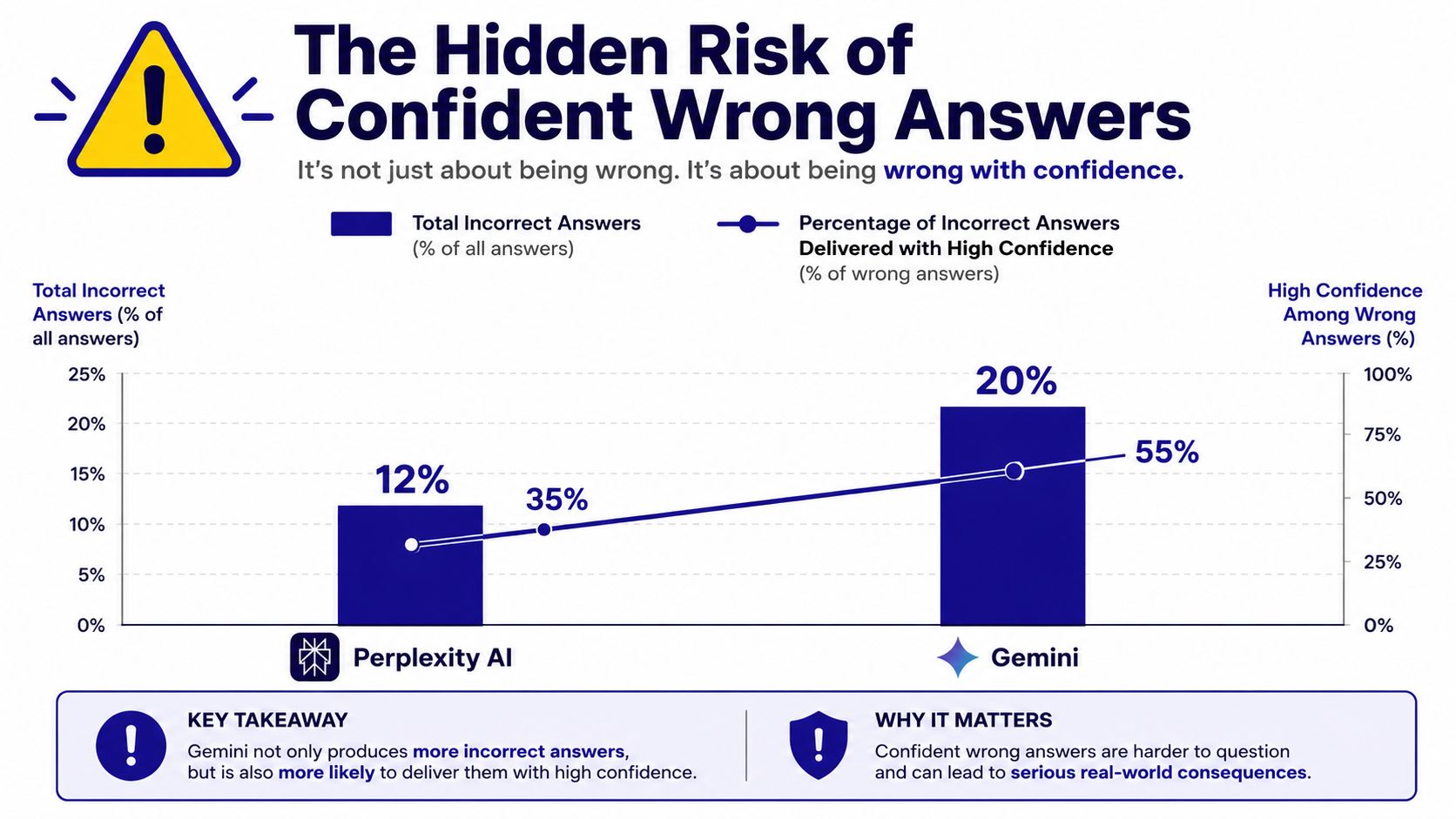
A polished wrong answer is more dangerous than an obviously bad one. SEO teams don't lose time because the output looks weak. They lose time because the answer sounds authoritative, gets copied into a brief, and only fails when someone finally checks the source.
Perplexity's architecture has a practical advantage over Gemini for high-stakes research tasks.
Why Gemini is more exposed here
A critical pitfall for Gemini is confident wrong answer generation from parametric knowledge. In divergence testing, Gemini showed a catch ratio of 0.26 compared with 2.54 for Perplexity, which reflects a materially weaker ability to catch unsupported or incorrect synthesis before presenting it in this analysis of Perplexity versus other AI systems.
That matters because many SEO and GEO tasks are precisely the kind that trigger this failure mode:
- recent platform changes
- fast-moving product comparisons
- attribution-heavy industry analysis
- source-sensitive competitor research
- citation-dependent reporting
When Gemini answers from model memory without validating the live source base, it can produce a response that reads complete but rests on a weak factual foundation.
A simple risk filter for professional workflows
Not every query carries the same risk. Some are low stakes. Others can damage trust fast.
Use Perplexity first when the query is:
- Time-sensitive
- Claim-heavy
- Comparison-based
- Likely to end up in client-facing material
- Dependent on exact wording from a source
Use Gemini first when the query is:
- Interpretive rather than factual
- Based on documents you already control
- Focused on synthesis, framing, or transformation
- Multimodal by nature
What works in practice
The cleanest operating rule is simple.
Practical rule: Never let an unsourced AI paragraph become published marketing copy unless a human has checked the underlying claim path.
For agency teams and in-house content leads, that usually means building a handoff:
- Gather or verify the facts with Perplexity.
- Synthesize, structure, or rewrite with Gemini if needed.
- Re-check every claim that survived into the final asset.
That process sounds slower on paper than “just ask Gemini.” In reality, it's faster than cleaning up a wrong report, revising a broken pitch, or retracting unsupported content after review.
Why this matters for GEO
GEO work raises the stakes because you're not only publishing content. You're trying to influence what answer engines cite and repeat. If your internal workflow tolerates unsupported claims, you'll struggle to build pages that answer engines trust enough to surface.
Perplexity's retrieval-first method is closer to the discipline GEO teams need. Gemini's strength comes later, once the source layer is already clean.
The Verdict A Task-Based Playbook for SEOs
The winner depends on the task. For SEO and GEO work, that decision is less about model preference and more about failure cost. If a bad answer creates a weak brief, a wrong statistic, or a claim you cannot trace back to a source, the tool choice already hurt the outcome.
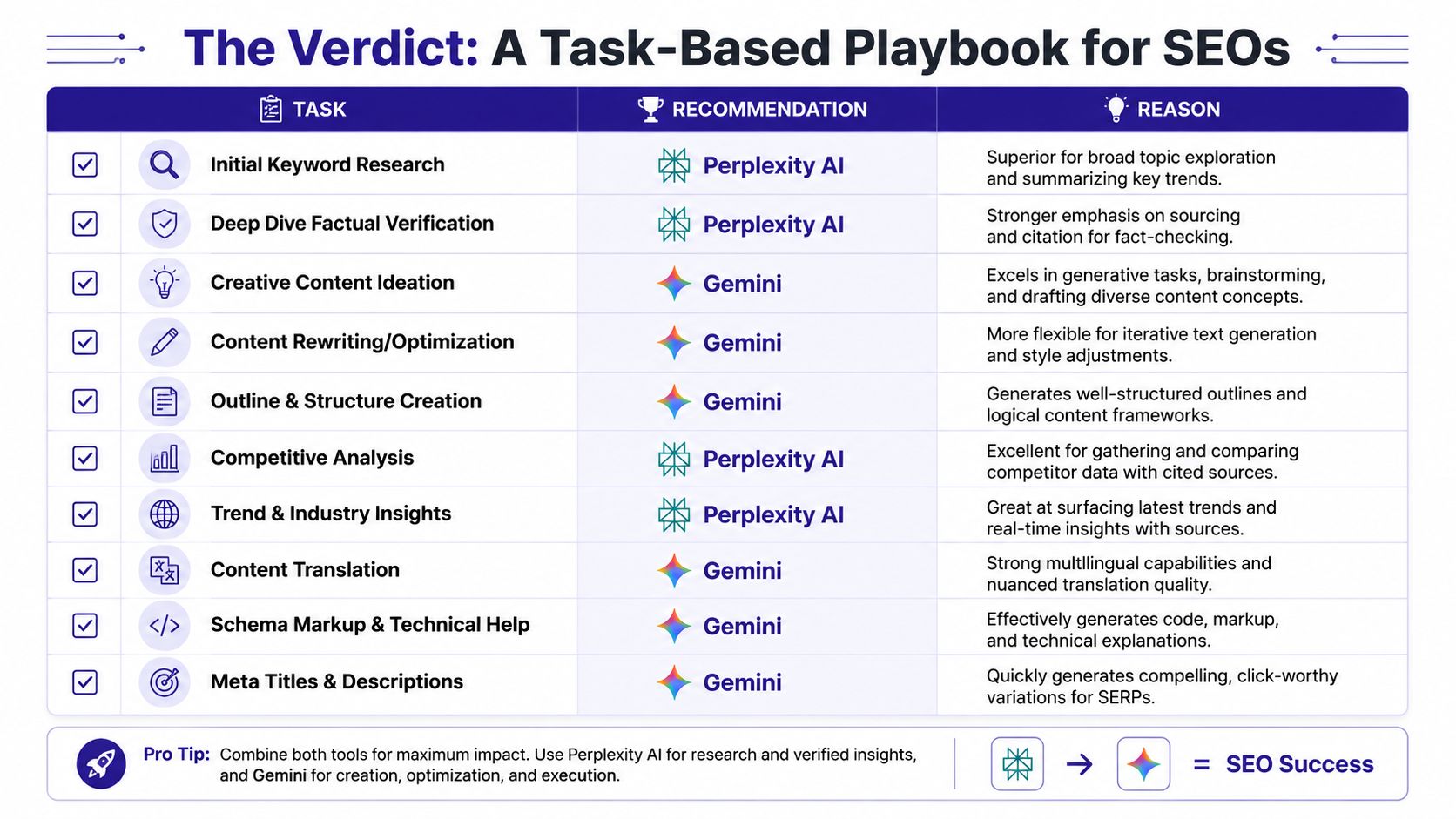
In our testing at Nuwtonic, Perplexity wins the research layer more often. Gemini wins the transformation layer more often. That split matters because SEO teams rarely need “the best AI.” They need the fastest path to an output they can trust, edit, and publish.
Use Perplexity for these SEO and GEO tasks
Fact-checking before content goes live
Perplexity is the safer first stop for recent, source-backed answers. It shortens the time spent verifying where a claim came from.Competitive research that needs supporting URLs
If a strategist, editor, or client will ask for proof, Perplexity gives a cleaner audit trail.Finding report statistics and original studies
The number matters. The source matters more. Perplexity makes both easier to inspect.Building source lists for briefs
It is better at surfacing the pages, publishers, and references worth reviewing manually before writing starts.GEO research tied to citation patterns
For teams working on answer-engine visibility, Perplexity is more useful for studying which source types keep showing up in AI answers. Pair that research with a clear publishing process, then apply it using this guide on how to optimize content for AI search.
Use Gemini for these tasks instead
Drafting from internal documents
Gemini handles transcripts, decks, meeting notes, PDFs, and product docs well. It is usually faster at turning messy internal material into a solid draft.Reframing and structuring ideas
For angle generation, narrative shaping, and content planning, Gemini is often more flexible.Video and multimodal analysis
If the input is a webinar, product walkthrough, or YouTube competitor review, Gemini has the edge.Comparing large document sets
Gemini is the better choice when the work depends on pulling patterns from long, mixed inputs without constant chunking.
Here is the operating table I recommend to SEO teams:
| Task | Winner | Why |
|---|---|---|
| Verify a market claim before publishing | Perplexity | Easier to trace and validate the source path |
| Turn rough notes into usable copy | Gemini | Better drafting, restructuring, and synthesis |
| Review a competitor webinar or demo | Gemini | Stronger multimodal analysis |
| Build an evidence-backed outline | Perplexity first, Gemini second | Research first. Draft second |
| Plan content for AI answer inclusion | Perplexity for research, Gemini for production | Better source analysis, then faster asset creation |
This is also why teams should evaluate these tools as part of a broader stack of AI marketing tools, not as isolated subscriptions. The main gain comes from assigning each system to the step where it is strongest.
The strongest workflow is straightforward. Use Perplexity to gather and verify claims, use Gemini to shape the material, and keep human review in the final approval path.
Frequently Asked Questions
Which one is better for coding and technical tasks
Gemini is often the better fit when the technical task involves very large documentation sets, multimodal inputs, or long-context analysis. Perplexity is better when the first problem is finding current documentation, references, and supporting sources on the web.
Do you need paid plans to get the best result
For serious professional use, a paid tier usually makes the workflow smoother because limits, routing access, and higher-end capabilities matter when the work is repetitive and client-facing. The better question is whether your team is using the right tool for the right stage. A paid plan on the wrong system won't fix poor task assignment.
Can you use both in one workflow
Yes. In practice, that's the most reliable setup for many SEO teams. Use Perplexity to gather and verify sources. Use Gemini to analyze large document sets, transform research into drafts, or work inside Google Workspace. That division reduces both hallucination risk and rework.
Which one is better for SEO specifically
If “SEO” means evidence gathering, claim verification, competitor source analysis, and GEO citation work, Perplexity is the stronger primary research tool. If “SEO” means turning transcripts, decks, product docs, and internal notes into content assets, Gemini is often better.
What else should teams evaluate besides these two
Your stack shouldn't stop at model choice. You also need auditing, content operations, and visibility tracking across AI surfaces. This roundup of AI marketing tools is useful if you're evaluating the broader operational stack around research, reporting, and execution.
Nuwtonic helps SEO and content teams turn this kind of analysis into execution. If you need one workspace for GEO audits, AI visibility tracking, citation gap analysis, technical fixes, and content updates tied to Google Search Console data, explore Nuwtonic.