You might be wondering if the traditional internet is dying. Over the last decade, we optimized content for a predictable machine: a search engine that matched keywords and served up ten blue links. But today, the rise of the AI Search Engine is fundamentally rewriting how humans find information online. We are moving away from a matchmaking ecosystem toward a synthesis-driven environment.
In my seven years of optimizing search algorithms, I have watched countless digital strategies fall flat because they treated modern AI search engines like traditional indexers. Here is the thing: optimizing for an AI search engine requires a completely different mental model. It is no longer about tricking a crawler with exact-match keywords—it is about providing undeniable semantic clarity and structured authority.
Key Takeaways
Before we break down the mechanics, here are the core principles you need to understand about the AI search engine shift:
• Answers Over Links: AI search engines prioritize direct, synthesized answers over a list of external URLs.
• Intent Over Keywords: Natural language processing (NLP) has made exact-match keyword optimization obsolete; query intent is now the primary ranking driver.
• Crawlability is Mandatory: To appear in Google's generative summaries, your content must be fully indexed and eligible for standard snippets.
• Structure Drives Discovery: Clean semantic HTML, schema markup, and concise Q&A formatting make it easier for AI systems to cite your brand.
Table of Contents
TL;DR Summary
An AI Search Engine uses natural language processing (NLP) and machine learning (ML) to crawl the web, extract facts, and synthesize customized, conversational answers with direct citations. Unlike traditional search engines that require users to click through multiple websites, AI search engines aim to solve queries directly on the results page. To remain visible, brands must shift from keyword-centric tactics to structured, high-authority, and highly readable content that AI engines can easily parse and cite.
What is an AI Search Engine?
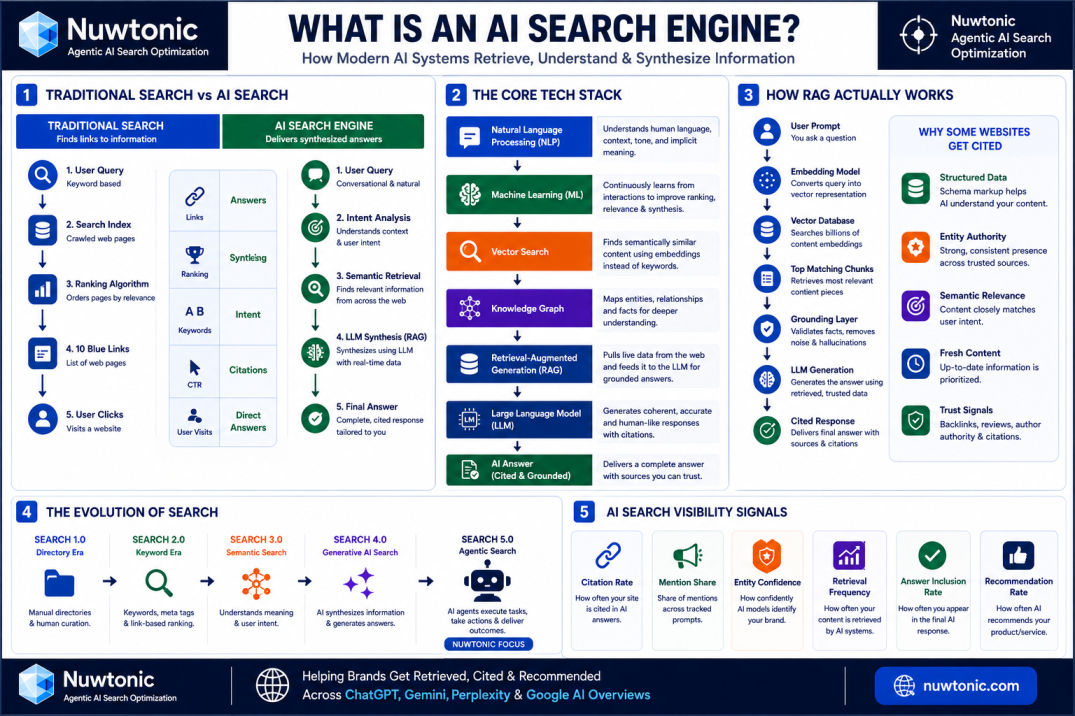
To understand an AI search engine, let's use a simple analogy. Think of traditional search like a dog fetching a stick—you throw the keyword, and the dog brings back the exact stick (or website) you pointed at. An AI search engine is more like a dog that fetches the stick, carves it into a customized walking cane on the fly, and hands you a finished product tailored to your exact height.
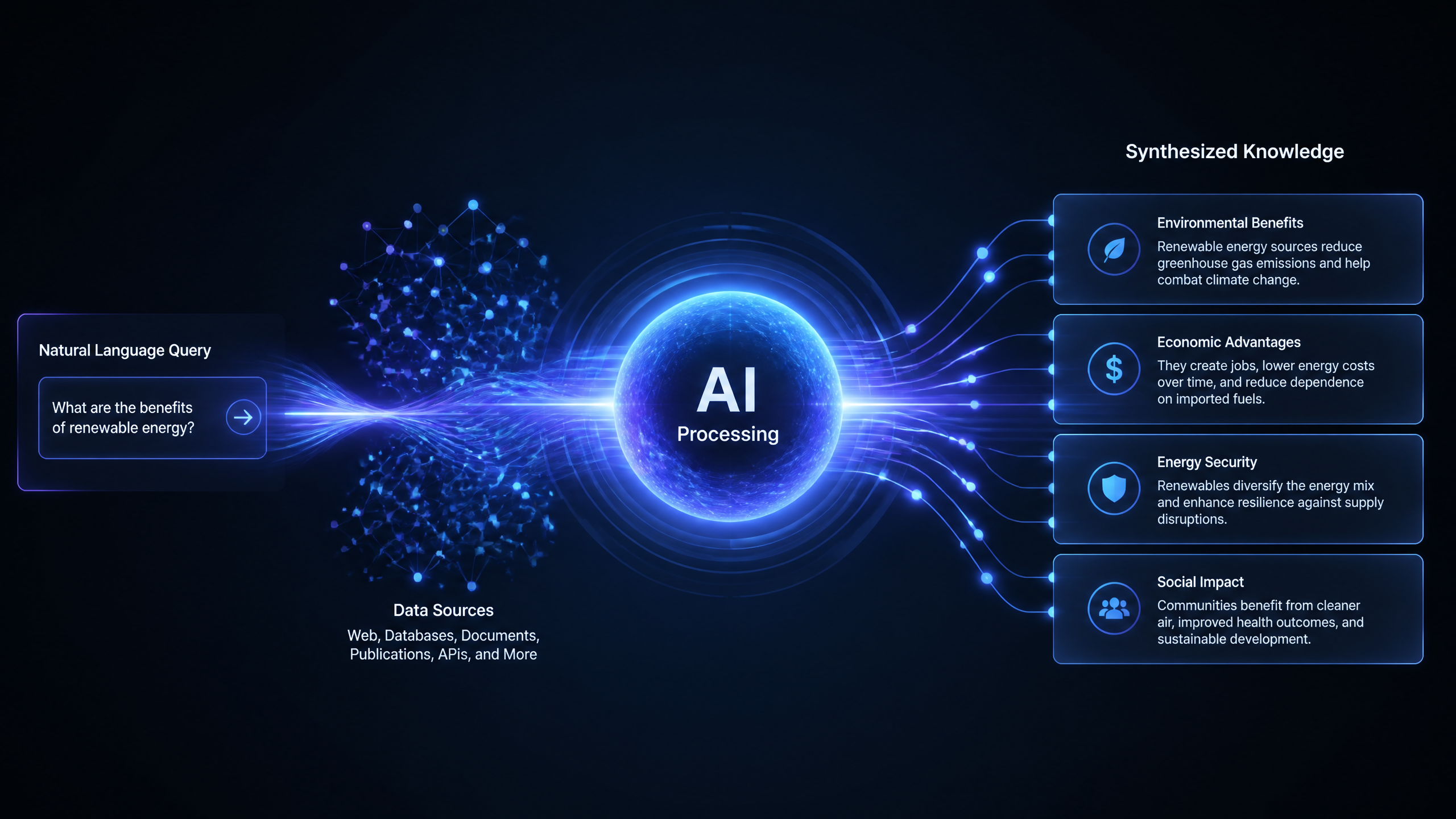
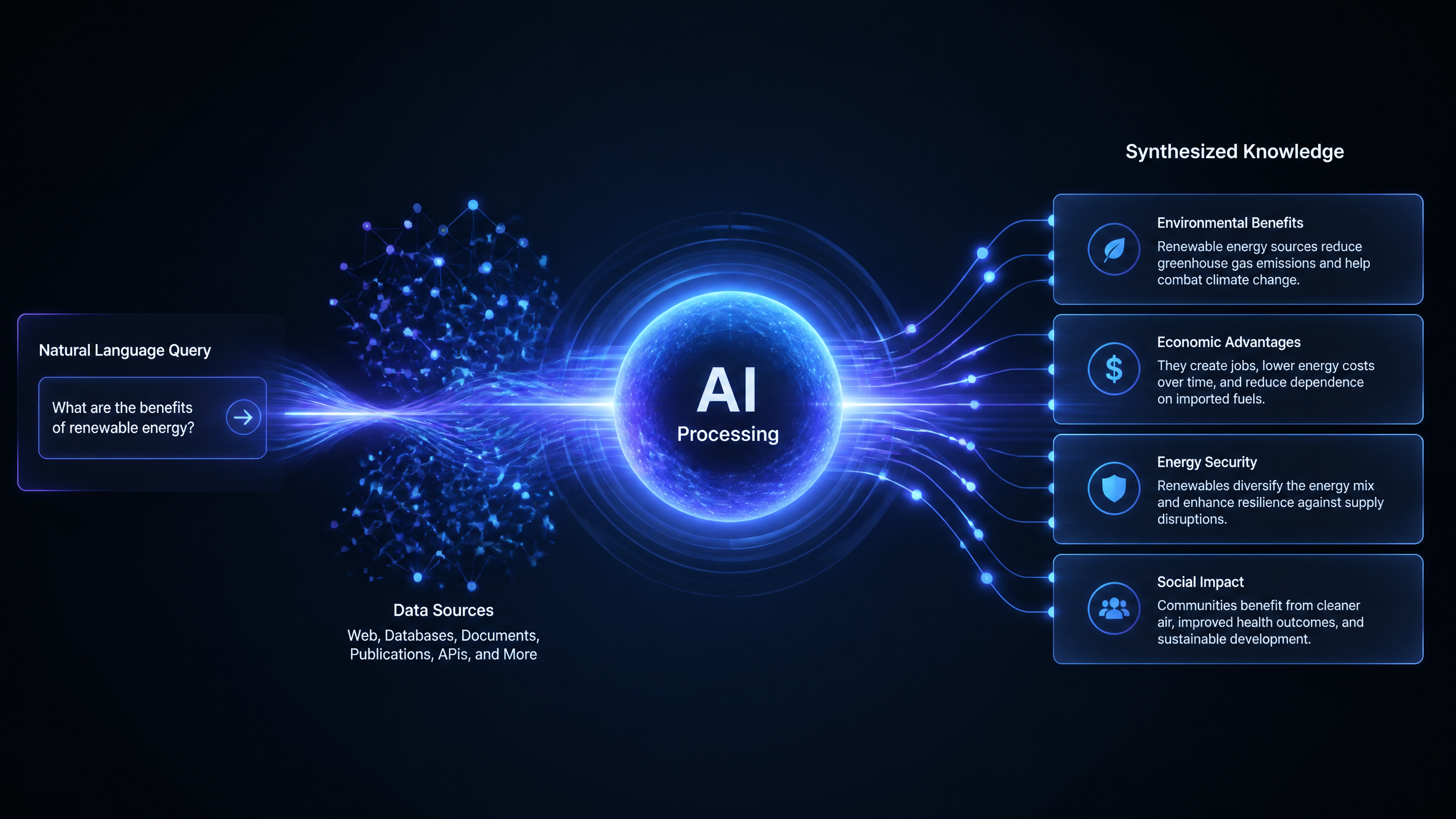
Instead of acting as a directory of websites, an AI search engine acts as a synthesis engine. It reads, understands, and compiles information from across the web to answer complex, multi-layered queries in a single, cohesive response.
The Core Tech Stack
Modern AI search engines rely on three primary technological pillars:
Natural Language Processing (NLP): Allows the system to understand conversational human queries, deciphering context, tone, and implicit needs.
Machine Learning (ML): Continuously refines how search results are ranked and synthesized based on user interactions and content relevance.
Retrieval-Augmented Generation (RAG): The process of pulling live, real-time web data and feeding it to a large language model (LLM) to generate an accurate, grounded, and cited response.
How is AI Different from a Traditional Search Engine?
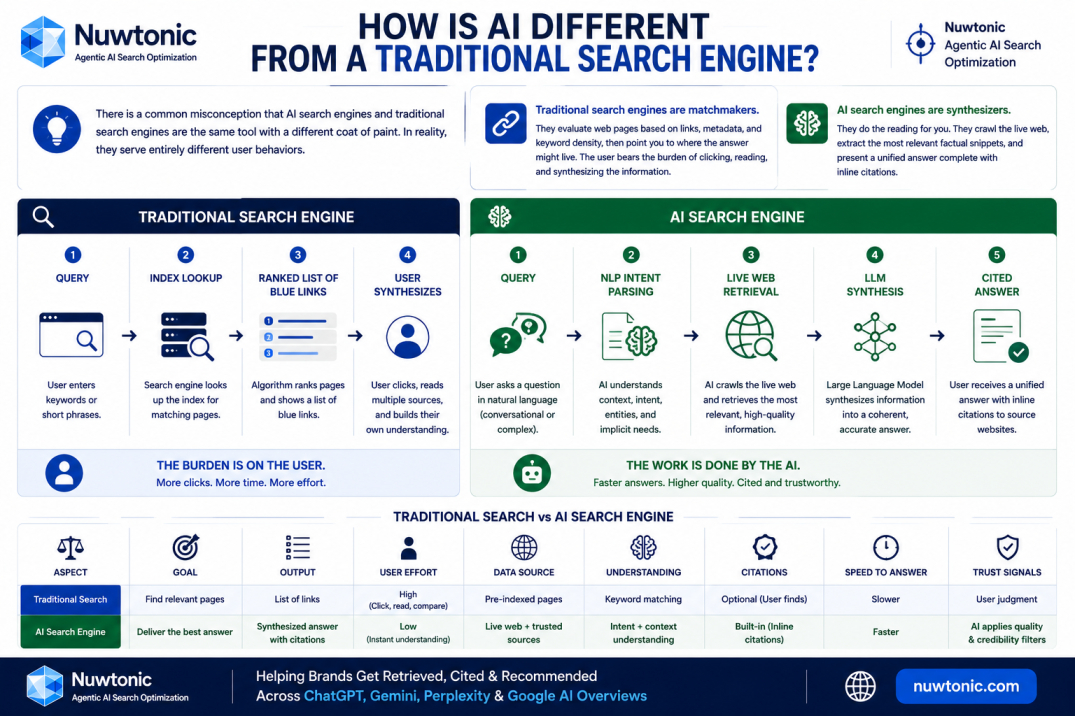
There is a common misconception that AI search engines and traditional search engines are the same tool with a different coat of paint. In reality, they serve entirely different user behaviors.
Traditional search engines are matchmakers. They evaluate web pages based on links, metadata, and keyword density, then point you to where the answer might live. The user bears the burden of clicking, reading, and synthesizing the information.
AI search engines are synthesizers. They do the reading for you. They crawl the live web, extract the most relevant factual snippets, and present a unified answer complete with inline citations.
Traditional Search: Query -> Index Lookup -> Ranked List of Blue Links -> User Synthesizes
AI Search Engine: Query -> NLP Intent Parsing -> Live Web Retrieval -> LLM Synthesis -> Cited Answer
How Does an AI Search Engine Work?
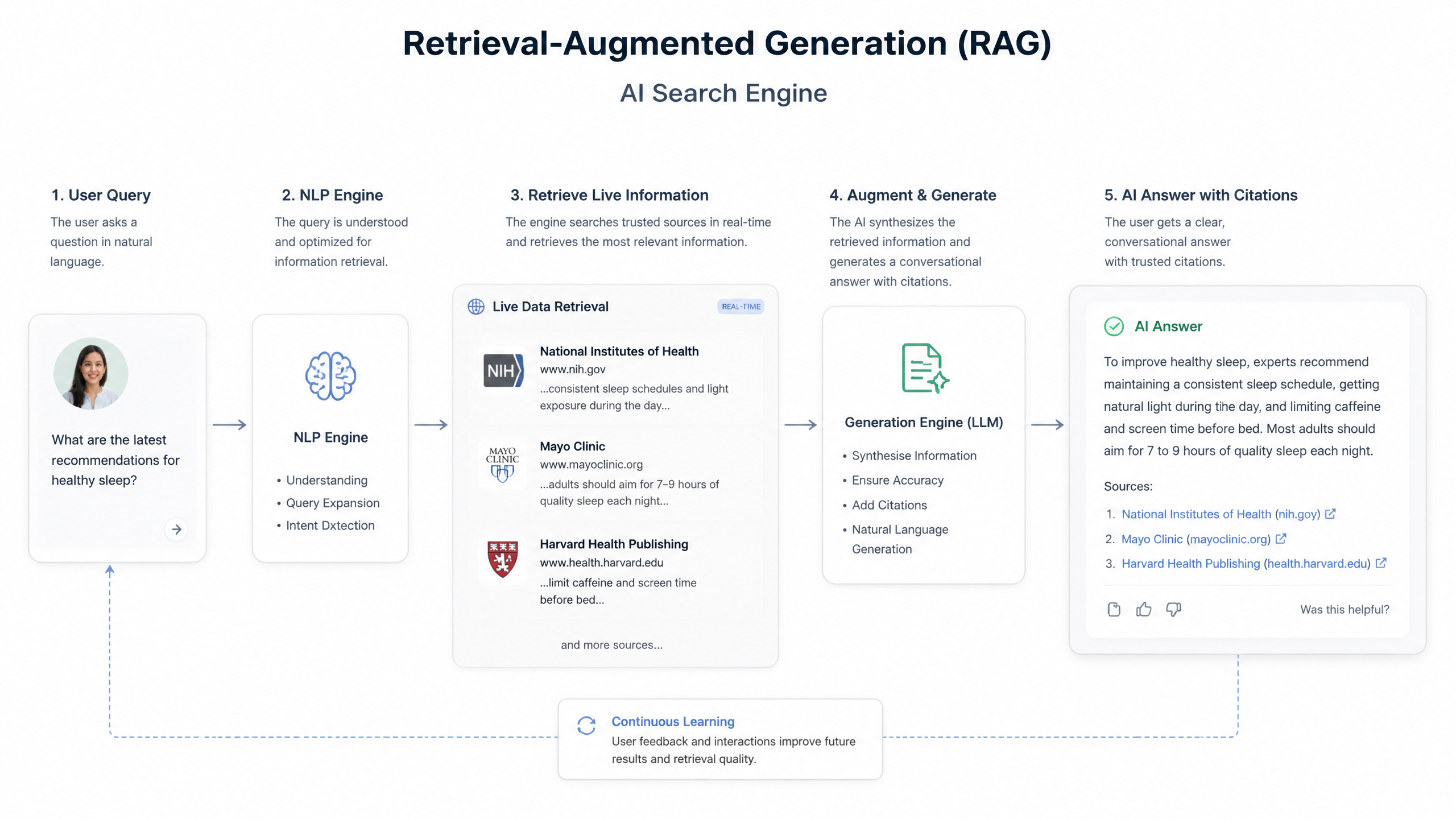
Under the hood, an AI search engine operates a highly coordinated, multi-step pipeline in a fraction of a second. When you type a query, the system executes the following steps:
Step 1: Query Processing and Intent Parsing
The engine uses NLP to break down your query. If you ask, "What is the best camera for a beginner videographer on a budget?" the system doesn't just search for those exact words. It parses the entities ("camera", "beginner videographer") and the constraint ("on a budget") to understand your true query intent.
Step 2: Information Retrieval (Crawl and Scrape)
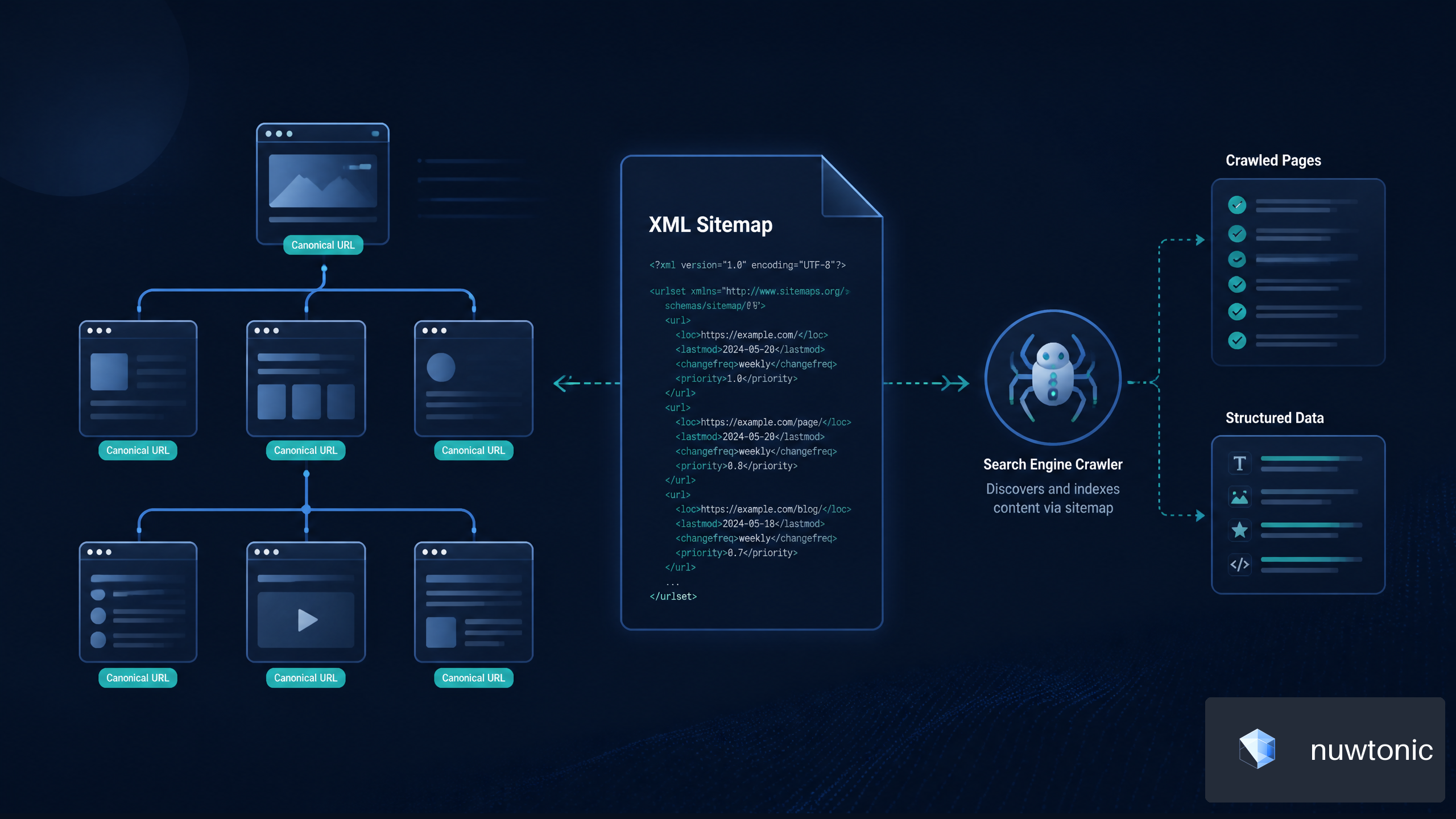
The system searches its index and the live web to find high-quality pages addressing the parsed intent. According to Google Search documentation, a page must be indexed and eligible to appear in standard search snippets to be considered for inclusion in Google's generative AI features. The engine retrieves these crawlable, public pages to gather patterns and factual data.
Step 3: Semantic Reranking
Once the pages are retrieved, a machine learning model evaluates them for content relevance. It filters out fluff, advertisements, and low-quality text, ranking the remaining snippets based on factual density and authority.
Step 4: Generation and Citation
The LLM takes the highly ranked snippets and writes a natural, cohesive summary. To prevent hallucinations, the engine applies strict "grounding" rules, forcing the model to only use facts present in the retrieved sources and to drop clickable citations next to every claim.
Traditional SEO vs. AI Search Optimization
Optimizing for this new breed of search requires a strategic pivot. If you are still relying on old-school playbook tactics, you are likely losing visibility in generative search results.
Here is a detailed comparison of how these two approaches differ:
Feature | Traditional SEO | AI Search Optimization |
|---|---|---|
Primary Goal | Rank #1 for specific keywords | Be cited as the primary source in AI summaries |
Target Metric | Organic Click-Through Rate (CTR) | Brand mention share and citation volume |
Content Structure | Long-form articles with keyword insertion | Concise, structured Q&A blocks and semantic HTML |
Ranking Signals | Backlinks, domain authority, keyword matching | Semantic clarity, entity relevance, and EEAT |
User Intent Focus | Informational, transactional, navigational | Complex, multi-turn conversational queries |
When comparing Traditional SEO vs AI SEO, the fundamental shift lies in how machines read your content. Traditional search engines indexed your words; AI search engines digest your concepts.
Optimizing Content for AI Search Discovery
So, how do you make your website the undeniable source of truth that an AI search engine wants to quote? In my experience, it comes down to structural clarity and authority.
1\. Write Answer-First, Concise Content
According to Microsoft Advertising guidance, AI search-friendly content should be concise and self-contained so it can be cleanly lifted into synthesized answers.
Instead of burying your answers under 500 words of introductory fluff, use an "inverted pyramid" writing style:
• State the direct answer in the first two sentences.
• Use clear, active voice.
• Support the answer with bullet points or structured data.
• Provide deep, contextual analysis afterward.
2\. Leverage Schema Markup and Semantic HTML
If you want an AI search engine to understand your data, you must speak its language. Structured data acts as a translator. Microsoft Advertising documentation indicates that adding schema markup—such as Article, Organization, FAQ, and Author—helps AI engines interpret page context and connect related entities.
At the same time, ensure your page uses clean semantic HTML (e.g., header, article, section, table). This makes it incredibly easy for scrapers to parse your page without getting tripped up by messy code.
3\. Establish Trust and Authority (E-E-A-T)
Because AI search engines are prone to hallucinations, they heavily favor credible, verifiable information. Google's core quality guidance emphasizes that content must be helpful, reliable, and people-first.
Understanding the Importance of EEAT for AI SEO is critical here. To build this trust:
• Include clear author bios with links to verified social profiles or professional portfolios.
• Cite your own primary data sources, studies, and original research.
• Secure high-quality, editorial mentions from trusted industry publications.
To implement these tactics successfully, you should study What is AI SEO Optimization to build a robust, future-proof framework.
Technical Barriers and Policy Constraints
Optimizing for AI search isn't just about writing great copy; you also have to navigate the technical limitations and strict policy boundaries of modern search platforms.
JavaScript Rendering Pitfalls
Here is a technical hurdle I have seen break dozens of sites: heavy reliance on JavaScript. While modern search crawlers are decent at rendering JS, some generative AI crawlers may not fully process JavaScript-heavy pages. If your main content is injected client-side via complex JS frameworks, the AI scraper might retrieve an empty page, rendering your content invisible to generative answers. Keep your critical content in the raw HTML payload whenever possible.
Compliance and Spam Policies
Do not try to game the system by mass-producing low-quality content to target every possible query variation. Google explicitly warns that creating separate pages for every minor query variation to manipulate AI responses can violate its scaled content abuse policy.
According to Google, AI-assisted writing is perfectly acceptable, but only if the final output meets Search Essentials and remains helpful, reliable, and uniquely valuable to human readers.
Measuring Visibility in AI Search
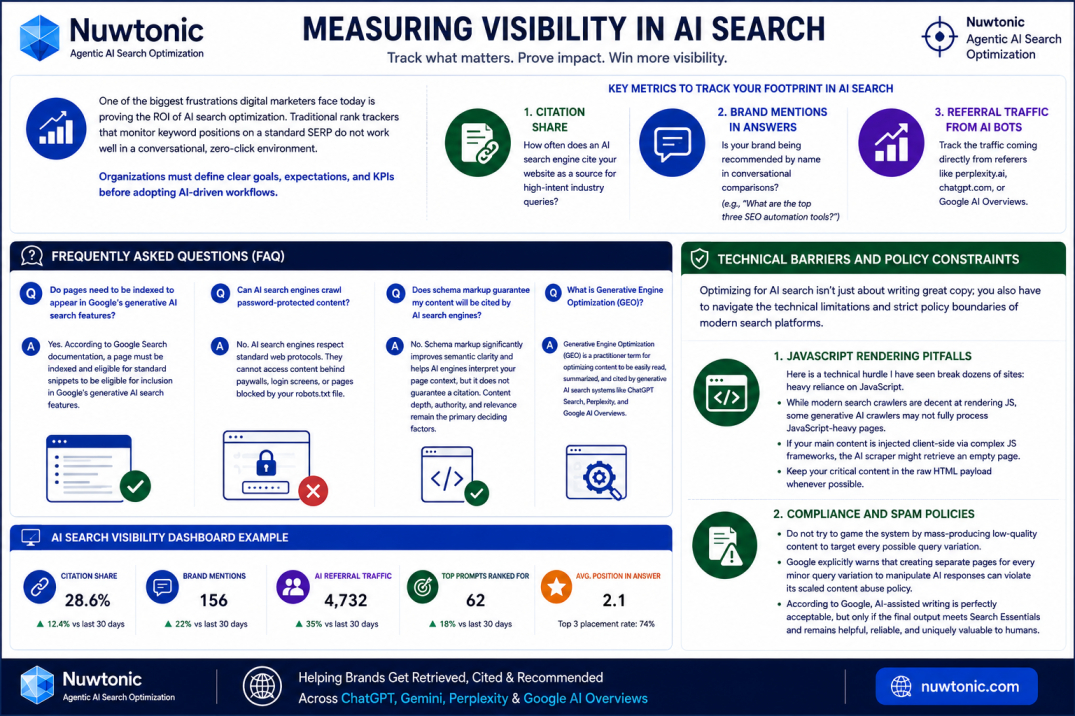
One of the biggest frustrations digital marketers face today is proving the ROI of AI search optimization. Traditional rank trackers that monitor keyword positions on a standard SERP do not work well in a conversational, zero-click environment.
According to IBM's marketing framework, organizations must define clear goals, expectations, and KPIs before adopting AI-driven workflows. When measuring your footprint in AI search, focus on these metrics:
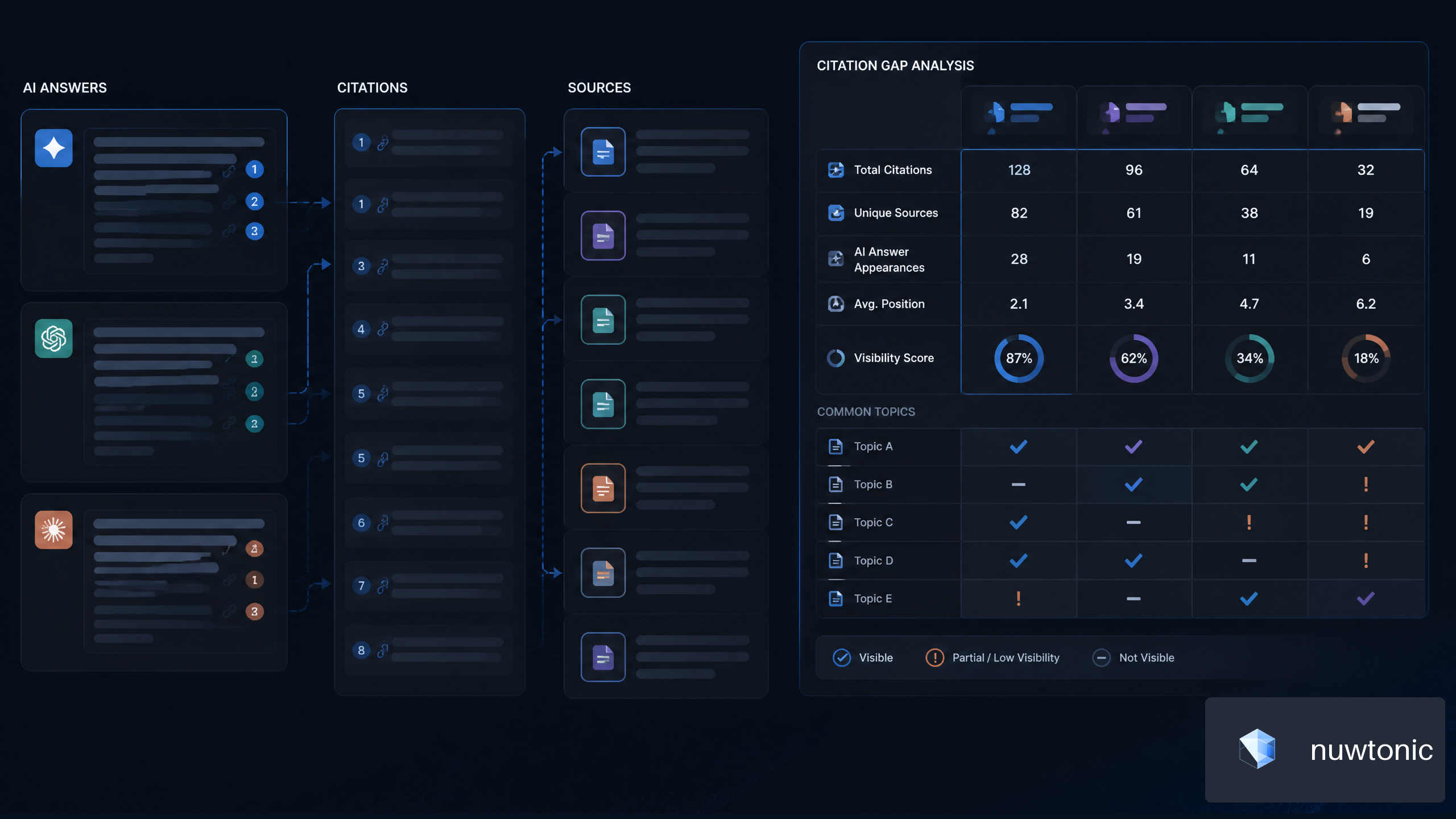
Citation Share: How often does an AI search engine cite your website as a source for high-intent industry queries?
Brand Mentions in Synthesized Answers: Is your brand being recommended by name in conversational comparisons (e.g., "What are the top three SEO automation tools?")?
Referral Traffic from AI Bots: Track the traffic coming directly from referers like
perplexity.ai,chatgpt.com, or Google's AI Overviews.
Frequently Asked Questions (FAQ)
Q: Do pages need to be indexed to appear in Google's generative AI search features?
Yes. According to Google Search documentation, a page must be indexed and eligible for standard snippets to be eligible for inclusion in Google's generative AI search features.
Q: Can AI search engines crawl password-protected content?
No. AI search engines respect standard web protocols. They cannot access content behind paywalls, login screens, or pages blocked by your robots.txt file.
Q: Does schema markup guarantee my content will be cited by AI search engines?
No. Schema markup significantly improves semantic clarity and helps AI engines interpret your page context, but it does not guarantee a citation. Content depth, authority, and relevance remain the primary deciding factors.
Q: What is Generative Engine Optimization (GEO)?
Generative Engine Optimization (GEO) is a practitioner term for optimizing content to be easily read, summarized, and cited by generative AI search systems like ChatGPT Search, Perplexity, and Google AI Overviews.
Sources and References
• Google Search Central: Google Search Generative AI Documentation
• Microsoft Advertising Blog: Optimizing Content for AI Search Answers
• IBM Think: AI in Marketing and Search Workflows