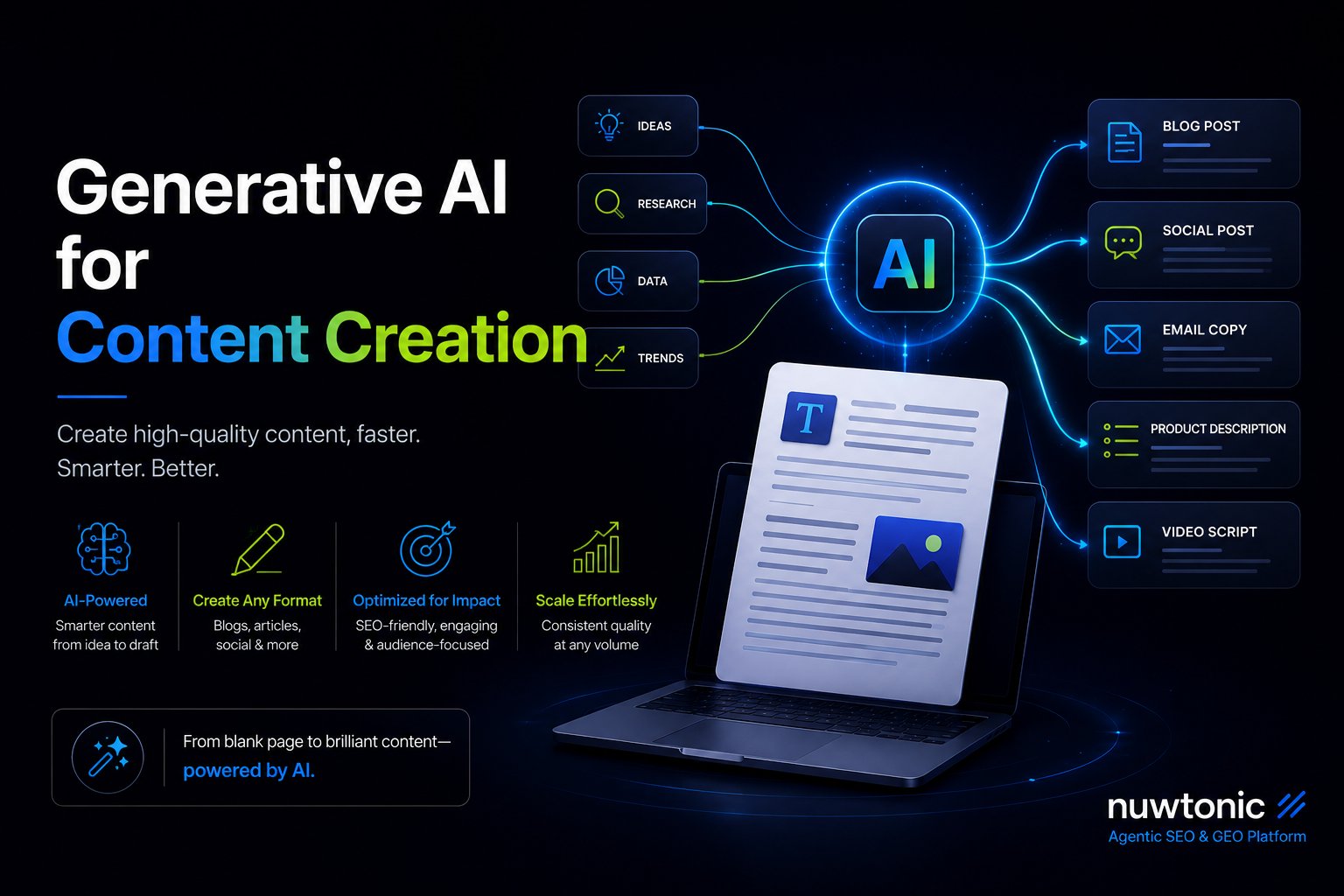
Most advice on generative AI for content creation still gets the main problem wrong. The win isn't “write faster,” it's “run a content operation that can ship, verify, govern, and refresh at scale without flattening the brand.” That shift matters because the dominant operating model is already human-edited and AI-assisted, not fully automated, and the gap between those two approaches decides whether teams publish useful assets or just more pages.
The bigger change is structural. Content teams are no longer only asking AI to draft paragraphs, they're using it across ideation, production, optimization, and maintenance, which means the bottleneck has moved from drafting to governance, originality, and lifecycle control. If you're still measuring success by output alone, you're missing the part that determines whether the content portfolio compounds or decays.
Table of Contents
- Why Generative AI Is Reshaping Content Operations
- How Generative AI Actually Works for Content Teams
- Real-World Use Cases Across Content Types
- Prompt Engineering and Quality Control Workflows
- Optimizing for AI Search Engines and GEO
- Measuring Performance Beyond Speed and Volume
- Governance and Maintenance at Scale
Why Generative AI Is Reshaping Content Operations
The old pitch was that AI helps writers work faster. That framing is too small. Content teams now use AI across the full chain, from topic discovery to post-publication updates, so the operational change shows up in editorial planning, SEO handoffs, legal review, and maintenance work.
The bigger shift is in how content gets produced at scale. Analysts at Ahrefs found that a large share of newly created pages now include AI-generated material, and most of that output is mixed with human writing rather than published straight from a model source. That fits what I see in practice. Human-edited, AI-assisted workflows are the default, because fully automated publishing falls apart as soon as a page needs brand judgment, source verification, or a revision path.
What that means for content ops
The mix matters because it shows where the labor sits. AI can produce a draft quickly, but people still decide what aligns with brand voice, what needs to be removed, what needs fact-checking, and what should be refreshed after intent shifts or ranking changes. The teams that hold up under editorial scrutiny build systems around review, reuse, and version control, not around one-off drafting sessions.
Practical rule: Treat AI as a production layer, not a publishing license. If a page cannot survive fact check, brand review, and a refresh plan, it is not ready.
The market is moving in the same direction. Grand View Research estimated the global generative AI in content creation market at USD 14.8 billion in 2024 and projected USD 80.12 billion by 2030 at a 32.5% CAGR from 2025 to 2030 source. That kind of growth points to a clear operational shift, teams are moving from isolated experiments to content systems that can handle volume without letting quality slip.
For teams trying to turn existing assets into new formats, repurpose your content library with AI is a useful place to start, especially if the bottleneck is not ideas but making old material cleaner, current, and easier to publish again. If topic selection is the harder part, ideas for blogging can help shape the pipeline before generation begins.
How Generative AI Actually Works for Content Teams
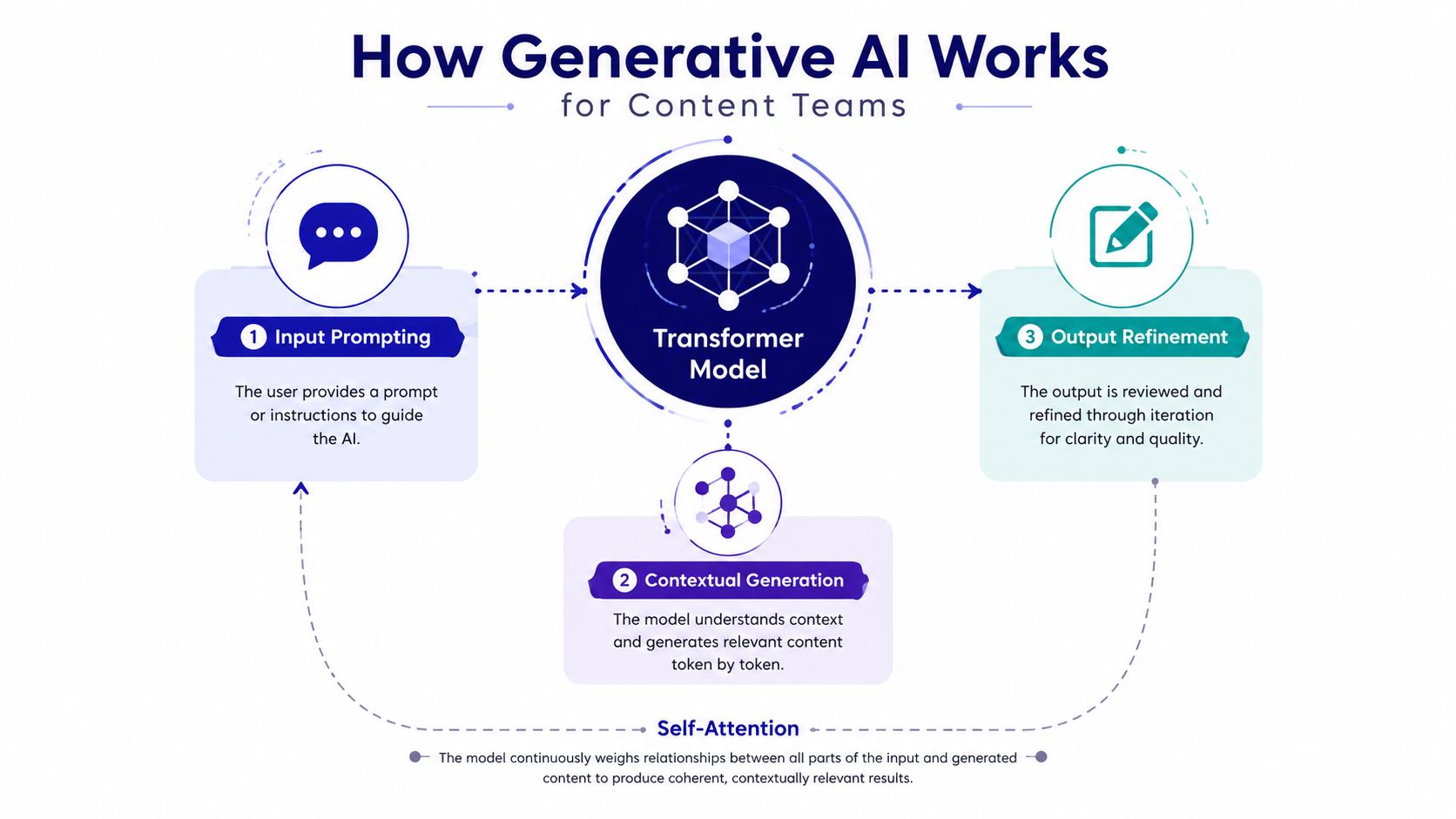
Transformer-based models dominate text because self-attention lets each token look back at long-range context, which is why they're better at sustaining style, structure, and topic continuity than older sequential approaches source. For content teams, that doesn't mean “the model understands the article.” It means the model can keep a heading aligned with a paragraph three screens later, which is enough to make first drafts usable, but not enough to make them trustworthy.
Text, images, and video do not behave the same way
Text models are strongest when the assignment is coherent prose, metadata, or structured content that benefits from context retention. Diffusion models work differently for visual generation, because they iteratively denoise random input, which gives more controllable image structure and visual fidelity source. That distinction matters when your team is deciding whether to ask AI for a product hero image, a blog draft, or a short-form video concept.
Recent review literature points to text-to-video systems such as Runway Gen-3, Kling AI, and Sora as examples of where generative quality has improved enough to produce more cinematically coherent scenes source. The useful takeaway for operators is simple, text generation rewards tight briefs and editorial refinement, while image and video generation reward visual references, frame constraints, and more manual selection.
Prompting that works in production
A prompt should not ask for “a great article.” It should define audience, angle, constraints, and output shape. Use prompts that separate tasks:
- Topic framing: “Write three B2B angles for a page about AI search visibility, each aimed at a different buyer stage.”
- Draft generation: “Create a 900-word outline in a neutral brand voice, include H2s, and avoid speculative claims.”
- Refinement: “Rewrite this section for clarity, keep the meaning, and flag any unsupported assertions.”
The reason this works is that it reduces the model's freedom where precision matters. The model is good at filling in patterns, but not at independently deciding which claims deserve restraint. That's why the best teams don't ask one prompt to do everything, they chain prompts and then force a human review step between them.
Real-World Use Cases Across Content Types
Long-form editorial is where AI usually gets misused first. A team asks for a full blog post, gets a passable draft, then spends more time fixing repetition, unsupported claims, and flat structure than they would have spent writing the piece from scratch. The better workflow is narrower. AI creates the outline, a senior editor defines the point of view, and the writer fills the gaps with examples, original reporting, and source-backed detail. That setup gives you something the model cannot produce on its own, a defensible article with a clear angle.
Product descriptions are a different case. In e-commerce, AI helps most when the catalog is large and the editorial rules are repetitive, because it can standardize tone, compress feature lists, and generate variants quickly. The failure mode is sameness. If every description uses the same sentence patterns, shoppers stop seeing differentiation and the page feels machine-built. Brand governance matters here because a scaled catalog can drift into bland copy long before anyone notices.
Metadata, schema, images, and video each need different controls
Metadata and schema are the easiest wins because the output is constrained. Titles, meta descriptions, alt text, and structured data all benefit from pattern generation, but they still need human review for accuracy and page intent. If the team does not check entity names, product variants, or schema alignment, AI will happily produce technically neat but commercially useless markup. For teams that are standardizing content for extraction and downstream reuse, reducing ambiguity in content for LLM extractability is the practical starting point.
Visual assets sit in a different category. Diffusion tools can accelerate concepting, mockups, and campaign variations, but they are weakest when the brief requires brand specificity, exact product representation, or legal precision. That is why many teams use AI images as starting points, then move them through designer review instead of publishing them raw. The review step is where originality checks and brand rules hold.
Video has the highest editorial friction. Even when the model produces a visually coherent scene, the team still has to handle pacing, messaging, compliance, and scene continuity. Recent review literature points to text-to-video systems such as Runway Gen-3, Kling AI, and Sora as examples of where generative quality has improved enough to produce more cinematically coherent scenes source. The value is strongest in ideation, storyboarding, and lightweight asset generation, not in replacing a creative lead.
Where different teams actually get value
- B2B SaaS: AI is most useful for first-draft educational assets, comparison pages, and FAQ variants, where subject-matter experts can add authority later.
- Agency teams: AI helps with volume, but only if every client gets a brand voice sheet and a review checklist.
- E-commerce operators: AI is strongest for large catalog maintenance, seasonal refreshes, and variation generation, especially when products change often.
The market incentive is obvious. Industry analysis from Precedence Research points to strong growth in generative AI adoption across content workflows, which explains why so many teams are trying to industrialize content generation instead of treating it like a novelty. The operational question is not whether teams will use AI, it is whether they can measure originality, keep brand standards intact, and produce content that still holds up in search and answer engines.
Prompt Engineering and Quality Control Workflows
Good prompt engineering is less about clever wording and more about reducing ambiguity. If the model has to infer audience, tone, length, structure, and source discipline at once, you've already lost control of the draft. A better prompt separates those variables so the review team can catch failures faster.
For a working definition of the discipline, what is prompt engineering is a useful primer, but the operational point is more important than the terminology. Prompting is a specification exercise, not a creative ritual.
A simple quality control stack
Start by sorting claims into risk categories before anything gets published.
| Risk Level | Claim Types | Verification Method | Example |
|---|---|---|---|
| High | Numbers, dates, names, quotations | Check against primary sources | Market size, research findings, product release date |
| Medium | Comparative statements, sequence-of-events claims | Cross-check with authoritative sources | “This workflow reduces edits” |
| Low | Brand voice, internal phrasing, structural recommendations | Editorial review | Tone, section order, CTA language |
That table matches the way fact checking works in production. Techtarget recommends checking numbers, dates, names, quotations, and sequence-of-events claims directly against sources source, while Contently recommends sorting claims into core, important, and peripheral buckets so the highest-risk items get priority source. For unresolved claims, use multiple authoritative sources rather than trusting the model's citation shape source.
AI should never be the last step before publishing. It can draft, restructure, and suggest. It can't approve its own claims.
A prompt structure that holds up
Use this sequence when you need consistent output:
- Define the audience and job. Say who the piece is for and what it must help them do.
- Set the source rule. State that unsupported numbers, names, and dates must be marked for review.
- Constrain the voice. Provide one or two brand adjectives, not a paragraph of abstract tone language.
- Specify the output shape. Ask for headings, bullets, FAQs, or comparison blocks.
- Force a self-check. Require the model to list uncertain claims separately.
For content teams with large libraries, this is also where how do I reduce ambiguity in content for LLM extractability becomes relevant, because ambiguity hurts both human readers and machine parsing.
Optimizing for AI Search Engines and GEO
Search visibility now depends on more than classic SEO signals. AI answer engines look for content that is structured, explicit, and easy to cite, so the page has to read like a dependable source, not just a keyword target. The operational shift is simple: optimize for extractability, attribution, and semantic clarity, not only for rankings.
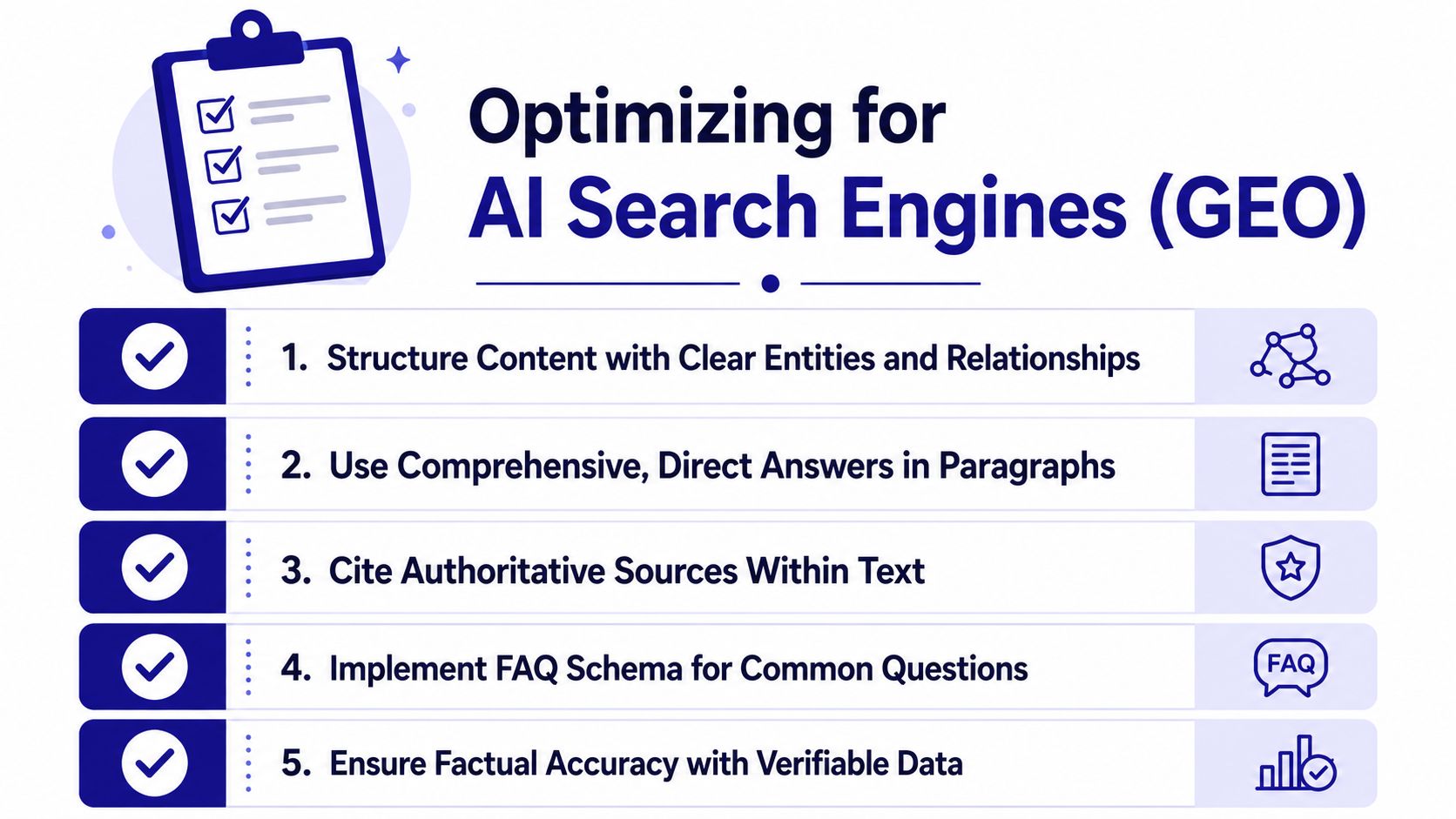
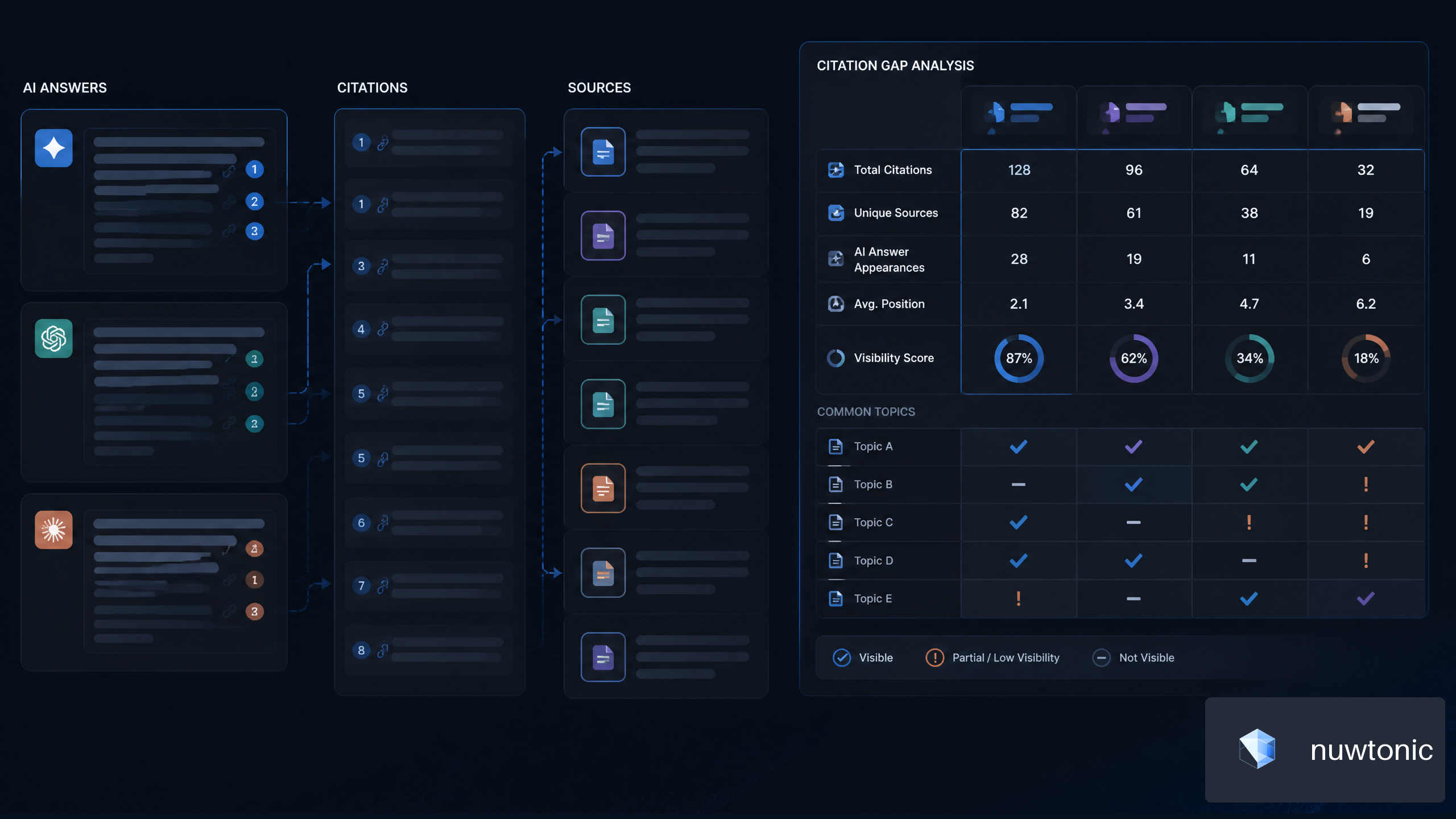
AI systems tend to surface pages that use authoritative sources, recent evidence, and clean citation patterns source. That guidance also points content teams toward government databases, academic journals, and industry reports, with statistical claims cross-checked against 2 to 3 independent sources source. For GEO, pages that combine direct answers, clear entities, and structured references usually have a better chance of being used than pages built around vague brand storytelling.
What to change on the page
Start with the answer in plain language, then add nuance. Keep entities explicit, products named, and relationships clear, because AI systems do better when they can map who did what, to whom, and in what context. FAQ schema helps when a page is built around repeated questions, since it gives machines a cleaner path to the answer.
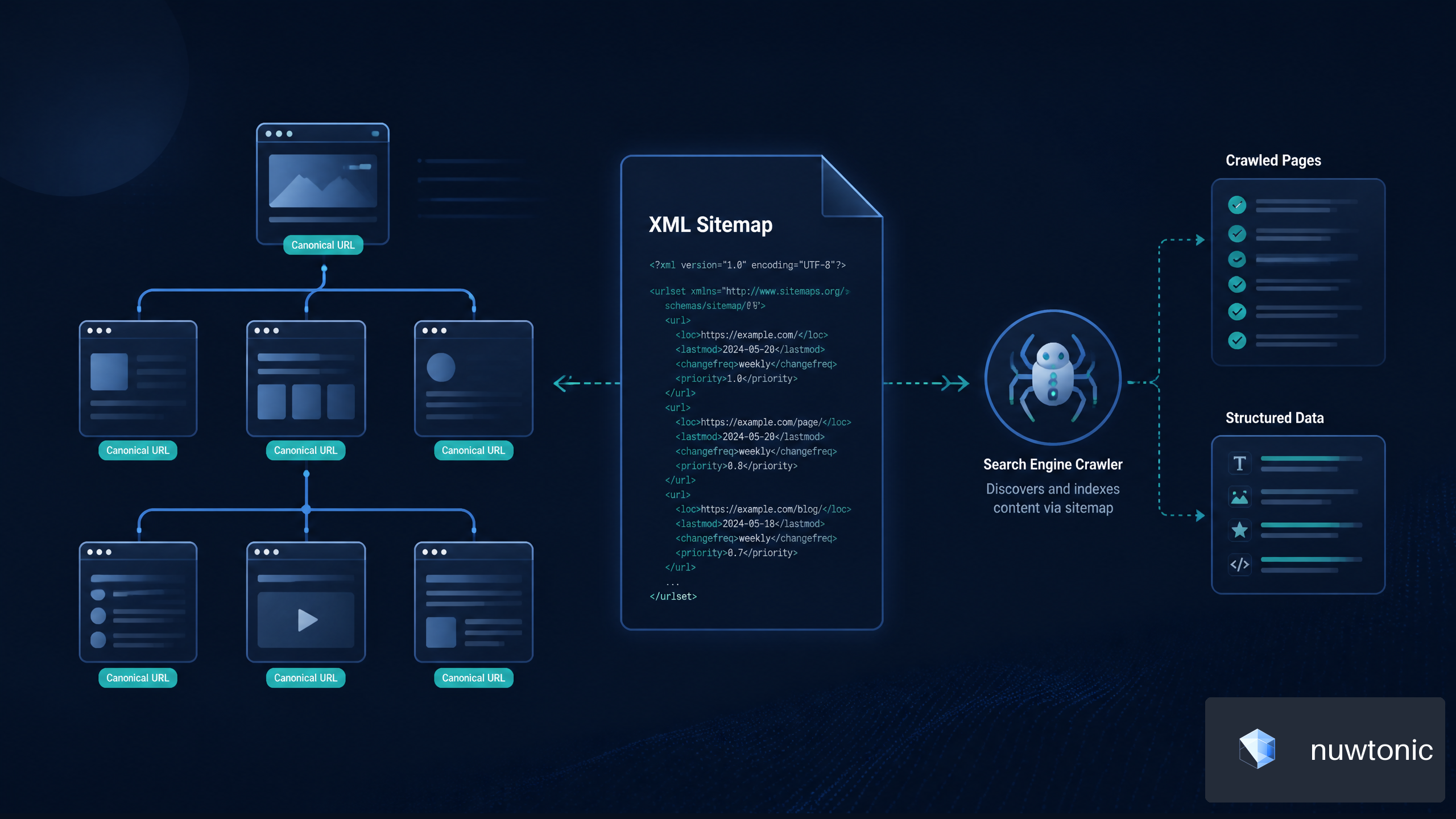
The practical execution layer sits in what is generative engine optimization GEO, which is a useful reference for the wider workflow. Nuwtonic is one platform that connects GEO audits, visibility checks, and reviewable updates in a single workspace, which matters when AI search visibility and content ops share the same backlog.
What gets ignored
Pages that hide the answer inside a wall of marketing copy tend to struggle. So do pages that rely on unsupported claims, thin summaries, or keyword stuffing without entity depth. If the answer engine cannot identify the claim, the source, and the surrounding context, it has little reason to quote the page.
A practical review layer can also analyze AI-generated content for patterns that look too repetitive or too generic. That kind of check works best when it is tied to editorial judgment, because pattern detection alone does not tell you whether a page is useful, original, or aligned with brand standards.
Measuring Performance Beyond Speed and Volume
Speed is the easiest metric to improve and the weakest one to optimize for. If your AI-assisted team ships more pages but the library gets blurrier, more repetitive, or less differentiated, the content system is getting worse even though the output count is climbing. That's the trap.
The better frame is to measure originality, differentiation, and portfolio diversity alongside output volume. Research in Science Advances found generative AI can increase individual novelty and usefulness, while also reducing collective diversity of novel content source. That means one writer's draft may look sharper, but the broader content library can converge toward the same angles if nobody is watching the portfolio level.
What to audit
A useful review process checks for three things:
- Angle overlap: Are multiple pages answering the same intent with the same framing?
- Entity repetition: Are the same examples, analogies, and product references showing up everywhere?
- Portfolio spread: Does the library cover different stages, subtopics, and buyer needs?
For deeper inspection, analyze AI-generated content can be part of the review stack, especially when teams need another signal on whether output is too patterned or too generic. That kind of analysis is most useful when it's tied to editorial decisions, not used as a standalone verdict.
The right question isn't “Did AI save time?” The right question is “Did the content library become more distinct, more useful, and easier to trust?”
Guardrails matter. If a new brief starts to resemble three older pages, change the angle before the draft is written. If the same outline keeps winning, force a different format, different audience, or different proof point. Teams that make these checks part of the sprint rarely need dramatic cleanup later.
Governance and Maintenance at Scale
The hard part is not producing one AI-assisted article. It is keeping version control, approval chains, refresh cadence, and audit trails under control across hundreds of pages and multiple markets. Once AI becomes part of the production system, content governance stops being optional and becomes the main guardrail against drift.
Recent guidance points in the same direction. Content teams should build AI into ideation, creation, optimization, and refresh workflows, while keeping human review, fact-checking, and brand voice controls in place source. That matters most for fast-changing topics, where explicit brand guidelines help prevent outdated or inconsistent pages from piling up.
A workflow that scales
Use a four-step loop.
- Draft generation with clear source and tone constraints.
- Approval workflow with separate review for claims, brand voice, and compliance.
- Performance monitoring tied to search behavior, internal feedback, and page decay.
- Content refresh/update based on what changed, not on arbitrary calendar reminders.
A practical platform layer can help here. Nuwtonic supports audit-to-fix workflows, review-before-deploy controls, and CMS-ready updates, which is useful when teams need to turn reports into page changes without losing oversight. That matters because the bottleneck has shifted from generating copy to managing controlled updates.
Originality also needs a real check, not a vague editorial instinct. I look for repeated angles, repeated examples, and repeated phrasing across a content library, then compare those patterns against the brand's core messages and search intent targets. If a page starts reading like a near-copy of older material, the problem is usually upstream in the brief or the prompt, not in the final edit.
The best governance teams keep an audit trail that shows what changed, who approved it, and why it changed. They also revisit high-traffic or high-risk pages on a fixed review cycle, because stale claims and out-of-date structure can drag both trust and visibility. For GEO, that review should also check whether the page still answers the target question in a way an AI search engine can summarize cleanly, since thin updates often change wording without improving extractable value.
Once that system is in place, AI stops behaving like a content multiplier and starts acting like a managed production system.