Most GEO advice starts in the wrong place. It tells you to “create helpful content” and “optimize for AI” as if AI systems read the web the way humans do. They don't. They retrieve fragments, skip slow pages, favor extractable passages, and often answer without sending a click. That changes the job.
If you're still treating AI visibility as a side effect of classic SEO, you're already behind. A page can rank well and still fail to get cited in ChatGPT, Perplexity, Gemini, or Google's AI experiences because the content isn't structured for machine extraction, the page isn't accessible to basic AI crawlers, or the answer is buried under unnecessary prose.
That's why Generative Engine Optimization (GEO) is becoming its own operating discipline. It isn't a rebrand of SEO. It's the work of making your content citable, your entities clear, your technical delivery readable, and your measurement system useful as AI systems increasingly decide what users see first. If you're also evaluating tools for AI content production, use them carefully. They can speed up drafts, but they won't fix weak structure, missing facts, or poor extractability.
The financial signal is already clear. GEO is projected to drive a $7.3 billion market by 2025, fueled by a 58% adoption rate of AI tools among users and a 34% CAGR for the sector, which reflects a shift from traditional search toward AI-driven visibility, according to AllAboutAI's GEO statistics roundup.
Table of Contents
- The End of Search As We Know It
- What Is Generative Engine Optimization (GEO)
- GEO vs Traditional SEO A Head-to-Head Comparison
- The Core Pillars of GEO Success
- The GEO Workflow From Audit to Optimization
- Measuring What Matters How to Track GEO Performance
- Your GEO Implementation Checklist
The End of Search As We Know It
Search hasn't disappeared. Its interface has changed.
Users still ask questions, compare products, evaluate vendors, and look for proof. The difference is that more of that work now happens inside generated answers instead of a list of ten blue links. That means your old definition of visibility is too narrow. Ranking matters, but citation matters too. In many cases, citation matters first.
Visibility is now an answer-layer problem
Traditional SEO trained teams to optimize for discovery. GEO adds a second layer. You also have to optimize for selection and synthesis. AI systems don't just find pages. They compress them, quote them, summarize them, and sometimes merge them with competing sources into one response.
That's a brutal environment for weak pages.
A page with solid rankings but vague headings, slow rendering, buried answers, and no clear entity framing may still lose to a cleaner, tighter page with less conventional authority. In practice, AI systems often reward content that's easier to extract from, not just content that exists.
Practical rule: If a human has to read three sections to find your answer, an AI system may never use it.
Ranking is not the same as inclusion
Many teams misread what's happening. They look at stable rankings and assume they're protected. They aren't. AI systems can bypass the pages that used to deliver your traffic and instead surface a summary that contains your competitor's framing, pricing logic, product category language, or recommendation criteria.
That creates a new risk. You can be present in search and absent in the answer.
Operationally, GEO forces a shift in mindset:
- From page traffic to answer presence: You need to know whether your brand appears in generated responses at all.
- From keyword placement to citation suitability: The content has to be chunkable, attributable, and easy to restate accurately.
- From static publishing to active maintenance: AI systems change, prompt patterns change, and your content has to keep pace.
The teams that adapt fastest won't be the ones producing the most content. They'll be the ones building pages that machines can retrieve, understand, and trust without friction.
What Is Generative Engine Optimization (GEO)
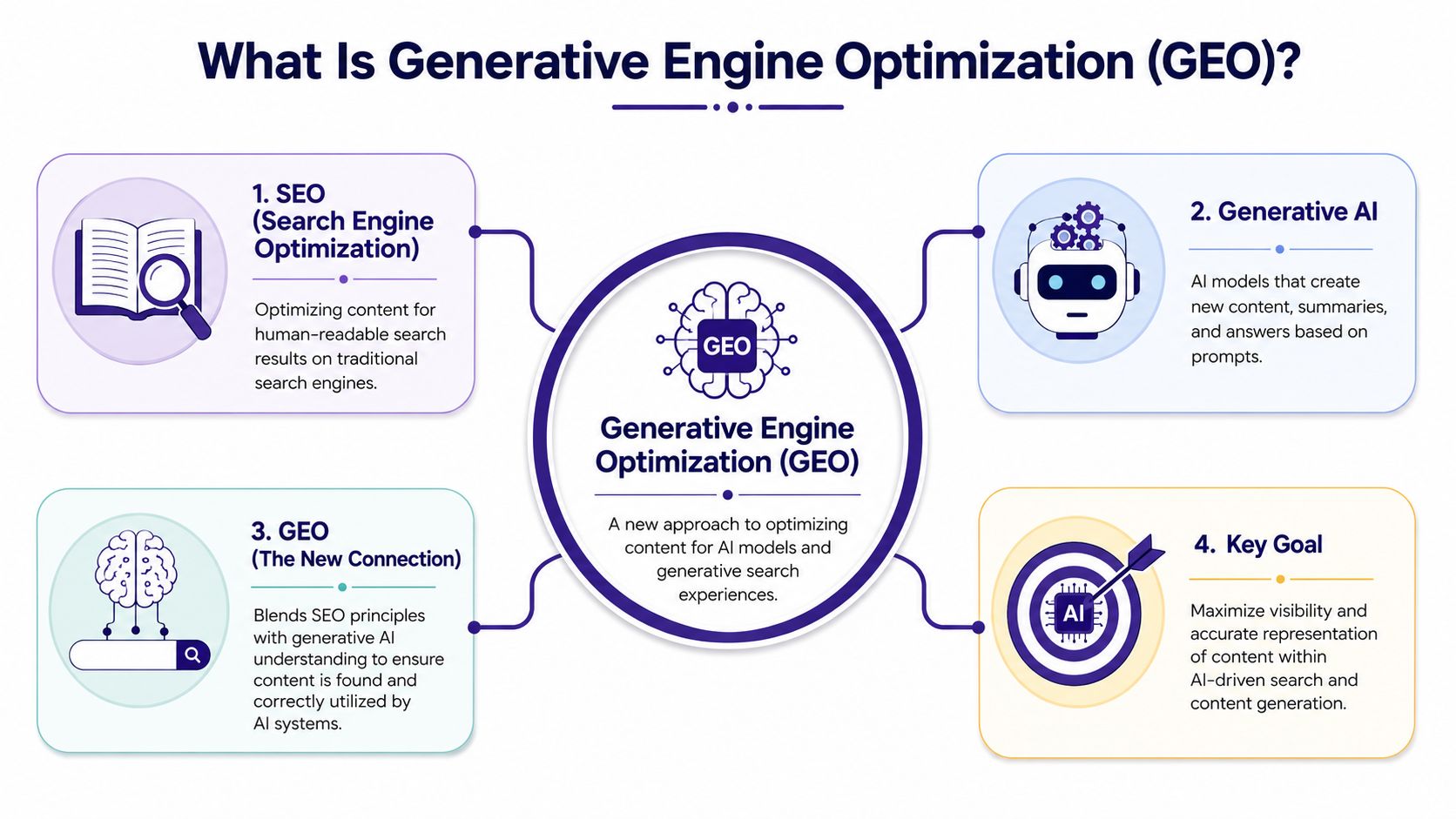
Generative Engine Optimization (GEO) is the practice of structuring content so AI systems can retrieve it, understand it, and cite or reflect it accurately in generated answers.
A simple analogy helps. SEO is like optimizing a book for a library catalog. GEO is like writing the book so a research assistant can quickly pull the right paragraph, quote it correctly, and summarize it without distorting the meaning. That's a different job. Catalog visibility gets you found. Extractable writing gets you used.
GEO is about becoming citable
When people ask what is Generative Engine Optimization GEO, the practical answer is this: it's the discipline of making your site the preferred source material for AI-generated responses.
That changes what you optimize for. You're no longer working only on rankings, snippets, and organic sessions. You're working on:
- Answer extraction: Can the model locate a direct response fast?
- Entity clarity: Does the page clearly state who, what, where, and why?
- Passage quality: Can a section stand on its own without surrounding context?
- Narrative control: If an AI summarizes your brand, does it describe you correctly?
This is why generic “long-form content” advice often fails. Length doesn't make a page useful to a language model. Structure does. Clear causality does. Distinct sections do. Factual density does.
GEO is not SEO with a new label
SEO and GEO overlap, but they don't optimize for the same end state.
SEO asks, “How do I earn discovery in search results?”
GEO asks, “How do I become part of the answer?”
That difference affects how you write. Instead of building pages around keyword variations alone, you build around resolvable questions, clean claims, and supporting evidence that a model can lift without ambiguity.
A strong GEO page usually does four things well:
- Answers early: It doesn't hide the main point.
- Expands cleanly: It explains why the answer matters in plain language.
- Supports with evidence: It includes specifics, examples, and trustworthy attribution.
- Separates ideas: It uses headings, bullets, tables, and concise paragraphs so retrieval systems can isolate useful passages.
GEO rewards content that survives compression. If your meaning falls apart when shortened, the page is harder for AI systems to reuse.
That's why the right way to think about GEO isn't “How do I game AI?” It's “How do I publish in a format AI can accurately carry forward?”
GEO vs Traditional SEO A Head-to-Head Comparison
Teams generally don't need to abandon SEO. They need to stop assuming SEO alone covers the new surface area.
The simplest way to explain the difference is side by side. If you need a broader framework around adjacent terms, this breakdown of GEO vs AIO vs AEO is useful because it separates optimization for AI answers from other AI-related marketing work.
| Dimension | Traditional SEO | Generative Engine Optimization (GEO) |
|---|---|---|
| Primary goal | Earn visibility in search results and drive clicks | Earn inclusion, citation, and accurate representation inside AI-generated answers |
| Main unit of optimization | Query, page, and SERP position | Prompt, passage, entity, and citation suitability |
| Success signal | Rankings, impressions, clicks, traffic trends | Mentions, citations, presence in answers, consistency across AI platforms |
| Content strategy | Topic targeting, keyword mapping, intent alignment, internal linking | Answer-first writing, extractable passages, entity-first framing, comparison-ready sections |
| Technical focus | Crawlability, indexability, metadata, Core Web Vitals | Machine readability, server-rendered content, structured data, retrieval-friendly delivery |
| Writing style that performs | Comprehensive pages that satisfy search intent | Clear sections that can be lifted, summarized, and recombined without losing meaning |
| Authority model | Links, relevance, page quality, domain strength | Trustworthy facts, unambiguous claims, source-ready structure, consistent brand representation |
| User outcome | User visits your page to get the answer | User may get the answer in the AI interface, with or without a click |
| Optimization cadence | Keyword updates, content refreshes, technical maintenance | Prompt testing, citation checks, structural rewrites, model-by-model monitoring |
| Failure mode | You don't rank high enough | You rank, but AI systems still don't cite or summarize you |
The biggest operational difference
SEO tolerates some mess if the page still ranks. GEO is less forgiving.
A traditional SEO page can succeed with long intros, heavy templates, repeated phrases, and buried conclusions if enough other signals are strong. A GEO page usually can't. The model needs to detect the answer, attribute the point, and compress the idea quickly.
That's why the shift isn't philosophical. It's editorial and technical.
- SEO can reward discoverability even when formatting is average
- GEO rewards extractability even before the click happens
- SEO reports often stop at traffic
- GEO reporting has to include whether the brand shaped the answer at all
If SEO wins the visit, GEO wins the wording of the recommendation.
The teams that grasp this early stop asking whether GEO replaces SEO. It doesn't. It sits on top of SEO and exposes where traditional workflows break under AI retrieval.
The Core Pillars of GEO Success
GEO gets practical when you stop treating it as a writing trick and start treating it as a system. Four pillars matter most in day-to-day execution: visibility tracking, entity-first content, machine-readable structure, and trust signals.
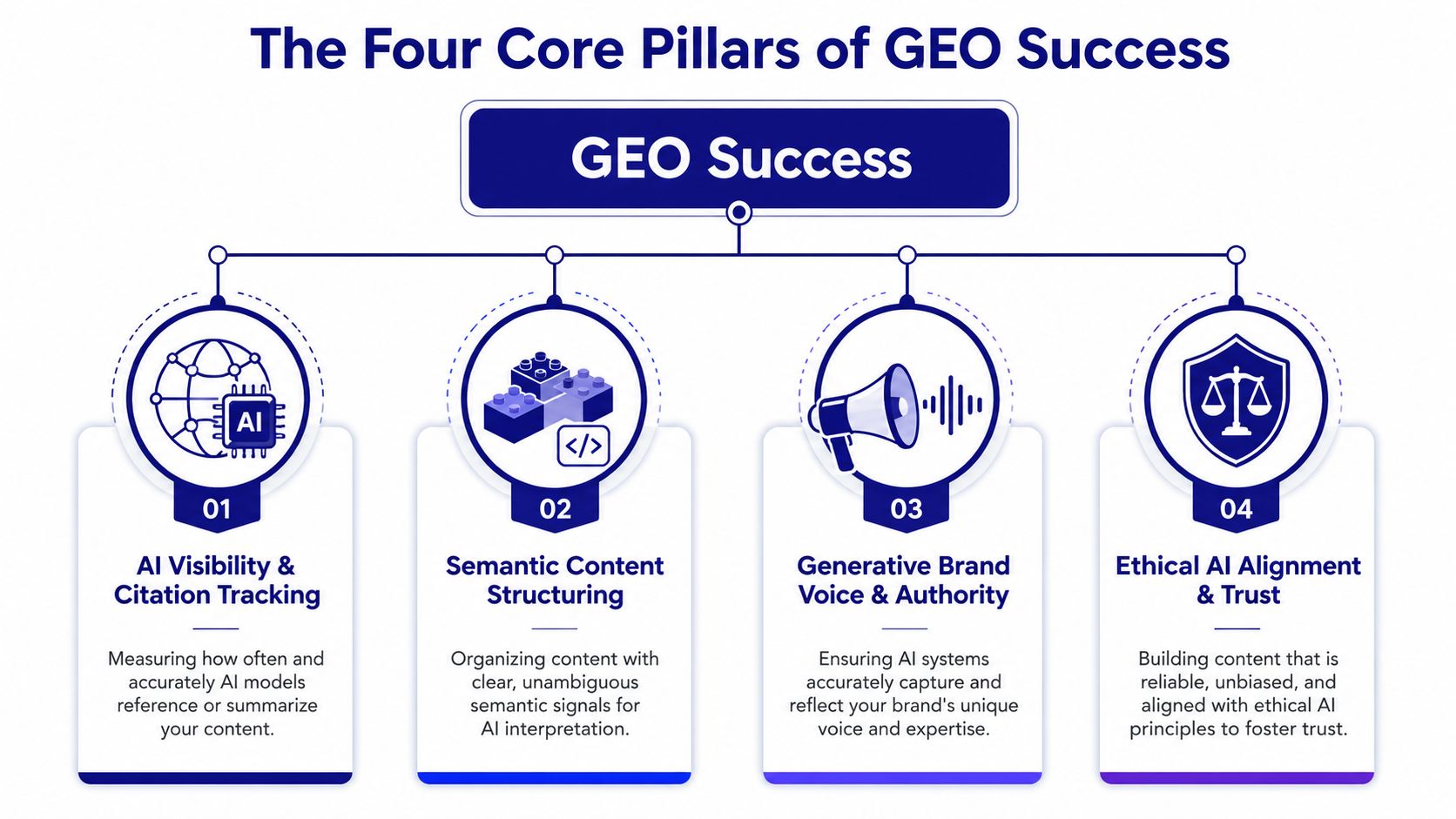
AI visibility and citation tracking
If you're not checking prompts, you're guessing.
The first pillar is measuring where your brand appears across AI systems, for which prompts, and in what position. This isn't the same as classic rank tracking. You need to inspect generated answers, compare outputs across platforms, and watch how often your brand is included when users ask category, comparison, and problem-solving questions.
Good tracking focuses on patterns like:
- Brand presence across models: Are you visible in ChatGPT, Perplexity, Gemini, Claude, and Google AI experiences?
- Citation consistency: Do the same core pages appear repeatedly, or is inclusion random?
- Competitive replacement: Which competitors get cited when you don't?
Without this layer, teams often keep publishing into a blind spot.
Entity-first content strategy
Keywords still matter, but they're no longer the only organizing principle. AI systems work better when your content clearly defines entities and their relationships. That means products, services, categories, pain points, use cases, buyer types, and attributes need to be stated directly, not implied.
An entity-first page doesn't dance around the subject. It says what something is, who it's for, what it does, how it differs, and when it should be chosen. This helps the model map your content to real user questions instead of just matching words on the page.
A few practical moves help:
- Define terms early: Put category labels and product descriptions near the top.
- Use comparison language carefully: “Best for,” “works well when,” and “not ideal if” are highly reusable by AI systems.
- Separate facts from opinion: Models can synthesize both, but they cite facts more reliably when they're explicit.
Machine-readable structure and schema
This pillar is where many sites fail. GEO requires content to be served in server-rendered HTML because basic AI crawlers like GPTBot cannot execute client-side rendering to access core passages, which reduces citation probability. Implementing Organization, WebSite, and Article or FAQPage schema is a minimum requirement, as outlined in Search Engine Land's technical GEO guidance.
That has immediate consequences for modern websites.
If your key copy lives behind heavy client-side JavaScript, accordions that don't render meaningful text server-side, or dynamic interfaces that bots can't reliably parse, your content may be effectively invisible to basic AI crawlers. A beautiful React front end doesn't help if the retriever never sees the answer.
Slow, script-heavy pages often fail GEO before the writing is even evaluated.
At the implementation level, check these first:
| Priority check | What to look for |
|---|---|
| Rendering | Core content appears in server-rendered HTML |
| Schema | Organization, WebSite, and Article or FAQPage are present and valid |
| Passage formatting | Key answers use headings, lists, and concise blocks |
| Content exposure | Important text isn't hidden behind interaction-dependent UI |
Authoritativeness and trust signals
AI systems don't just want an answer. They want an answer they can reuse without creating risk.
That means your pages need visible signals of expertise and reliability. In practice, that usually comes from well-scoped claims, cited facts, plain definitions, expert framing, and internal consistency across related pages. If one page describes your offer one way and another page contradicts it, you make synthesis harder.
Trust in GEO is less about sounding impressive and more about reducing ambiguity. The strongest pages don't just read well. They make interpretation easy.
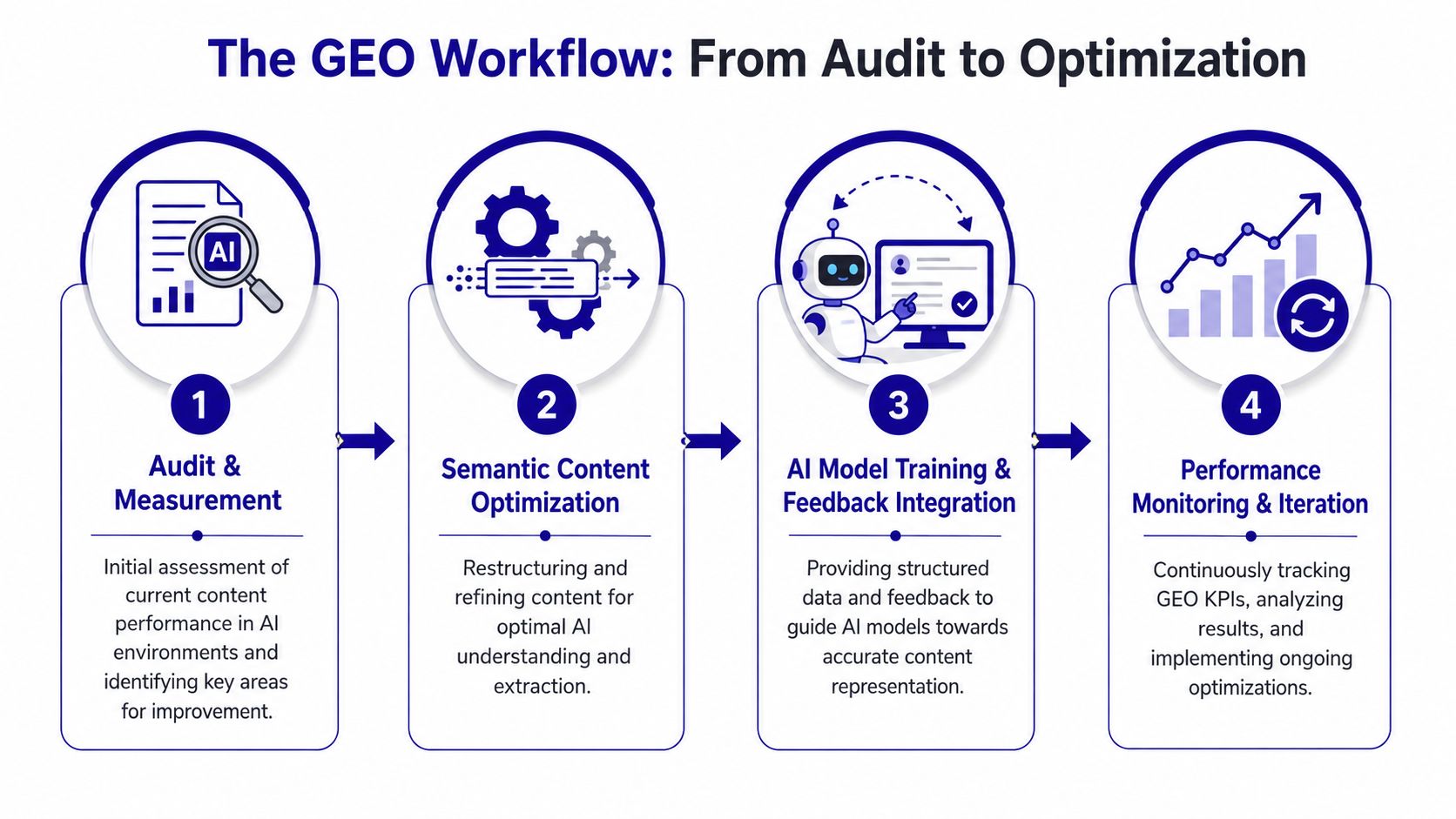
The GEO Workflow From Audit to Optimization
Most GEO projects fail because teams jump straight into rewriting content. That's backwards. Start by learning where you're absent, where you're misrepresented, and which pages are structurally unusable for AI systems.
Start with prompt-level auditing
Begin with a fixed prompt set that reflects how buyers ask questions. Don't only test branded prompts. Include informational, comparative, and transactional variations. Look for repeated omissions, weak category association, and competitor dominance in recommendation-style answers.
The goal of the audit is to map three things:
- Where your brand appears
- Which URLs support those appearances
- Which prompt types consistently exclude you
An operational platform can save time. For example, Nuwtonic includes an AI Search Agent for prompt tracking across major AI systems, GEO auditing, technical remediation workflows, and GSC-connected prioritization, which makes it useful when you need one workspace for both diagnosis and implementation.
Treat prompts like query sets. If you don't standardize them, you can't compare runs or prove improvement.
Fix content and delivery before you publish more
Once the gaps are visible, remediate the pages that already should be winning. That usually means restructuring existing content before creating net-new assets.
A November 2023 study by Aggarwal, Murahari, et al. from Princeton University found that optimizing content for clarity and structure can increase AI citation visibility by up to 40%, which supports the practical impact of headings, bullet points, and short paragraphs, as summarized in this write-up on GEO research.
In the field, the highest-impact fixes are usually boring:
- Move the answer up: Put the direct response near the top.
- Break dense prose: Use sections the model can isolate cleanly.
- Clarify comparisons: Add explicit differences, fit criteria, and trade-offs.
- Reduce rendering friction: Make sure the important text loads fast and is visible in HTML.
Speed matters here too. If your pages are slow, retrieval can fail before content quality gets a chance to help. For teams cleaning up front-end performance, this guide on optimizing website performance is a practical reference because GEO often depends on faster delivery, not just better copy.
Monitor prompts, not just pages
After changes go live, rerun the same prompt set and compare outputs over time. Don't treat this like a one-time audit. AI answer patterns shift, and content that gets cited today can disappear later if a competitor publishes a cleaner version or your own page drifts out of date.
A useful operating rhythm looks like this:
- Weekly: Check high-value prompt clusters and major competitor movement
- Monthly: Review citation-supporting pages for structural regressions
- Quarterly: Refresh core pages, update examples, tighten definitions, and revalidate schema
Many SEO teams need to adjust habits. A page isn't “done” when it ranks. In GEO, a page is only healthy if it keeps showing up in answers you care about.
Measuring What Matters How to Track GEO Performance
Most GEO reporting fails because it tries to force AI visibility into SEO dashboards built for rankings and clicks. That won't hold. AI answer systems create a different measurement problem, and you need metrics that reflect inclusion, position, and breadth.
A platform view helps because prompt-level outputs are hard to manage in spreadsheets alone.

Three metrics that actually matter
According to Foundation's GEO measurement framework, GEO performance is quantified through three expert metrics: Share of Model, Generative Position, and Query Coverage. Share of Model measures brand appearances across 20 to 50 prompt runs, Generative Position weights where you are mentioned in the answer, and Query Coverage tracks visibility across fanout queries. The same framework notes that baseline volatility of 20% to 30% is expected.
Those metrics are useful because they map to real-world performance:
- Share of Model tells you how often your brand appears at all.
- Generative Position tells you whether you're introduced early enough to matter.
- Query Coverage tells you if visibility is narrow or durable across adjacent prompt variations.
Traditional rank tracking can't answer those questions.
Build reporting around influence, not only clicks
A strong GEO reporting stack should combine prompt observations with traffic and site analytics, but the KPI model has to change. You're now measuring whether your content shapes the answer, not just whether it earns a visit.
That means your dashboard should connect:
| KPI area | What to track |
|---|---|
| Presence | Whether your brand appears in target AI responses |
| Placement | Whether the brand is mentioned early or late |
| Support pages | Which URLs are most often associated with citations |
| Coverage | Which prompt clusters include or exclude you |
| Outcome signals | Whether AI-driven visits engage, convert, or assist pipeline |
To support that layer, use analytics systems that help you track your website's metrics alongside prompt monitoring, because GEO performance only becomes useful when you can connect answer visibility to downstream business behavior.
If you want a more detailed breakdown of KPI definitions and reporting logic, this guide to AI search visibility metrics and KPIs is worth reviewing.
One more practical note: don't overreact to a single run. AI systems are variable by design. Look for repeated patterns across prompts, models, and time windows.
A walkthrough makes the reporting logic easier to visualize:
Your GEO Implementation Checklist
If you want a clean starting point, use this checklist and execute it in order. Don't start with content volume. Start with retrievability, structure, and measurement.
First priorities for the next cycle
- Audit your prompt set: Build a stable list of commercial, informational, and comparison prompts relevant to your category.
- Check rendering first: Make sure core answer content is visible in server-rendered HTML.
- Validate baseline schema: Confirm Organization, WebSite, and Article or FAQPage markup are present where appropriate.
- Rewrite key pages into answer-first format: Put the direct answer in the opening passage, then expand with clear supporting context.
- Refresh pages on a fixed cadence: AI models show a recency bias and content should be updated at least once every 3 months to maintain citation eligibility, according to LLMrefs' GEO guidance.
- Use the preferred passage pattern: That same guidance recommends a direct answer within the first 50 words, a why-it-matters section, and then deep analysis.
- Track inclusion, not just traffic: Review where your brand appears, where it's absent, and which competitor pages replace you.
- Create a remediation queue: Prioritize pages that already have authority but poor extractability.
- Standardize reviews: Compare the same prompt sets across the same platforms on a repeatable schedule.
- Use tools that support execution: If you're evaluating software, this roundup of generative engine optimization tools is a practical place to compare workflows.
The fastest GEO gains usually come from rewriting existing high-intent pages so AI systems can actually use them.
Nuwtonic fits teams that need one workspace for technical audits, content operations, and AI search visibility tracking. If you're building a real GEO process rather than running occasional prompt checks, you can explore Nuwtonic to see how it handles audits, prompt tracking, GSC-connected prioritization, and reviewable fixes in one system.