Introduction & TL;DR
Why AI Search Visibility Metrics KPIs Matter Now
Let’s be real—most of the SEO dashboards I audit these days are still stuck in 2018. They track organic traffic, keyword rankings, and bounce rate as if the SERP hasn't fundamentally broken open. In 2026, the traditional search engine results page is no longer the sole gatekeeper of organic discovery. With search engines increasingly relying on synthesized, conversational answers, tracking your performance requires a completely different playbook.
If you aren't measuring your presence inside AI-generated answers, you are essentially flying blind. Traditional rank tracking cannot tell you if an LLM-based engine recommended your brand or ignored you entirely. To prove the value of your organic efforts to stakeholders, you must establish a rigorous framework of ai search visibility metrics kpis that connects your content optimization directly to brand exposure and downstream conversions.
TL;DR: The Executive Summary
For the busy marketing lead, here is the short version: AI search visibility is not about ranking "blue links" in position one. It is about being selected as a trusted source by retrieval-augmented generation (RAG) systems. To measure this, you must track three primary KPIs: AI Answer Visibility Rate (how often you appear), Citation Share (how often you are linked), and Mention Share of Voice (how prominent your brand is compared to competitors). This guide details exactly how to build a stable prompt tracking set, calculate these metrics with statistical confidence, and tie them back to actual business revenue.
Key Takeaways
• Shift Focus to Citations: In conversational search, a citation is the new click. If you aren't cited, you don't exist in the user's path to purchase.
• Build Stable Prompt Sets: Stop tracking random queries. You need a curated, statistically sound prompt set split by intent (branded vs. non-branded) and geography.
• Embrace the Zero-Click Reality: AI search visibility often satisfies user intent directly on the SERP. Your attribution models must adapt to measure assisted conversions and branded search lift rather than relying purely on direct CTR.
• Optimize for Retrieval: Clean schema markup, clear HTML hierarchies, and verifiable trust signals are the primary levers for improving your AI search footprint.
Defining the Core AI Search Visibility Metrics
AI Answer Visibility Rate
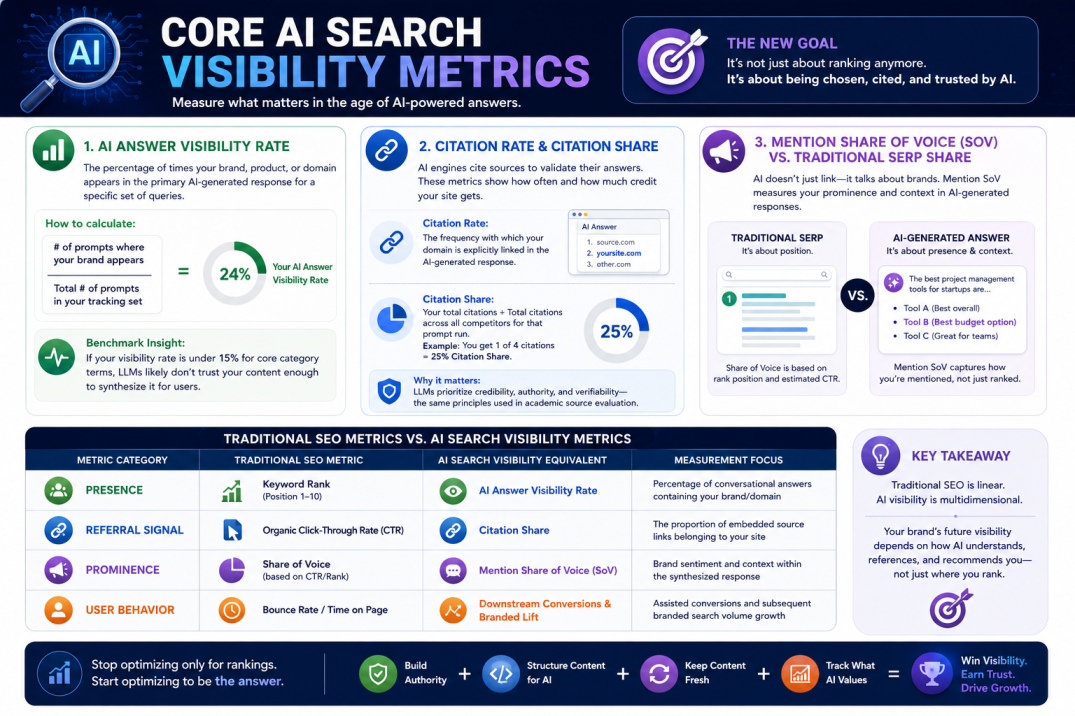
Here’s the thing about AI search: simply ranking in standard organic search doesn't guarantee you will make the cut when an engine synthesizes an answer. The AI Answer Visibility Rate measures the percentage of times your brand, product, or domain appears within the primary AI-generated response for a specific set of queries.
To calculate this, you divide the number of prompts where your brand is surfaced by the total number of prompts run in your tracking set. In my experience—especially during a major enterprise SaaS campaign I ran last year—this metric is the ultimate health indicator of your brand's topical authority. If your visibility rate is under 15% for your core category terms, the LLMs simply do not trust your content enough to synthesize it for users.
Citation Rate and Citation Share
Think of an LLM search engine like a lazy college student writing a term paper at 3 AM. It doesn't want to read your entire website; it wants to grab the most authoritative, cleanly structured snippet, synthesize it, and cite it just enough to avoid a plagiarism warning. The Citation Rate is the frequency with which your domain is explicitly linked in the generated response.
Citation Share, on the other hand, is a relative metric. It measures your total citations divided by the total number of citations granted across all competitors within that prompt run. This is crucial because a single AI answer might cite four different sources. If your competitor gets three of those citations and you get one, your Citation Share is 25%. To understand how engines evaluate which sources to trust, we can look at standard academic source evaluation criteria, which emphasize credibility, authority, and verifiability.
Mention Share of Voice (SoV) vs. Traditional SERP Share
Let's compare how these metrics stack up against traditional search metrics. Traditional SEO metrics are highly linear, whereas AI search visibility metrics are multidimensional.
Metric Category | Traditional SEO Metric | AI Search Visibility Equivalent | Measurement Focus |
|---|---|---|---|
Presence | Keyword Rank (Position 1-10) | AI Answer Visibility Rate | Percentage of conversational answers containing your brand/domain |
Referral Signal | Organic Click-Through Rate (CTR) | Citation Share | The proportion of embedded source links belonging to your site |
Prominence | Share of Voice (based on CTR/Rank) | Mention Share of Voice (SoV) | Brand sentiment and context within the synthesized response |
User Behavior | Bounce Rate / Time on Page | Downstream Conversions & Branded Lift | Assisted conversions and subsequent branded search volume growth |
Traditional Share of Voice relies heavily on estimated CTR models based on your position on the SERP. But when an AI engine synthesizes a paragraph comparing three software tools, your position in the "blue links" below the fold becomes secondary. What matters is how you are mentioned. Is your brand listed as the "best budget option" or the "industry standard"? Mention SoV quantifies your brand's prominence and contextual positioning within these synthesized narratives.
Designing a Reliable Prompt Set and Sampling Methodology
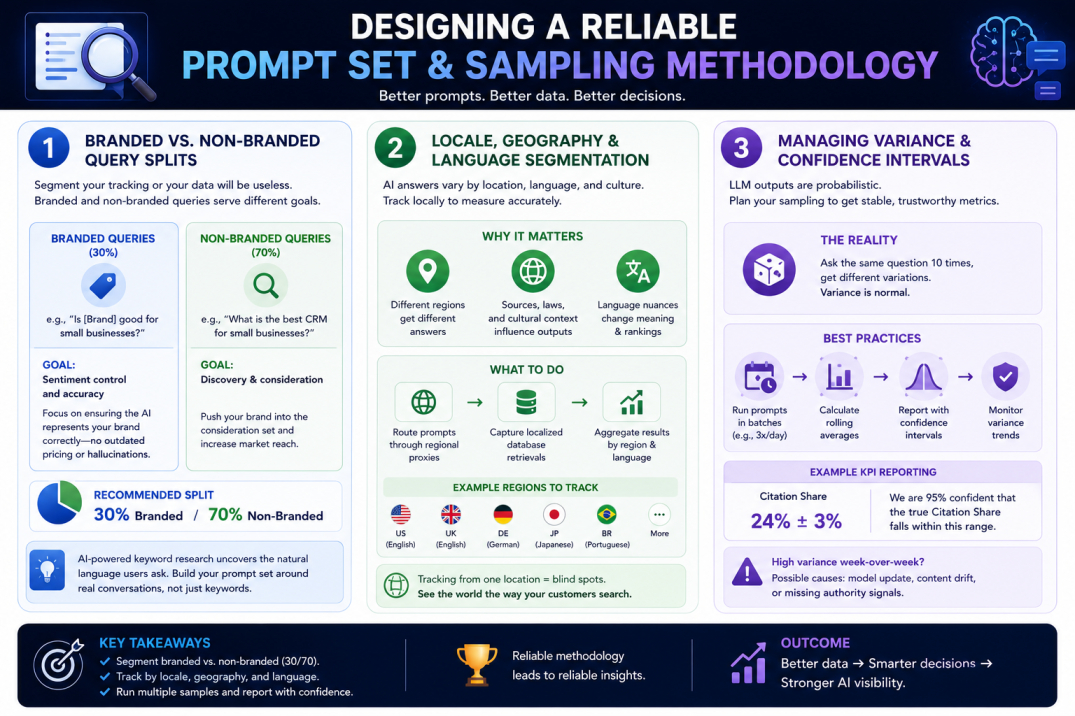
Branded vs. Non-Branded Query Splits
If you don't segment your tracking, your data will be useless. Branded prompts (e.g., "Is [Brand] good for small businesses?") behave very differently from non-branded category prompts (e.g., "What is the best CRM for small businesses?").
For branded queries, your goal is sentiment control and accuracy. You want to ensure the AI isn't hallucinating outdated pricing or misrepresenting your features. For non-branded queries, the goal is discovery—you want to push your way into the consideration set. When setting up your tracking, you should split your prompt sets 30/70 between branded and non-branded queries to get an accurate picture of your market reach. Understanding why use AI for keyword research can help you uncover the exact natural-language phrases users feed into these conversational engines, ensuring your prompt set is grounded in real-world behavior.

Locale, Geography, and Language Segmentation
Your target audience isn't a monolith, and neither are LLMs. An AI search engine running in New York will pull different sources and synthesize different answers than the same engine running in London or Tokyo.
To build a clean KPI dashboard, you must run localized prompt simulations. This means routing your automated search queries through regional proxies to capture localized database retrievals. If you sell globally but only track your AI search visibility metrics KPIs from a single US-based server, you are missing massive gaps in your international market share.
Managing Variance and Confidence Intervals
Here is a reality check: LLM outputs are probabilistic, not deterministic. If you ask an AI engine the same question ten times, you might get three slightly different variations of the answer. This variance can drive analytics teams absolutely crazy.
To combat this, your sampling methodology must account for volatility. Never rely on a single daily run. Instead, run your prompt sets in batches (e.g., three times a day) and calculate a rolling average. Your KPIs should be reported with a confidence interval (e.g., "Our Citation Share is 24% ± 3%"). If your weekly variance is wild, it usually indicates that the search engine's underlying model is undergoing an update, or your content lacks the authority signals required for stable retrieval.
Content Eligibility, Authority, and Retrieval Mechanics
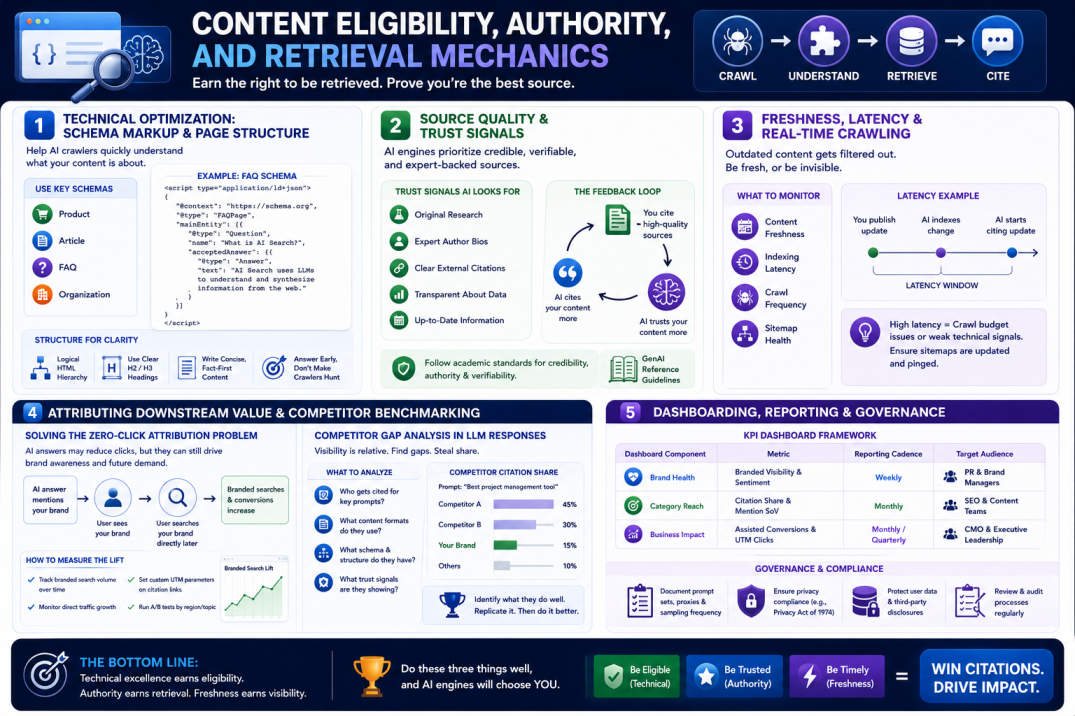
Technical Optimization: Schema Markup and Page Structure
Let’s be real—if your technical SEO is a mess, no AI engine is going to cite you. RAG systems rely on clean, parseable data structures to extract information quickly.
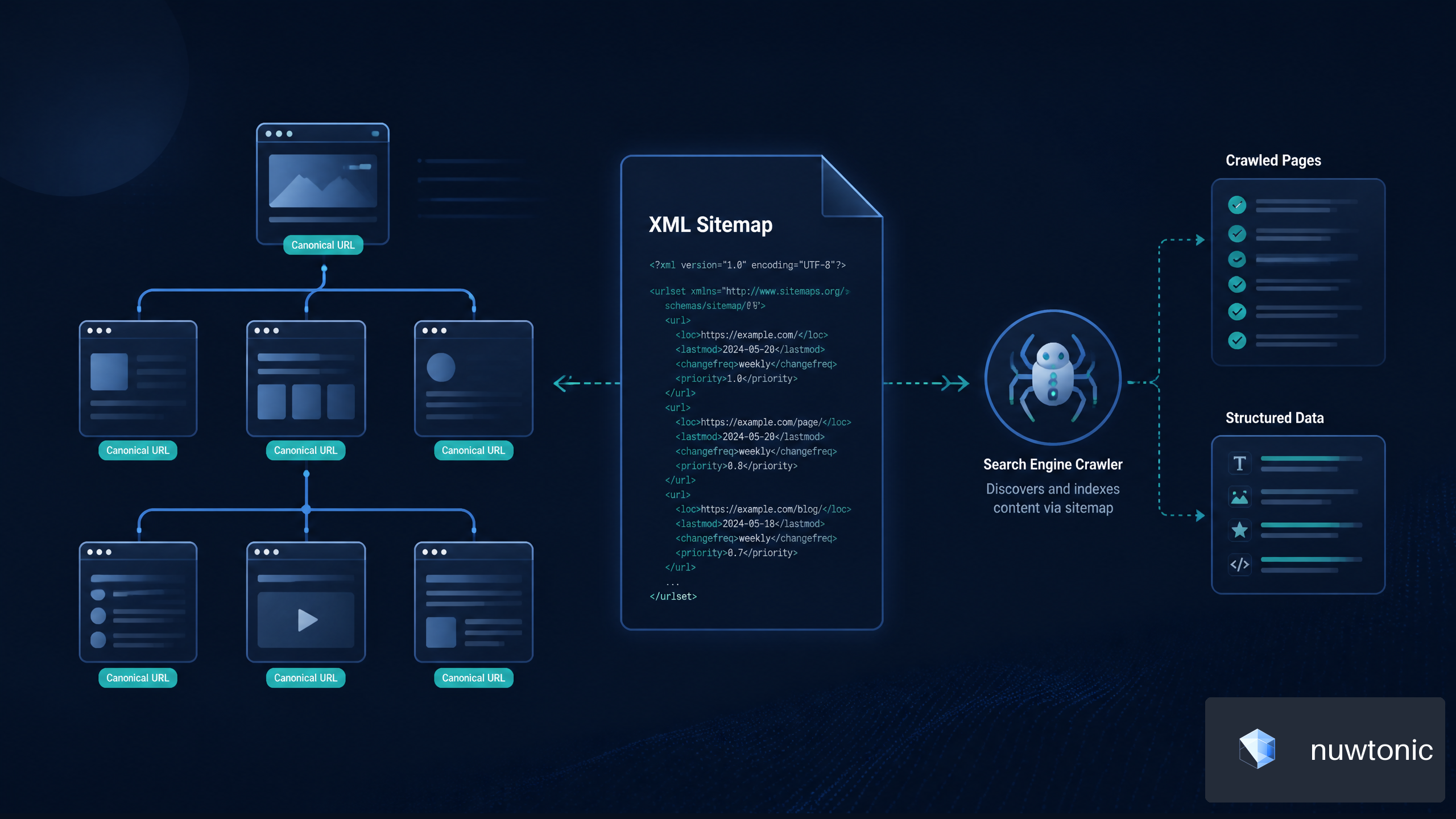
This is where traditional optimization meets conversational search. You need to use structured data and schema markup to explicitly tell the crawlers what your content is about. Use Product, Article, FAQ, and Organization schemas to feed clean entity relationships to the search bots. Additionally, keep your HTML hierarchy logical. Use clear H2 and H3 headings, and write in a concise, fact-first manner. If an AI crawler has to wade through 800 words of fluff to find a simple definition, it will pass you over for a competitor who gets straight to the point.
Source Quality and Trust Signals
AI engines are designed to avoid spreading misinformation, which means they prefer highly authoritative, verifiable sources. They look for signals of expertise, authoritativeness, and trustworthiness.
To build this trust, your content must be backed by original research, expert quotes, and clear external citations. Think of it as a feedback loop: the more high-quality sources you cite, the more likely AI engines are to cite you. This aligns closely with academic standards like those found in academic GenAI reference guidelines, which dictate how source credibility is established and maintained. If your site lacks these fundamental trust signals, your AI visibility will suffer, no matter how good your copy is.
Freshness, Latency, and Real-Time Crawling
I’ve seen teams get bogged down in vanity metrics when the focus should really be on user engagement and information freshness. AI search engines are increasingly integrating real-time web indexing to answer time-sensitive queries.
If your content is outdated, you will be filtered out of the retrieval pool. Monitor how quickly your updated pages are reflected in AI answers. If you publish a pricing change or a new product feature, track the latency—the time it takes for the LLM to start citing the updated information. If your latency is high, it’s a clear sign that your crawl budget is insufficient or your XML sitemaps are not being pinged correctly.
Attributing Downstream Value and Competitor Benchmarking
Solving the Zero-Click Attribution Problem
One of the biggest pain points for modern digital marketers is the rise of zero-click searches. When an AI engine answers a user's question completely on the SERP, the user has no reason to click through to your website. This can cause your organic traffic in GA (Google Analytics) to drop, even though your brand exposure has actually increased.
To solve this, you must look beyond direct CTR. Track assisted conversions and branded search lift. In my experience, a strong showing in AI search results correlates directly with an increase in direct traffic and branded search queries over the following weeks. Users see your brand recommended by the AI, and even if they don't click the citation immediately, they search for your brand directly later. Set up custom UTM parameters on all your citation links where possible, and run A/B testing on localized regions to measure the true lift of your AI visibility.
Competitor Gap Analysis in LLM Responses
Visibility is relative, not absolute. To win in conversational search, you must run a continuous competitor gap analysis to see who is stealing your citation share.
If a competitor is consistently cited for high-value transactional prompts, analyze their page structure and schema markup. Are they using structured tables that the LLM can easily scrape? Do they have a dedicated FAQ section that matches the user's conversational intent? By mapping your competitors' citation footprints, you can identify exactly what content formats and authority signals you need to replicate—or beat.
Dashboarding, Reporting Cadence, and Governance
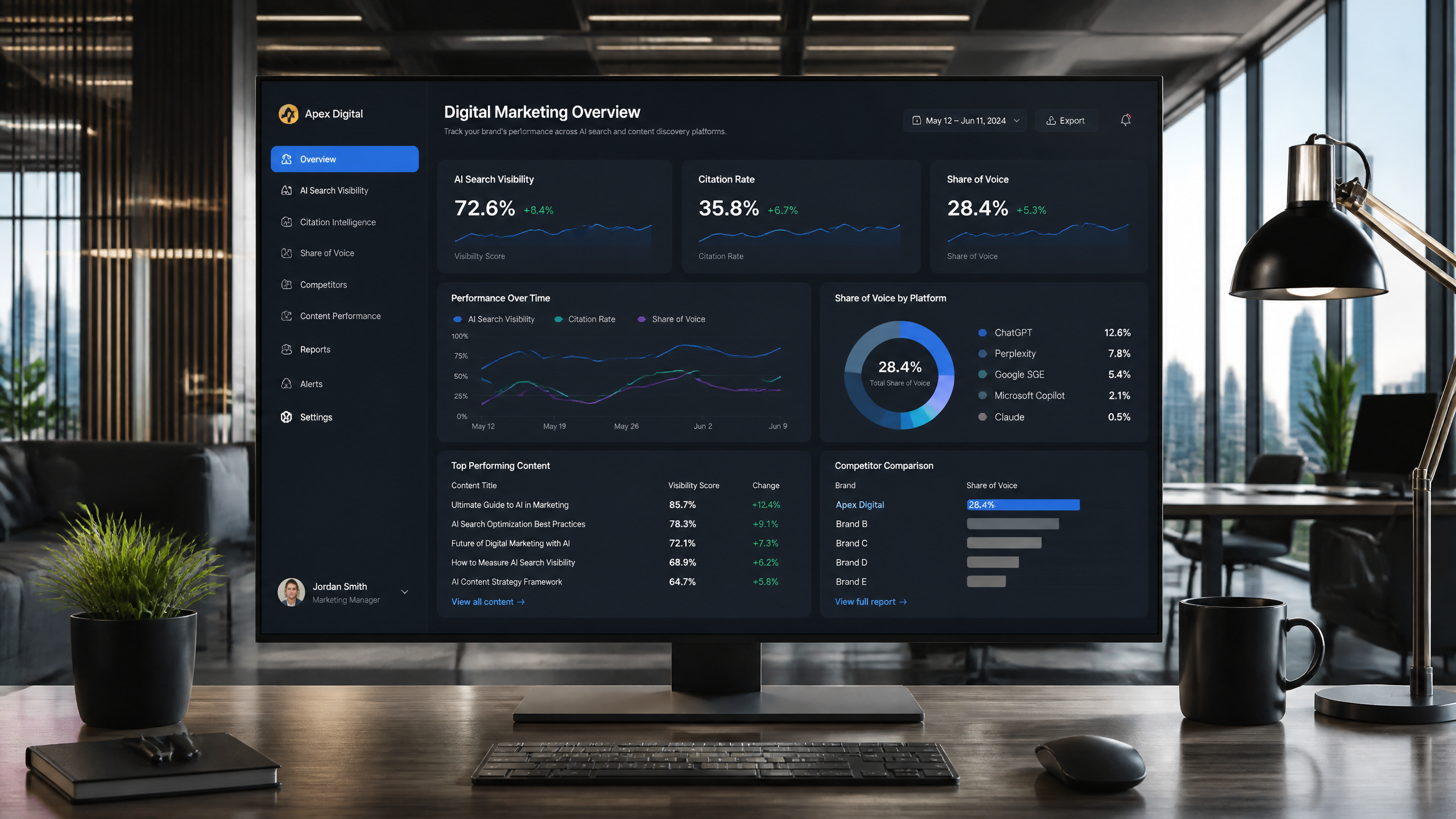
When building your reporting dashboard, keep it clean and actionable. Don't overwhelm your stakeholders with raw prompt logs. Group your metrics into high-level themes: Brand Health (branded visibility and sentiment), Category Reach (non-branded visibility and citation share), and Business Impact (assisted conversions and branded search lift).
Dashboard Component | Metric | Reporting Cadence | Target Audience |
|---|---|---|---|
Brand Health | Branded Visibility & Sentiment | Weekly | PR & Brand Managers |
Category Reach | Citation Share & Mention SoV | Monthly | SEO & Content Teams |
Business Impact | Assisted Conversions & UTM Clicks | Monthly / Quarterly | CMO & Executive Leadership |
Furthermore, establish strict governance guidelines for your tracking. Document your prompt sets, proxy locations, and sampling frequencies. If you are logging user-generated prompts for internal analysis, make sure your workflows comply with privacy standards—such as those outlined in the Privacy Act of 1974 regarding third-party data disclosures—to ensure your measurement practices remain fully compliant and secure.
Strategic Framework for AI Search Visibility
Step-by-Step Implementation Guide
If you want to move from theory to execution, follow this structured process to build your AI search tracking framework:
Define Your Prompt Universe: Gather your top-performing organic keywords and convert them into natural, conversational prompts. Use a mix of informational, navigational, and transactional intents.
Establish Your Baseline: Run your prompt set through your selected tracking tool to establish your current AI Answer Visibility Rate and Citation Share.
Identify Competitor Strengths: Run a gap analysis to pinpoint which competitors are dominating the citation landscape for your target terms.
Optimize Content for Retrieval: Restructure your target pages with clean HTML, comprehensive schema markup, and fact-first answers to make them highly eligible for RAG systems.
Monitor and Iterate: Track your rolling averages weekly, adjusting your content strategy based on changes in citation share and search engine latency.
Selecting Your Measurement Stack
Tracking these metrics manually is an absolute nightmare. To scale your efforts, you need to invest in the best AI visibility tracking tools available in 2026. These platforms automate the process of running prompt sets across multiple LLMs, calculating citation share, and monitoring competitor mentions in real-time. When choosing a tool, prioritize those that offer geo-targeted proxy runs and detailed sentiment analysis, as these features are critical for maintaining clean, actionable data.
Conclusion & Next Steps
At the end of the day, the landscape of organic search has changed permanently. The teams that continue to obsess solely over traditional keyword rankings will find themselves optimized for a SERP that no longer exists. By shifting your focus to AI search visibility metrics KPIs—specifically Citation Share and Mention SoV—you can position your brand as a trusted authority inside conversational engines. Start by building a small, highly targeted prompt set, establish your baseline, and begin optimizing your content for retrieval. The future of search is conversational, and it's time to start measuring it properly.
Sources and References
• Montana State University: Guidelines on evaluating source credibility and authority signals. (Source: https://research.gfcmsu.edu/IntroLibResearch/EvaluatingSources)
• University of Florida Business Library: Best practices for GenAI reference and citation tracking. (Source: https://answers.businesslibrary.uflib.ufl.edu/genai/faq/413647)
• US Department of Justice: Overview of privacy, data logging, and third-party disclosure regulations. (Source: https://www.justice.gov/opcl/overview-privacy-act-1974-2020-edition/disclosures-third-parties)
Frequently Asked Questions (FAQ)
How do traditional SEO metrics differ from AI search visibility metrics?
Traditional SEO metrics focus heavily on rank positions (1-10) and direct organic clicks. AI search visibility metrics focus on whether your content is synthesized inside conversational answers, your Citation Share (how often you are linked as a source), and your Mention Share of Voice (how prominently your brand is discussed within the LLM's response).
What is a good benchmark for AI citation share?
This depends heavily on your industry and query intent. For highly competitive non-branded category queries, a Citation Share of 15% to 20% is considered strong. For branded queries, your Citation Share should ideally be 90% or higher to ensure competitors aren't hijacking your brand space.
How do you handle LLM hallucinations or misattributions in your reporting?
When an LLM attributes your content to a competitor (or vice versa), it is usually a sign of poor entity clarity on your website. To fix this, you should improve your schema markup and ensure your brand name is explicitly tied to your unique products and services. In your reporting, keep a separate log of "misattributions" to track how well search engines are understanding your entity relationships over time.
How often should we refresh our prompt tracking sets?
You should run a comprehensive audit of your prompt sets quarterly. However, if you launch a new product or if a major competitor enters the market, you should update your tracking immediately to capture those shifts in real-time search behavior.