
Honestly, when we started tracking AI visibility across ChatGPT, Gemini, Claude, Perplexity, and other AI platforms, we noticed a recurring problem. Companies knew whether they were being mentioned or cited, but they had no idea why competitors were consistently recommended while they remained invisible.
Most AI visibility tools could show mentions, citations, recommendations, and Share of Voice. What they couldn't explain was why visibility was missing. Why was ChatGPT citing a competitor? Which topics, entities, trust signals, or authority factors were influencing AI recommendations? More importantly, what should be fixed?
That challenge became one of the reasons we built Nuwtonic. We wanted to go beyond visibility tracking and understand what actually drives AI citations, recommendations, and AI Search Share of Voice. In this guide, we'll compare the leading AI visibility tracking tools and explore what organizations should look for when evaluating AI visibility software.
What Is AI Visibility Tracking?
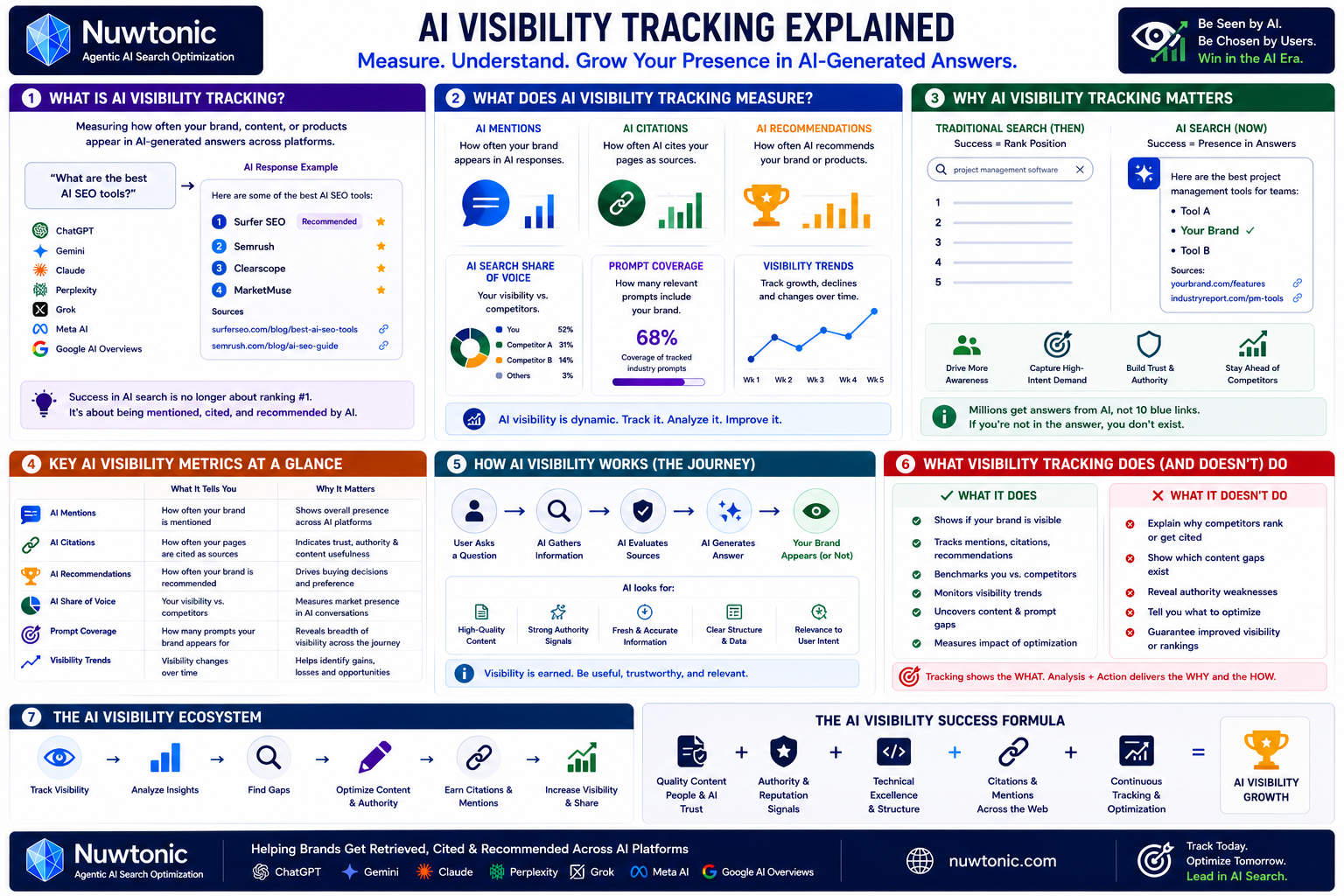
AI Visibility Tracking is the process of measuring how often your brand, website, products, or content appear inside AI-generated answers from platforms like ChatGPT, Gemini, Claude, Perplexity, Grok, Meta AI, and Google AI Overviews.
In traditional search, success was measured by where your page ranked in Google. In AI search, success is measured by whether AI systems mention your brand, cite your content, recommend your products, or use your information when generating answers.
For example, if someone asks ChatGPT:
"What are the best AI SEO tools?"
the AI may mention several companies, cite a few sources, and recommend specific platforms. AI Visibility Tracking helps you understand whether your brand appears in those responses, how frequently it appears, and how your visibility compares to competitors.
This shift is important because millions of users are no longer clicking through ten blue links. Instead, they are receiving direct answers from AI systems. If your brand is not included in those answers, potential customers may never discover you.
What Does AI Visibility Tracking Measure?
Modern AI visibility platforms measure far more than simple mentions. They help answer critical questions such as:
How often is my brand mentioned across AI platforms?
Which prompts trigger mentions of my competitors?
Which pages are being cited by AI systems?
How frequently is my brand recommended?
Which AI platforms provide the most visibility?
Has my visibility increased or decreased over time?
What percentage of industry conversations include my brand?
The most important AI visibility metrics include:
AI Mentions
AI mentions measure how often your brand appears inside AI-generated responses.
For example, if ChatGPT includes your company in an answer about project management software, that counts as a mention.
Mentions provide a high-level understanding of your presence across AI platforms.
AI Citations
A citation occurs when an AI system references a specific webpage, article, research study, documentation page, or website as a source.
Citations are often stronger signals than mentions because they indicate that the AI system considers your content trustworthy and useful enough to support its answer.
Many brands discover that competitors receive significantly more citations even when they have similar products or services.
AI Recommendations
Being mentioned is valuable.
Being recommended is far more valuable.
If a user asks:
"Which CRM should a startup choose?"
an AI model may mention ten companies but only recommend three.
Recommendation tracking helps brands understand how often they appear in these high-intent buying conversations.
AI Search Share of Voice
AI Share of Voice measures how much visibility your brand owns compared to competitors across a large set of prompts.
For example:
Brand A appears in 52% of tracked prompts
Brand B appears in 31%
Brand C appears in 14%
Brand A has the strongest AI Search Share of Voice.
This metric helps organizations understand their relative market presence inside AI search experiences.
Prompt Coverage
Prompt Coverage measures how many relevant prompts your brand appears for.
A company may dominate visibility for five prompts but be completely absent from hundreds of related questions customers ask every day.
Strong prompt coverage indicates broad visibility across the customer journey rather than visibility in only a few isolated searches.
Visibility Trends
AI visibility is constantly changing.
Models evolve.
New competitors emerge.
Content gets updated.
Visibility trend monitoring helps brands identify:
Visibility growth opportunities
Citation losses
Competitor gains
Emerging prompt categories
Changes across AI platforms
Tracking these trends helps teams understand whether their visibility strategy is improving or declining over time.
Why AI Visibility Tracking Matters
Many organizations discover that their competitors are being recommended by AI systems long before they notice any changes in traditional search rankings.
A company may rank well in Google yet receive very few mentions in ChatGPT, Gemini, Claude, or Perplexity.
This creates a new challenge.
You can have strong SEO performance while remaining largely invisible inside AI-generated answers.
AI Visibility Tracking helps uncover those blind spots before they become a traffic, lead generation, or brand awareness problem.
However, visibility tracking alone only answers one question:
"Am I visible?"
It does not explain:
Why competitors are being cited
Why your pages are being ignored
What content is missing
Which authority signals matter
What changes are needed to increase visibility
That is why leading brands increasingly combine visibility tracking with citation analysis, competitor intelligence, and AI search optimization workflows.
AI Visibility Tracking vs Traditional SEO Tracking
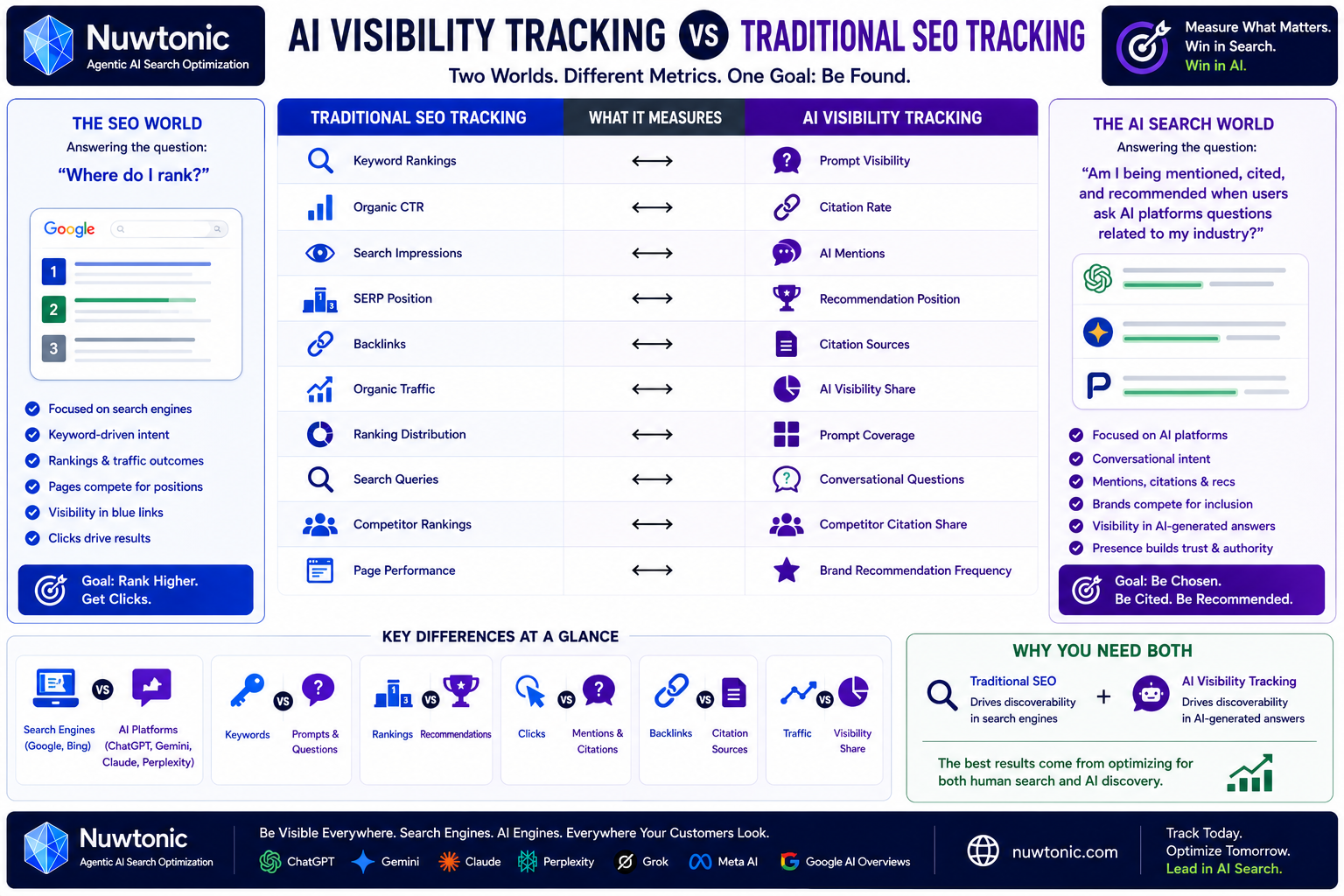
Although both disciplines focus on discoverability, they measure very different outcomes.
Traditional SEO Tracking | AI Visibility Tracking |
|---|---|
Keyword Rankings | Prompt Visibility |
Organic CTR | Citation Rate |
Search Impressions | AI Mentions |
SERP Position | Recommendation Position |
Backlinks | Citation Sources |
Organic Traffic | AI Visibility Share |
Ranking Distribution | Prompt Coverage |
Search Queries | Conversational Questions |
Competitor Rankings | Competitor Citation Share |
Page Performance | Brand Recommendation Frequency |
Traditional SEO answers:
"Where do I rank?"
AI Visibility Tracking answers:
"Am I being mentioned, cited, and recommended when users ask AI platforms questions related to my industry?"
As AI search continues to grow, businesses need visibility into both worlds.
Traditional SEO tells you how visible you are in search engines.
AI Visibility Tracking tells you how visible you are in AI-generated answers.
The organizations that win in AI search are increasingly measuring both.
How We Evaluate Data Credibility in AI Tracking
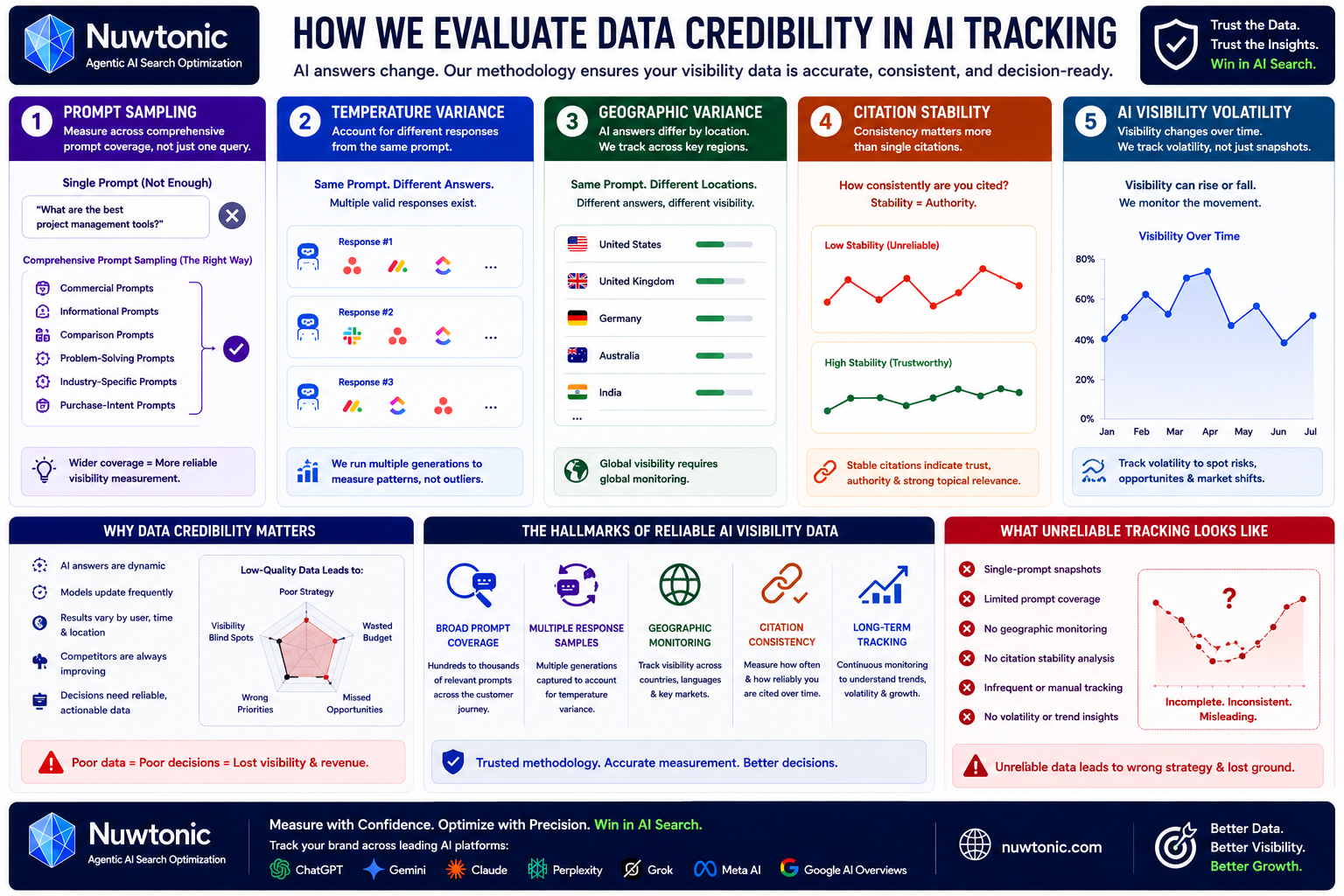
One of the biggest challenges in AI visibility tracking is that AI-generated answers are not fixed.
Unlike traditional search rankings, where a page might hold the same position for days or weeks, AI platforms can generate different responses to the same question depending on timing, model updates, user context, geographic location, and countless other variables.
This means measuring AI visibility accurately requires far more than running a single prompt and recording the result.
Without a reliable methodology, brands can easily make decisions based on incomplete, inconsistent, or misleading data.
When evaluating AI visibility platforms, we focus on five critical factors that determine whether visibility data can actually be trusted.
Prompt Sampling
One of the most common mistakes in AI visibility tracking is relying on a single prompt result.
Imagine asking ChatGPT:
"What are the best project management tools?"
The response you receive today may not be identical to the response generated tomorrow.
It may even differ from another user's response generated at the same time.
This is why professional AI visibility monitoring relies on prompt sampling rather than single-query snapshots.
Instead of measuring one response, platforms should evaluate multiple prompt variations across a topic area, including:
Commercial prompts
Informational prompts
Comparison prompts
Problem-solving prompts
Industry-specific prompts
Purchase-intent prompts
This provides a more representative picture of how often a brand actually appears across real-world AI conversations.
The broader the prompt coverage, the more reliable the visibility measurement becomes.
Temperature Variance
Large Language Models do not always generate identical answers.
Most AI systems use probabilistic generation, meaning multiple valid responses can exist for the same question.
For example, ChatGPT may recommend one set of SEO tools during one query and a slightly different set during another.
This variability is often referred to as temperature variance.
A reliable AI visibility platform must account for these fluctuations by monitoring performance across multiple response generations rather than relying on a single answer.
Otherwise, brands may mistake temporary visibility spikes or drops for meaningful trends.
The goal is not to measure one answer.
The goal is to measure patterns across many answers.
Geographic Variance
AI responses are increasingly influenced by location.
A user in the United States may receive different recommendations than a user in the United Kingdom, Germany, Australia, or India.
This is particularly noticeable in:
Local business recommendations
SaaS recommendations
Ecommerce products
Financial services
Healthcare providers
Regional service providers
For global organizations, visibility in one market does not guarantee visibility in another.
A robust AI visibility strategy should monitor how recommendations, citations, and mentions change across important geographic regions.
Otherwise, brands may overlook major visibility gaps in key markets.
Citation Stability
Many organizations focus on whether they are cited.
A more important question is:
"How consistently am I cited?"
A single citation provides limited insight.
Consistent citations across hundreds or thousands of prompts provide a much stronger indicator of authority and visibility.
Citation Stability measures how reliably a brand, page, or website appears as a referenced source over time.
Strong citation stability often indicates:
Strong topical authority
Comprehensive content coverage
High trust signals
Consistent relevance across multiple questions
Low citation stability often indicates that competitors have stronger authority signals or more complete content coverage.
This is why the best AI visibility strategies focus on sustainable citation growth rather than isolated citation wins.
AI Visibility Volatility
AI visibility is constantly changing.
New content gets published.
Competitors improve their authority.
AI models are updated.
Search behavior evolves.
As a result, visibility can fluctuate significantly over time.
AI Visibility Volatility measures how much your visibility changes across different periods.
Monitoring volatility helps identify:
Sudden citation losses
Emerging competitors
Model update impacts
Visibility growth opportunities
Shifts in recommendation patterns
A brand that appears in 60% of tracked prompts today may appear in only 40% a few months later if competitors strengthen their content and authority.
Tracking these changes helps organizations react before visibility losses become traffic losses.
Why Data Credibility Matters
The quality of an AI visibility platform ultimately depends on the quality of its data collection methodology.
If a tool relies on limited prompts, single-response tracking, or infrequent monitoring, the resulting visibility data may not accurately reflect real-world performance.
Reliable AI visibility measurement requires:
Broad prompt coverage
Multiple response samples
Geographic monitoring
Citation consistency analysis
Long-term visibility tracking
Without these safeguards, brands risk making strategic decisions based on incomplete visibility data rather than actual AI search performance.
As AI search continues to evolve, trustworthy measurement will become just as important as visibility itself.
To build a reliable tracking framework, we must apply a rigorous source evaluation framework to how LLMs pull and cite web data. Without a verified methodology, you risk making critical marketing decisions based on hallucinated or inconsistent tracking data.
How AI Models Choose Which Brands To Cite
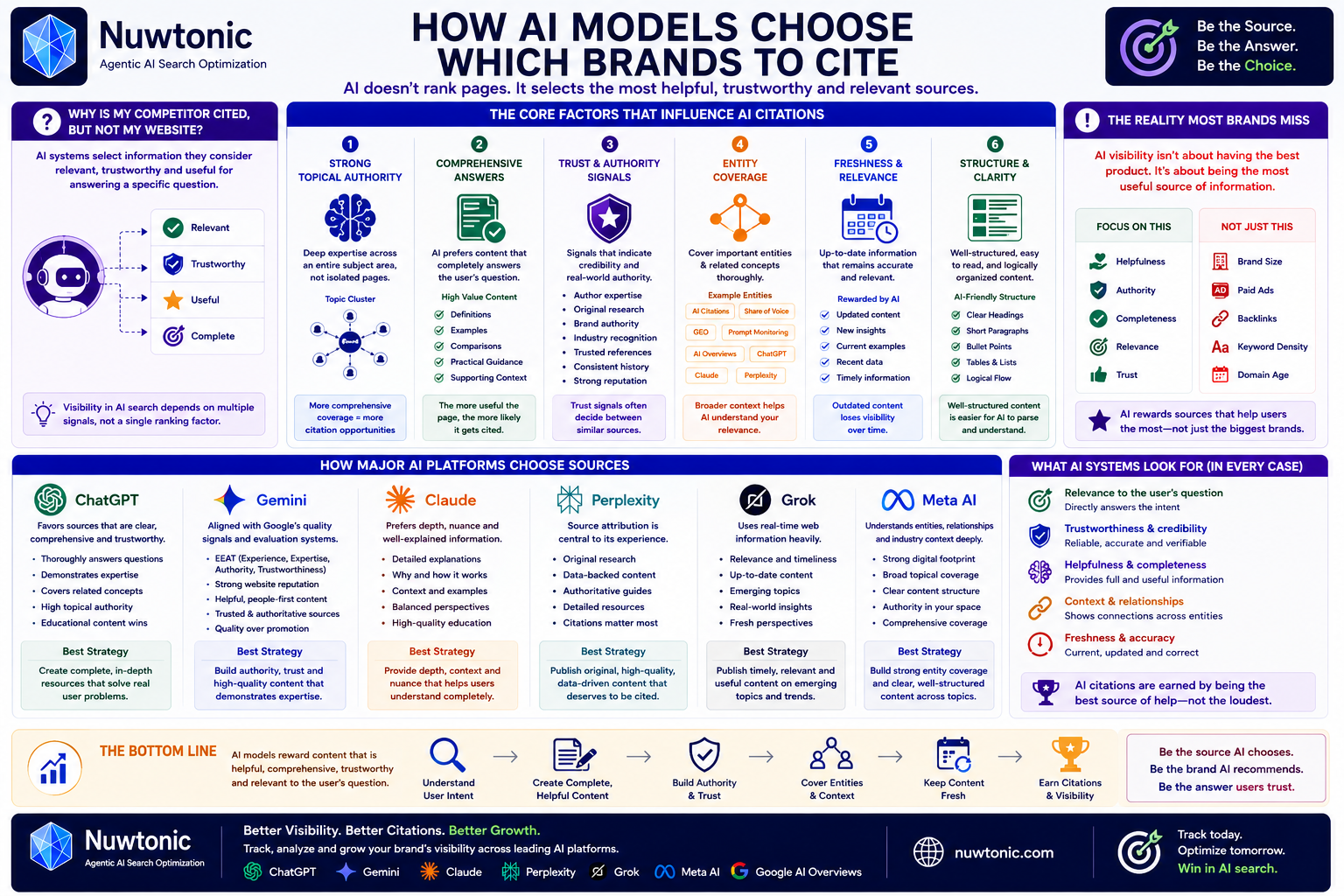
One of the most common questions businesses ask after starting AI visibility tracking is:
"Why is ChatGPT citing my competitor but not my website?"
The answer is more complicated than traditional search rankings.
Unlike Google's classic search results, AI systems do not simply display a list of webpages in order. Instead, they generate answers by selecting information they consider relevant, trustworthy, and useful for answering a specific question.
This means visibility in AI search is not determined by a single ranking factor.
Multiple signals influence whether a brand gets mentioned, cited, recommended, or completely ignored.
While every AI platform uses its own retrieval and ranking systems, most of them look for similar characteristics when deciding which brands and sources deserve visibility.
The Core Factors That Influence AI Citations
Across most AI platforms, brands that receive consistent citations tend to demonstrate several common characteristics.
Strong Topical Authority
AI systems prefer sources that demonstrate deep expertise across an entire subject area rather than isolated pages covering a single keyword.
For example, a company with dozens of comprehensive resources about technical SEO is more likely to be cited than a company with a single SEO article.
This is one reason why brands investing in content clusters and topical authority often see stronger AI visibility over time.
Comprehensive Answers
AI models favor content that completely answers a user's question.
Pages that provide definitions, examples, comparisons, practical guidance, and supporting context often outperform pages that only provide basic explanations.
The more useful a page is to the user, the more likely it is to contribute to an AI-generated response.
Trust and Authority Signals
AI systems increasingly look for signals that indicate credibility.
These may include:
Author expertise
Original research
Brand authority
Industry recognition
Trusted references
Consistent publishing history
Strong website reputation
When two pages provide similar information, trust signals often become the deciding factor.
Entity Coverage
Modern AI systems understand relationships between topics, brands, products, people, technologies, and concepts.
Brands that cover important industry entities thoroughly often gain visibility because AI models have a stronger understanding of their expertise.
For example, a page discussing AI visibility tracking may naturally reference:
AI citations
Share of voice
Generative Engine Optimization (GEO)
Prompt monitoring
AI Overviews
ChatGPT
Gemini
Claude
Perplexity
This broader context helps AI systems understand the page's relevance.
Freshness and Relevance
AI systems increasingly prioritize information that remains accurate and relevant.
Industries that evolve quickly often reward brands that consistently update content, publish new insights, and maintain current information.
Outdated information can reduce visibility even if a page previously performed well.
How ChatGPT Chooses Sources
ChatGPT tends to favor sources that provide clear, comprehensive, and trustworthy information.
Pages that thoroughly answer questions, demonstrate expertise, and cover related concepts often have a greater chance of being referenced.
Brands with strong topical authority frequently appear because their content helps ChatGPT construct complete answers rather than isolated facts.
In many industries, comprehensive educational content performs better than purely promotional content.
How Gemini Chooses Sources
Gemini operates within Google's ecosystem and often demonstrates strong alignment with many of the quality signals that have traditionally influenced Google Search.
This includes:
Expertise
Experience
Authority
Trustworthiness
Strong website reputation
Helpful content
Brands with strong EEAT signals and well-established authority frequently have an advantage when competing for visibility within Gemini and Google's AI experiences.
How Claude Chooses Sources
Claude is known for generating detailed and nuanced responses.
As a result, it often favors content that provides depth, context, and complete explanations.
Content that explains not only what something is but also why it matters and how it works tends to align well with the type of answers Claude generates.
Brands producing high-quality educational content frequently perform well in Claude visibility tracking.
How Perplexity Chooses Sources
Perplexity places significant emphasis on source attribution.
Its responses often include visible citations, making source quality particularly important.
Brands that publish original research, detailed guides, data-backed content, and authoritative resources often gain stronger visibility because Perplexity actively references supporting sources.
This makes citation quality especially important for brands targeting Perplexity visibility.
How Grok Chooses Sources
Grok frequently incorporates real-time and web-based information into its responses.
Because of this, relevance, authority, and current information often play a major role in visibility.
Brands that consistently publish useful and up-to-date content are generally better positioned to appear in emerging conversations and trending topics.
How Meta AI Chooses Sources
Meta AI relies heavily on understanding entities, concepts, and relationships between topics.
Brands with strong digital footprints, recognized authority, and broad topical coverage often have a visibility advantage.
Clear content structure and comprehensive subject coverage help Meta AI understand where a brand fits within a larger industry landscape.
The Reality Most Brands Miss
Many businesses assume that AI visibility is determined by a single factor.
In reality, AI citations are usually the result of multiple signals working together.
A competitor may be cited more often because they have:
Stronger topical authority
Better entity coverage
More comprehensive answers
Higher trust signals
Better content depth
Greater brand recognition
More supporting content around the topic
This is why visibility tracking alone is often not enough.
Knowing that a competitor is being cited is useful.
Understanding why they are being cited is where the real opportunity exists.
The brands gaining visibility fastest are not simply tracking mentions and citations. They are identifying the gaps between their content and the sources AI systems already trust, then systematically closing those gaps.
This is exactly why AI Citation Gap Analysis has become one of the fastest-growing areas within AI search optimization.
Why AI Models Are Not Citing Your Website
Many businesses start tracking AI visibility and discover something frustrating:
Their competitors are being cited, recommended, and mentioned across ChatGPT, Gemini, Claude, Perplexity, Grok, and AI Overviews while their own website is barely visible.
The natural assumption is often:
"Our content isn't good enough."
But in reality, AI visibility problems are usually much more specific.
Most websites are not invisible because of a single issue.
They are invisible because multiple gaps exist between what AI systems currently trust and what the website currently provides.
Understanding those gaps is the first step toward improving AI visibility.
Topical Authority Gaps
One of the biggest reasons AI systems overlook websites is a lack of topical authority.
Many companies create a handful of articles around a topic and assume they have established expertise.
AI systems often look for broader evidence.
For example, if a company wants visibility for AI SEO, AI visibility tracking, GEO, AI citations, and AI search optimization, publishing one article on each topic is rarely enough.
AI systems are more likely to trust websites that demonstrate deep coverage across the entire subject area.
This includes:
Core concepts
Supporting topics
Comparisons
Use cases
Best practices
Industry terminology
Emerging trends
The stronger the topical coverage, the easier it becomes for AI systems to associate the brand with expertise in that area.
EEAT Gaps
Experience, Expertise, Authoritativeness, and Trustworthiness continue to influence how information is evaluated across the web.
AI systems increasingly favor content backed by recognizable expertise and credible sources.
Common EEAT gaps include:
Weak author credibility
Missing expertise signals
Lack of original insights
No supporting evidence
Thin company authority
Weak brand recognition
When two websites cover the same topic, stronger authority signals often determine which one receives visibility.
Entity Gaps
AI systems understand entities.
An entity can be:
A brand
A person
A product
A company
A technology
A concept
An industry term
Many websites discuss a topic without covering the entities that AI systems expect to see.
For example, an article about AI visibility tracking may never mention:
AI citations
Share of voice
Prompt monitoring
AI Overviews
ChatGPT
Gemini
Claude
Perplexity
This creates weak contextual understanding.
Entity coverage helps AI systems understand what a page is actually about and how it relates to broader industry conversations.
Content Gaps
Sometimes competitors simply answer more questions.
Many pages focus only on definitions while competitors provide:
Examples
Frameworks
Comparisons
Statistics
Use cases
Practical implementation steps
AI systems often prefer content that helps them generate complete answers rather than isolated facts.
A page may rank well in traditional search but still fail to support the depth required for AI-generated responses.
Trust Gaps
Trust signals influence whether AI systems feel confident referencing a source.
Common trust gaps include:
Weak brand presence
Limited industry recognition
Few authoritative mentions
Sparse supporting evidence
Poor content quality
When trust is low, AI systems may rely on competitors even when the underlying information is similar.
Citation Gaps
One of the most overlooked problems is citation gaps.
In many cases, AI systems already understand the topic but do not see sufficient evidence to reference a particular page or brand.
Competitors may have:
Better referenced content
More supporting resources
Stronger authority signals
More complete topic coverage
The result is a visibility gap that is difficult to identify using traditional SEO tools alone.
Semantic Coverage Gaps
AI systems evaluate relationships between concepts.
A page may target the right topic but fail to cover related ideas that help establish relevance.
For example, a page about AI visibility tracking might never discuss:
AI recommendations
Citation share
Prompt coverage
AI search optimization
Competitor intelligence
Entity optimization
To a human reader, the page appears relevant.
To an AI system, the page may appear incomplete.
The Problem Most AI Visibility Tools Miss
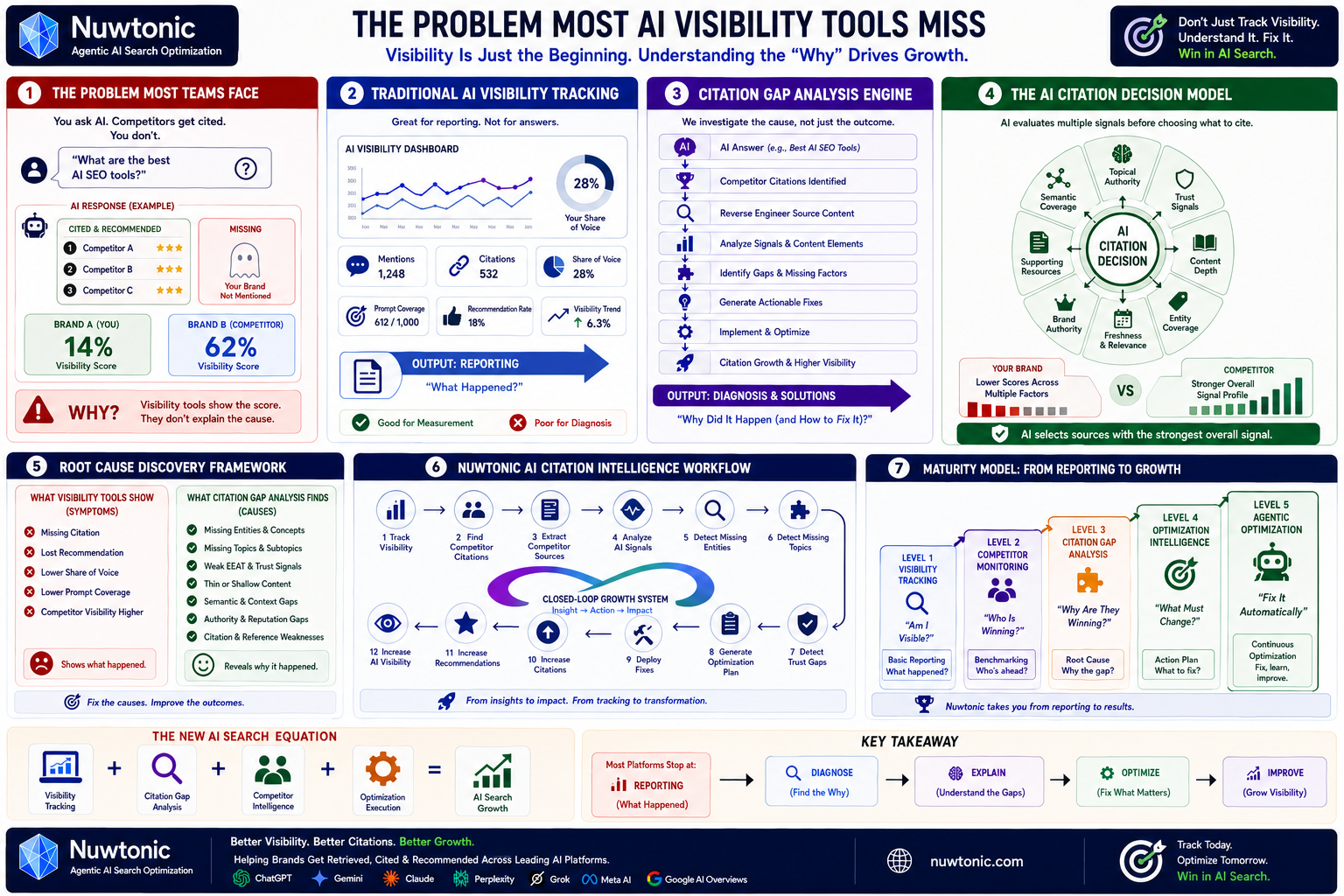
Most AI visibility platforms are excellent at answering one question:
"Am I visible?"
They show:
Mentions
Citations
Share of voice
Prompt performance
Competitor visibility
This information is valuable.
But it does not explain why visibility is missing.
Imagine discovering that your competitor appears in 62% of tracked prompts while your brand appears in only 14%.
The obvious next question is:
"What are they doing differently?"
Most visibility tools stop there.
They tell you what happened.
They do not tell you why it happened.
And they certainly do not tell you how to fix it.
This is the challenge that led to the creation of Nuwtonic.
What Is AI Citation Gap Analysis?
AI Citation Gap Analysis is the process of identifying why AI systems choose one source over another.
Instead of simply tracking visibility, Citation Gap Analysis investigates the underlying reasons behind visibility differences.
For example, imagine a prompt:
"What are the best AI SEO tools?"
ChatGPT cites three competitors but never mentions your brand.
Traditional visibility tracking tells you the outcome.
Citation Gap Analysis investigates the cause.
Questions include:
Which competitor pages are being cited?
What information do those pages contain?
Which entities are missing from your content?
Which trust signals are competitors demonstrating?
Which topics are competitors covering better?
Which content gaps exist?
Which authority signals are influencing citations?
What information should be added?
Where should it be added?
Why does it matter?
This transforms visibility tracking from reporting into actionable intelligence.
Why We Built Nuwtonic
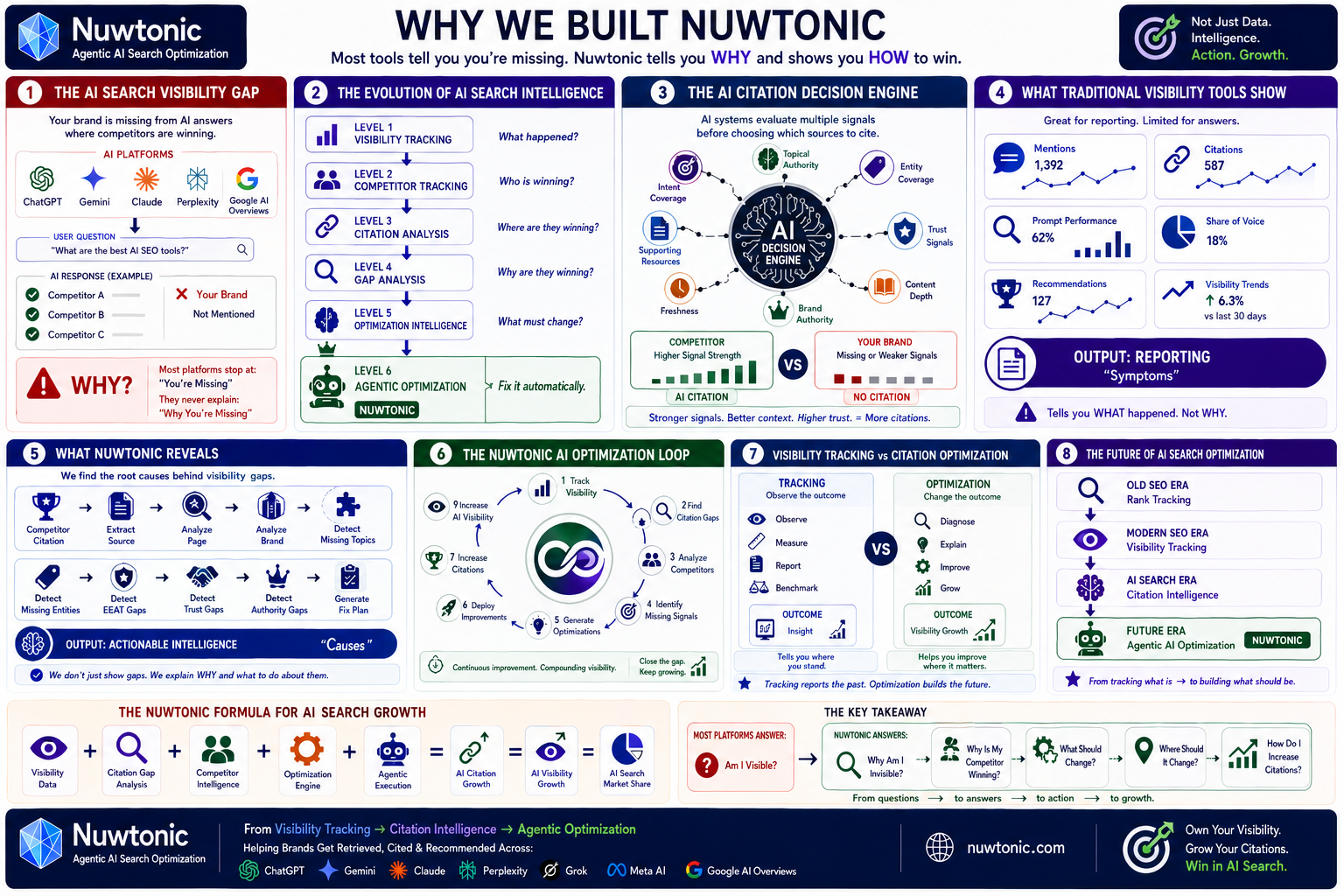
When we analyzed the AI visibility market, we noticed a common pattern.
Most platforms focused on monitoring.
They tracked visibility.
They tracked mentions.
They tracked citations.
They tracked share of voice.
But they rarely answered the question users cared about most:
"How do I improve my visibility?"
Knowing that your brand is invisible does not increase visibility.
Knowing that competitors are winning does not help you catch them.
What teams actually need is a way to understand why competitors are winning and what actions will close the gap.
That became the foundation for Nuwtonic.
Rather than stopping at visibility reporting, Nuwtonic was built to help organizations understand:
Why competitors are being cited
Why pages are being ignored
What information is missing
Which entities are missing
Which authority signals are weak
Which content gaps exist
Which pages should be improved first
More importantly, it helps teams identify exactly what should be added, where it should be added, and why those changes matter.
AI Visibility Tracking vs AI Citation Optimization
AI visibility tracking and AI citation optimization are often treated as the same thing.
They are not.
Visibility tracking measures outcomes.
Citation optimization improves outcomes.
Capability | Traditional AI Visibility Tools | Nuwtonic |
|---|---|---|
Track Mentions | Yes | Yes |
Track Citations | Yes | Yes |
Track Prompt Performance | Yes | Yes |
Track Share of Voice | Yes | Yes |
Identify Citation Gaps | Limited | Yes |
Analyze Competitor Pages | Limited | Yes |
Analyze Competitor Brands | Limited | Yes |
Discover Missing Entities | No | Yes |
Identify Content Gaps | No | Yes |
Analyze Topical Authority Gaps | No | Yes |
Analyze EEAT Signals | No | Yes |
Generate Optimization Recommendations | Limited | Yes |
Recommend Content Improvements | Limited | Yes |
Support AI Citation Growth | Limited | Yes |
The future of AI search optimization is not simply knowing where you appear.
It is understanding why you do not appear, what competitors are doing differently, and what actions will increase your visibility across AI platforms.
That is the difference between tracking AI visibility and actively improving it.
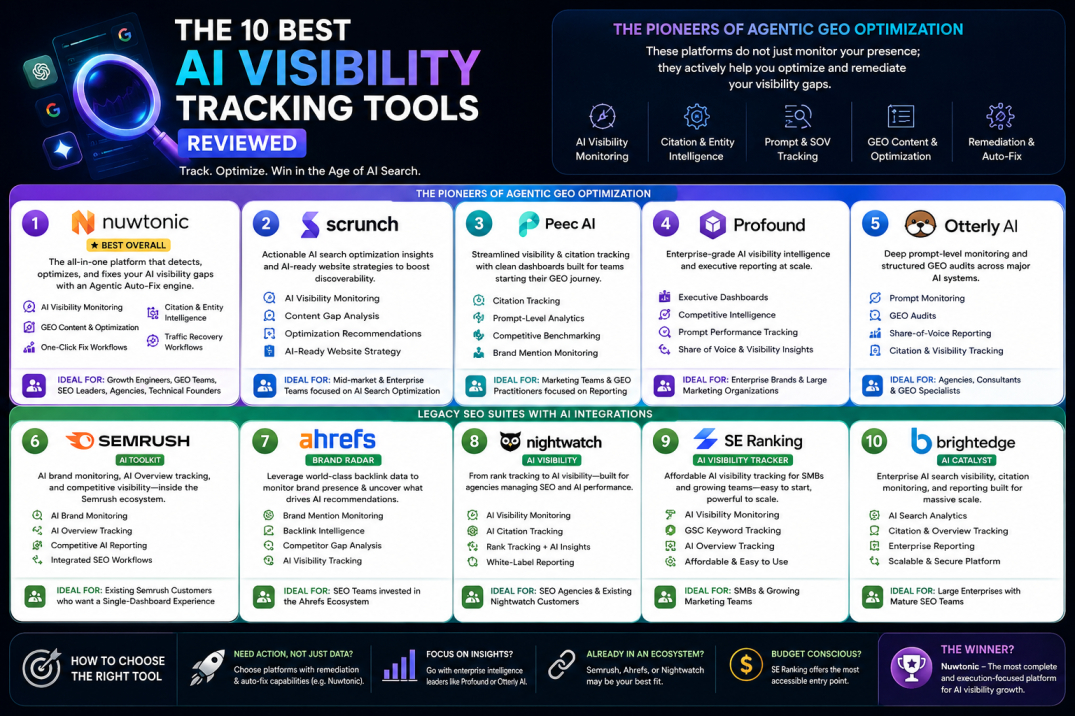
The 10 Best AI Visibility Tracking Tools Reviewed
The Pioneers of Agentic GEO Optimization
These platforms do not just monitor your presence; they actively help you optimize and remediate your visibility gaps.
**1\. Nuwtonic**
Nuwtonic is an AI Visibility, Citation Optimization, and AI Search Growth platform designed for teams that want to do more than simply monitor AI mentions.
While many platforms focus primarily on reporting visibility metrics, Nuwtonic focuses on helping brands understand why competitors are being cited, what is preventing visibility, and how those gaps can be closed.
The platform combines AI Visibility Tracking, Citation Intelligence, AI Search Auditing, Competitor Intelligence, Content Gap Analysis, and AI Citation Optimization into a single workflow.
For organizations actively investing in AI Search, Generative Engine Optimization (GEO), and AI visibility growth, this provides a more complete approach than monitoring alone.
Track Visibility Across 6 Major AI Platforms
AI visibility is no longer limited to a single platform.
Different AI systems often produce different recommendations, citations, and brand mentions for the same question.
Nuwtonic tracks visibility across:
ChatGPT
Claude
Gemini
Perplexity
Grok
Meta AI
This helps organizations understand how their visibility changes across different AI ecosystems rather than relying on data from a single platform.
For every tracked prompt, teams can monitor:
Brand mentions
Citations
Recommendations
Share of voice
Prompt performance
Competitor visibility
Visibility trends over time
This creates a much broader picture of AI search performance than traditional rank tracking.
AI Citation Gap Analysis
Most AI visibility tools answer a simple question:
"Was I cited?"
Nuwtonic was built to answer a much more valuable question:
"Why wasn't I cited?"
This is where AI Citation Gap Analysis becomes important.
Imagine tracking a prompt such as:
"What are the best AI SEO tools?"
ChatGPT mentions several competitors but never mentions your brand.
Traditional visibility platforms can identify the outcome.
They show that competitors were cited.
They show that your brand was not.
The investigation usually stops there.
Nuwtonic takes the next step.
Instead of simply reporting the result, it analyzes the factors influencing that result.
This includes:
Content gaps
EEAT gaps
Entity gaps
Trust signal gaps
Topical authority gaps
Semantic coverage gaps
Competitor advantages
The goal is not just to identify that visibility is missing.
The goal is to understand why visibility is missing.
This distinction is often what separates monitoring from optimization.
AI Citation Fix Engine
Finding visibility problems is useful.
Fixing them is where growth happens.
Once citation gaps are identified, Nuwtonic helps uncover exactly what is preventing a page from being cited or recommended.
The platform can identify:
Missing entities
Missing topics
Missing supporting concepts
Missing trust signals
Missing authority indicators
Missing citations
Missing semantic relationships
Instead of providing generic recommendations, the platform focuses on actionable improvements.
For every identified gap, teams can understand:
What should be added
Where it should be added
Why it matters
Which competitor advantages it addresses
How it may influence AI visibility
This creates a direct connection between visibility analysis and optimization efforts.
Why Visibility Tracking Alone Is Not Enough
Most organizations eventually encounter the same problem.
They discover that competitors are dominating AI visibility but have no clear understanding of why.
Visibility reports often show:
Citation losses
Visibility declines
Competitor growth
But they rarely explain the underlying cause.
Knowing that your competitor appears in 65% of tracked prompts while your brand appears in 12% does not tell you how to close the gap.
Improvement requires understanding:
What competitors are doing differently
Which pages are driving visibility
Which authority signals matter
Which content opportunities exist
Which gaps need to be addressed
This is where many traditional AI visibility platforms stop and where Nuwtonic continues.
Competitor AI Search Intelligence
Most AI visibility platforms analyze a relatively simple workflow:
Prompt
↓
Result
↓
Visibility Report
Nuwtonic expands the analysis far beyond the prompt itself.
Instead of analyzing only AI responses, it can analyze the broader competitive landscape behind those responses.
This includes:
Competitor websites
Competitor content libraries
Competitor topical coverage
Competitor entity coverage
Competitor citations
Competitor authority signals
Competitor EEAT indicators
Competitor content strengths
The objective is to understand why competitors are earning visibility rather than simply measuring that they are.
This provides a much deeper layer of competitive intelligence than standard visibility tracking.
Reverse Engineering Competitor AI Visibility
One of the most valuable ways to improve AI visibility is understanding what already works.
Rather than guessing which content should be created next, organizations can study the factors influencing competitor success.
Nuwtonic helps teams investigate:
Competitor
↓
Winning Pages
↓
Winning Topics
↓
Winning Entities
↓
Citation Drivers
↓
Content Opportunities
This allows organizations to identify:
Which pages drive competitor citations
Which topics generate recommendations
Which entities appear most frequently
Which authority signals influence visibility
Which content opportunities remain underserved
Instead of reacting to competitors after they gain visibility, teams can proactively identify opportunities before competitors dominate them.
Best For
Nuwtonic is best suited for:
GEO teams
SEO teams
Content strategists
Growth marketers
Agencies
SaaS companies
Brands actively investing in AI search visibility
It is particularly valuable for organizations that want to move beyond visibility reporting and actively improve citations, recommendations, and AI Search Share of Voice.
Pros
Tracks visibility across ChatGPT, Claude, Gemini, Perplexity, Grok, and Meta AI
Comprehensive AI visibility monitoring
AI Citation Gap Analysis capabilities
Competitor AI Search Intelligence
AI Search auditing and optimization workflows
Deep entity and topical authority analysis
Identifies why competitors are being cited
Reveals what content is missing
Helps prioritize visibility opportunities
Focuses on both detection and improvement rather than reporting alone
Ideal User
Organizations that want to understand not only where they appear in AI search, but also why they do or do not appear, and what actions can improve their visibility across AI platforms.
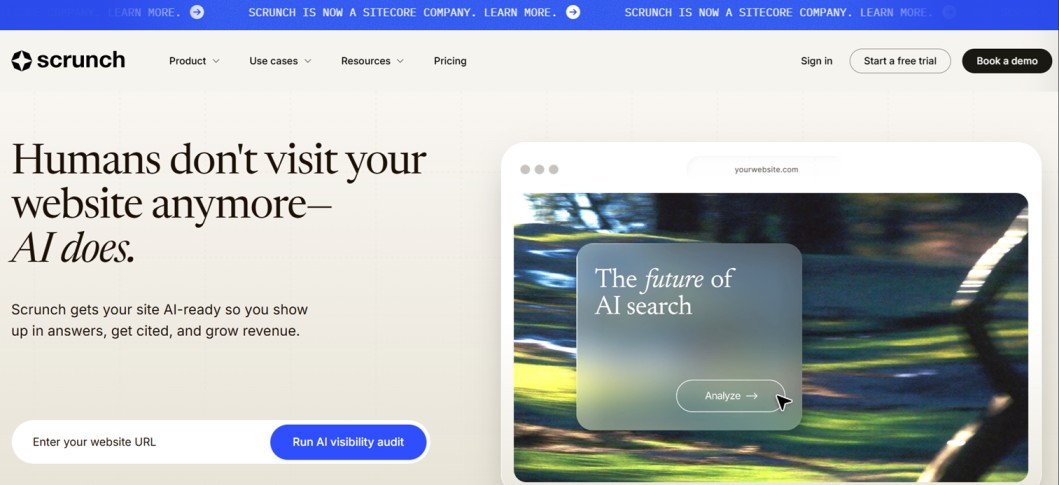
**2\. Scrunch**
Scrunch is built for organizations looking for AI search optimization insights and AI-ready website strategies. The platform combines visibility monitoring, citation analysis, optimization recommendations, and content gap analysis to help brands improve discoverability across AI systems.
• Pros:
• Strong AI visibility monitoring
• Actionable optimization recommendations
• Deep content gap analysis
• Strategic guidance for building AI-ready websites
• Cons:
• Recommendations still require manual execution
• AI Citation Gap Analysis and Fix
• Competitor Gap Analysis and identify Missing areas,
• Limited remediation automation
• Less focused on active traffic recovery
• Ideal User: Mid-market and enterprise teams focused on AI search optimization.
**3\. Peec AI**
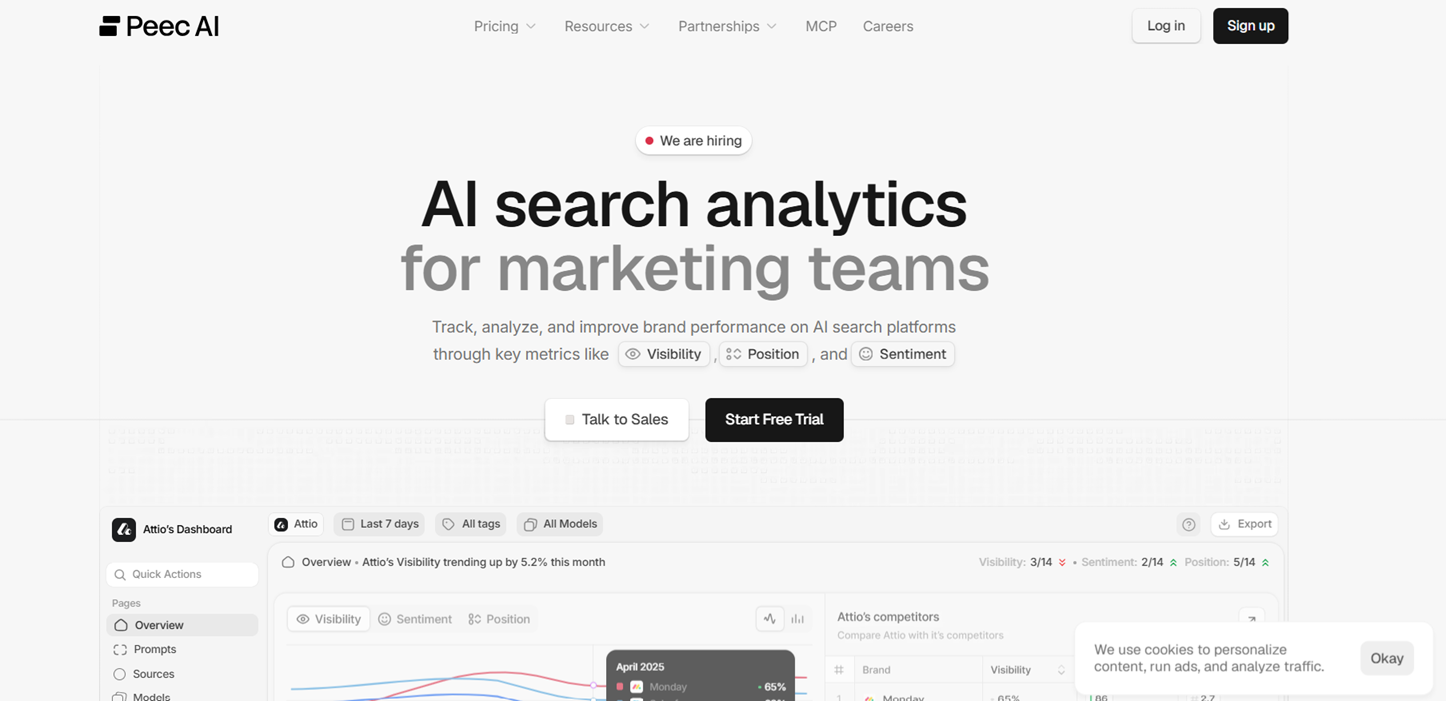
Peec AI targets organizations seeking streamlined AI visibility monitoring and citation tracking. The platform is particularly popular among teams beginning their GEO initiatives, offering clean dashboards to track brand mentions and prompt performance.
• Pros:
• Excellent citation tracking
• User-friendly dashboards
• Prompt-level analytics
• Competitive benchmarking
• Cons:
• Primarily monitoring-focused without direct execution tools
• AI Citation Gap Analysis and Fix
• Competitor Gap Analysis and identify Missing areas,
• Limited remediation workflows
• Requires separate optimization processes
• Ideal User: Marketing teams and GEO practitioners focused on AI visibility reporting.
Enterprise Intelligence & Standalone Trackers
These platforms focus heavily on high-level analytics, prompt performance, and executive-level reporting.
4. Profound
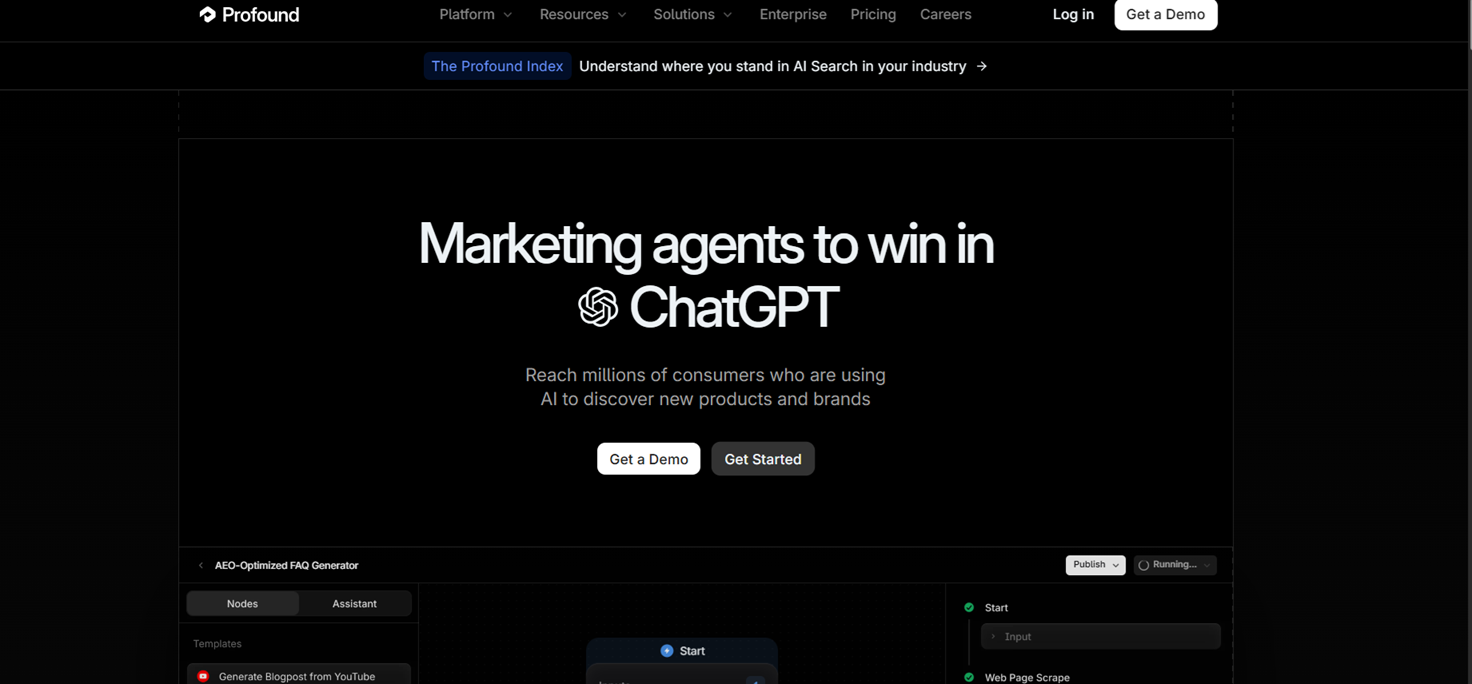
Profound is the go-to solution for enterprise organizations requiring deep AI visibility intelligence and executive reporting. It helps brands monitor visibility, citations, competitive positioning, and prompt performance across major answer engines.
• Pros:
• Enterprise-grade reporting and dashboards
• Comprehensive competitive intelligence
• Strong prompt performance tracking
• Large enterprise adoption and proven scale
• Cons:
• AI Citation Gap Analysis and Fix
• Competitor Gap Analysis and identify Missing areas
• High enterprise-focused pricing
• Implementation often requires cross-functional coordination
• Remains primarily a visibility intelligence tool
• Ideal User: Enterprise brands and large marketing organizations.
5. Otterly AI
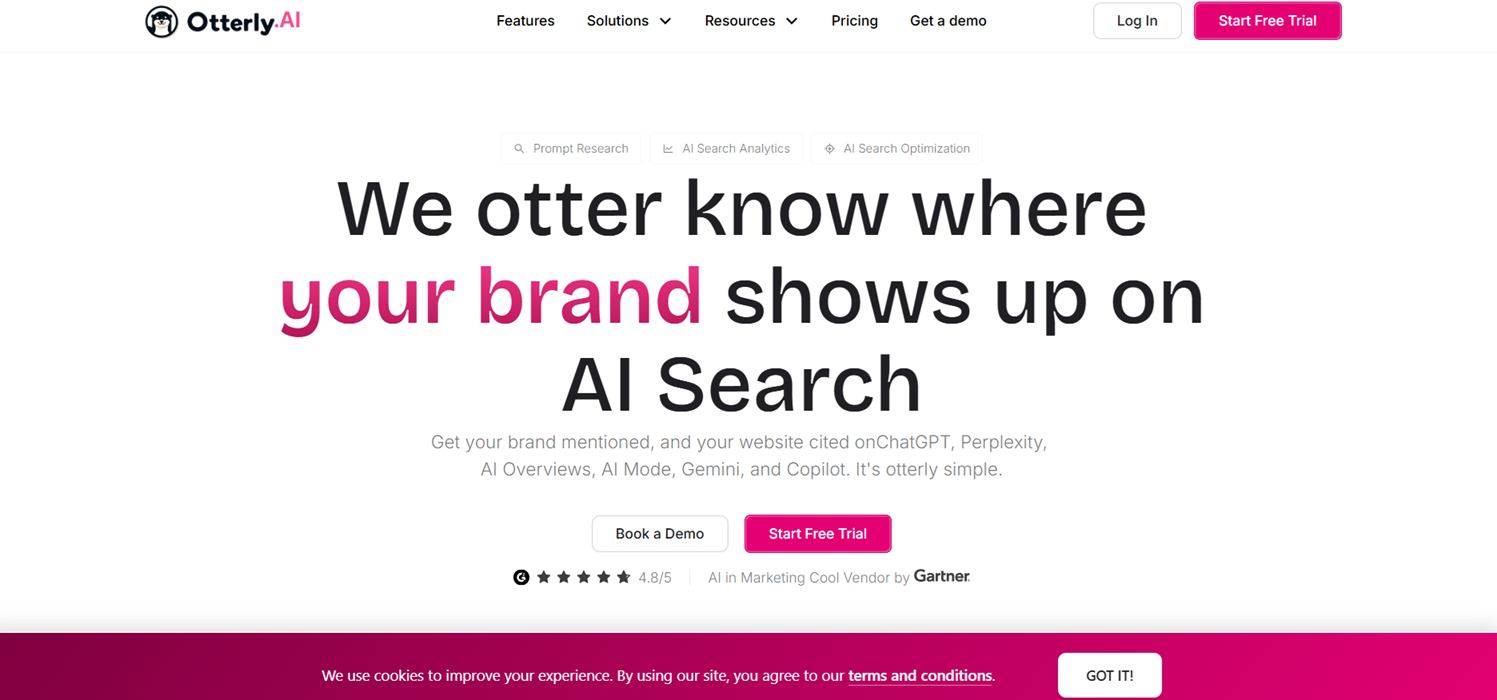
Otterly AI specializes in prompt-level AI visibility monitoring and GEO audits. It tracks visibility across ChatGPT, Google AI Overviews, Gemini, Perplexity, and other AI systems with a heavy emphasis on prompt formulation and citation tracking.
• Pros:
• Detailed prompt monitoring
• Structured GEO auditing
• Share-of-voice reporting
• Competitive monitoring
• Cons:
• AI Citation Gap Analysis and Fix
• Competitor Gap Analysis and identify Missing areas
• Monitoring-first architecture
• Limited built-in intervention capabilities
• Optimization work must be done externally
• Ideal User: Agencies, consultants, and GEO specialists.
Legacy SEO Suites with AI Integrations
These tools are built by established SEO vendors expanding their feature sets to include AI tracking.
6. Semrush AI Toolkit
Semrush has expanded into the AI space with tools for AI brand monitoring, AI Overview tracking, and competitive AI visibility reporting. The platform is highly integrated into the existing Semrush ecosystem.
• Pros:
• Fully integrated with the Semrush platform
• Massive keyword databases and competitive data
• Familiar workflows for existing users
• Cons:
• AI Citation Gap Analysis and Fix
• Competitor Gap Analysis and identify Missing areas
• AI visibility is not the platform's primary focus
• Limited GEO-specific workflows
• Less specialized than dedicated AI visibility tools
• Ideal User: Existing Semrush customers who want a single-dashboard experience.
7. Ahrefs Brand Radar
Ahrefs Brand Radar monitors brand mentions and AI search presence while leveraging its industry-leading backlink database. This makes it a great choice for teams looking to perform a Competitor Gap Analysis to see which referential links are driving AI recommendations.
• Pros:
• World-class backlink intelligence
• Massive web index for brand monitoring
• Strong competitive analysis features
• Cons:
• AI Citation Gap Analysis and Fix
• Competitor Gap Analysis and identify Missing areas
• GEO functionality is still relatively new
• Lacks built-in remediation workflows
• AI tracking is a secondary feature set
• Ideal User: SEO teams already heavily invested in the Ahrefs ecosystem.
8. Nightwatch AI Visibility
Nightwatch has expanded its core rank tracking heritage to include AI search visibility measurement and AI citation monitoring, making it a solid choice for agencies that manage both local SEO and AI search tracking.
• Pros:
• Strong rank-tracking heritage
• Accurate AI visibility monitoring
• Clean client reporting capabilities
• Cons:
• AI Citation Gap Analysis and Fix
• Competitor Gap Analysis and identify Missing areas
• Limited GEO-specific tooling
• Smaller ecosystem compared to major suites
• Less AI-focused than dedicated platforms
• Ideal User: SEO agencies and existing Nightwatch rank-tracking customers.
9. SE Ranking AI Visibility Tracker
SE Ranking has introduced affordable AI visibility monitoring capabilities to help small and mid-sized businesses track their presence inside AI-generated search experiences. It provides an excellent entry point for teams wanting to combine traditional tracking with GSC Keyword Tracking data.
• Pros:
• Highly affordable pricing tiers
• Easy onboarding and user-friendly interface
• Solid SEO foundation integrated with AI metrics
• Cons:
• AI Citation Gap Analysis and Fix
• Competitor Gap Analysis and identify Missing areas
• GEO features are relatively basic
• Limited advanced workflows for remediation
• Less specialized than dedicated platforms
• Ideal User: SMBs and growing marketing teams.
10. BrightEdge AI Catalyst
BrightEdge extends traditional enterprise SEO into AI search visibility, AI Overviews, citation monitoring, and AI performance reporting. It is built for massive scale and deep integration with corporate marketing stacks.
• Pros:
• Enterprise-level support and account management
• Powerful AI search analytics
• Strong existing corporate adoption
• Cons:
• AI Citation Gap Analysis and Fix
• Competitor Gap Analysis and identify Missing areas
• High enterprise pricing
• Complex implementation process
• Limited focus on active remediation workflows
• Ideal User: Large enterprises with dedicated, mature SEO teams.
Head-to-Head Comparison of the Top Platforms
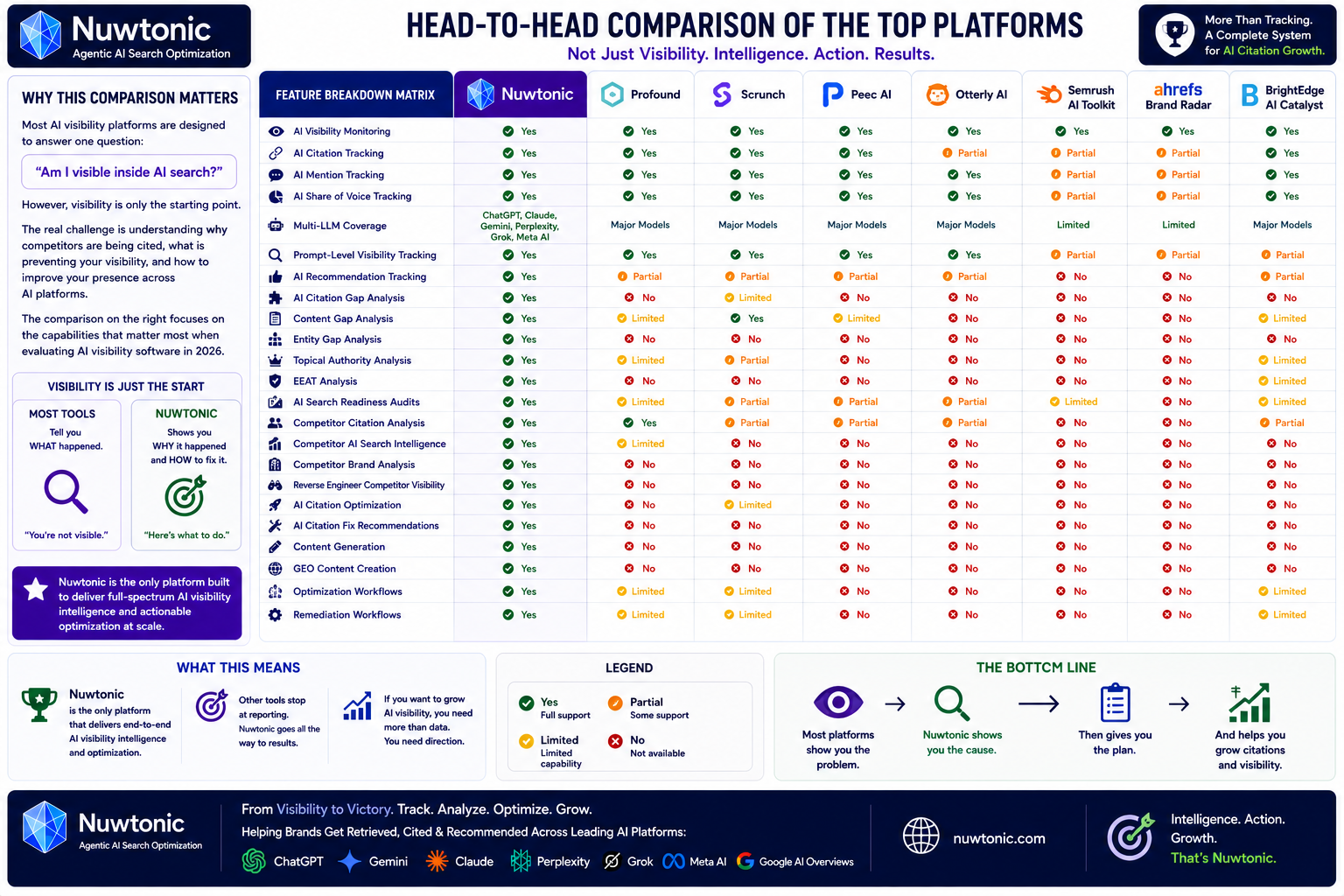
Feature Breakdown Matrix
Most AI visibility platforms are designed to answer one question:
"Am I visible inside AI search?"
However, visibility is only the starting point.
The real challenge is understanding why competitors are being cited, what is preventing your visibility, and how to improve your presence across AI platforms.
The comparison below focuses on the capabilities that matter most when evaluating AI visibility software in 2026.
Feature | Nuwtonic | Profound | Scrunch | Peec AI | Otterly AI | Semrush AI Toolkit | Ahrefs Brand Radar | BrightEdge AI Catalyst |
|---|---|---|---|---|---|---|---|---|
AI Visibility Monitoring | Yes | Yes | Yes | Yes | Yes | Yes | Yes | Yes |
AI Citation Tracking | Yes | Yes | Yes | Yes | Partial | Partial | Partial | Yes |
AI Mention Tracking | Yes | Yes | Yes | Yes | Yes | Partial | Partial | Yes |
AI Share of Voice Tracking | Yes | Yes | Yes | Yes | Yes | Partial | Partial | Yes |
Multi-LLM Coverage | ChatGPT, Claude, Gemini, Perplexity, Grok, Meta AI | Major Models | Major Models | Major Models | Major Models | Limited | Limited | Major Models |
Prompt-Level Visibility Tracking | Yes | Yes | Yes | Yes | Yes | Partial | Partial | Partial |
AI Recommendation Tracking | Yes | Partial | Partial | Partial | Partial | No | No | Partial |
AI Citation Gap Analysis | Yes | No | Limited | No | No | No | No | No |
Content Gap Analysis | Yes | Limited | Yes | Limited | No | No | No | Limited |
Entity Gap Analysis | Yes | No | No | No | No | No | No | No |
Topical Authority Analysis | Yes | Limited | Partial | No | No | No | No | Limited |
EEAT Analysis | Yes | No | No | No | No | No | No | Limited |
AI Search Readiness Audits | Yes | Limited | Partial | Partial | Partial | Limited | No | Limited |
Competitor Citation Analysis | Yes | Yes | Partial | Partial | Partial | No | No | Partial |
Competitor AI Search Intelligence | Yes | Limited | No | No | No | No | No | No |
Competitor Brand Analysis | Yes | No | No | No | No | No | No | No |
Reverse Engineer Competitor Visibility | Yes | No | No | No | No | No | No | No |
AI Citation Optimization | Yes | No | Limited | No | No | No | No | No |
AI Citation Fix Recommendations | Yes | No | No | No | No | No | No | No |
Content Generation | Yes | No | No | No | No | No | No | No |
GEO Content Creation | Yes | No | No | No | No | No | No | No |
Optimization Workflows | Yes | Limited | Limited | No | No | No | No | Limited |
Remediation Workflows | Yes | Limited | Limited | No | No | No | No | Limited |
How To Improve AI Visibility
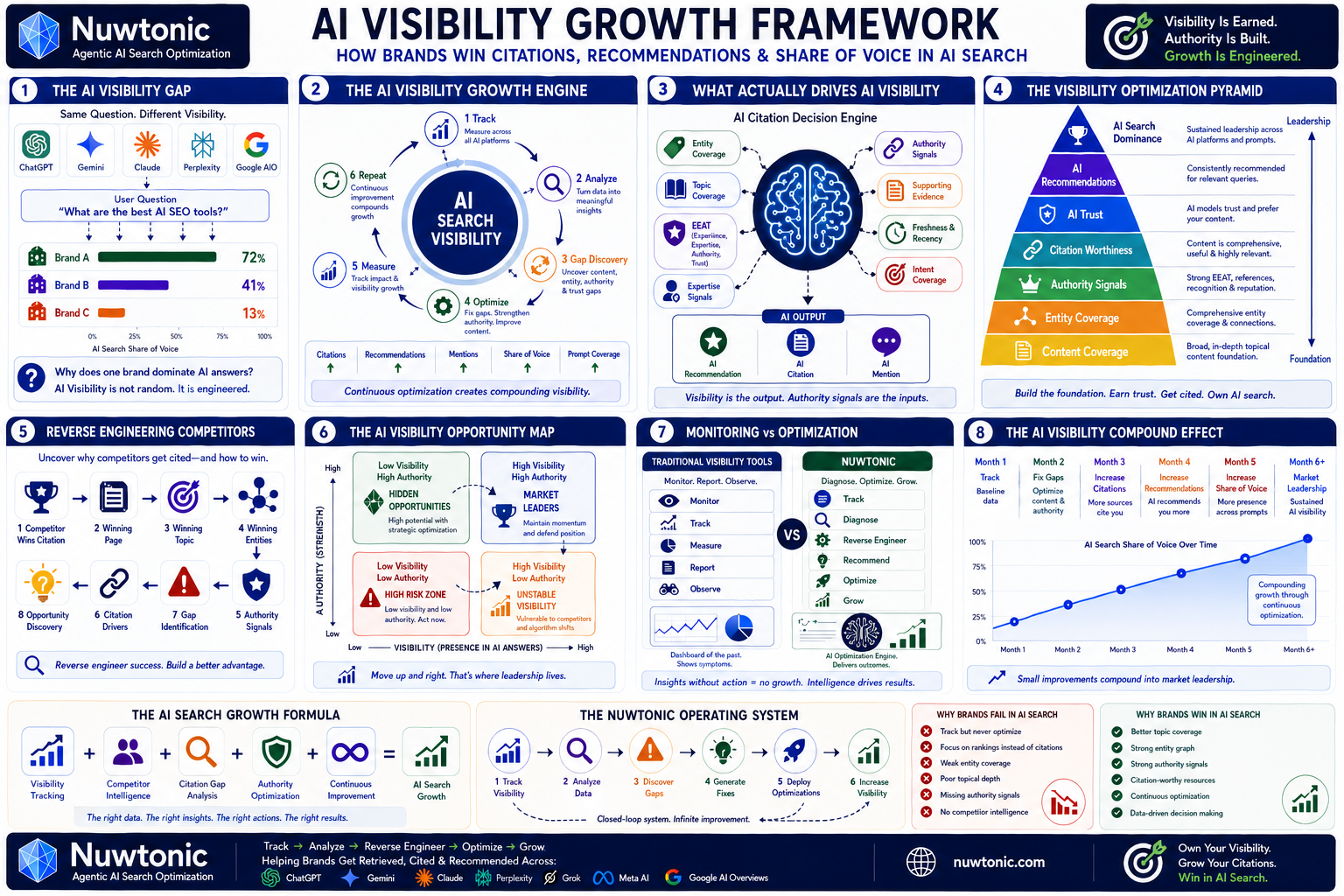
Many organizations approach AI visibility the same way they approach traditional SEO.
They publish content, wait for results, and hope AI systems eventually discover and recommend their brand.
Unfortunately, AI visibility rarely improves through passive publishing alone.
The organizations gaining visibility inside ChatGPT, Gemini, Claude, Perplexity, Grok, Meta AI, and AI Overviews typically follow a continuous optimization process.
A practical AI visibility strategy can be simplified into six stages.
1\. Track
You cannot improve what you do not measure.
The first step is understanding your current visibility across relevant AI platforms.
Monitor:
Brand mentions
Citations
Recommendations
Share of voice
Prompt coverage
Competitor visibility
The goal is to establish a baseline.
Without baseline visibility data, it becomes impossible to measure improvement.
2\. Analyze
Once visibility data is collected, the next step is understanding what the data actually means.
Questions to investigate include:
Which prompts generate visibility?
Which prompts do not?
Which competitors dominate recommendations?
Which AI platforms provide the most exposure?
Which pages receive citations?
Which pages never receive citations?
This stage turns raw visibility data into actionable insights.
3\. Identify Gaps
This is where many organizations stop—and where most visibility opportunities are discovered.
Instead of focusing only on outcomes, investigate the factors influencing those outcomes.
Common gaps include:
Content gaps
Entity gaps
EEAT gaps
Citation gaps
Topical authority gaps
Trust gaps
Semantic coverage gaps
For example:
If competitors are consistently cited for AI SEO prompts while your brand is absent, the underlying issue may not be visibility itself.
The issue may be missing topic coverage, missing entities, weak authority signals, or insufficient depth.
Identifying these gaps often produces the highest visibility gains.
4\. Fix
Once the root causes are understood, improvements can be prioritized.
Typical optimization activities include:
Expanding topic coverage
Strengthening topical authority
Adding missing entities
Improving content depth
Enhancing EEAT signals
Updating outdated information
Improving trust signals
Creating supporting content clusters
The goal is not simply publishing more content.
The goal is publishing the right content and improving the right pages.
5\. Measure
After changes are implemented, visibility performance should be monitored closely.
Track:
Citation growth
Recommendation growth
Prompt coverage growth
Share of voice improvements
Competitor movement
Visibility trends
Many visibility gains appear gradually over time rather than immediately.
Consistent measurement helps determine which optimizations are producing meaningful results.
6\. Repeat
AI search is not a one-time project.
AI models evolve.
Competitors publish new content.
Authority signals change.
New prompts emerge.
Visibility leaders continuously repeat the cycle:
Track
↓
Analyze
↓
Identify Gaps
↓
Fix
↓
Measure
↓
Repeat
Organizations that treat AI visibility as an ongoing process often outperform those relying on one-time optimization efforts.
The Difference Between Monitoring and Growth
Many companies spend months tracking visibility without improving it.
Tracking is valuable.
Growth happens when visibility data leads to action.
The most successful AI search strategies focus on understanding why visibility is missing and systematically addressing those gaps.
That is ultimately how citations, recommendations, and AI Search Share of Voice increase over time.
How To Reverse Engineer Competitors in AI Search
One of the fastest ways to improve AI visibility is studying brands that are already winning.
If ChatGPT, Gemini, Claude, Perplexity, or AI Overviews consistently recommend a competitor, there is usually a reason.
Rather than guessing what works, organizations can analyze the factors contributing to competitor visibility and uncover opportunities for improvement.
Step 1: Identify Competitors Dominating AI Results
Start by tracking the prompts that matter most to your business.
Examples:
Best AI SEO tools
Best CRM software
Best project management platforms
Best email marketing tools
Look for brands that appear repeatedly across AI responses.
These organizations often provide valuable clues about what AI systems currently trust.
Step 2: Identify Which Pages Drive Their Visibility
Many competitors generate most of their AI visibility from a relatively small number of pages.
Investigate:
Which pages are cited most often?
Which pages appear across multiple prompts?
Which content formats perform best?
In many cases, a handful of strategic pages generate a large percentage of AI citations.
Step 3: Analyze Winning Topics
Visibility is often driven by topic coverage rather than individual keywords.
Review:
Core topics competitors cover
Supporting topics
Related subtopics
Educational resources
Comparison content
Industry-specific content
Patterns quickly emerge.
You may discover entire topic areas your competitors cover that your website has never addressed.
Step 4: Analyze Entity Coverage
AI systems rely heavily on entities to understand context and expertise.
Examine:
Products mentioned
Technologies discussed
Industry concepts
Companies referenced
People referenced
Frameworks and methodologies
Strong entity coverage often helps AI systems connect a brand to a specific area of expertise.
Step 5: Analyze Authority Signals
Many competitors earn visibility because they demonstrate stronger authority.
Review:
Original research
Expert insights
Industry recognition
Supporting evidence
References and citations
Trust indicators
Authority signals frequently influence which brands AI systems choose to reference.
Step 6: Identify Citation Drivers
The next step is understanding what specifically makes competitors citation-worthy.
Ask:
Why are these pages being cited?
What information is unique?
What questions do they answer?
What supporting evidence do they provide?
What makes them more useful than alternatives?
These citation drivers often reveal opportunities for improvement.
Step 7: Discover Content Opportunities
Once competitor strengths are understood, gaps become easier to identify.
Look for:
Topics competitors have not covered deeply
Weak explanations
Missing examples
Outdated information
Unanswered user questions
These opportunities often represent the fastest path to increased visibility.
Step 8: Build Better Resources
The goal is not copying competitors.
The goal is creating more complete, useful, and trustworthy resources.
Focus on:
Better explanations
Stronger examples
More complete topic coverage
Better supporting evidence
Greater information depth
Improved user value
AI systems generally reward content that helps them generate better answers.
A Simple Competitor Visibility Framework
A practical competitor analysis workflow looks like this:
Competitor
↓
Winning Pages
↓
Winning Topics
↓
Winning Entities
↓
Authority Signals
↓
Citation Drivers
↓
Content Opportunities
↓
Optimization Roadmap
This framework helps transform competitor visibility data into actionable growth opportunities.
Rather than simply observing who is winning in AI search, organizations can understand why they are winning—and use those insights to improve their own visibility strategy.
Frequently Asked Questions About AI Visibility
Why is ChatGPT not citing my website?
ChatGPT may not cite your website if competitors provide stronger topical authority, more comprehensive content, better trust signals, stronger entity coverage, or more complete answers. In many cases, the issue is not visibility itself but the underlying content, authority, or citation gaps preventing AI systems from viewing your pages as trusted sources.
How do AI models choose sources?
AI systems evaluate multiple factors when generating answers, including topical authority, content quality, trust signals, entity coverage, relevance, freshness, and overall usefulness. Different AI platforms may weigh these factors differently, but most prioritize sources that help generate complete and trustworthy responses.
What is AI Citation Share?
AI Citation Share measures how often your brand, website, or content is cited compared to competitors across a defined set of AI prompts. A higher citation share generally indicates stronger authority and visibility within AI-generated search experiences.
What is AI Share of Voice?
AI Share of Voice measures the percentage of AI conversations where your brand appears compared to competitors. It is one of the most widely used metrics for evaluating AI search visibility.
What is an AI Visibility Score?
An AI Visibility Score is a metric used by visibility platforms to summarize overall visibility performance across tracked prompts, AI models, citations, recommendations, and mentions. Different platforms calculate this score using different methodologies.
How do I improve AI citations?
Improving AI citations typically involves increasing topical authority, strengthening EEAT signals, expanding entity coverage, improving content depth, filling content gaps, and creating resources that AI systems view as valuable and trustworthy.
How do I increase mentions in AI search?
To increase mentions, focus on creating authoritative content, covering topics comprehensively, improving brand authority, earning citations from trusted sources, and expanding visibility across the web. AI systems are more likely to mention brands they consistently encounter across relevant topics.
How do I track ChatGPT visibility?
ChatGPT visibility can be tracked using AI visibility monitoring platforms that evaluate prompt performance, brand mentions, citations, recommendations, and share of voice across a defined prompt set.
How do I track Gemini visibility?
Gemini visibility is typically measured by monitoring how frequently your brand appears, is cited, or is recommended within responses generated by Google's AI experiences and Gemini models.
What causes citation loss?
Citation loss can occur due to competitor improvements, content becoming outdated, reduced topical authority, missing entities, weaker trust signals, changes in AI models, or shifts in how AI systems evaluate and retrieve information.
How do I fix citation gaps?
The first step is identifying why competitors are being cited instead of your pages. Citation gaps often involve missing topics, missing entities, weak EEAT signals, insufficient depth, or poor topical coverage. Once identified, these gaps can be systematically addressed through content and authority improvements.
How do I analyze competitors in AI search?
Competitor analysis involves identifying which brands are cited most often, which pages drive visibility, which topics generate recommendations, and which authority signals contribute to AI visibility. This helps uncover opportunities for growth and differentiation.
How often should AI visibility be monitored?
AI visibility should be monitored continuously. AI models evolve, competitors publish new content, and visibility patterns change over time. Regular monitoring helps identify both opportunities and emerging risks.
What is the difference between GEO and AI visibility tracking?
AI visibility tracking measures how often your brand appears in AI-generated answers. GEO (Generative Engine Optimization) focuses on improving that visibility through content, authority building, optimization, and AI search readiness improvements.
Can AI visibility tracking increase traffic?
Visibility tracking itself does not increase traffic. However, the insights generated from visibility tracking can help organizations improve citations, recommendations, and visibility, which can ultimately influence traffic and brand discovery.
Can AI citations influence brand authority?
Yes. Frequent citations by AI systems can increase brand exposure, improve perceived authority, strengthen trust, and influence purchasing decisions during AI-assisted research and evaluation processes.
What is competitor AI intelligence?
Competitor AI intelligence involves understanding why competitors are being cited, recommended, and mentioned by AI systems. This includes analyzing their content, entities, topical authority, citations, trust signals, and AI visibility strategies.
What is AI recommendation tracking?
AI recommendation tracking measures how often AI systems actively recommend a brand, product, service, or website when users ask for suggestions, alternatives, comparisons, or purchasing advice.
How does Nuwtonic identify citation gaps?
Nuwtonic analyzes prompts, competitor citations, content coverage, entity coverage, EEAT signals, topical authority, trust signals, and content depth to identify why competitors are being cited and what improvements may help increase visibility.
How does Nuwtonic improve AI visibility?
Nuwtonic combines AI visibility monitoring, Citation Gap Analysis, Competitor AI Search Intelligence, AI Search Audits, optimization recommendations, and content generation workflows to help organizations improve their visibility across AI platforms.
Which AI platforms should businesses monitor?
Most organizations should monitor visibility across ChatGPT, Gemini, Claude, Perplexity, Grok, Meta AI, and Google AI Overviews because each platform may generate different recommendations and citations.
What is prompt coverage?
Prompt Coverage measures how many relevant prompts your brand appears for within a tracked prompt set. Strong prompt coverage indicates broad visibility across different stages of the customer journey.
What is AI citation optimization?
AI Citation Optimization is the process of improving the likelihood that AI systems will cite, reference, or recommend your content by addressing authority, content quality, entity coverage, trust signals, and topical relevance.
What is AI search visibility?
AI search visibility refers to how frequently a brand appears, is cited, or is recommended within AI-generated responses across platforms such as ChatGPT, Gemini, Claude, Perplexity, Grok, and AI Overviews.
Which metrics matter most in AI visibility tracking?
The most important metrics typically include:
AI Mentions
AI Citations
Recommendation Rate
Citation Share
Share of Voice
Prompt Coverage
Competitor Visibility
Visibility Trends
What is the biggest mistake companies make with AI visibility?
The most common mistake is focusing exclusively on tracking visibility without understanding why visibility is missing. Monitoring tells you what happened. Growth happens when organizations identify citation gaps, understand competitor advantages, and take action to improve visibility.