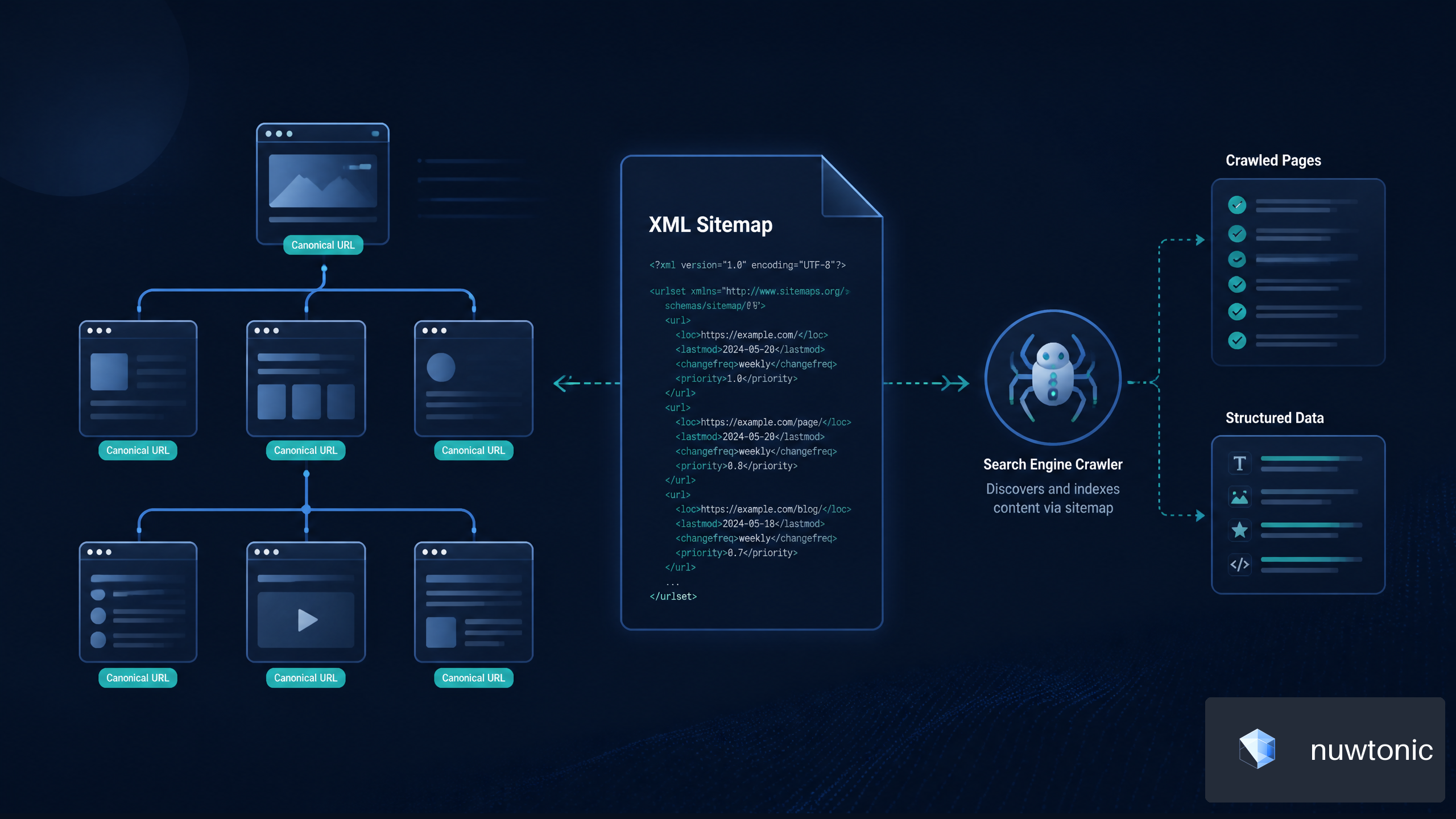

Claude doesn't rank pages, and it doesn't work like the other AI assistants either. Its baseline answers come straight from training data ,no live lookup at all , and when its web tool does fire, it pulls from Brave Search, not Google or Bing. That single detail breaks most teams' existing mental model: a page with strong Google authority can be functionally invisible to Claude if it isn't indexed well in Brave, and a rank tracker built around Google/Bing signal is measuring the wrong index entirely.
Anthropic isn't a rounding error anymore either — the company crossed a $30 billion revenue run-rate in early 2026 with roughly 30 million monthly active users on Claude, concentrated heavily in enterprise and developer workflows, which tends to be a high-intent, high-value audience to be invisible to.
Below are the 8 tools worth knowing for tracking and improving Claude visibility in 2026, starting with Nuwtonic, which — like the rest of this list — tracks Claude, but is built to also fix what's causing the gap rather than stop at reporting it.
Comparison Table
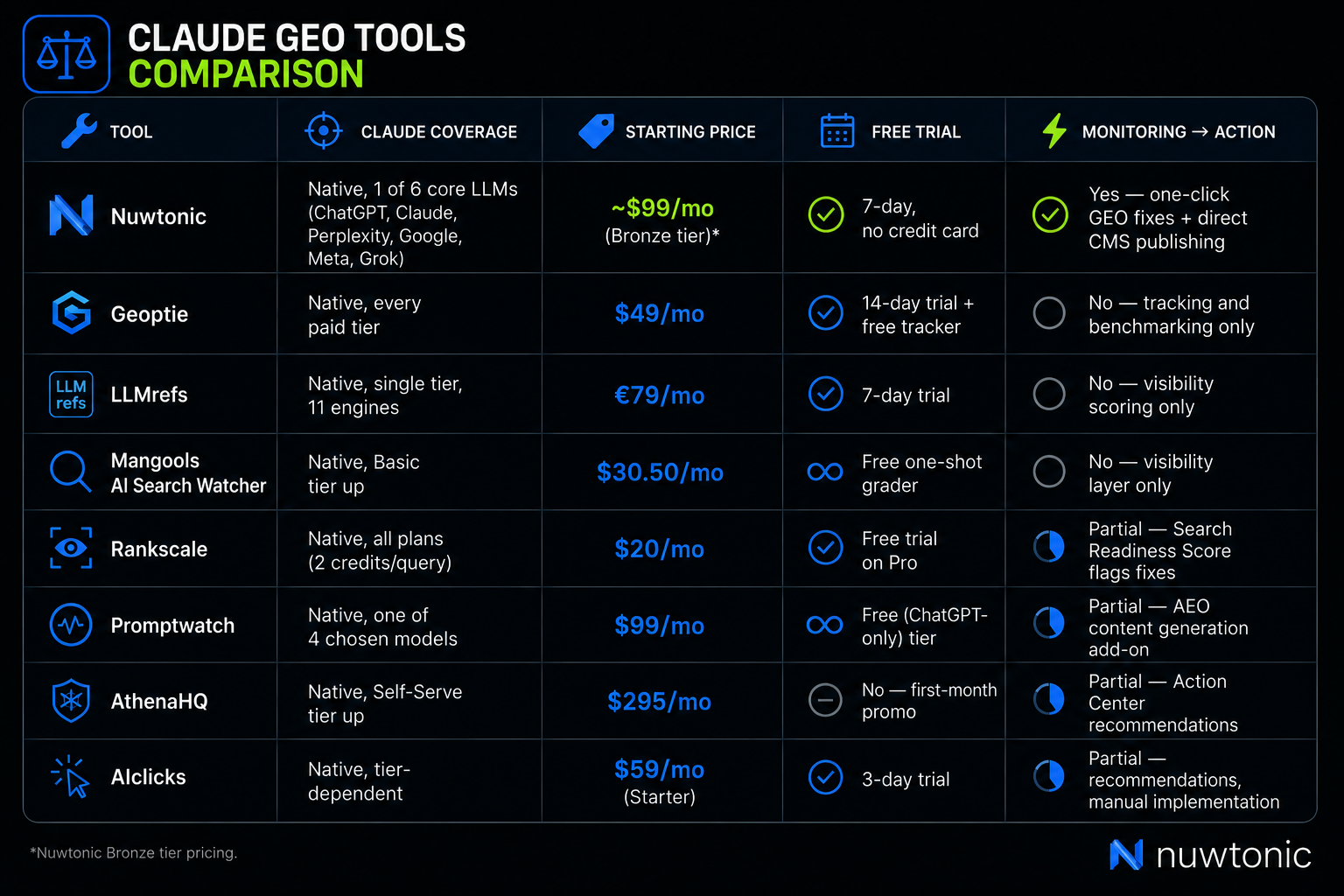
Tool | Claude Coverage | Starting Price | Free Trial | Monitoring → Action |
|---|---|---|---|---|
Nuwtonic | Native, 1 of 6 core LLMs (ChatGPT, Claude, Perplexity, Google, Meta, Grok) | ~$99/mo (Bronze tier)* | 7-day, no credit card | Yes — one-click GEO fixes + direct CMS publishing |
Geoptie | Native, every paid tier | $49/mo | 14-day trial + free tracker | No — tracking and benchmarking only |
LLMrefs | Native, single tier, 11 engines | €79/mo | 7-day trial | No — visibility scoring only |
Mangools AI Search Watcher | Native, Basic tier up | $30.50/mo | Free one-shot grader | No — visibility layer only |
Rankscale | Native, all plans (2 credits/query) | $20/mo | Free trial on Pro | Partial — Search Readiness Score flags fixes |
Promptwatch | Native, one of 4 chosen models | $99/mo | Free (ChatGPT-only) tier | Partial — AEO content generation add-on |
AthenaHQ | Native, Self-Serve tier up | $295/mo | No — first-month promo | Partial — Action Center recommendations |
AIclicks | Native, tier-dependent | $59/mo (Starter) | 3-day trial | Partial — recommendations, manual implementation |
Why People Look for a Claude Rank Tracker
Two tools can report wildly different Claude visibility numbers for the exact same brand, and both can be telling the truth — they're just measuring different things. That's the single biggest source of confusion in this category, and it's worth understanding before choosing a tool:
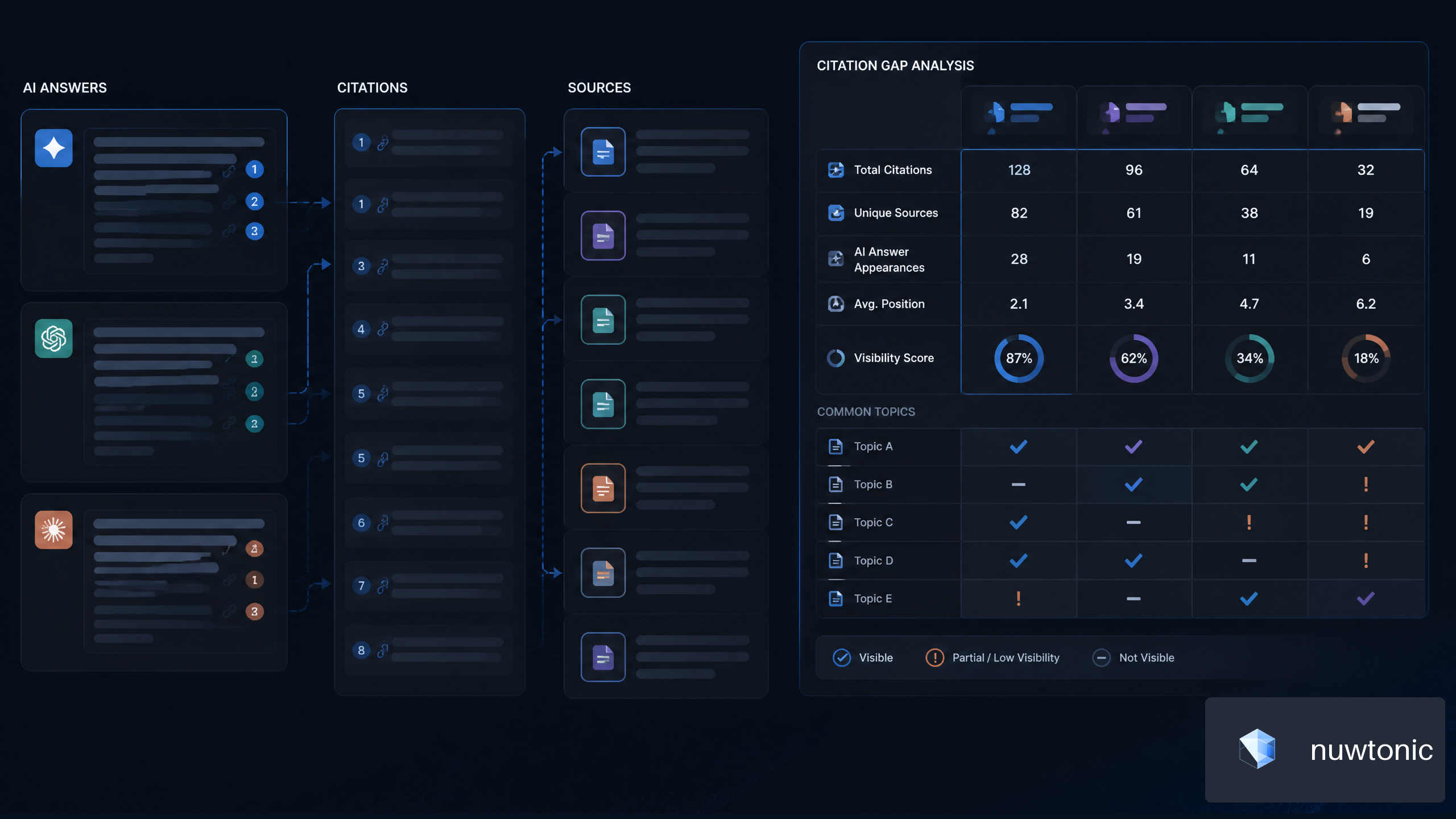
Citation and mention are different metrics, and the gap is unusually wide for Claude. Claude writes long, prose-heavy answers and frequently names a brand without dropping a link to it. A tool that only counts URL citations will systematically undercount real Claude visibility compared to one that also tracks brand mentions in the answer text.
Brave indexing is a layer most trackers never test. Strong Google rankings don't automatically translate into strong Brave Search coverage, and Claude's web tool reads from Brave when it fires. A brand can be well-optimized for Google and still be nearly invisible to Claude's retrieval layer.
Two separate crawlers matter, not one. ClaudeBot feeds Claude's training data; anthropic-ai feeds its live retrieval layer. Blocking either one in robots.txt — even by accident — cuts off a different part of Claude's visibility pipeline.
Monitoring without a path to action. As with most AI visibility tooling, the majority of the category tells you where you stand and stops there. Few tools connect a Claude visibility gap to an actual content or technical fix, and fewer still can publish that fix without a developer ticket.
None of this makes the tools below bad — Geoptie, LLMrefs, and Rankscale in particular have real, defensible tracking methodology. It just means the category has mostly stopped at "here's your data," which is exactly the gap an execution-first tool is built to close.
How We Evaluated
Criteria | Why it matters for Claude specifically |
|---|---|
Citation vs. mention tracking | Claude names brands without linking far more often than ChatGPT or Perplexity — tools that only track citations miss most of the real picture |
Brave Search awareness | Claude's web tool reads from Brave, not Google — a tracker that ignores this is measuring the wrong index |
Engine gating | Several tools in this category gate Claude behind an Enterprise tier rather than including it self-serve |
Monitoring → action | Whether the tool stops at a dashboard or helps you actually fix and publish |
Pricing transparency | Credit-based pricing (common here) can make Claude tracking cost more than the headline price suggests |
The 8 Best [Claude SEO](https://nuwtonic.com/blog/how-to-use-claude-ai-for-seo-11-strategies-prompts-and-limits) & Rank Tracking Tools
Nuwtonic — best for turning Claude visibility gaps into shipped fixes
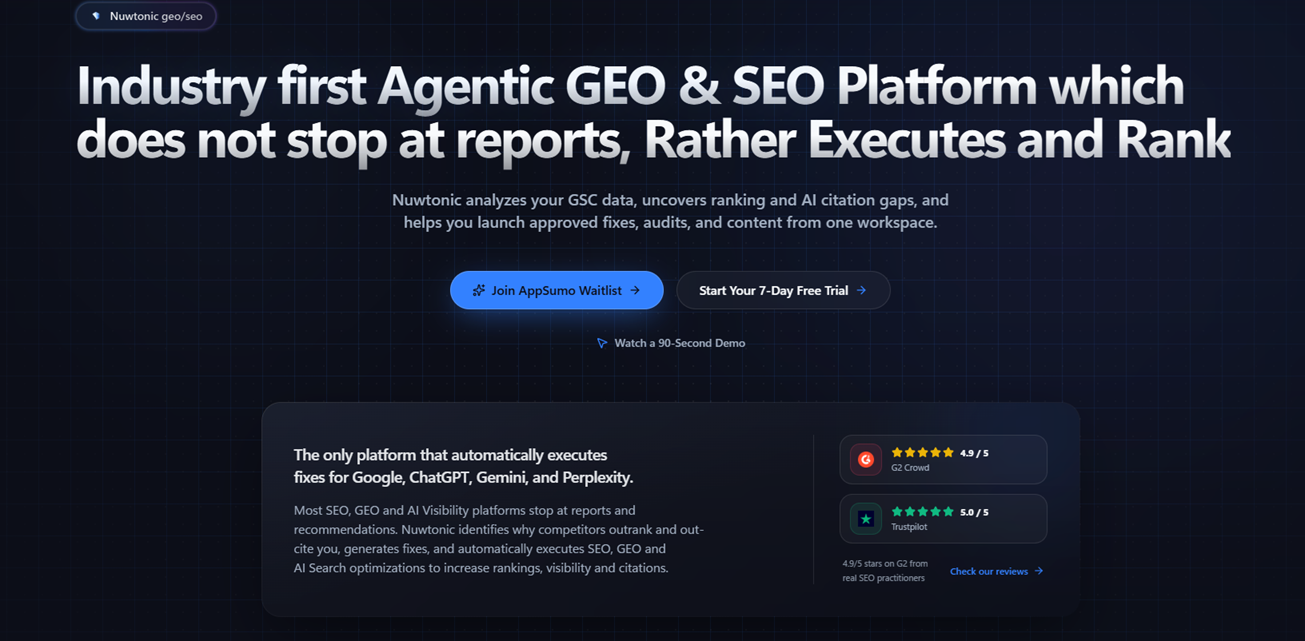
Nuwtonic tracks Claude as one of six core LLMs in its AI visibility module (alongside ChatGPT, Perplexity, Google, Meta AI, and Grok), so it isn't gated behind a premium tier or treated as an add-on — it's part of the same workspace from the start.
The differentiator is what happens after a gap is found. Nuwtonic's prompt tracking assigns funnel stage and commercial priority to tracked prompts, flags the specific URL losing citation credit in Claude's answers, and generates a one-click fix — entity, schema, or answer-first content restructuring — that you review and push directly to WordPress, Shopify, Webflow, or Ghost. A recursive optimization loop keeps re-checking as Claude's citation behavior shifts, instead of leaving your team to notice the next drop manually.
Pros:
Claude tracked natively alongside 5 other major LLMs in one workspace, not gated to a top tier
URL-level citation intelligence — see exactly which page earns (or loses) source credit
One-click GEO fixes with direct CMS publishing, not just a list of recommendations
Non-technical workflow — review and approve fixes without needing a developer
7-day free trial, no credit card required
4.9/5 on G2, 5/5 on Trustpilot
Cons / Limitations:
No dedicated ClaudeBot/anthropic-ai crawler-log analytics (a specialty of Scrunch) . Nuwtonic focuses on citation and content-level fixes rather than raw crawler-hit reporting
No backlink or domain-level competitive intelligence (Nuwtonic is built around GSC + AI visibility, so some teams pair it with a dedicated backlink tool)
Suitable use cases: Teams that don't want a Claude visibility report sitting in a shared drive waiting for someone to act on it — Nuwtonic is built so the fix happens in the same workflow as the detection.
Pricing: Plans start around $99/month (Bronze), scaling through Silver, Gold, Diamond, and Platinum tiers based on domains, prompt volume, and team seats — confirm current tier details at nuwtonic.com/pricing. 7-day free trial, no credit card required.
Geoptie — best multi-engine Claude tracking on a flat entry tier
Geoptie tracks Claude alongside ChatGPT, Perplexity, and Gemini on every paid plan starting at $49/mo — notable because most multi-engine competitors either gate Claude behind enterprise pricing or skip it entirely.
Pros:
Full Claude coverage from the $49 entry plan, not just higher tiers
Per-prompt citation and mention tracking with daily refresh
Sentiment scoring on every tracked Claude response
Free standalone Claude tracker available with no credit card
Cons:
Covers 4 engines total, fewer than AthenaHQ's 8 at its higher self-serve tier
No dedicated ClaudeBot crawler-log tracking
Sentiment scoring is less granular than Peec AI's (which specializes in this dimension, though Peec gates Claude to Enterprise)
Pricing: Starter $49/mo (15 prompts, 2 brands), Professional $99/mo (100 prompts, 10 brands), Enterprise $199/mo (400 prompts, unlimited brands).
LLMrefs — best value for broad engine coverage including Claude
LLMrefs takes a keyword-first approach: instead of manually writing prompts, it imports SEO keyword lists and auto-generates conversational prompt variations, then aggregates share-of-voice and citation data across them for statistical confidence. Claude is included in all 11 tracked engines on a single tier — no gating.
Pros:
Cheapest tool in this category that ships Claude without engine gating
Keyword-led methodology removes manual prompt-writing overhead
Geo-targeting across 50+ countries and 20+ languages, unlimited seats and projects
Cons:
Single-tier pricing hits a 500-prompt ceiling sooner than multi-tier platforms
Aggregated scoring is less granular than per-prompt drill-downs in Promptwatch
EUR-denominated pricing adds a small FX consideration for USD-only teams
Pricing: All in One — €79/mo, 500 prompts, all 11 engines. 7-day free trial.
Mangools AI Search Watcher — cheapest Claude tracking bundled with a full SEO suite
Mangools added Claude tracking to its existing SEO toolkit (KWFinder, SERPChecker, SERPWatcher, LinkMiner), shipping it on the entry Basic tier rather than gating it higher up.
Pros:
Cheapest paid bundle in this category once the broader SEO suite is factored in
Free one-shot AI Search Grader for a no-account Claude snapshot
Up to 500 prompts and unlimited monitors on Basic
Cons:
AI Search Watcher is bundle-only — no standalone purchase
Lighter sentiment and citation depth than dedicated AEO-first tools
Less suited as a long-term enterprise tracking solution
Pricing: Basic $30.50/mo (annual: $19.83/mo), Premium $40.50/mo, Agency $70.50/mo.
Rankscale — lowest paid floor, but budget for Claude's credit cost
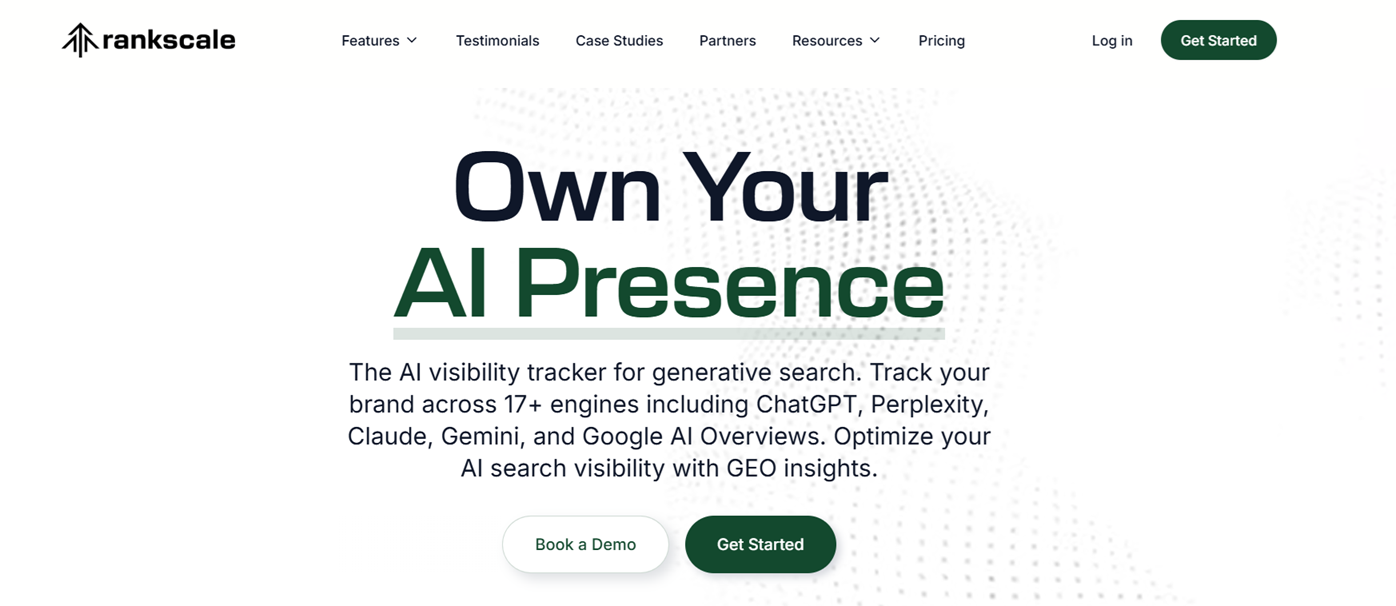
Rankscale includes Claude on its cheapest paid plan, but its credit-pool pricing charges Claude at roughly 8x the base rate per query (2 credits vs. 0.25 for ChatGPT, Gemini, or Perplexity), so a Claude-heavy tracking cadence burns through the credit pool faster than the headline price implies.
Pros:
Lowest paid floor in the category at $20/mo, with Claude included
Citation tracking and competitor benchmarking across 17+ engines
AI Search Readiness Score gives a prioritized, if manual, fix list
Cons:
Claude's 8x credit cost means usage forecasting takes real attention
Smaller ecosystem and team than more established platforms
No auto-fix or publishing layer — diagnostics stop at recommendations
Pricing: Essentials $20/mo, Pro $99/mo (1,200 credits), Growth/Enterprise custom.
Promptwatch — daily Claude refresh with MCP access at $99
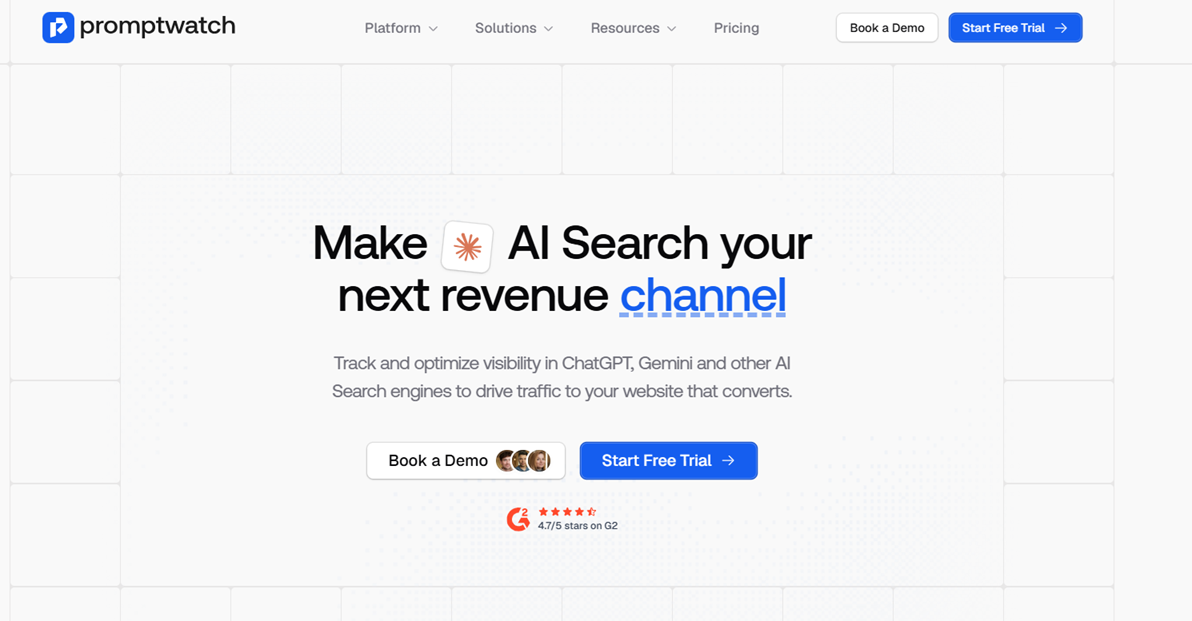
Promptwatch tracks Claude as one of four models you choose per plan (from nine supported engines), with daily refresh and Model Context Protocol (MCP) access starting at the $99 Essential tier — a feature rare at this price point.
Pros:
Claude on a $99 tier with daily refresh, uncommon at this price
AEO content-generation layer (5–30 articles/month by tier) included in the subscription
Country, state, and city-level geo-tracking depending on tier
Cons:
4-of-9 engine cap means tracking Claude trades against another engine on the same plan
Free tier is ChatGPT-only — no Claude without a paid plan
50 prompts on Essential is tight for a fully built-out prompt library
Pricing: Essential $99/mo, Professional $249/mo, Business $579/mo.
AthenaHQ — broadest self-serve engine list including Claude
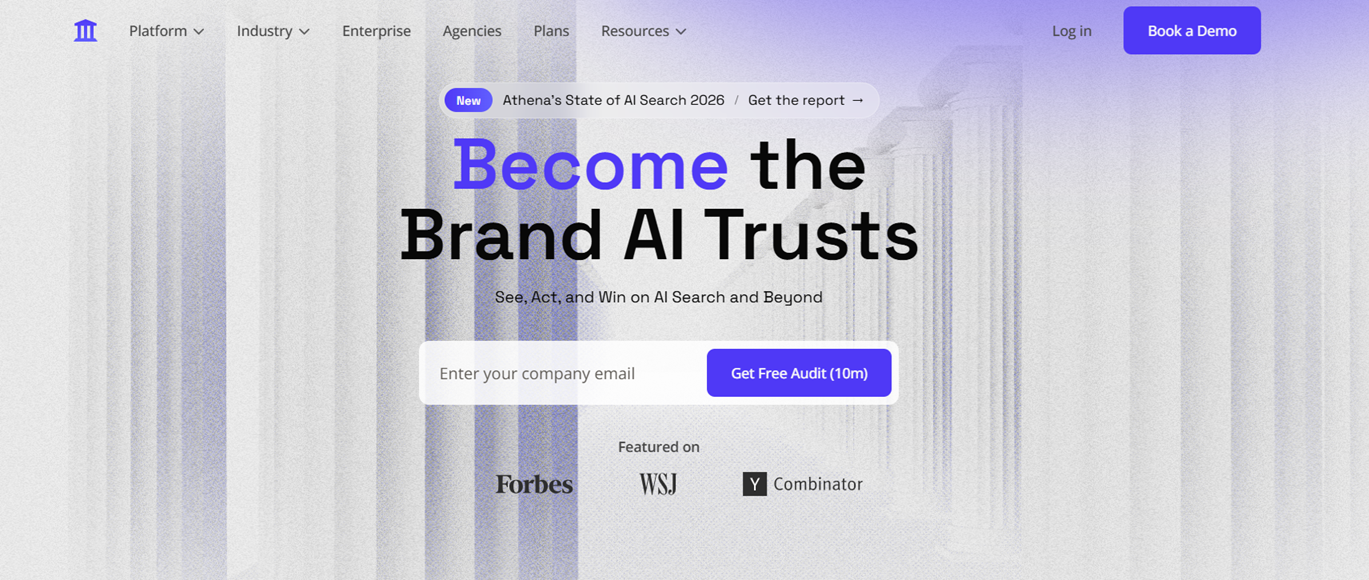
AthenaHQ includes Claude on its $295/mo Self-Serve tier alongside up to 8 total LLMs — one of the few tools in this category to include Claude self-serve at all rather than gating it to Enterprise. Pricing runs on a credit-pool model with a $300/month free credit allowance layered on top.
Pros:
Claude on a published-price, self-serve tier — broadest self-serve engine count (8) in this category
Unlimited seats with role-based access control even at the entry tier
Action Center recommendations plus AI blindspot and impersonation detection
Cons:
$295/mo is the highest published self-serve entry price in this comparison
Credit-based pricing makes usage forecasting harder than flat-rate plans
No free trial — a first-month promo functions as the substitute
Pricing: Self-Serve $295/mo (3,600 credits + $300/mo free allowance), Enterprise custom.
AIclicks — prompt-level Claude tracking with GA4 tie-in
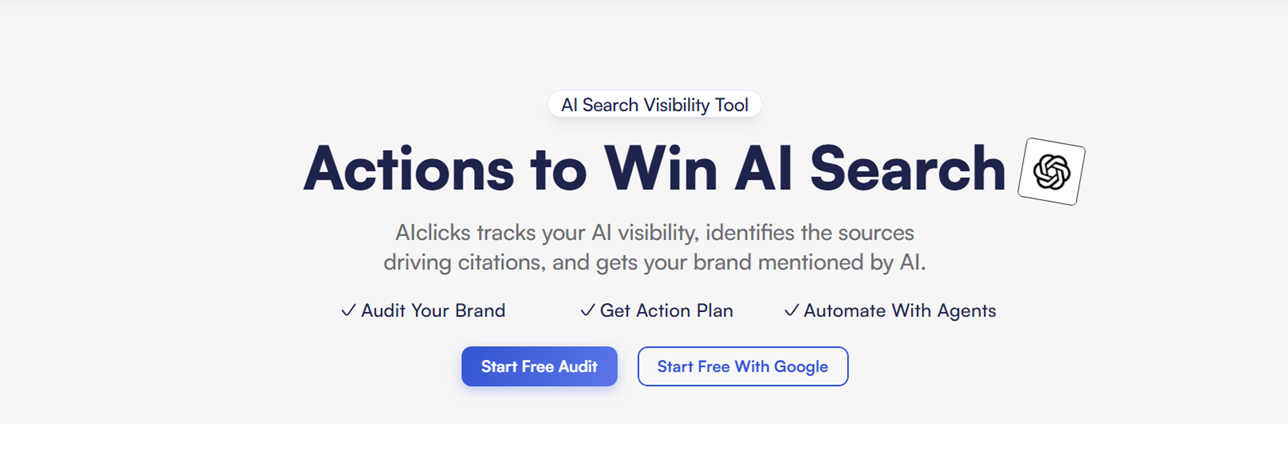
AIclicks tracks Claude alongside ChatGPT, Gemini, Perplexity, and more, with citation intelligence surfacing which domains get cited when Claude mentions your brand, plus GA4 integration to connect AI referral traffic to real site sessions.
Pros:
Prompt-level tracking with competitor extraction
GA4 integration linking Claude/AI visibility to real traffic data
Actionable recommendations built into the dashboard
Cons:
Starter plan ($59/mo) limits tracking to 3 AI platforms of your choice — Claude may compete with other engines for one of those slots
Only a 3-day trial window
Recommendations remain manual to implement — no CMS publishing layer
Pricing: Starter $59/mo (30 prompts, 3 LLMs), Pro $189/mo (150 prompts, 4 LLMs), Business $499/mo (300 prompts, 6 LLMs).
A Note on Tools That Gate Claude Behind Enterprise Pricing
Worth flagging before you shop: not every well-known AI visibility platform includes Claude on its published self-serve tiers. Scrunch — strong on named ClaudeBot/GPTBot/PerplexityBot crawler analytics — only unlocks Claude visibility on its custom-priced Enterprise tier; its published Core tier ($300/mo) covers four other engines but not Claude. Peec AI, which has some of the strongest sentiment-scoring depth in the category, caps self-serve engine selection at 3 of 7 non-Claude models, with Claude Sonnet available only via Enterprise API access. If either tool's specialty (crawler analytics or sentiment depth) is your primary need, budget for that Enterprise conversation; otherwise, the tools above ship Claude on a published, self-serve price.
Which Tool Should You Choose : When & Why ?
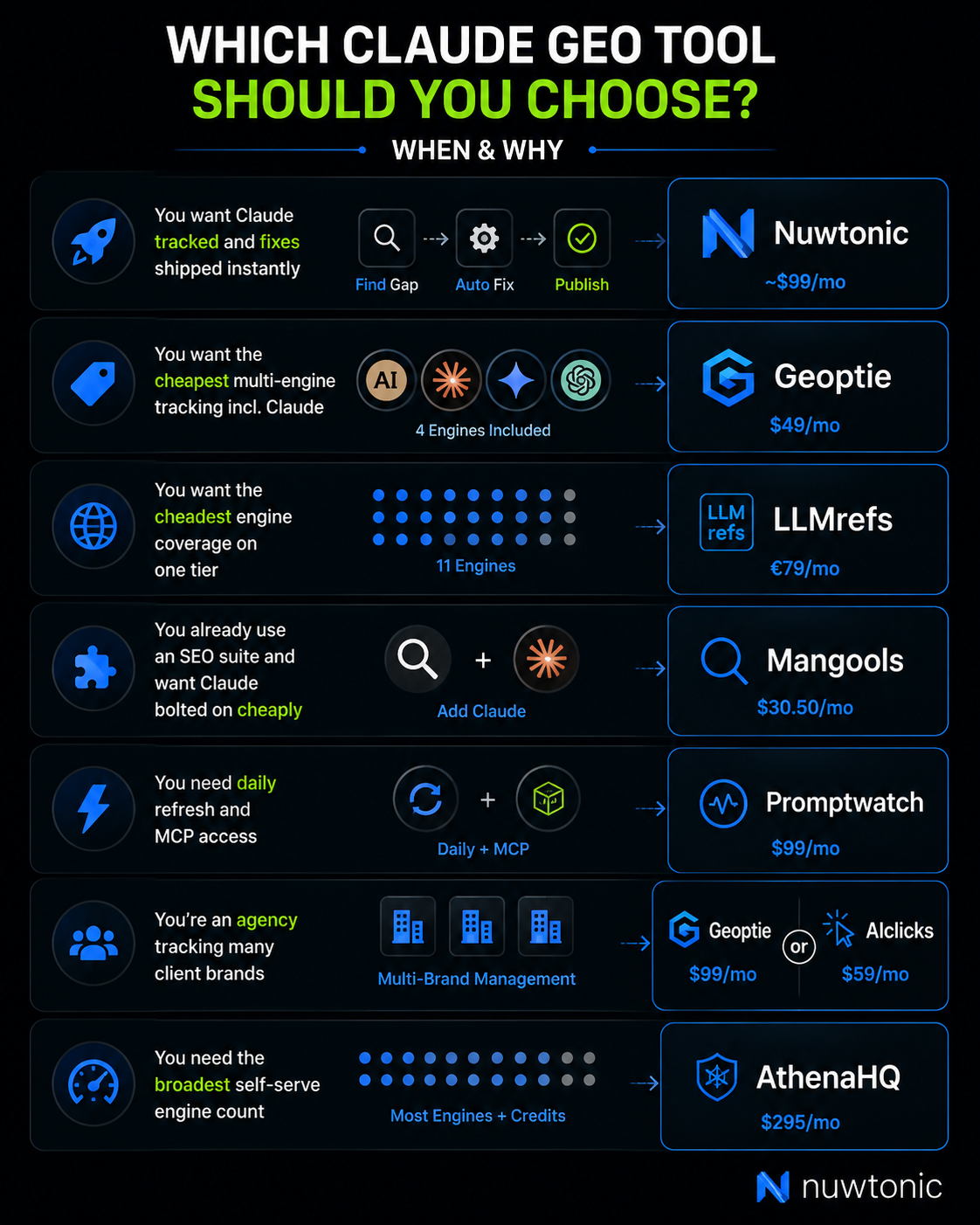
You want Claude visibility tracked and the fix shipped without a dev ticket → Nuwtonic. It's the only tool on this list where finding a citation gap and publishing the fix happen in the same workflow.
You want the cheapest multi-engine tracking that includes Claude by default → Geoptie, with Claude on the $49 entry tier alongside three other engines.
You want the broadest engine coverage on one tier without gating → LLMrefs, at €79/mo for 11 engines including Claude.
You already use a traditional SEO suite and want Claude bolted on cheaply → Mangools AI Search Watcher.
You need daily refresh and MCP access on a mid-tier budget → Promptwatch, accepting the 4-of-9 engine trade-off.
You're an agency tracking many client brands → Geoptie Professional (10 brand workspaces at $99/mo) or AIclicks.
You need the broadest self-serve engine count and can absorb credit-based pricing → AthenaHQ.
FAQ
**Does Claude actually cite sources the way Perplexity does?**
Less consistently, and in a way that specifically undercounts if you're only tracking links. Claude frequently names a brand in prose without dropping a citation link to it, which is why the gap between "brand-mention" tracking and "citation" tracking is wider for Claude than for any other major AI engine — two trackers measuring the same brand can report numbers that look nothing alike and both be accurate.
**Why doesn't my site show up in Claude even though I rank well on Google?**
Because Claude's web tool reads from Brave Search, not Google's index, when it fires — and strong Google rankings don't automatically translate into strong Brave coverage. A site can have years of Google-focused SEO work behind it and still be functionally invisible to Claude's retrieval layer if it was never optimized for or indexed well in Brave.
**Can blocking an AI crawler in robots.txt accidentally hurt my Claude visibility?**
Yes, and it's easy to do by accident because two separate crawlers are involved. ClaudeBot feeds Claude's training data, while a separate crawler, anthropic-ai, feeds its live retrieval layer — blocking either one in robots.txt cuts off a different part of the pipeline, so a robots.txt rule aimed at one can silently disable the other.
**How many people actually use Claude, and is it worth tracking?**
Anthropic crossed a $30 billion revenue run-rate in early 2026 with roughly 30 million monthly active users on Claude — smaller in raw user count than ChatGPT, but concentrated heavily in enterprise and developer workflows, which tends to be a higher-value audience per user than general consumer chat traffic.
**Can I use Google Search Console to see how I rank in Claude?**
No — GSC only reports on Google Search performance and has no visibility into Claude's training data or Brave-sourced retrieval, so there's no way to infer Claude visibility from GSC data even indirectly.
**Is it better to track Claude with a dedicated tool or rely on a bundled AI-visibility add-on inside my existing SEO software?**
It depends on whether Claude is included at all on the tier you can afford. Several general AI-visibility add-ons (including ones inside otherwise strong SEO suites) gate Claude behind their most expensive Enterprise tier rather than including it self-serve, so "we have an AI visibility feature" doesn't guarantee Claude is actually one of the tracked engines on your plan — always confirm Claude specifically, not just "AI search," is included before buying.
**What's the fastest way to start improving how Claude describes my brand?**
Start with structure, not volume: write answer-first sections where the first sentence of each block directly answers the implied question, use clear headings and schema markup so relationships between entities are explicit, and confirm you're indexed in Brave Search separately from Google, since that's the index Claude's web tool actually reads from when it decides to look something up live.
Final Thoughts
Claude's growth into a genuinely high-value, enterprise-heavy audience means it's no longer safe to treat it as an engine you'll "get to eventually." The category has real, well-built tracking tools now — the meaningful differences are whether a tool tests citation and mention separately, whether it accounts for Brave indexing at all, and whether Claude is available on a plan you can actually afford without an Enterprise sales call. The next differentiator, as with the rest of AI visibility tooling, is whether the tool stops at telling you the problem or actually helps you fix it.