Key Takeaways
The Shift is Real: Traditional keyword tracking on a standard SERP is no longer enough; e-commerce brands must optimize for conversational AI engines like ChatGPT Search, Gemini, and Perplexity.
Monitoring vs. Optimization: While most tools simply measure your AI Share of Voice (SoV), advanced platforms like Nuwtonic help you understand why your products aren't being recommended and how to fix those content gaps.
SKU-Level Precision: E-commerce requires tracking individual product SKUs, not just brand-level mentions, to drive actual revenue.
Structured Feeds & Offsite Authority: AI search engines rely heavily on clean product feeds, schema markup, and third-party review alignment to make recommendations.
TL;DR Summary
In 2026, the e-commerce buyer journey has shifted from traditional search engines to conversational AI shopping assistants. To stay visible, brands need specialized tools to measure and optimize their presence in AI-generated answers. This guide reviews the 10 best AI search visibility tools for e-commerce, highlighting Nuwtonic as the premier platform for actionable optimization workflows, alongside enterprise monitors like Profound and lightweight alternatives like Peec AI.
Table of Contents
• The Massive Shift in How Consumers Shop Online
• What Is an AI Search Visibility Tool for Ecommerce?
• Why AI Search Visibility Matters: High-Intent Shopping Prompts
• The Unique Challenges of Ecommerce AI Optimization
• What Makes Products Visible in AI Search?
• The 10 Best AI Search Visibility Tools for Ecommerce Brands (2026)
• Head-to-Head Feature Comparison
• How to Choose the Right AI Search Visibility Tool
• Frequently Asked Questions (FAQ)
• Sources and References
The Massive Shift in How Consumers Shop Online
The Death of the Traditional Search Funnel
For over a decade, the e-commerce playbook was simple—almost comforting in its predictability. A user had a problem, typed a keyword into Google, scanned a list of blue links, clicked through to a category page, filtered by price, and eventually landed on a product page to make a purchase. We obsessed over organic traffic, CTR, and keyword density.
But that traditional funnel is fracturing. Today, consumers are bypassing the search engine results page (SERP) entirely for high-intent queries. Instead of digging through pages of blog posts and category pages, they are asking conversational engines to do the heavy lifting for them. The journey has compressed from hours of manual research into a single, comprehensive AI prompt.
The Rise of the AI Shopping Agent
We have officially entered the era of the autonomous AI shopping agent. As highlighted in a recent Financial Times analysis of AI shopping agents, the rise of specialized AI agents is fundamentally transforming how e-commerce transactions are initiated and completed. These agents don't just find products; they compare specifications, read third-party reviews, analyze shipping policies, and present the shopper with a curated list of two or three highly tailored recommendations.
If your brand's SKUs aren't visible to these agents, you don't exist to the modern shopper. This is why having a dedicated ai search visibility tool for ecommerce brands has transitioned from a forward-looking experiment to an absolute survival requirement.
What Is an AI Search Visibility Tool for Ecommerce?
Defining the Core Metrics of AI Discovery
An AI search visibility tool uses artificial intelligence to analyze, measure, and optimize a brand’s presence across conversational search engines, identifying how visible its products are to users and uncovering critical content gaps. Unlike traditional SEO tools that rely on search volume and keyword rankings, these platforms evaluate how large language models (LLMs) interpret your brand's digital footprint.
You know what’s frustrating? Many e-commerce brands overlook the importance of AI in refining their search strategies—it’s not just a trend but a necessity now. I’ve spent over eight years helping brands optimize their digital presence, and I can tell you that optimizing for AI requires an entirely different vocabulary. You are no longer tracking "rankings"; you are tracking metrics like:
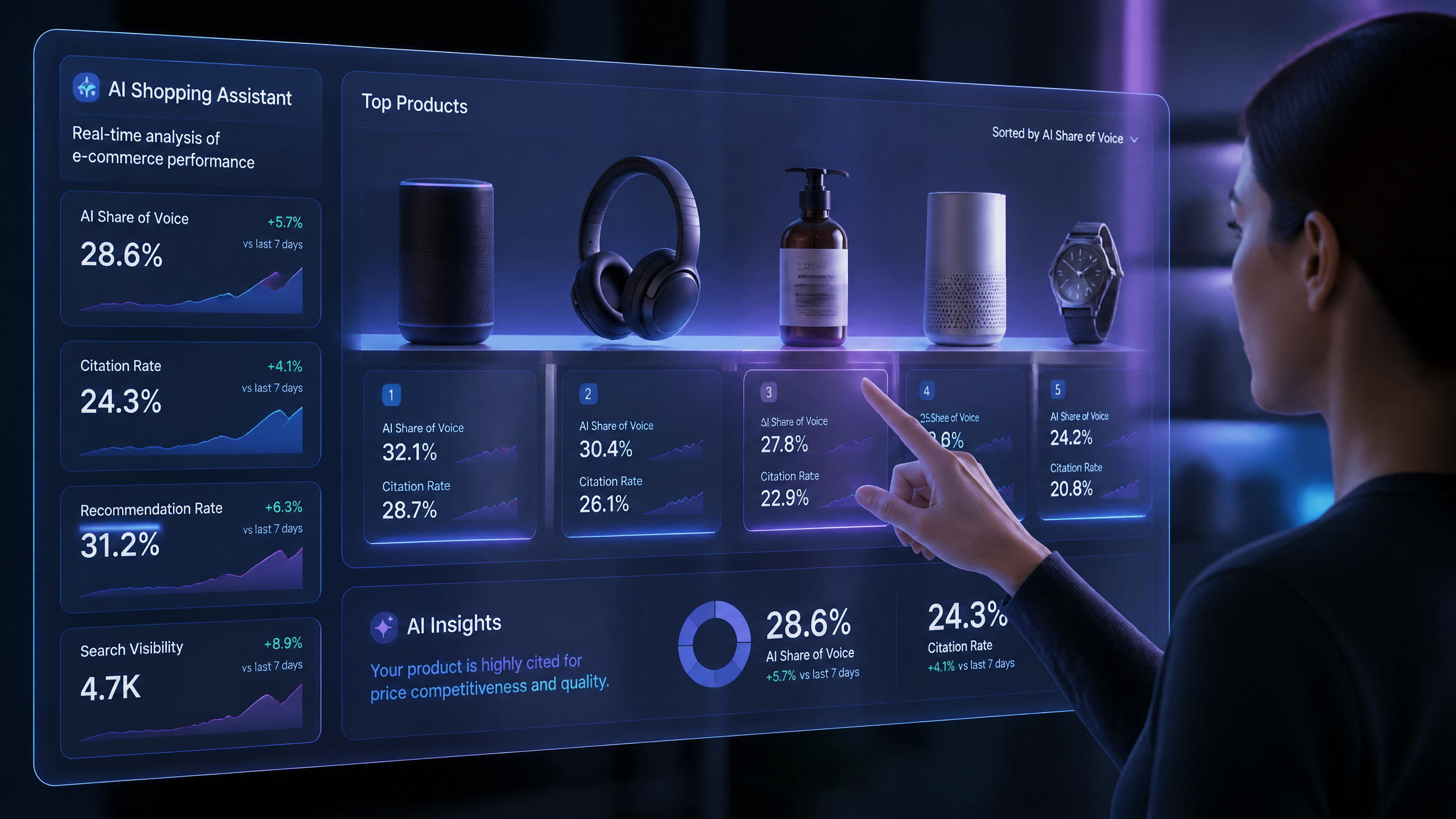
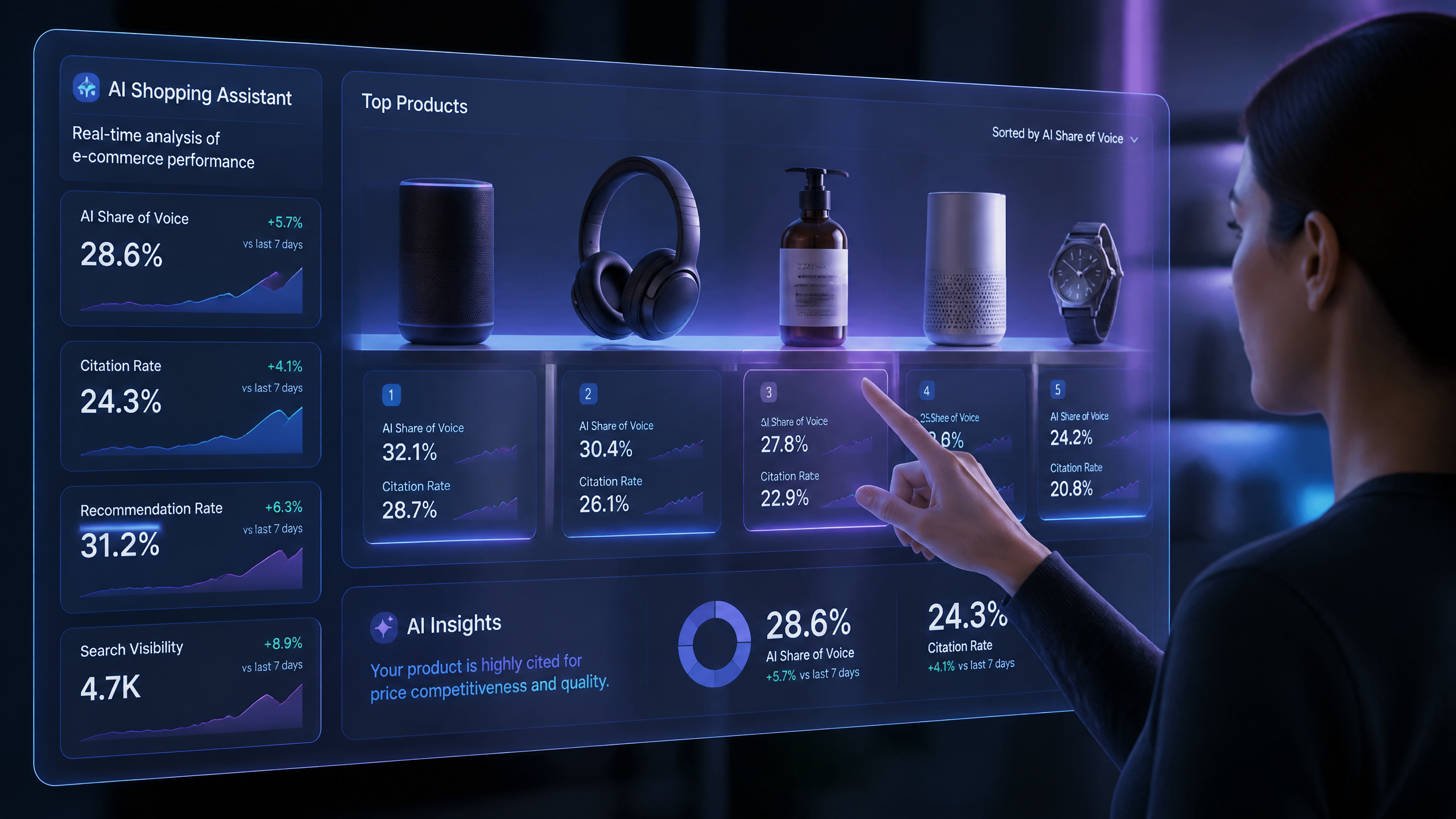
• AI Share of Voice (SoV): The percentage of chat-based queries in your category where your brand or specific SKUs are recommended.
• Citation Rate: The frequency with which an AI engine provides a clickable link back to your store to back up its recommendation.
• Offsite Sentiment Alignment: How closely the AI's summary of your brand matches actual third-party customer sentiment.
• SKU-Level Recommendation Depth: A measure of how many unique inventory items from your catalog are actively surfaced for specific user queries.
Type 1 vs. Type 2 AI Visibility Platforms
When shopping for a tool to solve this problem, you'll quickly realize the market is divided into two distinct philosophies. Understanding this distinction is crucial to avoiding a costly software mistake.
Feature | Type 1: AI Visibility Monitoring | Type 2: AI Search Visibility Optimization |
|---|---|---|
Primary Goal | Measure and report brand presence. | Explain why products are missing and how to fix it. |
Core Metrics | Mentions, Citations, Share of Voice. | Entity gaps, Buying guide gaps, Category authority. |
Actionability | Dashboards and reporting metrics. | Actionable optimization roadmaps and content generation. |
Target Audience | Executive leadership and PR teams. | E-commerce SEO managers and growth teams. |
Type 1 platforms are great for showing your board a pretty graph of your conversational market share. But if you actually want to change those numbers—which is where the real revenue is—you need a Type 2 platform like Nuwtonic that bridges the gap between analysis and automated execution.
Why AI Search Visibility Matters: High-Intent Shopping Prompts
Capturing the Bottom of the Funnel
Traditional search queries are often informational and broad ("mens running shoes"). Conversational prompts, however, are highly specific, contextual, and intensely transactional. Consider these examples of prompts that shoppers regularly feed into conversational engines:
• "What is the best gentle facial cleanser for sensitive, acne-prone skin under $30?"
• "Compare the Dyson V15 vs Shark Stratos—which is better for high-pile carpets and pet hair?"
• "I need a budget-friendly gaming mouse with at least 5 programmable buttons for a student."
These queries represent users who are at the very bottom of the purchasing funnel. They have their credit cards out; they just need the AI to validate their choice. If an AI engine recommends your competitor here, no amount of retargeting ads or high-budget PPC campaigns will win that customer back.
The Relationship Between AI Share of Voice and Revenue
I've seen too many businesses focus solely on paid ads when optimizing for organic search could yield better long-term results. As noted by industry reports, platforms like ChatGPT and Gemini actively recommend products for a shopper's specific needs, effectively merging product discovery and purchase assessment in a single conversational interface.
According to a Profound vs. AthenaHQ platform comparison, brands that actively monitor and optimize their AI Share of Voice experience a direct, measurable lift in first-party referral traffic and conversion rates. The traffic coming from a clickable citation in a ChatGPT recommendation has a significantly lower bounce rate and a higher average order value (AOV) because the customer has already been pre-sold by the AI's recommendation logic.
The Unique Challenges of Ecommerce AI Optimization
Managing Massive Product Catalogs and SKU Granularity
You know what’s frustrating? Most general-purpose AI tools track brand-level visibility but completely fail when it comes to tracking specific SKUs. If you run a DTC apparel brand with 5,000 product variants, knowing that your brand is "visible" for the query "best clothing brands" is practically useless. You need to know if your "Men's Waterproof Trail Runner - Size 11 - Blue" is being recommended when someone asks for a durable, water-resistant hiking shoe.
Managing this level of SKU-level recommendation depth requires massive, systematic prompting of LLMs. You have to simulate hundreds of thousands of hyper-specific shopper queries to reveal visibility gaps that manual checking or basic SEO tools would completely miss.
Fighting the "Hallucination" Overload and Data Inconsistency
Another major headache for e-commerce managers is data accuracy. LLMs are notorious for hallucinating. A general AI tracking tool might flag that your brand was "mentioned" in a response, only for you to realize upon manual inspection that the AI completely hallucinated a product name or linked to a dead competitor's page.
Furthermore, AI models are updated constantly. A prompt that recommends your product on Monday might return your competitor's product on Wednesday because of a minor model weights update or a fresh scrape of third-party review sites. Without a tool that continuously monitors these shifts across multiple engines (ChatGPT Search, Gemini, Claude, Perplexity, and Grok), you are essentially flying blind.
What Makes Products Visible in AI Search?
Technical Infrastructure and Structured Product Feeds
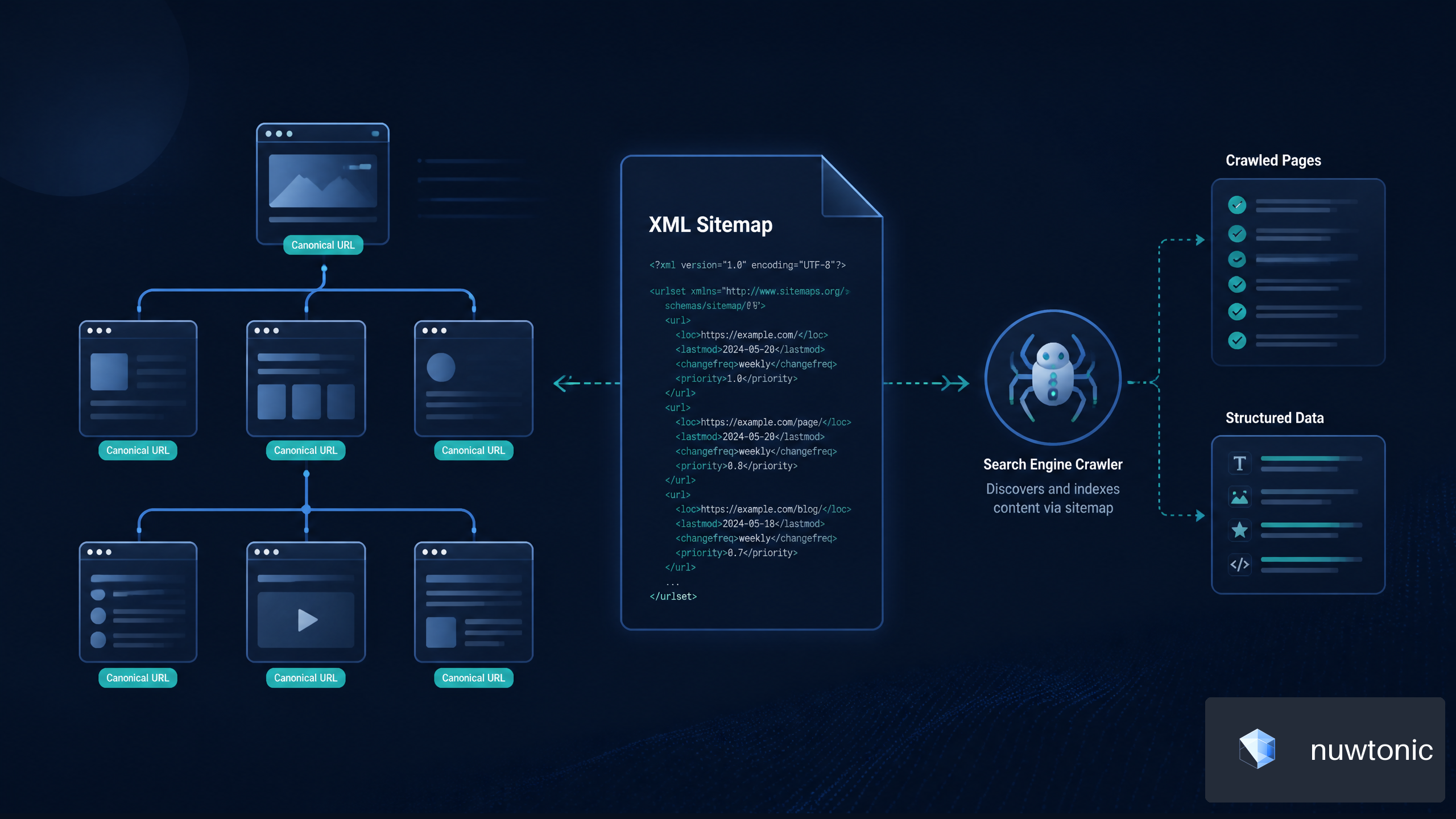
If you want AI shopping engines to recommend your products, you have to make it incredibly easy for them to read and understand your store's data. This starts with your technical infrastructure—specifically your schema markup and product feeds.
AI models don't read your website the way humans do; they parse structured data to extract product attributes like price, availability, material, dimensions, and customer ratings. Advanced platforms are even beginning to expose this data via Model Context Protocol (MCP) servers, allowing AI shopping agents to pull real-time inventory and pricing details directly from your database. If your schema is broken, or if your product feed lacks rich, semantic attributes, the AI will simply pass you over for a competitor who made their data easier to ingest.
Offsite Sentiment and Brand Authority Signals
Here’s what NOT to do: do not assume that writing great product descriptions on your own site is enough to win the AI search game. LLMs are trained on the entire web, which means they cross-reference your self-proclaimed product benefits with third-party reviews, Reddit threads, YouTube roundups, and digital publications.
If your product page claims your blender is "whisper-quiet," but fifty Reddit comments on r/appliances complain that it sounds like a jet engine, the AI will synthesize that sentiment and advise shoppers against buying your product. To build true category authority, you must monitor your offsite sentiment alignment and actively build high-quality citations across the digital ecosystem.
The 10 Best AI Search Visibility Tools for Ecommerce Brands (2026)
1\. Nuwtonic
Overview
Nuwtonic is the premier enterprise AI search visibility and optimization platform designed specifically for high-growth e-commerce brands and digital agencies. Unlike traditional trackers that simply report on your visibility, Nuwtonic functions as an active optimization engine. It combines advanced multi-platform AI tracking with agentic GEO (Generative Engine Optimization) to automate the analysis of your SEO issues and execute fixes directly within your workflow.
Best For
Shopify stores, enterprise e-commerce brands, DTC retailers, and digital marketing agencies looking to drive measurable revenue from conversational search.
Why It Stands Out
Nuwtonic doesn't just ask, "Were we recommended?" It answers, "Why weren't we recommended, and what exact content do we need to build to fix it?" It bridges the gap between tracking and execution, allowing you to run comprehensive AI search audits, identify missing product entities, and automatically generate optimized product descriptions, buying guides, and comparison pages that get cited by LLMs.
Core Ecommerce Features
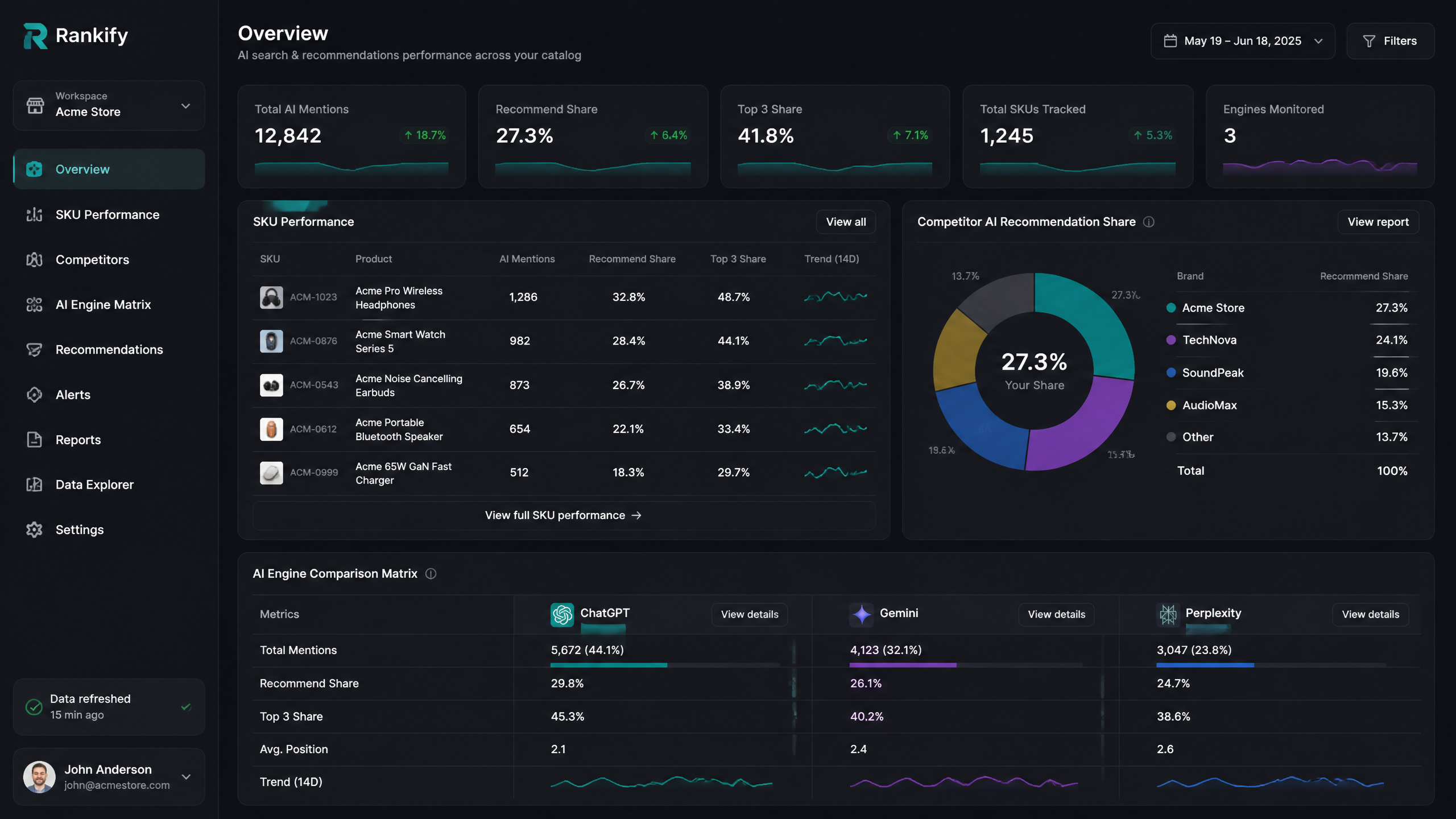
• Multi-Platform AI Visibility: Track product mentions, recommendations, and AI Share of Voice across ChatGPT Search, Gemini, Claude, Perplexity, Grok, and Meta AI in a single unified dashboard.
• AI Citation Gap Analysis: Instantly identify missing product attributes, semantic relationships, and trust signals that prevent AI engines from citing your URLs.
• Ecommerce AI Search Audit: Run deep audits on your product pages, collection pages, and category pages to evaluate their AI readiness and semantic completeness.
• Product Entity Intelligence: Map out your product specifications, compatibility details, and use cases to build a robust product entity graph that LLMs can easily parse.
• Competitor Product Intelligence: Reverse-engineer competitor product pages, buying guides, and review sentiment to understand why they are winning the AI Share of Voice.
• AI Search Optimization Engine: Seamlessly generate and deploy optimized content updates to fix technical SEO issues, enrich product feeds, and expand category authority.
Pros
• Actionable optimization workflows that go far beyond basic monitoring.
• Seamless integration with Google Search Console data to streamline analysis.
• Robust SKU-level tracking for complex, multi-variant product catalogs.
• Automated content generation with a strict user-review and approval process.
Cons
• The extensive feature set may require a brief learning curve for smaller teams.
Ideal For
Brands that want to actively increase their AI product recommendations and build long-term organic authority rather than just tracking vanity metrics.
2\. Profound
Overview
Profound is a highly regarded enterprise-grade AI visibility monitoring platform. It is designed for large brands that need deep, high-volume data on how their products are positioned across conversational search engines and AI shopping assistants.
Best For
Fortune 500 e-commerce brands and global enterprise marketing teams.
Why It Stands Out
Profound excels at high-level competitive benchmarking and market share analysis. It offers robust dashboards that track how often your brand is mentioned across various LLM shopping triggers, helping enterprise teams understand their overall market positioning.
Pros
• Exceptional enterprise-scale data processing and reporting.
• Detailed competitive benchmarking across multiple industries.
• High-quality visualization tools for executive reporting.
Cons
• Highly focused on monitoring; optimization and content generation workflows are relatively narrow.
• Enterprise pricing can be prohibitive for mid-market DTC brands.
3\. Peec AI
Overview
Peec AI (often styled as PEeC AI) is a specialized tool that focuses heavily on tracking brand mentions, citations, and links across a wide array of LLMs, including ChatGPT, Perplexity, Gemini, Llama, DeepSeek, and Claude.
Best For
Growth marketing teams and digital agencies looking for a dedicated solution to monitor offsite citations.
Why It Stands Out
Peec AI is incredibly efficient at highlighting the exact sources and third-party websites that AI engines use to back up their recommendations, making it a valuable asset for digital PR and citation-building campaigns.
Pros
• Supports a wide range of open-source and proprietary models.
• Excellent link-tracking and citation-source analysis.
• Clean, intuitive user interface.
Cons
• Lacks deep, automated on-page optimization workflows.
• Limited SKU-level catalog enrichment capabilities compared to dedicated e-commerce platforms.
4\. Scrunch AI
Overview
Scrunch AI is an enterprise-focused AI visibility platform designed to help large-scale retailers monitor their digital shelf space within generative search engines.
Best For
Multi-brand retailers and marketplace managers.
Why It Stands Out
Scrunch AI provides clear visibility into how different product categories are performing across conversational interfaces, allowing brands to monitor their overall category dominance.
Pros
• Strong focus on enterprise category tracking.
• Reliable automated reporting schedules.
• Solid competitor visibility tracking.
Cons
• Limited actionable insights for on-site content optimization.
• Can feel overly complex for single-brand DTC stores.
5\. AthenaHQ
Overview
AthenaHQ is a growth-focused platform designed to help mid-market e-commerce brands navigate the emerging world of Generative Engine Optimization (GEO).
Best For
Mid-market DTC brands looking to establish a baseline AI presence.
Why It Stands Out
AthenaHQ offers user-friendly GEO workflows that guide marketing teams through the process of updating their content to be more AI-friendly.
Pros
• Accessible interface with clear, step-by-step optimization suggestions.
• Reliable tracking of brand-level trends across major LLMs.
• Good integration options for standard e-commerce platforms.
Cons
• Focuses heavily on brand-level trends rather than deep, SKU-level product attribute optimization.
• Data refresh rates can lag during periods of rapid model updates.
6\. Semrush
Overview
Semrush, a titan in the traditional SEO space, has expanded its suite to include specialized AI visibility monitoring tools, allowing brands to track their market share within generative answer engines.
Best For
Marketing teams already heavily invested in the Semrush ecosystem.
Why It Stands Out
Semrush's AI Toolkit provides dashboard-level information on a brand's market share within LLM responses across 10 major AI answer engines, integrating this data alongside your traditional organic search metrics.
Pros
• Consolidates traditional SEO and AI search metrics in one platform.
• Access to Semrush's massive, industry-leading keyword database.
• Great for high-level competitive landscape mapping.
Cons
• AI tracking is an add-on, not the platform's core DNA.
• Lacks the deep product feed and SKU-level optimization required by complex e-commerce brands.
7\. Ahrefs
Overview
Ahrefs is another traditional SEO powerhouse that has introduced features to help webmasters monitor their performance in AI-driven search features like Google AI Overviews.
Best For
Technical SEO specialists who rely heavily on backlink analysis.
Why It Stands Out
Ahrefs is unmatched in tracking the backlink and citation profiles of the websites that AI engines frequently reference, helping you identify high-authority digital PR targets.
Pros
• World-class backlink and link-graph database.
• Reliable tracking of Google AI Overview citations.
• Deep technical site audit capabilities.
Cons
• Does not offer direct, automated content generation or product feed enrichment.
• Interface can be overwhelming for non-technical e-commerce managers.
8\. Otterly AI
Overview
Otterly AI is a lightweight, agile monitoring tool designed specifically to track brand mentions and sentiment across conversational search engines.
Best For
Boutique DTC brands and PR agencies.
Why It Stands Out
Otterly AI provides a cost-effective, straightforward way to monitor brand sentiment and alert your team whenever your products are recommended or criticized in AI chats.
Pros
• Highly affordable pricing tiers for smaller brands.
• Simple, clean dashboard focused on brand mentions.
• Real-time sentiment tracking alerts.
Cons
• Lacks the enterprise-grade SKU tracking needed for large catalogs.
• No advanced content optimization or gap analysis tools.
9\. Similarweb
Overview
Similarweb is a global leader in digital market intelligence, offering robust insights into referral traffic patterns, including traffic originating from AI search engines.
Best For
Market researchers and enterprise strategists.
Why It Stands Out
Similarweb excels at showing you the actual traffic volume coming to your site (and your competitors' sites) from platforms like ChatGPT and Perplexity, helping you separate vanity mentions from real revenue-driving traffic.
Pros
• Unmatched referral traffic and digital intelligence data.
• Clear mapping of user journey pathways from AI engines to purchases.
• Deep competitive traffic analysis.
Cons
• Does not offer on-page optimization or content creation tools.
• Focuses on macro-level traffic trends rather than micro-level SKU optimizations.
10\. Conductor
Overview
Conductor is an enterprise organic marketing platform that has built out advanced search intelligence features to help brands monitor their visibility in Google AI Overviews.
Best For
Large corporate marketing departments and enterprise e-commerce retailers.
Why It Stands Out
Conductor integrates deep search intent data with AI visibility metrics, helping content teams write comprehensive buying guides that align with what LLMs are looking for.
Pros
• Excellent workflow management and team collaboration tools.
• Strong integration with enterprise web analytics platforms.
• High-quality content brief generation.
Cons
• Primarily focused on enterprise SEO workflows rather than agile DTC execution.
• Does not offer automated, agentic site fixes like Nuwtonic.
Head-to-Head Feature Comparison
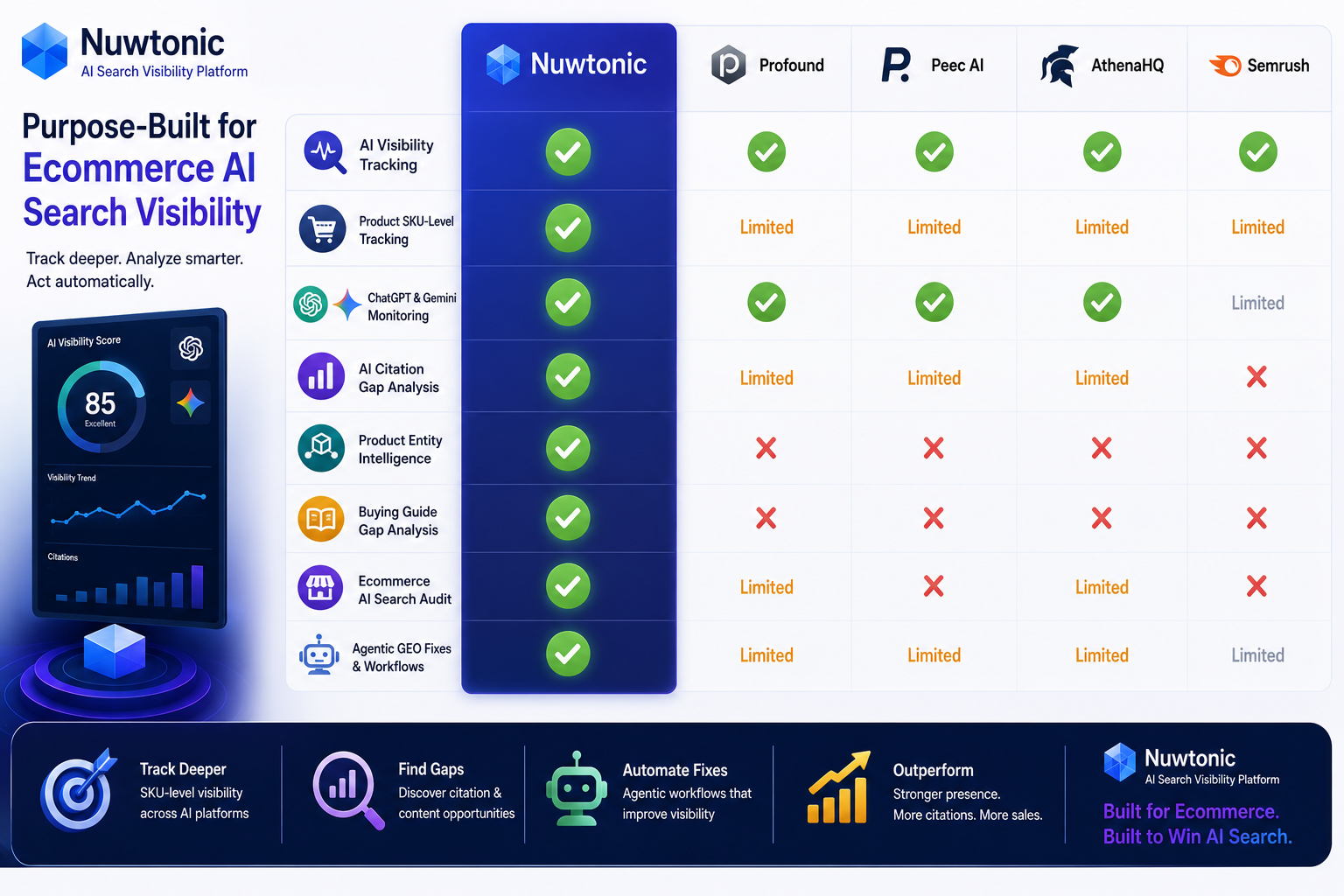
Feature Breakdown Matrix
To help you visualize how these tools stack up against each other, we have compiled a detailed comparison matrix of the top five platforms, as evaluated in NBound Marketing's GEO software feature comparison and our own practitioner testing.
Capability | Nuwtonic | Profound | Peec AI | AthenaHQ | Semrush |
|---|---|---|---|---|---|
AI Visibility Tracking | ✓ | ✓ | ✓ | ✓ | ✓ |
Product SKU-Level Tracking | ✓ | Limited | Limited | Limited | Limited |
ChatGPT & Gemini Monitoring | ✓ | ✓ | ✓ | ✓ | Limited |
AI Citation Gap Analysis | ✓ | Limited | Limited | Limited | ✗ |
Product Entity Intelligence | ✓ | ✗ | ✗ | ✗ | ✗ |
Buying Guide Gap Analysis | ✓ | ✗ | ✗ | ✗ | ✗ |
Ecommerce AI Search Audit | ✓ | Limited | ✗ | Limited | ✗ |
Agentic GEO Fixes & Workflows | ✓ | Limited | Limited | Limited | Limited |
Analyzing Capability Gaps Across Platforms
When you analyze the matrix above, the gap between simple monitoring and active optimization becomes glaringly obvious. Most traditional tools stop after they show you a chart of your AI Share of Voice. This is equivalent to an SEO tool telling you that you rank on page 5 of Google, but offering zero guidance on how to get to page 1.
Nuwtonic stands out because it is built from the ground up to address the specific, granular needs of e-commerce. It is the only platform that combines SKU-level tracking with product entity intelligence and buying guide gap analysis, allowing your team to immediately execute the exact content changes required to win recommendations.
How to Choose the Right AI Search Visibility Tool
A Decision Tree for Ecommerce Brands
To simplify your selection process, follow this straightforward decision pathway based on your brand's current size, catalog complexity, and strategic goals:
Are you looking solely for high-level, macro brand monitoring and corporate reporting?
• Yes: Choose Profound or Similarweb.
• No: Move to Step 2.Do you have a small catalog (under 50 SKUs) and just want to track brand mentions on a budget?
• Yes: Choose Peec AI or Otterly AI.
• No: Move to Step 3.Do you need to track specific, multi-variant SKUs, identify exact content gaps, and automatically deploy content optimization workflows to increase your sales?
• Yes: Choose Nuwtonic.
Critical KPIs Your Team Must Track
If you want to measure the success of your AI search optimization campaigns, you need to look beyond raw traffic. Establish a dashboard tracking these critical e-commerce KPIs:
• Product Recommendation Share: The percentage of category queries where the AI recommends your specific SKU over a competitor's.
• Clickable Citation Rate: The percentage of AI recommendations that include a direct, clickable link back to your product detail page (PDP).
• Entity Completeness Score: A technical metric evaluating how well your product attributes (specs, compatibility, materials) are defined in your schema markup.
• Comparison Prompt Coverage: Your brand's visibility in structured "vs" queries (e.g., "Your Brand vs. Competitor").
• First-Party AI Referral Revenue: Attributed revenue generated directly from users clicking through from conversational search engines.
Common Mistakes to Avoid (Here’s what NOT to do...)
In my experience, e-commerce brands make the same critical mistakes when first entering the world of AI search. Here’s what NOT to do if you want to protect your organic traffic:
• Do not track only branded prompts: It is easy to feel good because ChatGPT recommends your product when someone types your brand name. But the real revenue is won when you appear in unbranded, high-intent category queries like "best waterproof trail runners."
• Do not ignore comparison pages: AI models love citing comparison tables and buying guides. If your site doesn't have dedicated "alternative to" or "vs" pages, the AI will pull that data from third-party sites that you cannot control.
• Do not treat AI search like traditional SEO: Flooding your product descriptions with repetitive keywords (keyword density) will actually hurt your AI visibility. LLMs prioritize semantic completeness, natural language patterns, and clear, structured product specifications.
• Do not monitor without optimizing: Tracking your declining AI Share of Voice without having a tool to actively generate, review, and deploy content fixes is a waste of your marketing budget.
Frequently Asked Questions (FAQ)
Common Queries About AI Search Visibility
How do AI search visibility tools differ from traditional SEO tools?
Traditional SEO tools track keyword rankings and search volumes on a standard SERP. AI search visibility tools measure how often your products are recommended, summarized, and cited within conversational AI interfaces like ChatGPT, Gemini, and Perplexity, focusing on semantic context rather than exact-match keywords.
Can these tools track recommendations for specific product SKUs?
Most general-purpose tools only track brand-level mentions. However, dedicated e-commerce optimization platforms like Nuwtonic are built to track and optimize individual SKUs, which is critical for driving direct product sales.
How often do AI engines update their recommendation criteria?
AI models are updated constantly through continuous learning, user feedback loops, and web scraping. Because of this high volatility, brands should audit their AI visibility scores at least once a week using automated monitoring tools.
What role does schema markup play in AI search visibility?
Schema markup provides the structured data that LLMs and AI shopping agents use to verify product specifications, pricing, availability, and customer ratings. Without clean, complete schema markup, AI engines are highly likely to skip your products in favor of competitors with better technical infrastructure.
Is a Model Context Protocol (MCP) server necessary for AI shopping?
While not strictly mandatory in 2026, integrating an MCP server is rapidly becoming a best practice. It allows autonomous AI shopping agents to pull real-time inventory, pricing, and product details directly from your database, ensuring your brand is recommended accurately without relying on cached data.
Sources and References
Verified Industry Research
• Financial Times: Rise of AI shopping 'agents' set to transform ecommerce
• Profound: Profound vs. AthenaHQ: Which AI visibility platform is right for your brand?
• NBound Marketing: GEO Software Feature Comparison 2026 | NBound Research