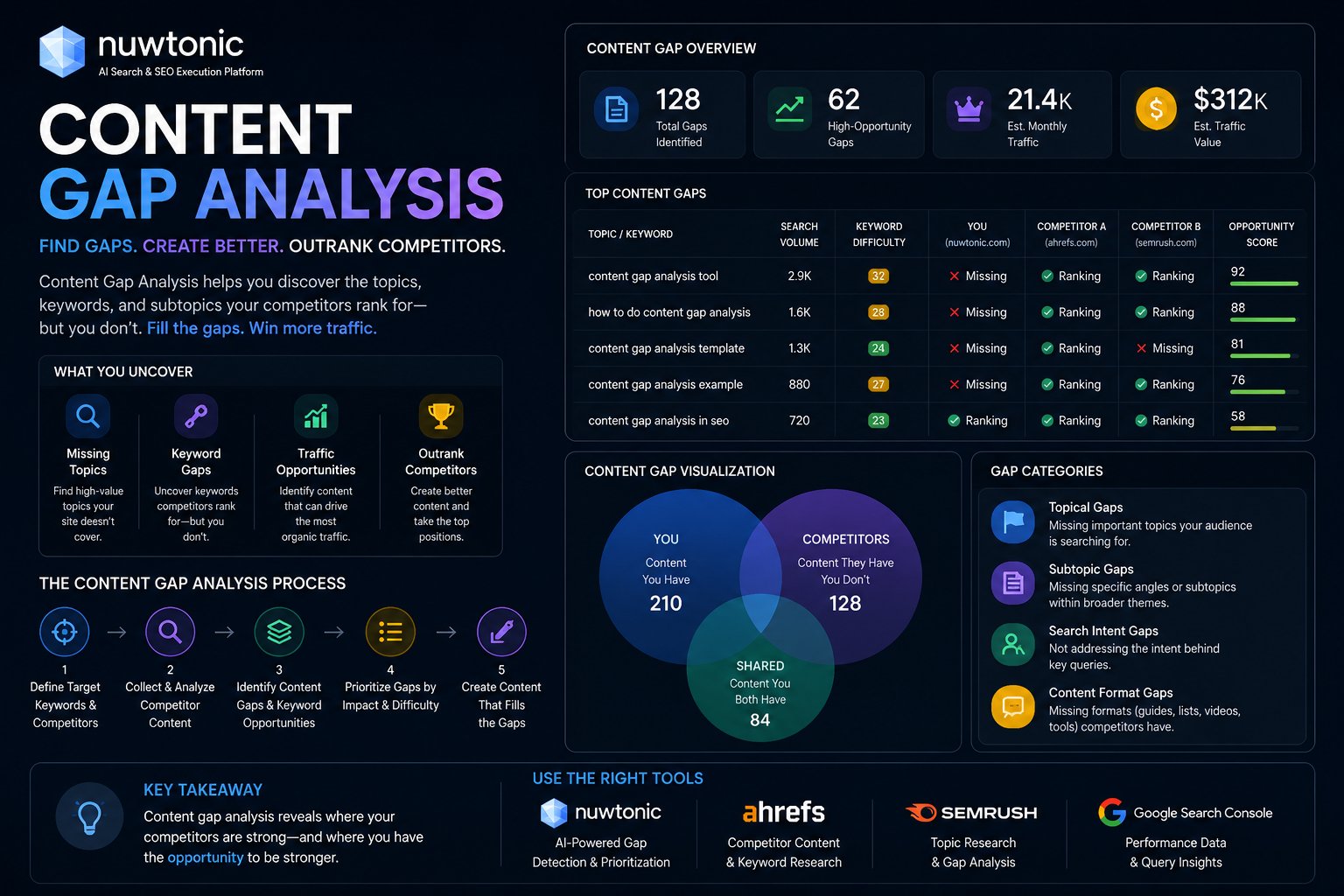
Content gap analysis is overdue for an update. The old workflow, export competitor keywords, sort by volume, publish the missing pages, still catches obvious opportunities. It does not explain why a brand can hold page-one rankings and still get ignored in AI answers.
That blind spot is now part of the gap.
A useful analysis has to cover search visibility and citation visibility. If ChatGPT, Gemini, or Perplexity keep citing competitors for queries where your pages already rank, the problem is no longer just keyword coverage. It is a GEO problem tied to entities, page structure, source clarity, and whether your content is easy for AI systems to extract and cite.
AI search often ends without a click, with 2025 data cited by Kompozy shows 68% of AI-powered queries result in zero-click outcomes, and only 12% of content strategies measure brand inclusion in LLM citations at the URL level. Teams that still treat content gaps as a spreadsheet of missing keywords are measuring the easy part and missing the part that now affects discovery.
After dozens of gap analyses, the pattern is consistent. The losing pages usually are not just missing terms. They miss subtopics that competitors cover, they use the wrong format for the query, or they bury the answer in a way that works poorly for both users and AI retrieval. In GSC, that often shows up as strong impressions with weak click-through rates or queries where one URL ranks for broad intent but never earns traction on comparison, pricing, or definition variants. In tools like Ahrefs or Semrush, it shows up as competitors owning adjacent terms and supporting pages that your site never built. In AI answer testing, it shows up as repeated citations to pages with clearer definitions, cleaner headings, original data, or stronger topical context.
That is the standard now. A complete content gap analysis checks what you do not rank for, what you do not cover well enough, and where your brand is absent from the answers users see before they ever reach the SERP.
Table of Contents
- Rethinking Content Gaps in the AI Search Era
- Defining Your Goals and Competitive Landscape
- Your Data Collection and Tooling Arsenal
- Identifying and Classifying the Four Types of Gaps
- Prioritizing Gaps with the Impact vs Effort Matrix
- Executing the Plan From Brief to Published
- Measuring ROI and Keeping Your Strategy Evergreen
Rethinking Content Gaps in the AI Search Era
A proper content gap analysis in 2026 has to answer two questions at once. Where are competitors winning clicks in search, and where are they winning citations in AI answers.
Those are not the same thing. A page can rank, collect impressions, and still lose the source slot inside a generated answer because the competitor page is easier to extract, more specific, more current, or carries stronger evidence. That's why the old habit of running one keyword gap report and calling it strategy doesn't hold up.
The new unit of analysis
The useful unit isn't just the keyword anymore. It's the query cluster plus prompt fan-out plus citation target.
That changes how you review gaps:
- Search gaps tell you where competitors rank and you don't.
- Coverage gaps tell you whether you touch the topic but stay too shallow.
- Extraction gaps show that your page contains the answer, but AI systems don't surface it.
- Citation gaps show that AI systems prefer competitor URLs as sources.
Practical rule: If your audit ends with a list of missing keywords and no review of cited URLs in AI answers, the audit is incomplete.
What outdated advice gets wrong
The most common bad advice is "publish what competitors rank for." That creates copycat content. Copycat content might fill a spreadsheet gap, but it often fails on two fronts. It doesn't add anything original, and it doesn't give machines a strong reason to cite you instead of the page that already exists.
The better approach is harsher and more useful. Treat every gap as a competitive weakness with a specific failure mode. Missing page. Thin page. Wrong format. Weak evidence. No citations. That framing forces a real decision about what to build or fix.
Defining Your Goals and Competitive Landscape
A useful content gap analysis starts before any tool export. If the goal is vague, the dataset gets bloated and the output turns into a backlog nobody trusts.
Start with the outcome, not the spreadsheet
Pick one primary outcome for the project. Not five.
Common goals that produce clean analysis:
- Recover commercial search demand for product, category, or high-intent comparison terms.
- Build topical authority in a specific cluster where your site is present but shallow.
- Increase AI citation coverage for a defined set of buyer questions.
- Support funnel weak spots where awareness content exists but consideration or decision content is thin.
If you're still at the stage where keyword targets are fuzzy, clean that up first with a structured workflow for keyword research fundamentals. Gap analysis works best when you already know the audience segments, the commercial themes, and the pages that matter to revenue.
A practical project charter should include:
| Field | What to define |
|---|---|
| Scope | Product line, category, market, or topic cluster |
| Success metric | Rankings, qualified traffic, conversions, or AI citation inclusion |
| Page types | Blog, solution page, comparison page, template, tool, documentation |
| Exclusions | Careers, support docs, partner pages, brand terms, irrelevant geos |
Choose competitors by SERP overlap, not brand familiarity
Teams waste time by picking "who we think we compete with." Use who appears for the target query set.
That usually means your competitor set includes more than direct business rivals:
- Direct commercial competitors that sell the same thing
- Media sites and publishers that dominate informational SERPs
- Niche blogs and communities that capture long-tail trust
- Review and comparison sites that intercept mid-funnel traffic
- AI-cited pages that show up repeatedly as sources even if they don't feel like market rivals
For broad research, I like combining standard SEO tools with manual SERP review and selective competitive intelligence scraping when a market moves too fast for static snapshots. That's especially useful when you need repeated page-level comparisons across templates, FAQ blocks, schema use, or recurring subtopics.
Most teams choose competitors by logo recognition. Search engines and AI systems choose them by relevance and usefulness.
A good competitor set is usually small and sharp. If a domain rarely overlaps with your core queries, leave it out. If a lesser-known site keeps appearing for your commercial terms or gets cited in AI answers, include it even if the sales team has never mentioned it.
Your Data Collection and Tooling Arsenal
Keyword gap reports are where weak analyses go to hide. They look precise, but they miss the harder question: why competitors get the click, and why AI systems cite them instead of you.
A usable workflow pulls from three evidence streams that answer different questions. Google Search Console shows what your site is already eligible for. Competitor tools show where other domains are winning coverage or format fit. Manual AI prompt testing shows whether your pages are even in the citation set for buyer questions. If one of those inputs is missing, the analysis is incomplete.
Start with GSC, because it reflects your actual search footprint
Third-party tools are useful for comparison. They are not the first place to diagnose your own gaps. GSC gives you the closest thing to ground truth on query associations, page eligibility, and weak spots that can often be fixed faster than creating net-new content.
I usually pull three patterns first:
- Near-win queries with impressions but weak average position
- Wrong-page rankings where Google surfaces a URL that does not match the query intent
- Fading pages where impressions hold up but clicks, CTR, or average position slip over time
Those three patterns lead to very different actions. Near-win queries often need stronger sections, better internal links, or a better title. Wrong-page rankings usually point to muddled topical architecture. Fading pages often need a refresh, a format change, or a clearer answer target for both search and AI retrieval.
Useful GSC cuts:
High-impression queries with poor average position
Google sees relevance, but the page is still losing on depth, trust signals, or format.Pages with broad query coverage and weak CTR
The title, meta description, or page angle is probably not competitive on the SERP.Query families that trigger multiple URLs
That usually means cannibalization, weak consolidation, or sloppy template decisions.Pages with impressions but no durable top-page presence
These are strong candidates for expansion or restructuring, especially if the query maps to product education, comparisons, or bottom-funnel evaluation.
Export discipline matters here. Inconsistent page groups, broken regex filters, and messy tagging can send a team toward the wrong rewrite or the wrong new page. If reporting hygiene is shaky, fix that first. Guidance on preventing data errors in analytics is useful before you trust any recurring export.
Add competitor data, then test for AI citation gaps
Once GSC shows your current footprint, compare that footprint against the domains winning the SERP. I care less about raw missing-keyword volume and more about repeatable patterns:
- terms where several competitors rank and you have no relevant URL
- terms where you rank, but with the wrong page type
- topics where competitors own the answer format, such as comparison tables, FAQs, examples, calculators, or template-led pages
- pages that appear repeatedly in AI answers, even when they are not the highest-ranking organic result
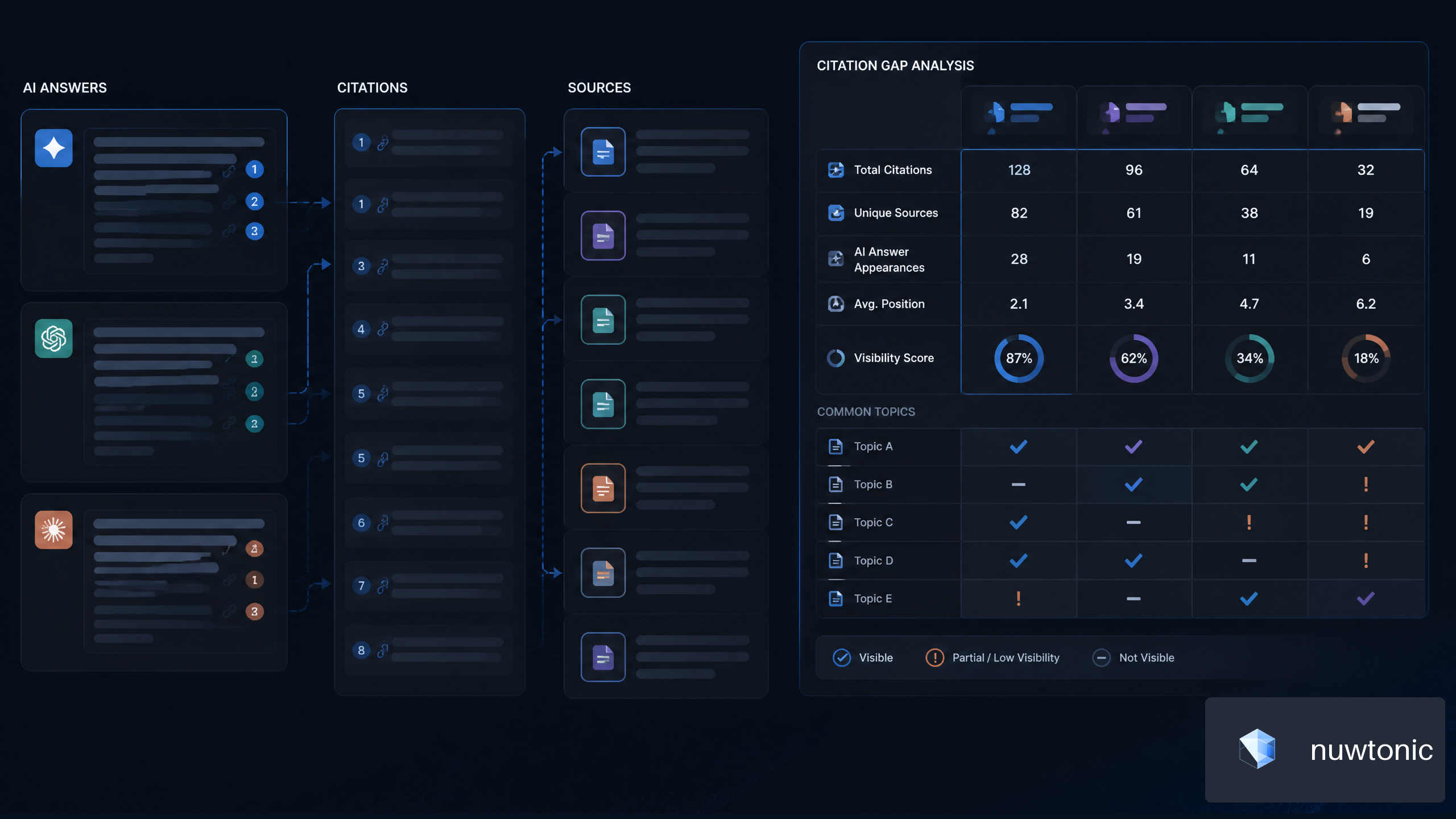
That last point changes the workflow. Traditional gap analysis stops at rankings. GEO work adds a second layer: citation visibility. A page can underperform in classic blue-link rankings and still get cited by AI systems if it answers the question cleanly, uses clear structure, and covers the supporting sub-questions better than the average SERP result. The reverse is also common. Pages that rank decently but bury the answer in fluff often disappear from AI responses.
Manual prompt testing is still worth doing because automated AI visibility tracking is noisy across models and sessions. Use prompts that match how buyers ask for help, not stripped-down keyword strings.
Examples:
- best [category] for [use case]
- how to choose [product] for [constraint]
- [brand] vs [competitor]
- what causes [problem] and how to fix it
- top tools for [job to be done]
Track the outputs in a simple sheet:
| Prompt | Brands mentioned | URLs cited | Your URL present |
|---|---|---|---|
| Buyer question | Named brands in answer | Source links shown | Yes or no |
This reveals a class of gap that keyword tools miss entirely. If competitor pages keep getting cited for comparison queries, implementation questions, or trust-building explainers, you do not just have a ranking gap. You have a retrieval and citation gap.
For teams that want one workflow for search visibility and AI-answer monitoring, some generative engine optimization tools now combine GSC signals, competitor tracking, and prompt-level citation checks. The tool matters less than the process. Keep organic rankings, page-level intent mapping, and AI citations in the same worksheet or system, or priorities will drift fast.
Identifying and Classifying the Four Types of Gaps
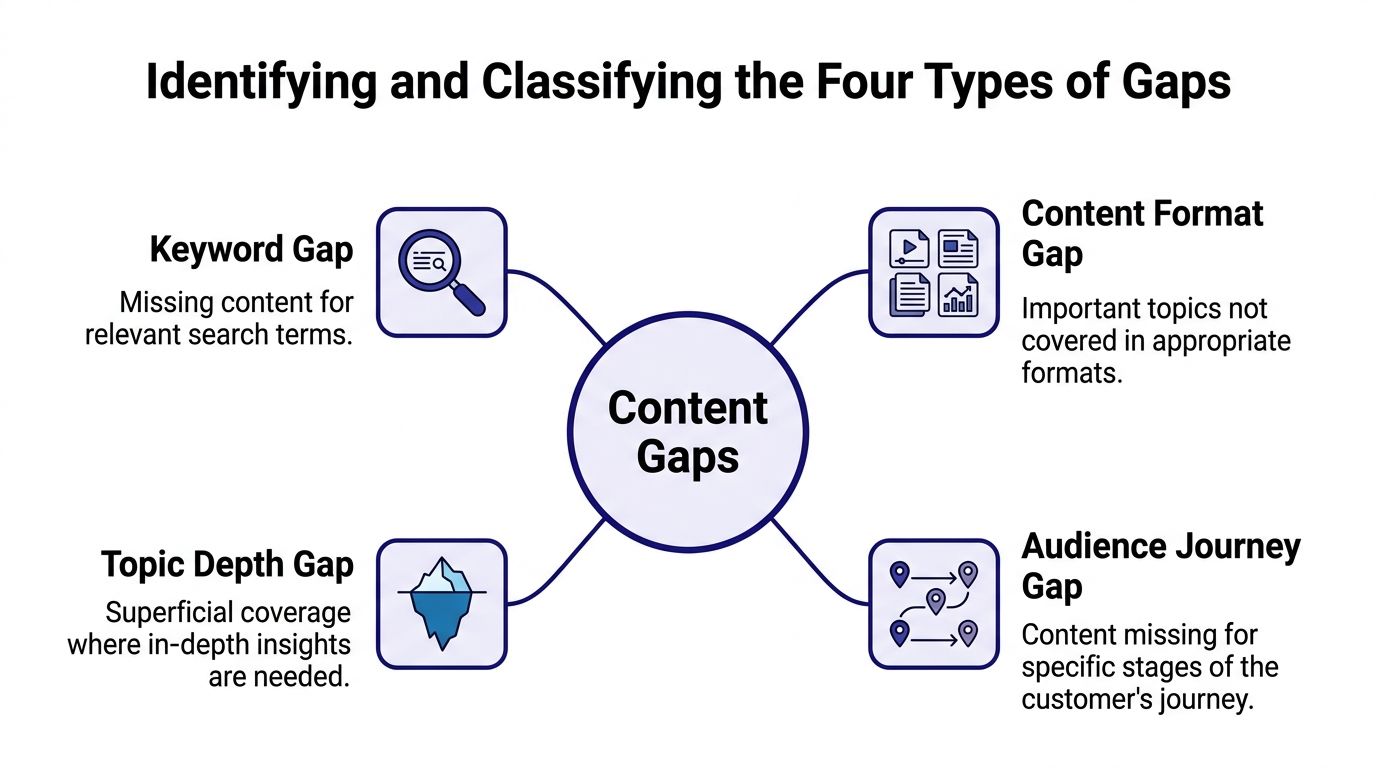
Treating every missed query as a keyword gap is how teams publish more and gain little. After enough audits, the pattern is clear. The missed opportunity usually sits in one of four buckets, and each bucket needs a different fix.
Keyword gaps are the starting line
This is the obvious one. Competitors rank for terms that matter to your category, and you have no page with a realistic claim on that intent.
That still deserves attention, especially for comparison terms, bottom-funnel category queries, and recurring informational searches tied to product adoption. But a keyword gap is only an inventory problem. It does not tell you whether you need a net-new page, a merged cluster, a stronger internal linking pattern, or a page that targets the query with more precision.
I usually call it a true keyword gap when four conditions are present:
- The query has a clear connection to the product or service
- The SERP maps to one dominant intent
- No existing URL on the site is a strong fit
- The topic supports a funnel stage the business prioritizes
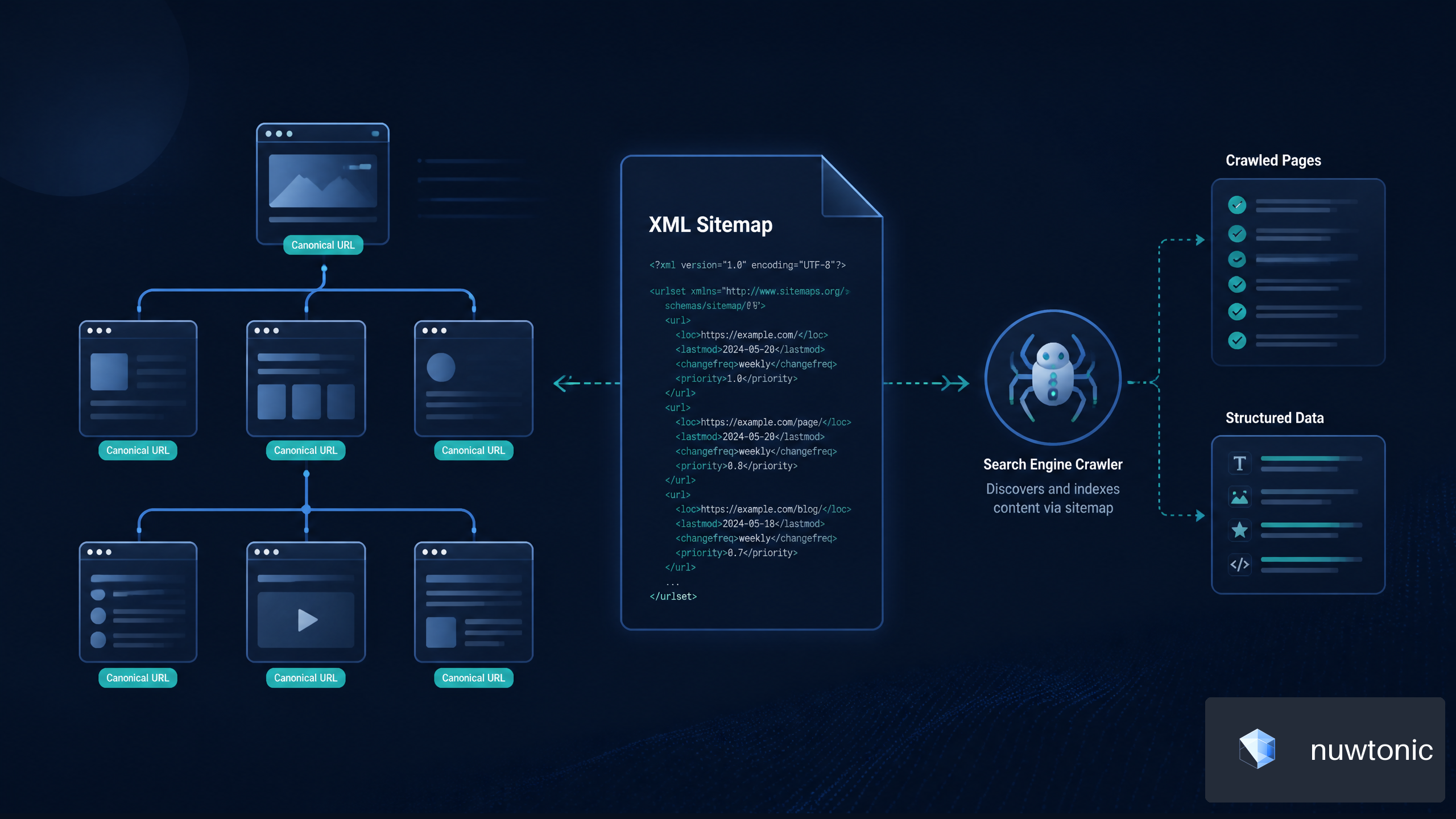
The fastest way to sort these across a rival set is with competitor gap analysis workflows that show missing terms alongside ranking URLs, page type, and intent pattern. A raw export from Ahrefs or Semrush is useful. It becomes actionable only after you match the gap to the kind of page Google is already rewarding.
Topic depth and format gaps explain why existing pages stall
"We already have that page" is one of the least useful sentences in SEO. A page can exist, rank on page two, and still fail because it answers the query halfway.
Recent frameworks have pushed gap analysis past basic keyword matching by scoring Information Gain across areas like proprietary data, first-hand evidence, original frameworks, expert attribution, and recent updates, as outlined in 12 AM Agency's content gap analysis framework. That standard is more useful than counting subheadings because it measures whether the page adds anything worth citing or ranking.
I also like simple scoring for depth because teams will use it. One practical model rates pages from 1 to 5 on whether they answer the core questions, include examples, add expert insight, and support claims with original research or data citations, based on David Hicks on quantifying content depth.
A quick review table keeps the diagnosis honest:
| Gap type | What you see | Typical fix |
|---|---|---|
| Topic depth gap | Page covers the basics and stops early | Expand sections, add evidence, answer follow-up questions |
| Format gap | SERP favors video, templates, tools, or comparison pages | Change the primary format or add a supporting asset |
| Intent gap | Page targets the wrong job to be done | Reposition the page or split it into separate URLs |
GSC helps confirm this fast. If a page gets impressions for a topic cluster but weak clicks and poor secondary-query spread, depth is often the problem. If it ranks for "what is" terms but never appears for "best," "vs," or "how to choose," the issue is usually intent or format, not word count.
Audience journey gaps rarely show up in keyword tools
Keyword databases flatten the messy parts of buyer behavior. Revenue does not.
The strongest gap analyses pull in language from sales calls, support tickets, Reddit threads, product reviews, and onboarding logs because those sources reveal the friction that search tools miss. Semrush notes that 43% of users abandon search when top results do not answer their specific problem, while only 9% of gap analyses use conversational data from forums or reviews. That mismatch is exactly why so many content plans look complete on paper and underperform in market.
The best inputs are usually close to the customer:
- Sales calls surface objections, comparisons, and approval-blocking questions
- Support tickets expose setup issues, edge cases, and feature confusion
- Reddit threads show how people describe the problem without brand language
- YouTube comments reveal unanswered follow-up questions and preferred formats
If the same objection appears in demos and support, I treat it as a content gap even when search volume looks small. Those pages often convert better than higher-volume topics because they address the point where deals stall.
AI visibility gaps deserve their own classification
This is the gap type a traditional audit misses. A page can rank, collect clicks, and still disappear from AI answers because the model cites a competitor's comparison page, pulls a cleaner explanation from a forum thread, or extracts a summary from the wrong URL on your site.
I separate AI visibility gaps into four failure modes:
Mention gap
Competing brands appear in AI answers for a commercial or evaluative prompt, and your brand does not.Citation gap
Your brand is mentioned, but the answer cites someone else's page as the source.URL gap
The cited page is not your best page. This usually happens when the strongest answer is buried inside a weak URL or a generic resource hub.Extraction gap
The needed information exists, but the page structure makes clean extraction harder. Common causes are vague headings, buried definitions, weak comparison tables, and long intros before the answer.
This classification matters because the fixes are different. Mention gaps often require stronger comparison and category positioning. Citation gaps usually point to weaker evidence, fewer quotable claims, or poor source formatting. URL gaps call for consolidation, internal linking changes, or canonical cleanup. Extraction gaps are often solved by rewriting the page structure so the answer is explicit in the first screen, supported by schema, tables, and direct subheadings.
That is the practical shift in content gap analysis now. The job is no longer just finding terms competitors rank for. The job is finding where your site fails to rank, fails to satisfy, fails to match the right format, and fails to get cited when AI systems assemble the answer.
Prioritizing Gaps with the Impact vs Effort Matrix
A serious content gap analysis usually produces too many opportunities. That's normal. The mistake is turning the whole list into a content calendar.
Industry-standard workflows prioritize gaps using three quantified metrics: search demand, ranking feasibility, and business value, often on a 1 to 5 priority scale, as outlined by LeadAdvisors on content gap analysis. That's the right backbone because it stops teams from chasing interesting topics that don't matter.
Use a scoring model before you assign work
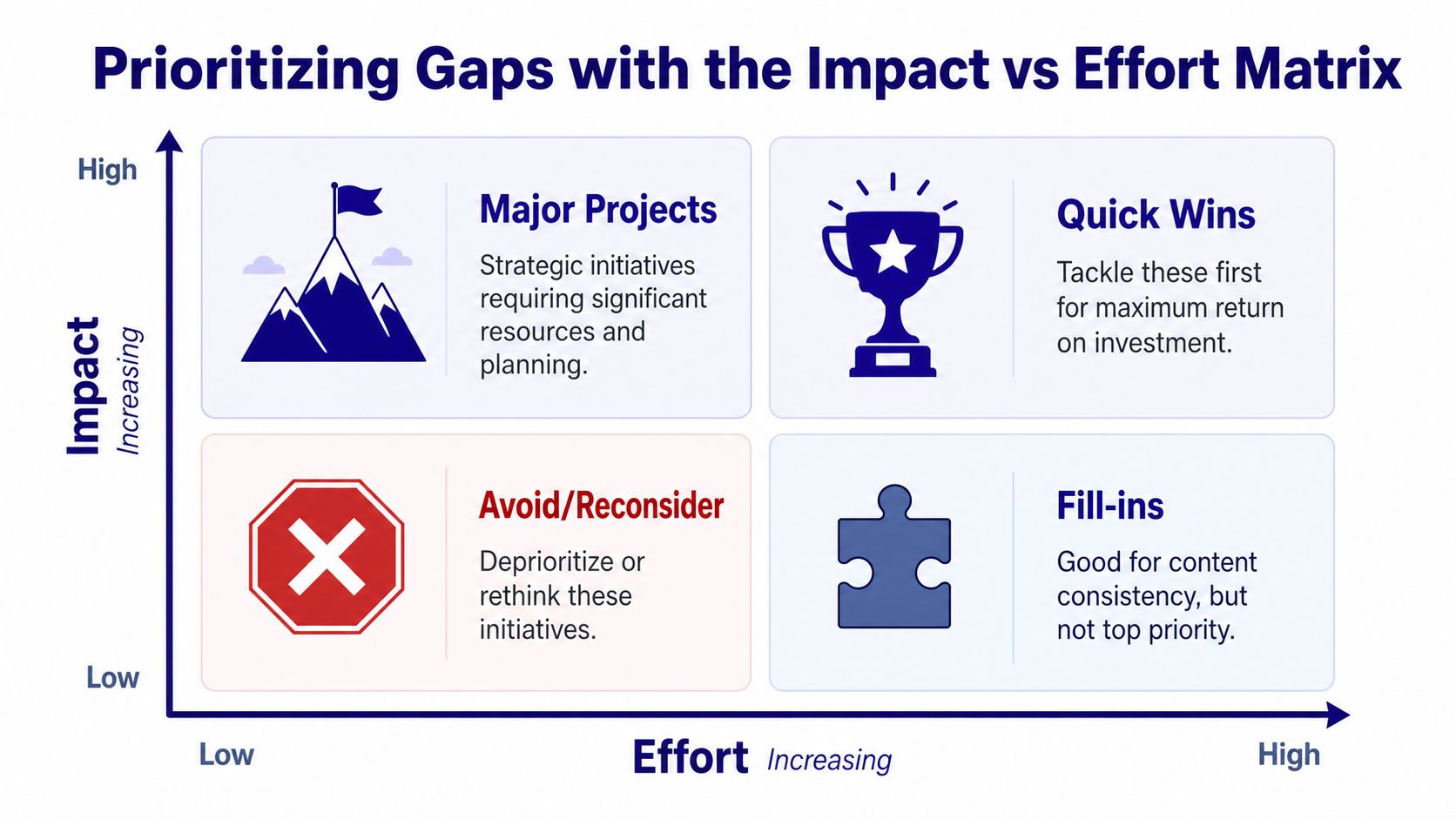
Score each gap on two axes.
Impact combines:
- search demand
- commercial relevance
- funnel importance
- AI citation value if the query is frequently answered by LLMs
Effort combines:
- content creation load
- research burden
- subject matter expert input
- page template or design needs
- link or authority challenge
A simple working model:
| Metric | Score 1 | Score 5 |
|---|---|---|
| Search demand | Low demand | Strong demand |
| Feasibility | Hard to compete | Achievable with current authority |
| Business value | Low commercial tie | Strong revenue alignment |
| Effort | Major rebuild | Light update or straightforward new page |
Then make a decision, not just a score.
What belongs in each quadrant
Quick wins are usually existing URLs that already rank, but need stronger subtopics, better structure, clearer headings, or a better match to the buyer question.
Major projects are new hubs, comparison pages, calculators, or expert-led assets where the upside is big but the work is substantial.
Fill-ins include minor support pieces that complete a cluster, answer adjacent questions, or tighten internal linking.
Avoid or reconsider means the topic is weak commercially, off-brand, or too expensive relative to the likely return.
Decision rule: A gap with decent demand and weak business value should usually lose to a smaller gap that directly supports conversion.
One more filter helps. If the opportunity only exists because a competitor published thin content and nobody else has validated the demand, don't rush. Some gaps are just noise in a tool.
Executing the Plan From Brief to Published
Publishing more pages does not fix a weak gap analysis. Better briefs do.
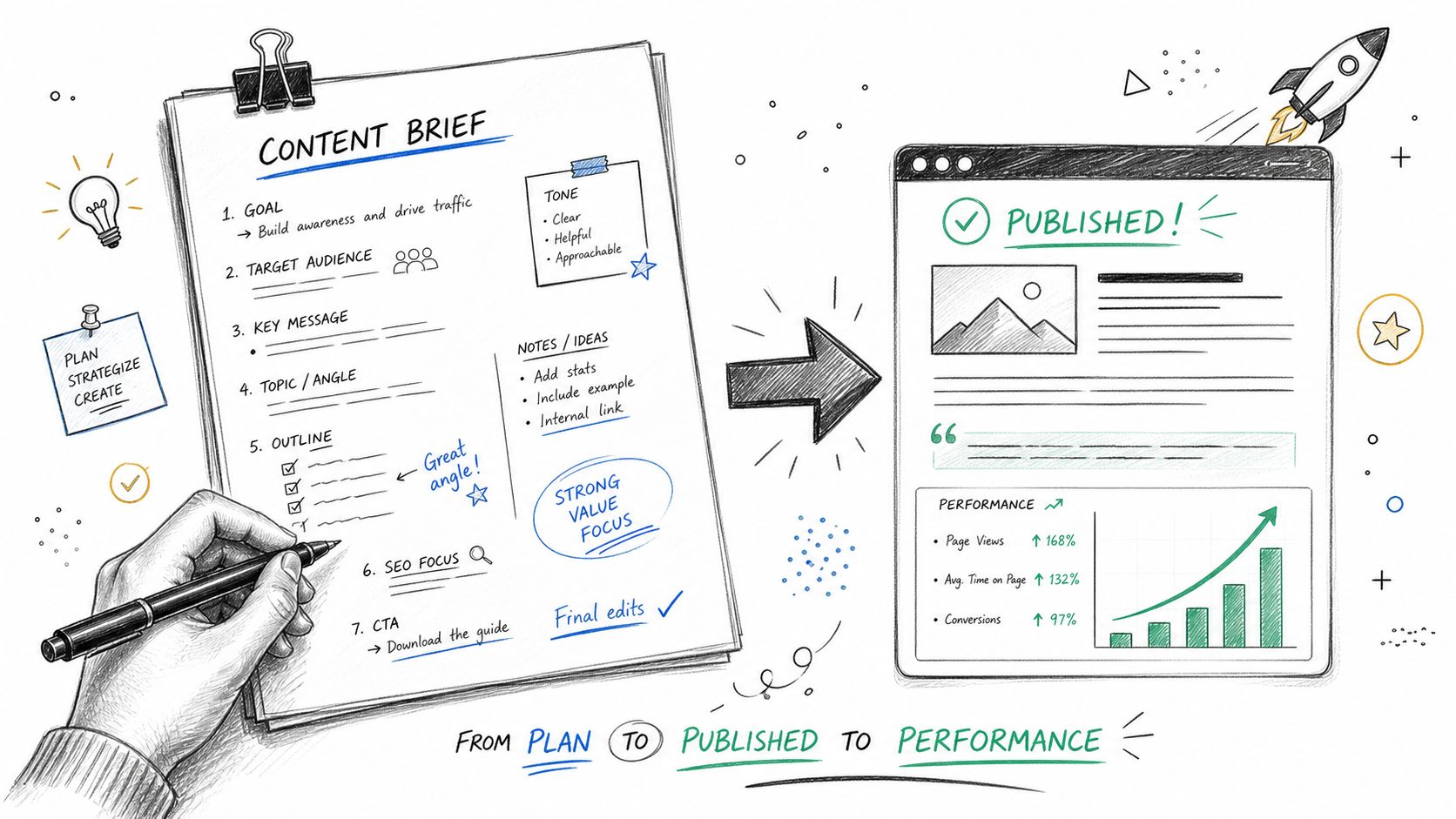
The brief is where strategy either survives or gets watered down into "write something about this keyword." After running dozens of these projects, I can say the same failure pattern shows up every time. The gap is real in Ahrefs or Semrush, GSC shows impressions sitting just outside page one, competitors cover the subtopic better, then the draft shows up with generic definitions and no reason to rank or get cited in AI answers.
A usable brief defines the exact gain the page needs to deliver over the current SERP and over the current AI answer set.
Include these fields every time:
- Primary query cluster and dominant intent
- Target reader and buying stage
- Current URL to update or net-new URL recommendation
- Competing URLs reviewed, including what they cover better than you
- GSC signals, such as queries with impressions but low clicks, or page-two terms where the page already has relevance
- Missing subtopics, entities, examples, and comparison points
- Evidence requirements, such as product data, SME review, screenshots, workflows, or customer scenarios
- Extraction requirements for GEO, including direct-answer paragraphs, scannable definitions, comparison tables, FAQ blocks, and clean heading structure
- AI citation goal, meaning which claim, workflow, or definition should be cite-worthy enough to appear in synthesized answers
- Primary CTA and next step
That last point matters more than many teams admit. A page can rank and still fail the business goal if it attracts the wrong reader or answers the question without creating a logical next action.
I also add a simple editorial rule to every brief. If a competitor could have written the same draft from public sources in an afternoon, the draft is too weak. Information gain has to be visible on the page. That can mean first-hand product screenshots, a sharper framework, an expert quote with a name attached, or a clearer explanation of trade-offs than the top-ranking pages provide. It also improves your odds of being cited by LLMs, which tend to favor concise, attributable passages over vague filler.
Decide between a new page and a content patch
The wrong URL decision wastes months.
Use a content patch when the page already has the right intent and some traction in GSC, but loses on coverage, clarity, formatting, or evidence. This is common with pages ranking in positions 8 through 20 for a cluster of related terms. They do not need a replacement. They need stronger sections, better internal logic, and more extractable answers.
Create a new page when the existing URL serves a different job. A broad category page should not absorb a high-intent comparison query. A product page should not try to rank for an educational term that needs neutral explanation. If the winning competitor set uses a different page type, treat that as a warning.
AI visibility changes this decision too. I have seen many citation gains come from updating an existing page with a direct definition block, a table comparing options, and attributed expert commentary. The raw information was already on the site. It was buried in long paragraphs, spread across multiple URLs, or written in a way that made extraction difficult.
Here's a useful walkthrough before publication:
Publishing standards that improve extraction and citation
Pages written to close gaps need to work in three places. The SERP. The page itself. AI-generated answers that quote, summarize, or cite the source.
That changes how the final draft should be edited.
- Answer the subquestion immediately under each meaningful H2 or H3.
- Keep sections self-contained so a single passage still makes sense when extracted out of context.
- Use tables, bullets, and comparison blocks for anything procedural or evaluative.
- Add named attribution for expert claims, especially on YMYL, technical, or experience-based topics.
- Show the proof with screenshots, original examples, or product-specific detail.
- Write for citation by making key definitions and claims precise enough to quote cleanly.
- Check snippet readiness in GSC and the live SERP after indexing, then refine intros and headings if the wrong passage is surfacing.
Bylines and expert bios still help, but they are not a substitute for substance. Outdated SEO playbooks treated authorship like a cosmetic E-E-A-T fix. It is more useful as support for better information.
Before hitting publish, review the page the same way you would review a likely AI source. Can a model pull a clean answer from the introduction? Is there a concise table for comparisons? Does the page resolve the query without forcing the reader through brand fluff first? Those are editorial decisions, not technical extras.
Once the page is live, track the URL like an asset, not a blog post. Use GSC for query movement and CTR shifts, check whether competitor pages still cover key subtopics better, and measure content performance against the conversion path the brief defined.
Measuring ROI and Keeping Your Strategy Evergreen
Content is often judged too early, metrics are tracked incorrectly, and auditing is stopped once pages are live. Consequently, gap analysis often looks less effective than it is.
Set baselines before you touch content
If you don't capture the starting point, you can't prove improvement later.
Before making changes, record:
- Current rankings for target query groups
- Impressions, clicks, CTR, and position in GSC
- Conversions or assisted conversions for affected pages
- Current AI mentions and cited URLs for your priority prompt set
- Competitor pages that currently win the SERP or the citation
Then give the work enough time. Expert benchmarking indicates content created to close identified gaps needs a minimum 90-day evaluation window before ranking performance is assessed, and modern protocols include checking LLMs for AI Visibility Gaps when competitors are cited and your brand is absent, based on MQL Magnet's content gap analysis guidance.
That window matters because publication is not the same as stabilization. Search visibility, CTR behavior, and conversion performance often lag.
Track outcomes on a quarterly cadence
A one-off audit goes stale fast. Competitive coverage changes. AI citation patterns change. Buyer questions change.
I like a quarterly review with three questions:
| Review area | What to check |
|---|---|
| Search performance | Are target pages gaining impressions, clicks, and better positions |
| Citation performance | Are your pages being named or cited for the priority prompt set |
| Competitive movement | Have competitors launched new pages, deeper sections, or new formats |
For teams refining dashboards, a good framework for measure content performance helps keep reporting tied to outcomes instead of vanity metrics.
The pages that lose traffic quietly are often the ones that were never re-audited after launch.
Evergreen strategy isn't about endless rewriting. It's about running a steady cadence of reclassification. Some pages need a light patch. Some need a format change. Some were the wrong bet from the start. The discipline is in checking, not assuming.
Nuwtonic fits this workflow if you want one system that connects GSC data, competitor gap detection, and AI citation tracking to actual content updates. It's built for teams that need to find missing opportunities, review fixes, and ship changes without splitting the work across separate SEO, GEO, and content operations tools.