Most advice on Perplexity vs ChatGPT starts with the wrong premise. It treats them like interchangeable chatbots and then asks which one is “better.” That framing hides the only comparison that matters in practice: what kind of work are you trying to do, and what kind of answer do you need to trust.
For research, current events, source verification, and AI citation visibility, the differences are structural. For drafting, iterative thinking, style control, and multi-step creative work, the differences are just as real. If you use these tools for SEO, content strategy, or client delivery, picking the wrong one wastes time. Worse, it creates false confidence in outputs that should have been checked.
The more important angle is the one most comparison posts skip entirely. If Perplexity and ChatGPT are becoming discovery layers, then brands need to think beyond “how do I use them?” and start asking “how do I get cited by them?” That's the operational heart of modern Generative Engine Optimization.
Table of Contents
- Perplexity vs ChatGPT Is the Wrong Question
- Search-First vs Generation-First Architectures
- Comparing Accuracy Verifiability and Sourcing
- Best Use Cases for Research Creative and Code
- Advanced Features Ecosystems and Pricing
- Optimizing for the AI Citation Gap
- The Right AI for the Right Job
Perplexity vs ChatGPT Is the Wrong Question
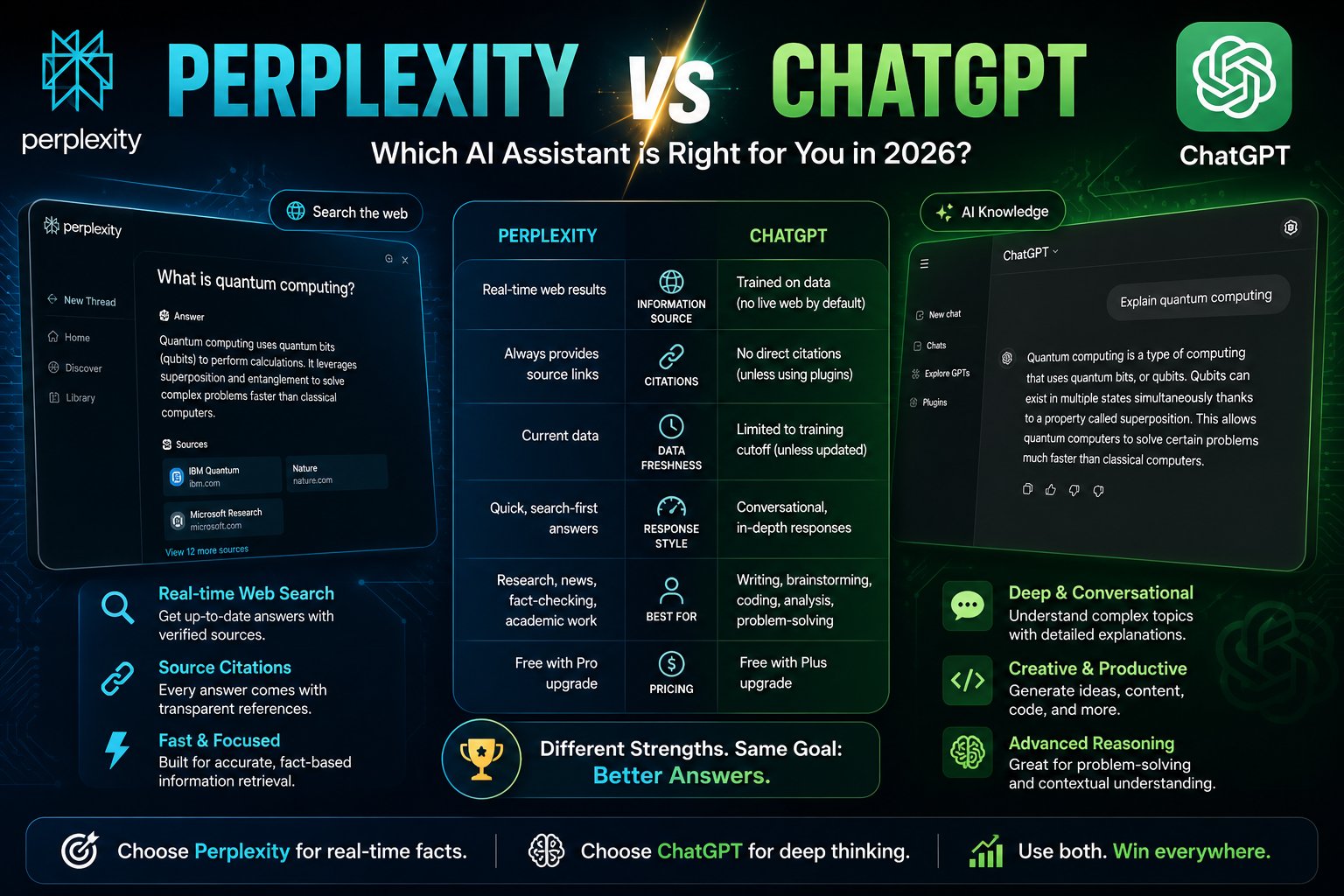
The cleanest way to understand Perplexity vs ChatGPT is this: Perplexity behaves like a research librarian. ChatGPT behaves like a creative polymath.
Perplexity AI was founded in 2022 by former Meta researchers and launched its public product in September 2023, reaching over 100 million monthly users by early 2025. Its core distinction is that it performs real-time web searches by default for nearly 95% of queries, grounding answers in live sources rather than relying mainly on model memory, as noted in the verified market summary provided for this comparison. ChatGPT, first released in November 2022, became the dominant general-purpose AI chatbot with over 180 million monthly users as of 2025, according to the same verified data set.
That growth can make them look like direct substitutes. They aren't.
One is built to retrieve, compare, and cite. The other is built to generate, reason, and carry a conversation with more fluidity. If your team asks both tools the same prompt and judges only which output “sounds smarter,” you'll miss the actual performance difference.
The real decision is task fit
For a live research question, the right test isn't eloquence. It's traceability. Can you inspect the answer, open the source, and see whether the claim holds up?
For a content workflow, the right test isn't citation density. It's whether the tool can hold tone, revise structure, brainstorm angles, or help you shape a rough draft into something publishable.
Practical rule: Use Perplexity when being wrong is expensive. Use ChatGPT when shaping ideas is the main job.
The overlooked business issue sits one layer deeper. AI systems increasingly decide which sources get surfaced inside answers. That means the key SEO problem isn't just ranking pages in classic search. It's increasing the chance that a specific URL becomes the source an answer engine chooses to cite.
Most “perplexity vs chatgpt” articles stop at features. That's surface-level advice. The operational question is whether your site is structured in a way these systems can parse, trust, and quote.
Search-First vs Generation-First Architectures
Perplexity and ChatGPT produce different kinds of answers because they start from different systems.
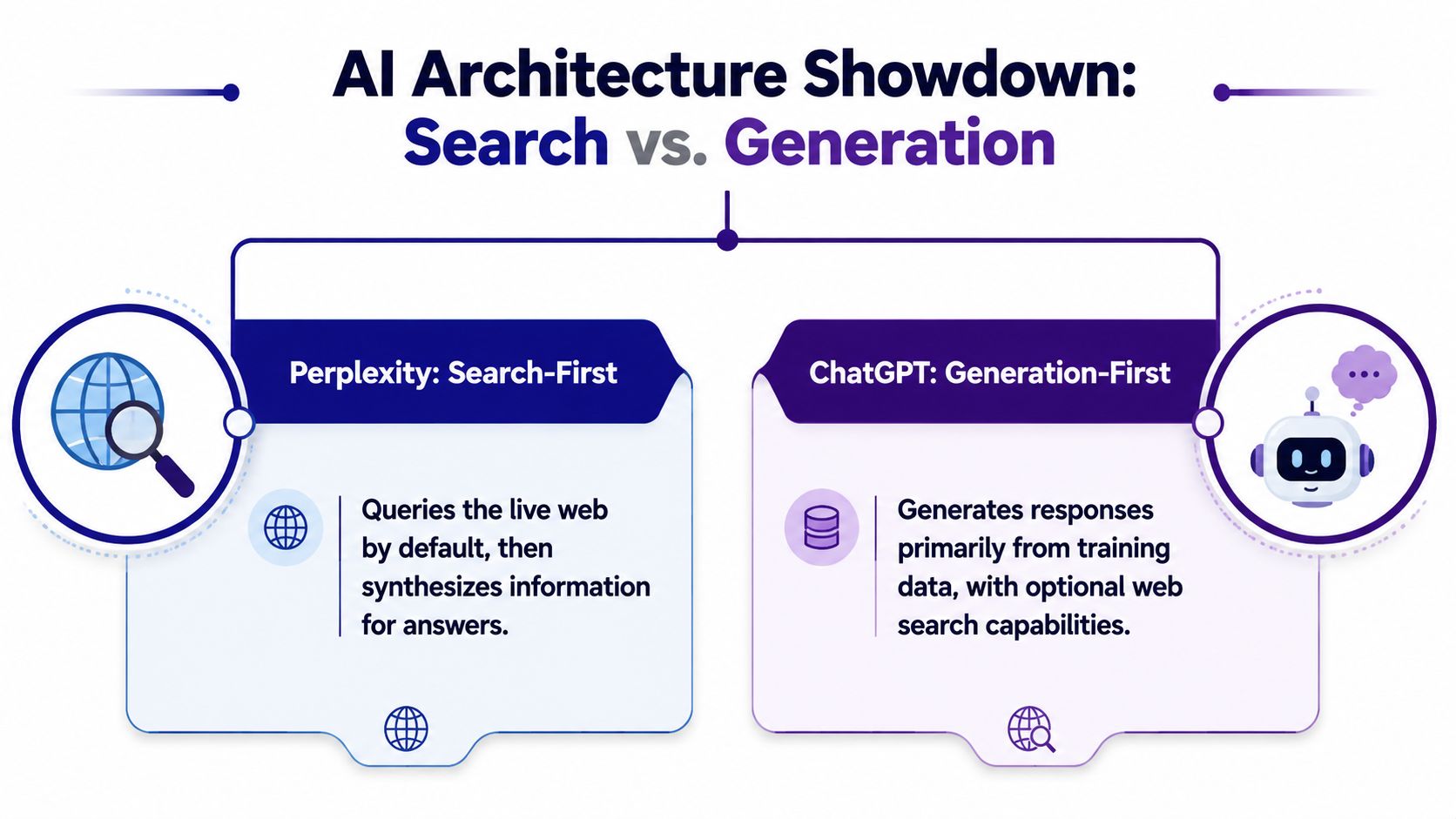
Perplexity uses a search-first architecture that retrieves live web information by default and then synthesizes a response. ChatGPT uses a generation-first model that primarily works from trained knowledge and conversation context, with web access enabled only when you deliberately invoke it, as explained in Nexos' comparison of Perplexity and ChatGPT.
Why the architecture changes the answer
A search-first system starts by asking, “What is available right now?” A generation-first system starts by asking, “What do I already know that fits this request?”
That sounds subtle. In practice, it changes everything.
If you ask about a fresh product launch, a changing regulation, or an updated earnings report, Perplexity's default behavior is aligned with the task. It goes outward first. If you ask for a messaging framework, rewrite options, or a strategic explanation, ChatGPT's internal reasoning and conversational flow often feel stronger because the job is less about retrieval and more about synthesis.
Think of it this way:
| Tool | Best analogy | Default behavior | Typical strength |
|---|---|---|---|
| Perplexity | Research assistant in a live library | Finds current sources first | Verifiable current answers |
| ChatGPT | Scholar working from memory | Generates from learned patterns first | Depth, iteration, and creative shaping |
What this means in daily use
This architectural split is why users often misjudge both tools. They ask ChatGPT for current facts, then complain about sourcing. Or they ask Perplexity for nuanced voice work, then complain that the prose feels rigid.
Both reactions are predictable.
If you're evaluating long-form retrieval workflows, testing whether AI deep search actually works is more useful than comparing chat interfaces. The interface matters less than the retrieval chain and whether you can inspect it.
A few practical implications follow:
- For SEO research: Perplexity is usually the first tab to open when you need live references, source comparison, or fast source triage.
- For content development: ChatGPT is often stronger once you already know the material and need to transform it into angles, outlines, copy, or structured recommendations.
- For client work: The safest workflow is sequential. Retrieve with one system. Refine with the other.
Search-first tools reduce ambiguity about where an answer came from. Generation-first tools reduce friction in developing what the answer should become.
Comparing Accuracy Verifiability and Sourcing
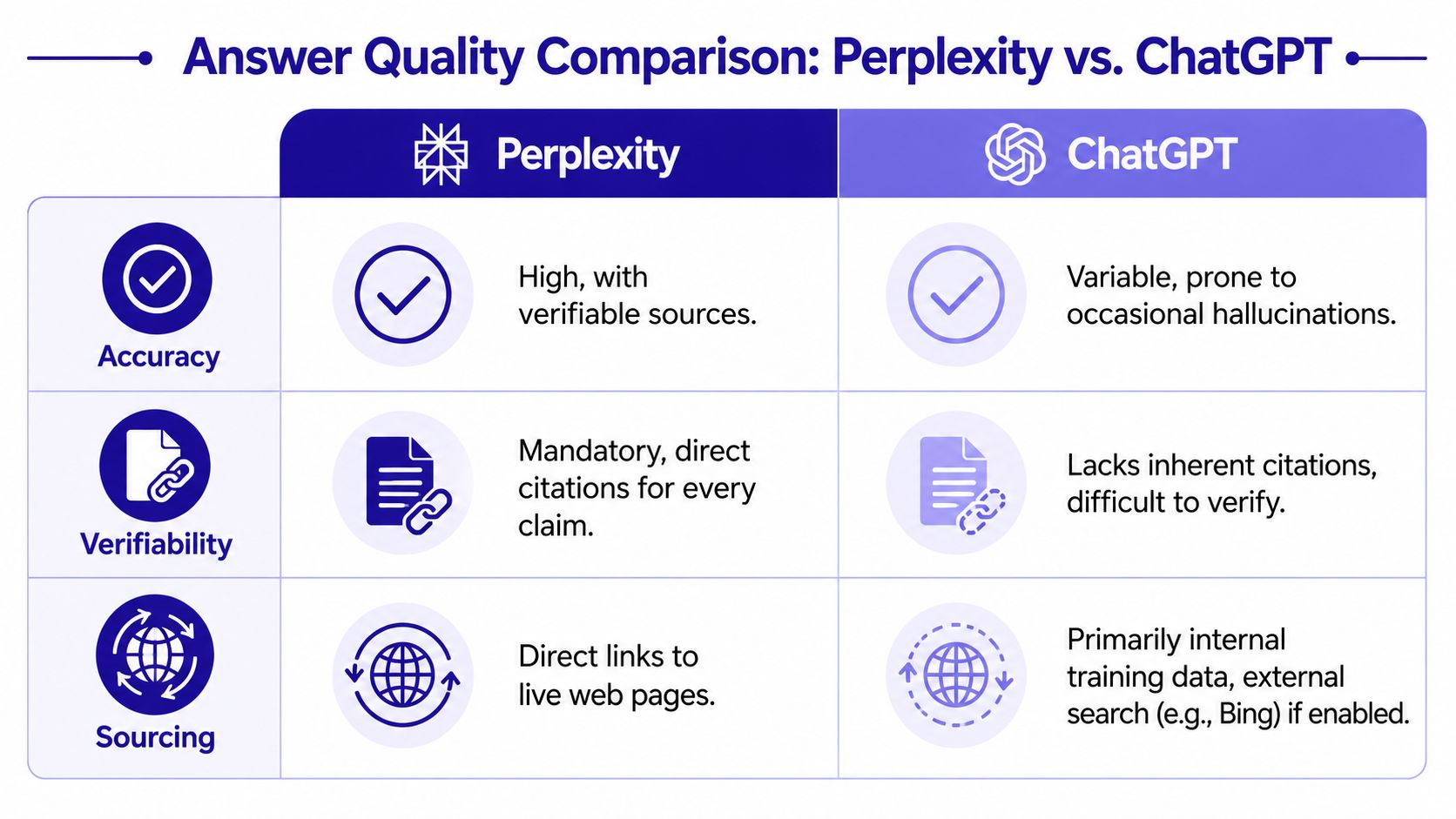
If you care about factual work, “accuracy” isn't enough as a standard. You need verifiability. An answer that sounds correct but can't be traced is still risky.
ChatGPT has become the largest general-purpose chatbot, with over 180 million monthly users as of 2025. But Perplexity's search-first setup makes it 2.3x more effective for fact-based research, and ChatGPT's confidence-led style produces a 35% higher rate of hallucinations in time-sensitive domains compared with Perplexity's source-verified model, according to the verified data set supplied for this article.
Perplexity is easier to audit
Perplexity's biggest operational advantage isn't that it's always smarter. It's that it's easier to check.
Its answer format encourages source inspection. You can see what pages it relied on, compare domains, and decide whether the response is grounded in a primary source, a secondary summary, or weak web clutter. For SEO teams, that matters because it mirrors how you should evaluate whether your own content is citation-worthy.
Use Perplexity when the prompt depends on freshness or source authority, such as:
- Time-sensitive business facts: latest filings, news, pricing changes, product launches
- Research synthesis: comparing public statements across publishers
- Source validation: checking whether a claim traces back to an original report or just gets repeated across blogs
A useful workflow is to ask for the answer, then immediately audit the sources. Open the cited URLs. Check publication date, first-party ownership, and whether the page supports the sentence Perplexity generated.
ChatGPT is smoother but less inspectable
ChatGPT often wins on readability. It can explain a difficult concept more naturally, maintain context across follow-up questions, and produce cleaner framing. That's useful. It's also where teams get overconfident.
When a model speaks fluently, people stop interrogating its claims.
If you use ChatGPT for research, treat it as a drafting and reasoning layer, not a final authority. Ask it to surface assumptions, identify missing variables, or restate source-backed material you've already gathered elsewhere.
For teams trying to operationalize this, analyzing citation gaps in AI answers is more productive than debating which chatbot “feels” more accurate. A key issue is whether your content appears in the answer layer at all.
A fluent answer is not the same thing as a defensible answer.
Best Use Cases for Research Creative and Code
The easiest way to choose between Perplexity and ChatGPT is to stop thinking in product terms and think in jobs.
Perplexity includes specialized research environments for academia, patents, and travel, plus Premium Sources that provide access to paywalled data from Statista, CB Insights, and PitchBook. ChatGPT's Deep Research is limited to publicly available web sources. User ratings give Perplexity a narrow lead in factual consistency, while ChatGPT performs better for creative coding such as Excel VBA and complex mathematical reasoning, according to Zapier's hands-on comparison.
Research and fact checking
If the work starts with “find out what's true,” Perplexity usually wins.
That includes market scans, competitor verification, trend checks, literature reviews, citation-led briefing docs, and sourcing for executive memos. The value isn't just the answer itself. It's the path from answer to source.
Choose Perplexity when you need to:
- Verify a moving target: recent developments, current vendor positioning, updated policy language
- Pull source sets fast: multiple articles, studies, or domain-specific references in one pass
- Work in specialist environments: academic or patent-oriented retrieval where source framing matters
Perplexity is also better suited for research handoff. A strategist can gather cited material, pass it to a writer or analyst, and preserve the source trail.
Creative writing and content production
ChatGPT is usually the better production partner once the facts are known.
It handles voice control, reframing, ideation, restructuring, and iterative refinement with less friction. If you need ten headline variants, a more assertive tone, a shorter executive summary, or alternate CTA directions, ChatGPT tends to respond more naturally.
Use ChatGPT for work like this:
- Draft shaping: turning notes into an article intro, landing page draft, or email sequence
- Style iteration: changing tone from technical to approachable, or from neutral to persuasive
- Content systems: repurposing one research set into FAQs, social posts, talking points, and briefs
If the task is “help me think and rewrite,” ChatGPT usually gives you more range.
Coding documentation and problem solving
This is the most nuanced category.
For current documentation, package changes, library examples, and external implementation references, Perplexity has a retrieval advantage because it can inspect live sources and point you to docs, discussions, and examples. For actual code generation, debugging logic, and iterating through a broken implementation, ChatGPT often feels stronger.
A practical split looks like this:
| Task | Better first tool | Why |
|---|---|---|
| Find the latest library docs | Perplexity | Live retrieval and source links |
| Compare implementation examples | Perplexity | Faster source gathering |
| Generate boilerplate code | ChatGPT | Better generative flow |
| Debug logic step by step | ChatGPT | Stronger conversational reasoning |
| Explain math-heavy logic | ChatGPT | Better structured explanation |
The strongest teams don't force a single winner. They use Perplexity to locate the current ground truth, then move into ChatGPT to build, revise, and troubleshoot against that material.
Advanced Features Ecosystems and Pricing
The free versions tell you how the tools think. The paid plans tell you how they fit into a workflow.
Perplexity Pro offers content generation in exactly 28 languages, and its deeper mode expands answers by actively pulling from multiple sources and structuring them with clickable citations. ChatGPT responds in the user's commanded language and is generally broader for multilingual conversational use, but it often lacks the same clear source attribution, according to ResultFirst's comparison of Perplexity AI and ChatGPT.
Where Perplexity pulls ahead
Perplexity's strongest paid advantage is model flexibility inside a research-centered interface. Verified data for this article notes that Perplexity Pro launched at $20/month, offers over 300 advanced searches per day, and supports access to third-party models in addition to its own research stack.
That matters if you want one environment for retrieval with model choice layered on top. It also matters if your work depends on premium data access rather than public web summaries.
Perplexity becomes more attractive when your workflow depends on:
- Model choice in one place: switching between providers without leaving the platform
- Citation-preserving output: keeping source links visible in the answer itself
- Research-oriented modes: deeper retrieval rather than open-ended chat as the default behavior
After teams compare pricing sheets, this product walkthrough helps anchor the ecosystem question in actual usage:
Where ChatGPT keeps the advantage
ChatGPT still has the broader general-purpose ecosystem.
The key edge isn't just the chat interface. It's the surrounding product surface. Teams that need custom workflows, internal assistants, broader enterprise integration, or a stronger operational layer for content and analysis will usually find ChatGPT more adaptable.
The trade-off is straightforward:
- Pick Perplexity Pro if your subscription needs to justify itself through research speed, source transparency, and live retrieval.
- Pick ChatGPT's paid plans if your subscription needs to support drafting, ideation, coding, internal workflows, and a wider set of business use cases.
- Use both if your team separates evidence gathering from output production.
For many professionals, price parity doesn't decide the winner. Workflow fit does.
Optimizing for the AI Citation Gap
Many organizations still approach AI search backward. They benchmark prompts, compare answers, and debate which system mentions their brand more often. That's useful, but incomplete.
The harder and more valuable question is why one URL gets cited while another gets ignored.
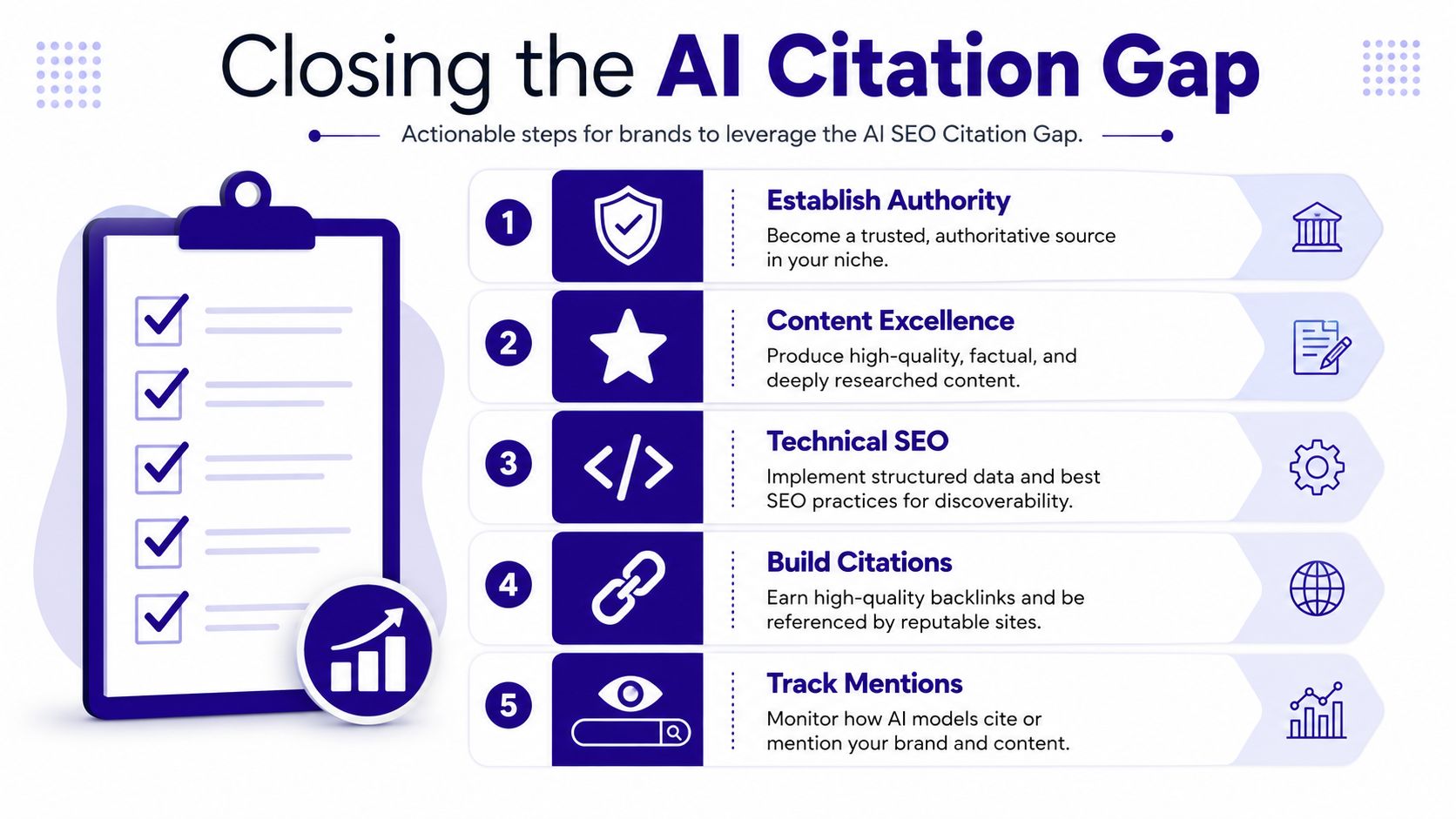
The AI SEO Citation Gap is the missing layer in most Perplexity vs ChatGPT discussions. Perplexity includes inline citations on nearly every response, yet mainstream guides rarely explain the structural updates that improve inclusion, such as schema and entity-rich content. One platform built specifically around this problem runs 120+ AI visibility checks to identify citation blockers and improve LLM inclusion, as described in Tech Insider's write-up on the AI SEO citation gap.
What most teams miss
AI systems don't cite pages because those pages are “good” in the abstract. They cite pages that are easy to parse, specific enough to trust, and structurally aligned with retrieval.
That means generic “helpful content” advice isn't enough. You need pages that clearly declare entities, answer discrete questions, expose supporting facts, and reduce ambiguity.
The pages most likely to earn citations usually share a few traits:
- Clear factual blocks: concise claims supported by surrounding context, not vague marketing copy
- Strong entity signals: products, people, organizations, methods, and concepts stated explicitly
- Readable structure: headings, lists, tables, and scannable sections that isolate answerable units
- Supportive markup: schema that helps machines interpret page purpose and content type
If you're serious about this channel, optimizing for Perplexity AI search is the right mindset. You aren't just publishing for humans or crawlers. You're publishing for answer extraction.
How to improve your odds of being cited
At this stage, GEO becomes operational. Start with page-level work, not vague brand-level ambition.
Tighten topic boundaries
One URL should answer one primary intent cluster well. Mixed-intent pages confuse retrieval systems.Add entity-rich language
State the exact product name, category, use case, audience, and context. Replace pronouns and loose references with explicit nouns where it improves clarity.Use structured answer formats
Short definitions, step lists, comparison tables, and FAQ-style sections create extractable units. Dense opinion-only prose is harder to cite.Support claims visibly
When you make a factual statement, anchor it in nearby context, first-party evidence, or clearly attributable material. Unsupported assertions are weak citation candidates.Implement useful schema
HowTo,FAQ,Article,Organization, and other relevant markup can improve machine readability when used correctly.
The citation opportunity usually isn't blocked by a lack of content. It's blocked by weak structure, vague entities, and pages that bury the answer.
Traditional SEO focused on ranking blue links. GEO adds a second job: making your content easy for AI systems to trust and quote at the URL level.
The Right AI for the Right Job
Perplexity and ChatGPT create different advantages, and the gap matters more now that AI answers shape what gets seen, trusted, and cited.
Choose Perplexity for live research, source checking, and SERP-adjacent work where verifiability matters. It is better suited to finding current evidence, comparing claims across sources, and pressure-testing what belongs in a brief. Choose ChatGPT for synthesis, rewriting, outlining, ideation, and turning raw inputs into usable deliverables.
For SEO teams, researchers, and content operators, the strongest setup is hybrid. Perplexity helps validate the facts and surface citation candidates. ChatGPT helps convert that material into strategy, drafts, content updates, and workflow outputs your team can ship.
The bigger shift is strategic. The next advantage is not just producing faster with AI. It is closing the AI SEO Citation Gap, which means structuring pages so these systems pull your URL into answers instead of summarizing a competitor.
That changes how teams should evaluate both tools. The question is no longer which assistant sounds smarter in a prompt window. The better question is which system helps you research accurately, create efficiently, and increase the odds that your own content becomes the cited source. If your team is working toward URL-level citation wins, Nuwtonic is built for that layer of work, combining AI search visibility tracking, GEO auditing, technical fixes, content operations, and prompt-level monitoring so teams can find why pages are not being cited, fix the blockers, and publish updates that improve discoverability across AI search surfaces.