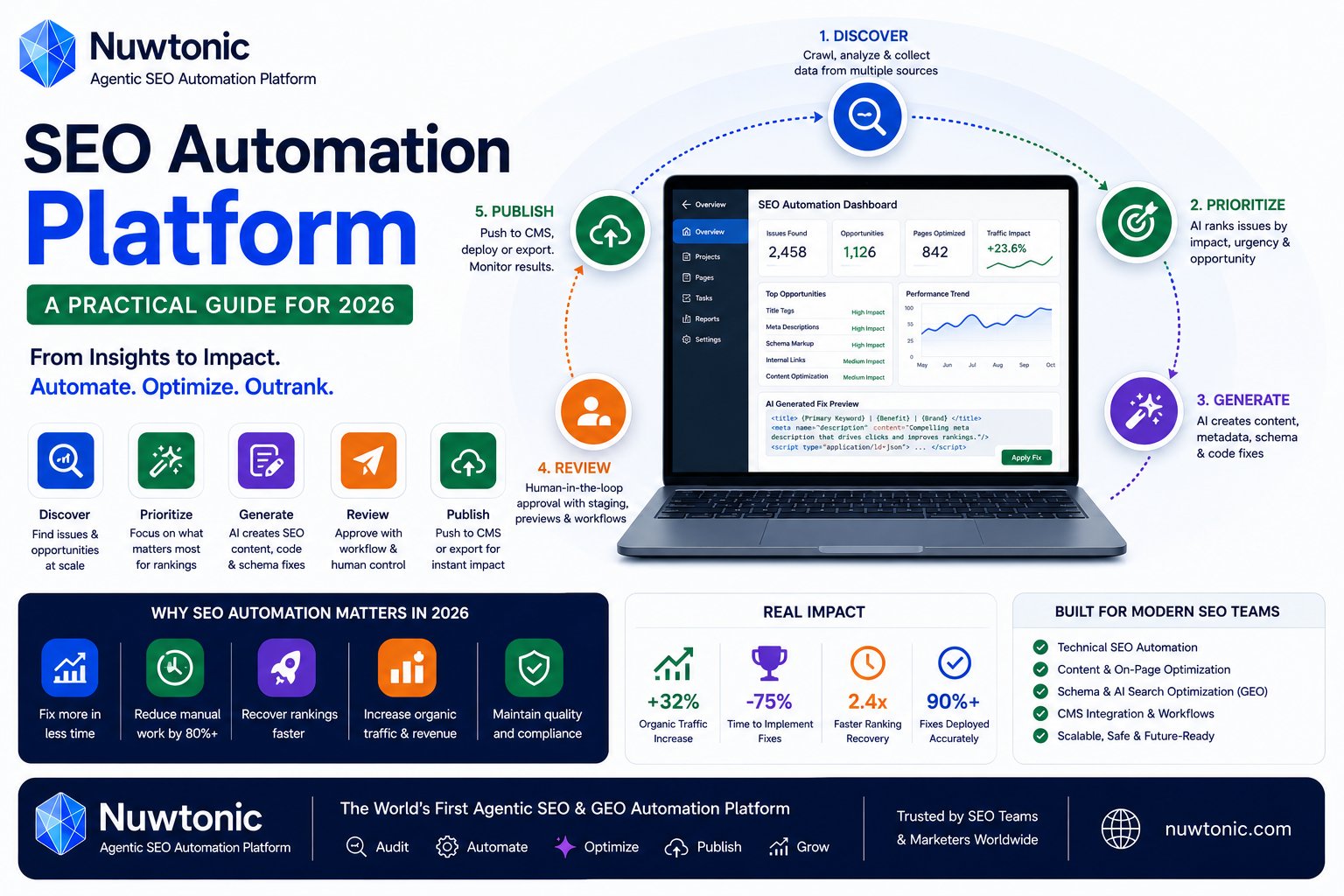
Most advice about SEO automation is stuck in the reporting era. It assumes the hard part is finding issues, exporting them, and handing a backlog to content teams, developers, or clients. That isn't automation. That's faster diagnosis followed by the same old manual work.
A real SEO automation platform closes the loop. It connects data, decides what matters, generates the fix, routes it for review, and pushes the approved update into the CMS or workflow you already use. That shift matters more now because search visibility no longer lives only in blue links. Teams also need machine-readable structure, AI citation visibility, and a way to act on both without creating another spreadsheet queue.
Table of Contents
- Beyond Reports The Execution Gap in SEO Automation
- Anatomy of a True SEO Automation Platform
- Optimizing for AI Search Generative Engine Optimization GEO
- A Hands-On Implementation Workflow
- Measuring ROI Key KPIs for SEO Automation
- Evaluation Checklist and Common Pitfalls
- Frequently Asked Questions
- Is an SEO automation platform only for large teams
- Will automation replace SEO specialists
- Is direct CMS publishing safe
- Do I still need tools like Ahrefs, Semrush, or Screaming Frog
- What's the biggest sign that a tool isn't real automation
- How should a team start without disrupting everything
- How is GEO different from traditional SEO in day-to-day work
Beyond Reports The Execution Gap in SEO Automation
For years, vendors labeled dashboards and audits as automation. They automated discovery, not delivery. If you've ever exported a crawl, opened a ticket, waited for approvals, then chased implementation for weeks, you've seen the problem firsthand.
The bottleneck isn't lack of insight. It's the handoff chain after the insight appears. According to Siteimprove's analysis of the SEO automation tools landscape, 68% of technical SEO errors remain unfixed for over 30 days due to implementation delays after reporting-only tools identify them. That one number explains why many teams feel over-instrumented and under-executed.
Why reporting-only tools stall out
Traditional tools do several jobs well:
- They surface issues fast: crawl errors, missing metadata, duplicate titles, thin pages, broken internal links.
- They organize evidence: screenshots, URL lists, severity labels, trend views.
- They help with diagnosis: rankings, competitors, content gaps, technical patterns.
What they don't do well is move from recommendation to approved production change.
A typical flow still looks like this:
- SEO team runs an audit.
- Team exports a CSV or creates tickets.
- Writer, developer, or client reviews the ask.
- Someone rewrites the recommendation into implementation language.
- Another person makes the update in the CMS.
- SEO checks whether it was done correctly.
That isn't a platform problem only. It's also an operating model problem. But the platform either reduces that friction or preserves it.
Practical rule: If a tool stops at "issue found" and your team still has to manually rewrite, assign, and publish the fix, you're buying a reporting engine, not automation.
What execution actually means
Execution-focused platforms add a working layer between diagnosis and deployment. That layer usually includes:
- Prioritized actions: not just error lists, but ranked opportunities tied to real search data.
- Generated fixes: metadata, schema, content patches, alt text, internal links, or structural updates.
- Review controls: staging, previews, permissions, and approval workflows.
- Publish paths: CMS pushes, exports built for direct implementation, or API-driven updates.
This matters most when rankings dip and recovery speed counts. Reporting-only stacks create lag because each team translates the same problem into its own language. Execution systems reduce that translation work.
The practical standard is simple. A modern SEO automation platform shouldn't only tell you what's wrong. It should help you ship the remedy while keeping human review in place.
Anatomy of a True SEO Automation Platform
The market is moving in that direction fast. The global SEO optimization software market was valued at $85.09 billion in 2025 and is projected to reach $207.43 billion by 2032, according to MetaStat Insight's SEO optimization software market report. That growth isn't about prettier dashboards. It's about demand for systems that can audit, optimize, and manage SEO work at scale.
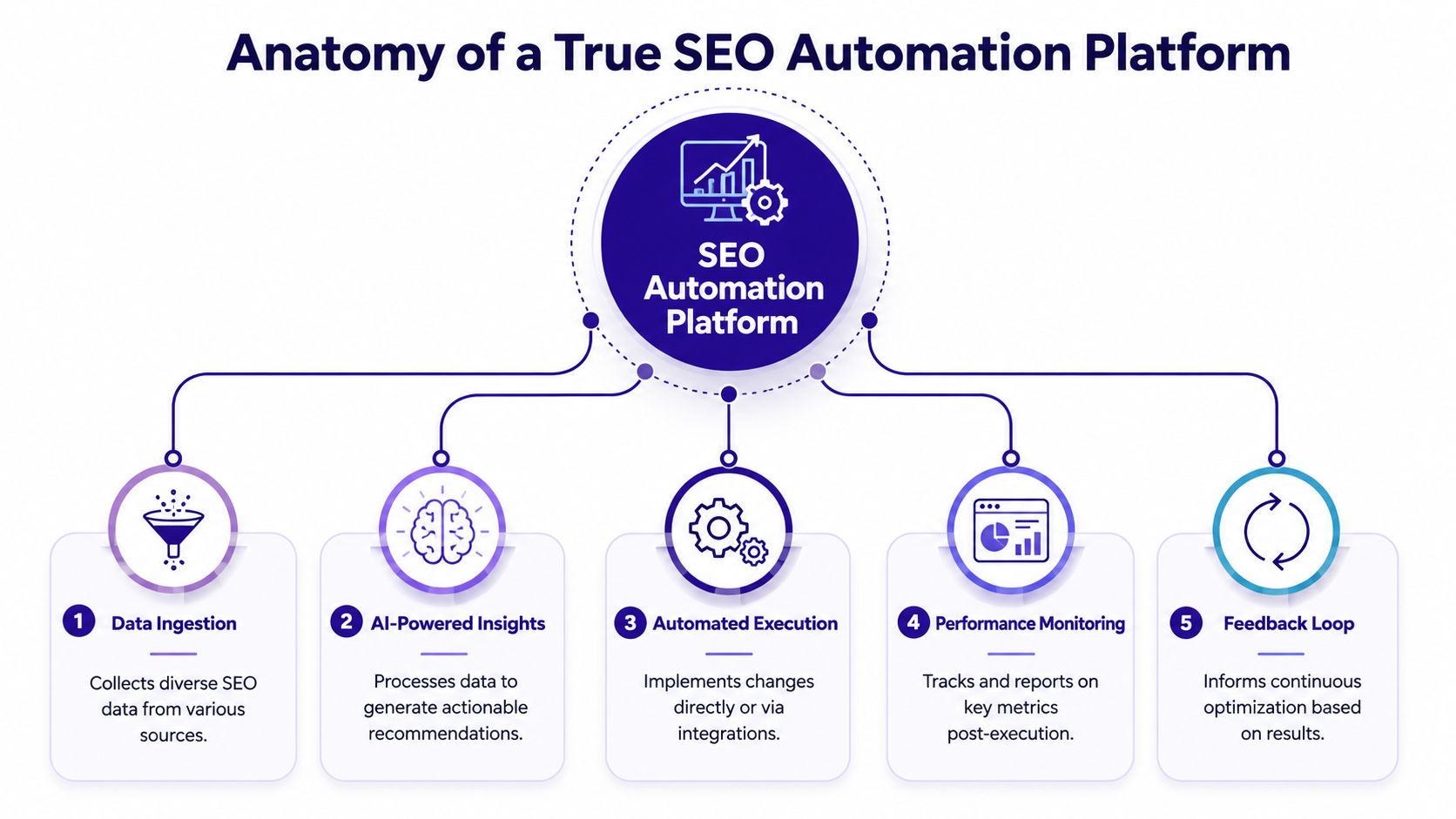
Five parts that need to work as one system
Think of a serious platform as a connected operating system, not a toolbox.
1. Data ingestion and diagnosis
This is the intake layer. It pulls in Google Search Console, crawl data, on-page signals, page templates, and often competitor context. Without this foundation, prioritization is guesswork.
2. Prioritization and strategy
A useful platform doesn't dump a thousand issues on the team. It ranks work by likely impact, urgency, and pattern. A falling page with strong impressions but weak CTR deserves attention before a random archive page with a missing H1.
3. Content and code generation
Automation then transitions to an operational state. The system should generate title tag revisions, meta descriptions, schema improvements, alt text, FAQ blocks, internal links, and content patches in a format people can review.
What a mature stack looks like in practice
4. The execution layer
This is a capability frequently overlooked. The platform should create deployable changes, not just advice. Good systems offer previews, approval steps, and direct publishing or CMS-ready output. That's the difference between "you should update this schema" and "here is the validated schema patch ready for approval."
5. Monitoring and adaptation
After deployment, the platform needs to watch query movement, CTR changes, cannibalization, crawl health, and AI visibility shifts. Otherwise you just automated publishing, not learning.
A compact way to evaluate architecture is to ask whether the platform can do these jobs in one flow:
| Platform layer | What it should do |
|---|---|
| Data layer | Pull performance and crawl signals into one view |
| Decision layer | Rank issues and opportunities by likely impact |
| Generation layer | Produce fixes for content and technical elements |
| Execution layer | Route reviewed updates into live environments |
| Feedback layer | Measure results and trigger the next action |
Some products cover only one or two layers. Screaming Frog is excellent for crawling. Semrush and Ahrefs are strong for research and diagnostics. A platform like Nuwtonic's SEO automation workspace is built around the missing execution layer as well, combining audits, prioritized actions, and reviewable fixes in one system.
Teams usually don't need more alerts. They need fewer handoffs between the alert and the deployed fix.
Optimizing for AI Search Generative Engine Optimization GEO
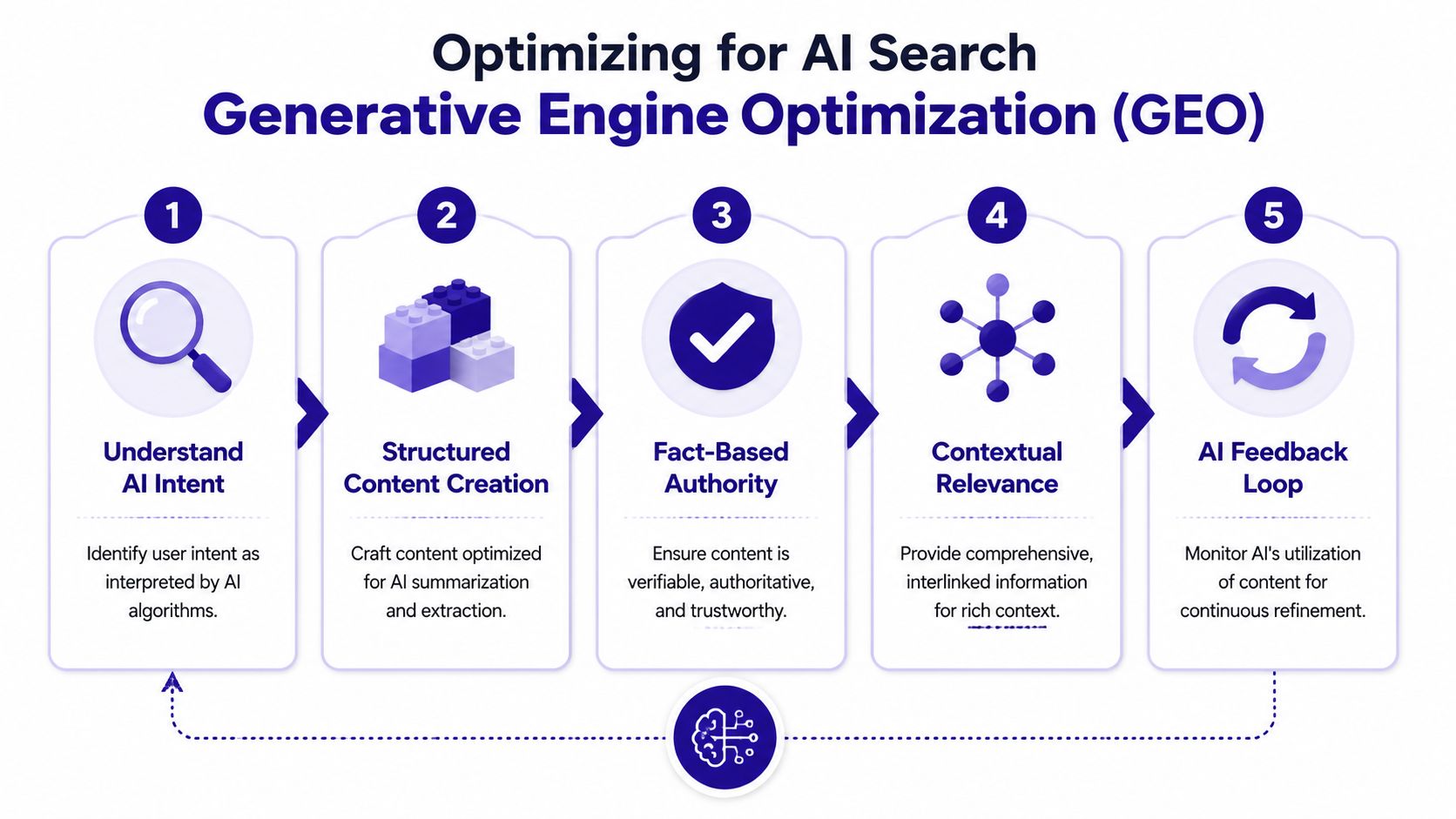
AI search changed the job description. Ranking in a classic SERP is no longer the whole game. A page can be visible to users through AI answers, summaries, and citations even when it isn't the top traditional result. That means a modern SEO automation platform needs a second operating mode: Generative Engine Optimization, or GEO.
A useful GEO workflow starts at the page level, not the brand level.
Why GEO changes platform requirements
Many tools still report AI visibility as broad brand mentions. That's not enough. According to Numerous.ai's discussion of SEO marketing automation, 52% of brands appear in AI answers without direct URL citations. If you can't see which pages are cited, omitted, or paraphrased, you can't fix this visibility problem.
That creates three new requirements.
- URL-level tracking: you need to know which page earns citation inclusion for a prompt or topic.
- Entity clarity: pages need machine-readable context so models can identify who the page is about, what it covers, and how it connects to the rest of the site.
- Structural consistency: AI systems depend on parseable formatting more than teams often assume.
A lot of old-school on-page advice doesn't survive contact with AI retrieval. Single pages targeting a broad topic often don't give models enough corroborating context. Topic depth, internal linking, and structural markup now carry more weight in practical workflows.
The technical layer most teams still miss
The technical side of GEO is where automation starts to matter. According to AI Growth Agent's overview of AI programmatic SEO platforms, modern platforms must automate AI-specific technical schema, including MCP servers and LLM.txt files, as these are now required for citations in AI search engines. Without end-to-end automation of these structural updates, brands face a measurable decline in AI citation rates.
That has direct workflow implications. A platform should be able to:
- Validate structure: confirm schema integrity, metadata completeness, and machine-readable content elements.
- Check AI-facing files: detect whether LLM.txt and related access structures are present and readable.
- Patch gaps at scale: apply fixes across multiple pages, templates, or content clusters.
- Track page-level inclusion: connect technical changes to observed citation behavior over time.
A short briefing on the topic helps before implementation:
Treat GEO like technical SEO plus citation engineering. If your system only measures mentions, you're missing the page-level levers that actually affect inclusion.
The practical takeaway is blunt. AI search isn't something to "also monitor." It requires dedicated audits, page-level tracking, and structural remediation that most reporting tools were never built to handle.
A Hands-On Implementation Workflow
The focus should not be on another abstract framework. What is required is a repeatable operating routine. The workflow below is the one that usually separates a useful platform from shelfware.

Step 1 through Step 3
Step 1. Connect Google Search Console first
Start with the source that shows impressions, clicks, CTR, and query-page relationships. According to this review discussing GSC-connected SEO automation workflows, SEO automation platforms that integrate directly with Google Search Console can reduce issue detection time by up to 70% compared to manual audits, which is why GSC should be the first connection, not an optional add-on.
Step 2. Run one unified audit
Don't split technical SEO, on-page checks, and AI visibility into separate tools if you can avoid it. Run one pass that inspects metadata, schema, alt text, internal linking, thin content, query decay, cannibalization, and AI-readiness signals. The output should be one ranked queue, not five disconnected dashboards.
Step 3. Triage by business impact
Operators save time here. Review pages with existing impressions first. Then look for pages with declining CTR, strong rankings but weak click capture, or multiple URLs competing for the same query set.
A good platform should also help map page clusters and AI-oriented content coverage. If you want a working example of the content side of that process, this guide on how to optimize content for AI search is a practical companion to the technical workflow.
Step 4 through Step 5
Step 4. Generate the fix, don't write tickets from scratch
Once the priority queue is clear, use the platform to produce concrete changes:
- Metadata revisions: title tags and descriptions built from query intent.
- Schema patches: fixes or additions tied to page type and content.
- Content improvements: missing sections, FAQs, entity reinforcement, and internal links.
- Template changes: repeated issues solved once at the source instead of page by page.
Step 5. Review in staging, then deploy
Automation without control is a governance problem. The right flow is review, approve, push. That means previews, permissions, and a staging checkpoint before the CMS update goes live.
The best implementations also keep a short post-deploy checklist:
- Confirm the page rendered correctly.
- Validate metadata and schema.
- Re-crawl or re-check the URL inside the platform.
- Monitor query and page movement over the next cycle.
This is the daily value of an execution-first SEO automation platform. It compresses detection, decision, and deployment into one working loop.
Measuring ROI Key KPIs for SEO Automation
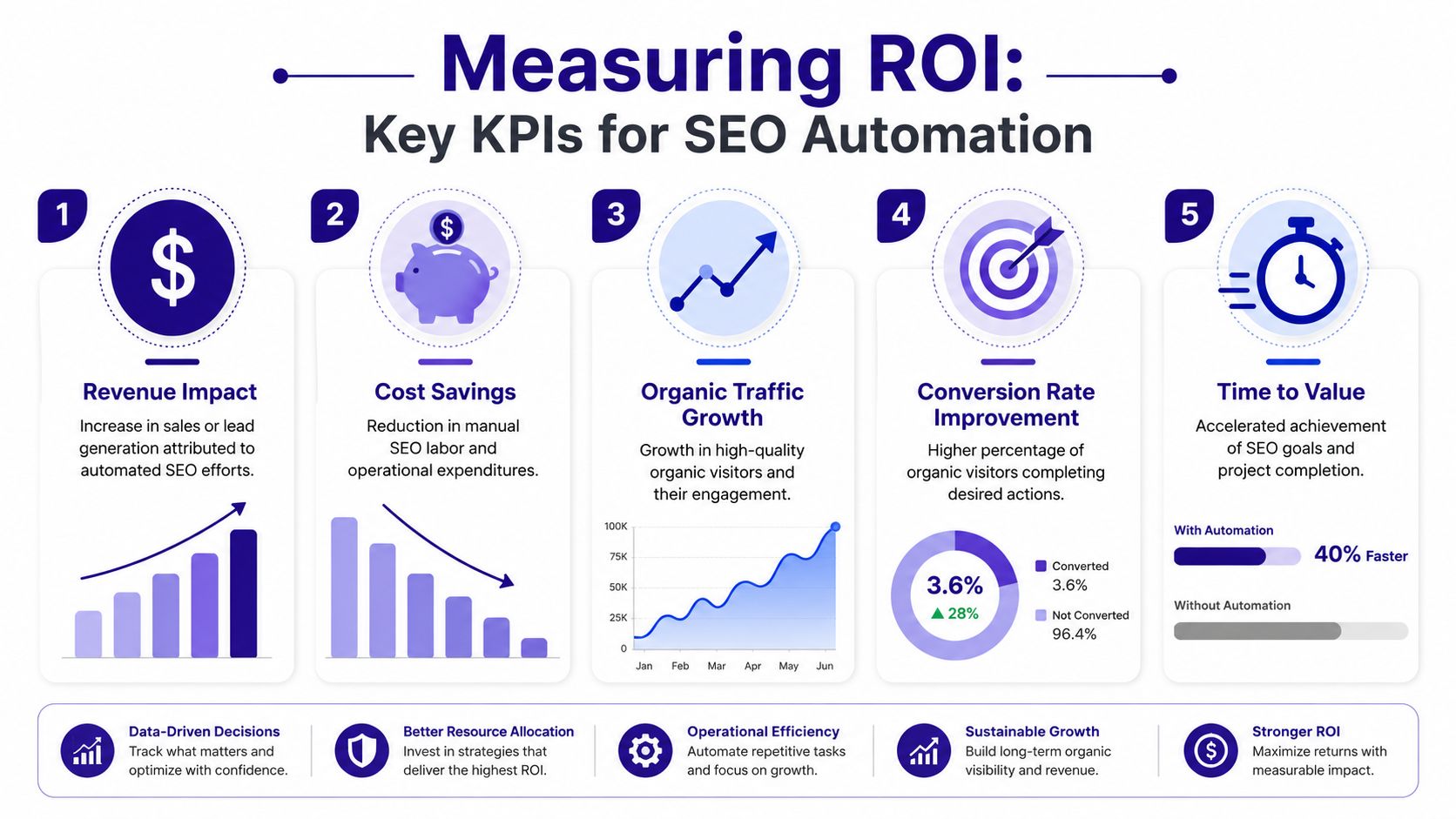
Rankings are a lagging indicator. They matter, but they do a poor job of explaining why an SEO automation platform is paying for itself in the first 30 to 90 days. True ROI shows up earlier in execution: how quickly teams fix issues, how many approved changes ship, and whether priority URLs gain visibility in both classic search and AI answers.
What to measure instead of vanity metrics
Start with KPIs tied to completed work, not observed problems.
Time to resolution
Measure the time from issue detection to approved deployment. Old reporting tools create activity. Execution platforms create fixes. That difference shows up in cycle time.
Content throughput
Track how many page updates, net new pages, metadata revisions, and schema fixes reach production in a given period. Nuwtonic notes on its LinkedIn company page that agent-driven workflows increase content throughput and reduce time to publish. The exact gain varies by team, but the KPI is still useful because faster publishing usually means faster response to demand shifts, content decay, and new query patterns.
AI share of voice
For GEO, measure whether specific URLs are cited in AI answers for your target prompt sets. Brand-level mention tracking is too broad to guide page-level optimization. A tighter KPI model for AI visibility is covered in this guide to AI search visibility metrics and KPIs.
One more filter helps. Separate detected issues from resolved issues. A backlog of findings can make a platform look busy while the site barely changes.
A simple operator view of ROI
I recommend a KPI stack that reflects execution speed, output, and URL-level visibility:
| KPI | Why it matters | What to look for |
|---|---|---|
| Time to resolution | Shows process efficiency | Shorter lag from issue to deployment |
| Content throughput | Shows production capacity | More updates shipped without adding manual steps |
| Publish cycle time | Shows workflow friction | Faster movement from draft or recommendation to live page |
| AI citation visibility | Shows GEO progress at the URL level | More target URLs cited in AI answers for priority prompts |
| Recovery speed | Shows response capability | Faster correction after traffic loss, indexing issues, or content decay |
A dashboard should also answer one operational question without manual cleanup: how many approved fixes shipped this week? If the platform cannot connect recommendations to deployed changes, it is measuring reporting volume, not automation.
Review these KPIs by workflow type as well. Technical fixes, content updates, and AI citation work often move at different speeds. That breakdown makes it easier to see where the platform is reducing manual effort and where the team is still stuck in review queues or copy-paste production work.
Evaluation Checklist and Common Pitfalls
Buying an SEO automation platform gets expensive when teams evaluate demos instead of workflows. The safest way to compare tools is to ask what happens after an issue is detected. That one question exposes most of the gap between reporting products and execution systems.
SEO Automation Platform Evaluation Checklist
| Capability | Question to Ask | Ideal Answer |
|---|---|---|
| Execution layer | Does the platform apply or prepare fixes, or only report them? | It generates reviewable fixes and supports deployment into the CMS or workflow |
| GSC integration | Does it use Search Console data for prioritization? | Yes, it ranks tasks using real query, page, and CTR signals |
| On-page automation | Can it generate metadata, schema, alt text, and content patches? | Yes, with page-level review before publishing |
| AI visibility tracking | Does it track AI inclusion at URL level? | Yes, it shows which URLs are cited, omitted, or surfaced in AI answers |
| GEO technical support | Can it detect and remediate AI-specific structural gaps? | Yes, it audits machine-readable SEO and AI-facing elements |
| Change control | Are there approvals, previews, and permissions? | Yes, human review is built into deployment |
| CMS connectivity | Can it push fixes directly or produce CMS-ready output? | Yes, deployment is part of the workflow |
| Monitoring | Does it measure results after changes go live? | Yes, it tracks post-deployment performance and visibility shifts |
Mistakes buyers keep making
The first mistake is overvaluing feature count. A long list of reports, graphs, and exports looks impressive in a sales call. It doesn't help if the team still has to manually translate each recommendation into publishable work.
The second mistake is ignoring URL-level AI tracking. If the tool only reports brand visibility, it won't help you improve page inclusion in AI outputs.
The third mistake is treating governance as a nice-to-have. Teams need review-before-deploy controls, especially when schema, content, and metadata are changing at scale.
A final mistake is buying a stack of point tools and assuming integration will solve everything later. Sometimes that's the right path. Often it leaves teams juggling crawlers, content tools, rank trackers, and AI monitors that never produce one deployable queue.
Frequently Asked Questions
Is an SEO automation platform only for large teams
No. Large teams feel the pain sooner because they manage more URLs, stakeholders, and CMS workflows. Small teams benefit too because automation removes repetitive implementation work that usually steals time from strategy.
Will automation replace SEO specialists
No. It changes where they spend time. Strong teams still decide priorities, review fixes, shape content direction, and handle trade-offs. The platform should take over repetitive detection and draft-level execution, not strategic judgment.
Is direct CMS publishing safe
It can be, if the platform includes staging, previews, approvals, and permissions. A review-before-deploy workflow is the safer model. Fully automatic publishing without controls creates obvious risk.
Do I still need tools like Ahrefs, Semrush, or Screaming Frog
Often, yes. Those tools remain useful for research, crawling, and competitive analysis. The question isn't whether they have value. The question is whether they stop at insight or help you execute. Many teams keep specialist tools and add an execution layer on top.
What's the biggest sign that a tool isn't real automation
It produces more tickets than fixes. If every recommendation still needs manual rewriting, routing, and CMS entry, the system is accelerating detection while preserving the same operational bottleneck.
How should a team start without disrupting everything
Start with one workflow. Good candidates are metadata fixes, schema remediation, or content refreshes on pages that already have impressions. Prove the review and deployment flow on a narrow set, then expand to broader technical and GEO use cases.
How is GEO different from traditional SEO in day-to-day work
Traditional SEO often focuses on rankings, CTR, and crawlability. GEO adds page-level citation visibility, machine-readable structure, and AI-facing technical elements. In practice, that means teams need to audit for inclusion, not just rank.
If you want one system that connects GSC data, technical audits, content operations, and URL-level AI search visibility with reviewable execution workflows, Nuwtonic is one option to evaluate alongside your current stack. The key test is simple. It should help your team ship approved fixes, not just find more problems.