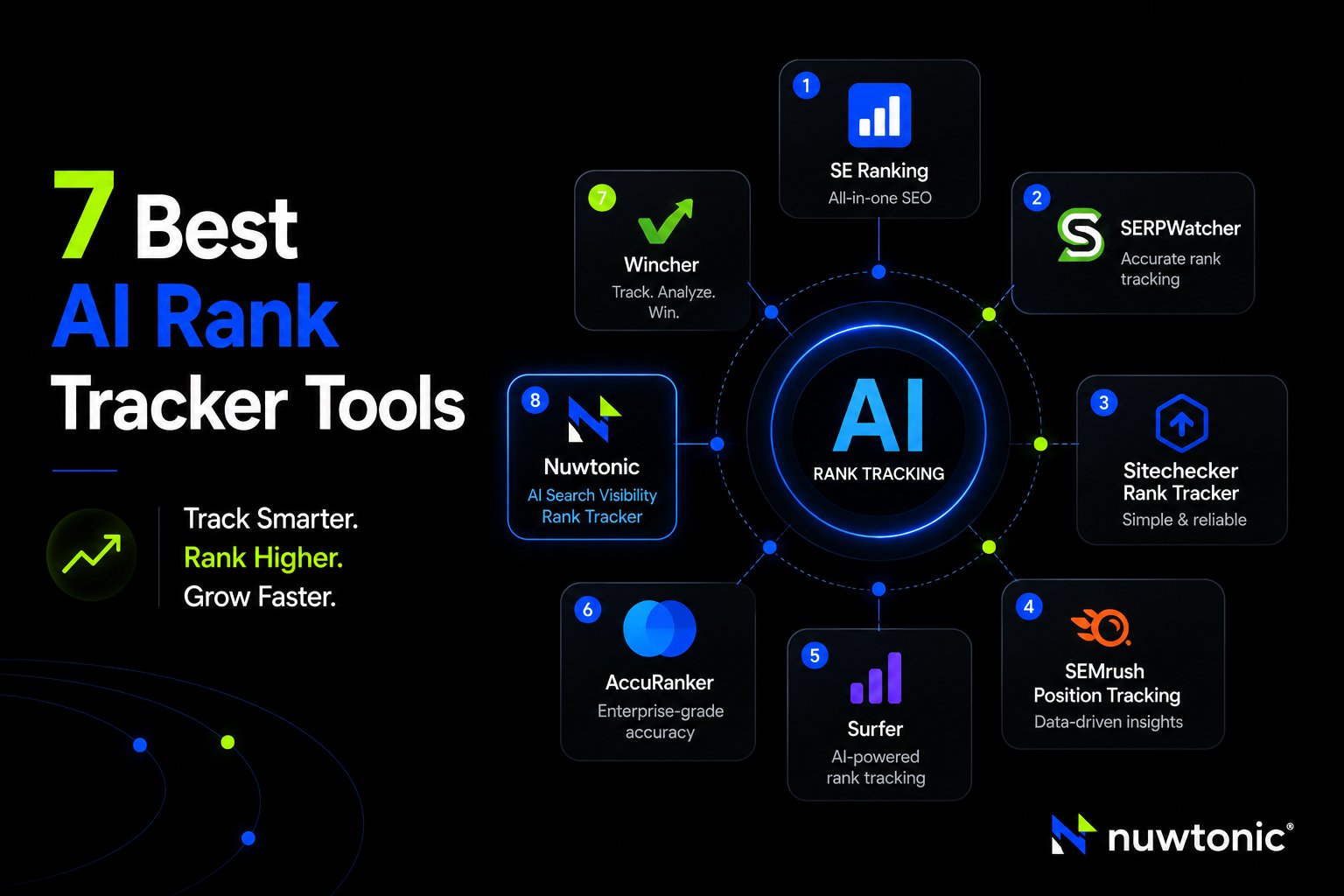
An AI rank tracker isn't a traditional keyword tool with an “AI” label attached. It measures two different layers of search visibility: conventional rankings, including position, clicks, CTR, SERP features, and competitor movement, plus AI-search presence, including prompts, brand mentions, cited URLs, and Google AI features. Treating those layers as interchangeable creates misleading reports. A page can retain a strong organic position while an AI Overview changes click distribution, or a brand can be mentioned by an assistant without receiving a link.
The business case for separating these signals is clear. Google holds about 89% of global search market share and processes an estimated 8.5 billion searches per day; organic search drives roughly 53% of website traffic in the same dataset (SEO statistics from InstantPress). Yet when an AI Overview appears, the top organic result loses about 58% of its clicks, which means rank monitoring now needs to explain both classic results and answer surfaces.
This comparison evaluates seven tools against the complete workflow: traditional rankings, direct LLM visibility, URL-level citations, Google Search Console prioritization, competitor gaps, reporting, APIs, and governed fixes. It covers what each platform measures, who should operate it, where its data model stops, and what teams can do after collection. If you're also evaluating a tracking API for product marketing, the API and execution implications matter as much as the dashboard.
Table of Contents
- 1. Nuwtonic
- 2. Semrush
- 3. seoClarity
- 4. SISTRIX
- 5. SEOmonitor
- 6. AccuRanker
- 7. Similarweb Rank Tracker
- Top 7 AI Rank Trackers, Feature Comparison
- Choose the Tracker That Completes the Workflow
1. Nuwtonic
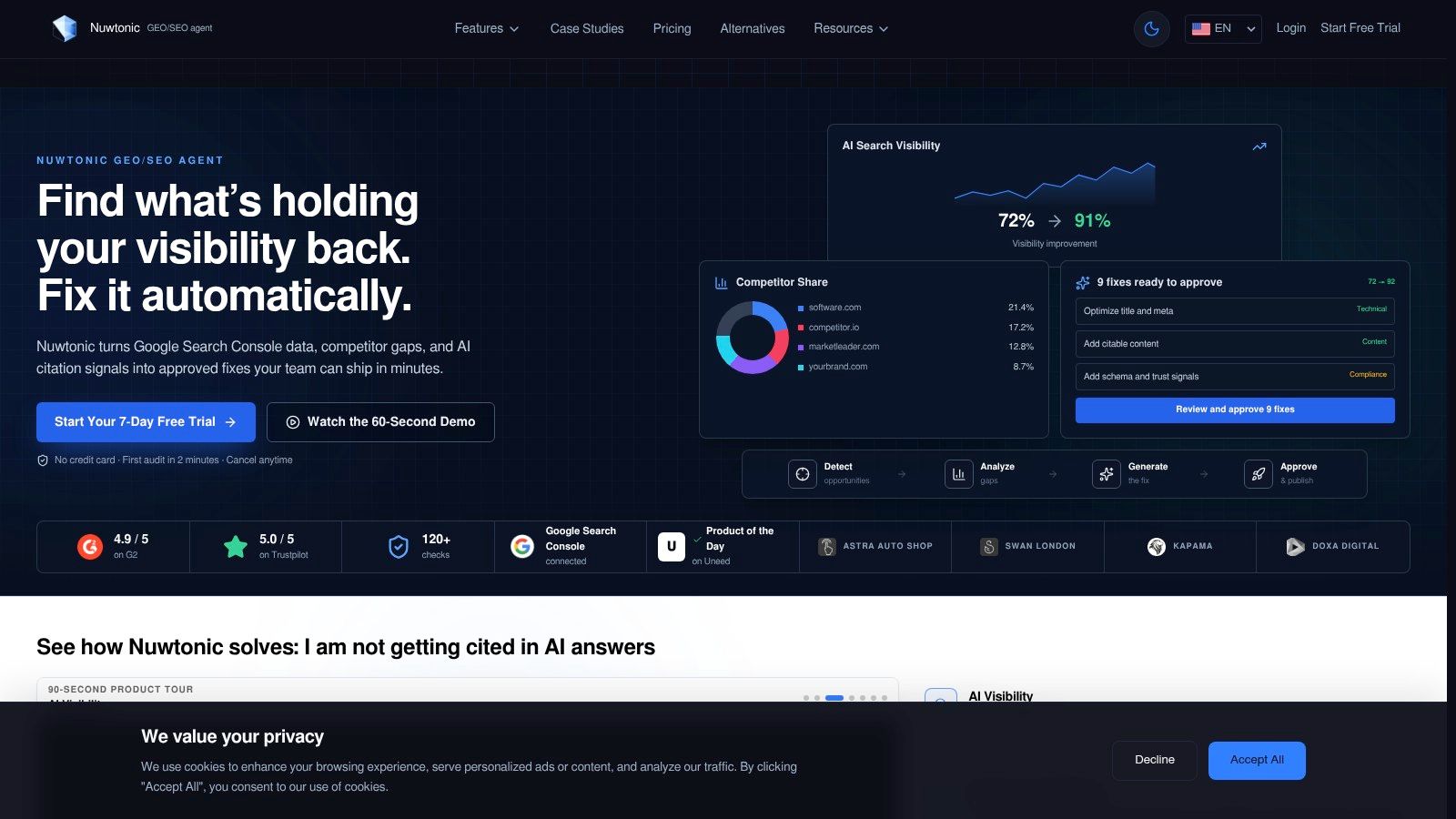
Nuwtonic is the strongest fit when an AI rank tracker must do more than identify a problem. Its operating model connects measurement, prioritization, remediation, review, and deployment in one SEO and GEO workspace. That distinction matters because visibility data has limited value if nobody can turn a lost citation, weak URL, or GSC opportunity into a governed change.
The platform connects Google Search Console with multi-model prompt tracking across ChatGPT, Gemini, Perplexity, Claude, Grok, and Google. Its AI Search Agent records prompt visibility and citations, while competitor gap mapping shows where competing pages or sources appear instead. The platform also runs 120+ AI-trained visibility and technical checks, including GEO structure, metadata, schema, alt text, and other on-page elements. Those checks are more useful when they're tied to a URL and a GSC-informed priority rather than presented as an undifferentiated audit score.
Where Nuwtonic changes the workflow
A team can start with a GSC query or ranking decline, inspect the affected URL, compare competitor coverage, and generate a reviewable fix. Available workflows include metadata, schema, alt text, content updates, keyword clustering, entity-first content generation, topical authority maps based on GSC patterns, cannibalization tracking, mobile opportunity analysis, and Content Autopilot for scheduled or bulk publishing.
The execution layer is the key trade-off. Nuwtonic supports one-click or staged fixes, CMS-ready changes, API and webhooks, workspace permissions, and review-before-deploy controls. It doesn't force automatic publishing by default, which gives agencies and in-house teams a way to preserve editorial and technical approval.
Practical rule: Use Nuwtonic when the reporting question is “what changed, and what should we safely fix next?” rather than only “where do we rank?”
The platform's self-serve plans start at $99 per month for Starter/Bronze, with one domain, one seat, and 1,200 monthly credits. Silver costs $199 per month for five domains, three seats, and 2,400 credits. A Custom Gold tier is available for larger agencies. Teams can test it through a 7-day free trial without a credit card, alongside free audit, schema, meta-generation, and preview tools. Self-serve plans include a 7-day money-back guarantee, and the platform states GDPR, CCPA, and 256-bit SSL protections.
The limitation is the credit model. High-volume publishers need to understand how audits, generations, and other actions consume credits before scaling. Setup also requires a Google Search Console connection and enough brand and site context for the system to prioritize accurately. Nuwtonic's SERP rank tracking feature is therefore best treated as the measurement entry point to a broader operating system, not as an isolated rank database.
Nuwtonic reports a 4.9/5 G2 rating and 5/5 Trustpilot rating, along with Product of the Day and Uneed recognition, but buyers should still validate workflow fit during the trial. Its site also presents customer case studies, including a quote describing a “massive traffic shoot in just 30 days,” and claims of up to roughly 97% less time spent resolving GSC issues. Those are vendor-reported signals, not independent benchmarks, so the useful test is whether the platform shortens your own path from detection to approved deployment.
2. Semrush
Semrush fits teams that want AI visibility beside a mature SEO suite, rather than a separate LLM-monitoring product. Position Tracking connects conventional rankings with SERP features, including AI Overviews presence and cited sources. Its AI Visibility Toolkit and Visibility Overview extend measurement across Google AI features and major assistants such as ChatGPT, Gemini, and Perplexity.
The practical advantage is context. A marketer can compare classic keyword positions, backlinks, audits, keyword research, and competitor data with AI mentions and citations inside the same broader environment. That helps answer a common diagnostic question: did visibility decline because the page lost organic position, because the SERP layout changed, or because an AI answer is now satisfying the query before the user reaches the result?
Best operating model
Semrush is well suited to mid-market and enterprise teams that already use a broad SEO stack. Its reporting can place AI presence next to established SEO KPIs, which reduces the need to explain an entirely new reporting system to stakeholders. It also has early and continuing support for Google AI Overviews within Position Tracking and Sensor, making Google feature monitoring a central part of the workflow.
The limitation is scope. Some AI visibility capabilities require higher tiers or add-ons, and the suite can feel heavy if your only need is daily rank monitoring. Buyers should map each required signal to the plan before comparing headline pricing. A platform that measures direct prompts, citations, and classic rankings may still leave URL remediation to another system.
Semrush is strongest when the organization values a shared intelligence layer more than a built-in deployment layer.
Semrush's large-scale research offers a useful benchmark for what serious AI measurement looks like. Its 2026 AI citations study analyzed more than 126 million real U.S. AI search prompts across 22 industries and four AI platforms (Semrush AI Visibility Index). That scale supports a practical design principle: prompt sets should be segmented by industry, audience intent, and model. A single manually tested prompt can't represent the variation across markets and engines.
Use Semrush when your workflow is research, comparison, reporting, and escalation into existing SEO or content teams. Consider a more execution-oriented platform if the next step needs to be a reviewed schema change, CMS push, or prioritized content patch. Teams comparing the two can also examine this Nuwtonic versus Semrush comparison.
3. seoClarity
seoClarity is designed for organizations that need large-scale rank tracking, enterprise reporting, APIs, and multi-market operations. Its dedicated AI Overviews tracking identifies when an AI Overview appears, how that presence changes over time, and which content receives citations. That makes it more useful for organizations that need historical visibility analysis across substantial keyword sets than for a small team checking a limited list.
The platform's value sits in its data infrastructure. Interactive rank tracking can support AEO and AI workflows, while APIs for rankings, keywords, and content analysis can feed internal business intelligence systems. Unlimited competitor comparisons and enterprise reporting support teams that divide ownership among country managers, product groups, agencies, and central SEO leadership.
Where it fits
A multinational business could use seoClarity to create market-specific keyword lists, isolate queries that trigger AI Overviews, and expose gains or losses to internal dashboards. An enterprise data team could then join those outputs to other business systems through APIs rather than relying on manual exports. This is a different operating model from a lightweight tracker, where the dashboard itself is the main destination.
The platform's main drawback is implementation weight. Custom or enterprise pricing is typically higher than SMB-focused tools, and onboarding requires more planning. Teams should define the data contract first: which markets, devices, competitors, URL fields, AI Overview states, and reporting destinations need to be supported. Without that design, scale produces more data without improving prioritization.
Implementation test: Ask whether your BI team can turn an AI Overview gain or loss into a URL-level owner and a documented action. If it can't, enterprise coverage may create a reporting backlog.
seoClarity is a particularly strong choice when APIs and market breadth outrank ease of setup. It's less compelling when the central requirement is direct fix execution inside the same workspace. The platform reports the visibility state and provides integration routes, but remediation remains dependent on the organization's content, engineering, and governance systems.
The buyer should also distinguish AI Overview tracking from full LLM prompt tracking. A tool may tell you when Google's AI feature appears and which pages it cites without measuring how ChatGPT, Claude, or Perplexity answer an equivalent prompt. That distinction should be explicit in procurement documents.
4. SISTRIX
SISTRIX works well for teams that prioritize clean competitive visibility data, international SERP coverage, and a straightforward interface. Its classic visibility metrics and Projects support ongoing keyword tracking, while its AI Visibility beta and Prompt Monitoring extend coverage to Google AI Overviews and AI Mode, ChatGPT, and Perplexity.
The platform's international orientation makes it useful for organizations managing several countries or comparing how a domain performs across markets. Users can track AI Overviews across countries and filter keyword sets where those features appear. Prompt grouping and model-level filters then make it possible to compare presence across different AI surfaces instead of hiding every result inside one blended score.
The beta trade-off
SISTRIX's AI features are available at no additional cost while in beta across all plans, which lowers the barrier to experimentation. That's attractive for a team that wants to establish an initial baseline before committing to a specialized AI visibility budget. It also lets analysts compare classic visibility trends with emerging prompt data in a familiar environment.
The limitation is uncertainty. Beta scope and stability can change, so teams should store exports or define a baseline process that doesn't depend entirely on an evolving interface. SISTRIX also offers less granular technical SEO functionality than heavier enterprise suites. It can reveal that a competitor has gained visibility or that an AI feature has changed the competitive field, but it won't match an execution platform for automated or staged fixes.
A useful SISTRIX workflow starts with a country-specific Project, then separates queries by intent and AI feature state. For every important movement, record the ranking URL, the competing URL, the presence of an AI Overview, and whether the brand appears in the answer or cited sources. That approach prevents a classic organic position from being mistaken for total visibility.
Measurement discipline: Keep beta AI metrics beside, not inside, your established organic visibility baseline until the collection method has remained consistent.
SISTRIX is best for SEO leads and analysts who need a readable competitive view and broad international coverage. It's less suitable for teams seeking GSC-driven issue prioritization, deep technical auto-audits, or governed CMS deployment. Its strength is clarity at the measurement layer, particularly when the operating team wants to investigate manually after a visibility change.
5. SEOmonitor
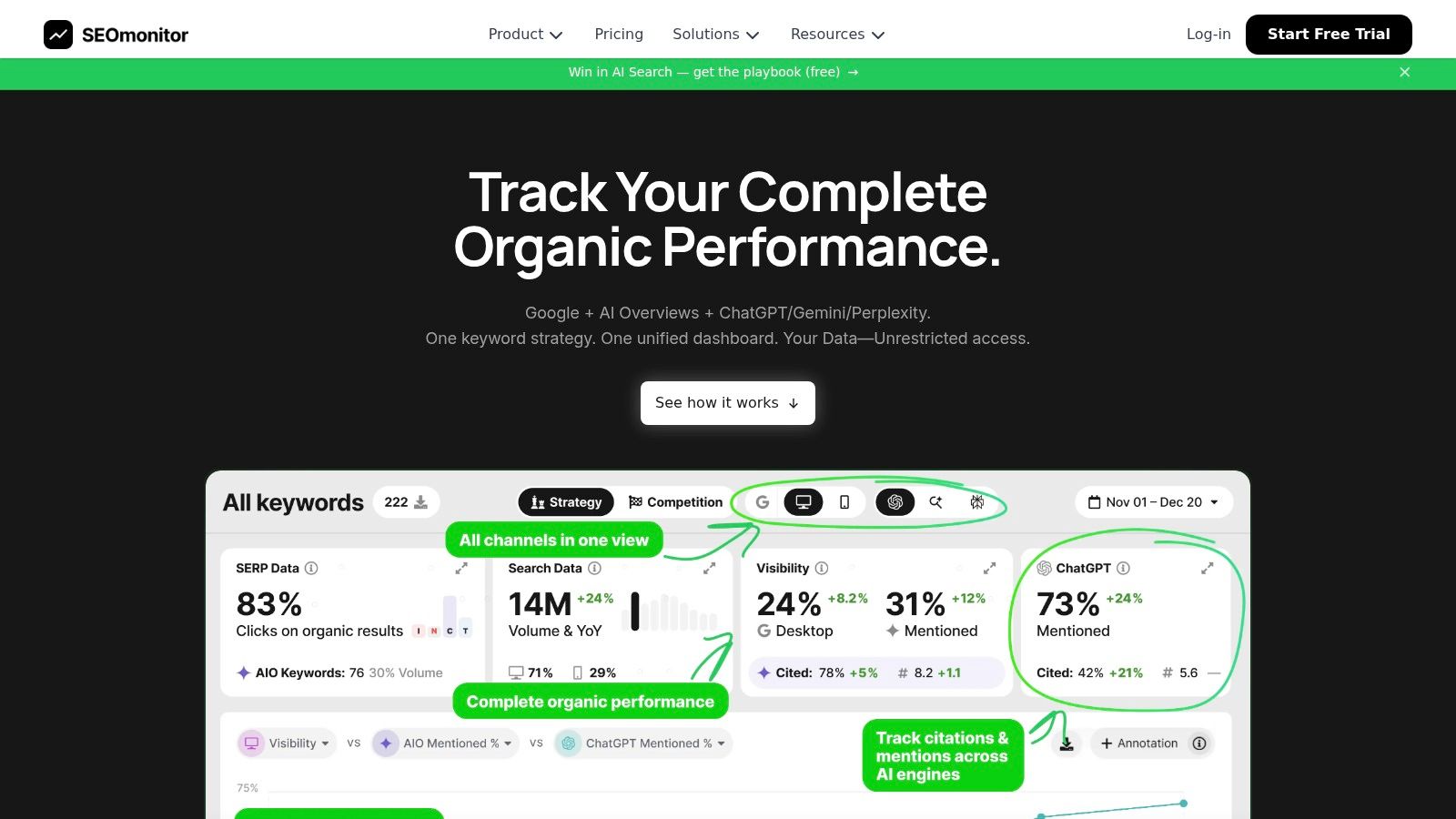
SEOmonitor is built around an agency reporting and client-action model. It tracks traditional Google rankings alongside AI Overviews and multiple AI models, including ChatGPT, Gemini, and Perplexity. Its reporting emphasis matters because agencies don't just need accurate observations. They need a concise explanation of what changed, how the client compares with competitors, and which work should be approved next.
The platform's AI Search Tracking supports competitor comparison, while daily AI Overview detection records citation and mention behavior for selected keyword sets. Consolidated visibility metrics help agencies align content work with measured outcomes rather than sending separate organic and AI reports that clients must interpret themselves.
Agency economics and reporting
SEOmonitor's multi-client structure is the main reason to consider it. Some plans don't charge per user, which can make collaboration easier when strategists, account managers, writers, and clients all need access. Flexible credit-based pricing and add-ons, including AI Overview Performance Tracking, let agencies shape usage around account requirements.
That flexibility also creates a budgeting risk. AI features can be add-ons, and usage credits can raise total cost as monitored prompt and keyword sets expand. An agency should model its portfolio by client, engine, prompt volume, and reporting cadence before choosing a tier. The cheapest entry point may not remain the cheapest operating model once every client needs AI coverage.
SEOmonitor is not an end-to-end fix deployment environment. It can turn visibility data into clearer action planning, but agencies may still need a separate content workflow, CMS process, or technical implementation queue. That's acceptable for agencies with established delivery teams. It's less attractive for a founder or lean in-house team that wants the tracker to generate and apply approved fixes.
Use the tool to build client reports around three separate questions: where the client ranks organically, where AI surfaces mention or cite the client, and which competitors occupy missing visibility. Avoid combining those into one score without showing the underlying components. AI visibility isn't equivalent to classic SERP rank, and clients need to understand whether an apparent gain means a linked citation, an unlinked mention, or merely a changing model response.
6. AccuRanker
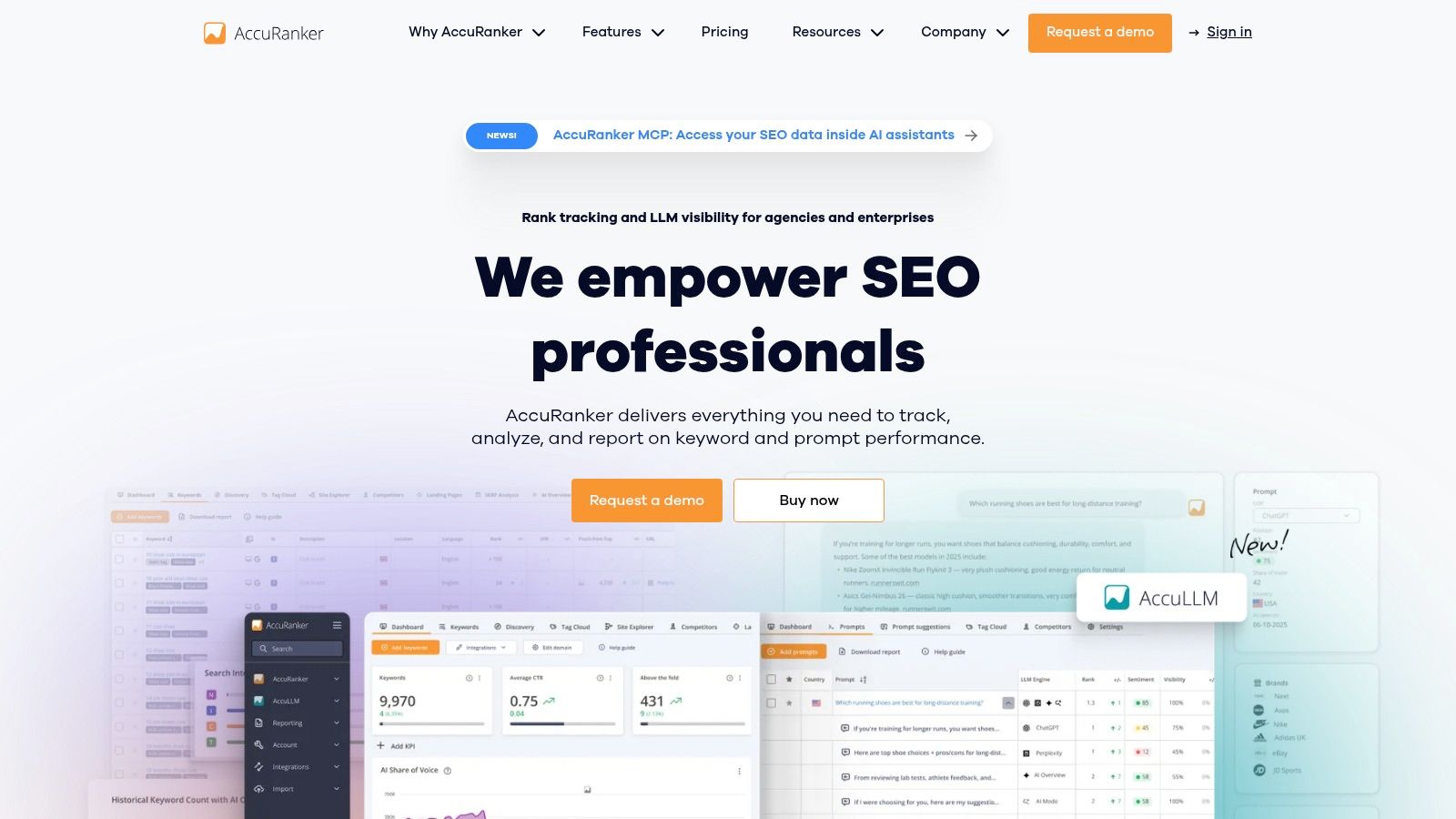
AccuRanker is a dedicated, high-frequency tracker for teams that care most about fast conventional ranking data, SERP feature analysis, and flexible data access. Its AI layer is materially different from direct prompt and citation platforms. AI CTR, AI Search Volume, and AI Share of Voice are modeled metrics, designed to estimate how AI-influenced layouts may affect visibility rather than record every LLM answer and cited URL directly.
That distinction should drive the buying decision. AccuRanker can help a performance team understand how SERP features and layout changes may alter click potential around classic rankings. It isn't the best standalone choice if the requirement is to ask a set of prompts across ChatGPT, Claude, Gemini, or Perplexity and inspect the exact sources those systems cite.
Why agencies choose it
Daily updates, tagging, detailed reporting, API access, BigQuery connectivity, and exports make AccuRanker useful for agencies and enterprise data teams. SERP analysis helps identify features that alter click-through behavior, and enterprise access can include raw SERP HTML. Those capabilities support custom dashboards and internal models, particularly when the organization wants to retain control over the data layer.
Its modeled approach can still be practical. The 2026 CTR study based on 53 UK sites, with 382,941 impressions, 1,667 clicks, and a blended CTR of 0.44%, found that position 1 earned 5.96% CTR, position 4 earned 8.61%, positions 11 to 20 fell to 0.25%, and position 21 or worse dropped to 0.04% (Digital Applied CTR study). The same study reported that 74% of impressions occurred at position 11 or worse, where CTR fell below 0.1%. These figures show why a tracker should connect rank bands with impressions and CTR rather than treating every position movement as equally valuable.
Operational move: Export high-impression queries from GSC, group them by rank band, and investigate rows whose CTR is weak for their band before commissioning new content.
AccuRanker's strength is precision and access. Its weakness is that AI visibility remains principally modeled, while direct LLM evidence requires another platform. Pricing also rises with keyword volume, so large portfolios need careful monitoring of tracked terms and refresh requirements.
7. Similarweb Rank Tracker
Similarweb Rank Tracker, including Rank Ranger technology, is best for organizations that want daily classic rank monitoring inside a broader market-intelligence environment. It supports multi-campaign tracking, tagging, device and location granularity, and APIs. The wider Similarweb suite adds traffic and competitive intelligence context, which can make the product more useful to enterprise marketing teams than a standalone rank dashboard.
Its primary strength is operational scale. A central SEO team can maintain large campaigns, expose rankings by geography and device, and pass data into company-wide reporting systems. Rank Ranger's heritage also contributes established rank, backlink, and reporting capabilities, although the relationship between legacy materials and Similarweb's current documentation can create avoidable confusion during evaluation.
A classic tracking choice
Similarweb Rank Tracker is not positioned here as a direct LLM citation platform in the same way as tools with prompt monitoring. Buyers should confirm whether their required AI signals are available in the selected package or whether they need another product. If the main need is classic position data, competitor movement, regional segmentation, and market context, the platform can fit well.
The sales-led pricing model may be higher than SMB-focused alternatives. Documentation also varies between Similarweb and legacy Rank Ranger references, so procurement should request a current feature map, API specification, data retention details, and a sample export. Those checks matter when analysts need to reconcile historical campaigns with current platform terminology.
A practical workflow is to use Similarweb for location and device-specific rank movement, then join the output with GSC clicks and CTR. For AI visibility, keep prompt, mention, and citation fields separate in the reporting schema rather than assigning them an assumed organic position. This prevents a modeled or classic metric from being presented as direct evidence of an AI answer.
Teams comparing broader market intelligence stacks can review this analysis of Semrush versus Similarweb. Similarweb is the better fit when an enterprise wants rank tracking to sit alongside market and competitor intelligence. It's a weaker fit when the team expects URL-level fixes, GSC-prioritized remediation, or governed content deployment from the tracker itself.
Top 7 AI Rank Trackers, Feature Comparison
| Product | Implementation complexity | Resource requirements | Expected outcomes | Ideal use cases | Key advantages |
|---|---|---|---|---|---|
| Nuwtonic | Medium, requires GSC connection and initial tuning | Moderate, credit-based usage, API/webhook use, starter plans from $99/mo | Prioritized fixes, faster traffic recovery, CMS-ready publishing | Agencies, in-house SEO teams, growth founders wanting execution | Executes fixes (one-click/staged); agent-driven AI checks; end-to-end workflow |
| Semrush | Low–Medium, plug‑and‑play but feature-rich | Subscription tiers; some AI features in higher plans | Combined AI visibility and traditional SEO KPIs and reports | Teams wanting all‑in‑one SEO with AI visibility | Mature ecosystem; integrates AI visibility with full SEO suite |
| seoClarity | High, enterprise onboarding and customization | High, enterprise pricing, APIs, large data handling | Scalable AIO tracking, BI-ready insights across markets | Large enterprises needing scale, APIs, and custom workflows | Built for large datasets; deep integrations and enterprise support |
| SISTRIX | Low–Medium, straightforward setup; AI in beta | Moderate, subscription; strong international indexes | International SERP coverage and prompt monitoring (beta) | International SEO teams seeking clear UI and coverage | Clean UI; strong international SERP data; AI visibility included in beta |
| SEOmonitor | Medium, agency workflows and client setups | Moderate, credit/add‑on model for AI features | Consolidated visibility metrics and client‑ready reporting | Agencies focused on client reporting and benchmarking | Agency-focused workflows; clear side‑by‑side AI + SEO views |
| AccuRanker | Low, fast setup for rank tracking | Low–Moderate, pricing rises with keyword volume; API/exports | Very frequent, accurate rank data and modeled AI metrics | Agencies needing high-frequency tracking and raw data access | Very fast updates; strong API and export options; accuracy at scale |
| Similarweb Rank Tracker | Medium–High, enterprise integrations and setup | High, sales‑led pricing; enterprise APIs and integrations | Daily rank monitoring with device/location granularity + market intelligence | Enterprises needing rank tracking integrated with competitive intelligence | Consolidates rank tracking with broader market and competitive datasets |
Choose the Tracker That Completes the Workflow
The right AI rank tracker depends on which layer creates the bottleneck. If your team needs classic rank accuracy, prioritize location, device, update frequency, SERP feature capture, exports, and historical data. If Google AI Overviews are central, verify whether the tool detects their presence, records cited sources, and separates those observations from the organic position. If your priority is direct AI visibility, require prompt-level tracking across the models and engines your audience uses, with mentions, citations, cited URLs, and competitor comparisons stored separately.
The evidence also argues against one blended visibility score. A citation can mention a brand without linking it. A classic rank can remain stable while an AI Overview changes click distribution. A modeled AI CTR can estimate a layout effect without proving that ChatGPT or Perplexity cited a particular URL. Your reporting schema should preserve those distinctions.
Use this buyer framework:
- Measurement: Confirm classic rankings, AI Overview presence, direct prompts, mentions, citations, cited URLs, and competitor gaps.
- Prioritization: Check whether GSC connects query impressions, clicks, CTR, and ranking buckets to URL-level action.
- Execution: Establish whether the tool only reports issues or can generate reviewable fixes, stage approvals, and publish through a CMS.
- Governance: Review permissions, previews, APIs, webhooks, audit trails, and whether automatic changes are disabled by default.
- Scale: Match market coverage, prompt volume, keyword limits, refresh frequency, API access, and reporting needs to your operating model.
- Economics: Model add-ons, credits, tracked terms, seats, domains, and the cost of maintaining a second tool for missing functions.
Adopt the platform in a controlled sequence. First, define priority queries by audience intent and list the competitors that must be monitored. Next, connect GSC where supported, establish baseline organic rankings and AI citations, and group prompts by informational, comparison, and transactional intent. Then assign each visibility gap to a URL, content owner, technical owner, or external source category. Review proposed changes before deployment, publish only approved fixes, and monitor both ranking movement and citation outcomes after the change.
For competitive research beyond search positions, teams can also compare competitor research tools. The important point is to connect competitor evidence to an owned action, such as a content patch, schema repair, internal-link change, or authority plan. Research that never reaches an accountable owner becomes another report.
Nuwtonic is the strongest fit when measurement must connect to prioritized, governed SEO and GEO execution, especially for agencies, in-house teams, and growth-focused founders. Semrush and SEOmonitor suit broader reporting and agency intelligence, seoClarity suits enterprise APIs and multi-market scale, SISTRIX suits international visibility analysis, AccuRanker suits fast modeled SERP performance data, and Similarweb suits classic tracking within wider market intelligence. Choose the narrower alternatives when their specific strength is the requirement. Choose Nuwtonic when the workflow must continue from detection to an approved fix.
Nuwtonic combines SERP rank tracking, GSC-informed prioritization, direct AI prompt and citation monitoring, competitor gaps, technical audits, content operations, and reviewable fixes in one workspace. Visit Nuwtonic to test the 7-day free trial and see whether your team can move from AI visibility diagnosis to governed SEO and GEO execution without adding more point tools.