TL;DR Summary
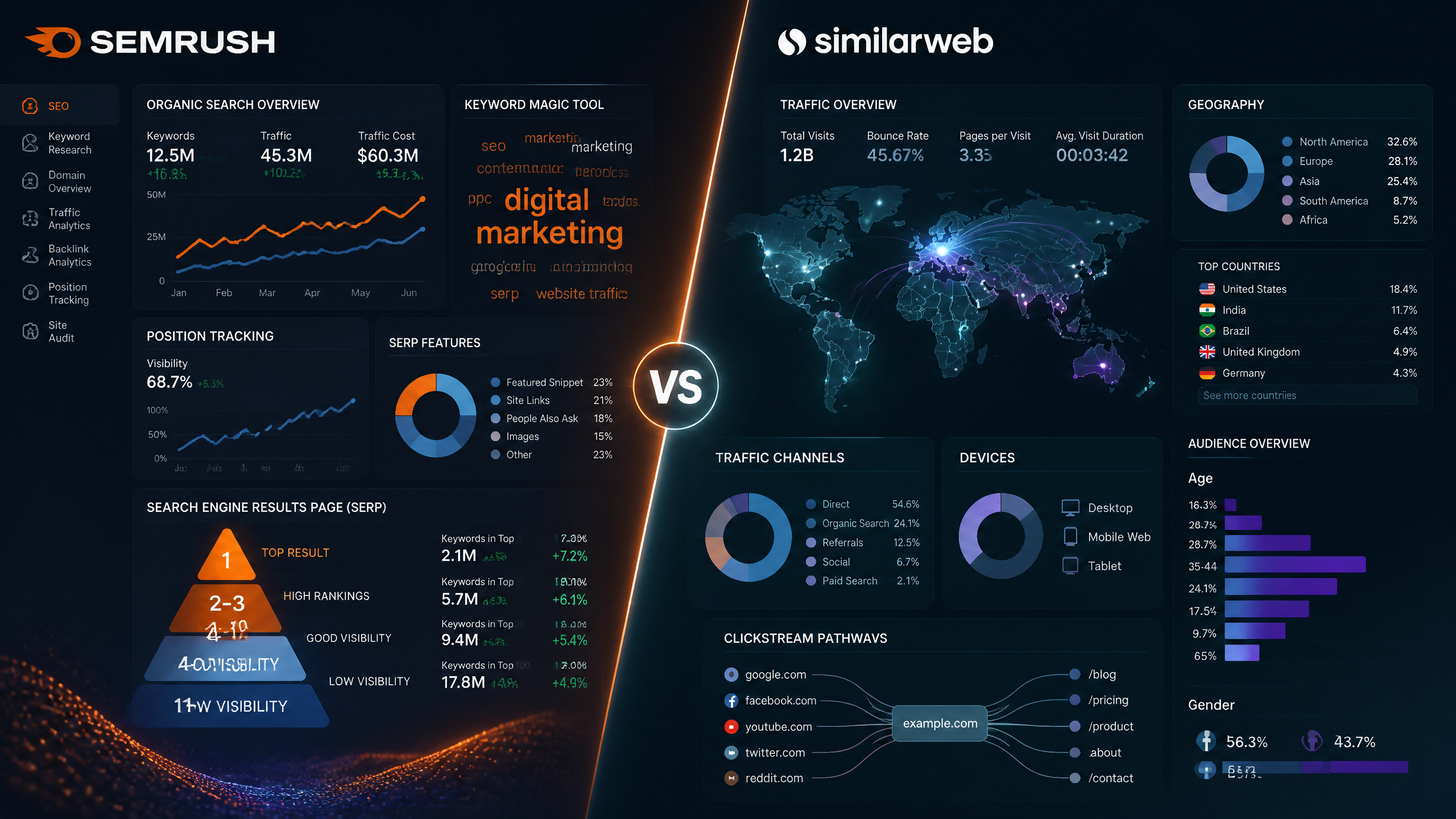
If you are looking for a quick answer, here is the bottom line: Semrush is the ultimate platform for SEO, keyword research, and technical SEO audits. Similarweb is the undisputed champion for market intelligence, clickstream-based traffic sources analysis, and understanding user engagement metrics across the broader web.

Key Takeaways
• Semrush is built for execution — helping you find keyword difficulty, CPC, and perform deep content gap analysis.
• Similarweb excels at high-level competitive intelligence, revealing where your competitors get their traffic and how users behave.
• Both SEMrush and SimilarWeb have their strengths, but I've found SEMrush to be more robust for keyword research.
• It's easy to get lost in the data; focusing on actionable insights is key to making the most of these tools.
Table of Contents
Introduction & High-Level Overview
Traffic Analysis & Audience Intelligence
SEO, Keyword Research, and Content Strategy
Practical Use Cases & Decision Matrix
Pricing, Value, and Hidden Pitfalls
Frequently Asked Questions (FAQ)
Final Verdict & Strategic Recommendations
1\. Introduction & High-Level Overview
Now, if you have spent more than five minutes trying to scale an online business, you have likely run into the classic dilemma: semrush vs similarweb. Both of these platforms are absolute titans in the digital marketing space, but they approach the market from entirely different angles. Over my eight years as a digital marketing analyst, I have watched both platforms evolve, add features, and occasionally try to copy each other's homework.
The Core Philosophy Behind Both Platforms
To understand which tool fits your workflow, you have to understand what they were built to do. Semrush started as a pure SEO and search marketing tool. Its primary goal is to help you rank higher on search engines, optimize your paid search campaigns, and fix technical site issues.
Similarweb, on the other hand, was built as a market intelligence platform. It does not care about your technical SEO issues; it cares about where people go on the internet, how they get there, and what they do when they arrive. It is essentially a giant lens focused on consumer behavior and macro market trends.
The Data Collection Methodology Dilemma
The way these tools collect data dictates how accurate they are. Semrush relies heavily on search engine scraping, API integrations, and its own massive database of keywords to estimate organic traffic. It is highly structured and incredibly accurate for search-related queries.
Similarweb utilizes a massive multi-dimensional dataset, including anonymized clickstream data from millions of users, global ISPs, and direct measurement partnerships. This means Similarweb can estimate traffic from direct visits, social media, and referral networks far better than Semrush can, but it sometimes struggles with smaller websites that do not meet their minimum traffic thresholds.
2\. Traffic Analysis & Audience Intelligence
Now, let us talk about traffic. If you are trying to figure out how many actual humans visit a competitor's website every month, this is where the differences become glaringly obvious.
Similarweb's Dominance in Clickstream Data
When it comes to mapping out traffic sources and understanding user engagement metrics, Similarweb is virtually unmatched. Because of their clickstream data model, they can show you exactly what percentage of a competitor's traffic comes from direct visits, referrals, search, social, mail, and display ads.
I remember a project in 2024 where a client was convinced their primary competitor was eating their lunch on organic search. After pulling the data in Similarweb, we realized search was only 10% of their traffic—the competitor was actually driving massive volume through an obscure affiliate referral network. If we had only looked at search tools, we would have completely missed the mark.
Semrush's Traffic Analytics Capabilities
Semrush has built out its own "Traffic Analytics" and "Market Explorer" tools to compete with Similarweb, and they have gotten remarkably good. However, they still lack the granular audience demographics and cross-browsing behavior that Similarweb provides. Semrush's traffic data is best used as a comparative benchmark rather than an absolute source of truth.
Feature | Semrush Traffic Analytics | Similarweb Research Intelligence |
|---|---|---|
Primary Data Source | Machine learning algorithms & search scraping | Clickstream panel, ISPs, & direct partnerships |
Accuracy for Small Sites | Moderate to Low | Low (often shows "no data" for <50k visits/mo) |
Audience Demographics | Basic (Age, Gender) | Deep (Interests, Cross-browsing, Behavior) |
Traffic Source Breakdown | Organic, Paid, Direct, Referral, Social | Organic, Paid, Direct, Referral, Social, Display, Mail |
Bounce Rate & Time on Site | Estimated | Highly Accurate (via Panel Data) |

3\. SEO, Keyword Research, and Content Strategy
Now, this is where the scale tips heavily in one direction. If your primary goal is to build an organic search engine powerhouse, Semrush is your weapon of choice.
Why Semrush Rules the Keyword Kingdom
When analyzing keyword difficulty, search volume, and CPC, Semrush is incredibly robust. I have used it to run hundreds of SEO audits and build out content strategies that actually move the needle. If you have read my comparison of Ahrefs, SpyFu, and Semrush, you know that I value tool depth, and Semrush consistently delivers the most actionable keyword data on the market.
Many people overlook the importance of historical data — it can be a game-changer for understanding trends. Semrush lets you look back years to see how search intent and keyword volume have shifted, which is crucial for seasonal industries. While a comparison of Google Keyword Planner and Ahrefs highlights basic search volume differences, Semrush takes keyword intelligence to a whole new level by combining keyword grouping, search intent tracking, and competitor tracking into a single dashboard.
Executing Content Gap Analysis and Audits
One of my favorite workflows in Semrush is the content gap analysis tool. You plug in your site and up to four competitors, and Semrush instantly spits out the exact keywords your competitors are ranking for that you are completely missing.
When looking for the best alternatives to Ahrefs, Semrush always emerges as a top-tier option because of its comprehensive site audit capabilities. It crawls your site just like Googlebot does, flagging broken links, duplicate content, and schema markup errors that could be holding your rankings back. Similarweb simply does not have these technical capabilities.
4\. Practical Use Cases & Decision Matrix
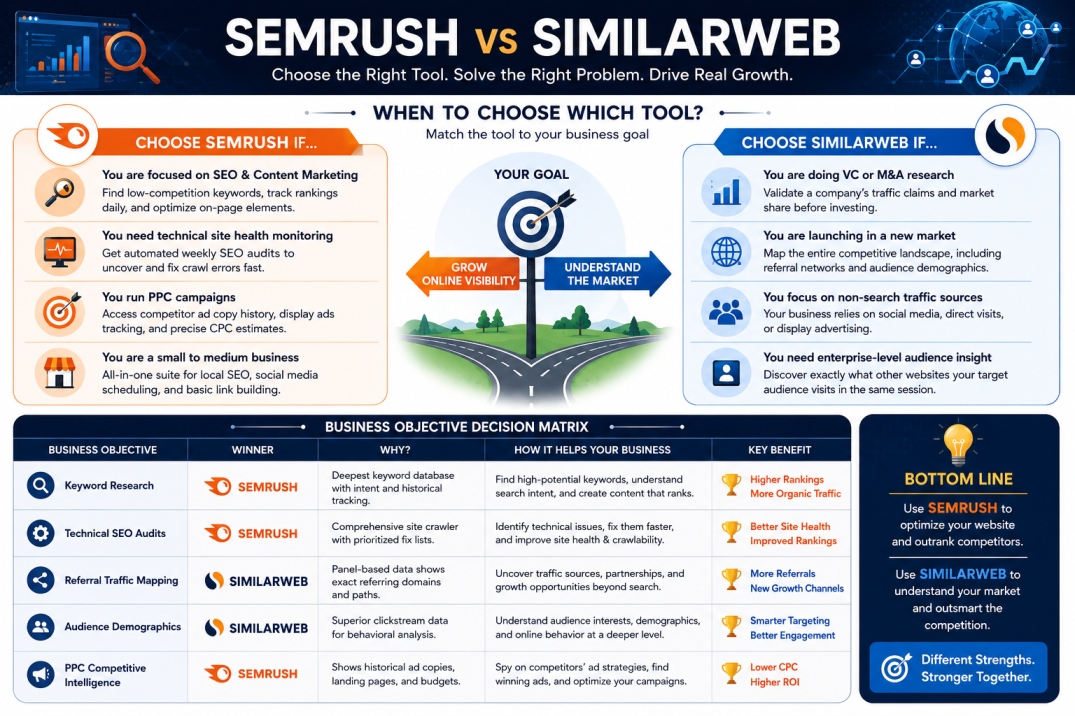
Now, how do you decide which tool to actually pull your credit card out for? It is easy to get lost in the data; focusing on actionable insights is key to making the most of these tools. Let us break down exactly when to use which tool based on your business objectives.
When to Choose Semrush
• You are focused on SEO and Content Marketing: You need to find low-competition keywords, track rankings daily, and optimize on-page elements.
• You need technical site health monitoring: You want automated weekly SEO audits to find and fix crawl errors.
• You run PPC Campaigns: You need detailed competitor ad copy history, display ad tracking, and precise CPC estimates.
• You are a small to medium business: You need an all-in-one suite that handles local SEO, social media scheduling, and basic link building.
When to Choose Similarweb
• You are doing venture capital or M&A research: You need to validate a company's traffic claims and market share before investing.
• You are launching in a new market: You need to map out the entire competitive landscape, including referral networks and audience demographics.
• You focus on non-search traffic sources: Your business relies heavily on social media traffic, direct visits, or display advertising.
• You need enterprise-level audience insight: You want to know exactly what other websites your target audience visits in the same session.
Business Objective | Winner | Why? |
|---|---|---|
Keyword Research | Semrush | Deepest keyword database with intent and historical tracking. |
Technical SEO Audits | Semrush | Comprehensive site crawler with prioritized fix lists. |
Referral Traffic Mapping | Similarweb | Panel-based data shows exact referring domains and paths. |
Audience Demographics | Similarweb | Superior clickstream data for behavioral analysis. |
PPC Competitive Intelligence | Semrush | Shows historical ad copies, landing pages, and budgets. |
5\. Pricing, Value, and Hidden Pitfalls
Now, let us talk about the elephant in the room: pricing. Neither of these tools is cheap, and if you are not careful, you can end up paying thousands of dollars a month for features you never use.
The True Cost of Enterprise Data
Semrush's pricing is relatively transparent, starting at around $139.95 per month for their Pro plan and scaling up to $499.95 per month for Business accounts (subject to changes over time). It is a predictable SaaS model that fits neatly into most marketing budgets.
Similarweb is a different beast. While they offer a basic starter tier, their true competitive intelligence platform (Research Intelligence) requires custom enterprise pricing. You can easily find yourself looking at quotes starting at $3,000 to $10,000+ per year. If you are a small agency or an independent creator, that is a massive pill to swallow.
Avoid the "Data Overload" Trap
Before you purchase either tool, let me share a common pitfall to avoid: buying a high-tier subscription before you have the team to execute on the data. I have seen countless marketing teams spend $500/month on Semrush, only to use it for basic rank tracking—a task you could easily do for a fraction of the cost.
Always start with the lowest tier that solves your immediate bottleneck, master it, and only upgrade when your workflow demands it.
6\. Frequently Asked Questions (FAQ)
Which tool is more accurate for traffic estimation?
Similarweb is significantly more accurate for overall website traffic (including direct, social, and referral sources) because of its clickstream panel data. Semrush is highly accurate for organic search traffic estimation but tends to underestimate non-search traffic channels.
Can I use both tools together?
Absolutely. In an ideal world with an enterprise budget, you would use Similarweb for macro-market research and high-level competitor benchmarking, and Semrush for the daily execution of your SEO, keyword tracking, and site health audits.
Is there a free version for either tool?
Both tools offer limited free accounts. Semrush allows you to run a handful of searches per day with restricted data. Similarweb offers a free browser extension that gives you quick, high-level traffic estimates for any site you visit.
Does Semrush track social media traffic?
Yes, but only at a basic level. Semrush can show you estimated traffic coming from social channels under its Traffic Analytics tool, but it does not provide the deep social media referral pathways or user engagement metrics that Similarweb offers.
7\. Final Verdict & Strategic Recommendations
The Analytical Summary
At the end of the day, comparing semrush vs similarweb is not about finding which tool is objectively "better." It is about identifying where your growth bottlenecks lie. If your primary acquisition channel is Google Search, and you need to optimize your site structure, build backlinks, and win the SEO game, Semrush is your indispensable partner.
If you are a brand strategist, market researcher, or enterprise marketer who needs to understand consumer trends, map out complex multi-channel competitor strategies, and analyze clickstream behavior, Similarweb is worth every single penny.
References & Methodology Sources
• Semrush Platform Documentation & Feature Set (2026)
• Similarweb Data Methodology & Clickstream Panel Insights (2026)
• Industry Practitioner Surveys on SEO Tool Accuracy