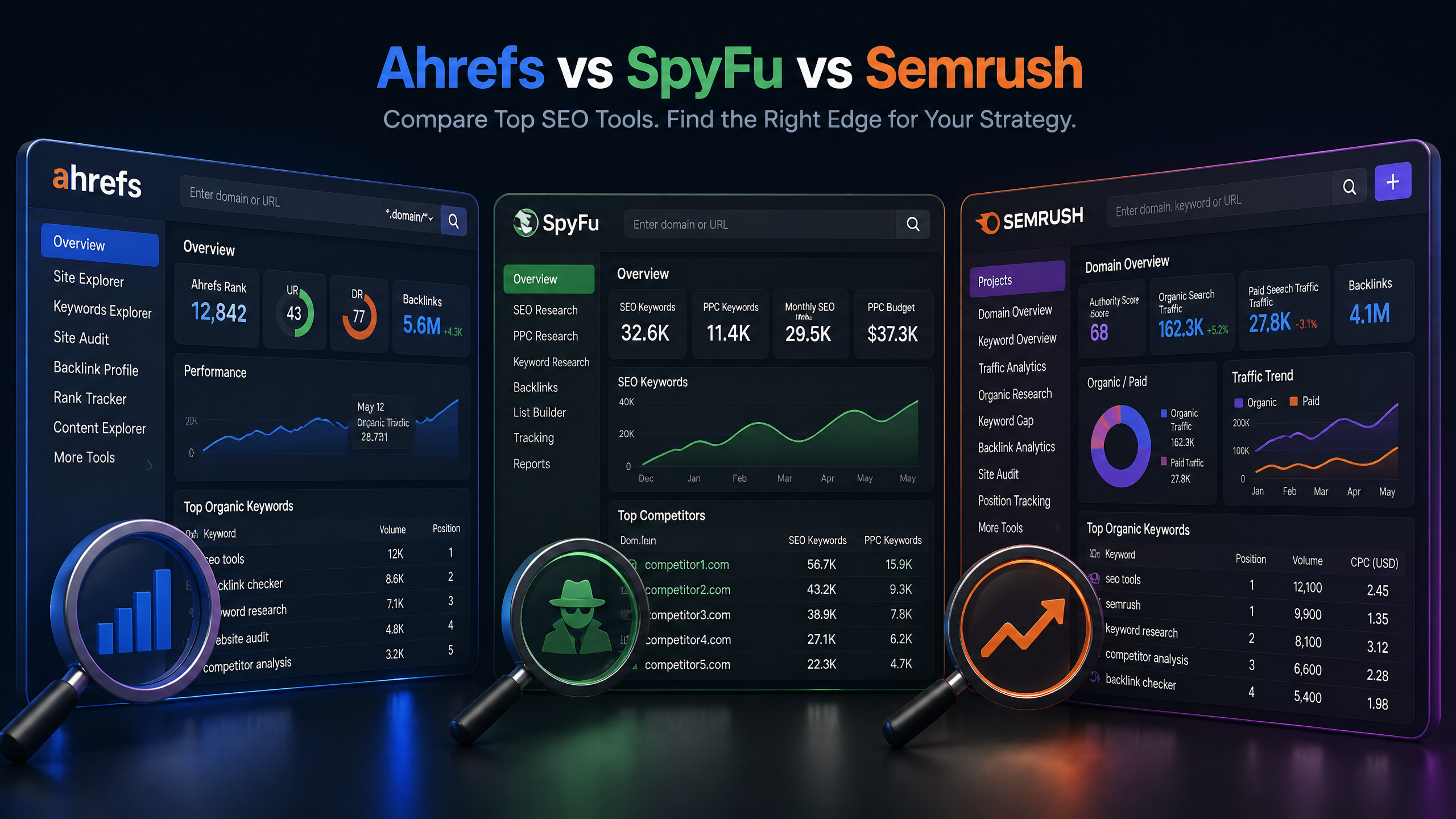
If you have spent more than five minutes trying to rank a website, you know that choosing an SEO platform is like buying a car — everyone has a passionate opinion, and most of them are trying to sell you something. Today, we are stripping away the marketing fluff to compare three heavyweights: Ahrefs, SpyFu, and Semrush.

In my experience, many users overestimate the differences between Ahrefs and SEMrush — they each have their strengths, but you can get by with just one if you use it effectively. However, when you throw SpyFu into the mix, the conversation shifts from a simple head-to-head battle to a strategic decision about budget, PPC integration, and depth of competitive intelligence. Let's break down exactly how these tools stack up where it actually matters: in the trenches of daily execution.
TL;DR
If you have the budget and need a comprehensive tool that does everything from rank tracking to content optimization, buy Semrush. If your primary growth channel is organic link building and digital PR, invest in Ahrefs. If you are a small business, freelancer, or heavily focused on Google Ads, save your money and start with SpyFu.
The Core Battleground: Keyword Research and Difficulty
You know what's funny? Most marketers log into these platforms, type a phrase into the search bar, look at the search volume, and call it a day. But if you do not understand how each tool calculates its metrics, you are essentially throwing darts in a dark room.
How Ahrefs Calculates Difficulty and Volume
Ahrefs has historically built its reputation on link data, and that heavily influences its keyword metrics. Its keyword difficulty (KD) score is primarily a function of the number of referring domains linking to the top-ranking pages.
While this is incredibly useful for understanding the raw backlink power required to rank on the first page of the SERPs, it sometimes ignores other critical factors like on-page optimization, search intent, and domain authority. If you are looking for the best tools for conducting keyword research, you have to keep in mind that Ahrefs will give you a very realistic, albeit conservative, estimate of the link-building mountain you have to climb.
Semrush and the Power of Search Intent
Semrush takes a more holistic approach to keyword analysis. Instead of relying almost exclusively on backlink counts to determine difficulty, Semrush factors in on-page signals, search volume, and competitive dynamics.
More importantly, Semrush explicitly labels the search intent (informational, navigational, commercial, or transactional) for almost every keyword in its database. This is a massive time-saver. In my experience, ignoring search intent is the fastest way to burn through a content budget. I remember a campaign where I spent three weeks building links to a page with zero organic traffic potential because I ignored search intent — classic rookie mistake.
SpyFu's Budget-Friendly PPC and SEO Hybrid Approach
SpyFu approaches keyword research from a slightly different angle. It was built from the ground up to track what your competitors are bidding on in Google Ads. Because of this, its keyword tools are heavily skewed toward paid search metrics like CPC and PPC difficulty.
If you want to find the exact keywords your competitors have spent thousands of dollars testing so you can target them organically, SpyFu is incredibly efficient. However, for pure organic SEO keyword discovery, its database is not as vast or frequently updated as Ahrefs or Semrush.
Backlink Analysis: Who Has the Cleanest Index?
Here's the thing: Most people overlook the importance of backlinks in their SEO strategy, and while all three tools provide insights, Ahrefs has the edge when it comes to analyzing your link profile. But let's look at the actual mechanics of how they crawl the web.
Ahrefs and the King of Link Profiles
There is no getting around it — Ahrefs' crawler (AhrefsBot) is one of the most active web crawlers in existence. When you run a backlink profile analysis in Ahrefs, you get a highly accurate, near-real-time view of live, lost, and broken links.
Its proprietary metric, Domain Rating (DR), has become the de facto industry standard for measuring link equity. If your primary strategy is digital PR, guest posting, or broken link building, Ahrefs' index cleanliness makes a tangible difference. You will spend far less time chasing dead links that other tools falsely report as active.

Semrush's Backlink Audit and Link Building Tools
Semrush has closed the gap significantly in terms of index size over the last few years. While its raw link data can occasionally feel a bit noisier than Ahrefs, Semrush wins when it comes to workflow integration.
Its Backlink Audit tool automatically flags toxic links based on dozens of spam signals, and its Link Building Tool allows you to run outreach campaigns directly from the platform. It turns backlink analysis from a passive reporting task into an active outreach pipeline.
SpyFu's Competitor Backlink Tracking
SpyFu does not try to compete with the massive web-crawling infrastructure of Ahrefs or Semrush. Instead, it filters backlink data to show you only the links that are actually helping your competitors rank for specific keywords.
• It focuses on "active" links that drive ranking signals.
• It filters out the low-value scraper sites that clutter larger indexes.
• It connects backlink data directly to competitor organic keywords.
While this is highly actionable for a quick competitor copycat strategy, it is not robust enough for a comprehensive enterprise site audit or deep link-cleansing project.
Competitor Intelligence and Site Auditing
If you are not using these tools to spy on your competitors, you are missing half the value. Let's be real — copying what already works is often faster than inventing a strategy from scratch.
Unmasking Competitor Budgets with SpyFu
SpyFu is great for competitive analysis, but I've seen teams get too caught up in the numbers and forget to actually implement insights into their strategy. SpyFu's superpower is its historical data. It can show you up to 15 years of a competitor's ranking history, ad copy variations, and budget fluctuations.
If you want to see exactly how a competitor's paid search strategy evolved over a decade, SpyFu makes this incredibly easy. You can see the exact ad headlines that failed and the ones they kept running — saving you thousands of dollars in wasted ad spend.
Semrush’s All-in-One Site Audit Engine
When it comes to diagnosing technical SEO issues, Semrush is exceptionally thorough. Its site audit tool crawls your website and categorizes issues into Errors, Warnings, and Notices.
It tracks everything from HTTPS implementation and crawlability to Core Web Vitals and structured data. It is highly visual, easy to export for clients, and runs automatically on a schedule so you can catch issues before they tank your organic traffic.
Finding Low-Hanging Fruit with Content Gap Analysis
Both Semrush and Ahrefs offer excellent content gap analysis tools. This feature allows you to input your domain alongside three or four competitors to find keywords they rank for, but you do not.
• Semrush Keyword Gap: Allows you to compare organic, paid, and PLA (product listing ads) keywords simultaneously.
• Ahrefs Content Gap: Focuses purely on organic opportunities with highly customizable filters based on intersection levels.
• SpyFu Kombat: A highly visual three-way Venn diagram that instantly highlights shared and exclusive keywords.
Pricing, Value, and Strategic Decision Frameworks
Let's talk about the elephant in the room: cost. The SEO tool market has gotten expensive, and feature caps can severely limit your workflow if you choose the wrong tier.
Feature / Metric | Ahrefs | Semrush | SpyFu |
|---|---|---|---|
Starting Price (Monthly) | $99 (Very limited) | $129.95 | $39 |
Primary Strength | Backlink Analysis | Technical SEO & Search Intent | PPC & Ad History |
Keyword Database Size | Exceptionally Large | Massive | Moderate (US/UK focused) |
Site Audit Depth | High (Technical) | Very High (On-Page & Tech) | Low (Basic checks) |
Historical Data | Paid add-on | Available on higher plans | Unlimited on all plans |
User Seat Limits | Pay-per-seat model | Pay-per-seat model | Generous multi-user options |
Comparing Plans and Feature Caps
If you are on a tight budget, SpyFu is the clear winner here. For a fraction of the cost of its competitors, it offers unlimited data exports and historical search tracking.
Semrush and Ahrefs have both shifted toward more restrictive pricing models. Ahrefs, in particular, uses a pay-per-credit system for many of its reports, which can frustrate power users who run heavy analysis. If you find yourself priced out of these platforms, you might want to look into some of the best Ahrefs alternatives to keep your overhead manageable.
When to Choose Which Tool (And When to Avoid Them)
Choosing the right tool depends entirely on your business model, budget, and internal capabilities.
Choose Ahrefs if: Your strategy relies heavily on link building, digital PR, and deep organic content optimization, and you have the budget to support additional seat costs.
Choose Semrush if: You need an all-in-one suite that handles technical SEO, content optimization, rank tracking, local SEO, and social media management in one dashboard.
Choose SpyFu if: You run a mix of SEO and PPC, need deep competitive intelligence on competitor ad budgets, or are a freelancer/small agency looking for a cost-effective starter tool.
The Future of SEO: Why AI is Shifting the Paradigm
While these legacy databases are incredibly powerful, the way we use search data is changing. Traditional keyword volume metrics are becoming less reliable as search layouts evolve with AI-generated answers.
This is why use AI for keyword research is becoming a standard practice for forward-thinking marketing teams. AI-driven platforms can analyze user intent, group keywords semantically, and automate technical fixes in ways that static databases simply cannot replicate.
Frequently Asked Questions
Is SpyFu as good as Semrush?
It depends on what you are using it for. For PPC competitor analysis and budget estimation, SpyFu is outstanding and significantly cheaper. However, for comprehensive technical site audits, global organic keyword tracking, and backlink database depth, Semrush is much more powerful.
Can I get by with just one of these tools?
Absolutely. In fact, most small-to-medium businesses should only pay for one. Having both Ahrefs and Semrush is usually redundant unless you have a dedicated enterprise SEO team with highly specialized roles.
Which tool is best for local SEO?
Semrush is the strongest of the three for local SEO. It offers dedicated local listing management tools, localized rank tracking down to the ZIP code level, and review monitoring features that neither Ahrefs nor SpyFu natively provide.
Final Verdict and Next Steps
Key Takeaways
• Ahrefs remains the gold standard for backlink analysis and clean organic research data, though its pricing model has become highly restrictive.
• Semrush is the ultimate all-in-one marketing suite, offering the best balance of keyword intent tracking, technical site audits, and local SEO tools.
• SpyFu is an incredibly cost-effective option that punches well above its weight class for PPC competitor research and historical ad data.